
Quantifying Non Preferential Origin Threshold Limits for Cross Border Linen Chemical Finishing Protocols
Chemical finishing confers non-preferential origin only when value-added thresholds match local customs rules under documented transformation.

Chemical finishing confers non-preferential origin only when value-added thresholds match local customs rules under documented transformation.

Elementary cell morphology and middle lamella fineness dictate long line hackling yield, drafting force, and maximum wet-spun yarn count per finished metre.
Deconvoluting Gaussian azimuthal tilt from Lorentzian kink scattering isolates genetic helical angle from mechanical scutching damage to predict spinning yields.
Substantial transformation of imported greige linen requires multi-stage wet processing with double finish operations to satisfy tariff shift criteria.

Fine linen jacquard shedding demands minimizing shed lift height to prevent flax end breaks while maintaining spring return force above friction threshold.

Diffraction azimuthal deconvolution isolates bast microfibril misalignment and kink bands, protecting spinners from premature drafting failure and yield loss.

Valid textile origin documentation relies on batch-level transaction certificates matched to mill mass-balance logs rather than annual scope certificates.

Secondary cell wall crystallite orientation dictates axial tensile modulus, hackling line yield, and wet-spinning metric count limits in bast fibers.

Fine wet spun linen warps require water-injection splicing to exceed 75% tensile retention and avoid tension-boundary failures during cyclic shed opening.

Origin enforcement for made-up linen rests on tariff shift rules, mill mass-balance records, and statutory processing criteria across trading blocks.

Imported woven flax goods carrying hemmed edges, drawn threads, or sealed borders transition from Chapter 53 fabric to Chapter 63 made-up articles under Note 7.

Continuous woven linen fabric classification under HS Heading 5309 requires minimum 85 percent flax content by dry weight and uncut continuous roll edges.

Thermally softened middle lamella homogalacturonan enables controlled inter-fibre shear slippage at 65C, determining line flax yield and spinnable count.
Wet spun linen warp dynamic strain limits must stay below 0.8 percent at baseline tension to prevent pectin matrix breakdown and premature fatigue rupture.

Thermal softening of pectic middle lamellae reduces sliver interfacial shear stress, eliminating stick-slip defects and lowering yarn end breakage rates.

Contractual European Flax verification demands valid transaction certificates reconciled against physical mill mass-balance ledgers and tariff shift rules.

Mass balance reconciliation requires adjusting gross fiber intake to dry commercial mass standards and applying empirically verified process loss factors.
Climate heat stress reduces pectin methyl-esterification, causing premature middle lamella shear failure, higher hackling waste, and lower spun yarn counts.

Maintaining single end linen tenacity variation below fourteen percent prevents excessive warp end breakage during high speed loom shedding cycles.

Certified Western European flax tracing demands transaction certificates for every owner change and precise mass balance auditing across all hackling steps.

Non-linear shear slippage requires heating middle lamellae above 65 C to lower yield stress, preventing elementary fibre rupture and controlling mass CV%.
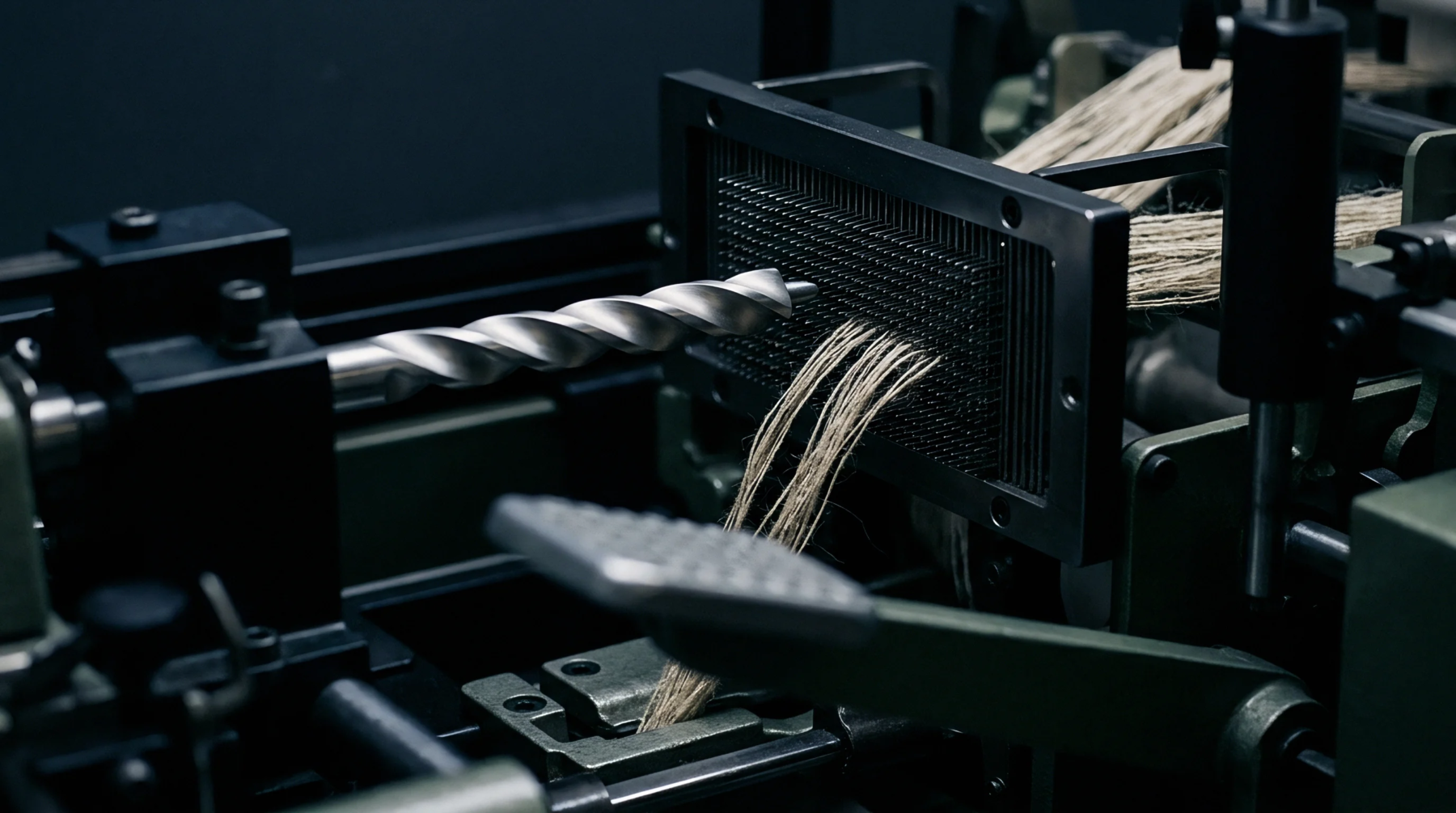
Hermans orientation factors derived from X-ray diffraction predict wet-spun line yarn tenacity by setting the upper boundary for crystallite strength translation.

Reconciling multi-site tow bleaching and spinning losses demands correcting gross bale weights for chemical extractive drop and official moisture regain baselines.

Determining fine wet spun linen tensile baselines requires pneumatic capstan grips, 500 mm gauge lengths, and conditioning at 65 percent relative humidity.

Predicting deformation limits in saturated heavy linen under tension demands calculating fiber lateral swell, warp crimp interchange, and primary cell creep.

Secondary wall microfibrillar angle measurement in flax uses diffraction and spectroscopy to map S2 crystalline cellulose orientation for yarn stiffness.

Audits of offshore linen convert wet mass to oven-dry baseline under ISO 6741, stopping regain shifts from masking fiber substitution.

Hydrodynamic drag in wet spinning troughs shears microfibrillar dislocation zones in bast fibers, requiring precise trough temperature and speed limits to maintain wet tenacity.

Accurate flax yield reconciliation requires converting gross fiber intake to oven-dry mass, adjusting for pectin dissolution loss, and auditing bale ledgers.

Nonlinear crimp interchange in heavy bast finishes stems from elastoplastic bundle flattening and pectin glass transitions, demanding exact loom-hour planning.
Expertise is a utility, not a secret. sentiention™ publishes its working knowledge as open reference: intelligence layer covering the materials it sources, the markets it enters, and the reference that serves both.