Diffraction Azimuthal Profile Deconvolution for Bast Microfibril Misalignment Detection
Diffraction azimuthal deconvolution isolates bast microfibril misalignment and kink bands, protecting spinners from premature drafting failure and yield loss.
Aperture
Wide-angle X-ray scattering directly quantifies cellulose crystallite orientation in bast fibres, resolving the mean microfibril angle alongside local angular dispersion. The 200 reflection of monoclinic cellulose I-beta ~ appearing at a scattering angle two-theta near 22.6 degrees for copper K-alpha radiation of 0.15418 nanometre wavelength ~ isolates the equatorial orientation of the crystalline core. When an intact primary bast fibre bundle passes through a monochromatic pinhole collimation beam of 200 to 500 micrometres in diameter, the azimuthal intensity distribution I(phi) forms an arc around the beam centre.
A bundle aligned perpendicular to the incident beam shows two diametrically opposed equatorial intensity peaks whose angular spread reflects microfibril deviation from the primary fibre axis.
Incoming long-staple line flax shipments destined for wet spinning above metric count Nm 60 carry specified azimuthal full-width at half-maximum boundaries between 14.5 and 18.0 degrees. Raw tow lots, mechanical decortication waste, and under-retted bast bundles show azimuthal profiles that broaden beyond 28 degrees. This broadening occurs as the microfibril angle departs from the longitudinal axis and processing defects introduce structural disorder.
Under copper K-alpha radiation at 0.15418 nanometres, a baseline 200 reflection full-width at half-maximum under 16 degrees correlates with wet-spun line yarn tenacities surpassing 55 centinewtons per tex at metric count Nm 68.
Processing strains distort raw diffraction patterns. Flax cell walls consist of an outer primary wall and a thick secondary wall divided into S1, S2, and S3 sub-layers, where the S2 layer accounts for over 70 percent of total cross-sectional cell wall volume. In high-grade Linum usitatissimum, cellulose fibrils in the S2 layer wind in an S-twist helix at an angle between 6 and 11 degrees relative to the cell axis.
Mechanical scutching, aggressive roller fluted decortication, and excessive chemical extraction fracture this ordered crystalline sheath, creating dislocation zones known as kink bands. Azimuthal profiles taken across severe kink bands record an intensity shoulder spreading beyond the central helical peak.

Cell Wall Morphologies across Commercial Bast Fibres
Different commercial bast fibres maintain characteristic crystalline helical layouts that directly alter the raw azimuthal profile. Primary line flax bundles yield clean, narrow distributions centered on the dominant helical angle. Ramie exhibits steep microfibril alignment, generating baseline profiles with narrower peaks.
True hemp and jute show wider profiles, driven by native microfibril angles between 8 and 14 degrees for hemp and 10 to 18 degrees for jute, alongside higher non-cellulosic encrusting matrix fractions.
| Fibre Type | Mean Native MFA (Degrees) | Raw Azimuthal FWHM (Degrees) | Deconvolved Helical Peak (Degrees) | Typical Defect Area Ratio | Cellulose Fraction (Percent) |
|---|---|---|---|---|---|
| Scutched Line Flax (Dew Retted) | 8.2 to 10.5 | 15.2 to 18.4 | 9.1 | 0.08 to 0.14 | 71.0 to 76.5 |
| Scutched Line Flax (Water Retted) | 6.8 to 8.9 | 13.8 to 16.2 | 7.6 | 0.04 to 0.08 | 78.0 to 82.0 |
| Flax Machine Tow (Carded) | 9.5 to 13.8 | 22.4 to 29.1 | 11.2 | 0.24 to 0.38 | 64.0 to 69.5 |
| Degummed Industrial Hemp | 10.2 to 14.6 | 20.8 to 26.5 | 12.4 | 0.16 to 0.26 | 67.0 to 72.0 |
| Industrial Decorticated Ramie | 5.2 to 7.1 | 9.8 to 12.6 | 6.0 | 0.02 to 0.05 | 83.0 to 88.5 |
| Raw Corchorus Jute Line | 12.0 to 17.5 | 24.0 to 32.5 | 14.8 | 0.18 to 0.31 | 59.0 to 64.0 |
Azimuthal intensity broadening registers structural disorder along the fibre strand. When spinning mills buy scutched line flax based strictly on visual organoleptic review and scutched yield estimates, lots contaminated with internal microfibril dislocations enter the wet-spinning draw frame undetected. These internal dislocations lead to premature fibre breakage under drafting tension, increasing drafting waste and yarn hairiness.
Flax classers verify physical bundle tenacity, but bundle tensile tests cannot isolate microfibrillar slip from non-cellulosic middle lamella shearing. Azimuthal diffraction profile deconvolution identifies the crystallite orientation distribution directly, establishing an objective structural baseline before the raw sliver touches the hackling pins.
If the deconvolution mathematics fail to account for physical bundle divergence inside the specimen holder, the calculated microfibril misalignment angle will reflect sample mounting errors rather than intrinsic fibre defects.


Deconvolution
Extracting genuine microfibril disorientation from an experimental 200 azimuthal arc requires mathematical separation of three distinct broadening mechanisms. The raw measured intensity I_meas(phi) represents a continuous convolution integral where the intrinsic microfibril orientation distribution D_mfa(phi) convolves with the sample orientation distribution function S_bundle(phi) and the instrumental point spread function G_inst(phi).
The instrumental broadening function G_inst(phi) stems from finite beam cross-section, source spectral divergence, pinhole geometry, and detector point spread. A standard crystalline reference material, such as finely powdered lanthanum hexaboride or silicon standard powder 640d mounted in identical aperture configurations, defines G_inst(phi). Because standard calibrants produce isotropic rings, the instrumental contribution in narrow-beam setups stays below 0.35 degrees azimuthal width, creating minimal distortion relative to bast fibre signals.
The sample orientation distribution function S_bundle(phi) originates from structural misalignment of individual elementary fibres within the technical bast bundle clamped in the goniometer beam path. Manual bundle tensioning cannot eliminate stray fibres departing from the true mechanical tensile axis. A scanning mechanical stage collects mosaic scans across the clamped array, establishing a bundle tilt distribution function that approximates a narrow Gaussian profile with full-width at half-maximum between 2.5 and 5.0 degrees.
Without accounting for S_bundle(phi), the calculated microfibril misalignment absorbs external bundle skew, overestimating intrinsic dislocation density.

Fourier and Iterative Mathematical Stripping
Deconvolution proceeds through iterative optimization routines or direct Fourier transform division. Fourier transformation converts the convolution equation into a direct algebraic product in frequency space:
F = F F F
High-frequency Fourier components amplify high-frequency measurement noise, making direct spectral inversion unstable across the profile tails. Truncated singular value decomposition or Tikhonov regularization stabilizes the inversion. An adjustable regularization parameter alpha balances residual minimization against the smoothness of the recovered orientation profile D_mfa(phi):
Minimize: ||(S_bundle G_inst) D_mfa – I_meas||^2 + alpha ||L D_mfa||^2
Here, L represents the second-order differential operator penalizing excessive curvature across recovered profiles. Alternatively, constrained non-linear least-squares algorithms fit multi-component parametric functions directly to I_meas(phi).
The baseline parametric fit decomposes corrected azimuthal intensity into an intrinsic helical microfibril component, an amorphous background halo, and a broader secondary distribution capturing local kink band misorientations. The intrinsic helical component fits a pair of symmetric Voigt or pseudo-Voigt profiles centered at plus and minus the mean microfibril angle theta_0 relative to the equator. The kink band dislocation component maps onto an expansive Gaussian distribution centered at phi equals zero.
The background halo reflects non-crystalline cell wall fractions, including amorphous cellulose, glucomannans, rhamnogalacturonans, and residual interlamellar lignin.
A raw azimuthal scan without bundle tilt correction overstates the intrinsic microfibril angle by 2.2 to 4.1 degrees across commercial dew-retted slivers.
Separating the crystalline peak from the amorphous halo requires systematic radial baseline subtraction before executing azimuthal profile integration. An azimuthal profile extracted without prior two-theta radial background correction incorporates non-crystalline scattering, artificially inflating the apparent baseline. Radial scans taken along narrow two-theta intervals across the 200 crystalline peak allow point-by-point subtraction of the amorphous baseline, derived from zero-orientation regions above 26 degrees and below 18 degrees two-theta.
Numerical optimization protocols iterate until the root-mean-square error between the reconstituted model curve and experimental profile drops below 0.015. At this threshold, mathematical deconvolution reliably distinguishes whether profile broadening stems from an enlarged native helical angle or from mechanical damage sustained during decortication.
Residual ambiguities persist over whether the non-helical broadening distribution stems entirely from discrete dislocation bands or includes continuous elastic twisting within unperturbed elementary cell walls.


Dislocation
Mechanical decortication and scutching introduce localized plastic shear deformations into brittle flax cell walls. Cellulose microfibrils within elementary bast fibres resist axial tension efficiently, yielding axial tensile moduli between 110 and 130 gigapascals. Under compressive or transverse shear loads, the soft amorphous matrix of hemicellulose and pectin yields, allowing crystalline microfibrils to buckle locally.
These buckled microfibrils form discrete microscopic defects ~ known as kink bands, slip planes, or dislocations ~ spaced between 20 and 150 micrometres apart along the fibre axis depending on extraction severity.
Within a dislocation zone, crystalline microfibrils detach from the non-cellulosic matrix and deflect from their native helical pitch. Under polarised light microscopy, dislocations show up as bright cross-markings caused by local optical axis shifts. Under wide-angle X-ray scattering, these displaced microfibrils no longer scatter into the narrow helical peaks at plus or minus theta_0; instead, they scatter into the central azimuthal region between the twin peaks or into the peripheral tails beyond the primary orientation arcs.
Quantifying the Dislocation Area Ratio
Quantifying total dislocation severity relies on the Dislocation Area Ratio, derived from deconvolved profile components. The deconvolved orientation distribution decomposes into:
D_mfa(phi) = A_helix + A_defect P_G(phi) + A_random
In this formulation, P_V represents the normalized pseudo-Voigt profile describing intact helical microfibrils, while P_G represents the broadened Gaussian peak of misaligned microfibrils within dislocations. A_random accounts for isotropic background noise. The Dislocation Area Ratio, designated R_d, reflects the proportion of misaligned crystalline material:
R_d = A_defect / (2 A_helix + A_defect)
Industrial scutching and carding alter R_d, providing a quantitative metric of mechanical damage.
Fine line flax intended for high-count apparel yarn demands an R_d strictly below 0.12. Lots exceeding an R_d of 0.22, such as coarse carded flax tows, exhibit reduced tensile performance during wet-spinning drafting operations.
Enzyme-assisted chemical retting alters how dislocations manifest under X-ray scattering. Incomplete enzymatic clearance leaves rigid, pectin-rich middle lamellae attached to outer elementary walls. During subsequent mechanical hackling, high shear stresses transfer directly into the secondary cell walls, increasing the frequency of microscopic slip planes.
Properly retted bast fibres shed intercellular pectin cleanly, allowing individual elementary fibres to slide freely across one another within the technical bundle. This shear relief limits compressive microfibril buckling throughout mechanical scutching.
Technical bundles showing a Dislocation Area Ratio above 0.20 yield 35 to 45 percent more short-fibre noils on the hackling machine than bundles with an index below 0.10.
Physical dislocation defects lower the effective cross-sectional load-bearing capacity of the fibre. When an axial load is applied to an elementary fibre during spinning, stress concentrations develop around the edges of the dislocation zone. The misaligned microfibrils within the kink band undergo premature shear failure at tenacities well below the theoretical tensile limit of intact crystalline cellulose.
This structural weakness explains why scutched line flax bundles with high overall cellulose purity can still display poor yarn-spinning performance.
Spinning mills that monitor bundle tenacity without verifying microfibrillar alignment often misclassify brittle, mechanically compromised flax lots as sound spinning material.

Bench
Translating X-ray deconvolution from an academic analytical tool into an industrial quality verification protocol requires standardized specimen preparation, beam alignment, and profile acquisition methods. An incoming shipment of long-staple scutched line flax or carded tow undergoes systematic sampling before laboratory mounting. From an incoming 20-tonne shipping container, fifteen commercial bales are selected at random.
Five individual technical fibre bundles, measuring approximately 150 millimetres long, are drawn from the core of each opened bale, yielding a representative test population of 75 primary bundles.
Fibres condition in a climate-controlled chamber at 20 degrees Celsius and 65 percent relative humidity for at least 24 hours prior to X-ray testing. Bast fibre cellulose exhibits hygroscopic swelling, where moisture uptake within the amorphous hemicellulose matrix alters inter-crystalline packing distances, shifting the 200 equatorial peak position along the two-theta scale. Standardized relative humidity maintains a consistent 200 crystalline d-spacing of 0.395 nanometres across all test runs.

Mechanical Clamping and Stage Alignment
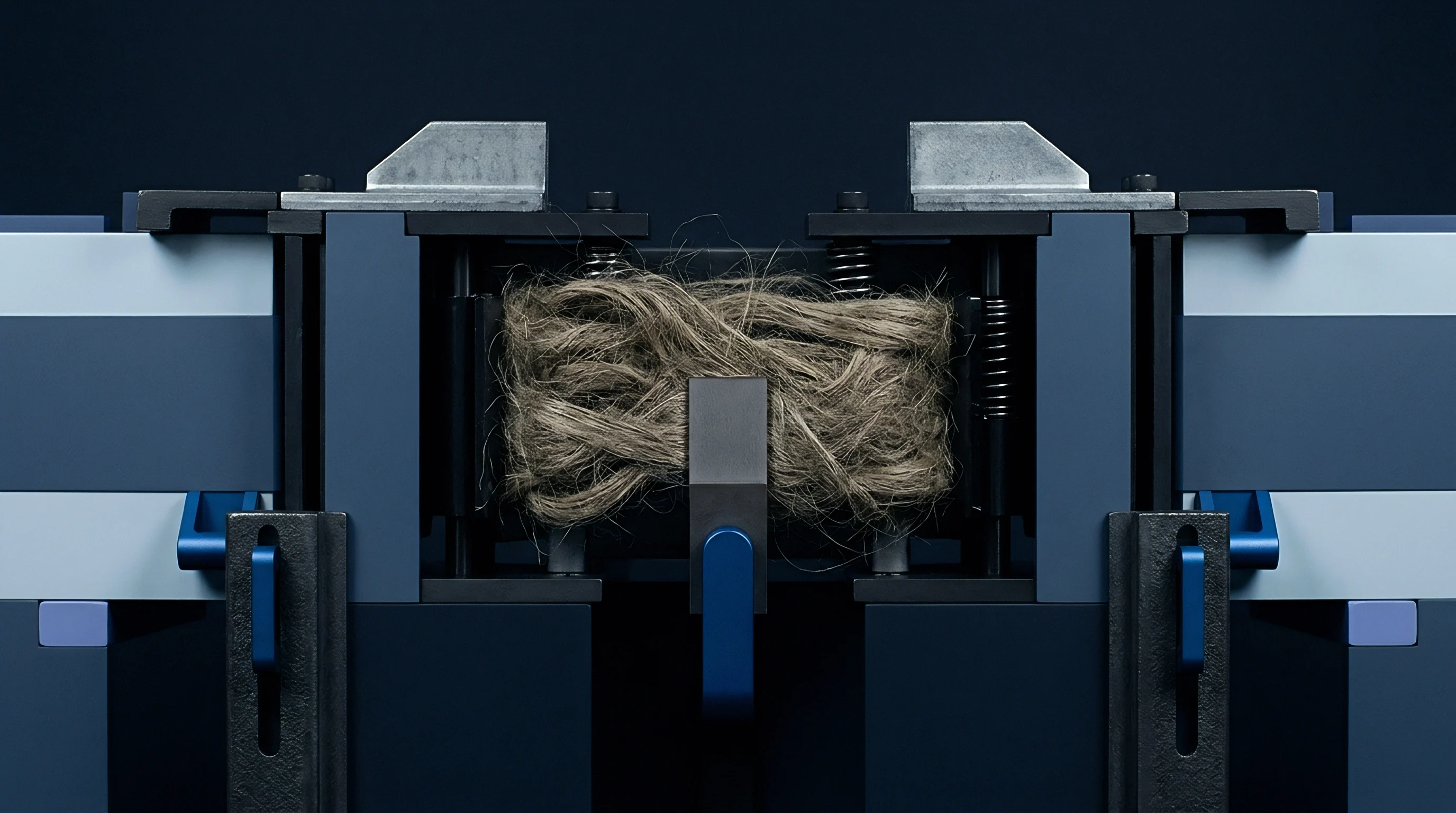
Fibre bundles are mounted within a custom tensioning clamp fitted to a four-axis Eulerian goniometer stage. Hand-tensioned bundles introduce uncontrolled angular slack that compromises orientation profile measurements. The clamping apparatus incorporates a spring-loaded linear micrometer slide that applies a calibrated axial preload of 0.5 centinewtons per tex across the parallel fibre array.
This preload aligns loose bundle curvature without inducing artificial tensile strain along intrinsic dislocation zones.
The operational verification sequence proceeds through systematic procedural stages:
- Bundle Parallelization aligns elementary fibres within the technical bundle under a stereomicroscope to eliminate macroscopic bundle crossing before clamping.
- Tension Calibration tensions the specimen clamp to precisely 0.5 centinewtons per tex, preventing structural slack without exceeding the elastic limit of the bast bundle.
- Laser Triangulation positions the bundle perpendicular to the primary X-ray beam, establishing an optical focal tolerance of plus or minus 10 micrometres along the beam axis.
- Radon Transform Centering verifies that the macroscopic bundle mechanical axis aligns to within 0.2 degrees of the goniometer reference plane.
- Background Scatter Subtraction records an air-scattering profile using an empty specimen clamp to enable background subtraction across the azimuthal baseline.
A high-resolution two-dimensional pixel-array detector, positioned at a calibrated sample-to-detector distance of 100 millimetres, collects transmitted diffraction patterns. High-flux laboratory microfocus X-ray sources, operated at 50 kilovolts and 1 milliampere, deliver reliable counting statistics within an exposure time of 120 seconds per target node. Across each 150-millimetre bundle specimen, automated stepped scans collect diffraction frames at 10-millimetre intervals along the fibre axis, capturing regional variation in dislocation density along the length of the technical bundle.
| Parameter | Specification Limit | Standard Tolerances | Impact of Non-Compliance |
|---|---|---|---|
| Beam Diameter | 300 micrometres | plus or minus 25 micrometres | Beam wider than bundle captures edge scatter |
| Pre-tension Load | 0.50 cN/tex | plus or minus 0.05 cN/tex | Under-tensioning broadens S_bundle function |
| Two-theta Integration Window | 21.8 to 23.4 degrees | plus or minus 0.1 degrees | Wide window admits 004 and amorphous halos |
| Detector Distance | 100.0 millimetres | plus or minus 0.2 millimetres | Distance shifts calibration of pixel-to-angle map |
| Azimuthal Binning Width | 0.25 degrees | Fixed | Over-binning artificially rounds sharp Voigt peaks |
| Signal-to-Noise Ratio | Minimum 80:1 at peak | Target greater than 120:1 | Low SNR prevents stable Tikhonov deconvolution |
The integrated azimuthal profile I(phi) is derived by integrating the 200 crystalline ring across the radial limits of 21.8 degrees to 23.4 degrees two-theta. Pixel values across this circular ring segment map into discrete 0.25-degree azimuthal bins. Once binned, the raw azimuthal profile moves to the deconvolution pipeline, generating the quantitative report that decides batch acceptance or commercial rejection.
If the sample preparation clamp pinches fibres unevenly, local compressive stresses generate artificial slip planes beneath the clamp jaws, skewing measurements whenever the X-ray beam strikes adjacent fibre regions.

Drafting
During yarn manufacturing, structural dislocations detected by X-ray deconvolution manifest as yarn breakages and drafting defects. In the wet-spinning sequence, roving packages produced from hackled sliver enter a hot water trough maintained between 60 and 70 degrees Celsius. Hot water softens the cross-linking pectin and hemicellulose glue of the middle lamella, enabling elementary bast fibres to slide smoothly past one another between the back drafting rollers and high-speed front fluted drafting rollers.
The drafting system assumes that individual elementary fibres possess uniform axial tensile strength. When an elementary fibre contains multiple dislocation zones, axial tension during drafting exceeds the shear yield strength of the disordered microfibrils inside the kink bands. The elementary fibre fractures prematurely within the drafting zone, breaking long-staple line fibres into erratic short fragments.

Breakage Kinetics and Mass Irregularity
These premature fibre breaks generate floating short fibres within the drafting zone. Uncontrolled, these floating fibres travel erratically between drafting rollers, clumping together into drafting waves. On yarn capacitance evenness testers like an Uster Tester 6, these drafting waves show up as elevated mass variation coefficients, excessive thin places, and thick slub defects.
The relationship between the X-ray Dislocation Area Ratio and wet-spinning mechanical efficiency shows a clear threshold. Bundles with an R_d below 0.10 maintain stable drafting at front roller delivery speeds exceeding 30 metres per minute, producing high-count wet-spun yarn at metric count Nm 75 with low end-breakage rates.
When the Dislocation Area Ratio rises from 0.12 to 0.22, wet-spinning frame end breakages rise from 18 to 48 breaks per 1,000 spindle-hours at metric count Nm 60.
A mill processing lots with an R_d above 0.20 must lower spindle frame speeds to 18 metres per minute, widen the drafting roller reach, and restrict spinning targets to coarse yarns below Nm 39. These adjustments increase energy consumption while cutting commercial output per spinning frame.
Dry-spun flax processing presents distinct operational challenges when microfibrillar damage is present. Dry spinning lacks pectin-softening water baths, so technical bundles draft as composite structures. Dislocation zones become initiation sites for bundle splitting and lint shed, driving up dust accumulation across the ring rail and increasing yarn hairiness.
Yarn spun from lots contaminated with structural dislocations exhibits low tenacity under standard ISO 2062 single-end tensile testing. The fracture surfaces of these yarns show clean transverse breaks through the elementary fibre bodies, unlike the tapered, stepped pull-out failures characteristic of undamaged, well-retted bast bundles.
Spinning auditors who observe elevated thin places and erratic roving slip during production can trace the root cause back to microfibrillar disorientation introduced during initial scutching operations.
Margin
The financial consequences of bast fibre structural damage carry through each processing stage, from raw bale purchase through hackling and wet spinning to final finished greige fabric. Line flax pricing reflects anticipated yarn counts and processing waste allowances. When a buyer accepts scutched flax containing undetected microfibril dislocations, the material yields less usable line sliver and more low-value hackling tow, undermining projected spinning margins.
Consider a commercial procurement scenario for an industrial wet-spinning run:
- Raw Material Allocation ~ The mill purchases a 40-tonne commercial lot of scutched dew-retted line flax at a delivered cost of 4.80 USD per kilogram, targeting the production of Nm 60 wet-spun apparel yarn.
- Hackling Yield Degradation ~ Processing sound flax sliver with an R_d under 0.10 delivers a 55 percent hackling line yield and 35 percent hackling tow yield, with 10 percent dust and shive loss. In contrast, an undetected high-dislocation lot with an R_d of 0.22 drops the hackling line yield to 42 percent, converting 48 percent of the fibre into low-value tow.
- By-product Value Loss ~ Hackling tow trades at 1.40 USD per kilogram, whereas hackled line sliver represents a built-in value of 7.20 USD per kilogram within the mill ledger.
- Direct Spinning Scrap Costs ~ The high-dislocation lot generates frequent end breaks, increasing roving waste by 4.5 percent and dropping spinning room capacity utilization from 92 percent to 76 percent.
- Fabric Conversion Penalties ~ The resulting yarn delivers an unevenness CVm of 24.5 percent instead of the specified 17.5 percent, forcing down-grading of the finished woven greige fabric from first-quality apparel shirting to secondary home furnishing utility fabric.
The economic impact of structural dislocation translates directly into finished fabric manufacturing costs per linear metre.
| Cost Component | Sound Lot (R_d = 0.08) | Damaged Lot (R_d = 0.22) | Variance per Kilo / Metre |
|---|---|---|---|
| Scutched Fibre Invoiced Cost | 4.80 USD / kg | 4.80 USD / kg | 0.00 USD / kg |
| Hackling Processing Cost | 0.75 USD / kg | 0.75 USD / kg | 0.00 USD / kg |
| Hackling Tow Credit (Salvage) | -0.49 USD / kg | -0.67 USD / kg | -0.18 USD / kg |
| Net Line Sliver Cost Basis | 9.20 USD / kg | 11.62 USD / kg | +2.42 USD / kg |
| Wet Spinning Conversion Cost | 4.50 USD / kg | 6.20 USD / kg | +1.70 USD / kg |
| Yarn Spun Tenacity (cN/tex) | 52.5 cN/tex | 36.8 cN/tex | -15.7 cN/tex |
| Warp Break Frequency (per 100k picks) | 1.2 breaks | 4.8 breaks | +3.6 breaks |
| Greige Fabric Prime Yield | 96.5 percent | 81.0 percent | -15.5 percent |
| Landed Cost per Finished Metre | 3.15 USD / m | 4.22 USD / m | +1.07 USD / m |
A financial variance of 1.07 USD per finished linear metre erases the manufacturing margin for high-end linen weavers. To manage this commercial exposure, sourcing agreements incorporate X-ray diffraction quality clauses. These contractual provisions set an empirical ceiling on the azimuthal full-width at half-maximum of the 200 equatorial peak and restrict the deconvolved Dislocation Area Ratio.
Suppliers whose shipments breach the specified R_d threshold bear the cost of price discounts, reassignment to carded tow pricing tiers, or commercial rejection of the delivered container. Implementing wide-angle X-ray scattering protocols gives buyers empirical data to verify internal fibre integrity before committing capital to spinning and weaving.
Sourcing houses that adopt structural diffraction screening eliminate supplier disputes regarding fiber quality by establishing empirical, reproducible metrics that protect production margins.