Flax Fibre Fineness and Elementary Cell Morphology
Elementary cell morphology and middle lamella fineness dictate long line hackling yield, drafting force, and maximum wet-spun yarn count per finished metre.

Architecture
Bast tissue extracted from the stem of Linum usitatissimum consists of distinct morphological units arranged in concentric layers around a woody core. Individual phloem fibres form composite technical bundles bound by intercellular pectinous adhesives. Primary processing breaks down these complex aggregate structures into functional units whose dimensions set spinning limits and yarn evenness.
Elementary Cell Structural Dimensions
Single cells within the bast stem present an elongated polyhedral shape with tapered, overlapping ends. Measured cell lengths range between 15 and 50 millimetres, while transverse cell diameters vary from 10 to 30 micrometres. The cell wall comprises a thin primary layer and a thick secondary wall structured into distinct S1, S2, and S3 sub-layers.
Secondary wall material consists of highly crystalline cellulose microfibrils oriented at a spiral angle of 6 degrees to 10 degrees relative to the longitudinal axis. Cell wall thickness typically occupies 60 to 80 percent of the total transverse radius, leaving a narrow central cavity known as the lumen, where a thinner lumen yields higher flexibility.
Cellular dimensions vary along the stem. Fibres in the middle third exhibit maximum cell wall thickness and uniform transverse diameters, whereas basal cells feature wider lumens and thicker primary walls. Apical cells display smaller diameters and shorter overall lengths.
Crystalline cellulose domains within the secondary wall give individual cells a high tensile modulus ranging between 60 and 100 gigapascals, establishing the link between linear density and drafting stability.
Thinner elementary cell walls enhance yarn flexibility while thick secondary layers improve axial break resistance.
Middle Lamella Composition and Technical Bundles
Individual elementary cells do not occur in isolation within the unretted stem. They gather in groups of 10 to 40 cells bound together by an extracellular matrix termed the middle lamella, an intercellular cement of branched pectins, hemicelluloses, phenolic compounds, and structural proteins. Technical fibres are the commercial ribbons stripped during decortication, comprising multiple elementary cells joined end-to-end and side-by-side in a staggered overlapping matrix.
Technical bundle lengths range from 50 to 90 centimetres, carrying total linear densities between 15 and 30 dtex.
Retting degrades the complex galacturonan components of the middle lamella through controlled enzymatic cleavage. Fungal and bacterial enzymes target specific glycosidic bonds, leaving sufficient pectin intact to hold elementary cells together while weakening cross-links between adjacent sub-bundles. This controlled breakdown allows mechanical hackling frames to divide coarse technical bundles into finer strand aggregates without rupturing individual cell walls.
Thick middle lamellae produce rigid, heavy strands that resist drafting during yarn production. Over-retted material loses intercellular cohesion, causing technical bundles to disintegrate prematurely into short, unspinnable fragments during carding and drawing. Balanced pectin removal leaves strand aggregates with linear densities between 2.0 and 4.0 dtex, suited for high-count wet spinning.
Fibre bundle flexibility increases as the count of elementary cells per cross-section decreases.


Assay
Determining fibre linear density accurately requires standardized testing environments and specialized laboratory equipment. Atmospheric conditions during testing follow ISO 139, maintaining 20 degrees Celsius and 65 percent relative humidity for at least 24 hours prior to measurement. Shifts in moisture regain alter both fibre mass and transverse cross-sectional swell, distorting raw measurement data.

Gravimetric Determination of Linear Density
Direct measurement of linear density relies on cut-and-weigh routines executed according to ISO 1973 standards. Technicians prepare aligned fibre bundles under a pre-tension of 0.5 cN per tex to eliminate crimp and curvature. Precision cutter blades isolate a central specimen length, typically 10 or 20 millimetres, removing tapered end regions.
Micro-balances with a resolution of 0.001 milligrams weigh the cut bundle.
- Mount the conditioned fibre strand on the pre-tensioning rack under a standardized load of 0.5 cN per tex.
- Align individual technical strands parallel to each other using fine steel needle combs to eliminate crossover points.
- Insert the assembly into the dual-blade precision cutter set to extract exactly 20.0 millimetres of middle strand length.
- Transfer the cut bundle to an analytical balance reading to 0.001 milligrams inside an enclosure shielded from air currents.
- Count the total number of elementary strands present in the sample under a stereomicroscope at 40x magnification.
- Calculate individual fibre linear density in decitex by dividing total bundle mass by total cumulative strand length.
- Repeat the cut-and-weigh sequence across ten distinct sampling locations per bale to establish lot variance.
Direct gravimetric methods yield accurate mean linear density values but demand extensive manual preparation. Sampling bias occurs if technicians select thicker technical bundles during manual extraction, skewing results toward higher linear densities.

Airflow Permeametry and Specific Surface Area
Indirect measurement via airflow permeametry offers rapid, high-throughput assessments suitable for mill intake control. Standardized according to ISO 2370, airflow devices force a controlled volume of dry air through a compacted plug of flax fibres weighing exactly 2.50 grams. Resistance to air movement through the chamber correlates inversely with the specific surface area of the fibre mass.
Finer fibres present a greater total surface area per unit mass, generating higher pressure drops across the test chamber. Permeametry instruments register this resistance on a calibrated scale, expressing results as metric fibre number or equivalent microaire units. Because airflow permeametry assumes cylindrical, uniform geometry, measuring non-circular, irregular flax technical bundles introduces systemic error.
| Method Standard | Primary Parameter | Sample Size | Operating Time | Source of Variance |
|---|---|---|---|---|
| ISO 1973 Gravimetric | Mass per unit length (dtex) | 500 individual strands | 45 minutes per sample | Operator sampling bias |
| ISO 2370 Airflow | Specific surface area resistance | 2.50 gram packed plug | 2 minutes per sample | Non-uniform plug density |
| ISO 137 Optical Cross-Section | Major/minor axis diameter (µm) | 200 cell sections | 20 minutes per sample | Mounting resin contraction |
| Automated Image Analysis | Transverse area and perimeter | 1000 cell sections | 5 minutes per sample | Focus depth distortion |
| All testing parameters validated under standard atmosphere ISO 139 (20 degrees Celsius, 65 percent relative humidity). | ||||
Optical projection microscopy standardized under ISO 137 provides true morphological dimensions by measuring transverse cross-sections mounted in epoxy resin. Image analysis software calculates the major and minor axes of individual elementary cells, revealing ellipticity ratios between 1.3 and 1.6, while water extraction removes soluble salts.
Contracts specifying ISO 2370 airflow permeability testing automatically reject lots where bundle linear density variance exceeds twelve percent across three sampling core locations.
Under international trading rules governed by the Confederation European du Lin et du Chanvre, raw fibre shipments delivered without certified ISO 1973 gravimetric test reports grant the buyer the contractual right to enforce a mandatory five percent invoice price retention pending independent third-party laboratory verification.


Flaw
Defects within elementary cell structures limit the mechanical performance of processed flax yarns. Stress during field harvesting, decortication, and carding creates localized microstructural alterations that disrupt force transmission along the fibre axis. Identifying these structural defects before spinning prevents processing disruptions.

Cell Wall Dislocations and Microstructural Damage
Intense bending forces during mechanical scutching produce trans-crystalline shear zones inside the secondary cell wall S2 layer. These features, termed dislocations, kink bands, or slip planes, break the parallel alignment of cellulose microfibrils. Under polarized light microscopy, dislocations appear as bright transverse V-shaped or X-shaped lines across the elementary cell width.
Dislocations form regions of localized micro-voids and lower mass density. Structural integrity drops at these nodes, reducing local tensile strength by 20 to 40 percent. During wet spinning, aqueous solutions penetrate dislocation sites rapidly, causing localized axial swelling that disrupts uniform drafting dynamics, as kink bands act as stress concentrators.
- Over-retting Degradation occurs when prolonged exposure to fungal pathogens leads to non-selective cellulase production, eroding crystalline cellulose domains and dropping bundle tenacity below 35 cN per tex.
- Mechanical Kink Bands form during aggressive turbine scutching, creating localized structural weak points that fracture during open-end or ring drafting routines.
- Shive Contamination introduces rigid woody xylem fragments that pinch technical bundles against drawing rolls, causing immediate end breaks at high spinning speeds.
- Fungal Mildew Staining degrades middle lamella pectins unevenly in storage, creating localized fineness variations and dark spots that resist wet-dye penetration.
Decortication machinery operating at excessive rotor speeds increases dislocation frequency from 5 bands per millimetre to over 18 bands per millimetre of fibre length. High dislocation density elevates short-fibre content during hackling, turning high-value long line flax into low-value tow waste.

Why Does Retting Degree Alter Bundle Cohesion?
Field retting relies on environmental moisture and indigenous soil microorganisms to break down middle lamella components. Insufficient retting leaves thick pectinous sheaths around technical bundles, preventing effective splitting during hackling. The resulting coarse bundles resist mechanical drafting, producing thick, uneven yarns with high linear mass variation, while enzymatic retting alters pectin chemistry.
Excessive retting destroys the middle lamella entirely, causing technical bundles to decompose into isolated, short elementary cells. Because individual elementary cells average only 25 to 30 millimetres in length, fully unbonded fibres lack sufficient length to generate inter-fibre friction during dry spinning. Over-retted stock experiences catastrophic drafting slippage, leading to web collapse in carding and continuous thread breakage at the spinning frame.
Processing damaged fibre lots results in an immediate 15 percent drop in spinning hall efficiency, driving waste rates above acceptable limits and increasing total production costs per kilo of finished yarn.
Mechanical decortication generates localized cell wall dislocations that accelerate moisture absorption during wet drafting.

Cohesion
Yarn formation requires balanced friction between individual technical strands during attenuation. As slivers pass through successive drafting zones, roller pairs accelerate individual fibres, sliding them past adjacent strands. Inter-fibre cohesion dictates drafting resistance and yarn structural stability.
Elementary Cross Sections in Wet Spinning
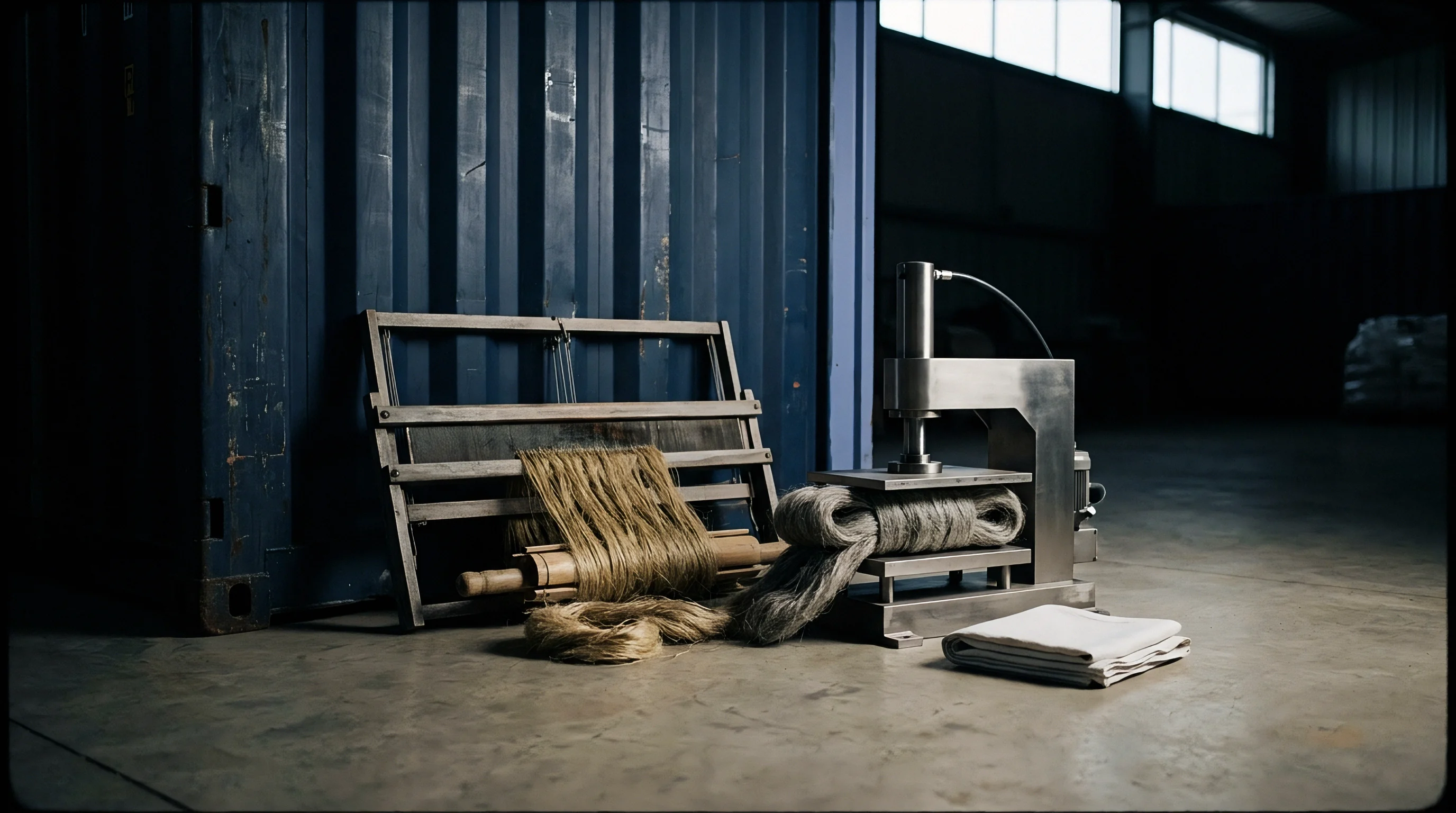
Wet spinning submerges roving strands in a hot water bath heated between 60 and 70 degrees Celsius prior to drafting. Hot water softens residual pectinous binders remaining within the technical middle lamella. Softened pectins act as a lubricant, allowing technical bundles to slide and split into fine sub-units under drafting tension.
Controlled splitting during wet drafting reduces the mean strand cross-section to near-elementary dimensions. Fine strand cross-sections allow the production of high-count yarns ranging from Nm 40 to Nm 100. Lower water bath temperatures prevent adequate pectin softening, forcing coarse intact bundles through the drafting nip and causing thread breakage.
Overheating leaches soluble binders into the bath, causing web breakdown, especially when higher draft ratios demand uniform fibres.
Cohesion limits the maximum spinnable count.
Inter-Fibre Friction and Drafting Dynamics
Surface roughness and cross-sectional geometry govern inter-fibre frictional forces. Flax elementary cells exhibit a polyhedral cross-section with defined longitudinal ridges that generate mechanical interlocking between adjacent strands during twist insertion.
- Strand Fineness Spectrum defines the cross-sectional count of individual fibres within a yarn slice, where finer strands increase contact surface area and improve twist holding capacity.
- Twist Factor Selection establishes the normal force pressing adjacent strands together in the spinning triangle, counteracting drafting draft tensions.
- Surface Pectin Residuals control sliding friction coefficients during draft zone passage, requiring strict temperature control in wet-spinning water troughs.
- Staple Length Distribution governs force distribution along drafting zones, where short elementary fragments cause localized nip slippage and drafting waves.
Maintaining uniform linear density across incoming roving strands ensures constant frictional resistance in the drafting zone. Variable fibre fineness alters the total contact surface area, causing draft force fluctuations that manifest as periodic thin and thick places in the spun yarn.
Natural agronomic variations in elementary cell diameter affect draft force control across different crop years, contributing to yarn count variation.

Yield
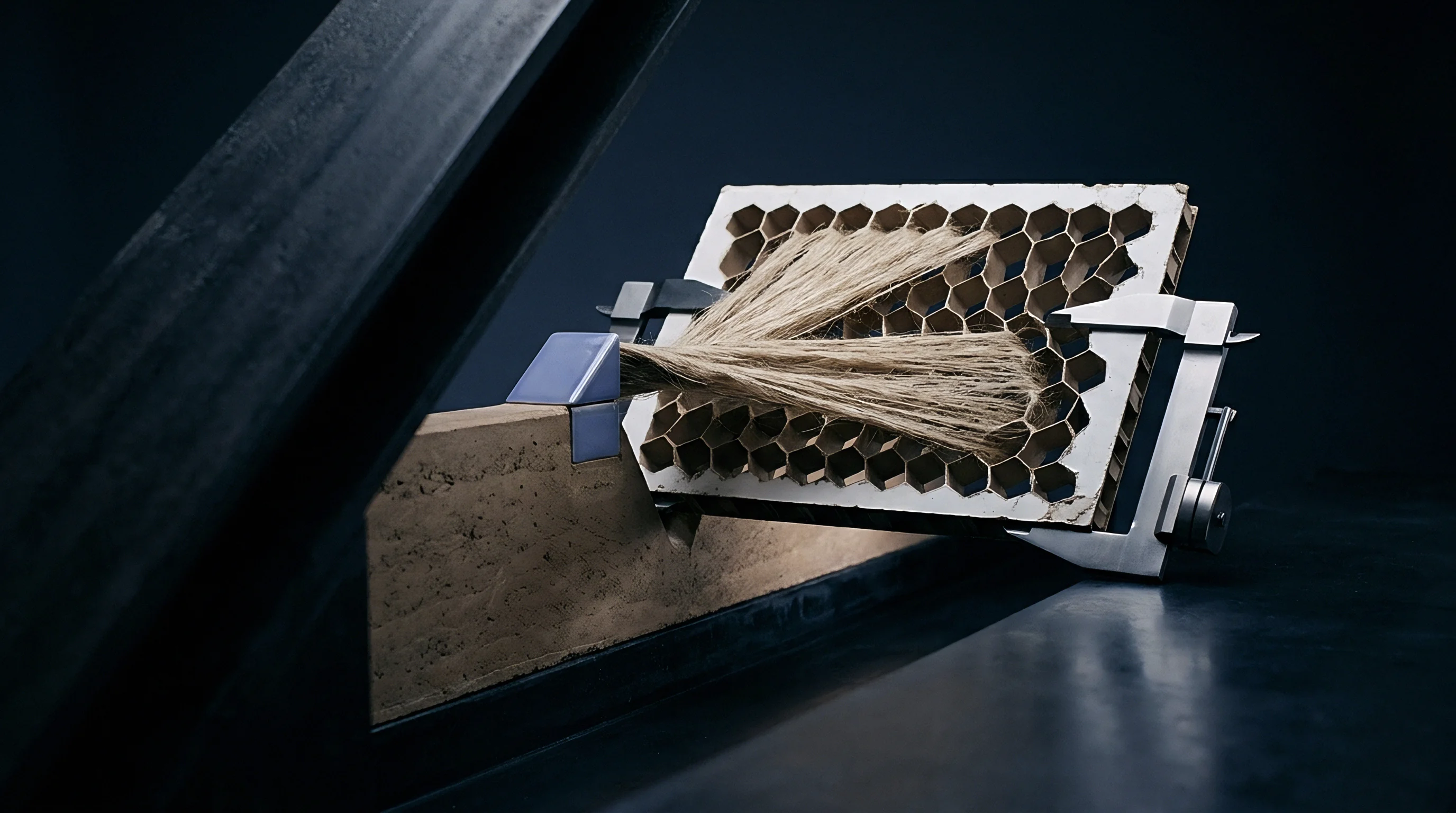
Converting raw scutched flax into spinnable line fibre requires mechanical combing on hackling machines. The hackling operation removes short, entangled strands and residual shive while splitting technical bundles longitudinally. Mass retention during hackling directly determines the commercial yield and value of the processed lot.

Hackling Efficiency and Fibre Mass Retention
Hackling machines pass scutched long line flax through a sequence of increasingly fine pin fields. Coarse initial pins remove tangled tow and break large wooden shive particles away from the root ends. Middle and fine pin zones split thick technical ribbons into fine strands with linear densities approaching 2.5 dtex.
The process separates raw input mass into long line fibre, hackled tow, and waste dust.
Fibre fineness dictates hackling performance. Fine, well-retted technical bundles yield high proportions of long line fibre because pin fields penetrate the flexible strands without causing axial fracture. Coarse, under-retted strands resist pin penetration, suffering mechanical breakage that drives intact long fibres into the hackled tow collector box.

Mass Balance in Processing
Mass distribution across hackling stages demonstrates the economic impact of raw fibre selection. Fine, dew-retted European flax yields higher long line recovery compared to coarse, poorly retted domestic stock. Processing efficiency depends on maintaining bundle integrity throughout the mechanical comb sequence.
| Parameter | Grade A Fine Line | Grade B Medium Line | Grade C Coarse Line |
|---|---|---|---|
| Mean Technical Linear Density (dtex) | 2.1 | 3.4 | 5.2 |
| Mean Elementary Cell Diameter (µm) | 14.2 | 18.5 | 24.1 |
| Long Line Fibre Recovery (%) | 64.5 | 54.2 | 41.8 |
| Hackled Tow Generation (%) | 28.2 | 36.5 | 44.2 |
| Shive and Dust Waste (%) | 7.3 | 9.3 | 14.0 |
| Maximum Wet Spinnable Count (Nm) | 80.0 | 40.0 | 26.0 |
Higher long line fibre recovery directly reduces the raw material mass required to produce a kilogram of fine yarn. Grade A fine line yields 64.5 percent long line fibre, whereas Grade C coarse stock yields only 41.8 percent, increasing the raw mass input needed to achieve equivalent spun yarn output.
Dew-retted long line flax tested at 21 degrees Celsius and 65 percent relative humidity exhibits an average elementary cell linear density of 1.8 dtex across a 500-fibre bundle sample.
Whether advances in enzymatic retting can target intercellular middle lamella pectins without compromising the crystalline integrity of the S2 cell wall layer remains a topic of active investigation across the European bast fibre sector.

Valuation
Raw material purchasing decisions impact final fabric manufacturing costs. Fibre fineness determines both the maximum achievable yarn metric count (Nm) and the speed at which spinning frames operate without excessive end breakage. Sourcing low-dtex flax line fibre carries a purchase price premium that must be balanced against yield improvements and fabric mass per square metre.
Fineness Premiums in Yarn Sourcing
Commercial pricing for scutched flax long line tracks elementary cell and technical bundle fineness. Fine European flax commands higher prices per metric ton due to its capacity for wet spinning into high-count, fine yarns suitable for luxury apparel and high-density home textiles. Coarse tow strands sell at substantial discounts, finding utility in coarse dry-spun industrial yarns or blended non-woven fabrics.
Spun yarn count dictates the mass of fibre contained in a square metre of woven fabric. Producing lightweight fabrics weighing under 120 grams per square metre requires fine yarns of Nm 50 or higher, and achieving these counts without excessive thread breakage demands raw fibre with a mean elementary linear density below 2.2 dtex.
Landed Cost Arithmetic per Finished Metre
Evaluating raw material selection requires walking costs from landed fibre bales through spinning and weaving to delivered fabric metres. Consider two commercial scenarios producing an identical plain-weave fabric structure measuring 1.5 metres wide with 20 ends per centimetre and 18 picks per centimetre, comparing Nm 40 wet-spun yarn against Nm 26 dry-spun yarn.
Assume Scenario A utilizes Grade A fine long line flax costing 4.80 Euros per kilogram landed at the mill. Hackling yields 64.5 percent long line fibre, with residual tow credited back at 1.20 Euros per kilogram. Wet spinning produces Nm 40 yarn at a spinning cost of 3.20 Euros per kilogram of yarn.
Scenario B uses Grade C coarse flax costing 3.10 Euros per kilogram landed, yielding 41.8 percent line fibre, wet-spun to Nm 26 yarn at a spinning cost of 2.10 Euros per kilogram.
| Cost Component | Scenario A (Fine Nm 40) | Scenario B (Coarse Nm 26) |
|---|---|---|
| Landed Fibre Cost (EUR/kg) | 4.80 | 3.10 |
| Hackling Yield Efficiency (%) | 64.5 | 41.8 |
| Net Fibre Cost Post-Hackling (EUR/kg) | 6.78 | 6.42 |
| Spinning Conversion Cost (EUR/kg) | 3.20 | 2.10 |
| Total Spun Yarn Cost (EUR/kg) | 9.98 | 8.52 |
| Finished Fabric Weight (g/m²) | 115.0 | 177.0 |
| Yarn Consumption Per Linear Metre (kg) | 0.207 | 0.318 |
| Delivered Yarn Cost Per Metre (EUR/m) | 2.07 | 2.71 |
Scenario A demonstrates that higher initial raw material prices per kilogram translate into lower landed yarn costs per linear metre of fabric. The fine Nm 40 yarn reduces finished fabric aerial weight to 115 grams per square metre, requiring only 0.207 kilograms of yarn per linear metre. Scenario B produces a heavier 177 gram per square metre fabric consuming 0.318 kilograms of yarn per metre, raising the delivered material cost per linear metre from 2.07 Euros to 2.71 Euros despite lower initial fibre purchasing costs.
Sourcing finer fibre grades lowers overall metre-based manufacturing expenses while enabling high-value, lightweight fabric production.