Analyzing Wet Spun Linen Strain Limits under Cyclic Dynamic Tension
Wet spun linen warp dynamic strain limits must stay below 0.8 percent at baseline tension to prevent pectin matrix breakdown and premature fatigue rupture.
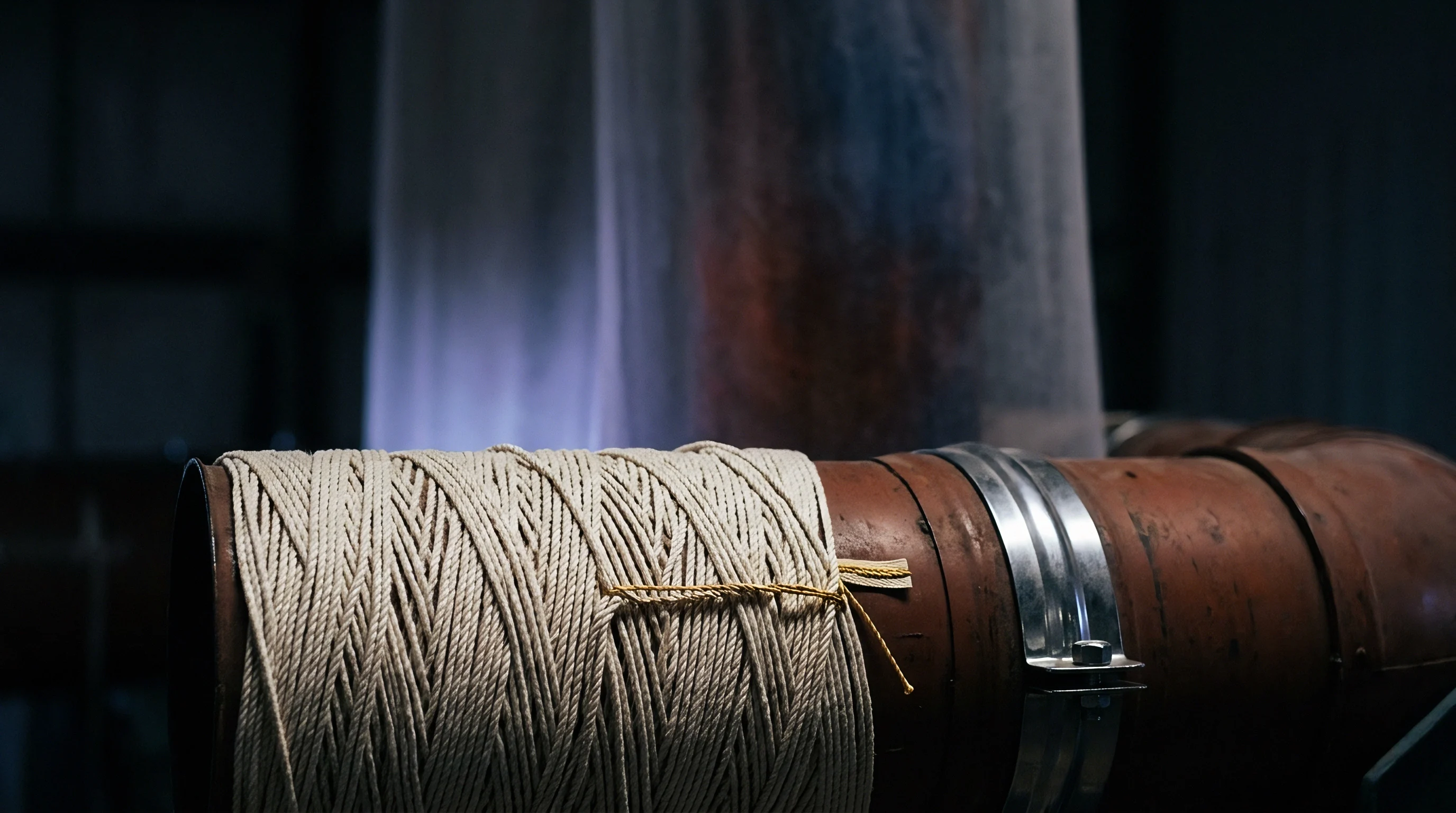

Strand
The internal structure of wet spun flax yarn develops during production as natural binders soften under heat and redistribute. Elementary fibers, ten to forty millimeters long and twelve to thirty micrometers in diameter, combine into technical fiber bundles held together by a non-cellulosic middle lamella matrix ~ mostly low-methoxyl pectins, hemicelluloses, and residual lignin. High moisture and heat force these filaments to slide past each other before consolidating, setting up tight microfibril alignment along the yarn axis.
As a result, wet spun yarns achieve dry tenacity values of 35 to 55 cN/tex, well above dry spun yarns in static tensile strength. This stiffness limits strain compliance, however; the parallel crystalline cellulose fibrils break at low strain, typically 1.8 to 3.2 percent under quasi-static testing.
Cellulosic Microfibril Alignment in Wet Spinning
In wet spinning, soaking the roving in hot water softens pectin bonds, allowing high draft ratios that align cellulosic microfibrils to a spiral angle of eight to eleven degrees along the fiber axis. Highly crystalline cellulose makes up to seventy percent of total dry fiber mass, leaving little room for longitudinal extension through fibril uncoiling. When pulled in axial tension, load transfers directly into primary cell walls and the intercellular middle lamella via shear stress.
Under static loads, this structure produces high stiffness, with an initial Young’s modulus between 18 and 28 GPa. Under dynamic loading, lacking extensible amorphous regions, the yarn must absorb cyclic displacement entirely inside the thin, viscoelastic pectin interfaces between elementary fibers.
Wet spun flax yarns lose inter-fiber cohesion when strain cycles exceed the plastic threshold of the pectin matrix.

Pectin Matrix Viscoelasticity under Load
Inter-fiber cohesion depends on the non-cellulosic binders cementing adjacent elementary filaments. At ambient relative humidity between 60 percent and 65 percent, the middle lamella serves as a viscoelastic damper for micro-scale shear displacements. Once cyclic dynamic loads pass the linear elastic limit, individual elementary fibers inside the bundle slip against one another in localized shear.
This slippage cannot be recovered. Each cycle adds microscopic shear strain inside the pectin layers, driving progressive micro-cracking and structural decay long before the yarn breaks at macro scale. Water molecules plasticize the pectin network, dropping the glass transition temperature of the binder and lowering the point where cyclic strain becomes permanent plastic movement.
Whether a wet spun yarn survives dynamic tension comes down to whether applied cyclic strain remains in the reversible elastic band of the middle lamella or spills into progressive inter-fiber slippage. Current mill research has not yet pinpointed the exact moisture threshold where pectin plasticization stops acting as a helpful strain-damping mechanism and starts accelerating structural sliding during high-frequency tension cycles.
Dynamics
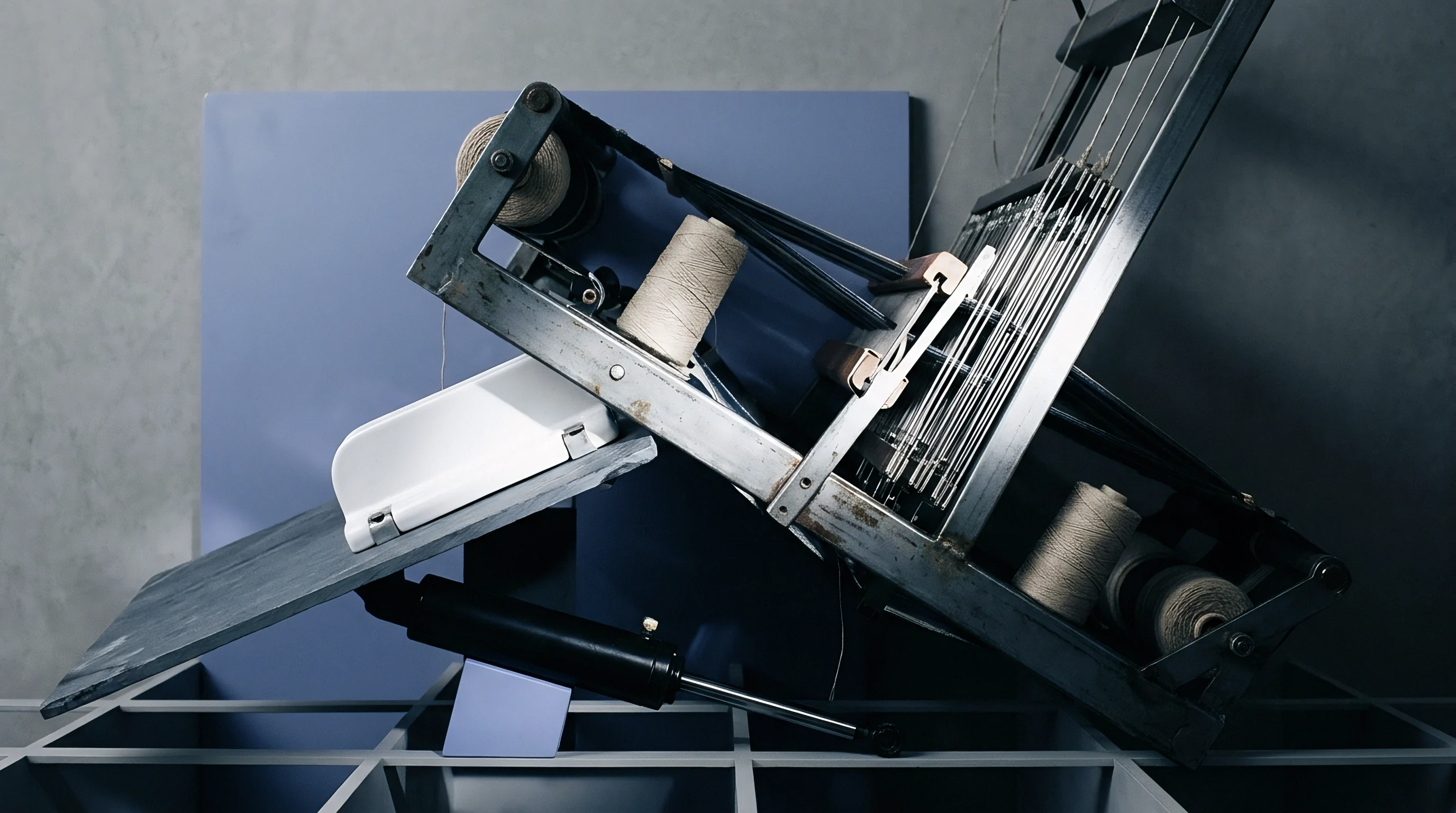
High-speed weaving exposes warp ends to sharp tension oscillations from harness shedding, sley beat-up, and let-off motion. Operating at 400 to 600 picks per minute, modern rapier looms flex warp threads through dynamic strain cycles at frequencies between 6.6 Hz and 10 Hz. Sley motion adds a secondary beat-up pulse on top of shedding tension, producing a multi-peak cyclic load profile. Although a 26 Nm (38.5 tex) wet spun flax yarn has a static breaking elongation of 2.2 to 2.8 percent, cyclic dynamic tension brings on fatigue at strain amplitudes as small as 0.8 to 1.2 percent when riding on a baseline warp tension of 25 to 35 cN per end.
Peak Shedding Tension and Cyclical Amplitude
Harness movement lifts warp threads into open sheds, demanding elastic extension that changes with shed geometry, backrest roll height, and drop wire angle. Sley beat-up drives the reed into the cloth fell, adding a short load spike that can raise local tension 40 to 70 percent above static settings. Combined shedding displacement and beat-up pulses produce dynamic strain amplitudes throughout the run.
When peak dynamic strain reaches roughly 1.5 percent on a wet spun linen warp, strain ratcheting sets in: each pulse adds an unrecovered sliver of plastic extension, steadily eating away the yarn’s remaining elongation capacity.
- Baseline Tension Calibration setting static warp tension on the let-off motion to 20 cN per end prevents excessive slack without exceeding the elastic limit of the wet spun yarn bundle.
- Backrest Motion Synchronization adjusting backrest roller spring rate and damping position reduces peak shedding load spikes by absorbing sudden geometric path length changes.
- Shed Geometry Optimization minimizing asymmetric shed opening height lowers peak dynamic elongation imposed on top and bottom shed sheets during weaving cycles.
- Humidity Control Enforcement maintaining weave room moisture between 65 percent and 70 percent relative humidity stabilizes pectin moisture absorption and keeps viscoelastic damping steady.
Cyclic Tensile Fatigue Test Methodologies
Laboratory tests replicate machine stress by oscillating yarn specimens between fixed strain limits at controlled frequencies, using dynamic mechanical analyzers or dedicated fatigue units. Analysts establish stress-strain hysteresis loops across extended cycle counts. The area inside the hysteresis loop measures energy dissipated per cycle, reflecting internal friction and micro-structural sliding between elementary flax fibers.
As fatigue accumulates, the hysteresis loop skews, signaling a drop in dynamic storage modulus and progressive permanent deformation.
Dynamic strain limits established under static tensile testing overestimate loom performance by up to forty percent.
| Mean Strain (%) | Dynamic Amplitude (%) | Frequency (Hz) | Mean Cycles to Failure | Accumulated Plastic Strain (%) | Failure Mode |
|---|---|---|---|---|---|
| 1.0 | 0.3 | 5.0 | 185,000 | 0.18 | Fibrillar abrasion |
| 1.0 | 0.6 | 5.0 | 62,000 | 0.42 | Inter-fiber matrix slip |
| 1.0 | 0.9 | 5.0 | 14,500 | 0.78 | Elementary bundle shear |
| 1.2 | 0.6 | 8.0 | 28,000 | 0.55 | Pectin binder rupture |
| 1.2 | 0.9 | 8.0 | 4,200 | 0.95 | Catastrophic yarn snap |
Setting baseline warp let-off tension to half the linear elastic strain limit preserves yarn structure through millions of loom cycles.

Geometry
Interlacing warp and weft shifts how tensile loads travel through fabric under mechanical strain. Weave architecture balances structural crimp extension against direct yarn material strain. In loose weaves with long floats, dynamic tension pulls crimp out of the active yarn system before loading the fibers directly.
Plain weaves bind yarns tightly at every intersection, transferring applied dynamic strain into the fiber body almost immediately. Weave pattern, thread count per centimeter, and crimp percentage set the limit for cyclic dynamic strain a woven linen can take before localized fatigue sets in.
Crimp Interchange Dynamics across Weave Structures
Yarn curvature inside a fabric acts as a mechanical buffer, shielding fibers from dynamic peak loads. A 1/1 plain weave provides maximum crossover points per unit area, yielding warp crimp between 6.0 and 10.0 percent depending on weft sett and tension. Under dynamic cycling, this crimp flexes continually like a geometric spring to absorb movement.
By contrast, 2/2 twill and 5-end satin weaves have fewer crossovers, dropping warp crimp to between 2.5 and 4.5 percent. That lower crimp provides less geometric compliance, sending external movement straight into axial strain on the wet spun yarn.
When plain weave warp density using 26 Nm linen increases from 20 ends to 32 ends per centimeter, lateral contact pressure between yarns rises sharply. This tight packing restricts crimp interchange during dynamic cycles. High-density fabrics force the wet spun yarn to absorb dynamic loads through internal fiber extension instead of geometric fabric movement, accelerating inter-fiber pectin shearing.
A plain weave fabric subjected to three percent dynamic strain distributes sixty percent of the displacement into crimp interchange.
- Inter-Yarn Abrasion Fatigue rapid cyclic rubbing at crossover points wears away protective size films and fibrillates elementary flax bundles.
- Crimp Lock Failure excessive thread density prevents structural geometric flex, forcing wet spun yarn bundles into premature plastic extension.
- Asymmetric Tension Shear unbalanced warp and weft cover factors cause dynamic load concentration on low-crimp warp systems during beat-up.
- Reed Line Flaw Creation localized strain spikes on tightly crowded warp ends induce permanent thread dislocation along the cloth fell.
Sett Selection and Cover Factor Impact
Warp and weft cover factors measure the proportion of fabric area occupied by yarn, directly affecting structural stiffness under tension. Calculating fractional cover factor with K = d p ~ where d is yarn diameter in millimeters and p is picks or ends per millimeter ~ defines construction tightness. Wet spun linen requires careful sett balancing to prevent over-consolidation, ensuring fabric geometry offers enough structural compliance to compensate for the yarn’s low elongation.
| Weave Pattern | Warp Sett (ends/cm) | Weft Sett (picks/cm) | Warp Crimp (%) | Dynamic Load Share in Crimp (%) | Cycle Life at 3% Strain Limit |
|---|---|---|---|---|---|
| Plain 1/1 | 22 | 20 | 7.2 | 58 | 120,000 |
| Plain 1/1 | 28 | 26 | 4.1 | 32 | 35,000 |
| Twill 2/2 | 26 | 24 | 4.8 | 41 | 68,000 |
| Twill 3/1 | 30 | 24 | 3.2 | 26 | 22,000 |
| Satin 5-end | 32 | 28 | 2.4 | 18 | 11,000 |
Selecting an overly tight construction without accounting for yarn strain limits leads to high warp breakage, excessive loom downtime, and permanent reed marks across the finished fabric.
Fatigue
Repeated stress cycles degrade textile structures far below their ultimate tensile strength through cumulative internal damage. In wet spun linen yarns, fatigue failure is not a single, sudden snap across all fibers. Progressive breakdown starts with micro-cleavage of inter-fiber pectin bonds, followed by elementary fiber pull-out, localized stress concentration, and sequential strand breakage.
Establishing cyclic strain limits requires isolating where reversible elastic deformation stops and progressive inter-fiber damage begins.

Which Dynamic Tension Limits Govern Wet Spun Linen Fatigue Life?
Setting maximum allowable strain amplitude depends on finding the elastic threshold where the pectin matrix starts taking on cumulative shear displacement. A high-quality 26 Nm wet spun flax yarn shows a static dry breaking strain of 2.5 percent, but under 8 Hz dynamic cycling, its true elastic limit falls to 0.75 percent. Running a loom above 0.75 percent dynamic strain triggers progressive strain ratcheting.
At 1.2 percent dynamic strain, cycle life drops under 50,000 cycles, leaving the warp vulnerable to frequent breaks over a standard shift.
Microscopic evaluation of fatigue samples shows non-linear damage accumulation. Over the first 20 percent of fatigue life, yarn modulus drops rapidly as weaker binder regions yield. The middle 60 percent shows steady, linear plastic strain accumulation marked by slow fiber pull-out.
The final 20 percent brings rapid structural breakdown as remaining sound fibers overload, resulting in total bundle failure.

Worked Cycle Life Calculation for High Speed Weaving
Evaluating a standard 26 Nm warp under production conditions illustrates how mechanical breakdown progresses. Consider a 26 Nm wet spun linen warp with static tenacity of 42 cN/tex ~ a breaking force of 1,617 cN per end. Operating at 480 picks per minute with a baseline warp tension of 30 cN per end imposes 0.35 percent static strain.
Harness motion and beat-up add 0.65 percent dynamic strain amplitude, pushing peak dynamic strain to 1.0 percent at 8 Hz.
Under these conditions, total peak dynamic tension reaches 85 cN per end ~ 5.2 percent of static breaking load. Protective chemical sizing increases initial bundle stiffness and suppresses inter-fiber slip up to a critical cycle count, but repeated flexure eventually cracks the film. After 30,000 pick insertions, sizing breakdown exposes raw fiber bundles to dynamic shear stresses, with plastic strain accumulating at 0.000015 percent per cycle.
Reaching the critical damage threshold of 0.45 percent plastic strain requires 30,000 initial cycles plus 30,000 degraded cycles, giving a predicted fatigue life of 60,000 picks.
- Yarn Quality Verification audit single-end tenacity and elongation CV percentage to ensure yarn uniformity prior to warp beam mounting.
- Size Pickup Measurement verify dry size solids add-on reaches 8 to 11 percent to secure elementary fiber bundles against early micro-slip.
- Dynamic Strain Bench Testing run cyclic fatigue tests at target weaving frequency to locate the actual strain limit threshold for each yarn batch.
- Loom Motion Adjustment set let-off responsiveness and backrest spring tension to cap dynamic peak strain spikes below 0.8 percent during shedding.
High static tensile test values do not guarantee superior weaving performance, as dynamic strain fatigue operates through inter-fiber shear mechanisms completely unrelated to static breaking force.


Ledger
Commercial viability depends on minimizing shed stoppages and yarn damage during high-speed weaving. Warp breaks halt looms, burning unrecoverable machine hours and creating defects that downgrade fabric from firsts to seconds. Running a warp above critical dynamic strain limits increases stop frequency from an acceptable 1.5 stops per 100,000 picks to over 8.0 stops.
Quantifying financial impact requires balancing sizing cost, loom speed reductions, weaver workload limits, and landed cost per finished metre.

Sizing Pickup and Polymer Reinforcement Economics
Applying protective sizing chemistry to warp threads adds strength and delays fatigue onset. Native potato starch modified with synthetic PVA or acrylic polymers anchors surface fibers to the yarn core, pinning elementary flax filaments in place. Sizing pickup requires careful balance: undersizing allows premature pectin matrix failure under dynamic tension, whereas oversizing makes yarn stiff and brittle, leading to cracks during shedding.
Optimization balances sizing chemical costs against reduced warp break rates on the loom floor.
Applying an optimal nine percent PVA starch size add-on increases wet spun linen warp dynamic cycle life by three hundred percent.
| Peak Strain Limit (%) | Sizing Add-On (%) | Loom Speed (PPM) | Warp Stops / 100k Picks | Shed Efficiency (%) | Landed Cost (€/m) |
|---|---|---|---|---|---|
| 0.70 | 10.5 | 520 | 0.8 | 94.2 | 4.15 |
| 0.85 | 9.0 | 480 | 1.4 | 91.5 | 4.38 |
| 1.00 | 8.0 | 440 | 3.2 | 84.0 | 4.92 |
| 1.20 | 6.5 | 380 | 6.8 | 72.5 | 5.85 |
| 1.40 | 0.0 (Unsized) | 280 | 14.5 | 51.0 | 8.40 |
Commercial Specification Boundaries and Standard Clauses
Supply contracts set physical performance thresholds to prevent disputes over broken warps and poor room efficiency. Purchasing terms typically cite ISO 13934-1 static tensile targets alongside dynamic fatigue tolerances. Buyers ordering wet spun linen require suppliers to guarantee yarn compliance under specified dynamic strain limits before committing to warp beams.
Under standard commercial procurement terms, any yarn batch failing to meet 50,000 cycles at 0.8 percent dynamic strain under ISO 2062 modified cyclic conditions is rejected at the supplier’s expense, placing financial responsibility for loom downtime and warp re-preparation on the spinner.