Substantial Transformation and Preferential Rules of Origin Enforcement for Multi Country Made up Linen
Origin enforcement for made-up linen rests on tariff shift rules, mill mass-balance records, and statutory processing criteria across trading blocks.


Shift

Classification Gates across Processing Stages
Linen goods pass through four distinct tariff chapters between raw field straw and finished bed sheets. Raw or scutched flax fibre enters customs classifications under Harmonized System heading 5301, while wet-spun single or folded linen yarn moves to heading 5306. Woven fabrics containing at least 85 percent flax by weight fall under heading 5309, and finished bed, table, or kitchen linen items exit the manufacturing sequence inside heading 6302.
Each tariff jump represents a change in four-digit classification, which serves as the legal foundation for non-preferential origin determination under international trade rules.
Customs authorities distinguish preferential origin rules, which grant duty reductions under trade agreements, from non-preferential origin rules that govern marking requirements and trade remedies. Preferential trade agreements between regional blocks frequently impose double-transformation requirements, demanding that both weaving and subsequent cut-and-sew assembly occur within participating agreement territories to qualify for zero-duty rates. Simple cut-and-sew finishing on imported foreign fabric routinely fails preferential origin tests while simultaneously satisfying non-preferential substantial transformation criteria for country-of-origin marking.
In non-preferential trade determinations, origin sits where the yarn is woven into fabric, altering the four-digit classification from 5309 to 6302 when plain yardage is hemmed, edge-finished, or packaged into flat sheets or duvet covers in a secondary country. Customs administrations across North America and Europe apply different statutory criteria when evaluating whether simple assembly converts non-originating grey cloth into a product of the assembly country.
The non-preferential origin of woven linen bed sheets rests on the location of fabric weaving unless assembly operations meet specific value-added or structural modification thresholds.

Substantial Transformation Assessment Matrix
Determining origin requires evaluating processing steps against statutory thresholds. The assessment matrix below contrasts process criteria across major customs regimes for multi-country made-up linen articles.
| Processing Stage | HS Code Change | EU Customs Code Rule | US Customs (CBP) Rule | Preferential FTA Standard |
|---|---|---|---|---|
| Scutching & Hackling | 5301.10 to 5301.29 | Country of fibre harvest | Country of fibre harvest | Fibre origin retained |
| Yarn Spinning | 5301 to 5306 | Country of spinning shed | Country of spinning shed | Single transformation step |
| Weaving Greige Fabric | 5306 to 5309 | Country of loom shed | Country of loom shed | First structural origin gate |
| Dyeing & Bleaching | 5309.11 to 5309.19 | Insufficient transformation | Insufficient transformation | No origin change without weaving |
| Cut, Sew & Hemming | 5309 to 6302 | Assembly country origin if complete | Fabric origin retained (Rule 102.21) | Double transformation required |
European Union customs directives under Regulation 952/2013 treat the complete assembly of linen bedding as an origin-conferring process when cutting, sewing, and folding convert fabric rolls into complete articles. United States Customs and Border Protection enforces Section 102.21 rules, which assign origin for Chapter 63 made-up articles back to the country where fabric was woven, regardless of where cutting and sewing occurred. Importers shipping linen bedding cut and sewn in Southeast Asia from Chinese woven fabric face conflicting origin assignments depending on whether clearance occurs in European or American ports.
Raw scutched flax grown in France and exported to Jiangsu province for spinning does not transmit European origin to the resulting yarn unless specific agreement rules allow bilateral cumulation. When an importer asserts European origin for final linen bedding, every intermediate processing step must be documented against the specific tariff shift definitions governing the destination market.
- Tariff heading jump verification confirms that incoming greige cloth under heading 5309 converts to heading 6302 through physical cutting and edge finishing.
- Double transformation compliance checks verify that both yarn spinning and fabric weaving took place within qualified free-trade zone boundaries.
- Non-qualifying processing exclusions identify simple packaging, tagging, and press-ironing operations that fail to confer origin.
- Regional value content calculations aggregate direct labor and processing costs when trade agreements permit value-addition rules.
Substantial transformation analysis yields predictable customs outcomes when documented prior to export. The physical movement of goods across borders creates legal liability for the importer of record whenever declarations conflict with underlying processing locations.


Shed
Physical Transformation from Fibre to Assembly
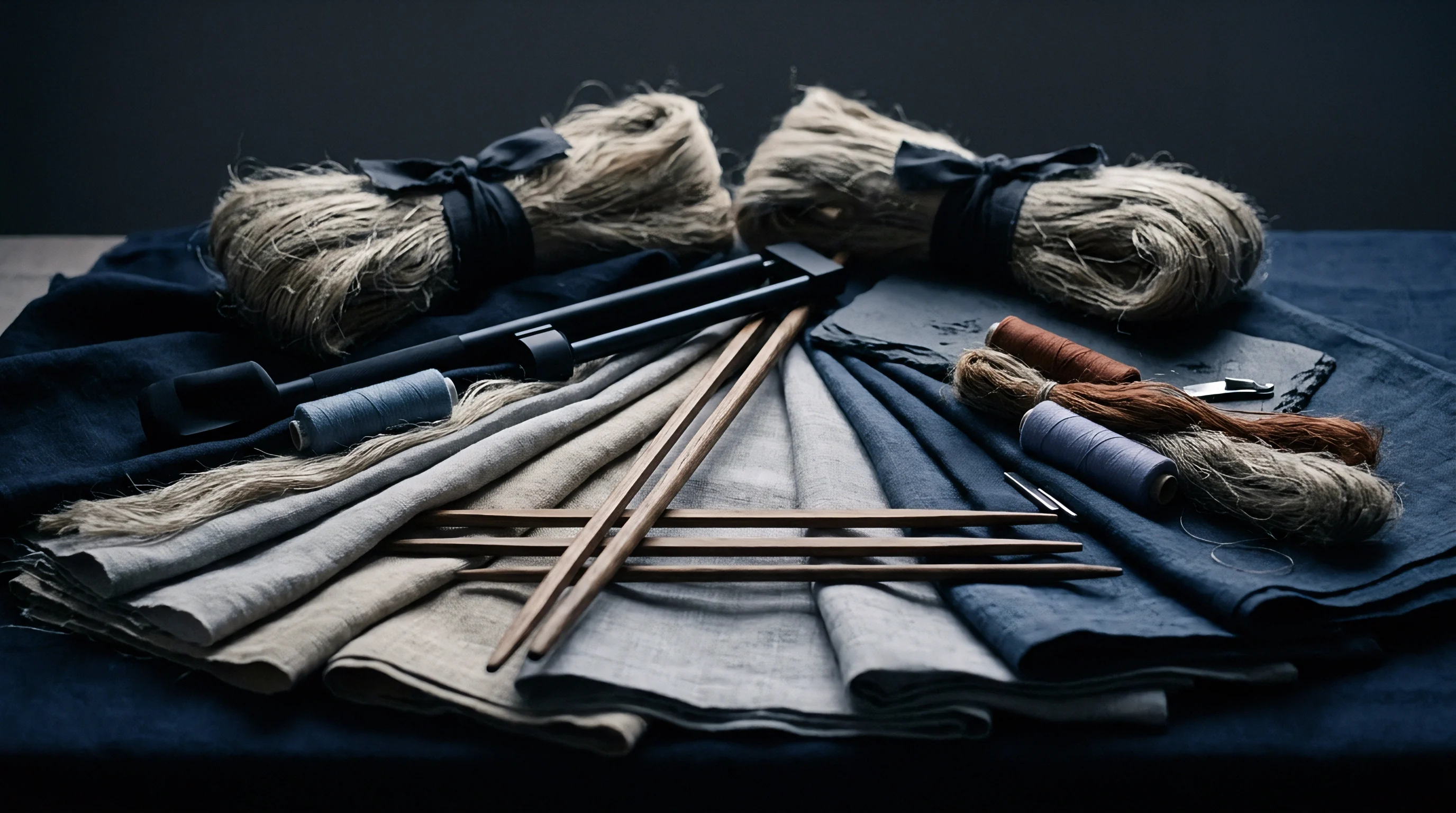
Raw flax fibre arrives at the spinning mill as scutched long flax or tow. Scutched fibre undergoes hackling to comb out short fibres and align long parallel stricks, which pass through drawing frames into continuous slivers. These slivers enter wet spinning frames where hot water softens pectin bonds to produce smooth, high-tenacity yarn.
Spinning mills in Ningbo or Shaoxing process European flax straw into yarn counts ranging from 14 NM to 40 NM.
Yarn packages move to the weaving shed for warping and sizing. Rapier or air-jet looms interlace warp and weft yarns to produce woven fabric at weights between 110 and 240 grams per square metre. Greige fabric rolls travel to finishing plants for desizing, scouring, bleaching, or piece dyeing before being wrapped in protective polyethylene film, labeled with batch tags, and dispatched to assembly facilities.
Cut-and-sew operations unroll the fabric onto multi-ply tables where automated laser or rotary blades slice sheets, pillowcases, and duvet panels to specification. Workers execute lockstitch or overlock edging on high-speed industrial sewing machines before folding, pressing, and boxing the finished bed linen. Each step generates mill-level records that serve as primary proof during origin audits.
The sequence of operations across multiple physical locations requires precise log recording.
- Scutched flax bales arrive at the spinning store accompanied by weighbridge tickets and grower delivery receipts.
- Hackling and drawing frames convert long flax stricks into combed sliver batches assigned to specific spinning runs.
- Wet spinning spindles produce yarn bobbins marked with lot numbers matching the raw fibre bale batch.
- Warping creels align bobbin yarn into warp beams routed directly to designated loomshed production lines.
- Loom monitors record fabric roll output linked to warp beam identities and weft package yarn lots.
- Dyehouses process greige rolls under batch dye receipts specifying roll serial numbers and chemical additives.
- Garment cutting floors log fabric roll consumption against production orders for specific bedding dimensions.
- Sewing lines assemble cut panels into finished articles and apply sewn-in care and origin tags containing lot codes.
Bale store registers match incoming raw materials against outgoing spun yarn weights. Yield loss during hackling and wet spinning typically ranges from 22 percent to 30 percent depending on raw fibre quality and target yarn count, while dyeing and finishing shrinkage introduces an additional 4 to 8 percent dimensional change in fabric yardage.
Yield reconciliation across mill records identifies material gaps where non-certified yarn or fabric entered the production stream.

Mill Floor Record Reconciliation
Auditors cross-reference incoming bale weights against outgoing fabric metres to detect volume substitution. A mill processing 100 tonnes of European Flax fibre produces approximately 72 tonnes of wet-spun yarn, yielding roughly 300,000 linear metres of plain weave fabric at 160 grams per square metre. If an assembly facility produces 400,000 linear metres of finished linen sheets from that same fibre allotment, uncertified greige cloth entered the converting line.
Yield gaps often stem from blending supplementary local yarn into weft runs to meet delivery deadlines. This commercial reality breaks the chain of custody and invalidates origin claims that rely on 100 percent European fibre input, making complete volume continuity essential at every transfer point.
Batch identity tags must remain attached to goods throughout transport between facilities. A cut-and-sew factory in Vietnam receiving finished fabric rolls from China must retain invoice pack slips, bill of lading documentation, and internal fabric roll registers showing the precise usage of each roll in every batch of finished bedding.
Discrepancies between raw bale usage logs and finished carton packing lists trigger immediate origin challenges during customs clearance inspections unless underlying mill registers corroborate the claim.


Proof

Documentary Frameworks and Scheme Scope
Verifying origin and provenance requires evaluating the scope of independent certification schemes against customs statutory rules. Certification programs carry explicit territorial and operational limits that determine their admissibility in customs disputes.
European Flax certifies the origin of raw flax fibre harvested in France, Belgium, and the Netherlands. The certificate follows raw fibre through global spinning and weaving facilities, confirming that the physical plant material originated in Western Europe. It does not prove that yarn spinning or fabric weaving occurred within Europe, and importers who present European Flax certificates to prove European processing origin face immediate rejection by trade authorities.
Masters of Linen provides a stricter chain-of-custody guarantee, mandating that raw fibre cultivation, spinning, and weaving occur entirely within European territory. A product carrying Masters of Linen certification inherently satisfies European origin criteria under both preferential and non-preferential definitions. Chinese spinning or weaving mills cannot hold Masters of Linen certification, as any processing outside European geographic boundaries revokes the designation.
OEKO-TEX Standard 100 certifies human-ecological safety and chemical compliance in finished textiles, confirming that finished linen sheets contain no harmful levels of restricted substances such as heavy metals, formaldehyde, or fluorinated chemicals. OEKO-TEX certificates contain no origin evaluation and provide zero evidentiary value during customs origin audits.
Scope certificates verify facility capability while transaction certificates validate the exact weight and movement of specific material lots.

When Does Cutting and Sewing Alter Non Preferential Origin?
Non-preferential origin regulations in the European Union assign country of origin to the territory where complete assembly occurs. Cutting woven yardage into rectangular panels, sewing finished border hems, and attaching closures transforms heading 5309 fabric into heading 6302 bed linen. This cut-and-sew sequence constitutes substantial transformation under Article 60 of Regulation 952/2013, making the assembly nation the non-preferential country of origin.
United States trade rules operate under a contrasting standard. Section 102.21 of the United States Customs Regulations specifies that for Chapter 63 made-up articles, cutting and hemming flat textiles does not alter origin. The origin of bed sheets entering American ports remains the country where the greige cloth was woven.
An importer bringing linen sheets into Los Angeles that were cut and sewn in Vietnam from Chinese fabric must declare China as the non-preferential country of origin.
Because customs authorities reject incomplete documentation, the file ladder required to support multi-country origin declarations must cover every step from harvest to final distribution.
- Scope certificates issued by certifying bodies confirm that manufacturing facilities maintain active system approval during production windows.
- Transaction certificates issued for specific shipments prove that designated volumes of certified yarn or fabric moved between buyer and seller.
- Commercial invoices detailing line-item tariff codes, gross and net weights, and yarn counts must link directly to transport documents.
- Bills of lading establish the physical transport route and transport equipment identity across international shipping lanes.
- Mill processing logs substantiate direct labor input and mill-floor machine time expended on specific production batches.
Documentary files must remain accessible for five years following import entry. Importers who rely on verbal supplier declarations or generic marketing claims without underlying mill registers remain exposed to retroactively applied customs penalties.
Customs verifications frequently raise questions regarding mixed-origin yarn inputs. When spun yarn contains a blend of European scutched flax and non-certified regional tow, which specific analytical mass-balance method must the importer submit to prove that the preferential content threshold was maintained across continuous spinning runs?

Margin

Duty Differentials and Landed Cost Arithmetic
The financial impact of origin decisions appears directly on the landed cost sheet. Importers calculate duty expenses by applying statutory tariff rates to the customs valuation of imported goods. Importing finished linen bed sheets under Most-Favoured-Nation (MFN) rates subjects shipments to base duty tariffs that vary substantially between destinations.
Preferential Trade Agreements (PTAs) reduce import tariffs to zero or reduced preferential rates when origin criteria are satisfied. Claiming preferential treatment under FTAs without complete chain-of-custody documentation creates severe financial exposure. When customs authorities conduct post-clearance audits and invalidate origin claims, importers must pay back-duties, administrative interest, and statutory penalties.
Landed cost calculations must incorporate raw material surcharges, audit costs, and tariff duty variance. Certified European Flax fibre carries a market surcharge of 0.35 EUR to 0.60 EUR per kilogram over uncertified flax fibre. Independent supply-chain audits add between 2,500 EUR and 5,000 EUR per facility evaluation, costs that are weighed directly against duty savings achieved through preferential trade access.
Worked Financial Models across Sourcing Routes
Consider a production run of 10,000 units of pure linen bed sheet sets exported to the European Union. Each set contains 2.2 kilograms of finished fabric, representing a total shipment weight of 22,000 kilograms of finished linen goods. Assume a factory FOB price of 45.00 EUR per set, yielding a total FOB consignment value of 450,000 EUR.
Shipping and insurance add 15,000 EUR, establishing a CIF customs value of 465,000 EUR.
| Cost Component | Route A: China Weave & Assembly (MFN) | Route B: China Weave, Vietnam Cut/Sew (EU Non-Pref) | Route C: Full EU Processing (Preferential Zero-Duty) |
|---|---|---|---|
| Base Production Cost (FOB) | 450,000 EUR | 475,000 EUR | 680,000 EUR |
| Freight & Logistics (CIF) | 15,000 EUR | 18,000 EUR | 8,000 EUR |
| Certified Fibre Surcharge | 8,800 EUR | 8,800 EUR | 12,000 EUR |
| Customs CIF Value | 473,800 EUR | 501,800 EUR | 700,000 EUR |
| Applicable Duty Rate | 12.0% (MFN Rate) | 0.0% (EVFTA Preferential) | 0.0% (Intra-EU / Preferential) |
| Import Duty Amount | 56,856 EUR | 0 EUR | 0 EUR |
| Post-Clearance Audit Provision | 0 EUR | 15,000 EUR | 2,000 EUR |
| Total Landed Cost | 530,656 EUR | 516,800 EUR | 702,000 EUR |
| Effective Cost Per Unit | 53.07 EUR | 51.68 EUR | 70.20 EUR |
Route A reflects standard MFN entry from China. The importer pays a 12.0 percent customs duty on the CIF value, yielding a total landed duty expense of 56,856 EUR. The documentation is simple, and audit risk remains low because no preferential tariff preference is claimed.
Route B utilizes cutting and sewing in Vietnam under the EU-Vietnam Free Trade Agreement (EVFTA). The base duty drops to zero percent, saving 56,856 EUR in statutory duty. EVFTA rules of origin require fabric to be woven in Vietnam or the EU (with specific cumulation exceptions).
If the fabric was woven in China, claiming EVFTA preferential origin constitutes non-compliance. A subsequent customs audit that invalidates the EVFTA origin claim results in back-duty recovery of 56,856 EUR plus administrative penalties up to 100 percent of the duty amount, driving total consignment financial risk to 627,512 EUR.
Duty savings disappear instantly when customs enforcement rejects invalid certificate filings. Sourcing managers who select multi-country production routes based on nominal duty rates without verifying processing rules risk wiping out entire operating margins during post-clearance enforcement actions.


Dispute

Enforcement Protocols and Customs Verifications
Customs enforcement agencies enforce rules of origin through physical inspections, document verifications, and laboratory testing. Verification requests initiate under international administrative assistance protocols, with customs authorities issuing official questionnaires to importers requiring full documentary substantiation of declared origin within 30 to 90 days.
Failure to supply mill-level operational logs triggers immediate suspension of preferential tariff treatment. Customs agencies issue formal notices of action, reclassifying shipments under MFN rates and demanding immediate security deposits for unpaid duties. Repeated origin non-compliance leads to administrative blacklisting and mandatory physical inspection of all future imports.
Testing laboratories employ analytical techniques to verify fibre composition and geographical provenance. Isotope Ratio Mass Spectrometry (IRMS) measures stable isotopes of hydrogen, oxygen, carbon, and strontium within cellulose fibres. Isotopic ratios reflect local climate, precipitation, and soil chemistry, establishing geographic signatures that distinguish European flax straw from flax cultivated in East Asia or North America.
Isotopic analysis of linen fibre cellulose detects geographical mislabeling even after chemical bleaching and piece dyeing.

Labelling Compliance and Marking Statutes
Labelling directives enforce country-of-origin disclosure on physical consumer products. EU Regulation 1007/2011 governs textile fibre names and related labelling within European markets, requiring textile products to carry durable, legible, and accessible labels indicating fibre composition. Country-of-origin marking on European consumer goods follows national regulations, where non-preferential customs origin rules dictate the declared nation.
United States enforcement under the Textile Fiber Products Identification Act requires sewn-in labels stating exact fibre percentage composition and country of origin. The Federal Trade Commission (FTC) enforces strict marking regulations for made-up textile articles. Under FTC rules, a bed sheet assembled in Vietnam from Chinese fabric must be permanently labeled: Made in Vietnam from imported fabric, or Made in Vietnam from Chinese fabric.
Discrepancies between customs entry declarations and consumer label text attract regulatory action. Customs officers inspect container shipments at port entry gates, comparing sewn-in garment labels against the country of origin declared on commercial invoices and customs entry summaries.
The importer agrees that presenting origin documentation found to be invalid or incomplete constitutes a material breach of supply contract, entitling the buyer to full indemnification for back-duties, penalties, and legal expenses incurred.


Friction

Contractual Warranties and Risk Allocation
Mitigating provenance risk requires explicit contractual terms in supply agreements with foreign mills and converters. Purchase contracts must shift legal and financial liability for origin compliance onto the vendor, as standard commercial sales terms that rely on generic quality clauses provide insufficient protection against customs origin assessments.
Supply contracts must incorporate explicit origin warranty clauses, obligating vendors to warrant that all supplied goods satisfy the specific rule of origin definitions of the target import market. The warranty must require the seller to maintain complete batch records and grant independent auditors unrestricted access to mill premises, bale stores, and spinning logs.
Failure to provide verified transaction certificates within fifteen days of bill of lading issuance must trigger commercial remedy provisions. Sourcing agreements must specify liquidated damages or contract price withholdings equal to maximum potential customs penalty exposures.

Supplier Representations and Liability Clauses
Foreign suppliers frequently attempt to limit origin liability by offering standard commercial certificates of origin issued by local chambers of commerce. Chambers of commerce issue non-preferential origin certificates based solely on seller affidavits without conducting independent mill audits or batch record reconciliations. Customs authorities view local chamber certificates as self-serving administrative declarations that carry zero legal weight during origin disputes.
When origin documentation fails customs audit scrutiny, processing definitions are often defended under local commercial interpretations that conflict with importing rules. Sourcing practice requires replacing verbal understandings with binding legal indemnity agreements governed by buyer-jurisdiction law.
Effective contract design binds the supplier to supply chain transparency standards. Sourcing practice embeds verification rights directly into purchase orders, ensuring that audit access, document retention, and financial liabilities remain enforceable throughout the commercial relationship.