
Flax Fiber Mass Balance Audit Principles in Textile Spinning
Audit flax mass balance by verifying moisture-adjusted fiber intake, mechanical hackling yields, and temporal credit allocations against Transaction Certificates.
Audit flax mass balance by verifying moisture-adjusted fiber intake, mechanical hackling yields, and temporal credit allocations against Transaction Certificates.

Irrigated non European flax alters oxygen and hydrogen isotope baselines through evapotranspiration enrichment requiring hydraulic correction models for valid origin proof.

Commercial yield adjustments for hackled flax roving require combining dry mass loss gravimetry with standard moisture regain corrections on every lot.

Reconciling bonded mill records demands converting port scale intake and certificate masses to ISO 6741 dry mass equivalents across all processing losses.

Enforce raw flax yield guarantees and cross-border origin compliance by linking invoice payments directly to mass balance audits and valid transaction certificates.

Scutching yield audits reconcile dry matter straw against line fibre, tow, and shives using ISO 6741-1 regain to prevent origin fraud and yield inflation.

Adjusting ISO 1833 d-values for mechanically degraded recycled flax prevents composition misrepresentation during GRS mass balance audits.

Standard chemical digestion isolates flax cellulose by sequentially extracting waxes, pectins, and hemicelluloses, establishing true mass yield for origin audits.

Verify flax roving dry mass at 105 degrees Celsius to bill strictly on the official 12.00 percent commercial regain allowance rather than humid scale weight.

Unverified yarn admixtures strip preferential duty rates, triggering retroactive transaction value rejection, dumping penalties, and mandatory cash deposits.

Stable isotope ratios in bast cellulose provide verifiable chemical proof of western European flax origin, defending customs declarations against substitution.

Mass balance yarn accounting requires empirical conversion factors adjusting for moisture regain, mechanical tow extraction, and customs processing loss limits.

Importers bear strict regulatory liability and unrecoverable commercial loss when overseas spinning mills commingle certified flax without batch transaction records.

Non preferential origin for scutched flax depends on verifying where primary mechanical scutching transformed raw flax straw under specific tariff rule tests.

Establishing unspun flax origin requires reconciling scutching mass balances, valid Transaction Certificates, and isotope tests against strict customs rules.

HS classification for raw bast fibres hinges on mechanical extraction limits under heading 5301, where chemical degumming or combing shifts duty lines.

Carded greige yarn isotope models require Soxhlet pre-wash to eliminate batching oil shifts and physical card-room audits to constrain Bayesian blend priors.

Flax origin verification couples pure alpha-cellulose isolation with multi-isotope and strontium ratio mass spectrometry to map fiber against regional isoscapes.

Variable hot water pectin dissolution in wet spinning causes unrecorded mass losses up to 6 percent, creating phantom discrepancies in European Flax audits.

Gravimetric verification of flax boiling isolates true pectin extraction losses to detect mass-balance manipulation and uncertified fiber substitution.

Dynamic tensile stress accelerates microstructural cell wall dislocation propagation in single flax fibres, mandating strict mechanical and audit qualification.

Graduating hackling pins from coarse opening needles to fine finishing combs preserves long bast bundle length while generating maximum linear sliver tenacity.
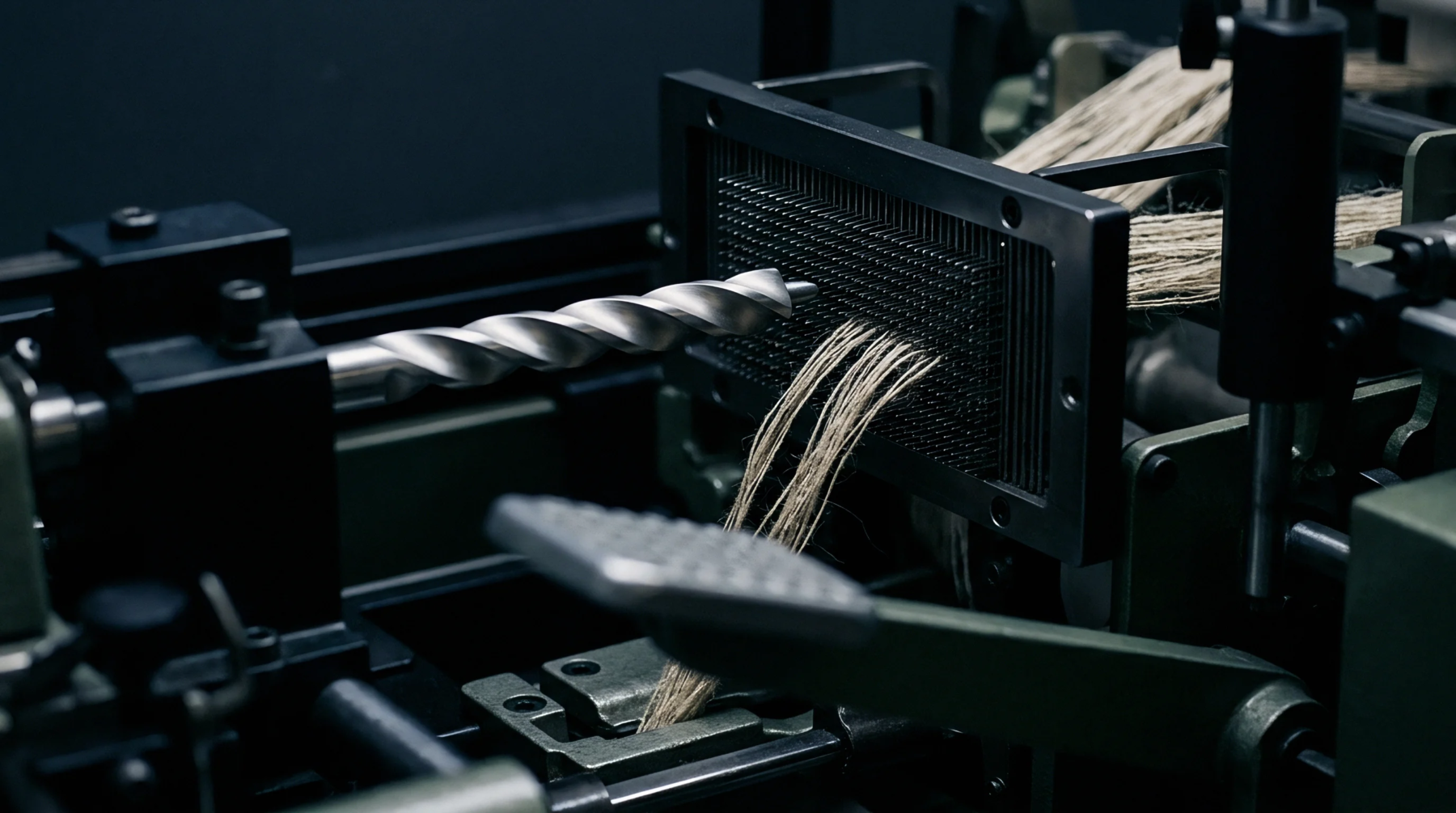
Scutched flax hackling requires progressive pin densities up to 20 pins/cm to maximize sliver tenacity without increasing tow loss or cutting fiber length.

Customs clearance mandates unbroken mass-balance dossiers linking finished flax yardage through spinning and scutching to specific agricultural parcel coordinates.

Reconciling offshore linen weaving discrepancies requires oven-dry mass balance models that strip volatile sizing and ambient moisture from physical scrap ledgers.

Mass balance accounting in offshore linen spinning succeeds only when spinners isolate comber noil and verify dry weight loss at each draw frame stage.

European Flax origin claims require batch-level transaction certificates matching mill mass-balance yields across line hackling and wet spinning stages.

Caustic scouring shifts bast fiber delta 13 C positive by up to 1.8 per mil while process water exchange alters delta 18 O by up to 1.4 per mil.
Scouring shifts linen isotopic ratios through mass loss and water exchange, requiring isolated cellulose testing and process offset vectors for origin audit.

Alkaline scouring strips wax and pectin, enriching delta 13C and shifting delta 18O; origin assays require alpha-cellulose extraction to prevent false rejections.
Expertise is a utility, not a secret. sentiention™ publishes its working knowledge as open reference: intelligence layer covering the materials it sources, the markets it enters, and the reference that serves both.