Multi Isotope Mixing Model Uncertainty in Carded Greige Yarn Processing
Carded greige yarn isotope models require Soxhlet pre-wash to eliminate batching oil shifts and physical card-room audits to constrain Bayesian blend priors.


Endmember
Caen to Amsterdam bounds the oceanic coastal belt where Western Europe concentrates its certified commercial flax. The underlying marine limestones and coastal loess give soils across Normandy, Picardy, and Zeeland bioavailable strontium ratios between 0.7085 and 0.7102, while local surface waters run from minus 4.5 to minus 6.0 per mil in oxygen against Vienna Standard Mean Ocean Water. Farther inland, processing centers in Heilongjiang and Xinjiang sit under continental air masses that push oxygen values below minus 11.0 per mil.
These geographic gradients fix the boundary conditions for origin attribution models.
Like other C3 plants running the Calvin cycle, Linum usitatissimum fractionates carbon to between minus 25.5 and minus 29.5 per mil against Vienna Pee Dee Belemnite. Drought during stem elongation in June constricts stomatal conductance, driving those ratios higher; during dry French harvests, raw scutched flax can enrich by up to 1.8 per mil. Because progressive rainout depletes precipitation isotopes across continental interiors, an attribution database lacking seasonal climate context risks misreading drought-stressed coastal crops as arid inland fiber.
Commercial flax fibers grown under severe coastal drought shift carbon values by 1.8 per mil, mimicking inland arid signatures.
Nitrogen ratios track the soil amendments applied during vegetative growth. Synthetic fertilizers from the Haber-Bosch process register between minus 1.0 and plus 2.0 per mil relative to atmospheric nitrogen, whereas livestock manure pushes vegetative values past plus 8.0 per mil. That spread keeps industrial holdings using synthetic ammonium nitrate clearly separated from smallholder plots dressed with composted manure.
Still, because heavy soils depress strontium mobility, these combined biological and edaphic influences produce overlapping isotopic envelopes that complicate source deconvolution.
Continental Isotopic Gradients across Bast Crops
Cultivation regions fall into discrete isotopic bands governed by latitude, bedrock geology, and distance from the sea. Western European fields show tight oceanic groupings, while Asian continental basins cluster at depleted oxygen and hydrogen values with more radiogenic strontium. Quantitative provenance programs rely on these geographic splits as their baseline.
- Oceanic precipitation bands hold coastal Western European hydrogen values between minus 35 and minus 55 per mil, tempered by maritime humidity.
- Continental temperature gradients pull Eurasian bast fiber oxygen below minus 12 per mil as storms track inland and rain out heavy isotopes.
- Arid irrigation regimes drive up vegetative carbon ratios by forcing stomatal closure under chronic moisture deficits during stem elongation.
- Geological bedrock ages govern bioavailable soil strontium, spanning from 0.7080 in young sedimentary basins to 0.7250 over ancient granitic shields.
Source resolution falters once processors pull raw straw from across different sub-basins. Scutchers regularly blend straw from communes throughout Seine-Maritime and the Somme to meet fiber-length specifications, meaning a finished lot reflects an integrated regional mean rather than a point source. Any model testing raw European fiber has to incorporate that baseline spread, with intra-regional standard deviations reaching 0.4 per mil for carbon and 1.2 per mil for oxygen.

Bioavailable Strontium and Precipitation Signatures
Strontium ratios in flax fiber reflect only the labile pool roots draw from the upper thirty centimeters of soil. Whole-rock digestion misrepresents the growing environment because the hundred-day crop cycle cannot break down silicate-bound strontium; defining the bioavailable endmember requires selective ammonium nitrate or acetic acid leaches.
| Cultivation Region | Carbon (per mil VPDB) | Oxygen (per mil VSMOW) | Hydrogen (per mil VSMOW) | Nitrogen (per mil Air) | Strontium (87Sr/86Sr) |
|---|---|---|---|---|---|
| Normandy (France) | -28.5 to -26.2 | +18.5 to +21.2 | -65 to -48 | +1.8 to +4.5 | 0.7086 to 0.7098 |
| Flanders (Belgium) | -28.2 to -26.0 | +18.8 to +21.5 | -62 to -45 | +2.2 to +5.1 | 0.7089 to 0.7104 |
| Nile Delta (Egypt) | -25.5 to -23.8 | +24.5 to +27.8 | -28 to -12 | +5.5 to +9.2 | 0.7075 to 0.7088 |
| Heilongjiang (China) | -27.8 to -25.5 | +13.2 to +16.5 | -95 to -78 | +2.0 to +4.8 | 0.7112 to 0.7135 |
| Xinjiang (China) | -24.8 to -22.5 | +16.0 to +19.5 | -75 to -55 | +4.2 to +8.5 | 0.7105 to 0.7128 |
Repeated liming also resets topsoil strontium. Marine limestone soil conditioners carry ratios near modern seawater at 0.7092, swamping older radiogenic signatures in weathered soils. In Normandy, a 2018 baseline covering ninety-two reference lots showed a mean strontium ratio of 0.7091 with a standard deviation of 0.0004.
Heavy changes in liming practice or sampling across deep alluvial pockets push values outside those parameters, and it remains unclear how many seasons of fertilizer application it takes to blur the geological distinction between neighbouring European valleys.


Sliver
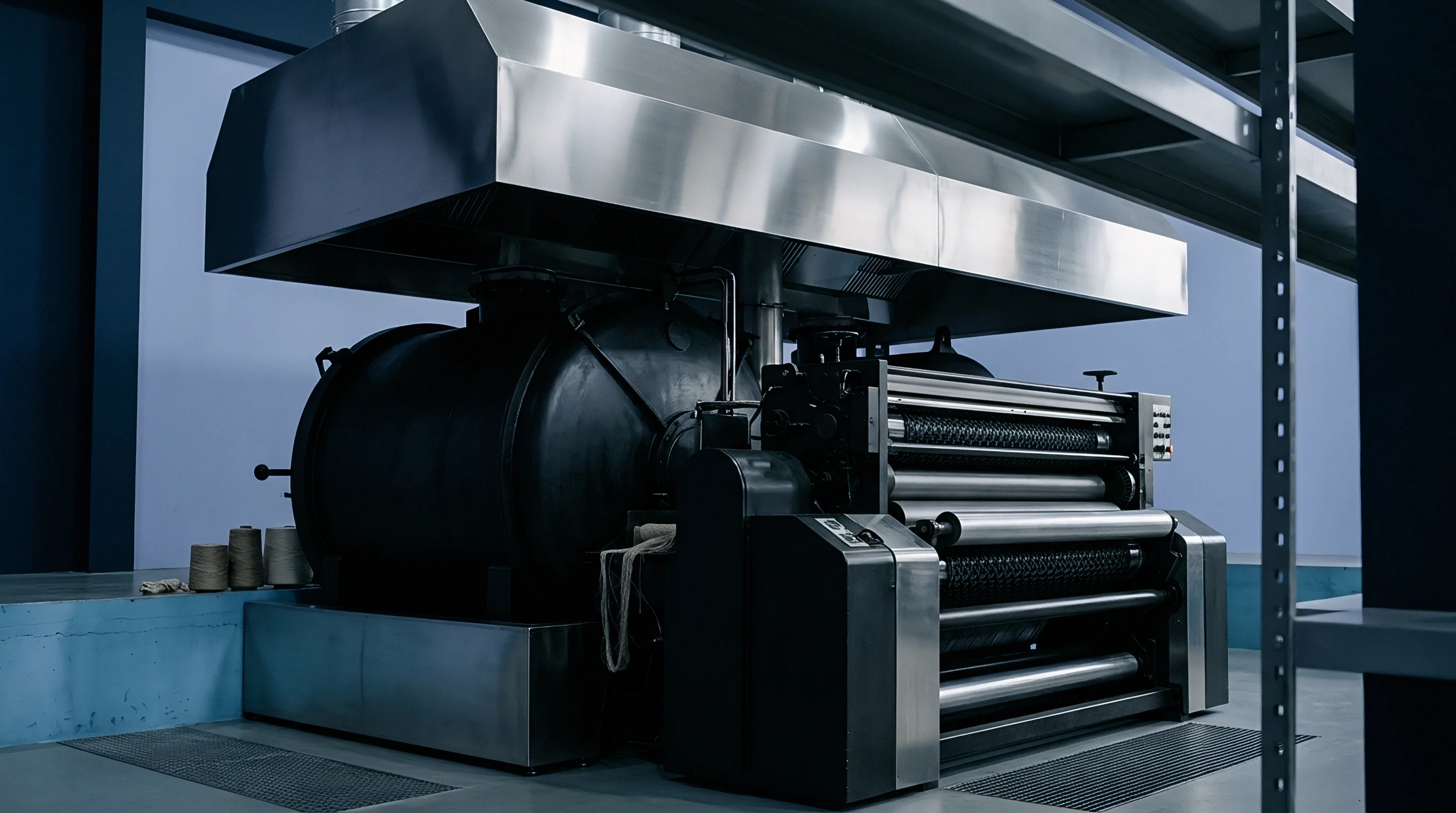
Carding tow carries considerably more shive, epidermal fragments, and cortical tissue than combed line flax. While pure cellulose preserves oxygen ratios, the surrounding primary walls and middle lamellae contain pectins, hemicelluloses, and lignins that fractionate away from the crystalline core. As carding cylinders strip pectins and drop non-cellulosic debris, they systematically alter the bulk isotope profile of the finished sliver relative to the incoming raw tow.
Shive lignin runs 2.0 to 3.5 per mil lighter in carbon than pure bast fiber. Because carding lines aim to cut shive from seven percent in raw scutching tow to below one percent in sliver, removing those woody fragments enriches the sliver’s bulk carbon by 0.3 to 0.6 per mil simply through physical cleaning. Surface waxes similarly skew hydrogen values.
When laboratories compare raw bale samples against carded greige yarn, mechanical cleaning alone creates isotopic differences that can be mistaken for origin blending.

Which Mechanical Fractions Shift Stable Isotope Ratios?
Carding separates fiber bundles while shifting the balance between structural cellulose and non-structural matrix polymers. Waste pulled away by the licker-in, flats, and doffer represents distinct anatomical fractions with divergent chemical makeups.
- Woody core shives concentrate depleted lignin, depressing the carbon signature of card waste relative to the continuing sliver.
- Middle lamella pectins enrich oxygen values during early drafting via carboxyl exchange that occurs during dew retting.
- Cuticular wax films drive down bulk hydrogen values, as plant lipids run up to one hundred per mil depleted in deuterium compared to carbohydrates.
- Cortical parenchyma cells supply higher nitrogen values through cytoplasmic protein fragments carried into unwashed greige waste.
Fiber blending starts at the willow and hopper feeder, where mills commonly mix three to eight lots to stabilize yarn count and tensile strength. If a mill blends seventy percent Normandy tow with thirty percent domestic Chinese tow, the resulting sliver forms an intimate physical assembly of chemically discrete fibers. Because isotope ratio mass spectrometry requires finely milled, homogeneous powders, testing converts that physical mixture into a single averaged reading that conceals the separate origins.
Chemical Contamination from Spinning Lubricants
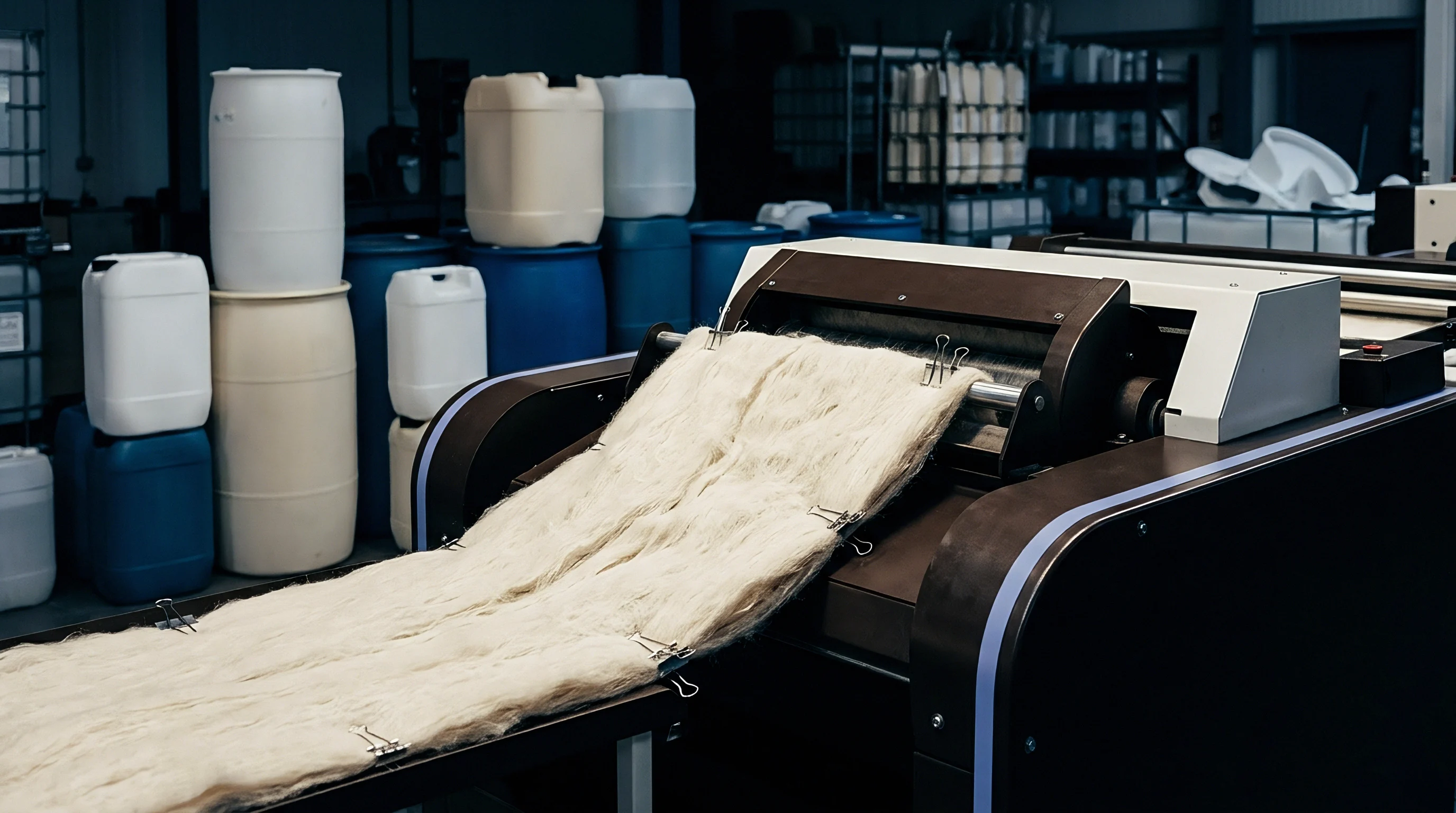
Without processing lubricants, dry flax carding causes severe fiber breakage and uncontrollable static. Mills counteract this with batching emulsions of water, emulsifiers, and petroleum-based mineral oils or synthetic esters applied at 1.0 to 2.5 percent by weight. Fossil-derived mineral oils run light in carbon ~ typically minus 29.0 to minus 32.5 per mil ~ and contain no radiocarbon, while their hydrogen values drop to between minus one hundred and minus one hundred and fifty per mil due to extreme deuterium depletion.
Contamination from two percent unextracted petroleum spinning lubricant shifts bulk fiber carbon values negative by 0.7 per mil.
Lubricants carry straight through ring spinning and winding onto the greige yarn. Testing unwashed yarn produces a composite reading of bast fiber and petrochemical residue. While Soxhlet extraction with dichloromethane or petroleum ether strips these oils alongside surface waxes, leaving as little as 0.3 percent residual lubricant skews carbon by 0.15 per mil and hydrogen by 8.0 per mil.
Without rigorous solvent cleaning, laboratories routinely misclassify oiled European flax as inland continental fiber.
Fiber cannot clear card clothing without continuous emulsion spraying to control static accumulation and limit fly waste generation.


Likelihood
Bayesian mixing models using Dirichlet priors provide the standard framework for deconvolving isotopic mixtures. When presented with five isotope measurements from a carded greige yarn, the model builds a likelihood function comparing those values against baseline distributions for each candidate region. If the number of potential sources exceeds the discriminating isotope dimensions plus one, the system becomes mathematically underdetermined.
Platforms like MixSIAR generate probability distributions over potential source fractions rather than deterministic point estimates. When baseline databases carry wide variance from seasonal weather or divergent farming methods, the posterior envelope broadens and flattens across all candidates. A 50/50 carded blend of French and Chinese fiber can yield an intermediate isotopic signature that the model misreads as a pure, unblended product from an intermediate region such as Egypt or Eastern Europe.

Bayesian Formulations under Nonorthogonal Source Geometries
Resolving origins requires isotopic separation among candidates. When reference regions project onto similar coordinates along one or two analytical axes, mixing models run into non-uniqueness. In a three-isotope space of carbon, oxygen, and hydrogen, French and Belgian profiles overlap so heavily that statistical separation in carded yarns becomes impossible.
Consider a carded greige yarn testing at minus 26.5 per mil for carbon, plus 17.5 per mil for oxygen, and 0.7108 for strontium, evaluated against Western Europe, Inland China, and the Nile Delta. Running Markov Chain Monte Carlo sampling over 100,000 iterations produces posterior probabilities across the Dirichlet space that hinge heavily on how the priors are weighted.
| Model Run Scenario | Assigned Prior Weighting | Solvent Wash State | Western Europe Posterior | Inland China Posterior | Nile Delta Posterior | Credible Interval (95%) |
|---|---|---|---|---|---|---|
| Uninformative Baseline | Equal (1/3 each source) | Complete Soxhlet Wash | 0.42 | 0.48 | 0.10 | 0.28 to 0.68 |
| Trade Flow Informative | Documented Imports (80/20) | Complete Soxhlet Wash | 0.74 | 0.24 | 0.02 | 0.61 to 0.86 |
| Hydrocarbon Artifact | Equal (1/3 each source) | Unwashed (1.5% oil) | 0.18 | 0.76 | 0.06 | 0.58 to 0.92 |
| Constrained Strontium | Geological Priors Applied | Complete Soxhlet Wash | 0.58 | 0.39 | 0.03 | 0.44 to 0.71 |
Uniform, uninformative priors distort source estimates by reflecting geometric distance in isotopic space instead of commercial trade flows. If customs quotas document that a Chinese spinning mill imports eighty percent of its raw flax from France, encoding that reality into an informative prior pulls the posterior median firmly toward Western Europe.

Prior Weighting and Dirichlet Distribution Effects
The concentration parameters chosen for Dirichlet priors dictate how probability density settles near the edges of the solution space. As parameters approach zero, the model favors corner solutions that attribute entire lots to single origins. Setting concentration parameters above five does the reverse, artificially pulling the posterior distribution toward an equal split among all candidates.
A broad posterior distribution reveals overlapping endmember signatures rather than a definitive commercial blend.
A testing laboratory evaluating carded greige yarn must disclose its prior parameters. In one model run on carded tow yarn, an attribution of ninety percent Western European origin carried a ninety-five percent credible interval spanning thirty-five to ninety-eight percent, largely because the reference library was gathered during a single wet harvest year. A dry harvest pushes the European envelope directly into Chinese isotopic territory; under those conditions, a ninety percent median reflects parameter tuning rather than definitive physical proof.
Laboratories working under ISO 17025 publish analytical repeatability figures ~ typically 0.15 per mil for carbon and 0.30 per mil for oxygen ~ which reflect instrument precision rather than mixing model confidence. Total model uncertainty compounds instrument error, baseline endmember variance, residual processing aids, and prior geometry; propagating these factors through simulations pushes the overall uncertainty envelope past twenty-five percent in a three-source blend. The model yields probabilistic bounds once Markov Chain Monte Carlo convergence metrics stabilize.


Reconciliation
Paperwork audits establish the operational reality that isotope testing is meant to verify. An on-site mill audit tracks bale tags, scutching delivery slips, and internal lot logs through the carding room. Scutched tow arrives at the spinning mill in strapped bales with paper lot tags, where runs of thirty to fifty metric tons are assigned an internal batch number linked directly to incoming bale numbers.
Mass balance audits determine whether certified intake tallies with finished yarn shipments. Carding flax tow generates seventeen to twenty-five percent mechanical drop waste in the form of shive, dust, and unspinnable short fibers, while ring spinning and winding add another five to eight percent hard waste. A mill taking in one hundred metric tons of certified European Flax tow should yield between sixty-seven and seventy-eight metric tons of carded greige yarn, provided lots remain physically segregated on the floor.

Whose Baseline Governs Multi Source Allocation?
Proprietary baselines held by private laboratories frequently produce commercial stalemates. If a European laboratory relies on collections from French cooperatives while a Chinese institute references provincial data from Heilongjiang, an importer that orders testing without naming an authoritative dataset will receive contradictory findings on identical cones of greige yarn.
A buyer verifying carded greige yarn provenance executes a structured four-stage site reconciliation protocol.
- Reconcile weighbridge receipts against tags on bales stacked in the raw fiber warehouse, confirming the scutcher names and European Flax certificate numbers.
- Audit daily carding logs to verify that card hopper bins received only the designated lot numbers without off-book fiber additions.
- Calculate mass balances by balancing raw bale intake against card sliver output and weighed drop-waste bins.
- Take composite sliver samples directly at the card doffer before batching emulsion is applied, preserving an untreated baseline archive.
When testing turns up non-European markers, internal mill records determine whether the issue is fraudulent blending or residual processing oil. Mills in China often run uncertified domestic flax for local buyers alongside certified European fiber for export accounts on neighbouring carding lines. Without documented machine cleaning between lots, shared carding clothing and airborne fly easily cross-contaminate adjacent runs.

Transaction Certificates against Physical Spinning Lot Records
Scope certificates merely verify that a mill maintains tracking systems approved under standards like European Flax or the Global Organic Textile Standard; they do not validate individual consignments. Verifying specific shipments requires Transaction Certificates that tie bale lot numbers from seller to buyer, confirming, for example, that sixty metric tons of scutched tow moved under chain-of-custody rules.
Fraud typically involves purchasing Transaction Certificates for a modest volume and blending uncertified local fiber into export orders. On paper, the mass balance holds if the mill sells uncertified yarn into the domestic market without paperwork while assigning the certified credits entirely to export orders. Reconciling weave-shed consumption logs against customs declarations exposes that substitution.
Chain of custody documents establish fiber volume authenticity only when physical carding waste tallies match mill weighbridge declarations.
Bale reconciliations uncover procedural lapses that chemistry alone cannot explain. When greige yarn carries valid paperwork but displays conflicting isotopic ratios, checking previous production runs often clarifies the discrepancy: if the line processed thirty metric tons of uncertified tow immediately before certified fiber without cleaning the machines, mechanical carryover explains the shift. Documentation records what arrived at the warehouse gate, but floor audits determine what entered the draft rollers.


Warranty
Sourcing contracts must translate statistical ambiguity into concrete commercial terms. Certified European Flax carded yarn commands a premium of 1.20 to 2.10 US dollars per kilogram over uncertified Asian or Egyptian yarns. On an eighteen-metric-ton container of Nm 26 carded greige yarn, that premium totals 21,600 to 37,800 US dollars ~ a difference that leads buyers to contractually push testing expenses and detention liabilities onto their suppliers.
Port authorities enforcing trade bans inspect textile shipments upon arrival. Under Withhold Release Orders and the Uyghur Forced Labor Prevention Act, United States Customs and Border Protection detains cargo suspected of containing fiber from prohibited regions, using multi-isotope testing and trace element analysis to audit origin declarations. Testing delays keep shipments in port, accumulating demurrage and bonded warehouse charges while missing retail delivery deadlines.

Contractual Allocation of Isotopic Screening Liabilities
Purchase contracts need to name the governing laboratory, the reference database, and the probability threshold required for lot acceptance. Simply specifying “100 percent European Flax” leaves buyers exposed: if an independent analysis returns an eighty percent probability of European origin and a twenty percent probability of blending, the buyer lacks grounds to reject the consignment without an agreed contractual baseline.
Agreements must stipulate that lots failing agreed Bayesian thresholds are subject to cancellation, with the supplier reimbursing freight, duties, and analytical fees. In return, mills typically insist that testing occur only on solvent-washed fiber before finishing or weaving, requiring contracts to specify the Soxhlet extraction protocol to prevent lubricants from triggering false positives.
| Cost Component | Uncertified Blend (USD) | European Flax Certified (USD) | Dual-Audited Chain (USD) |
|---|---|---|---|
| Raw Fiber Input (13,500 kg tow equivalent) | 37,800 | 54,000 | 54,000 |
| Carding and Spinning Conversion | 22,000 | 22,000 | 23,500 |
| Certification and Transaction Fees | 0 | 1,800 | 1,800 |
| Independent Mill Physical Audit Fee | 0 | 0 | 4,500 |
| Five-Isotope Mass Spectrometry (3 samples) | 0 | 0 | 3,600 |
| Freight and Port Handling | 4,200 | 4,200 | 4,200 |
| Tariff and Customs Entry (6%) | 3,840 | 4,920 | 5,496 |
| Total Landed Cost | 67,840 | 86,920 | 97,096 |
| Landed Cost Per Kilogram | 6.78 | 8.69 | 9.71 |
Supply chains audited through both physical inspections and isotopic testing carry an additional landed cost of 1.02 US dollars per kilogram ~ an operational premium against border detentions and brand liability. On large-scale programs, buyers amortize audit and testing fees across multiple shipping containers.

Landed Cost Arithmetic under Testing and Audit Surcharges
Analytical fees mount rapidly across the screening protocol. Elemental analysis for carbon, nitrogen, and sulfur runs 350 to 500 US dollars per sample. Thermal conversion mass spectrometry for oxygen and hydrogen adds 400 to 600 US dollars, and multi-collector ICP-MS for radiogenic strontium costs another 450 to 700 US dollars, pushing a full five-isotope test to between 1,200 and 1,800 US dollars per sample point.
A documented origin file requires matching isotopic probability thresholds with physical bale-to-spindle mass balance reconciliation.
Under ISO 2859-1, sampling an eighteen-ton lot requires at least three composite specimens drawn from separate spinning frames, bringing testing costs to between 3,600 and 5,400 US dollars per consignment. Sourcing teams manage that overhead with risk-stratified testing, screening initial runs exhaustively before stepping down to random sampling once a mill establishes its compliance record.
Commercial contracts enforce these terms through explicit warranty clauses: The seller warrants that each delivery of carded greige yarn demonstrates an isotopic attribution probability exceeding ninety percent Western European origin when tested in accordance with ISO 17025 accredited multi-isotope protocols following Soxhlet solvent extraction, failing which the seller shall accept return of the shipment at its own expense and refund all advances within ten banking days.