Establishing Origin Criteria for Imported Unspun Flax Fibers
Establishing unspun flax origin requires reconciling scutching mass balances, valid Transaction Certificates, and isotope tests against strict customs rules.


Bales
Cross-border flax fiber verification begins with the weighbridge ticket and the physical tag wired to the bale. When unspun flax under Harmonized System heading 5301 crosses a border, customs origin settles where the primary agricultural work took place, while commercial certification schemes track back to the exact field where the crop was pulled. Importers routinely blur the distinction.
For raw, retted flax straw under subheading 5301.10, non-preferential rules assign origin strictly to the country of harvest. Once the material is processed into scutched flax under subheading 5301.21 or hackled line flax under subheading 5301.29, customs authorities evaluate origin through substantial transformation rules or specific processing lists. Mechanical scutching simply separates the scutched flax and short tow from woody shive.
Both the European Union and the United States treat harvesting and retting as the decisive origin-conferring steps under non-preferential criteria, meaning straw imported into a third country and scutched there still retains the origin of the harvest country.
Commercial provenance programs draw narrower boundaries. The European Flax standard, overseen by the Alliance for European Flax-Linen & Hemp, requires certified fiber to come exclusively from farms in France, Belgium, or the Netherlands. Masters of Linen goes further, requiring every operation from pulling and mechanical scutching through spinning and weaving to remain within European territory, ruling out offshore manufacturing entirely.
A spinning mill in Jiangsu running imported hackled flax under subheading 5301.29 can hold European Flax chain of custody certification, yet that same fiber cannot qualify for Masters of Linen labeling.
Under European non-preferential origin rules, agricultural harvesting establishes raw fiber nationality regardless of offshore hackling location.
Opening bales in a receiving warehouse quickly shows whether the paperwork reflects the shipment. Certified shipments arrive with durable, wire-bound or thermal plastic tags attached directly to the outer strapping of each 200-kilogram bale. These tags record the scutching plant’s registration code, batch identifier, moisture bracket, and certification license number.
An unverified bill of lading declaring French origin cannot stand when the tags show Russian or Belarusian Cyrillic text, or carry generic marks with no lot numbers. Physical audits also weigh strapping allowances, comparing a 1.5 to 2.0 percent wire deduction against total gross mass.

Mechanical Extraction Stages Defining Tariff Classification
Flax fiber exists in multiple physical states, each matching distinct customs and origin criteria:
- Raw or retted flax straw enters under tariff line 5301.10, covering unworked pulled stalks that retain the full woody shive core, demanding pure field-level agricultural origin certification.
- Scutched flax line fiber falls under tariff line 5301.21, representing long stricks obtained through turbine scutching rollers that fracture and strip the outer woody stem tissue.
- Hackled flax line fiber classifies under tariff line 5301.29, identifying scutched bundles combed through graduated steel pins to parallelize long strands and remove residual shive.
- Flax tow and waste falls under tariff line 5301.30, encompassing entangled short fibers separated during mechanical scutching and combing operations.
Each processing step creates another opportunity to blend low-grade, non-certified fiber into the lot. A supplier can introduce secondary domestic tow into genuine imported scutched inventory during blending with little visible change. While the customs broker files entry papers based entirely on commercial invoices, the actual origin trail stays back in the scutching ledger.
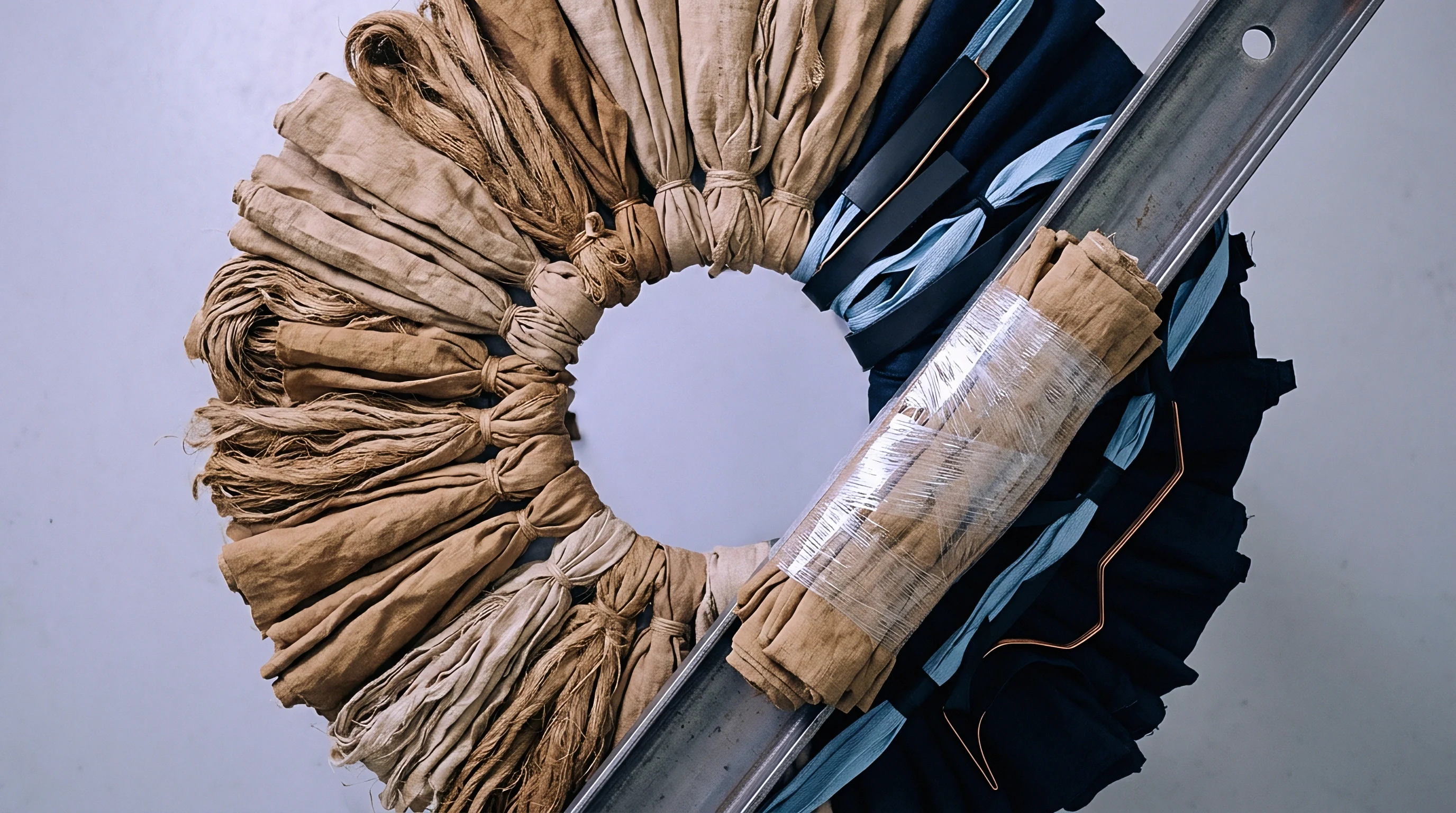
Scutch
Turbine scutching mills are the primary documentary choke point in the supply chain. The line breaks dried straw down into scutched long fiber, tow, and residual shives. Standard mass balances provide reliable baselines: air-dry straw yields 16 to 22 percent scutched long flax, 8 to 12 percent tow, and roughly 50 percent shive, with moisture loss and dust making up the rest.
If a scutching facility reports long fiber recovery exceeding 26 percent on French-grown straw, uncertified local straw has entered the line.
Verifying input volumes requires the physical delivery register from the scutcher. Growers provide weighbridge tickets showing gross straw volume, field parcel codes, harvest year, and moisture levels recorded by calibrated probe. European Flax rules require scutchers to register certified acreage using annual cadastral parcel declarations before field pulling starts, closing the door on retroactive paper trails for straw bought on the spot market.
An auditor must balance the total weight of bales leaving the plant against the incoming harvest receipts, adjusted for mechanical yields.
| Fiber Category | Tariff Heading | Mass Yield Range (Percent Straw Input) | Tensile Tenacity (cN/tex) | Mean Fiber Length (mm) |
|---|---|---|---|---|
| Scutched Long Line | 5301.21 | 16.0 – 22.0 | 50.0 – 68.0 | 600 – 950 |
| Scutching Tow | 5301.30 | 8.0 – 12.0 | 32.0 – 46.0 | 120 – 250 |
| Hackling Tow | 5301.30 | 4.5 – 7.0 | 38.0 – 52.0 | 80 – 180 |
| Hackled Combed Slivers | 5301.29 | 11.0 – 15.0 | 58.0 – 75.0 | 700 – 900 |
The transformation ledger is the central tool for catching volumetric laundering. When an offshore mill imports scutched flax, the original declaration from the scutching cooperative should accompany the bill of lading, noting the harvest campaign year, farm certification numbers, and certified dry lot weight. Hackling separates long bundles into fine stricks and leaves behind secondary hackling tow.
Splitting and recombining these streams gives traders a way to swap documents between certified long line and cheaper short tow, capturing the premium without delivering the fiber.
A scutching yield exceeding twenty-six percent long line fiber signals the addition of off-protocol agricultural biomass into the processing line.
Moisture shifts the mass balance significantly. Standard commercial moisture regain for raw flax fiber is set at 12.0 percent under international rules. Fiber baled at 17 percent humidity adds weight that evaporates during transit, disguising natural loss or intentional short-weighting.
Reliable audits recalculate dry mass for every lot individually.
Processors running high-speed turbine lines rarely document the fiber drift that occurs across adjacent lots.
Ledger
Chain-of-custody documentation relies on two working instruments: the Scope Certificate and the Transaction Certificate. A Scope Certificate confirms that a processing site has the segregation procedures, machinery, and inventory systems needed to manage certified flax. It records the site name, physical address, certification standard, and an expiration date, usually twelve months out.
Crucially, the Scope Certificate does not certify specific outgoing bales or containers; it only establishes that the facility is authorized to trade certified goods.
The Transaction Certificate verifies the shipment itself. Issued by certification bodies like Control Union, Peterson Projects, or Centrocot, it records the seller, buyer, invoice numbers, transport references, net dispatch weights, product classifications, and crop harvest years. An importer must verify that the Transaction Certificate was issued after the dispatch date and that the container numbers match those on the marine bill of lading.
- Validate Scope Certificate validity windows by cross-referencing certifier public directories to ensure the seller held active certification on the exact day physical processing took place.
- Reconcile Transaction Certificate product entries directly against commercial invoices and customs entries to spot unauthorized product description upgrades during transit.
- Inspect transport dispatch records including inland bills of lading, marine sea waybills, and weighbridge slips to prove physical movement occurred between licensed facilities.
- Recalculate volume balance registers by verifying that the facility sold no more certified fiber than it acquired during the accounting quarter.
Clerical mistakes on Transaction Certificates can compromise a shipment’s legal standing. Certifiers frequently modify their internal databases, which creates delays before changes appear in public registries. Gross and net weights demand careful comparison: a sea container showing 22,000 kilograms gross on the transport slip cannot clear customs on a certificate declaring 24,500 kilograms net without triggering a formal discrepancy review by the certifier.
Scheme rules nullify any Transaction Certificate issued after an unannounced certifier inspection uncovers lot segregation breaches.
Mass-balance figures in an import file leave no room for approximation. Inward certified volumes must balance against outward shipments and documented waste. In combing plants, processing loss typically ranges from 3.5 to 5.0 percent.
When mill records claim zero fiber loss across a 50-tonne batch of French flax, the inventory logs have been manually balanced.
Arguments often arise over whether a non-preferential certificate of origin stamped by a local chamber of commerce overrides a private sustainability certificate. Customs agencies view chamber stamps as formal entry paperwork only, retaining full authority to inspect original farm receipts during post-clearance reviews.
In targeted audits, customs examiners follow these verification guidelines down to the underlying commercial records.
Tariff
Import entries require clean alignment between shipping papers and the physical condition of the unspun flax. Heading 5301 classifications depend on how far the raw fiber has been processed, which dictates customs duty rates, trade remedy actions, and quota rules. Misdeclaring hackled line flax under subheading 5301.21 instead of 5301.29 to avoid higher duties risks penalties and port detentions.
Customs inspectors assess fiber alignment and combing quality to confirm the code used.
| HS Code | Commercial Description | Physical Identification Criteria | Substantial Transformation Status | Primary Origin Evidence |
|---|---|---|---|---|
| 5301.10 | Raw or retted flax straw | Intact dried stems, uncrushed shive core, unaligned fiber bundles | Agricultural harvest confers initial nationality | Field parcel records, farm gate delivery receipts |
| 5301.21 | Broken or scutched flax | Flattened, decorticated long bundles, broken shive fragments present | Mechanical extraction leaves harvest origin unchanged | Scutching cooperative weighbridge logs, bale tags |
| 5301.29 | Hackled or combed flax | Parallelized slivers or stricks, shive removed, hackling tow separated | Refining operation does not confer new non-preferential origin | Combing plant production slips, certified batch tags |
| 5301.30 | Flax tow and waste | Entangled short fibers, residual shive core bits, variable lengths | Byproduct processing maintains parent crop nationality | Turbine waste collection reports, mass loss slips |
Substantial transformation tests under United States 19 CFR Part 102 and European Union Union Customs Code Article 60 determine origin whenever processing spans more than one country. Breaking, scutching, and hackling rarely alter customs origin on unspun flax. World Customs Organization guidelines maintain that simple combing or mechanical cleaning does not yield a new commercial article with an altered character, name, or use.
Flax straw pulled in France, shipped to Turkey for scutching, and delivered to the United Kingdom keeps its French origin under non-preferential rules.
Trade defense actions raise the cost of origin errors. Importers facing targeted tariffs often route fiber through third-party countries. Intermediary mills run hackled line flax across secondary combing pins to justify issuing local origin documents.
Verifying an entry dossier requires auditing the continuous bills of lading back to the original growing district.
Comparing container packing slips against the mill’s rated output flags the volume anomalies customs fraud units look for during audits.

Proof
Laboratory testing provides the definitive physical check against documentary manipulation. Certificates of origin record paper declarations, but laboratory tests evaluate the fiber itself. Standard mechanical combing and wet cleaning leave the natural chemical composition and trace isotopes of raw flax unchanged.
Profiling these isotopes reveals the environmental conditions where the straw grew.
Stable isotope ratio mass spectrometry measures hydrogen, oxygen, carbon, and strontium preserved in the plant’s cellulose. Rainfall across Normandy, Picardy, and Flanders produces oxygen-18 and deuterium signatures distinct from water absorbed in the Nile delta, Heilongjiang, or the Volga basin. Strontium-87 to strontium-86 ratios reflect the geological age of the underlying bedrock, giving the fiber a permanent local marker.
If bales enter with European Flax certificates but show strontium ratios typical of geologically younger or non-European soils, the documentation does not match the fiber.
Can Stable Isotope Testing Confirm Flax Cultivation Origins?
Isotope analysis isolates structural cellulose from non-cellulosic impurities before mass spectrometry combustion. The process requires specific analytical benchmarks:
- Stable oxygen isotope ratios define geographic latitude and maritime distance, separating Western European oceanic growth from continental or irrigated crops.
- Carbon-13 isotopic fractionation values verify regional solar radiation and drought stress conditions typical of specific continental microclimates.
- Strontium isotope analysis measures bedrock weathering uptake, directly anchoring raw fibers to ancient sedimentary agricultural basins.
- Trace heavy metal profiles map localized soil mineralogy, revealing characteristic concentrations of zinc, manganese, and barium.
The method depends entirely on reference data. Confirming a sample came from Normandy requires a current database of verified harvest samples across successive crop seasons. Weather swings alter oxygen and hydrogen values between wet and dry summers, so the reference set must account for annual climate shifts to avoid misidentifying drought-stressed crops.
Testing uses about 15 grams of clean, degummed fiber and returns results within five to eight business days.
A batch showing an oxygen-18 deviation exceeding 2.5 parts per thousand from reference European summer rainfall values indicates off-protocol raw fiber origin.
Microscopic analysis complements the isotope work. Polarized light and scanning electron microscopy show lumen diameters, cell wall thickness, and transverse nodes. Unspun flax presents characteristic polygonal cross-sections with narrow lumens.
These visual markers verify botanical species, distinguishing Linum usitatissimum from bast substitutes like hemp, ramie, or jute introduced into the batch.

Exposure
Sourcing unspun flax fiber involves serious financial liabilities. When false origin documents enter the file, commercial and legal exposures compound down the processing chain. A Ningbo spinning mill importing 100 metric tons of hackled fiber on forged French certificates passes that legal liability to every downstream customer buying the resulting yarn, greige fabric, and finished garments.
Consider the exposure on a 100-tonne shipment of hackled flax under subheading 5301.29. Certified European Flax commands an average premium of 1.10 to 1.60 USD per kilogram over non-certified fiber, representing 110,000 to 160,000 USD on a 100-tonne order. If customs authorities reject the origin declaration at the border, the financial fallout goes well beyond the lost certificate premium:
- Customs penalties and back duties range from 20 percent to 100 percent of the dutiable fiber value under civil fraud statutes.
- Demurrage and container holding fees accrue at port terminals at rates between 150 and 300 USD per container day during customs origin investigations.
- Mandatory product recalls and relabeling cost brand buyers upwards of 1.80 USD per garment when goods reach store shelves bearing fraudulent origin claims.
- Inventory devaluation discounts trigger commercial markdowns of 30 to 45 percent when unverified greige goods sell on the open uncertified textile market.
Managing origin exposure in textile purchasing requires assigning non-compliance costs directly to the primary supplier in the contract. Purchase orders should condition payment release on validated Transaction Certificates and satisfactory isotope test results.
Standard indemnity terms stipulate that origin fraud or cancelled certificates invalidate open letters of credit and leave the vendor responsible for all subsequent testing, shipping, and processing losses.