Standard Cantilever Testing and Defect Scoring in Greige Cloth Inspection
Standard cantilever testing and four-point inspection verify greige cloth stiffness and fault densities to enforce contract specifications before finishing.


Rigidity
Bending resistance in unwashed, unfinished loom-state goods dictates both machine pass-through behavior and mechanical deformation during preparation for finishing. When greige flax or cotton emerges from the take-up motion, the cloth carries an applied sizing formulation alongside raw fiber waxes, residual spinning tensions, and structural interlacing friction. Standard cantilever measurements quantify the flexural stiffness of this raw material through the deflection of a strip under its own mass.
Under ASTM D1388 and British Standard BS EN 22313, a standardized specimen slides at a controlled velocity along a horizontal platform toward a polished steel incline angled at 41.5 degrees. The leading edge advances into open space until gravity deflects the tip downward to touch the slope. At that exact geometry, the length of the overhang divides by two to give the precise bending length of the substrate.
Mathematical determination of cloth stiffness relies directly on this overhang value. The fundamental calculation for bending length appears as:
c = O / 2
In this equation, c designates the bending length in centimeters, while O represents the measured length of the specimen overhang reaching the 41.5-degree plane. When the test establishes the bending length, the flexural rigidity translates the geometric value into a mass-weighted physical force:
G = 0.10 × M × c3
Here, G represents the flexural rigidity expressed in milligram-centimeters, M denotes the cloth area mass in grams per square meter determined under ISO 3801, and c represents the bending length in centimeters. For technical purchasers and plant managers, this calculation isolates structural resistance from yarn mass. High-density structures with high pick counts register elevated flexural rigidity independent of raw fiber weight because yarn-on-yarn friction arrests strand rotation at each crossover point.
Warp and take-up tension directly influence how the fabric sags during cantilever testing.
Sizing add-on radically shifts cantilever deflection between loom-state goods and desized base cloths. In industrial linen weaving, sizing recipes often introduce potato starch, carboxymethyl cellulose, or modified polyacrylates to fortify single flax warp yarns against abrasion inside the harness eyes and reed dents. A raw flax warp carrying eight percent size add-on yields cantilever bending lengths between 4.8 and 6.2 centimeters on a plain sheeting construction of 18 ends and 16 picks per centimeter.
The identical construction, stripped of size in an open-width enzymatic wash, yields bending lengths between 2.1 and 2.7 centimeters. The sizing film glues the warp ends to neighboring weft insertion points, freezing the structure into an unyielding planar sheet.
ASTM D1388 test protocol requires five warp and five weft specimens per sample lot conditioned at sixty-five percent relative humidity.
Directional variance across warp and weft directions reveals structural anisotropy within the loom setup. In almost all loom configurations, the warp direction demonstrates higher flexural rigidity than the weft direction. Warp ends experience continuous, cyclical strain under heddle movement and beating impulses, leaving the warp yarn pathways elongated with minimal crimp amplitude.
Weft picks, laid across an open shed under controlled pneumatic or rapier insertion tension, retain substantial undulating crimp as they wrap around the tense warp strands. The higher crimp amplitude and lower processing strain grant the weft higher freedom of deflection, generating shorter overhang lengths on the test incline.
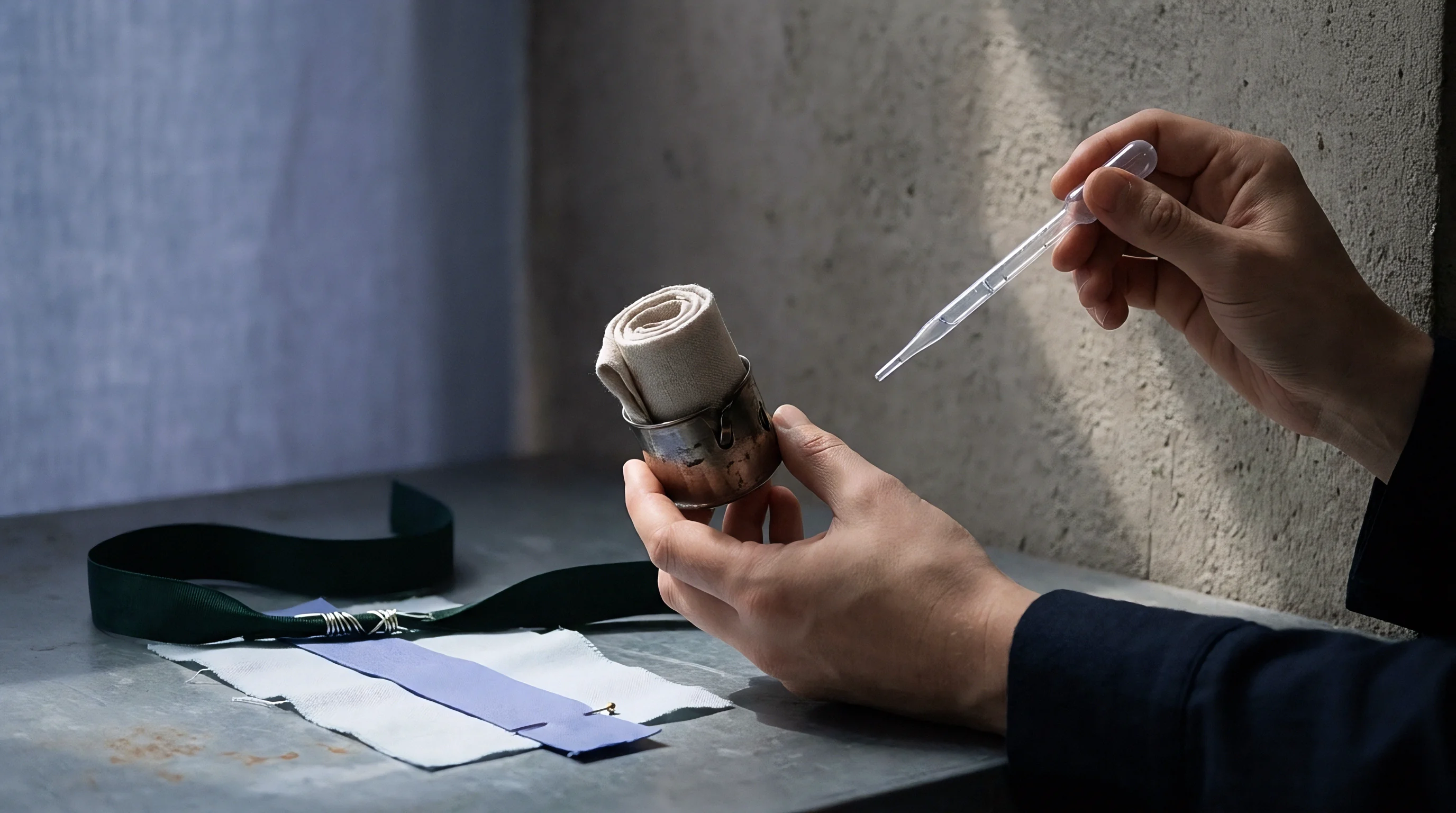
Cantilever Geometry and Mechanics
The selection of the 41.5-degree slope angle rests on exact mathematical derivations published in Shirley Institute mechanical treatises. At an angle of deflection equal to 41.493 degrees, the mathematical function relating overhang length and uniform beam elasticity simplifies so that the bending length equals half of the overhang. The cantilever calculation treats the textile strip as a modified heavy elastic cantilever beam with uniform cross-sectional density.
While flexible textiles experience internal shear and non-linear bending moments under extreme curvature, the initial 41.5-degree deflection stays largely within the linear region of structural deformation.
Testing unwashed cloth directly from the loom winder presents immediate procedural challenges. Loom-state goods display cut-edge curl, temple marks, residual static charges, and loose lint accumulation. If the specimen strip curls along its transverse axis, the resulting cross-sectional curvature creates an artificial structural channel, dramatically raising the moment of inertia.
A curled strip extends significantly farther past the edge before collapsing under gravity, delivering an artificially elevated bending length that misrepresents the actual properties of the yarn binding.
Initial greige flexural stiffness dictates how readily wet finishing agents penetrate the yarn bundle.
Inspectors counter specimen curvature by testing both face-up and face-down orientations for each cut strip. The four standard readings per specimen strip encompass face-up leading-end forward, face-up trailing-end forward, face-down leading-end forward, and face-down trailing-end forward. Averaging these four passes neutralizes edge curl and curl induced by directional yarn twist.
Testing greige flax on the incline isolates the warp sizing contribution from the raw fiber modulus.
ASTM D1388 Section 9 mandates that the buyer contractually record whether the bending length represents individual direction components or the overall flexural rigidity calculated as the geometric mean of the two axes.
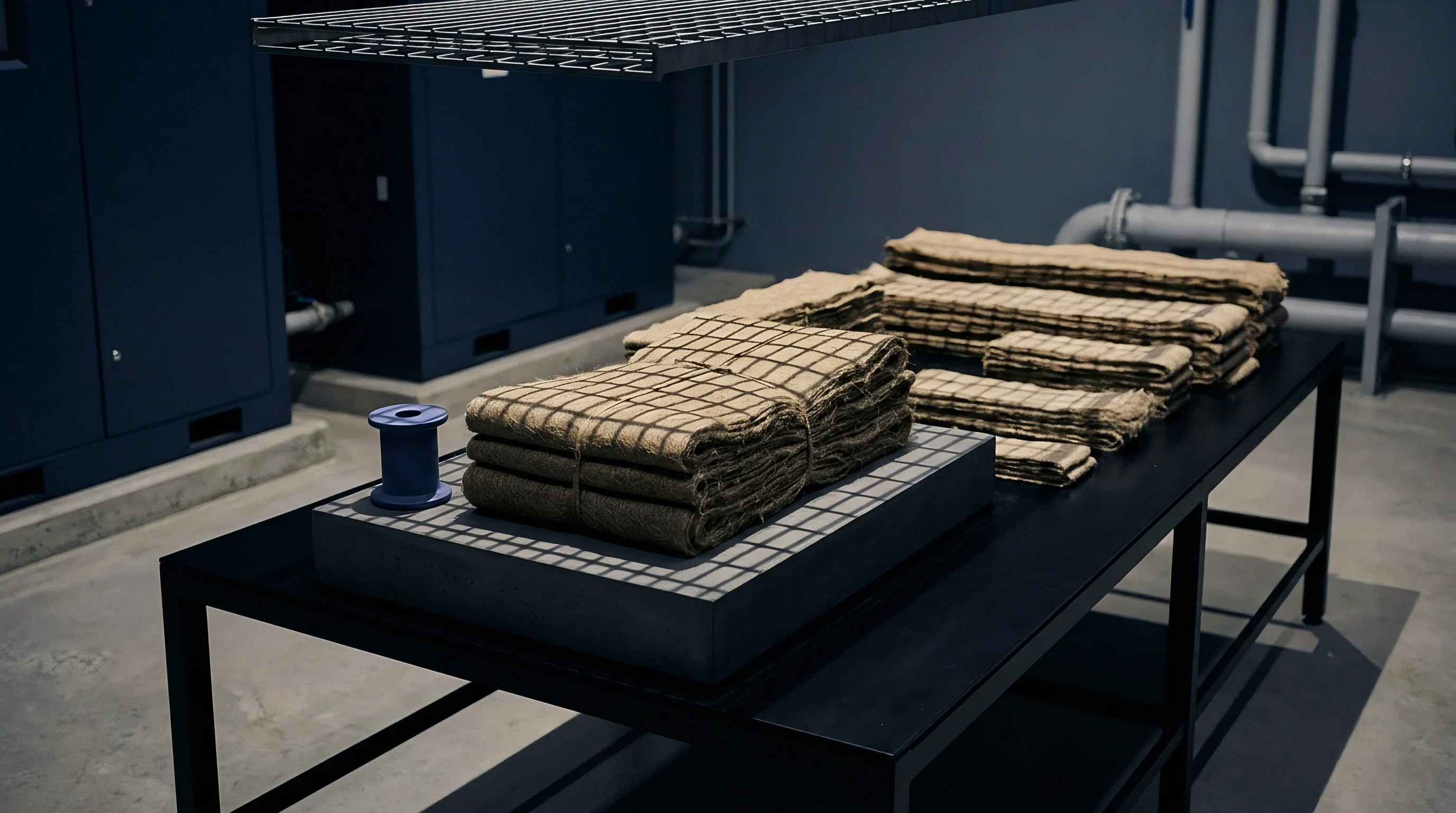
Bench
Physical preparation of cantilever specimens demands strict atmospheric control and sharp cutting dies. Testing greige textiles without rigorous preconditioning produces wild swings in flexural values. Flax, hemp, and carded cotton yarns are hydrophilic lignocellulosic structures whose moisture regain shifts continuously based on ambient dry-bulb temperature and relative humidity.
In dry environments, natural fibers turn brittle and unyielding, registering artificially inflated bending resistance. In humid air exceeding seventy percent saturation, absorbed water molecules plasticize the hydrogen bonds within the amorphous zones of cellulose, softening the yarn and shortening the recorded overhang length.
Standard testing environments follow ISO 139 specifications, maintained rigidly at 20.0 ± 2.0 degrees Celsius and 65.0 ± 4.0 percent relative humidity. For dispute arbitrations or baseline qualification runs, laboratories condition greige swatches for a minimum of twenty-four hours in conditioned flow racks prior to cutting. Strips excised directly from warm cloth rolls taken off the loom take-up winder retain process heat and compressed moisture profiles that invalidate comparison against certified specification sheets.
Precision cutting ensures the test strip maintains uniform dimensions along its entire length.
Specimen preparation requires dedicated steel rule dies or automated rotary specimen cutters to generate strips measuring precisely 25.0 millimeters wide by 200.0 millimeters long. Hand-cutting with shears along drawn pencil lines introduces edge fraying and micro-tears along outer warp yarns. A single severed outer warp yarn dangling from the specimen edge catches on the sliding carriage or drags across the platform edge, generating mechanical drag that halts the advance prematurely.
The die must punch clean edges through the greige material, severing all yarns without pulling fibers out of the cross-thread matrix.
Technicians cut five longitudinal specimens parallel to the warp direction and five transverse specimens parallel to the weft direction. No two test strips may contain the same warp ends or weft picks to eliminate localized sizing inconsistencies or tension lanes from the statistical sample. Cut specimens must sit at least one-tenth of the overall cloth width away from the selvage.
Edge zones experience intense lateral pull from loom temples, introducing skewed yarn alignments and abnormal crimp ratios that misrepresent the central cloth body.
Slide velocity introduces another physical variable on the testing apparatus. Manual pushing of the movable slide carriage invites operator bias. Rapid pushing gives the extending strip forward kinetic momentum, causing the specimen to sag downward prematurely under dynamic acceleration.
Overly hesitant or jerky advance allows ambient airflow or electrostatic attraction to deflect the tip toward the metal slope before reaching true equilibrium overhang. Motorized slide assemblies advancing at a verified uniform speed of 120 millimeters per minute eliminate manual inconsistency and provide repeatable, operator-independent deflection readings.
Bias-angle testing presents specialized diagnostic utility for technical weaves and heavy twills. While standard compliance testing measures warp and weft axes, cutting specimens at a 45-degree bias angle reveals the internal shear modulus of the interlaced matrix. In a balanced plain construction, bias bending lengths fall significantly below orthogonal measurements because the yarns rotate at their intersection nodes rather than bending along their individual fiber axes.
If a greige cloth shows high orthogonal bending lengths alongside exceptionally low bias stiffness, the finished goods will drape smoothly around compound contours while resisting longitudinal stretching during wet processing.
| Conditioning Environment | Mean Warp Overhang (cm) | Mean Warp Bending Length (cm) | Calculated Flexural Rigidity (mg-cm) | Observed Specimen Curl |
|---|---|---|---|---|
| Bone Dry (105°C Oven Desiccated) | 12.80 | 6.40 | 5635.8 | Severe longitudinal curl |
| Dry Ambient (22°C, 35% RH) | 11.10 | 5.55 | 3672.4 | Moderate edge lift |
| Standard Atmosphere (20°C, 65% RH) | 9.60 | 4.80 | 2377.7 | Planar flat |
| High Humidity (24°C, 85% RH) | 8.10 | 4.05 | 1428.6 | Downward edge droop |
| Wet Saturated (Immersion Blotting) | 5.40 | 2.70 | 423.1 | Complete plastic collapse |
The physical carriage plate resting on top of the specimen requires regular calibration. The sliding weight must exert sufficient down-force to keep the cloth strip planar against the steel stage without compressing the natural thickness of the textile. Heavy steel carriage weights distort loose or lofty structures, squashing the interlacing points and artificially stiffening the extending tongue.
Polished brass or low-friction acrylic carriages weighted to 270 grams deliver the uniform downward force specified across international test protocols. Dry winter conditions in the weaving shed can induce temporary sizing crystallization, accounting for elevated stiffness values reported at receiving.

Scoring
Systematic quantification of surface imperfections across running rolls separates commercially acceptable greige yardage from substandard yardage heading toward credit claims or rejection. The textile industry relies overwhelmingly on the standard four-point grading methodology codified in ASTM D5430. This system assigns penalty points to visual defects based strictly on their physical dimensions along the linear axis or across the cloth width.
Unlike older ten-point frameworks or subjective penalty systems, the four-point system operates on an objective, dimensional tier that leaves no room for arbitrary interpretation by mill inspectors or receiving auditors.
Points allocate according to strict size parameters:
- Single-point penalties apply to localized defects possessing a maximum length or width of three inches or less in any dimension.
- Two-point penalties encompass defects measuring greater than three inches up to and including six inches in length or width.
- Three-point penalties penalize imperfections extending past six inches up to and including nine inches in physical dimension.
- Four-point penalties assign to any individual defect exceeding nine inches in length or width, as well as any through-hole or severed structural strand regardless of its size.
Inspectors score defects across the entire usable width of the cloth web, excluding the selvages unless the selvage defect distorts the body of the material. No single linear yard of cloth can accumulate more than four penalty points, regardless of the quantity or variety of defects occurring within that thirty-six-inch increment. If a yard of greige linen displays three small slubs measuring two inches each alongside a four-inch filling bar, the calculated points would sum to seven under raw counting.
The four-point saturation rule caps the penalty for that specific linear yard at four points. This ceiling prevents a localized cluster of minor defects from distorting the statistical score of an entire five-hundred-meter master roll.
Normalized penalty totals determine final invoice adjustments and quality adjustments.
Converting raw penalty point tallies into a normalized metric allows direct comparison across rolls of varying widths and running lengths. The internationally accepted formula calculates total defect points per one hundred square yards:
Points per 100 yd2 = (Total Points Scored × 3600) / (Inspected Linear Yards × Cloth Width in Inches)
For operations functioning entirely in the metric system under ISO standards, the equivalent formula calculates penalty points per one hundred square meters:
Points per 100 m2 = (Total Points Scored × 10,000) / (Inspected Linear Meters × Usable Cloth Width in Centimeters)
Accurate defect tallying requires assessing every observable flaw across the full width of the roll.
On the inspection perch, auditors measure width between outer pin marks rather than untrimmed fringe. The width figure plugged into the denominator must reflect usable cloth width rather than gross width between extreme selvage fringes. If a rapier loom runs a flax warp drawn to 160 centimeters in the reed, yielding 154 centimeters gross width at the take-up roll with 3 centimeters of auxiliary leno selvage on each edge, the denominator uses 148 centimeters.
Using the unclipped gross width artificially inflates the square yardage denominator, depressing the resulting defect score to pass borderline shipments.
| Linear Yard Range | Defect Description | Physical Size (Inches) | Raw Points | Applied Points (Max 4/yd) | Cumulative Roll Points |
|---|---|---|---|---|---|
| Yards 012 – 013 | Coarse slub in weft | 2.5 | 1 | 1 | 1 |
| Yards 045 – 046 | Broken warp end, tied knot | 1.0 | 1 | 1 | 2 |
| Yards 089 – 090 | Dense starting mark across web | 52.0 | 4 | 4 | 6 |
| Yards 114 – 115 | Oil splash from rapier gearbox | 7.5 | 3 | 3 | 9 |
| Yards 156 – 157 | Two small slubs and one pick repair | 2.0, 2.0, 1.5 | 3 | 3 | 12 |
| Yards 201 – 202 | Heavy filling bar, thin pick band | 48.0, 48.0 | 4, 4 | 4 | 16 |
| Yards 267 – 268 | Pin hole from temple ring slip | 0.25 (Through-hole) | 4 | 4 | 20 |
| Yards 342 – 343 | Warp streak from tight heddle | 36.0 linear | 4 | 4 | 24 |
| Yards 410 – 411 | Knot with loose fiber tail | 1.5 | 1 | 1 | 25 |
| Yards 485 – 486 | Mispick run across shed | 58.0 | 4 | 4 | 29 |
| Final Calculated Defect Score: (29 points × 3600) / (500 yards × 58 inches) = 3.60 points per 100 square yards. Quality Level: Grade A. | |||||
Acceptance thresholds vary across raw materials and yarn classifications. Premium continuous filament synthetics and combed ring-spun cottons run under tight tolerances, typically capping first-quality acceptance at 15 to 20 points per 100 square yards. Conversely, unbleached, wet-spun greige flax represents a natural bast fiber characterized by inherent cross-sectional variations, node irregularities, and unavoidable woody shive particles.
Standard commercial settlement schedules often specify a twenty-eight point threshold per hundred square yards for high-density flax plain goods.
A worked comparative calculation clarifies the threshold boundary. Consider a shipment of 10,000 linear meters of plain greige linen measuring 150 centimeters usable width. The receiving warehouse inspects a representative ten percent sample, pulling two full rolls totaling 1,000 linear meters.
During manual perch inspection, the auditor identifies the following defect tally across the two sample rolls:
- Minor slubs and knots totaling 112 instances under three inches, contributing 112 single penalty points.
- Medium filling imperfections totaling 42 instances between three and six inches, generating 84 points.
- Long warp striping and heavy slubs totaling 18 instances between six and nine inches, contributing 54 points.
- Full-width starting marks and mispicks totaling 26 instances exceeding nine inches, generating 104 points.
Adding the raw point values yields 354 points. When examining the inspection logs, sixteen instances occurred in the same linear yards as other defects, removing 22 duplicate points under the four-point-per-yard saturation cap. The net applied points equal 332 points across the 1,000 inspected meters.
Applying the metric formula:
Points per 100 m2 = (332 × 10,000) / (1,000 × 150) = 22.13 points per 100 m2
Because the result sits comfortably beneath the contract ceiling of 28.0 points per 100 square meters, the auditor signs off on lot acceptance. If the mill had allowed oil spatter from unshielded rapier drive gears to contaminate several yards along the center line, an additional twenty full-width four-point marks would add 80 points to the tally. The score would surge to 27.46 points per 100 square meters, hovering at the failure edge and triggering mandatory inspection of another twenty percent of the delivered lot.
Continuous defect scoring governs running flaws that extend over multiple yards. A tight warp end caused by a stuck drop wire or an over-tensioned spool creates an unyielding longitudinal ridge that can run for thirty consecutive meters. In the four-point system, such a continuous defect earns four penalty points for every single linear yard it contaminates.
A continuous ridge extending thirty yards collects 120 points on its own. Furthermore, major industrial buying contracts include a critical single-defect termination clause: any individual continuous defect running longer than three unbroken yards results in the immediate, non-negotiable rejection of that entire individual roll, regardless of whether the mathematical points-per-hundred-square-yards calculation falls below the commercial threshold.
The speed of the inspection frame drastically affects point collection reliability. An inspector viewing greige goods advancing at sixty meters per minute misses short filling bars and faint reed lines that become glaringly visible once dyed. Standard perch inspection protocols mandate a maximum cloth speed of fifteen meters per minute under calibrated, high-intensity surface illumination delivering at least 1000 lux across the inspection plane.
Lighting must hit the moving textile from both direct overhead fixtures and low-angle back-lit inspection panels. Back-lighting reveals reed marks, thin places, misdraws, and missing warp ends with absolute clarity, while overhead lighting exposes oil drops, scuffs, surface contamination, and loose knots.
Allowing defective yardage to pass the greige inspection perch results in massive financial liabilities downstream when wet processing, continuous scouring, and reactive piece dyeing amplify mechanical yarn flaws into irreversible visual rejections across finished apparel bolts.
Slub
Loom-state textiles display an extensive variety of structural, mechanical, and yarn-related defects that must be isolated back to their root causes on the weaving machine. Bast fiber yarns, particularly wet-spun flax, present intrinsic irregularities that complicate the boundary between normal fiber character and actionable yarn faults. A true slub forms during spinning when fibers fail to draft smoothly through the drawing rollers, creating an abnormally thick, soft, low-twist yarn segment.
If this swollen mass enters the weaving shed, it can catch inside the drop wires, wedge between heddle eyes, or drag across adjacent warp ends, causing loom stops or severe shear deformation.
Warp beam tension discrepancies manifest immediately as visible cloth irregularities.
Structural faults generate immediate operational friction on high-speed weaving machines. Starting marks represent the most prevalent machine-induced defect in modern automated sheds. When a loom halts due to a weft break or warp failure, the tension distribution across the cloth changes instantly.
The running tension exerted by the take-up motion relaxes slightly, while the warp ends held under high tension creep and stretch between the back rest and the fell of the cloth. Upon restart, if the computerized loom control fails to adjust the take-up position by fractions of a millimeter to compensate for mechanical relaxation, the first beat-up stroke lands out of place.
Unplanned machine halts leave physical pick-density distortions across the weave.
A starting mark manifests either as a dense, dark transverse stripe where picks pile on top of each other, or as an open, translucent band where picks sit too far apart. Both variations count as major structural faults. In a 240 centimeter wide sheet, a dense starting mark extends from selvage to selvage, immediately taking the maximum four-point penalty under ASTM D5430.
If an older loom experiences ten stops per hour due to brittle warp yarns, the resulting roll becomes entirely unmarketable due to starting mark penalties alone.
ASTM D5430 establishes that four penalty points must be applied to every linear yard containing a through-hole or open tear.
Reed marks represent another chronic greige defect born from mechanical misalignment. A modern profile reed consists of precision-spaced flat steel wires brazed into top and bottom balks. If a heavy knot or an aggressive shuttle or rapier guide strikes a reed wire, the metal blade deflects out of true perpendicular alignment.
The open space between adjacent reed wires widens on one side and constricts on the other. Warp ends passing through the damaged dent spread apart, leaving a permanent longitudinal streak of low pick density down the entire length of the warp beam.
Damaged reed wires create persistent longitudinal streaks that persist through finishing.
Greige inspection frames must distinguish between temporary harness crowding and permanent reed marks. Washing and scour relaxation can close mild reed marks in loose plain cloths, but dense structural twills and poplins lock the displaced warp pathways permanently in place. An inspector spots a true reed mark by taking a pick glass and counting ends per centimeter at the streak; if the count remains correct while the spatial gap between yarns widens, a bent reed blade generated the fault.
- Filling bars result from count variations in weft yarn packages, tension imbalances on weft accumulators, or mismatched bobbin changes on rapier feeds.
- Mispicks and broken picks manifest when an inserted weft yarn breaks midway across the shed, leaving a partial pick that terminates awkwardly inside the body of the textile.
- Warp floats occur when a warp end fails to lift or lower into the proper shed geometry, allowing the weft yarn to pass over a bundle of threads without standard interlacing.
- Drop wires and pin marks appear as continuous tiny perforations or localized scuffs along selvages where mechanical temple rings slip under excessive warp take-up tension.
Oil contamination constitutes an immediate four-point defect whenever hydraulic lubricant, gear grease, or overhead blower oil drips onto the unwashed goods. Mineral oils and synthetic lubricants containing metallic wear particles chemically bind to natural flax and cotton waxes. While standard enzymatic desizing and scouring wash away water-soluble starch sizes, industrial gearbox oils resist basic scouring baths.
The contaminated patch blocks the penetration of dyestuffs in downstream wet processing, leaving glaring white or pale splotches across finished goods. If an inspector identifies recurring oil drops at regular linear intervals along the roll edge, the loom must halt instantly to replace worn seals on the rapier head drives.
A systematic operational checklist guides the perch auditor through defect identification:
- Selvage inspection verifies that edge fringes are trimmed evenly, leno binding catches all picks, and temple pins do not tear the ground structure.
- Surface scanning under direct light flags visible slubs, knots, foreign fibers, and oil drips across the face of the moving web.
- Transverse inspection under back-lighting locates starting marks, light picks, heavy filling bars, and uneven pick-density banding.
- Longitudinal inspection under back-lighting traces misdraws, missing warp ends, double ends, and continuous reed lines.
- Defect measurement and logging applies calibrated measuring rules to determine exact defect dimensions for four-point tally assignment.
Yarn knots inside greige goods present severe snags for downstream processing. When a warp end breaks on the loom, the weaver manually ties the broken end using a weaver’s knot or joins it using an air splicer. A mechanical knot creates a localized lump three to four times the nominal yarn diameter.
If the knot tails remain long, they become trapped within the shed, creating secondary mispicks or tangling into adjacent warp ends. Modern high-efficiency sheds replace manual knots with pneumatic yarn splicers, joining broken ends through fiber entangling without knots, preserving uniform cross-sectional diameter across the entire warp web.
Maintaining clean warp sheds prevents yarn entanglements and minimizes scoring penalties.
Ledger
Translating defect scores and cantilever stiffness into balance-sheet settlements forms the commercial bedrock of greige textile procurement. Greige cloth transactions operate on razor-thin operating margins where minor quality shortfalls destroy profitability. Mill contracts establish strict performance bands, linking physical inspection results directly to payment terms, price debits, or outright rejection of entire production runs.
When an inspected lot crosses the contractual point threshold, the purchasing company executes commercial remedies defined in the master supply agreement.
Commercial grading partitions delivered lots into defined quality tiers based on the calculated points per one hundred square yards or square meters. Standard industrial classification divides goods into three distinct categories:
First Quality (Grade A) encompasses all rolls scoring below the baseline contract threshold, typically set between 20 and 28 points per 100 square yards for natural bast and coarse cotton textiles. Grade A yardage pays the full contract invoice price without deduction. Second Quality (Grade B) incorporates rolls scoring between the Grade A ceiling and an upper allowable limit, usually pegged at 40 points per 100 square yards.
Grade B goods pass into commercial cutting only after receiving an automatic, contractual price deduction ranging between 15 and 30 percent of the gross meter price. Any roll exceeding the 40-point ceiling is designated as Substandard (Grade C), requiring immediate replacement or full credit return at the mill’s expense.
Invoiced yardage is adjusted downward to account for major localized flaws.
Yardage allowance clauses protect buyers against unusable material hidden within otherwise acceptable rolls. Master contracts stipulate that every individual four-point defect automatically credits the buyer with one full linear yard of material on the commercial invoice. If a 500-yard roll contains twelve localized four-point defects such as heavy starting marks or through-holes, the mill invoices only 488 linear yards, despite delivering 500 physical yards on the cardboard tube.
This allowance covers the material waste the apparel cutting room encounters when spreading cloth, since the automated cutting head must skip around the marked four-point defects.
Demerit point escalation clauses penalize continuous poor performance across successive delivery cycles. If three consecutive monthly shipments deliver point averages above 24 points per 100 square yards, even while technically slipping under the 28-point rejection ceiling, the contract grants the buyer the unilateral right to cancel all remaining forward loom bookings without penalty. This mechanism protects the buyer from being flooded with borderline second-quality goods that degrade manufacturing efficiency on cutting and sewing lines.
The financial arithmetic of greige settlement governs mill behavior directly. Consider an industrial order for 50,000 meters of 100% greige linen woven on 220-centimeter rapier looms at a contract price of $4.85 per linear meter. The production run consumes approximately 415 loom hours across twelve machines operating at 88 percent efficiency.
Upon delivery, the receiving warehouse inspects a 5,000-meter sample across ten master rolls. The four-point inspection log reveals an average score of 34.2 points per 100 square meters, exceeding the 25.0 point ceiling established for Grade A material, but landing below the 40.0 point Grade C scrap limit.
The contract stipulates an automatic twenty percent price deduction on all yardage qualifying only as Grade B, alongside full yardage allowances for every four-point flaw. With 140 individual four-point defects logged across the sample and scaled across the shipment, 1,400 meters convert to free allowance yardage. The net invoice settles as follows:
Net Billable Meters = 50,000 Total Meters – 1,400 Allowance Meters = 48,600 Meters
Base Invoice Amount = 48,600 Meters × $4.85 = $235,710.00
Grade B Penalty Deduction = $235,710.00 × 0.20 = $47,142.00
Final Settled Invoice = $188,568.00
Yarn defects reduce weaving efficiency and increase commercial penalty debits.
The mill forfeits $53,932.00 from the anticipated top-line revenue of $242,500.00. That penalty erases the mill’s operating margin, converting the loom booking into a substantial net cash loss. For this reason, mill superintendents vigorously defend greige inspection perch logs, frequently questioning the dimensional measurements recorded by the buyer’s quality auditors.
Cantilever stiffness thresholds tie directly into finishing charge-backs. If a greige cloth arrives with excessive flexural rigidity caused by over-sizing or unapproved tallow additives, the buyer’s finishing house incurs steep cost overruns. The dyer must run multiple open-width desizing passes and apply aggressive surfactant baths to strip the unyielding sizing compounds before dyeing.
When cantilever testing under ASTM D1388 demonstrates that greige flexural rigidity exceeds the specification sheet by more than twenty-five percent, standard purchasing terms shift the cost of supplementary scouring chemicals and extra range hours directly to the weaving mill via invoice debit notes.
Tracking flexural variance prevents processing failures during subsequent finishing runs.
Laboratory arbitration procedures handle contested test values between buyers and mills. If the buyer’s incoming inspection rejects a lot for high defect tallies or elevated stiffness while the mill’s internal certificates show Grade A compliance, an independent accredited textile laboratory pulls sealed reference rolls from the disputed lot. The laboratory’s findings serve as binding arbitration.
The losing party pays all testing fees, freight charges, and warehouse storage costs incurred during the dispute window.
Whether automated optical inspection cameras mounted on running looms can completely displace human perch inspectors while maintaining legal defensibility in commercial arbitration remains an unresolved question across the international textile trade.