Quantifying Microstructural Defect Accumulation during High Speed Mechanical Scutching and Hackling Operations
High-speed mechanical scutching and hackling induce cell wall dislocations in flax bast fibers, directly degrading yarn tenacity and fine-count spinning yield.
Kink
Flax bast fiber bundles experience heavy mechanical impact as raw retted straw enters high-speed scutching turbines. Decortication uses fluted breaker rollers alongside turbine rotors equipped with steel or wooden blades running between 180 and 320 revolutions per minute. Mechanical beaters strike the raw stems to fracture the woody core (shive) into short fragments and separate the bast bundles from inner core tissues.
Bending loads on the outer fibrous sheath easily exceed the elastic limit of individual elementary fiber cell walls, establishing strain fields well before the shive breaks free.
Elementary flax fibers consist of a primary cell wall, a thin secondary S1 layer, and a thick secondary S2 layer that accounts for roughly 85 percent of the total cell wall cross section. Highly crystalline cellulose microfibrils in the S2 layer spiral at an angle of 8 to 11 degrees relative to the longitudinal fiber axis, embedded in an amorphous matrix of hemicellulose and pectin. When scutching beaters deliver high-velocity transverse strikes, shear bands develop along the cell walls, causing microfibrils on the inner arc to buckle under localized axial compression.
These impacts disrupt the crystalline lattice and leave micro-compression folds ~ termed cell wall dislocations or knee joints in textile physics.
Turbine rotor velocity dictates the energy transferred with each blade strike. As mills raise rotor speeds to maximize throughput, the rate of mechanical energy delivered per unit mass of fiber scales up sharply. Above 240 revolutions per minute, breaker flutes subject the straw to rapid cyclic flexure.
Rather than remaining isolated anomalies, micro-compression folds collect in dense bands along the fiber shaft. Elementary fibers develop structural defect zones spaced under 50 micrometers apart, marking regions where hydrogen bonding networks across adjacent cellulose chains suffer severe lattice strain or complete cleavage.
Scutcher turbine speeds exceeding 240 revolutions per minute increase dislocation node density in elementary fibers by 38 percent at 12 percent relative moisture.
Fiber moisture during decortication governs cell wall matrix mechanics. Below 10 percent moisture, hemicellulose and pectin matrices lock into a rigid, glassy state. Transverse blade impacts on dry straw cause brittle micro-fractures through the S2 layer, creating micro-cracks alongside standard compression kinks.
Processing straw above 14 percent relative fiber moisture plasticizes the matrix, allowing microfibrils greater lateral freedom. While this plasticization limits catastrophic transverse cracking, it facilitates microfibril slippage, raising total dislocation node density across the S2 layer. Auditors trace batch delivery notes back to the scutcher weighbridge to confirm moisture history before assessing damage metrics.
Cell wall dislocations accumulate through non-linear damage propagation. Initial impacts from breaker rollers create primary dislocation sites at natural weak points like growth nodes and cell wall pits. Subsequent strikes from high-speed turbine blades concentrate strain directly into these pre-existing dislocations.
Decortication beaters widen existing dislocation zones rather than spreading mechanical work evenly along the fiber shaft, turning narrow kinks into broad micro-fracture bands. Microfibril orientation within these bands can deviate up to 30 degrees from the longitudinal axis, permanently misaligning the bundle’s primary load-bearing elements.
Internal crystalline disruptions of this type are often mistaken for natural growth nodes formed by field wind stress during crop growth.

Comb
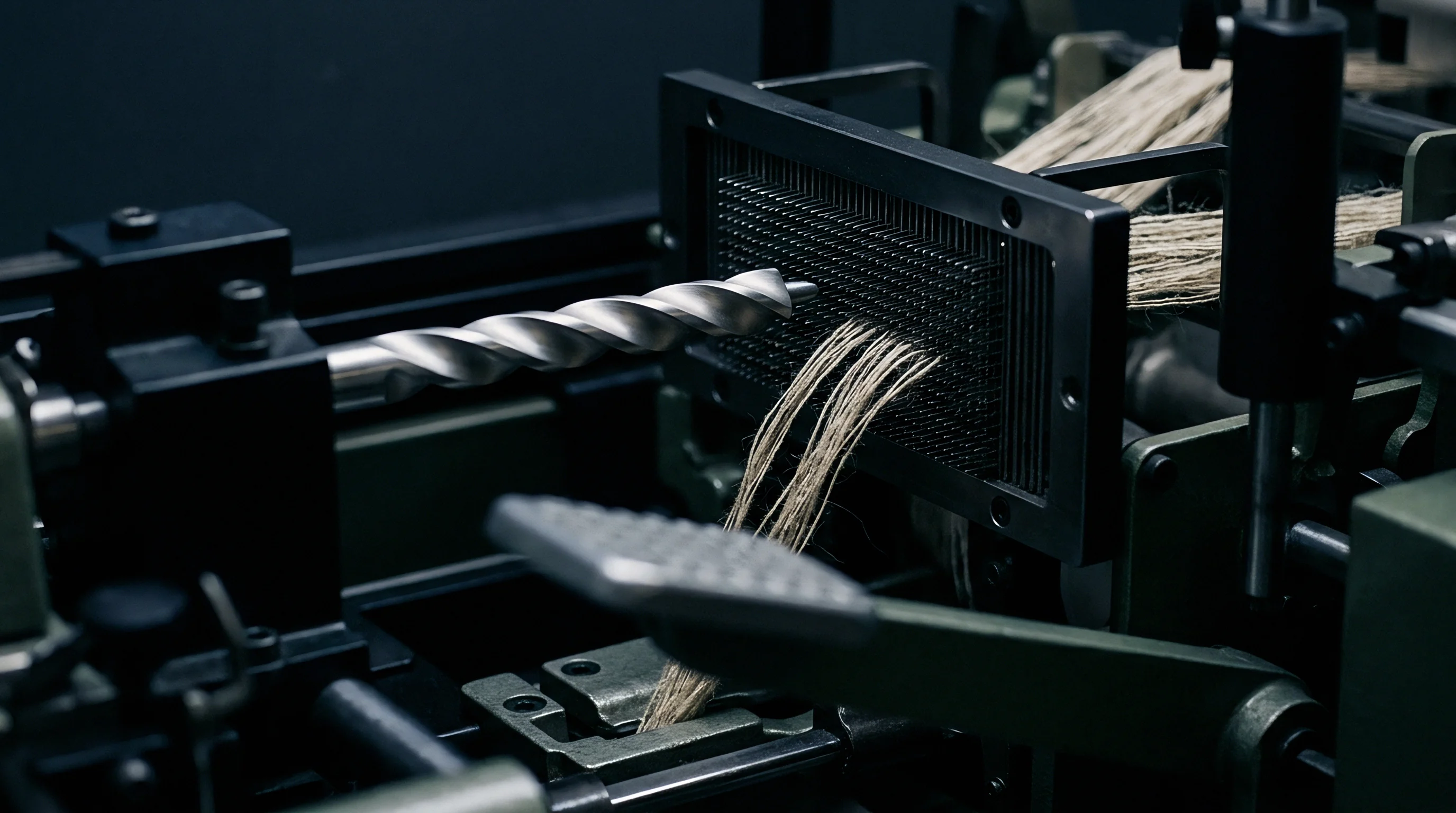
Industrial hackling machines refine and align bast bundles into slivers through successive pin beds of increasing density. Clamped long flax enters the line as coarse, tangled strands, where steel pins penetrate the parallel bundles. Aprons lined with pointed steel needles comb through the hanging fringe to clear short fibers, loose shive, and un-retted cortical tissue.
Field pin densities progress from coarse arrangements at 2 to 4 pins per centimeter up to high-density finishing fields carrying 28 pins per centimeter. As bundles advance, processing forces shift from basic strand alignment to intensive longitudinal splitting of technical fibers.
Pin penetration subjects bundle cross-sections to combined tensile and shear stress, shearing the weaker pectin bonds. Technical flax fibers consist of elementary fibers joined by middle lamella pectins. Dense pin fields force individual needles between elementary walls, setting up lateral cleavage stresses.
When pin entry speeds exceed 25 meters per minute in intermediate fields, shear deformation outpaces the relaxation rate of the pectin matrix, splitting bundles into finer fibrillar groups. Simultaneously, sharp needle tips scrape the primary wall, stripping protective cuticle tissue and exposing the underlying S1 and S2 layers to direct frictional wear.
Micro-compression folds introduced during scutching act as stress concentrators during hackling, opening dislocation nodes into structural fissures. When hackling needles pull tension along the fiber strand, local stress at a dislocation node jumps three- to five-fold over undamaged sections. Crystalline microfibrils in the damaged S2 layer pull apart longitudinally, expanding isolated kinks into continuous micro-fissures.
These fissures run parallel to the microfibrillar helix, degrading transverse fiber strength and accelerating fragmentation during sliver drafting.
Stepping up pin density requires tight velocity control across machine fields to avoid premature fiber breakage. Table 1 outlines operating parameters across four hackling stages, showing the relationship between pin density, apron speed, and accumulated cell wall dislocations measured by optical metrology.
| Field Stage | Pin Density (pins/cm) | Apron Velocity (m/min) | Pin Diameter (mm) | Accumulated Dislocations (nodes/mm) | Elementary Fiber Micro-cracks (%) |
|---|---|---|---|---|---|
| Coarse Field 1 | 3.2 | 14.0 | 1.80 | 6.4 | 2.1 |
| Medium Field 2 | 8.5 | 22.5 | 1.20 | 11.2 | 5.8 |
| Fine Field 3 | 16.0 | 31.0 | 0.85 | 17.8 | 12.4 |
| Ultra-Fine Field 4 | 26.5 | 38.0 | 0.50 | 24.3 | 21.9 |
Aggressive combing alters sliver length distribution by breaking damaged long flax strands. Elementary fibers with high dislocation counts snap under the bending loads applied by fine finishing aprons. Mechanical fiber separation during hackling produces several distinct failure modes across elementary cell walls:
- Transverse Dislocation Fracture occurs when tensile loads applied by finishing pins snap elementary fibers directly across a dense cell wall compression kink, producing flat, low-energy fracture surfaces.
- Longitudinal Middle Lamella Cleavage splits technical fiber bundles along pectin interfaces, exposing raw elementary fiber outer surfaces without fracturing internal cell walls.
- Fibrillar Peeling strips outer S1 secondary cell wall layers away from the S2 core when fine hackling pins drag against un-aligned bundle tips, creating microscopic ribbon-like debris.
- Shear-Induced Micro-Delamination separates adjacent microfibril sheets within the secondary S2 layer, forming internal longitudinal voids that reduce fiber optical density under polarized illumination.
Increasing hackling pin tip speed above thirty-five meters per minute drops sliver tenacity by roughly sixteen percent. Increasing pin density without adjusting apron velocity multiplies mechanical impact cycles per unit mass, compounding microstructural defects throughout the entire long flax lot.
Damp straw subjected to rapid breaker roller compression develops continuous internal dislocation bands without showing external cortical sheath tearing.
Excessive pin density in the initial beds ruins long fiber yield before bundles have been properly aligned.

Metrology
Quantifying cell wall damage requires optical and physical methods that resolve sub-micron lattice variations. Polarized Light Microscopy (PLM) provides a practical baseline for assessing microstructural defects, as polarized illumination highlights micro-compression bands. Crystalline cellulose microfibrils in undamaged S2 layers exhibit strong optical anisotropy, extinguishing transmitted light when aligned parallel to the axes of crossed polarizers.
Dislocation nodes, compression kinks, and micro-cracks break this lattice alignment and rotate local microfibril orientation away from the optical axis.
Under crossed polarizers, micro-compression folds show up as bright, colorful bands crossing the fiber shaft at angles matching local microfibril displacement, while broken nodes lose anisotropy altogether. Quantitative PLM metrology determines defect density by counting distinct birefringent bands per millimeter of fiber length. Samples are mounted in an optical immersion oil matching the refractive index of amorphous cellulose (n = 1.540) to eliminate surface refraction.
Image analysis systems take high-resolution micrographs at 400x magnification, thresholding shaft intensity values to log dislocation nodes automatically.

Which Analytical Techniques Isolate Processing Damage from Retting Softening?
Distinguishing mechanical damage from agricultural or retting degradation calls for multi-method verification. Retting digests pectin matrices through enzymatic action without altering secondary cell wall cellulose lattices. Scutching and hackling fracture crystalline microfibrils mechanically, leaving clear physical markers.
Table 2 compares four primary metrological methods, detailing their diagnostic metrics, resolution limits, and detection capabilities.
| Method | Physical Signal | Resolution Limit | Primary Defect Metric | Retting vs Mechanical Sensitivity |
|---|---|---|---|---|
| Polarized Light Microscopy (PLM) | Birefringence extinction angle shift | 0.5 micrometers | Dislocation node density (nodes/mm) | High sensitivity to mechanical cell wall kinking |
| Micro-Computed Tomography (Micro-CT) | X-ray attenuation density variation | 0.8 micrometers | Internal micro-void volume fraction (%) | Isolates structural cell wall delamination |
| Acoustic Emission Testing (AE) | Transient elastic wave frequency | 10 nanometers strain | Micro-crack propagation rate (events/sec) | Detects brittle cellulose lattice fracture during loading |
| Automated Fiber Image Analysis (AFIA) | High-contrast edge diffraction mapping | 1.2 micrometers | Fibrillation index and node spacing (mm) | Measures outer cell wall peeling and bundle splitting |
Micro-Computed Tomography (Micro-CT) produces non-destructive, three-dimensional density maps of elementary fibers to identify internal voids. Synchrotron-based micro-tomography resolves density shifts within single cell walls, locating sub-micron delaminations running between adjacent S2 layers. Volumetric analysis separates structural air voids caused by aggressive beating from natural lumen geometry, establishing true defect percentages for scutched slivers.
Acoustic Emission (AE) monitoring during single-fiber tensile tests tracks defect growth in real time. Sound elementary fibers subjected to axial tension generate minimal acoustic activity until final brittle failure. Fibers with high scutching dislocation counts emit high-amplitude elastic waves at low strain, corresponding to micro-cracks opening along pre-existing dislocation bands.
Fast Fourier Transform spectral analysis separates high-frequency signals (300 to 500 kHz) caused by microfibril fractures from lower-frequency events (100 to 200 kHz) produced by middle lamella pectin shear.
Comparing polarized light micrographs against mechanical test data isolates mechanical processing damage from field-grown stress marks. Automated optical diffraction profiling expands testing throughput for commercial lots. Processing pipelines inspect thousands of fiber segments per hour to calculate Weibull distribution parameters for dislocation spacing.
A narrow Weibull shape parameter reflects consistent mechanical processing, whereas a wide distribution points to uneven gaps between breaker rollers and turbine blades.
ISO 11566 tensile test protocols produce artificial strength values when jaw clamping pressure crushes pre-existing microstructural dislocations.
The precise energy threshold where microscopic dislocation nodes transition into catastrophic micro-cracks under wet spinning tension remains poorly defined.

Depreciation
Microstructural defects directly impair downstream yarn processing and sliver commercial value, as fractured cell walls lower breaking tenacity. Elementary flax fibers carrying high dislocation counts show sharp drops in ultimate tensile strength. Sound, hand-decorticated fibers reach breaking tenacities between 65 and 85 cN/tex.
Running the same straw through high-speed mechanical scutchers at elevated rotor speeds reduces average single-fiber tenacity to 38 to 48 cN/tex.
Tensile failures during spinning happen predominantly across pre-existing dislocation bands rather than through middle lamella shear. In wet ring spinning, water plasticizes pectin matrices so elementary fibers can draft past each other within the technical strand. Dislocation nodes act as severe structural flaws along the fiber shaft.
When drafting tension exceeds the yield strength of the damaged S2 lattice, fibers break inside the drafting zone, forming thin spots in the yarn and driving up end-break rates.
Yield losses mount quickly on ring frames, where low tenacity limits yarn counts and spinning efficiency falls alongside rising end-break rates. Spinning fine yarns above metric counts of Nm 40 (25 tex) requires robust sliver integrity to sustain spindle speeds without thread breaks. Table 3 maps the relationship between dislocation density, spinning break frequency, maximum yarn count, and sliver market value discounts.
| Dislocation Density (nodes/mm) | Sliver Tenacity (cN/tex) | End-Break Rate (breaks/1000 sp-hr) | Spinning Limit Target (Nm) | Commercial Discount (%) |
|---|---|---|---|---|
| 4.0 to 7.0 | 62.0 | 18 | Nm 80 | 0.0 (Baseline) |
| 7.1 to 12.0 | 51.5 | 42 | Nm 60 | -6.5 |
| 12.1 to 18.0 | 41.0 | 98 | Nm 39 | -14.8 |
| 18.1 to 26.0 | 31.5 | 240 | Nm 26 | -28.0 |
Screening raw long flax slivers prior to fine spinning prevents costly production stops. Mills run structured qualification routines to verify defect densities when bales arrive:
- Extract representative ten-gram sliver samples from five randomly selected bales per delivery lot according to ISO 2859 acceptance sampling procedures.
- Prepare one hundred single-fiber mounts per sample, clearing cell wall structures in immersion oil matching index 1.540.
- Quantify dislocation node frequency under cross-polarized light microscopy at 400x magnification, recording all birefringent bands crossing the S2 cell wall.
- Execute single-fiber tensile testing on fifty mounted fibers per sample using a gauge length of 10 millimeters and a constant rate of extension of 1 millimeter per minute.
- Calculate the Weibull characteristic strength and shape parameter for single-fiber tenacity across the complete sample population.
- Reject or re-grade sliver lots demonstrating characteristic tenacities below 45 cN/tex or average dislocation densities exceeding 14 nodes per millimeter.
Sliver lots with excessive defect densities face mandatory metric count downgrading. Stock ordered for fine apparel weaving at Nm 60 is diverted to coarse furnishing yarns at Nm 26. This downgrade carries an immediate financial penalty, since the market price per kilogram for coarse sliver sits well below that of fine-count long flax.
Excessive hackling pin contact degrades long flax bundle length long before spinning machines take delivery of the sliver.
Unquantified scutching damage can generate claims exceeding twelve thousand euros on a sixty metric yarn lot when defective fiber causes continuous end-breaks across twenty spinning frames.

Attribution
Separating mechanical extraction damage from retting variation requires mill-floor audits and physical log reconciliation against scutcher rotor records. Field retting conditions dictate initial pectin degradation across the bast tissue. Under-retted straw resists mechanical separation, prompting operators to close roller gaps and speed up turbine blades to knock off stubborn shive.
This mechanical adjustment places heavy strain on cell wall structures, driving up dislocation counts on naturally strong fiber.
Dry straw breaks easily under breaker rollers, and decorticating below 10 percent moisture causes brittle micro-cracking across elementary S2 layers. When mills lack online moisture controls, production logs frequently show dry bales entering flutes set for moist straw, multiplying internal cell wall fractures. Auditors check hourly humidity records from the decortication hall against machine tachometer charts to spot runs executed outside safe operational limits.
Auditors inspect processing logs at European and Asian mills to verify rotor tip speeds during decortication. Mill verification requires systematic checks on machine adjustments and incoming material quality across the line:
- Turbine Blade Tip Clearance Settings must match raw stem diameter distributions precisely, maintaining minimum clearances above 2.5 millimeters to prevent blade-on-anvil fiber crushing.
- Breaker Roller Flute Pitch Alignment requires exact gear synchronization to prevent tooth slip that imparts violent longitudinal shear forces directly to the bast sheath.
- Online Moisture Sensors require daily multi-point calibration against oven-dry gravimetric controls to guarantee straw moisture content remains between 12 and 14 percent during decortication.
- Hackling Apron Speed Controls must maintain linear step-up ratios under 1.4 between consecutive pin fields to prevent sudden tensile shock loading on long fiber clamps.
Comparing machine parameters directly to fiber damage allows auditors to resolve agricultural failure claims by checking optical dislocation counts against raw straw retains. When un-scutched straw retains show low node counts (under 4 nodes per millimeter) but output sliver reaches over 16 nodes per millimeter, liability for fiber degradation falls squarely on scutching and hackling operations.
Clause 14B of the International Linen Processing Standard reduces raw sliver lot valuation by 1.8 percent for every unit increase in average dislocation node count above twelve per millimeter.

Indemnity
Contracts for long flax sliver allocate financial risk using verifiable defect thresholds that set maximum allowable node counts. Technical specifications for fine-count sliver (target Nm 50 to Nm 80) incorporate microstructural limits alongside standard length, cleanliness, and linear density requirements. Purchase contracts bind suppliers to strict limits on S2 cell wall dislocations, verified by third-party ISO 17025 accredited laboratories using standardized polarized light microscopy protocols.
When third-party testing uncovers dislocation densities above contract limits, landed price adjustments apply automatically. Discount schedules follow a sliding scale tied to measured tenacity loss. Lots showing 12 to 15 nodes per millimeter take a fixed 8 percent invoice deduction to offset anticipated spinning efficiency losses.
Dislocation counts above 18 nodes per millimeter entitle the buyer to reject the entire shipment at the seller’s expense.
Clear physical specifications in purchase orders protect spinning yields through lab-confirmed defect metrics. Standard certificates of origin and broad scope schemes (such as European Flax) verify regional cultivation origins but offer no guarantees regarding mechanical processing damage or cell wall condition. Technical buyers require explicit mechanical integrity warranties in commercial contracts, placing financial liability for scutching damage directly on the decorticator.
Procurement specifications incorporate polarized light microscopy metrics directly into standard purchase agreements, holding mills to verified mechanical limits before releasing shipments.