
Separating Viscoelastic Crimp Interchange from Biochemical Mass Loss in Scouring
Scouring linen increases GSM despite mass loss because wet viscoelastic crimp interchange condenses thread count faster than non-cellulosic extraction lightens yarn.
Scouring linen increases GSM despite mass loss because wet viscoelastic crimp interchange condenses thread count faster than non-cellulosic extraction lightens yarn.

Deriving greige linen count requires dividing target finished linear density by chemical yield and adjusting for warp crimp, reed spread, and sizing loss.

Calculating reed width requires multiplying target greige width by weft crimp and finish shrinkage allowances tailored to flax yarn modulus.
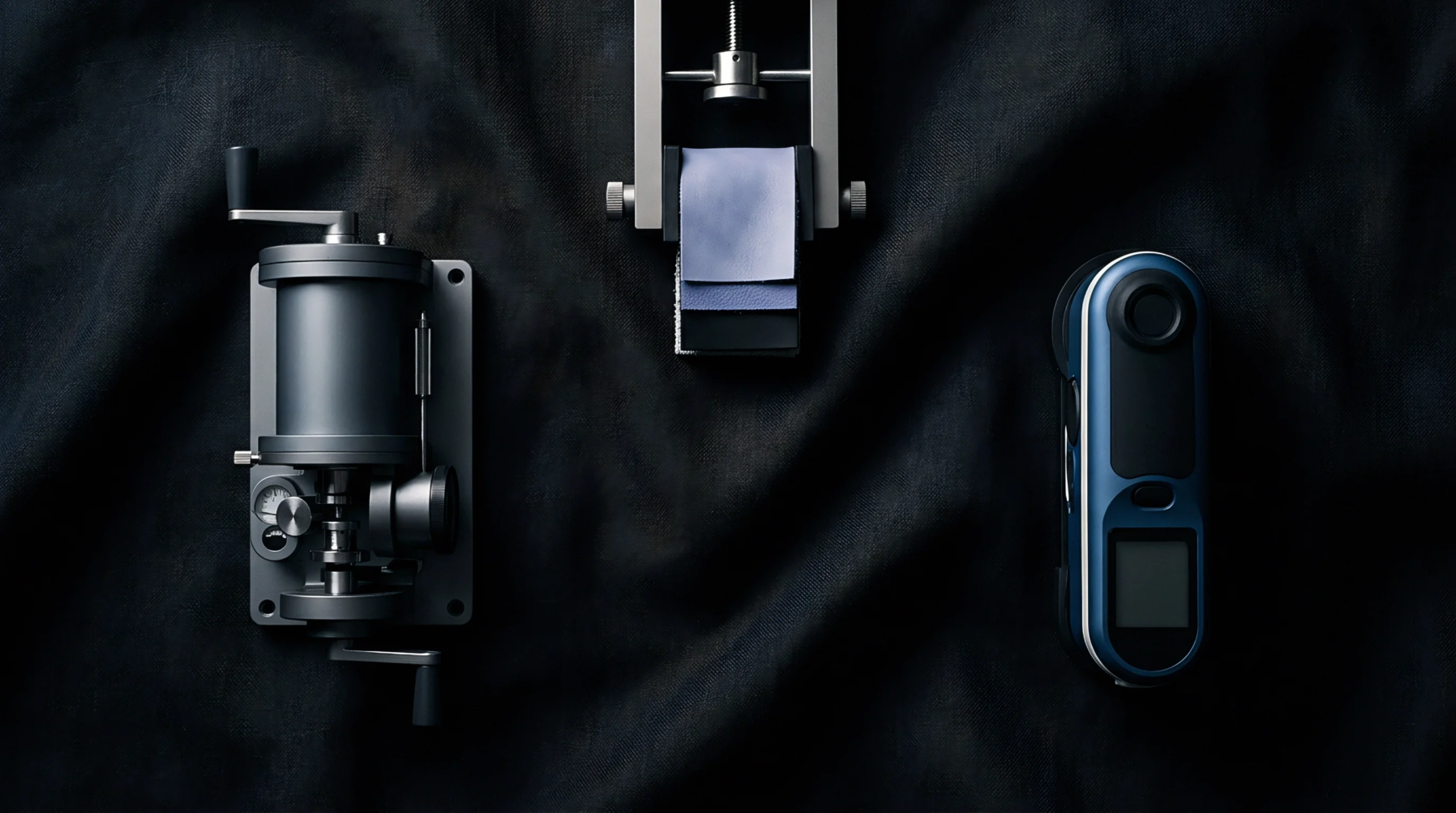
Evaluating unfinished linen crimp by ISO 7211-3 unstraightened thread ratios prevents yarn displacement faults and stabilizes post-scour finished fabric weight.

Deriving finished linen weight from greige density factors requires adjusting thread counts for dimensional contraction while subtracting non-cellulosic scour loss.

Calculate linear greige yield by dividing net picks per hour by pick density, adjusting reed width and warp length for crimp contraction.

Flax moisture regain directly alters measured yarn count and fabric mass; accurate verification requires oven-drying to normalize weights against standard commercial regain allowances.

Standard cantilever testing and four-point inspection verify greige cloth stiffness and fault densities to enforce contract specifications before finishing.
Determine woven linen weight and thread density by converting yarn Lea to Tex, applying cover factor equations, and accounting for finishing shrinkage.

Exact yarn mass calculation for plain weave greige linen requires converting Lea to Tex, factoring warp crimp, reed width, and 12% standard moisture regain.

Converting hand-loom swatches to rapier loom specs requires rebalancing warp crimp, sizing single yarns, and setting weft brakes to hold cover factor at speed.

Managing off-loom flax warp crimp contraction requires precise reed denting allowances, ELO tension tuning, and size solubility control to hit target grey widths.

Reconciling linen weight requires balancing chemical extraction losses against warp crimp contraction to hit target finished areal mass and dimensional stability.

Standardized testing of flexural hysteresis and crimp balance isolates structural yarn friction, securing dimensional stability and reducing garment scrap.

Greige reed marks and starting marks map directly to reed wire spacing and loom stoppage dynamics, requiring electronic let-off adjustment to eliminate defects.

Reconciling warp crimp and waste factors prevents yarn budget deficits by capturing cumulative process losses across landed fabric cost models.

Engineering accurate linen fabric specifications requires coupling loom crimp take-up equations with wet process shrinkage factors to fix finished GSM and width.
Calculating real landed fabric cost requires dividing hourly loom shed rates by efficiency-adjusted yield and adding verified yarn loss, finishing shrinkage, and freight.

Target linen weight equals yarn tex multiplied by thread density, adjusted for warp size, crimp, wet process mass loss, and area shrinkage factors.
Expertise is a utility, not a secret. sentiention™ publishes its working knowledge as open reference: intelligence layer covering the materials it sources, the markets it enters, and the reference that serves both.