Optimizing Shed Height Settings for Air Jet Linen Fabric Construction
Optimizing air jet linen shedding requires asymmetric harness levelling at 26 millimetres to balance relay nozzle clearance with tension limits.

Frame
Harness levelling on profile-reed looms defines the physical aperture through which compressed air relays drive the weft. Linen yarn resists stretching, so running 100% wet-spun flax at 550 to 700 picks per minute forces a compromise between two distinct failure modes. Set the harness frames too low, and the compressed profile reed tunnel causes air jets to brush against the warp sheets, triggering turbulence that stops the filling yarn mid-traverse.
Set them too high, and rigid flax fibers face dynamic tensions that exceed their tensile strength when the shed crosses.
Cotton settings rely on elongation to absorb shed movements, but flax breaks at just 2.0% to 3.5% strain, compared to 7.0% to 9.0% for long-staple cotton. Profile reeds leave little room for error; opening the warp sheet beyond the minimum clearance of the nozzle tips spikes end breakage sharply. On 26 Lea (44 Nm) wet-spun pure linen warps, increasing total frame opening from 24 millimetres to 30 millimetres drives warp stop rates from 1.2 up to 8.7 stops per 100,000 picks.
Harness Motion and Aperture Dimensions
Total clearance in the profile reed channel depends on frame stroke, backrest roller height, and the distance from the harness frames to the reed at beat-up. On a 220-centimetre nominal reed width air jet loom, the front harness frame stroke governs the minimum vertical opening.
For a standard 100% linen plain weave woven with 26 Lea warp and 26 Lea weft at 18 ends per centimetre, a front harness frame clearance of 25 to 26 millimetres produces a clean 12 to 14 millimetres shed opening along the relay nozzle insertion line. This leaves sufficient boundary layer clearance for 3.5-millimetre diameter relay nozzle tips without dragging the bottom warp sheet across the guidance teeth.

Asymmetric Levelling Mechanics
Symmetric shed geometry aligns the closed shed line on the exact horizontal plane between backrest roller and breast beam, balancing dynamic strain across both warp sheets. In dense linen weaves, however, symmetric shedding causes heavy reed marks and insertion stops as adjacent warp threads cling together.
Lowering the harness frame zero position introduces an asymmetric shed, shifting higher tension onto the upper warp sheet at maximum opening. Raising the backrest roller 10 to 15 millimetres above the horizontal center line slackens the lower sheet, allowing flax fibers enough lateral movement to keep adjacent neps from interlocking while the filling inserts.
| Warp Count (Lea / Nm) | Warp Sett (ends/cm) | Front Frame Lift (mm) | Backrest Offset (mm) | Profile Reed Gap (mm) | Target Warp Stop Rate (stops/10^5 picks) |
|---|---|---|---|---|---|
| 14 Lea / 24 Nm | 14.0 | 28.0 | +15.0 | 15.2 | 2.1 |
| 26 Lea / 44 Nm | 18.0 | 26.0 | +12.0 | 13.8 | 1.4 |
| 36 Lea / 61 Nm | 22.0 | 24.5 | +10.0 | 12.5 | 1.8 |
| 40 Lea / 68 Nm | 26.0 | 23.5 | +8.0 | 11.8 | 2.6 |
Adjusting shed geometry on production looms requires a strict sequence to avoid mechanical interference between harness frames and warp stop motions.
- Baseline Levelling Verification Set all harness frames flat at 180 degrees relative to the main drive shaft, ensuring eyelets align along the horizontal center axis.
- Backrest Elevation Adjustment Raise the backrest roller 12 millimetres above the breast beam line to set an initial tension differential between warp sheets.
- Front Harness Height Calibration Adjust front harness frame stroke to yield a 26-millimetre total opening at the drop wire box edge.
- Rear Harness Gradient Setting Increase frame strokes progressively by 1.0 millimetre per rear harness to keep a straight sightline through the open shed.
- Reed Channel Clearance Audit Turn the loom manually through a 180-degree crank angle to verify physical clearance between relay nozzle tips and the lower warp sheet.
Running pure linen warps with excessive, uncalibrated harness heights causes rapid fiber fatigue. Broken ends multiply under the drop wires, draining up to two loom efficiency points per shift in manual piecing downtime.


Airflow
Relay nozzles entering the shed must clear both warp sheets without rubbing or deflecting the air stream. Profile reed channels direct compressed air blasts across the width; when shed height is set too narrow, sagging linen warp threads drop into the channel. These blockages cause blow-backs, short picks, and repeated loom stops.
Wet-spun flax carries surface fuzz, micro-slubs, and pectin scales projecting from the yarn core, lacking the smoothness of filament or combed cotton. These projections disturb the laminar boundary layer formed by the main nozzle. Setting shed height too low pushes these fibers right into the jet stream, scattering the air and causing the filling tip to curl on insertion.
Relay Nozzle Trajectory and Clearance
Relay nozzle position must match harness height settings. Nozzle tips reach into the profile reed channel during filling insertion, between 80 degrees and 240 degrees of the crank cycle. Excessive shed height drags the upper warp sheet against the back of the relay nozzles as the shed closes.
Maintaining at least 2.5 millimetres of vertical clearance between the relay nozzle tip and the upper warp sheet avoids mechanical abrasion. Air jet looms weaving flax require single-hole or multi-ring relay nozzles set at a pitch of 35 to 45 millimetres across the reed width. Narrower pitch arrangements preserve propulsion pressure, allowing lower overall air usage at reduced shed heights.
Operating pure linen warps at a shed height below twenty-four millimetres increases profile reed guide strikes by thirty percent when relay nozzle firing pressure drops below three bar.

Pneumatic Dwell and Pressure Profiles
Air pressure profiles interact directly with harness timing. Opening the shed early demands higher pressure from the first relay group to force air through the tight channel space while harness frames move.
Shifting shed opening timing to 300 degrees crank angle lets the shed reach 80% of its total height before the main nozzle fires. This cut in resistance lowers the initial acceleration pressure from 5.5 bar to 4.2 bar, saving energy on the air line. Main nozzle valve timing must sync with harness movement so the air front moves down a clear tunnel.
Clearance issues are often blamed on weak line pressure or worn relay valves when the real culprit is insufficient frame stroke, which lets slack bottom warp threads droop into the channel during firing.


Strain
Flax fibers exhibit an elongation at break between two and three point five percent, leaving warp threads susceptible to permanent stretching under heavy mechanical loads. High dynamic tension during shedding degrades elasticity, spiking sharply as the harness pulls the threads open. Under dynamic loading, the modulus of flax yarn reaches 18 to 22 Gigapascals, far above the 6 to 9 Gigapascals typical of ring-spun cotton.
Peak dynamic stress hits at maximum shed opening, near 180 degrees crank angle. If total shed height creates a warp angular displacement greater than 14 degrees relative to the horizontal cloth line, tension exceeds the elastic limit of the sizing film. Sizing cracks, yarn frays, and warp breaks follow quickly.

Tensile Modulus and Dynamic Warp Load
Dynamic tension monitoring shows peak loads concentrated on selvedge and edge ends. Linen sizing blends high-viscosity polyvinyl alcohol with modified starches to coat the flax core. While this hard film handles direct tensile pull, it fractures under the sharp bending angles caused by excessive shed heights.
Lowering harness lift reduces angular bending at the drop wires and reed back-line. On a 26 Lea warp, trimming lift from 28 millimetres to 24 millimetres drops peak dynamic tension from 85 grams per end to 52 grams per end, protecting the sizing film and preventing yarn shredding under the lease rods.

Crossed Shed Timing and Backrest Height
Setting crossed shed timing early, between 280 degrees and 300 degrees crank angle, locks the inserted filling pick tightly into the cloth fell before beat-up occurs.
Combining early shed timing with large shed heights generates severe warp strain: the reed strikes the fell while threads are already fully split under peak tension. Raising the backrest roller offsets this strain by balancing tension through an asymmetric shed.
Lowering the backrest roller below the chest line transfers peak dynamic load to the lower shed sheet, reducing yarn-on-yarn friction during crossing.
Poor tension control and excessive frame stroke profiles leave distinct structural and visual flaws in greige linen cloth.
- Shed Line Reed Marks Vertical streaks along the warp axis caused by uneven tension from symmetric harness levelling at high shed settings.
- Drop Wire Abrasion Chafing Frayed surfaces and sizing dust under the drop box caused by sharp friction angles at maximum frame lift.
- Fell Bounce Mispicks Irregular pick spacing and wavy fells caused by sudden elastic rebound as peak tension releases at beat-up.
- Selvedge End Snap-Offs Edge warp snapping caused by unequal shedding angles between ground frames and selvedge motions.
Setting harness frame stroke to the absolute minimum that ensures clear insertion prolongs warp life and stops tension-driven end breaks on dense linen runs.

Cover
Fabric construction changes how much resistance the warp sheet offers to beat-up and filling movement. Cover factor calculations measure how tightly warp yarns pack together; higher setts demand greater clearance, meaning a lightweight plain weave requires quite different shed geometry than a dense apparel twill or heavy drapery cloth.
When warp density exceeds 22 ends per centimetre with 36 Lea flax, tight packing makes adjacent yarns stick during shedding. While raising shed height seems like the natural way to pull them apart, doing so over-tensions the fiber. Asymmetric settings offer the needed clearance without spiking peak yarn stress.

Which Sett Threshold Demands Asymmetric Harness Levelling?
Asymmetric levelling becomes necessary once the fractional warp cover factor exceeds 0.55 under Crompton structural equations. In lighter fabrics, like a 12 ends per centimetre plain weave using 14 Lea yarn, symmetric shedding works reliably at 24 millimetres of lift because generous warp spacing leaves room for the relay channels.
Above 0.55 cover factor, yarn-on-yarn friction keeps the lower warp sheet from separating cleanly. Raising the backrest roller tightens the upper sheet while keeping physical harness lift capped at 25 to 26 millimetres to protect the air channel.
| Cloth Construction | Yarn Count (Warp x Weft) | Sett (Ends x Picks / cm) | Crompton Cover Factor | Minimum Shed Height (mm) | Levelling Profile Type |
|---|---|---|---|---|---|
| Light Sheer Plain | 40 Lea x 40 Lea | 20.0 x 18.0 | 0.48 | 23.0 | Symmetric |
| Apparel Plain Weave | 26 Lea x 26 Lea | 18.0 x 16.0 | 0.54 | 25.0 | Symmetric |
| Dense Drapery Plain | 26 Lea x 26 Lea | 24.0 x 20.0 | 0.72 | 26.5 | Asymmetric (+12mm) |
| Heavy Upholstery Twill | 14 Lea x 14 Lea | 22.0 x 18.0 | 0.81 | 28.0 | Asymmetric (+15mm) |

Crompton Fractional Density Metrics
Crompton fractional cover factor compares yarn diameter against end spacing. For wet-spun linen, diameter in millimetres is estimated as 0.907 divided by the square root of the metric yarn count (Nm). For 26 Lea yarn (44 Nm), this gives a calculated diameter of 0.137 millimetres.
At 24 ends per centimetre, yarn occupies 3.28 millimetres across each centimetre of warp width, giving a warp cover factor of 0.328. Combined with thread crimp and weft packing density, total cover factor determines whether shed clearance must be opened mechanically or managed by staggering harness frame timing.
Fabric rejected under ASTM D5430 four-point inspection for repeated warp end tension breaks forfeits all mill rework credit unless shed height logs confirm compliance with yarn tenacity limits.
Troubleshooting high filling stop rates caused by tight shed clearance in dense weaves involves checking specific loom parameters in order.
- Density Verification Measure greige warp end density per centimetre at the drop wires with a counting glass to confirm actual reed expansion.
- Crompton Calculation Calculate warp cover factor to decide whether symmetric or asymmetric levelling applies.
- Timing Adjustment Audit Confirm crossed shed timing is set between 300 and 320 degrees crank angle for maximum channel clearance during propulsion.
- Backrest Offset Check Check vertical height of the backrest roller relative to the breast beam, raising it in 2-millimetre increments if warp cling persists.
- Staggered Harness Setup Set a 2-degree mechanical delay between adjacent harness frames to open the shed across two planes, reducing peak thread density at crossing.
When contract terms require meeting ISO 7211 construction tolerances, any change to warp density or yarn count requires recalibrating harness lift to stay within certified tensile limits.
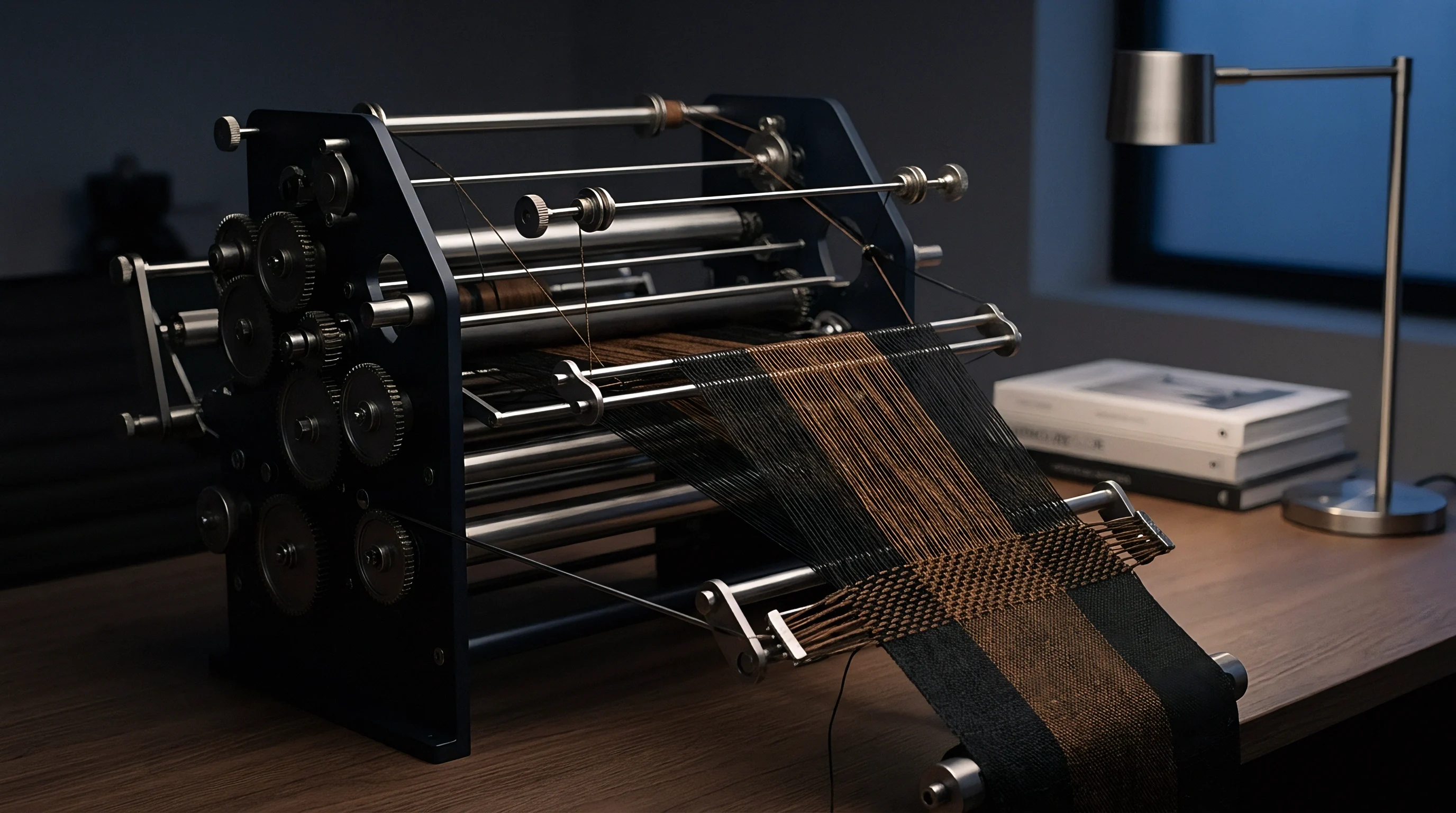

Cling
Unspun tow fibers and residual pectin nodes form micro-hooks that bind adjacent warp threads during harness movement. On air jet looms, incomplete warp separation creates a fine veil across the profile reed tunnel; as filling yarn travels down the channel, it catches on these hanging fibers, causing bent tips, loops, or full machine stops.
Linen yarn hairiness is measured with the S3 metric ~ the count of fibers per metre extending past 3 millimetres from the yarn core. Pure flax frequently ranges from 120 to 250 S3, while ring-spun cotton stays below 20. Sizing quality alters these friction dynamics, but higher hairiness consistently prevents clean shed opening without precise geometric adjustments.
Nep Entanglement and Hairiness Mitigation
Neps are dense clusters of raw flax fiber that survive carding and spinning. When neps on adjacent warp ends align as the harness moves, they catch. Small shed heights lack the clearance to pull them apart, leaving a loose warp thread floating in the relay channel.
Raising harness height to force nep separation degrades warp tenacity. Staggering frame motion works better: setting frames 1 and 2 to open slightly ahead of frames 3 and 4 splits the separation force across two timing phases. This prevents simultaneous nep collisions and clears the profile reed channel without increasing overall warp tension.
Slubs in long-staple flax yarn cause temporary shed geometry collapse whenever two coarse yarn nodes align at the reed wires during crossing.
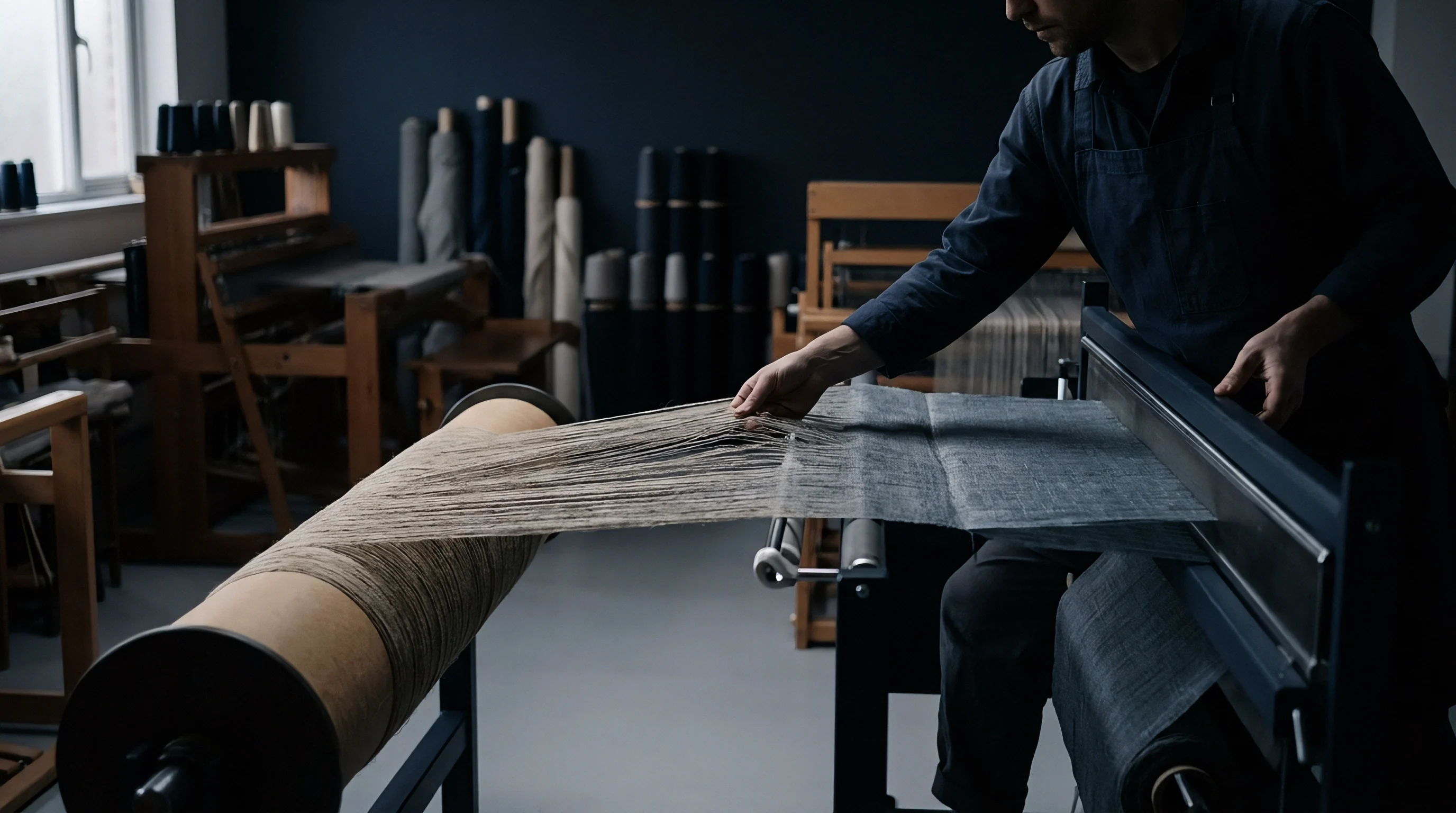
Leasing Rod and Staggering Protocols
Lease rod positions behind the drop wire box alter the warp sheet split angle. Moving lease rods closer to the harness sharpens the angle, forcing sticky threads to separate earlier in the stroke. Placing them too close, however, increases friction on sized yarn, generating dust that plugs relay nozzle orifices.
For wet-spun linen, optimal lease rod distance sits between 450 and 550 millimetres behind the back harness frame. This location balances fiber separation against gentle tension buildup, keeping the reed channel clear of debris at high loom speeds.
Diagnosing and clearing filling stops caused by warp clingage involves systematic mechanical steps.
- Confirm whether filling stops concentrate in the second half of the weaving width, where air pressure drops off.
- Inspect the profile reed channel for pectin powder or sizing dust caused by yarn scraping during shedding.
- Advance crossed shed timing from 360 degrees to 310 degrees crank angle to open the channel earlier in the main jet cycle.
- Adjust frame staggering controls to set a 3-millimetre vertical separation between frame pairs at crossing.
- Increase sizing solids or PVA binder ratios if incoming yarn audits show S3 hairiness over 180 fibers per metre.
When yarn hairiness spikes mid-warp, weavers must choose between bumping air pressure or raising harness lift ~ a trade-off that quickly tests warp end survival limits.


Booking
Loom efficiency directly dictates landed fabric cost per linear metre. Weaving sheds bill by loom hours consumed, and miscalibrated shed settings on flax yarns incur real financial penalties: higher stop rates lower weaver efficiency, boost scrap rates, and raise compressor power demand per metre of cloth.
Running an air jet loom at 650 picks per minute consumes 35 to 45 cubic metres of compressed air per hour at 6.0 bar. When tight shed height forces operators to bump relay nozzle pressure from 4.5 bar to 6.0 bar to drive filling past obstructions, compressor electrical power increases by 18% per loom hour.
Compressor Power and Insertion Efficiency
Landed metre cost estimates must factor in electrical power drawn by air compressors. Running 100 air jet looms on 100% linen plain weave requires a continuous supply of 4,000 cubic metres per hour. At 0.12 Euros per kilowatt-hour, compressed air can account for up to 25% of total conversion costs per loom hour.
Reducing harness frame lift from 28 millimetres to 25 millimetres allows clean insertion at lower pressures. Dropping relay nozzle pressure by 1.0 bar across a 100-loom shed cuts annual operating expenses by more than 42,000 Euros while reducing tension-related end breaks.
Loom Hour Financial Calculation
A practical comparison highlights the financial impact of shed optimization. Consider a 10,000-metre production run of 230 GSM pure linen apparel fabric woven at 18 picks per centimetre on a 220-centimetre reed width loom at 600 picks per minute baseline speed.
Scenario A uses an unoptimized 29-millimetre shed height with symmetric levelling. High warp breakage (6.5 stops per 100,000 picks) drops loom efficiency to 82% and demands 5.8 bar relay pressure. Scenario B applies an optimized 25.5-millimetre asymmetric shed with 310-degree crossed timing.
Operating efficiency rises to 91% (1.2 stops per 100,000 picks) while required air pressure falls to 4.6 bar.
| Operating Parameter | Scenario A (Unoptimized Shed) | Scenario B (Optimized Shed) | Performance Delta |
|---|---|---|---|
| Harness Frame Lift | 29.0 mm | 25.5 mm | -3.5 mm |
| Relay Air Pressure | 5.8 bar | 4.6 bar | -1.2 bar |
| Warp Stop Rate (per 10^5 picks) | 6.5 stops | 1.2 stops | -81.5% |
| Loom Operating Efficiency | 82.0% | 91.0% | +9.0% |
| Actual Output per Loom Hour | 16.4 metres | 18.2 metres | +1.8 metres |
| Total Production Time (10,000 m) | 609.7 loom hours | 549.4 loom hours | -60.3 loom hours |
| Air Compressor Energy Cost / Metre | 0.28 EUR | 0.20 EUR | -0.08 EUR |
| Total Landed Weaving Cost / Metre | 1.85 EUR | 1.52 EUR | -0.33 EUR |
Optimizing harness clearance impacts the entire weaving schedule. Scenario B finishes the 10,000-metre contract 60.3 loom hours faster than Scenario A, freeing capacity for subsequent orders while lowering conversion cost by 0.33 Euros per finished linear metre.
Commercial specifications for contracted linen must reflect physical loom constraints. Procurement contracts mandating strict four-point inspection thresholds without acknowledging harness lift boundaries push mills to over-tension warps for visual clarity, creating latent fabric damage that emerges during wet processing and dyeing.