Standardized Air Permeability Test Parameters for Raw Flax Bundles
Air permeability fineness tests for raw flax require strict 65 percent RH conditioning, precise chamber packing density, and pre-cleaning of shive debris.
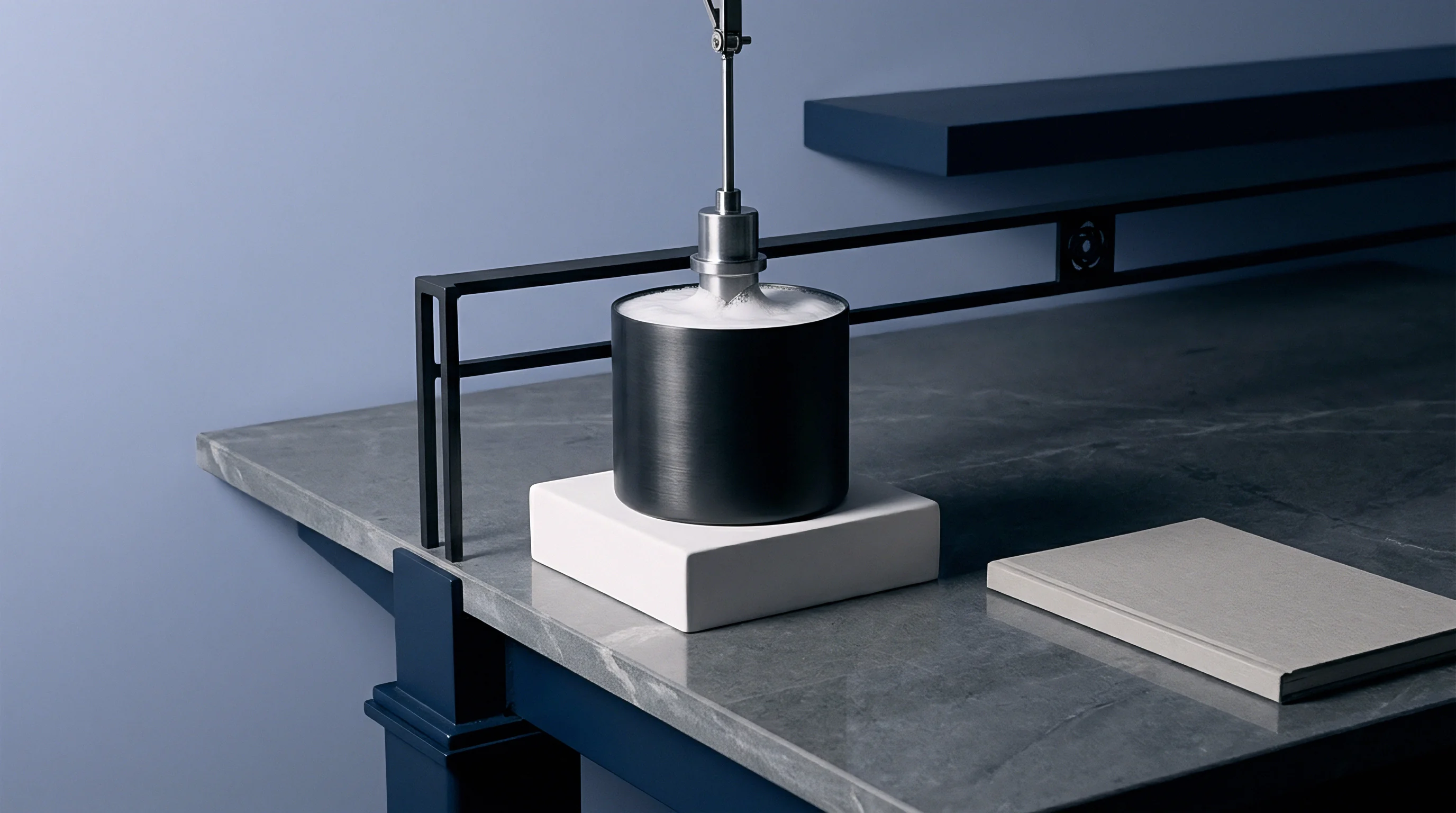

Chamber
Air permeability testing for raw flax bundles passes dry air at a controlled rate through a packed cylindrical chamber containing a precise specimen mass. The cell creates a fixed boundary condition where fluid drag reflects total specific surface area. While standardized airflow instruments for cotton assume uniform ultimate fiber diameters, flax has a far more complex composite structure.
Raw scutched flax consists of long technical fibers made up of elementary ultimate fibers bonded by middle lamellae of pectin, hemicellulose, and residual lignin. Packing the specimen into the test plug creates an anisotropic pore structure; airflow through the chamber slows as technical fiber bundles become finer, as smaller bundle diameters present more surface area per unit mass to the moving fluid.
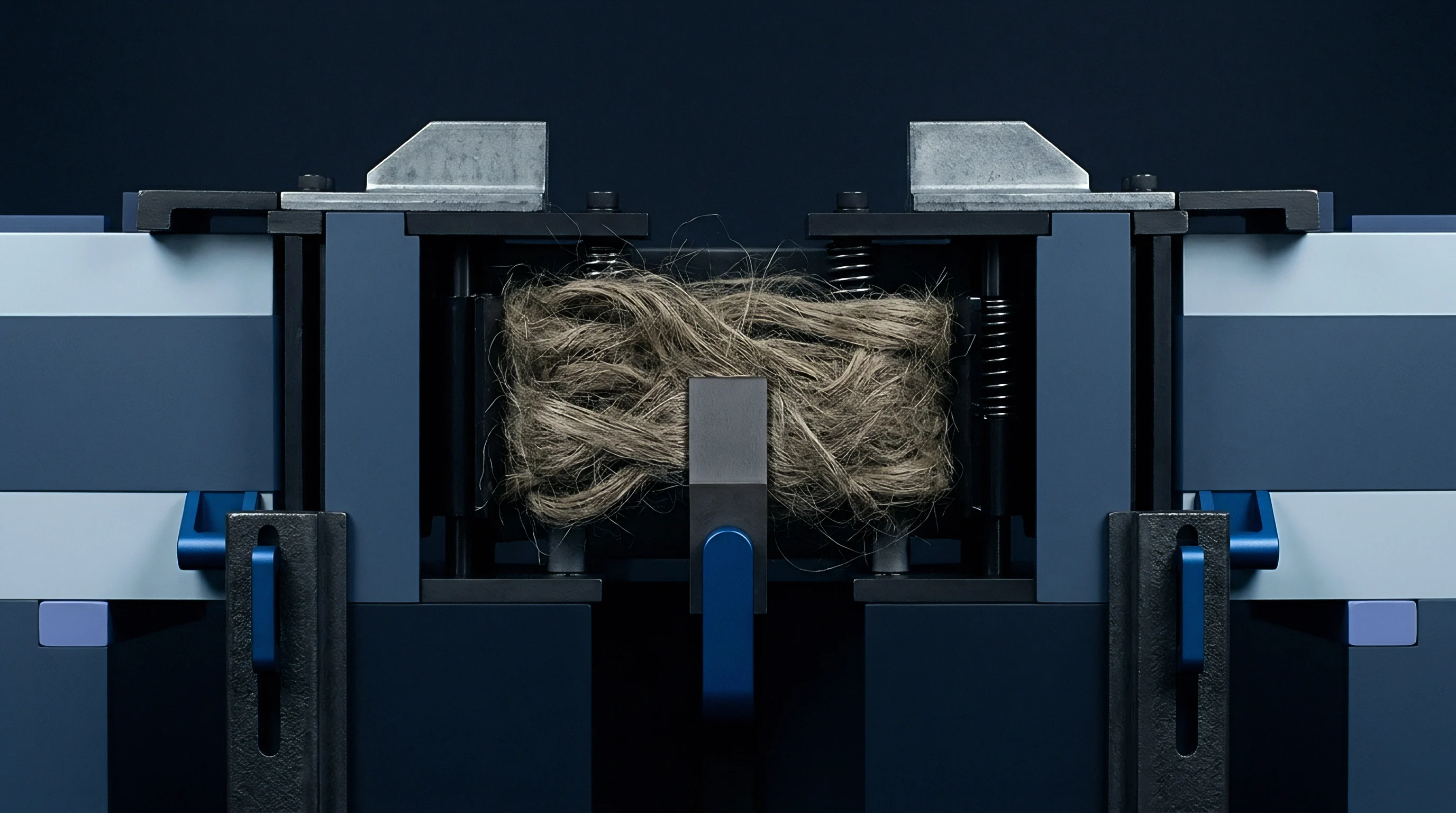
The geometry of the test chamber determines the flow velocity profile across the bundle plug. Standard cylindrical chambers for raw flax specify an internal diameter of 25.0 mm and a fixed or variable compression height between 25.0 mm and 50.0 mm. Target specimen mass is 5.000 g with a tolerance of 0.005 g.
Inserting 5.000 g of flax into a 25.0 mm diameter chamber compressed to a height of 25.0 mm yields an overall plug volume of 12.27 cubic centimeters. Assuming a solid fiber density of 1.50 g per cubic centimeter for raw flax, the solid fiber volume is 3.33 cubic centimeters, resulting in a bed porosity of 0.728. This sits within the viscous flow regime governed by the Kozeny-Carman differential pressure model.
Chamber seals require careful inspection, as any leak allows air to bypass the fiber bed along the cell walls.
Measuring differential pressure requires precise transducers operating from 0 to 2000 Pa. Standard test parameters call for either a constant pressure drop across the plug or a constant volumetric flow rate. In constant differential pressure protocols, the pressure drop across the bed is fixed at 1000 Pa ± 5 Pa while the instrument measures the resulting flow rate in liters per minute. Under constant flow protocols, an internal pump maintains a steady 10.0 liters per minute through the plug while the instrument measures the pressure drop across the specimen face.
Variable flow rates require non-linear turbulence corrections, as laminar flow through the compressed bed holds only while the Reynolds number based on hydraulic pore diameter stays below 2.0.
Chamber seal leaks allow air to escape along the inner wall, inflating the measured flow rate and artificially lowering calculated fiber fineness. This leakage occurs when raw flax bundles lie parallel to the airflow vector without sufficient transverse compression. Standardized test cells prevent this by using internal steps or slotted brass retaining plates with 40 percent open area, holding the bundle ends in place while keeping axial flow lines uniform through the core of the specimen.
| Parameter | Standard Value | Tolerance | Impact of Deviation |
|---|---|---|---|
| Chamber Diameter | 25.0 mm | ±0.05 mm | Alters cross-sectional pore area and flow velocity |
| Plug Compressed Height | 25.0 mm | ±0.10 mm | Shifts overall bed porosity and Kozeny constant |
| Specimen Mass | 5.000 g | ±0.005 g | Directly errors calculated specific surface area |
| Differential Pressure | 1000 Pa | ±5 Pa | Induces non-laminar flow if exceeded |
| Volumetric Flow Rate | 10.0 L/min | ±0.1 L/min | Distorts flow resistance baseline readings |
Flow meter calibration relies on primary volumetric standards or calibrated trace-standard porous ceramic plugs, with routine checks scheduled every 200 test cycles or at the start of each shift. Because ambient temperature and barometric pressure alter air density and dynamic viscosity, standardized calculations apply real-time viscosity adjustments using Sutherland equations based on room temperature. Leaving raw airflow readings uncorrected for temperature shifts can introduce up to 4 percent error in calculated fiber linear density.
Mechanical wear on compression piston seals gradually changes the internal volume of the test chamber. Technicians verify cylinder height by checking piston stroke position with precision block gauges. A reduction in plug height of just 0.5 mm increases compression enough to drop bed porosity from 0.728 to 0.713.
That added resistance can make a fine flax sample appear up to 15 percent finer than its true physical linear density, making regular maintenance essential to keep piston tolerances within specification.
Discrepancies in airflow fineness ratings can stem from natural seasonal variations in raw flax bundle elasticity, which cause unpredictable rebound against the piston during compression.
Porosity
Fluid motion through a packed flax bundle follows the Kozeny-Carman model for flow through porous media, treating the fiber mass as a network of parallel microscopic capillary channels with an equivalent hydraulic radius. This hydraulic radius represents the ratio of bed void volume to total exposed fiber surface area. That surface area per unit volume of fiber directly drives flow resistance: fine flax bundles contain many thin technical fibers per unit mass, presenting a large surface area that restricts airflow, whereas coarse bundles contain thick, un-split fibers with less surface area, allowing air to pass at lower pressure drops.
Calculating specific surface area from permeability data requires accurate measurements of fiber density and bed porosity. The volume flow rate per unit cross-sectional area is modeled as a function of pressure drop, bed height, dynamic air viscosity, and the dimensionless Kozeny constant. For randomly oriented fiber plugs, the Kozeny constant sits near an empirical value of 5.0.
Aligning long-staple flax bundles parallel to flow lowers the effective constant toward 3.5, while perpendicular alignment pushes it above 6.0. To ensure a stable, isotropic Kozeny factor, standardized loading protocols specify randomized carded sliver or a criss-cross hand-hackled web.
Technical flax fiber bundles are structurally distinct from individual ultimate fibers. An ultimate flax cell measures 10 to 30 micrometers in diameter and 20 to 40 mm long, whereas technical fibers are composite bundles of tens or hundreds of ultimate cells cemented together, spanning 40 to 100 micrometers across. Air permeability testing measures only the outer surface of these technical bundles.
It cannot capture individual ultimate fiber diameters unless full chemical degumming or intensive mechanical cottonisation breaks the pectin bonds prior to testing.
Air permeability flow resistance across a compressed flax bed scales inversely with the square of technical fiber specific surface area at a constant bed porosity of 0.728.
Channel tortuosity measures the winding path air takes through the porous bed relative to the straight cylinder height of the chamber. Bundle crimp, micro-entanglement, and residual bark fragments all increase this path length. The added tortuosity raises the measured pressure drop, making the fiber mass appear finer than its actual cross-section indicates.
Standard preparation steps control for this by removing heavy entanglements through hand hackling over standardized pin density beds.
| Processing State | Mean Bundle Fineness (dtex) | Specific Surface Area (m²/g) | Bed Porosity (ε) | Air Resistance (kPa·s/m²) |
|---|---|---|---|---|
| Scutched Raw Line Flax | 25.0 to 35.0 | 0.18 to 0.25 | 0.728 | 12.5 to 18.0 |
| Hackled Line Sliver | 12.0 to 18.0 | 0.30 to 0.42 | 0.728 | 22.0 to 31.0 |
| Combed Tow Sliver | 15.0 to 22.0 | 0.26 to 0.35 | 0.728 | 19.0 to 26.0 |
| Cottonised Flax Fiber | 2.5 to 4.5 | 0.85 to 1.30 | 0.728 | 65.0 to 95.0 |
Interactions between air molecules and fiber surfaces transition from continuum fluid flow to slip flow as pore channels approach microscopic dimensions. Under standard test conditions, where mean hydraulic channel diameters stay above 5 micrometers, continuum flow mechanisms dominate and air viscosity remains uniform across the pore network. Extreme micro-fibrillation in raw flax bundles can narrow pore channels enough to trigger Knudsen diffusion, where gas molecules collide more often with channel walls than with each other.
Maintaining standardized pressure drops of 1000 Pa keeps fluid movement firmly inside the laminar continuum regime.
Fineness values calculated from permeability readings are reported as an equivalent linear density in millitex or dtex, or as a metric fiber number (Nm) ~ the length in meters of one gram of fiber. Fine flax line slivers reach Nm values of 2000 to 3000, corresponding to linear densities of 3.3 to 5.0 dtex, while coarse scutched flax yields Nm values between 300 and 600 (16.6 to 33.3 dtex). Ultimately, fiber surface and mass density govern flow resistance.
Dew-retted technical fiber bundles with identical specific surface areas can produce divergent pressure drops when tested in dry versus humidified air streams due to underlying structural mechanisms.

Moisture
Flax is a highly hygroscopic bast fiber with a standard moisture regain of 12.0 percent under ambient test conditions. Absorbed water causes significant transverse swelling in the cell wall while longitudinal extension remains negligible. This swelling expands technical fiber bundle diameters by up to 15 percent as relative humidity rises from 0 percent to 90 percent.
Cross-sectional expansion directly reduces void volume inside the fixed-volume test cell, driving down bed porosity and pushing up measured airflow resistance.
Standard testing calls for strict environmental control per ISO 139: a laboratory atmosphere maintained at 20.0°C ± 2.0°C and 65.0 percent ± 4.0 percent relative humidity. Before reaching equilibrium, specimens must be pre-conditioned in a low-humidity atmosphere between 10 percent and 25 percent relative humidity for at least 4 hours. This eliminates hysteresis effects between desorption and adsorption.
Testing damp flax straight out of unventilated bales without pre-conditioning leads to severely inflated fineness values because channel constriction artificially restricts flow.
How Does Ambient Moisture Alter Airflow Resistance?
Moisture within the bundle drives both physical swelling and gas-liquid surface interactions. When moist air passes through a dry specimen, localized moisture absorption releases heat of sorption, shifting local air temperature and dynamic viscosity. Conversely, pushing dry air through a damp flax plug evaporates bound water, cooling the cell and narrowing pore spaces.
Reliable readings require complete thermal equilibrium between the incoming air stream, the fiber sample, and the brass cell walls, with temperature recorded hourly.
Uncontrolled humidity drift across the conditioning cabinet can alter resistance values significantly. Relative humidity spikes from 65 percent to 75 percent increase airflow resistance by an average of 8.2 percent across identical long-staple flax lots. That shift drops calculated metric fiber numbers from Nm 1200 down to Nm 1080, misrepresenting high-grade spinning stock as mid-grade material.
Tight atmospheric control prevents these costly false rejections when commercial shipments arrive.
Water regain values vary with how thoroughly the fiber was retted. Under-retted flax retains significant hydrophilic hemicellulose and pectin, absorbing up to 14 percent moisture under standard conditions. Over-retted or dew-retted fiber with stripped outer layers holds less, around 10.5 percent.
Calibration curves built for water-retted flax therefore create systematic errors if applied to field-retted or enzymatically processed stock without adjusting for regain.
Uncontrolled moisture distorts readings, meaning airflow resistance values remain consistent and repeatable only when ambient relative humidity is kept strictly within specified tolerances.

Debris
Raw scutched flax contains varying amounts of non-fibrous epidermal debris, woody stem shive, cuticular wax, and dust. Rigid, non-porous shive fragments disrupt uniform fiber alignment inside the test plug, creating localized macro-voids along their surfaces. Air takes the path of least resistance, channeling through these gaps instead of percolating evenly through the micro-porous fiber matrix.
This bypass artificially drops the measured pressure differential, producing low resistance readings that overestimate true fiber fineness.
Preparing raw flax for permeability testing requires careful cleaning. Overly aggressive mechanical carding or motorized hackling breaks technical bundles, shortening staple length and generating artificial fines. Conversely, leaving intact shive plates causes airflow bypass.
Standard pre-cleaning protocols call for manual hand hackling across three pin density beds: coarse (2 pins per centimeter), medium (6 pins per centimeter), and fine (12 pins per centimeter). This strips unretted cortical tissue and loose shive without altering the natural fineness distribution of the bundles.
Uncleaned cortical trash and residual pectin glues can quickly blind the cell’s retaining mesh plates. Micro-fine shive dust accumulates on lower brass orifice plates, restricting exit ports and creating false resistance readings. Cleaning chamber interiors with soft brass wire brushes and acetone wipes every 10 test runs prevents resin accumulation, as clogged mesh screens restrict airflow regardless of actual fiber properties.
Coarse shive fragments present in raw scutched flax specimen plugs generate micro-channel bypass routes that reduce measured air pressure drop by up to 22 percent.
Mills absorb the cost of rejected shipments when uncleaned shive skews initial permeability readings. Raw scutched line flax rated at Nm 1100 based on uncleaned samples can yield an audited true fineness of only Nm 850 when subjected to standardized hand hackling and shive extraction. Lots that prove too coarse to spin fine wet-spun yarns force an immediate downgrade to coarse dry-spun upholstery counts.
Shive content determination runs alongside air permeability testing. Standard procedures weigh residual shive collected on a 0.5 mm mesh sieve after manual hackling. Typical raw long flax carries between 1.0 percent and 3.5 percent shive by mass.
If shive content exceeds 2.5 percent, raw airflow fineness values must be corrected mathematically using empirical trash coefficients, or the sample must undergo secondary manual dressing before cell loading.
- Macro-void formation creates preferred air pathways along rigid woody stem surfaces, lowering pressure drop across the specimen plug.
- Mesh plate blinding restricts orifice exhaust areas when fine epidermal dust lodges inside retaining screens, inflating apparent fiber flow resistance.
- Pectin film bridge formation seals pore channels when damp, unretted middle lamellae compress under piston load, falsely raising calculated fiber fineness.
- Fibre breakage during aggressive cleaning creates artificial micro-bundle fragments, artificially elevating exposed specific surface area.
Omitting manual shive extraction destroys inter-laboratory test correlation and invalidates compliance certificates.

Specimen
Specimen preparation dictates the precision and repeatability of raw flax airflow testing. Unlike standardized cotton testing, where random fiber masses are loaded directly into the chamber, raw flax requires structured bundle sampling, alignment, and staple cutting. Testing follows modified ISO 2370 methods for bast fiber fineness determination.
Technicians draw random samples across at least ten individual scutched flax stricks taken from different depths of a bale, pulling thin parallel ribbons from the mid-section to avoid non-linear thickness variations found at root and top ends.
Extracted fiber ribbons are aligned by drawing them repeatedly across hand-hackling pin beds until they form a uniform parallel web. This alignment eliminates transverse criss-crossing so air distributes evenly through the fiber array. The aligned web is then cut to precise staple lengths ~ typically 40.0 mm using a dual-blade rotary guillotine cutter.
Trimming removes feathered bundle ends, creating square, clean boundaries inside the cylindrical chamber.
The cut fiber mass is weighed on an analytical balance precise to 0.001 g to reach the target specimen mass of 5.000 g. The technician divides this 5.000 g sample into four equal sub-bundles of roughly 1.250 g, placing them in the test chamber in alternating layers rotated 90 degrees. Cross-layering prevents continuous air channels from forming in one direction, creating an isotropic plug when compressed.
Compression is applied slowly over a 5-second stroke, allowing trapped air to escape without disrupting fiber alignment.
- Sample ten distinct stricks across the bale mass, drawing 15-gram ribbons from the central section of each strick.
- Dress ribbons across coarse, medium, and fine hand-hackling pin beds to strip loose shive and align technical fiber bundles.
- Trim dressed ribbons to a uniform 40.0 mm staple length using a calibrated dual-blade cutter block.
- Weigh a 5.000 g ± 0.005 g test specimen on an analytical balance under standard atmospheric conditions.
- Load four equal sub-layers into the test chamber in alternating 90-degree orientations before applying piston compression.
Testing protocols require at least three replicate specimens per sample lot, with individual readings falling within a 3 percent coefficient of variation. If variation across three replicates exceeds 5 percent, the technician discards the dataset, cleans the test cell, recalibrates the pressure transducer, and prepares three fresh specimens from the original strick samples. High variance between replicates usually signals inconsistent hand hackling or uneven shive distribution in the plug.
| Parameter Name | ISO 2370 Modified Standard | Commercial High-Throughput Protocol | Acceptable Range |
|---|---|---|---|
| Specimen Mass | 5.000 g | 2.500 g | ±0.005 g |
| Cut Staple Length | 40.0 mm | 25.0 mm | ±0.5 mm |
| Chamber Diameter | 25.0 mm | 20.0 mm | ±0.05 mm |
| Compression Height | 25.0 mm | 15.0 mm | ±0.10 mm |
| Pressure Drop | 1000 Pa | 500 Pa | ±5 Pa |
| Conditioning Time | 24 Hours at 65% RH | 4 Hours Rapid Flow | Minimum 4 Hours |
| Replicate Count | 3 Bundles | 5 Bundles | Minimum 3 Valid Tests |
Excessive bundle length variation increases drafting forces during yarn spinning. Precise cutting during sample preparation stops long fiber entanglements from distorting packing inside the chamber; shoving uncut continuous bundles into small cells creates dense corners and loose center cores, invalidating Kozeny-Carman flow assumptions.
- Conditioning certificates must detail ambient laboratory relative humidity, temperature, and pre-conditioning history alongside mean flow rates.
- Hackling yield logs must track mass loss during manual specimen dressing to verify representative bundle selection.
- Transducer calibration records must document zero-point pressure offsets and flow meter calibration checks.
- Shive mass correction figures must report residual woody matter percentage extracted during specimen preparation.
Per ISO 2370 Section 6.2, contracts specify that raw flax fineness values derived from air permeability testing carry an acceptable inter-laboratory error margin of ±4 percent when both parties employ identical hand-hackling preparation protocols and conditioned laboratory environments.
Valuation
Air permeability test data directly connects physical fiber properties to spinning mill performance and commercial value. Technical bundle fineness dictates the fine limit of yarn counts achievable on wet- and dry-spinning frames. Fine flax with high metric numbers (Nm 1500 to 2000) lets wet spinners draft thin roving strands with enough fibers per cross-section to maintain strength and avoid end breaks, whereas coarse fibers (Nm 400 to 700) limit production to thick yarns, heavy canvas, or industrial twines.
These spinning limits directly set the commercial price per kilogram of raw scutched line flax. High-grade French or Belgian water-retted line flax measuring Nm 1800 on airflow tests commands 4.80 EUR to 5.50 EUR per kilogram, while coarse domestic dew-retted flax measuring Nm 600 fetches only 2.10 EUR to 2.60 EUR per kilogram. Precise airflow testing protects buyers from paying premium prices for lots containing coarse, un-split bundles that cannot spin fine counts.
| Commercial Fiber Grade | Airflow Fineness (Nm) | Max Wet Spun Count (Ne / lea) | Hackling Yield (%) | Landed Cost (EUR/kg) | Woven Fabric Cost (EUR/m) |
|---|---|---|---|---|---|
| Premium Line Flax (Grade 1) | 1800 to 2200 | 60 lea (Nm 100) | 68% to 72% | 5.20 | 8.40 |
| Standard Line Flax (Grade 2) | 1200 to 1500 | 40 lea (Nm 67) | 62% to 66% | 3.80 | 6.10 |
| Coarse Scutched Flax (Grade 3) | 700 to 900 | 25 lea (Nm 42) | 54% to 58% | 2.80 | 4.60 |
| Combed Tow Stock | 500 to 650 | 14 lea (Nm 23) | N/A (Tow) | 1.90 | 3.20 |
Hackling yield tracks closely with initial airflow fineness readings. Raw scutched flax with fine, well-retted bundles suffers far less fiber breakage and produces less tow on industrial hackling frames. A lot testing at Nm 1600 can yield up to 70 percent hackled line fiber sliver against 30 percent tow.
Conversely, a coarse, under-retted lot testing at Nm 600 breaks heavily during pin combing, dropping line yield to 52 percent and turning 48 percent of the input mass into low-value tow because un-split bundles resist the comb pins.
Spinners calculate yield deductions directly from mean fiber linear density, and buyers routinely include these price adjustments in raw fiber purchase agreements. A typical clause penalizes the invoice price by 1.5 percent for every 50 Nm drop below specified baseline fineness, compensating the spinner for increased comb waste and lost spinning efficiency.
Calculating finished fabric costs requires tracking waste across hackling, drawing, roving, and spinning steps. High-quality Nm 1800 raw fiber at 5.20 EUR per kilogram with a 70 percent hackling yield produces combed sliver costing 7.42 EUR per kilogram. Spinning that sliver into fine 60 lea yarn adds 3.10 EUR per kilogram in processing costs, and weaving it into 150 g/m² linen shirting brings the final landed material cost to 8.40 EUR per linear meter.
Flawed airflow fineness metrics cause spinners to underestimate waste, quickly eroding weaving margins.
Standardized air permeability testing provides an objective physical basis for raw flax grading, eliminating visual bias and tying raw fiber pricing directly to mill yields and fabric economics.