Integration of Reed Width Contraction and Loom Crimp Take up in Linen Weaving
Reed width contraction and warp crimp take-up in linen weaving require dynamic adjustment of loom tension and denting space to offset flax inelasticity.


Dent
Denting width establishes the structural baseline for greige linen construction. When high-modulus bast fibers enter the reed under tension, yarn resistance opposes the lateral forces generated at beat-up. Bast fibers have high flexural rigidity and minimal elastic strain compared to cotton or synthetics.
Warp beam tension provides little linear stretch, forcing the weft thread to bend around warp ends and pulling the fabric inward the moment it leaves the fell of the loom.
Across various wet-spun linen densities, the dimensional shift from drawn width to the off-loom state reflects internal bending moments seeking equilibrium as warp tension relaxes at the cloth roller. In 100 percent linen fabrics, weft crimp drives most of this contraction. The stiffness of wet-spun flax keeps the weft from lying flat as the reed pushes each pick into position, drawing outer warp ends inward and narrowing the fabric across the reed space.
Miscalculating this pull alters finished ends per centimetre, distorts fabric mass, and risks leaving reed marks along the selvedges.

Reed Space Mechanics and Width Contraction Mechanics
Sizing the total reed space requires accounting for reed wire thickness, dent spacing, and selvedge reinforcement. Warp width in the reed always exceeds target grey width. For standard plain-weave linen, contraction from reed to off-loom greige ranges between 4 percent and 9 percent, depending on pick density, yarn count, and beam tension.
High pick densities amplify contraction because each added pick forces the weft through more structural undulations per unit length, pulling the selvedges closer together.
Relative humidity in the weaving shed directly alters flax flexural rigidity, shifting width contraction by over one percent across seasonal shifts.
Reed selection ~ measured in dents per centimetre ~ governs yarn distribution and localized friction. High denting densities increase friction against flax slubs, which occur naturally as thick and thin spots throughout the fiber bundle structure. When a heavy slub wedges into a narrow dent, friction creates sudden spikes in warp tension.
These tension spikes restrict weft crimp at specific dents, causing uneven width contraction across the reed space. A uniform denting plan helps smooth out these variations.
Selvedge construction forms the mechanical boundary resisting lateral contraction. Standard practice deploys heavier double-end denting or specialized selvedge yarns with higher elasticity ~ such as plied flax or textured filament ~ to anchor cloth edges. If selvedge ends draw in too far, heavy temple loading is required to hold fabric width.
Temple pins can pierce and snap stiff flax fibers, causing edge breaks and stop marks. Balancing reed width against temple settings limits edge damage while maintaining target greige width.

Lateral Force Allocation in High-Modulus Flax Warps
Rather than absorbing impact through elastic stretch, high-modulus fibers transmit beat-up forces directly into the loom frame. During beat-up, the fell shifts forward under the impulse of the reed, subjecting the weft to sharp tension spikes at the apex of the warp shed. With an initial modulus ranging from 50 to 80 GPa, flax resists axial extension and dissipates energy by forcing the weft into a serpentine path around warp ends.
Linen yarn resists structural bending during weave formation.
Greige fabric width drops immediately upon leaving the loom.
This displacement draws warp ends closer together. The compressive force traveling along the weft scales directly with yarn diameter and twist factor. Thanks to high bundle cohesion and smooth surface profiles, wet-spun linen yarns transfer lateral compression far more efficiently than dry-spun yarns.
Loose fiber ends and lower structural density in dry-spun linen cushion the contact zone, slightly reducing overall reed width contraction.
- Yarn Spinning System determines fiber packing density and surface friction; wet-spun flax yields higher contraction than dry-spun alternatives under identical loom settings.
- Pick Density Setting governs the frequency of structural crimp intersections per unit length, driving greater lateral draw-in as picks per centimetre increase.
- Warp Sheet Tension forces the weft into maximum structural deflection, directly increasing width contraction while suppressing warp crimp take-up.
- Shed Opening Angle defines mechanical clearance during insertion, influencing thread friction and edge contraction forces at beat-up.
- Tempering Pin Geometry holds the fell at target width, counteracting the natural inward pull of the interlacing weft thread.
Accounting for these variables enables production planners to calculate accurate reed widths before warping. On the floor, operators sometimes attempt to compensate for narrow greige width simply by tightening temple grip, but excess temple load damages stiff flax without altering structural width. The correct fix scales reed denting width based on measured yarn crimp behavior and moisture conditions.
Underestimating the lateral force of high-modulus linen causes cloth to narrow past design tolerances before reaching the batching motion. Fabric then enters finishing with inaccurate thread counts, shifting finished weight per square metre and invalidating cost models established at contract signing.
Geometry
Modeling linen fabric geometry requires adapting classic Pierce thread interlock equations to accommodate the rigid, non-circular structure of flax yarn. Standard geometric models assume flexible, round yarns that deform uniformly under tension. Flax behaves differently: cross-sections flatten into elliptical profiles at beat-up points, while high flexural rigidity prevents full flattening, establishing a stiff equilibrium between warp and weft bending radii.
Calculating exact warp yarn consumption requires integrating reed width contraction and crimp take-up into a single structural model. Relationships between reed width, greige width, finished width, warp crimp, and weft crimp form an interdependent system where changing one variable forces measurable shifts in the rest. Crimp take-up (Cw) represents the fractional excess of warp yarn length (Lw) over the length of the woven fabric (lf), expressed mathematically as:
Cw = fracLw – lfLw
Simultaneously, weft crimp (Cf) governs the relationship between reed width (Wr) and off-loom grey fabric width (Wg), defined relative to drawn warp width in the reed:
Cf = fracWr – WgWr

Pierce Model Adaptations for Inelastic Bast Fibers
Applying Pierce fabric geometry to linen requires modified equations that incorporate yarn flattening ratio (η = dminor / dmajor) and bending energy limits. High flexural stiffness (B) prevents flax yarns from making zero-radius bends at thread crossings. The thread path follows a modified elastica curve dictated by fiber modulus rather than tight geometric wrapping.
Crimp wave height (hw for warp, hf for weft) determines overall fabric thickness (Tf) according to:
Tf = dw + df + hw + hf
Where dw and df represent effective minor diameters of warp and weft yarns after compression. In plain weave linen, thread spacing (pw along weft, pf along warp) interacts directly with yarn crimp height. Increasing warp ends per centimetre reduces pw, forcing weft crimp height (hf) upward through spatial crowding.
Higher hf increases weft crimp percentage, driving greater reed width contraction.
Stiff fiber dynamics alter the underlying fabric geometry.
When warp tension rises, warp crimp height (hw) approaches zero, flattening the warp sheet. Weft yarn must then assume maximum crimp height (hf) to clear the taut warp ends. This condition ~ warp-dominated crimp exchange ~ produces maximum reed width contraction.
Conversely, lowering warp tension lets the warp bend around the weft, balancing crimp height (hw ≈ hf) and reducing weft crimp, preserving off-loom width closer to drawn reed width.
A 10 percent increase in warp beam tension can force an additional 3 percent reed width contraction while reducing warp crimp take-up by 2.5 percent on Nm 26 linen.

Mathematical Derivation of Integrated Width and Crimp Factors
Integrating reed width contraction (Sr) and warp crimp take-up (Cw) for production planning requires deriving total yarn length per metre of finished fabric. Assigning Sr as the reed contraction factor, Sf as the finishing width contraction factor, Cw as greige warp crimp, and Cwf as final finished warp crimp, total warp yarn length (Lwarp) required per finished fabric metre (mf) is calculated through sequential contraction steps:
Lwarp = fracmf(1 – Cw)(1 – Slong)
Where Slong represents the longitudinal wet processing shrinkage factor. Off-loom pick density (Pg) relates to loom pick counter setting (Pl) through warp crimp take-up:
Pg = fracPl1 – Cw
Similarly, off-loom ends per centimetre (Eg) relates to denting ends per centimetre (Er) through reed width contraction (Sr):
Eg = fracEr1 – Sr
Combining these expressions yields the finished thread count equation. Expressing total width contraction from reed to finished fabric as St (St = 1 – (Wf / Wr)), finished ends per centimetre (Ef) is calculated as:
Ef = fracEr1 – St
Running these calculations beforehand prevents yarn shortfalls during warp preparation. The sequence below derives grey reed width directly from target finished specifications.
- Determine the target finished fabric width and target ends per centimetre based on customer specification requirements.
- Obtain historical wet processing contraction percentages for the chosen finishing route, separating mechanical relaxation from thermal shrinkage.
- Calculate targeted greige width by applying finishing width shrinkage factors to the target finished width.
- Select reed denting configuration based on yarn count, determining ends per dent and total active dents required.
- Estimate weft crimp take-up using yarn flexural rigidity metrics and target pick density settings.
- Calculate required total reed width by dividing targeted greige width by the quantity one minus the estimated weft crimp fraction.
- Verify total warp end count by multiplying calculated reed width by reed ends per centimetre, adding dedicated selvedge ends.
- Adjust loom take-up wheel gearing to achieve target greige picks per centimetre after accounting for warp crimp take-up.

Empirical Construction Matrix across Flax Yarns
Flax yarns vary widely across metric count (Nm), twist level, and spinning method. Fine wet-spun yarns (Nm 39 to Nm 60) exhibit different crimp integration behavior compared to coarse dry-spun yarns (Nm 8 to Nm 14). Finer yarns bend more easily, allowing closer thread spacing without driving up weft crimp.
Coarse yarns resist bending, generating larger crimp wave amplitudes and higher lateral contraction forces.
The table below details comparative construction parameters, reed settings, off-loom contraction values, and crimp integration metrics across three standard linen fabric classes woven on rapier looms under controlled 65 percent relative humidity conditions.
| Yarn Count (Warp/Weft) | Weave Structure | Reed Width (cm) | Off-Loom Width (cm) | Finished Width (cm) | Warp Crimp (%) | Weft Crimp (%) | Total Width Contraction (%) |
|---|---|---|---|---|---|---|---|
| Nm 14 / Nm 14 | Plain 1/1 | 168.0 | 155.0 | 148.0 | 7.2 | 7.7 | 11.9 |
| Nm 26 / Nm 26 | Plain 1/1 | 165.0 | 154.5 | 150.0 | 5.8 | 6.4 | 9.1 |
| Nm 26 / Nm 26 | Twill 2/2 | 162.0 | 154.0 | 150.0 | 4.2 | 4.9 | 7.4 |
| Nm 39 / Nm 39 | Plain 1/1 | 160.0 | 152.0 | 148.0 | 4.9 | 5.0 | 7.5 |
| Nm 39 / Nm 39 | Satin 5 | 157.0 | 151.5 | 148.0 | 3.1 | 3.5 | 5.7 |
Analyzing this matrix highlights how weave float length influences dimensional contraction. Plain weave structures show the highest warp and weft crimp take-up because thread interlocks occur at every single pick. Twill and satin weaves lower interlock frequency per unit area, letting threads lie straighter.
Consequently, a 2/2 twill yields lower width contraction (7.4 percent total) compared to a plain weave of identical yarn count (9.1 percent total).
Warp tension directly governs crimp exchange.
Overlooking these structural distinctions during loom setup leads to off-spec fabric. Applying a plain-weave reed calculation to a 5-shaft satin construction results in fabric coming off the loom wider than intended, dropping pick density below target and yielding insufficient fabric weight per square metre.
Faulty geometric models risk over-ordering warp yarn by up to 8 percent or delivering narrow greige rolls that miss finished width specifications following scouring and tentering.
Rigidity
Bending stiffness in bast fibers creates mechanical challenges during shed formation and beat-up that directly alter crimp distribution. Unlike high-elasticity synthetics that handle tension shifts through axial stretch, flax fibers absorb mechanical loads through flexural deformation and inter-fiber friction inside the yarn core. Rigidity scales with the square of yarn diameter and depends heavily on moisture content and pectin lubrication.
Dry flax yarn becomes brittle and stiff, resisting the crimp formation necessary for stable fabric construction.

How Does Fiber Inelasticity Impact Warp Crimp Exchange?
Inelastic warp yarns resist bending around the weft during shed opening and beat-up. As the shed opens, warp ends undergo cyclical extension; high-modulus flax tolerates less than 2 percent elastic elongation before permanent deformation or breakage occurs. Controlling peak shed tension requires dynamic backrest rollers and easing motions.
High backrest tension keeps the warp taut, shifting nearly all interlacing curvature into the weft yarn.
On a 44 Nm wet-spun linen warp, warp end breakage reached 4.2 percent when beam tension exceeded 180 cN per end. Lowering warp beam tension to 120 cN per end reduced breakage to 0.4 stops per loom-hour while allowing warp crimp to rise from 3.8 percent to 5.4 percent. This shift in crimp distribution reduced off-loom weft crimp, causing greige width to expand by 1.8 centimetres across a 160 centimetre reed width setting, demonstrating how loom tension directly regulates width contraction through mechanical crimp exchange.
Pick density increases as the fabric relaxes.
Warp beam tension directly alters thread spacing.
Flax’s inelasticity also causes uneven tension distribution across the warp sheet. Outer warp ends near the edges experience higher lateral drag from weft insertion pull. Lacking elasticity to equalize tension across the shed, outer ends carry higher static loads.
This localized tension spike restricts weft bending near the selvedges, creating firm, tight edges prone to tearing under temple stress or distorting during wet finishing.
Loom Setting Dynamics and Tension Transients
Optimizing loom settings for linen weaving requires synchronizing shed timing, backrest position, and beat-up point. Closing the shed late (after beat-up) eases warp tension when the reed strikes the fell, minimizing yarn abrasion but reducing weft crimp insertion, which leads to lower reed width contraction and reduced off-loom pick density. Closing the shed early (before beat-up) locks the inserted pick inside a crossed warp shed as the reed advances, forcing maximum crimp into the weft thread and raising width contraction.
Maintaining loom shed relative humidity at 68 percent stabilizes flax flexural stiffness, ensuring consistent crimp take-up across continuous production runs.
Backrest roller height alters the geometry of top and bottom shed lines. Raising the backrest roller above horizontal alignment creates an asymmetrical shed that balances tension between top and bottom warp sheets during movement. This setting prevents slack warp ends, improves beat-up clarity, and stabilizes width contraction along the entire length of the warp beam.
Defect Cascades Driven by Miscalculated Reed Contraction
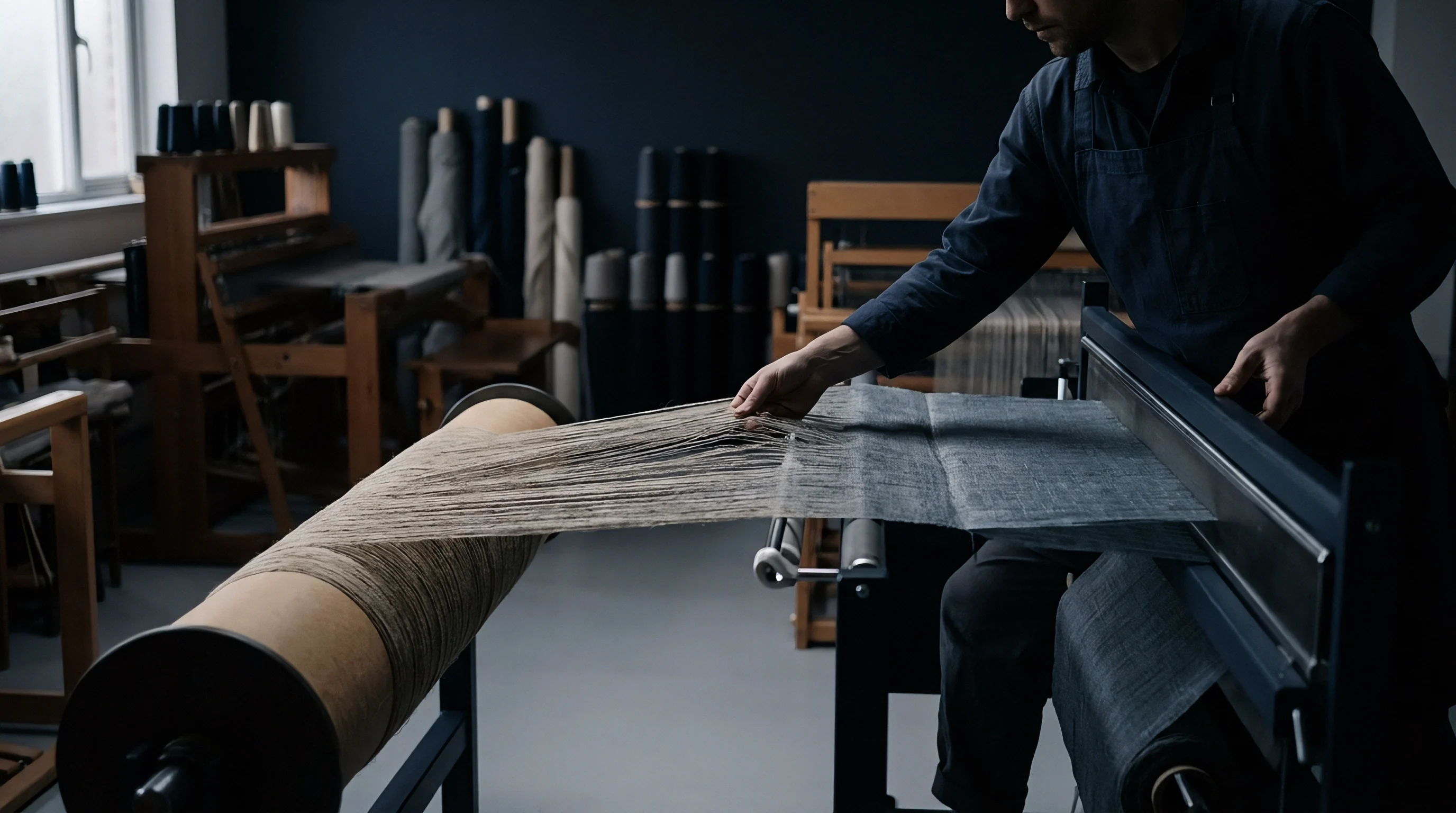
Improper calculation of reed width contraction and crimp take-up triggers secondary quality defects during high-speed rapier or air-jet weaving. The list below highlights critical machine-level failure modes resulting from incorrect width and tension alignment.
- Temple Mark Piercing occurs when excessive width contraction forces the fabric selvedge to enter the temple rings at an acute angle, causing steel pins to puncture and sever warp threads.
- Selvedge Tightness Wave results from unequal crimp distribution between selvedge ends and ground cloth, creating wavy edges that buckle during batching.
- Reed Line Faults develop when dense warp end packing in over-crowded dents increases inter-thread friction, preventing clean shed separation and causing broken picks.
- Fell Rebound Instability emerges when high warp tension pushes the fell back toward the reed between beats, leading to pick density variations and horizontal shading bands.
- Warp Streak Formation arises from uneven lateral draw-in across the reed space, causing localized density variations that appear as shaded vertical bands in finished dyed fabric.
Shed geometry directly controls warp stress.
Resolving these defect cascades requires systematic adjustment of backrest timing, warp beam tension, and reed denting plans. Operators cannot rely on static formulas alone; dynamic loom trials are required to measure actual width contraction under operational shedding conditions.
Irregular yarn slubs and natural fiber variations present challenges to width control, but off-spec grey dimensions remain manageable through proper tension and reed adjustments.

Finish
Wet processing causes substantial dimensional shifts in woven linen fabrics. Flax fibers contain amorphous regions, natural hemicellulose, and pectins that swell when exposed to water and elevated temperatures. This radial swelling expands yarn diameter, altering the geometric packing of the weave matrix.
As yarn thickness grows, the crimp path around intersecting threads deepens, driving significant longitudinal and transverse shrinkage.
Wet-Processing Shrinkage and Crimp Amplification
In the grey state, linen fabric retains mechanical tension imposed by the loom batcher, storing residual stress inside the rigid fiber structure. Immersing the cloth in hot scouring liquor fully relaxes these stresses. As the fiber bundles swell, warp and weft threads adopt higher crimp configurations ~ a process known as relaxation shrinkage, operating independently of thermal fiber contraction.
Heavy yarn slubs disrupt beat-up uniformity.
Mechanical tumbling and washing consolidate threads, amplifying crimp further. Agitation in wet finishing machinery lowers inter-thread friction, allowing interlaced yarns to slip into their lowest energy states. Warp crimp take-up climbs from off-loom greige levels (typically 5 to 7 percent) to finished levels exceeding 8 to 12 percent in heavy plain weaves.
Total width contraction expands accordingly, taking net width loss from reed space to finished bolt up to 12 to 16 percent.

Finishing Route Impact on Dimensional Stability
Finishing sequences exert varying levels of mechanical tension and chemical alteration on flax fabric. Continuous routes, like open-width scouring and pad-steam bleaching, apply axial tension that restricts warp shrinkage while pulling fabric width narrower. Discontinuous batch routes, such as jet washing or soft-flow rope processing, permit tensionless relaxation, maximizing longitudinal crimp take-up and width contraction.
The table below summarizes dimensional contraction percentages, warp crimp shifts, and pick density gains across four standard industrial finishing routes applied to Nm 26 plain weave linen drawn at 165 cm reed width.
| Finishing Route Description | Mechanical Processing State | Finished Width (cm) | Total Width Contraction (%) | Finished Warp Crimp (%) | Finished Pick Density (picks/cm) | Longitudinal Shrinkage (%) |
|---|---|---|---|---|---|---|
| Continuous Open-Width Bleach & Tenter | High Warp Tension / Stenter Width Held | 152.0 | 7.9 | 6.2 | 17.5 | 3.1 |
| Rope Scour / Jet Dye / Tenter Dry | Moderate Relaxation / Moderate Tension | 148.0 | 10.3 | 8.8 | 18.4 | 6.2 |
| Continuous Mercerization / Washing | High Caustic Swelling / Staged Tension | 145.0 | 12.1 | 10.4 | 19.1 | 7.8 |
| Air-Jet Mechanical Softening (Airo) | Zero Tension / Maximum Tumbling | 141.0 | 14.5 | 12.1 | 20.2 | 10.5 |
Selecting the right finishing route is essential for meeting target fabric performance metrics. Mercerization using concentrated sodium hydroxide (28 to 30 degrees Baumé) alters cellulose crystal structure, converting Cellulose I to Cellulose II. This chemical shift causes severe fiber swelling and longitudinal contraction, driving total width contraction past 12 percent unless stenter chains mechanically restrain the fabric.
Wet processing steps intensify overall width contraction.
Chemical and mechanical finishing shrinks the linen matrix.
Air-jet mechanical tumbling represents maximum tensionless relaxation. High-velocity air streams drive wet fabric against stainless steel baffle plates, softening stiff fibers and forcing the weave into full structural consolidation. While this process creates a soft hand, it increases warp crimp to 12.1 percent and raises pick density from 16.5 picks/cm off-loom to 20.2 picks/cm finished.
Standard purchasing specifications must incorporate ISO 5077 test protocols for dimensional stability, setting maximum allowable residual washing shrinkage at 3.0 percent for finished linen goods.
Failing to account for finishing shrinkage in initial loom setup calculations yields incorrect finished dimensions. If reed width is calculated for continuous open-width processing but the batch undergoes rope-jet dyeing instead, finished width can drop up to seven centimetres below specification, making the fabric unusable on automated cutting tables.
Standard buyer specification clauses state: Finished width tolerance shall not exceed plus or minus 1.0 centimetre from purchase order target, and residual laundering shrinkage shall not exceed 2.5 percent in either direction under ISO 6330 washing procedure 4N.
Yield
Factoring reed width contraction and crimp take-up into operational planning determines financial yield per loom-hour and total landed fabric cost. Linen yarn represents between 50 percent and 70 percent of woven cloth production expenses. Waste from miscalculated warp lengths, excessive off-loom width contraction, or stenter trim losses directly erodes manufacturing profit margins.
Loom Capacity and Width Utilization Economics
Weaving planners evaluate loom allocation based on net usable cloth width rather than total reed space. Modern rapier looms carry high hourly operating costs, so maximizing financial output requires utilizing as much effective reed space as possible. If a loom possessing a 220-centimetre maximum reed space is assigned to weave fabric with a target finished width of 145 centimetres, width utilization efficiency drops significantly unless dual-width weaving is implemented.
Off-loom fabric relaxation shifts end density.
Loom reed width directly dictates yarn allocation.
Running a loom at partial reed occupancy increases fixed overhead cost allocation per metre. The table below outlines loom capacity economics, warp yarn consumption rates, and loom-hour costs across single-width and double-width configurations weaving Nm 26 plain linen.
| Parameter Description | Single-Width Configuration | Double-Width Configuration |
|---|---|---|
| Target Finished Fabric Width (cm) | 150.0 | 150.0 (x2 = 300.0) |
| Required Total Reed Width (cm) | 165.0 | 330.0 (plus 5 cm centre selvedge) |
| Nominal Loom Reed Machine Width (cm) | 190.0 | 360.0 |
| Loom Width Space Occupancy (%) | 86.8 | 93.0 |
| Loom Speed (Picks Per Minute) | 450 | 340 |
| Loom Operational Efficiency (%) | 88.0 | 82.0 |
| Weft Insertion Rate (Metres/Minute) | 742.5 | 1139.0 |
| Off-Loom Production Speed (Metres/Hour) | 13.2 | 18.6 (total combined metres) |
| Direct Loom Operating Cost ($/Loom-Hour) | $28.50 | $36.00 |
| Weaving Conversion Cost ($/Finished Metre) | $2.16 | $1.93 |
Calculated crimp rates guide initial loom settings.
Double-width weaving on wider machines (360 cm reed space) improves financial yield despite slower running speeds (340 PPM versus 450 PPM) and slightly lower efficiency from longer yarn travel paths. The weft insertion rate rises from 742.5 to 1139.0 metres per minute, dropping direct conversion costs from $2.16 to $1.93 per finished metre.
Landed Cost Calculations and Fabric Density Tolerances
Landed cost calculations must incorporate warp crimp take-up (Cw) and reed contraction (Sr) to price raw material mass per finished linear metre accurately. Fabric mass per square metre (G, in g/m2) is calculated from finished ends per cm (Ef), finished picks per cm (Pf), warp count (Nmw), and weft count (Nmf):
G = left( fracEf × 100Nmw × (1 – Cwf) right) + left( fracPf × 100Nmf × (1 – Cff) right)
Where Cwf and Cff represent final warp and weft crimp fractions in the finished fabric, incorporating sizing removal and fiber weight loss during scouring (typically 3 to 5 percent mass loss for unbleached flax). Misjudging crimp take-up distorts calculated fabric weight. If actual warp crimp take-up is 10 percent while the cost model assumes 7 percent, warp yarn mass is understated by 3.2 grams per square metre.
Across a 50,000-metre production run of 200 g/m2 cloth, that discrepancy equates to an unbilled raw material consumption of 240 kilograms of flax yarn.
Commercial contract negotiations rely on strict tolerance limits for width, weight, and pick density. Standard trade terms allow a mass tolerance of plus or minus 5 percent and a width tolerance of plus or minus 1.5 percent. Because flax prices fluctuate with seasonal harvest yields, tighter operational control over width contraction and crimp integration is necessary to safeguard margins.
Establishing accurate crimp take-up and width contraction matrices shifts loom shed operations from reactive adjustment to systematic engineering. Combining yarn flexural parameters, modified Pierce geometry models, loom dynamics, and finishing relaxation factors builds a continuous control framework across the linen supply chain. Managing these mechanical interactions ensures woven bolts meet specifications, maximizes loom capacity, and protects landed profit margins.
Determining the right sensor configuration enables real-time, closed-loop adjustment of warp beam tension to dynamically stabilize reed width contraction as yarn moisture levels fluctuate during weaving.