Minimum Warp Lengths That Decide Whether a Sample Becomes Production
Minimum warp lengths depend on creel setup waste, sizing lead length, and loom setup hours, requiring at least 1,000 metres for viable production runs.
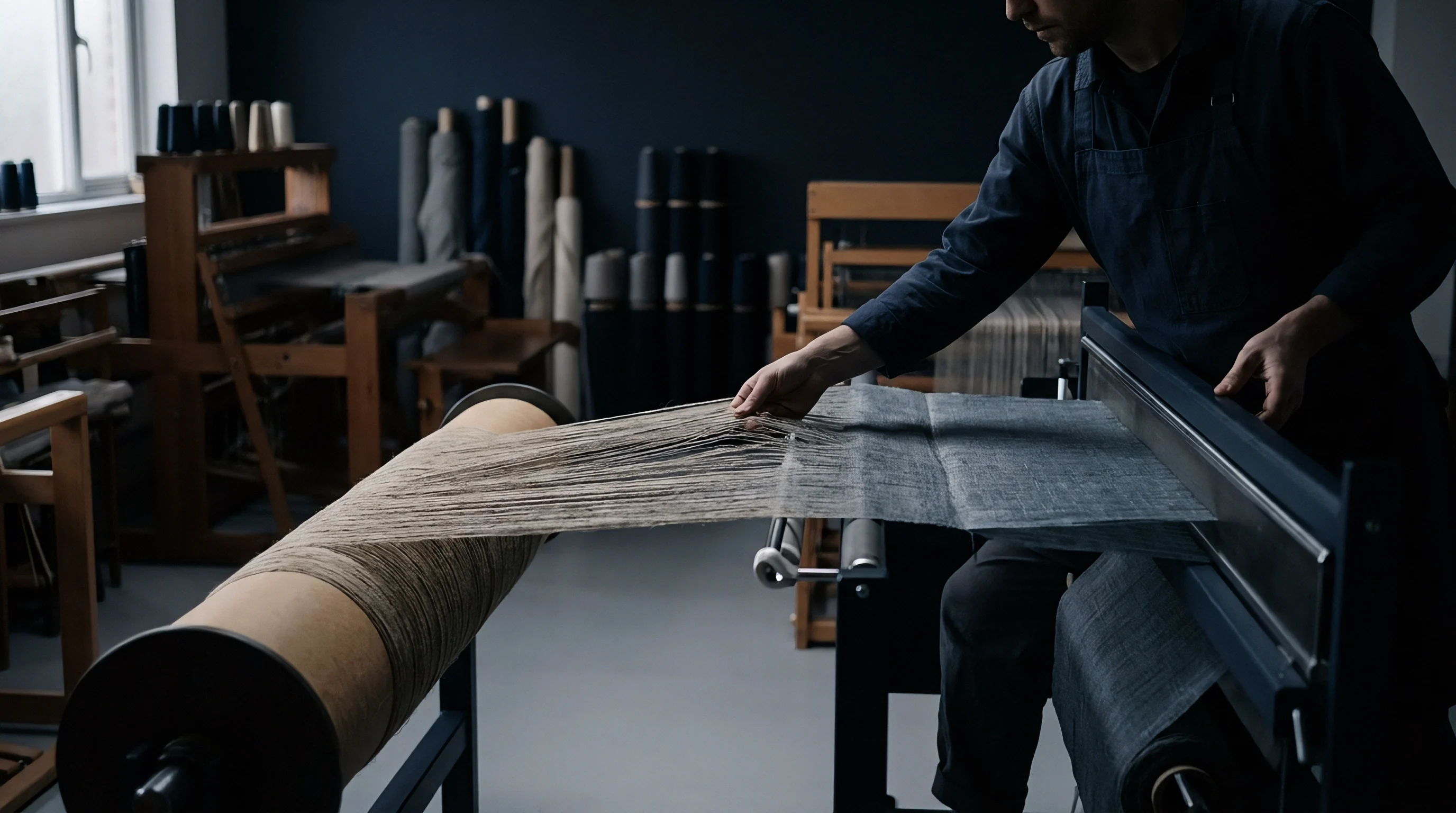
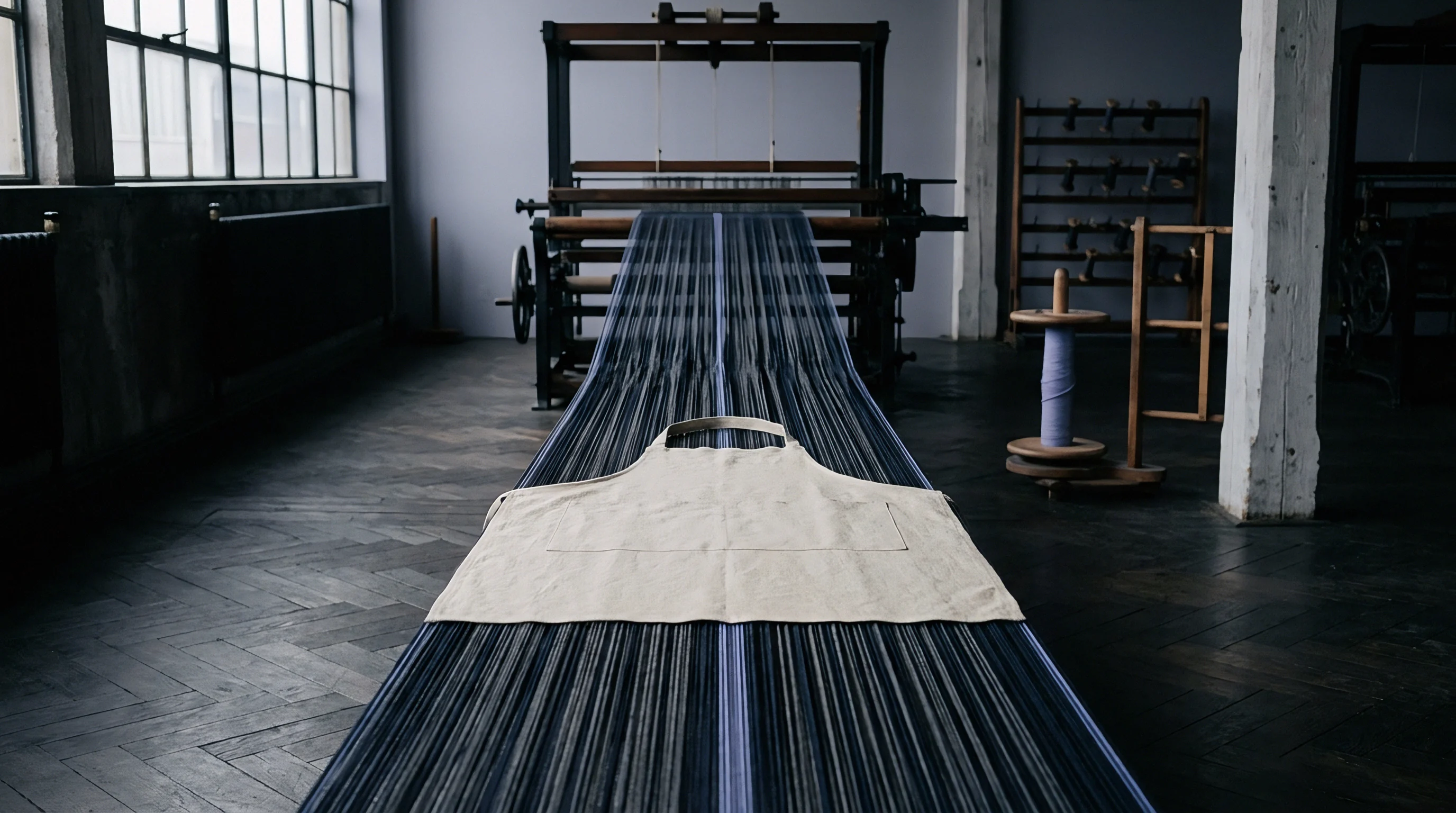
Creel
Warp preparation decides whether a woven construction can be run profitably on industrial looms. Turning packages of spun yarn into a parallel sheet with even density requires exact tensioning across every end. In a development facility, a sample warp typically runs fifty to one hundred metres ~ just enough for a sample loom to weave a few test cuts for handfeel, dye testing, and visual checks.
Scaling that same structure to bulk production brings minimum warp length physics into play. A commercial mill running sample-length warps quickly runs into severe financial losses and downtime. Moving from a sample beam to a production beam requires different machinery, creates unavoidable yarn waste, and demands setup labor that scales inversely with warp length.
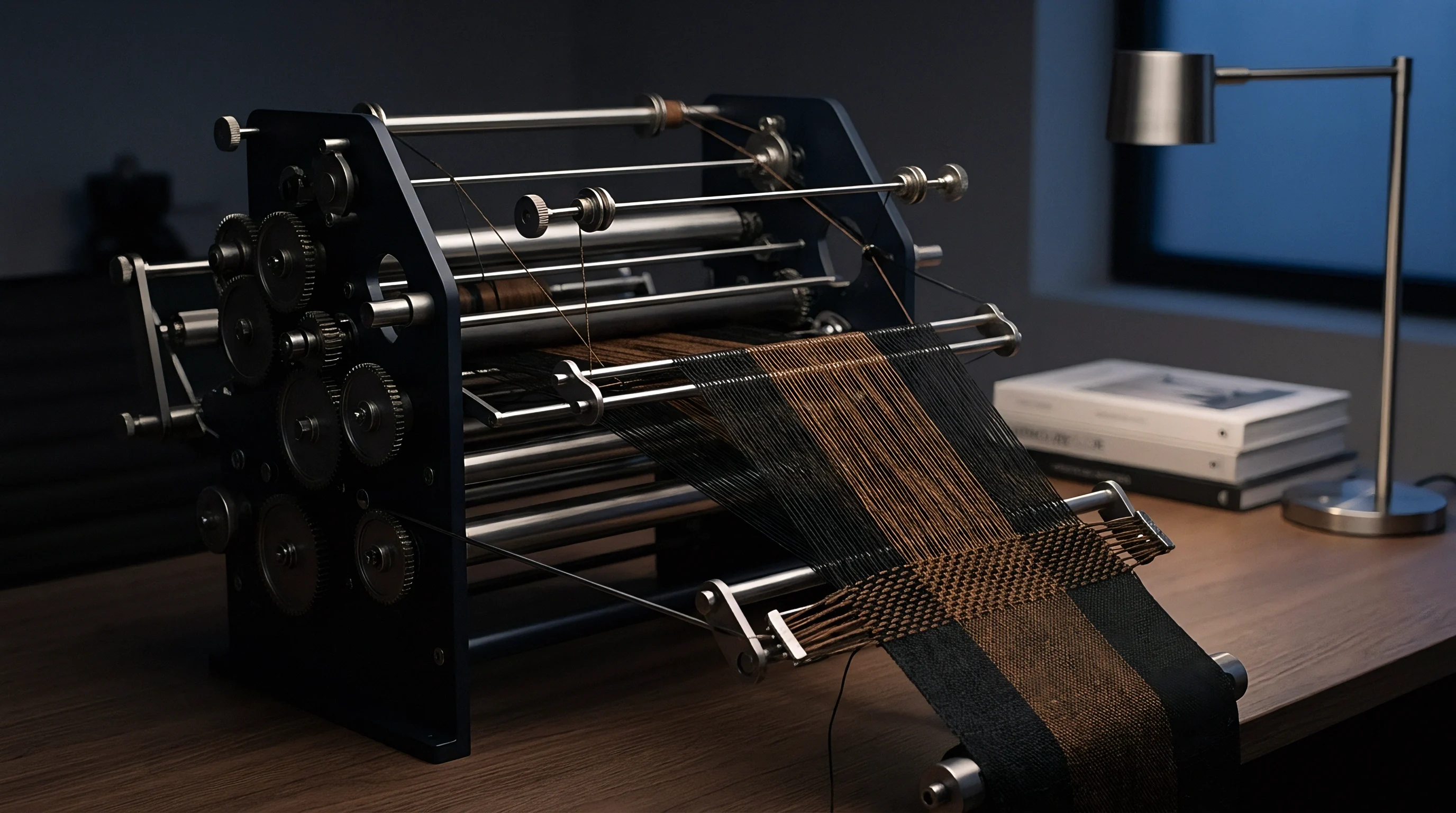
Sectional warping machinery is built for pattern development, short sample runs, and complex multi-color warps. Packages sit on a stationary creel holding a set number of spools, usually between 320 and 640 ends. Threads travel through tensioners and lease reeds onto an inclined conical drum in distinct bands, each carrying a fraction of the total warp ends needed for the fabric width.
For instance, a fabric requiring 4,800 total warp ends produced on a 400-cone creel takes twelve parallel bands wound side-by-side across the drum. After all twelve bands rest on the drum at uniform tension and length, the full sheet winds off onto a loom beam in a reverse operation known as beaming.
On a sectional warping mill, band length sets the final warp length. If an order calls for 150 linear metres of sample fabric, the operator winds 150 metres per band onto the drum. Mechanically, sectional warping forces tail-end waste at every package change and section start.
Threading ends through tension discs, lease reeds, and guides causes steady length loss. Later, during beam transfer, the tensioning setup needs extra length to lay the yarn sheet flat against the loom beam core. On a 150-metre band, setup and beaming losses eat up twenty to thirty metres of yarn before the beam even reaches the loom, dropping effective yield immediately and driving per-metre material costs sharply upward.
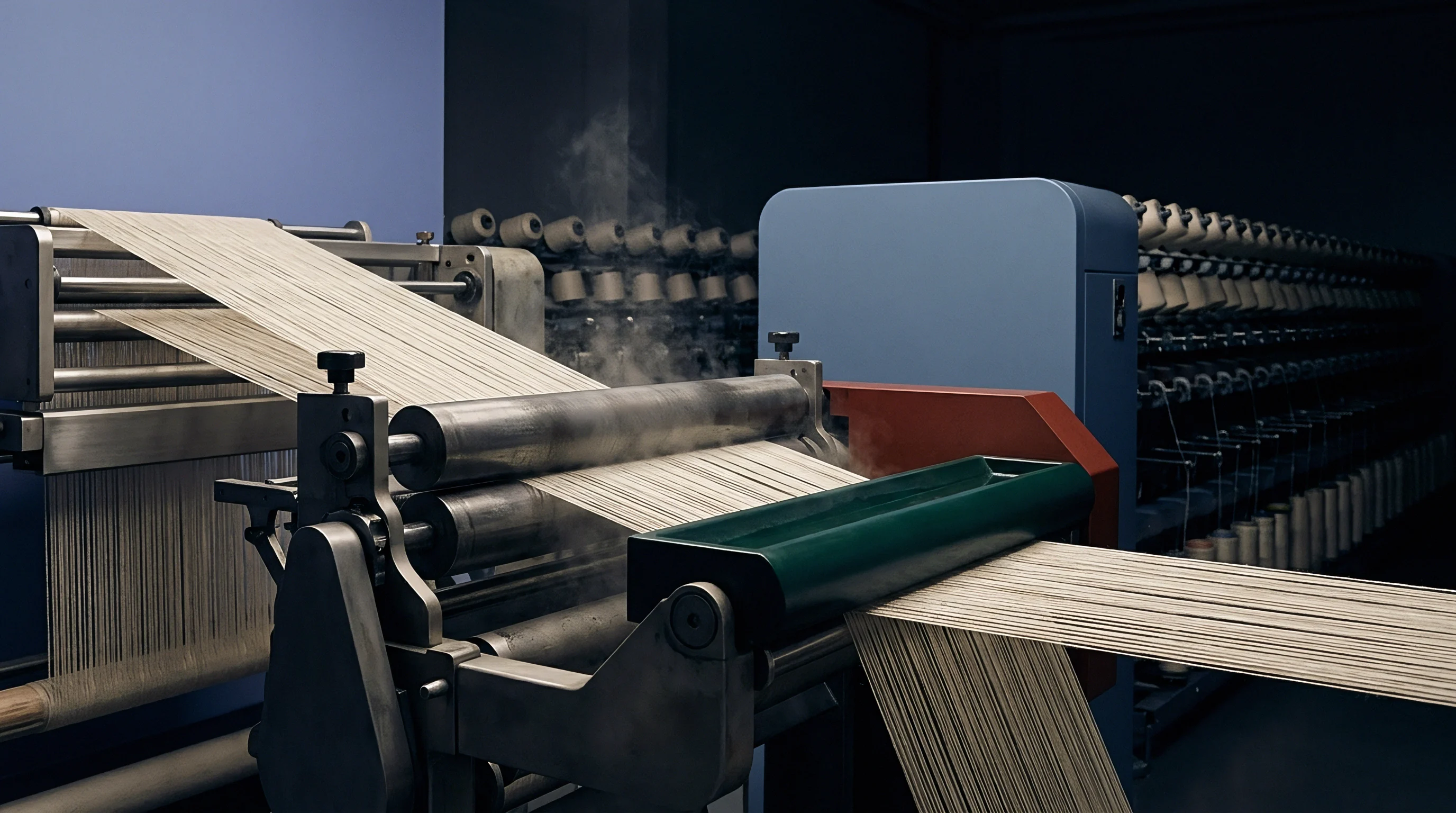
Direct beam warping works on entirely different principles, engineered for high-volume, solid-color, or simple stripe goods. Threads are pulled from a massive creel holding up to 1,200 packages, winding all ends at once onto a single section beam. To reach the end density needed for wide fabric, four to eight section beams are combined through a sizing machine onto a final loom beam.
Direct warping runs at up to 1,000 metres per minute, compared to 400 metres per minute on sectional units. However, creel loading and alignment demand long warps to make economic sense. Two operators spend about three hours just creeling a 1,000-package frame.
Running that creel for a mere 300 metres means far more time is spent in setup than in production, making short warps unviable on direct systems.
Package residue creates a strict physical limit on creel efficiency. Every yarn cone loaded onto a creel leaves an unwindable tail at the core. As yarn pulls off at high speed, tension becomes unstable near the inner paper tube, forcing operators to strip and throw away the final fifteen to twenty-five metres per package to prevent slubs, tension spikes, and warp breaks.
On a 4,800-end warp, scrapping 20 metres per package discards 96,000 metres of yarn. On a 5,000-metre production warp, that loss is under 0.4 percent of total volume. On a 200-metre sample warp, however, those same 96,000 metres equate to nearly 10 percent of the yarn bought, driving the cost per linear metre out of reach.
Sectional warping creel waste locks at twenty-eight metres per yarn package when running wet-spun flax at twenty-six metric yarn count.
Tying-in mechanics widen the split between short sample runs and production orders. When a loom finishes a beam, a new beam with the exact same end count and reed layout can be spliced directly into the existing sheet using an automatic knotting machine. The knotting head travels across the warp sheet, joining old and new ends at over 600 knots per minute.
This automated process takes only two to three hours of loom downtime and wastes about 0.5 metres of yarn per end. But automatic tying-in only works when the weave structure, reed count, and end total stay identical from one run to the next.
Because samples routinely tweak end counts, reed spacing, or yarn counts, automatic knotting is usually out of the question. The loom requires a full re-draw instead. Manual or semi-automatic drawing-in means pulling every single warp end through a drop wire, a harness eye in the shaft frame, and a dent in the reed.
On a complex 4,800-end dobby or Jacquard construction, this takes twelve to sixteen hours of manual labor while the loom sits dead idle. That setup expense has to be absorbed by the warp yardage. Spreading sixteen hours of loom downtime across a 100-metre sample imposes an immense cost penalty per metre; spreading it across a 3,000-metre bulk beam reduces that setup burden to a fraction of a cent.
Determining minimum viable warp length means factoring in yarn count, creel size, headstock loss, lease waste, and loom setup allowances. The equation pinpointing where structural setup waste falls within acceptable operational targets ~ normally under three percent total yarn loss ~ is expressed as:
L_min = (L_headstock + L_lease + L_tying + L_creel_tail) / (1 – (Y_target / 100))
Here, L_min is the minimum warp length in linear metres. L_headstock covers the length lost during headstock threading and drum transfer, typically 18 metres. L_lease accounts for leasing and cross-string insertion, averaging 6 metres.
L_tying includes knotting waste or re-drawing leader lengths, taking about 12 metres. L_creel_tail represents the unrecoverable package residue converted to warp length, calculated as total package tail length divided by total ends. Finally, Y_target sets the mill’s maximum acceptable yarn loss threshold, typically 3.5 percent for high-grade spun linen.
In a sectional setup, the creel’s physical spool capacity dictates the minimum ends per band pass. Running a 400-cone creel to build a 3,600-end warp requires nine band passes across the drum width. Tracking real yarn consumption across different warp lengths highlights how severely short runs compromise material efficiency.
| Warp Length Tier | Warping System | Setup Waste (m) | Creel Residue (m) | Total Yarn Loss (%) | Setup Labor (Hours) | Warping Efficiency (%) |
|---|---|---|---|---|---|---|
| 100 Metres (Sample) | Sectional Mill | 36.0 | 22.5 | 36.9% | 8.5 | 22.4% |
| 300 Metres (Development) | Sectional Mill | 36.0 | 22.5 | 16.3% | 8.5 | 48.1% |
| 1,000 Metres (Commercial Sample) | Sectional Mill | 36.0 | 22.5 | 5.5% | 9.0 | 76.5% |
| 3,000 Metres (Bulk Production) | Direct / Slasher Set | 48.0 | 15.0 | 2.0% | 12.0 | 88.9% |
| 6,000 Metres (Optimized Set) | Direct / Slasher Set | 48.0 | 15.0 | 1.0% | 12.0 | 94.2% |
Floor tracking data shows why commercial mills decline short warps for production runs. A 100-metre sample warp loses over 36 percent of its fiber to setup waste and creel residue before a single pick is inserted, while frequent re-threading and band positioning keep warping efficiency down at 22.4 percent. Scale that up to a 3,000-metre production warp on direct warping gear, and waste drops to 2.0 percent as efficiency reaches 88.9 percent.
Short sample warps simply cannot mirror the economics of bulk production.
Yarn lot continuity adds another layer of complexity when scaling up from development. Sample warps rely on small, uniform yarn batches ~ often spun on lab equipment or small pilot frames. Depending on density and count, a 100-metre sample needs roughly thirty to fifty kilograms of yarn.
A 3,000-metre production warp requires well over 1,500 kilograms. Because spinning mills produce in standard commercial lots of 1,000 to 3,000 kilograms per batch or autoclave, transitioning to bulk manufacturing means sourcing entirely new yarn lots. Critical properties like linear density CV, twist per metre, fiber length distribution, and residual moisture inevitably shift between spinning batches.
Those lot-to-lot variations directly impact fabric weight, cover factor, and pick uptake. A 26 Nm yarn targeted at 38.4 tex can drift by plus or minus 3 percent across production lots while still meeting commercial yarn standards. On a dense linen weave, that 3 percent shift alters finished cloth weight by eight to twelve grams per square metre.
Consequently, a sample swatch woven from a single pilot lot on a 100-metre warp feels noticeably different from bulk fabric woven from a commercial spinning lot on a 3,000-metre warp. Sourcing restraints enforce these minimum warp thresholds; purchasing smaller yarn quantities for intermediate runs incurs heavy lot surcharges from spinners, driving material costs past commercial feasibility.
Running short warp beams on industrial looms introduces mechanical failure modes. Warp tension fluctuates rapidly on short warps because the beam radius drops quickly during weaving. As the beam diameter shrinks from an 800-millimetre flange down to the 215-millimetre bare barrel, the let-off system has to constantly adjust brake torque.
Modern rapier looms rely on electronic let-off motors that adjust speed using continuous load cell feedback. On short warps, the rapid change in beam diameter forces the control loop to hunt for equilibrium, producing micro-variations in pick spacing that show up as periodic reed streaks or thick-and-thin bars across the cloth face.
Tension instability on short beams accelerates yarn abrasion in the shed. When tension drops as the beam radius changes, threads slacken during shed opening. These slack ends catch on adjacent threads, triggering false trips on electronic warp stop motions and causing frequent automatic stops.
Every restart risks leaving a starting mark ~ a visible line of altered pick density where the reed hits the cloth fell upon motor engagement. Defect rates per hundred square metres rise sharply compared to stable, long production warps. In one trial run, short-beam tension hunting caused six thousand euros in lost material when persistent start marks ruined twelve consecutive cuts.
Shed
Loom behavior during sample runs rarely predicts performance in bulk production because of mechanical settling factors. Modern rapier and air-jet looms demand steady thermal and mechanical stability. High-speed rapier machines insert weft yarn at rates above 600 picks per minute with shed angles set to fractions of a degree.
Over the first fifty to one hundred metres of a fresh beam, the shedding motion, let-off load cells, take-up rollers, and temple cutters undergo continuous mechanical adjustments. A 100-metre sample ends before the loom settles into equilibrium, so evaluating quality strictly from a short sample run masks defects that surface only during continuous, long-run weaving.
Mounting a new warp beam requires threading thousands of ends through drop wires, harness eyes, and reed dents. The bring-up sequence requires meticulous work from weave room technicians to ensure consistent cloth structure across the full width. Cutting corners during setup introduces permanent defects across the entire beam.
On the shed floor, bring-up follows a strict sequence.
- The weave technician mounts the filled loom beam into the let-off gudgeon bearings, locking the mechanical brake assemblies and engaging the electronic let-off drive gears.
- The warp sheet passes over the backrest roller and drop wire sensor arrays, verifying that every individual thread breaks contact with the electrical drop wire ground bars.
- The harness frame height is leveled using optical height gauges, establishing correct shed geometry and equalizing tension between top and bottom shed positions during shaft opening.
- The reed enters the lay pocket, requiring precision alignment against the race board to prevent rapier guide teeth from cutting warp threads during insertion.
- The temple assemblies are positioned along the selvedge zones, setting ring pin angles to grip the fabric edge and maintain width against weft pull-in forces.
- The electronic take-up gear teeth mesh with the primary drive train, matching pick wheel teeth calculations to target picks per centimetre settings.
- The loom performs slow-motion inching cycles to verify shed clearance, rapier tape entrance timing, selvedge tuck-in pin motion, and left-hand cutter blade clearance.
- The main drive motor engages full continuous operating speed, running fifty test picks before inspecting fell line stability and electronic stop motion sensitivity.
Speed mechanics highlight clear differences between lab environments and production floors. Development sampling looms usually operate at lower speeds ~ 150 to 250 picks per minute ~ to avoid snapping un-sized or light-sized warps. Production looms running the same weave run at 500 to 750 picks per minute.
Dynamic stress on warp ends increases exponentially with loom speed, with tension spikes during shed opening scaling with the square of operating frequency. Yarn that weaves without issue on a slow sample loom can easily suffer severe end-break rates under production speeds as the reed cuts through the yarn.
Speed differences also alter weft insertion. Air-jet looms rely on main and relay nozzles to carry weft yarn across the shed through a profiled reed guide channel. Air velocity, pulse timing, and tank pressure must match the yarn’s linear density and surface hairiness exactly.
Spun flax and linen blends carry loose surface fibers that generate high aerodynamic drag and mechanical snagging. On short sample runs, technicians tweak nozzle pressures manually to force individual picks across. On a 5,000-metre production warp, compressed air consumption determines line profitability.
Running air-jets on spun linen requires consistent yarn hairiness, solid size protection, and precise nozzle timing to maintain efficiency above 90 percent.
Pattern repeat economics dictate whether complex dobby or Jacquard weaves can make the jump from sampling to volume runs. Dobby shedding motions operate up to 24 harness shafts through electronic solenoids and lifting hooks. Jacquard mechanisms bypass shafts entirely, controlling individual warp cords through solenoid modules managing anywhere from 1,200 to 14,400 independent hooks.
Setting up a Jacquard harness matrix involves threading cords through a comber board, fixing return springs or lingo weights to every line, and leveling hook heights across the entire frame ~ a major setup investment.
Jacquard repeat limits directly interface with reed width and minimum warp requirements. A large structural repeat, like a 1,200-hook independent figure spanning 20 centimetres, demands precise cord alignment. If a customer orders a 150-metre sample of custom Jacquard damask, the mill still incurs full programming fees, harness leveling time, and comber board threading costs.
That setup fee alone can equal the yarn value of the entire short warp. Amortizing that fixed charge over 150 metres inflates the fabric’s per-metre price, whereas spreading it over a 3,000-metre warp reduces setup overhead to a minor line item.
| Loom Insertion Type | Speed Range (PPM) | Max Reed Width (cm) | Selvedge Waste (cm) | Optimal Warp Length (m) | Target Efficiency (%) | Power Consumption (kW) |
|---|---|---|---|---|---|---|
| Flexible Rapier | 450 – 650 | 360 | 4.5 – 6.0 | 2,000 – 4,000 | 88.5% | 5.5 |
| Air-Jet Insertion | 700 – 1,000 | 340 | 6.0 – 8.5 | 4,000 – 8,000 | 92.0% | 11.2 |
| Projectile Drive | 350 – 450 | 540 | 3.0 – 4.0 | 3,000 – 6,000 | 86.0% | 4.8 |
| Sample Rapier (Narrow) | 150 – 250 | 190 | 5.0 – 7.0 | 50 – 300 | 55.0% | 2.2 |
Operating metrics from commercial weave sheds illustrate why loom selection drives minimum warp lengths. Air-jet looms achieve high insertion rates up to 1,000 picks per minute, but draw 11.2 kilowatts of electrical power, mostly for compressed air generation. They demand long runs over 4,000 metres to offset setup time and air compressor overhead.
Flexible rapier looms handle coarse and fine spun yarns with moderate power draw, making them the standard choice for linen and blends. Sample rapier looms run at just 55.0 percent efficiency with high labor costs per metre, which is why mills attach heavy price multipliers to short development runs.
Selvedge formation creates steady structural waste that scales directly with woven yardage. Modern rapier and air-jet looms do not weave continuous shuttle selvedges; they cut the weft on every insertion, leaving trimmed fringe edges on both sides of the sheet. To lock those edges and stop unraveling, looms use auxiliary selvedge devices: tuck-in units, leno binders, or catch cord systems.
A catch cord setup runs independent warp ends outside the main fabric width to catch the cut weft end. After beat-up, edge cutters trim the catch cord fringe away, leaving a continuous waste strip of warp and weft yarn.
Catch cord waste strips consume four to eight centimeters of width across the loom lay. On every inserted pick, excess weft extends into the catch cord zone and cutter trough. Over a 3,000-metre production run of 160-centimetre finished cloth, the trimmed selvedge fringe amounts to 25 to 40 kilograms of usable yarn.
This material loss is engineered into high-speed shuttleless weaving. On short sample warps, selvedge waste stacks on top of creel and headstock waste, driving up overall loss percentages.
On rapier looms running flax warps, tension spikes occur whenever the warp beam diameter drops below two hundred millimeters. The beam has to rotate faster as the barrel empties to maintain linear yarn delivery for each pick cycle. The rotational inertia of the heavy metal beam flange resists the quick acceleration required by electronic let-offs during variable pick-density weaving.
Resulting tension spikes exceed the yield strength of single spun linen yarns, snapping multiple ends across the sheet. Running beams down to the bare barrel on short sampling runs causes three times more end breaks per hour than weaving through the middle section of a full beam.
Downtime from end breaks destroys shed profitability. When an end snaps, its drop wire falls against the sensor bar, grounding the electrical circuit and stopping the motor instantly. The weaver has to locate the broken end behind the harness frames, re-thread it through the drop wire and harness eye, guide it through the correct reed dent, knot it to the fell line, and restart the loom.
Manual piecing takes forty-five seconds to two minutes per break. If an unstable or under-sized short warp suffers fifteen breaks per hour, loom efficiency drops below 60 percent. Short warps tie up technician labor, block production lines, and yield greige rolls that fail basic inspection standards.
Sizing
Slashing coats continuous spun yarns with a protective film to prevent end breaks during high-frequency shedding cycles. Raw spun yarns ~ especially staple fibers like linen, cotton, and viscose ~ have surface hairiness and poor abrasion resistance. In the loom, warp ends rub against adjacent ends, drop wires, harness eyes, and reed wires thousands of times per minute.
Without sizing protection, fiber bundles fray, cling together, form fuzz balls, and snap under shed tension. Sizing coats individual yarn surfaces with film-forming polymers, binding loose surface fibers to the core while adding tensile strength and elasticity.
Sizing recipes combine water-soluble film formers, binders, and lubricants. Hydrolyzed polyvinyl alcohol (PVA), modified corn or potato starches, carboxymethyl cellulose (CMC), and acrylic copolymers form the core of modern formulations. Recipes for 100 percent spun flax prioritize film flexibility and moisture retention, since flax fibers are stiff and exhibit low elongation at break (typically 2.0 to 3.5 percent).
Sizing agents must penetrate outer fiber layers to provide internal cohesion without embrittling the yarn. Sizing wax or tallow emulsions add surface lubricity, lowering friction against metal loom components.
Liquor concentration in the size box determines dry size addon percentage. Size addon measures the dry chemical mass applied relative to dry raw yarn mass, calculated as:
Addon_% = ((W_sized – W_dry) / W_dry) 100
Here, Addon_% is the dry sizing pickup percentage, W_sized is the oven-dry weight of the sized yarn, and W_dry is the initial oven-dry weight of the raw yarn. For spun flax on high-speed rapier looms, target size addon ranges from 8.5 percent to 12.0 percent by weight. Below 7.0 percent, abrasion resistance breaks down and end breaks spike in the shed.
Above 14.0 percent, the yarn turns overly rigid, losing elasticity and causing brittle breaks at the fell line.
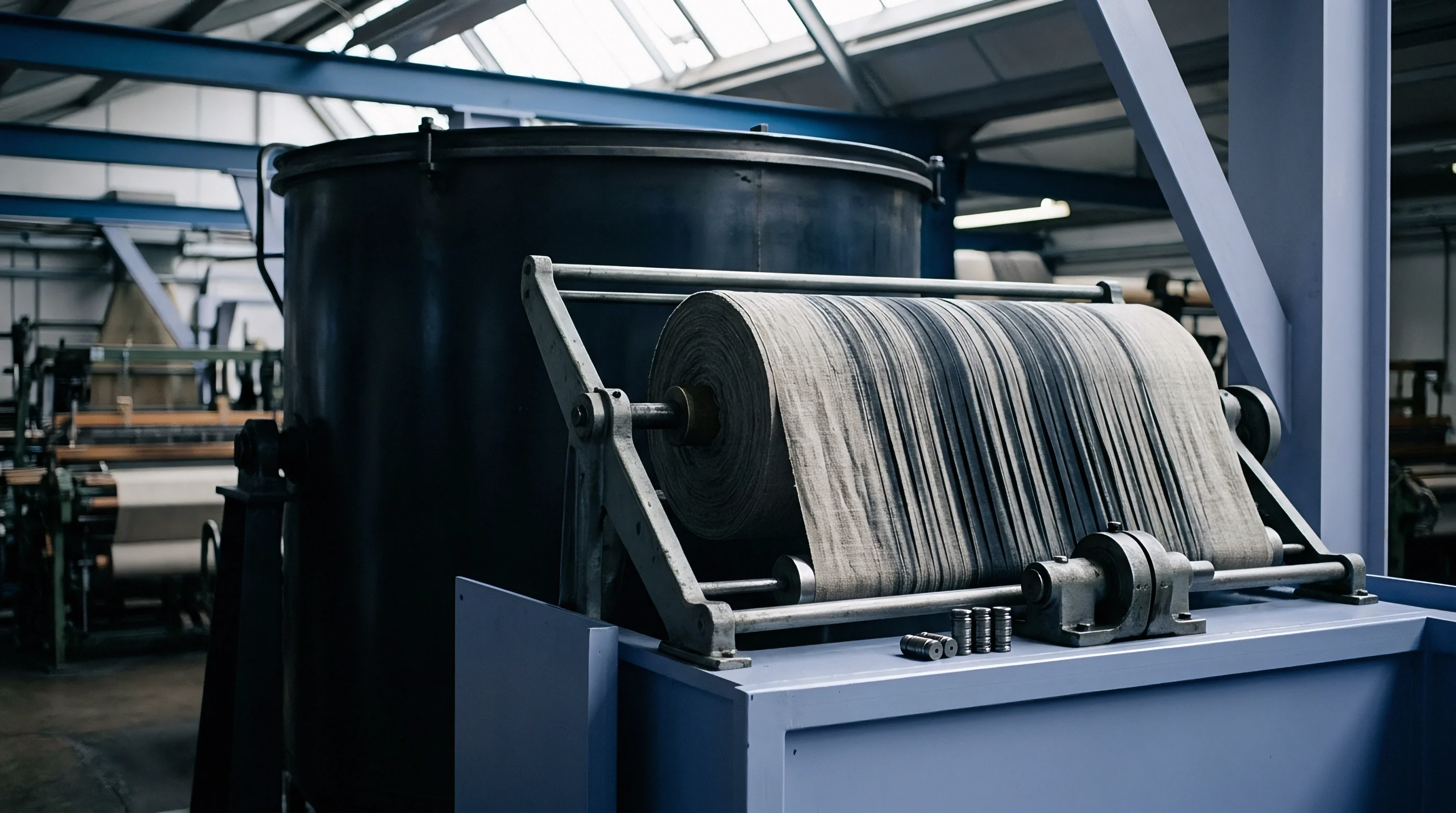
Slashing machinery relies on careful fluid dynamics and thermal control. The yarn sheet drawn from direct warping beams enters the size box, passing under immersion rollers that submerge the threads in hot sizing liquor kept at 85 to 90 degrees Celsius. Pneumatic squeeze rollers press out excess liquor, forcing chemical penetration into the core and establishing wet pickup levels.
Squeeze roller nip pressure must be adjusted based on sheet density and line speed. Running the sizing line too slowly during startup or speed transitions causes over-soaking, leaving heavy size deposits and uneven yarn stiffness across the sheet.
Drying cylinder thermodynamics ensure controlled moisture loss from the wet size film. The sized sheet moves over steam-heated stainless steel cylinders organized in temperature zones from 110 degrees Celsius down to 80 degrees Celsius. Drying must proceed gradually to avoid skinning ~ where the outer sizing film dries rapidly, trapping steam bubbles inside that rupture the protective shell.
Sized spun flax should leave the drying section at 7.5 to 8.5 percent residual moisture. Drying below 5.0 percent bakes natural flax fibers, leaving them brittle and unweavable; leaving moisture above 10.0 percent causes tacky size film that sticks on the loom beam.
Exiting the drying cylinders, the solid sheet enters the split rod field. Because size chemicals lightly glue adjacent threads together as they dry, lease split rods physically break these chemical bridges to separate individual ends before loom beam winding. Thread separation at the split rods puts high mechanical stress on the sized yarn.
Weak spots or uneven size application cause threads to snap at the rods. Slasher operators monitor split rod tension continuously to keep crossed or lost ends off the final loom beam.
Slashing waste mechanics explain why sizing short warps on commercial slashers is practical suicide. A commercial sizing line measures forty to sixty metres long from creel stand to front headstock winder. Threading the line requires pulling leader threads through immersion rollers, squeeze nips, steam cylinder banks, split rods, and front comb guides.
The yarn held within the machine footprint during threading becomes un-sized or unevenly sized leader waste. Tail-end waste occurs as rear warping beams empty, leaving un-pressurized lengths in the size box.
Threading and tail-end waste on a commercial slasher consumes 120 to 180 metres of warp sheet per sizing set. On a 4,000-metre production warp, 150 metres of slasher waste equals a modest 3.75 percent material loss. Try processing a 300-metre sample warp through that same slasher, and 150 metres of machine waste consumes 50 percent of the entire warp length.
Running short warps through full-scale slashers causes severe material loss and erratic size addon across the remaining yardage.
Standard slashing machinery wastes one hundred and fifty metres of thread sheet per run during size box immersion and split rod threading.
Alternative sample sizing methods try to bypass production slasher waste using single-end sizing or lab-scale tape sizing machines. Single-end sizing passes individual yarn packages through small chemical baths before re-winding onto cones. However, single-end sizing suffers from slow output, uneven size pickup control, and high labor costs per kilogram.
Single-end sized warps display erratic friction coefficients, leading to unstable loom tension and inconsistent fabric hand. Lab tape sizing units handle narrow warps up to 50 centimeters wide, but cannot duplicate the squeeze roller nip pressures or drying temperature gradients of production slashers.
This structural sizing gap creates a major hurdle when moving from development samples to bulk production. Sample swatches woven from un-sized yarns on low-speed hand looms, or single-end sized yarns on sample rapier looms, show different surface traits than production fabrics. Goods woven on high-speed looms carry heavy size coats that must be thoroughly desized during finishing.
If the desizing process in the finishing plant does not match the specific polymer chemistry and addon percentage applied during slashing, residual size remains in the cloth. Leftover PVA or starch stiffens the finished hand, blocks dye penetration, and causes blotchy shade variations across piece-dyed rolls.
Removing size formulations requires targeted enzyme or chemical wash steps during finishing. Starch sizes require amylase enzyme baths at controlled pH and temperature to break down insoluble starch into water-soluble dextrins. PVA films demand hot water washes above 85 degrees Celsius with surfactant additives to dissolve the polymer.
If a client approves a sample swatch that skipped industrial sizing and desizing cycles, the production fabric delivered after slashing, weaving, and chemical desizing may not match the original sample’s hand, drape, or luster. A sample woven without industrial slashing rarely matches the true hand, wet shrinkage, and tensile performance of a fully sized and desized bulk production fabric.

Tolerance
Physical properties measured on sample swatches alter when the same weave structure runs on production warps. Standard trade specs define acceptable variations between sample swatches and bulk shipments, yet buyers frequently overlook structural shifts caused by machine scale, yarn lot differences, and finishing adjustments. A sample swatch approved during development reflects a single physical state produced under controlled, low-speed conditions.
Bulk production fabric comes off multi-thousand-metre warps woven at high speed, subjected to mechanical tensions that alter dimensions, weight per unit area, and tensile behavior.
Spun yarn lot variance introduces structural baseline shifts before weaving starts. Yarns produced from natural staple fibers like flax, cotton, or wool show natural variation in linear density, twist distribution, and fiber crimp. A spinning mill supplying 26 Nm wet-spun flax guarantees linear density within a commercial tolerance band of plus or minus 3.0 percent, with twist multiplier tolerances permitting plus or minus 2.5 percent.
On short sample warps drawn from a single pilot spinning lot, yarn traits remain uniform throughout. Bulk production warps, by contrast, require multiple spinning lots blended across hundreds of yarn cones.
Variations in yarn twist directly change fabric hand and light reflection. Higher twist tightens the yarn structure, yielding a firmer hand and cleaner surface while slightly reducing yarn diameter. Lower twist lets fibers bloom, producing a softer hand, greater fabric thickness, and increased surface fuzz.
When bulk warps combine yarn packages from different spinning lots with slight twist differences, tiny variations in yarn diameter alter pick packing density during beat-up. The resulting bulk fabric can show subtle shifts in cover factor and drape compared to the single-lot sample swatch.
How Does Warp Crimp Variance Move Production Weight?
Thread curvature inside a woven matrix changes when warp tension shifts between short sample beams and long production runs. Warp crimp percentage measures the geometric difference between un-woven warp thread length and woven cloth length, expressed as:
Crimp_% = ((L_yarn – L_cloth) / L_cloth) 100
In this formula, Crimp_% is warp crimp percentage, L_yarn is the straightened length of warp yarn removed from the fabric, and L_cloth is the linear length of the cloth specimen. On narrow sample looms running under low beam tension, warp crimp often reaches 10.0 to 12.0 percent because low tension allows weft picks to push warp ends into deep undulations during beat-up.
High-speed production rapier looms run under heavy warp tension ~ typically 6 to 9 kilonewtons across full width ~ to ensure clean shed opening and prevent entanglements. High tension pulls warp threads flat, dropping warp crimp to 6.0 or 8.0 percent while forcing weft threads to absorb more bend crimp. This crimp interchange alters fabric dimensions and mass per square metre.
Lower warp crimp on production looms increases linear fabric yield per warp metre, but reduces overall fabric thickness and elasticity along the warp direction.
Commercial sampling trials across European weaving sheds show a 4.2 percent drop in fabric weight when shifting a 26 Nm linen construction from a 150-metre sample beam to a 2,000-metre production set. That weight drop occurred entirely because higher warp tension on the production loom flattened the warp crimp, extending the cloth yield while reducing thread density per unit length. The sample swatch weighed 210 grams per square metre, whereas the bulk production fabric settled at 201 grams per square metre under identical reed settings.
Buyers who write fixed fabric weight requirements without accounting for crimp interchange risk rejecting sound commercial production runs.
Cover factor calculations show how structural density moves between sample and bulk states. Fractional cover models measure the proportion of total fabric area covered by yarn surfaces. Using the standard Peirce fractional cover equation for plain weaves, we determine total fabric cover factor K_total from warp cover K_1 and weft cover K_2 ~
K_1 = n_1 sqrt(tex_1) / 10
K_2 = n_2 sqrt(tex_2) / 10
K_total = K_1 + K_2 – (K_1 K_2)
In these equations, n_1 and n_2 represent warp ends per centimetre and weft picks per centimetre, while tex_1 and tex_2 are yarn linear densities in tex. If high loom tension on bulk warps reduces warp end count per centimetre through fabric width spread or lower crimp contraction, K_1 falls. A lower total cover factor increases air permeability, reduces opacity, and softens structural firmness.
Evaluating a sample swatch without factoring in cover factor shifts under production tension distorts product development expectations.
When evaluating structural shifts between sample and production warps, technical buyers rely on a systematic checklist.
- Yarn Linear Density Verification ~ Test raw yarn linear density across five packages per spinning lot using ISO 2060 methods to confirm tex values remain within plus or minus 2.5 percent of approved sample specs.
- On-Loom Warp Tension Adjustment ~ Measure warp sheet tension during continuous production weaving using electronic tensiometers, locking target tension within five percent of specified engineering setup parameters.
- Crimp Interchange Balance Check ~ Calculate warp and weft crimp percentages on off-loom greige fabric samples according to ISO 7211-3 to detect unwanted crimp transfer caused by let-off tension shifts.
- Desizing and Finishing Route Lock ~ Verify that bulk finishing plants execute identical desizing, scouring, and dimensional stabilization routines as applied to initial development sample cuts.
- Dimensional Shrinkage Audit ~ Test washed fabric dimensional stability under ISO 5077 protocols, establishing baseline wash shrinkage allowances for both warp and weft directions.
Dimensional changes during wet finishing compound structural shifts originating on the loom. Greige fabric coming off a production loom goes through scouring, bleaching, dyeing, calendering, and tumble-drying or sanforizing. Sample swatches, by contrast, are finished on lab equipment: small jet-dyeing vessels, pad-steam swatches, and small tumble dryers.
Lab machinery applies gentle agitation and low longitudinal tension. Continuous industrial finishing lines pull fabric webs over dozens of driven rollers under high longitudinal tension, stretching wet fabric along the warp while narrowing its width.
Continuous industrial finishing can stretch warp length by 2.0 to 4.0 percent while narrowing finished width by 3.0 to 5.0 percent compared to relaxed lab finishing. When the finished fabric is laundered by an end user, the stretched production fabric undergoes high residual warp shrinkage as internal stress relaxes. Fabric showing 2.0 percent wash shrinkage in lab testing can easily show 6.0 percent shrinkage when cut from industrial rolls.
Validating finishing line tension parameters is essential when translating sample approval into contract specs.
Quality inspection standards apply different defect allowances to sample runs versus production sets. Modern industrial grading relies on the ASTM D5430 four-point system. Under four-point grading, visual defects earn penalty points based on length: defects under three inches get 1 point; three to six inches get 2 points; six to nine inches get 3 points; over nine inches get 4 points.
Total penalty points per roll convert to a standard rating per hundred square metres.
Grade A commercial fabric standards require a defect score under 28 to 32 points per hundred square metres. Short sample runs woven during loom setup routinely score 60 to 90 points per hundred square metres because of start marks, tension streaks, and reed lines. Expecting a 100-metre sample run to hit Grade A defect thresholds is statistically unrealistic.
Conversely, assuming a clean 10-metre hand-picked sample cut guarantees a 5,000-metre production set will run entirely free of slubs or stop marks is equally flawed. Operational stability takes yardage and time.
Accepting a sample swatch without formal agreement on structural tolerance bands leaves buyers exposed during delivery disputes. Standard commercial contracts, such as the General Conditions for European Linen Weavers, set clear default limits: width tolerances allow plus or minus 1.5 percent; pick density tolerances allow plus or minus 3.0 percent; finished fabric weight tolerances allow plus or minus 5.0 percent. When developing custom weave structures, buyers and mills must explicitly negotiate whether sample swatch metrics mark target medians or outer boundary limits.
A sample swatch shows design intent; bulk production tolerances reflect manufacturing reality.

Tariff
Commercial pricing for woven cloth reflects machine occupancy time rather than raw material weight alone. Weaving mills are capital-intensive environments where modern high-speed looms represent major investments ~ often 120,000 to 250,000 euros per machine cell. Financial models depend on high machine utilization, spreading fixed plant overhead, power consumption, labor, and depreciation across total loom hours.
Pricing fabric strictly by the linear metre distorts manufacturing costs on short warps because it ignores loom downtime during setup and tuning.
Loom-hour accounting models isolate the real manufacturing cost per operational hour. The running cost of an industrial rapier loom includes direct operating costs and allocated overhead: electrical power (5.5 kW at local industrial rates), technician labor (one weaver per twelve looms, one fixer per forty looms), maintenance reserves, harness wire replacement allowances, ambient climate control (holding 65 percent relative humidity at 21 degrees Celsius), and capital depreciation over a seven-year asset life. Total operating costs for a modern rapier shed average 28.00 to 42.00 euros per loom hour, excluding yarn costs.
Financial formulas convert loom-hour rates into linear metre costs using pick density and operational efficiency metrics. The formula for loom running cost per linear metre C_metre is:
C_metre = (C_hour P_cm 100) / (PPM 60 (E_shed / 100))
Here, C_metre is the weaving conversion cost per linear metre in euros, C_hour is the hourly running cost (e.g., 35.00 EUR/hr), P_cm is weft pick density in picks per centimetre (e.g., 20 picks/cm), PPM is loom speed in picks per minute (e.g., 500 PPM), and E_shed is overall shed efficiency (e.g., 88 percent). Running at 500 PPM and 20 picks/cm at 88 percent efficiency yields 13.2 linear metres per loom hour, resulting in a weaving conversion cost of 2.65 euros per linear metre.
Fixed setup charges create steep cost curves on short warp lengths. Setup expenses cover creeling, warping drum winding, sizing machine threading and chemical startup waste, harness drawing-in labor, beam transport, loom dressing, optical alignment, and trial pick inspections. Total setup labor and machine downtime for a complex Jacquard or dobby construction run between 1,200 and 2,800 euros per warp setup ~ regardless of whether that warp is 100 metres or 5,000 metres long.
Amortizing a 2,000 euro setup charge across different warp lengths highlights the unit cost impact on small orders. Amortized setup cost per linear metre equals the total setup charge divided by usable warp yield, a cost that rests entirely with the buyer.
| Warp Length (Linear m) | Raw Yarn Cost (EUR/m) | Weaving Cost (EUR/m) | Sizing & Finishing (EUR/m) | Amortized Setup (EUR/m) | Total Production Cost (EUR/m) | Price Index vs Baseline |
|---|---|---|---|---|---|---|
| 100 Metres (Sample) | 4.80 | 6.20 | 3.50 | 20.00 | 34.50 | 331.7% |
| 300 Metres (Short Run) | 4.10 | 3.80 | 2.40 | 6.67 | 16.97 | 163.2% |
| 1,000 Metres (Minimum Bulk) | 3.40 | 2.85 | 1.80 | 2.00 | 10.05 | 96.6% |
| 3,000 Metres (Standard Bulk) | 3.10 | 2.65 | 1.50 | 0.67 | 7.92 | 76.2% |
| 6,000 Metres (Optimal Set) | 2.90 | 2.50 | 1.35 | 0.33 | 7.08 | 68.1% |
Commercial cost data illustrates why ordering 100-metre sample cuts costs over four times the baseline manufacturing cost of a 6,000-metre production run. On a 100-metre sample warp, the amortized setup charge of 20.00 euros per metre far exceeds raw material yarn inputs and weaving running costs combined. Furthermore, raw yarn costs rise on short runs because spinning mills apply small-lot surcharges for order volumes under 500 kilograms.
Sizing and finishing costs also reflect minimum bath charges imposed by dye houses for processing short rolls through continuous finishing gear.
Contract accounting for woven goods requires clear itemization of setup fees, yarn surcharges, running conversion rates, and volume thresholds. A structured commercial weaving invoice breaks down these core lines:
- Fixed Beam Dressing and Threading Allowance ~ Lump-sum labor allocation covering drawing-in technicians, reed denting operators, and harness leveling fixture setup hours.
- Chemical Slasher Box Minimum Charge ~ Fixed fee compensating the finishing mill for chemical sizing liquor preparation, size box heating energy, and slasher machine lead-in yarn waste.
- Loom Downtime Efficiency Fee ~ Daily rate applied to compensate the weave shed for lost production output during loom idle time between beam changes and setup sign-offs.
- Yarn Spinning Small Lot Premium ~ Percentage markup added by yarn suppliers for dye-lot volumes below standard package creel batch weights.
- Incremental Running Metre Conversion Rate ~ Pure variable manufacturing charge per linear metre produced after complete absorption of fixed setup costs.
Minimum order quantities enforce threshold jumps on mill booking schedules. Weaving mills do not set minimum order quantities arbitrarily; minimums stem from physical machine capacities. A standard direct warping creel holds 800 to 1,200 yarn packages weighing approximately 2.0 kilograms per cone.
Loading a full direct warping creel requires 1,600 to 2,400 kilograms of yarn. Converted into a mid-weight linen fabric weighing 200 grams per linear metre, a single direct warping creel setup yields between 8,000 and 12,000 linear metres of warp sheet across multiple beams.
If a buyer orders only 1,500 linear metres, the mill must either run a sectional warping machine at a higher per-metre warping cost or buy a full creel of yarn and store un-warped inventory. Carrying costs, tied-up capital, and yarn degradation risk force mills to establish strict minimum order tiers: 1,000 metres for sectional-warped custom structures, and 3,000 to 5,000 metres for direct-warped standard lines. Buyers attempting to negotiate order volumes below these physical limits face steep surcharges or outright rejections.
Surcharge structures protect mill operational margins when buyers demand sub-minimum warp lengths. Common penalty mechanisms include unamortized setup line items, sampling price multipliers (typically two point five to four times base production metre price), and split-beam charges. A split-beam charge applies when a buyer requests multiple colorways woven on a single ground warp.
While changing weft colorways on a rapier loom takes only minutes, executing yarn color changes in the warp sheet requires cutting, re-tying, and re-leasing individual ends across full width. Split-beam warp alterations add four to six hours of loom downtime, generating explicit line-item charges on the final invoice.
Terms governing warp length minimums should be written directly into master purchasing agreements to avoid billing disputes. A standard commercial clause reads: “Minimum production warp length for custom weave construction is established at 2,000 linear metres per dye-lot set; orders placed below this threshold incur an unamortized setup surcharge of 1,850.00 EUR per beam change, and raw material small-lot surcharges will be billed at actual supplier invoice cost plus six percent handling fee.” Establishing setup amortization schedules in supply contracts clarifies commercial expectations before committing raw yarn to warping creels.
Dossier
Translating a sample swatch into a bulk supply contract demands explicit technical specs. A frequent mistake in textile procurement occurs when a buyer approves a 20×20 centimetre hand sample and attaches it to a purchase order marked “production to match sample.” That phrase provides zero legal protection against structural shifts caused by machine scaling, warp tension changes, yarn lot variations, and industrial desizing routes. A complete technical dossier bridges design intent and loom execution, establishing structural parameters, performance tolerances, inspection standards, and testing methods in clear engineering terms.
Master purchase orders specify warp ends per centimetre, weft picks per centimetre, yarn counts, and target finished weight. Drafting a comprehensive construction dossier requires documenting all off-loom and finished fabric parameters. The dossier must explicitly state yarn fiber content, spinning method (wet-spun flax, dry-spun flax, open-end rotor cotton, ring-spun cotton), yarn linear density in tex or metric count for both warp and weft, reed density in dents per centimetre, reed denting plan (ends per dent gap), greige width on loom, usable finished width after selvedge trimming, target mass per unit area in grams per square metre under ISO 3801 standards, and weave pattern draft and lifting plans.
Technical dossier drafting establishes clear structural limits for every physical property of the woven cloth. The table below illustrates a complete engineering specification sheet for a high-grade commercial linen weave construction, contrasting initial development sample parameters against agreed bulk production tolerance bands.
| Specification Parameter | Test Method Standard | Sample Target Value | Bulk Acceptance Range | Rejection Threshold |
|---|---|---|---|---|
| Warp Yarn Linear Density | ISO 2060 / Tex System | 38.4 tex (26 Nm) | 37.2 – 39.6 tex | < 36.5 or > 40.3 tex |
| Weft Yarn Linear Density | ISO 2060 / Tex System | 38.4 tex (26 Nm) | 37.2 – 39.6 tex | < 36.5 or > 40.3 tex |
| Warp Density (Finished) | ISO 7211-2 | 22.0 ends/cm | 21.3 – 22.7 ends/cm | < 20.9 or > 23.1 ends/cm |
| Weft Density (Finished) | ISO 7211-2 | 19.5 picks/cm | 18.9 – 20.1 picks/cm | < 18.5 or > 20.5 picks/cm |
| Mass Per Unit Area | ISO 3801 | 210 g/m² | 199.5 – 220.5 g/m² | < 195 or > 225 g/m² |
| Usable Fabric Width | ISO 22198 | 150 cm | 148.0 – 152.0 cm | < 147.0 cm |
| Warp Tensile Strength | ISO 13934-1 | 580 N | > 520 N | < 500 N |
| Weft Tensile Strength | ISO 13934-1 | 490 N | > 440 N | < 420 N |
| Washing Dimensional Change | ISO 5077 (1x 40°C) | -3.5% Warp / -2.0% Weft | -2.5% to -4.5% Warp | > -5.5% Warp Shrinkage |
| Fabric Defect Rating | ASTM D5430 (4-Point) | 12 pts / 100 m² | < 28 pts / 100 m² | > 32 pts / 100 m² |
Qualification clauses in supply contracts define testing protocols required before releasing bulk shipments. Pre-production sample cuts (PPS coupons) must be taken from the first fifty metres of a production beam run at full continuous loom speed. The mill submits the coupon to an accredited third-party lab or internal buyer quality team.
Technicians verify end and pick counts under ISO 7211-2, mass per unit area under ISO 3801, breaking strength under ISO 13934-1, and wash shrinkage under ISO 5077. Weaving continues during testing, but finished goods release remains locked pending laboratory pass notification.
Buyer protection mechanisms include mandatory pre-shipment roll inspections, loom-state greige audits, and yarn lot lock-in clauses. A yarn lot lock-in clause requires the mill to purchase and reserve sufficient yarn from a single spinning batch to complete the contract volume before launching the initial production warp. If the order volume requires multiple spinning lots, the contract mandates that yarn lots must be blended systematically across warping creels according to a documented creel-loading pattern, preventing sudden bands of different yarn lots from appearing as horizontal shade bars across piece-dyed fabric bolts.
Dispute resolution parameters covering structural deviations between sample swatches and delivered bulk rolls depend on statistical sampling and standardized test reports. If a buyer claims a bulk delivery is non-compliant because the fabric hand feels softer or thinner than the approved sample swatch, the contract must default to objective physical measurements rather than subjective sensory appraisals. Mass per unit area testing, thread density counts, and cover factor calculations under standardized laboratory atmospheric conditions (20 degrees Celsius, 65 percent relative humidity per ISO 139) serve as sole arbiters of physical compliance.
If measured parameters fall within agreed dossier tolerance limits, the shipment is legally compliant, and handfeel differences resulting from normal crimp interchange or continuous finishing mechanical tensions are accepted as commercial variation.
Buyers should state warp length minimums alongside reed width parameters inside every master purchasing agreement. When designing custom woven products, technical buyers must analyze the complete manufacturing chain: from spinning lot sizes to sectional warping creel limits, sizing box lead waste, loom tension equilibrium points, and finishing plant continuous roll minimums. A sample swatch proves that a weave pattern can exist in small physical dimensions; a fully calculated production warp dossier proves that the same fabric can be manufactured continuously, profitably, and consistently across thousands of linear metres.