Dynamic Backrest Spring Rate Calibration for Linen Warp Peak Stress Reduction
Dynamic backrest spring calibration reduces peak linen warp stress below 35 cN/tex, cutting loom stops by 80% and increasing efficiency to 96%.

Beam
Loom geometry determines how tension pulses radiate through warp threads during every revolution of the main drive shaft. As the harness frames rise and fall to form the shed opening, the physical path length from the warp supply beam across the backrest roller to the fell of the cloth changes continuously. Synthetic filaments and combed cotton yarns possess sufficient elastic elongation to absorb these length variations without sudden tension peaks, but linen offers virtually no give: flax fibers exhibit an ultimate tensile elongation of only 1.5% to 2.5%, paired with a high initial elastic modulus.
When the shed opens on a rigid weaving frame, the geometric extension of the yarn path translates into an immediate spike in warp line tension.
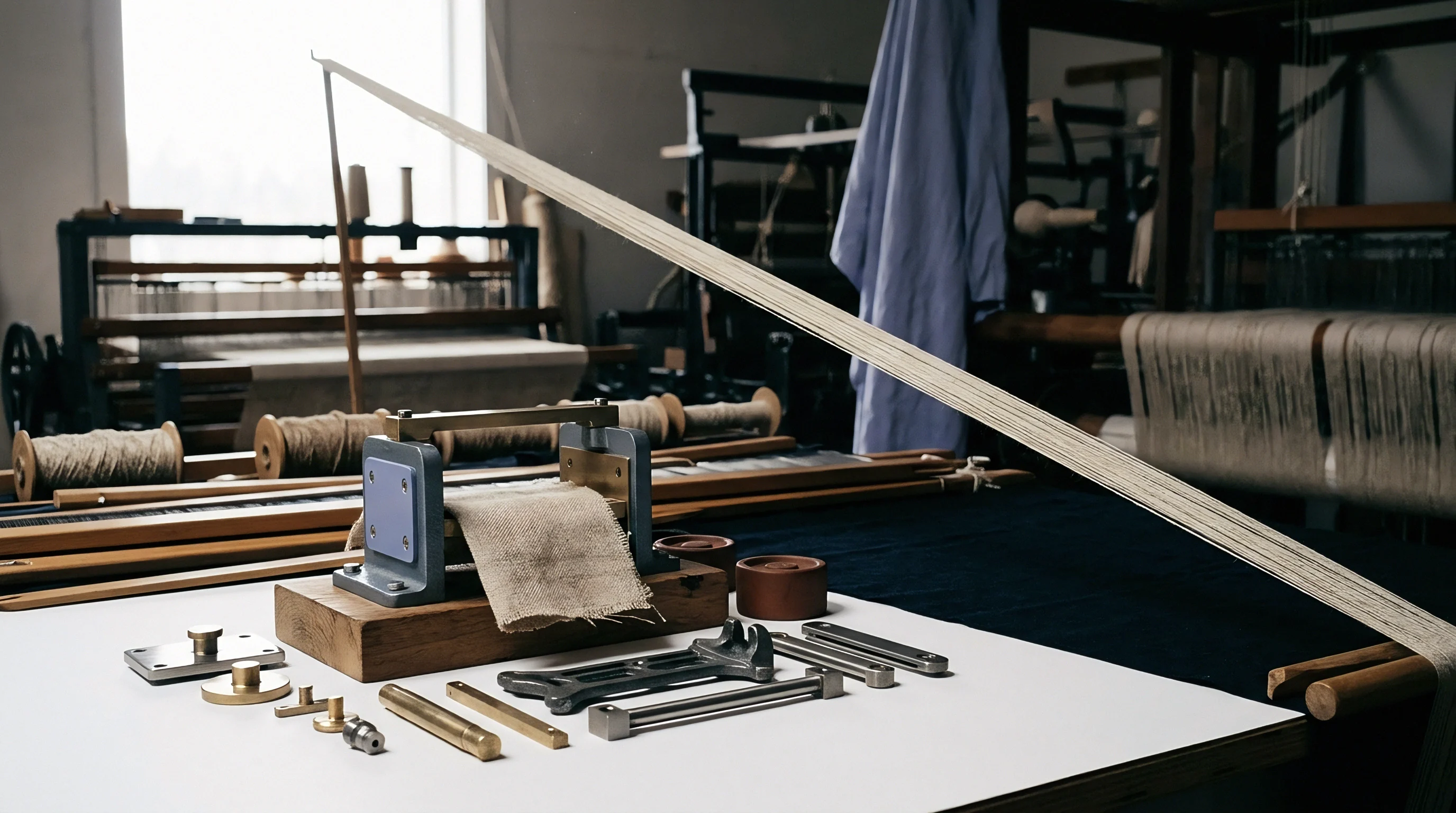
The backrest assembly serves as the primary mechanical buffer for managing warp line geometry. Positioned at the rear of the loom above the warp beam, the backrest roller redirects threads coming off the warp package horizontally toward the drop wires and heddles. When fitted with rigid brackets, the roller maintains a fixed position throughout the weaving cycle, forcing the yarn structure to absorb every millimetre of shed opening displacement.
Peak tension surges at two distinct moments in the loom cycle: the crest of shed opening when harness displacement reaches its maximum, and beat-up when the reed forces the newly inserted weft pick into the cloth fell.
Kinematic Chains in Harness Movement
Kinematic chains connecting the main drive shaft to the shedding motion govern harness frame movement. On high-speed rapier and air-jet looms running linen warps at speeds between 320 and 420 picks per minute, shed opening occurs within a duration of 60 to 80 milliseconds. The geometric path extension during this window ranges from 3.5 millimetres to 6.0 millimetres, depending on shed height settings, depth of the warp shed, and harness frame stroke length.
Without dynamic compensation, this transient length deficit imposes instantaneous axial loads exceeding 80 cN/tex on individual warp ends.
Flax yarn structural behavior under high-rate cyclic load differs markedly from spun staple cotton. Unprocessed bast fibers consist of microcrystalline cellulose fibrils bound by amorphous pectin networks that lack the time needed to undergo viscoelastic relaxation under high-velocity impact loading. Instantaneous stress loads concentrate directly along micro-cracks inside individual ultimate fibers.
This localized structural cleavage produces micro-fibrillar sloughing, warp end splitting, and catastrophic end breaks at the reed dent entrance.
When tension peak spikes coincide with beat-up impact, soft spring rates absorb path length changes while stiff spring rates transfer destructive stress into yarn knots.
Decoupling Peak Impact Loads
Dynamic backrest systems introduce controlled mechanical compliance into the warp yarn path. By mounting the backrest roller on pivoted rocker arms supported by adjustable spring packages, the roller deflects forward and downward in direct response to increasing warp tension. This rotational deflection releases yarn back into the active weaving zone, neutralizing the geometric path deficit created by shed movement.
The spring-loaded system converts high-magnitude, short-duration force spikes into manageable mechanical displacement, flattening the tension profile across the full 360 degrees of loom rotation.
Calibrating the dynamic backrest spring rate requires matching mechanical compliance to yarn properties. If the spring constant is too high, the backrest remains effectively motionless during peak tension events, transferring destructive stress directly into the linen yarn. Conversely, an overly soft spring allows the backrest to deflect completely against its mechanical limit stops before shed opening completes.
Once bottomed out, the backrest acts as a rigid beam, leaving the warp yarn exposed to unmitigated peak stress during beat-up impact. Failing to decouple beat-up impacts from the warp line leads to microscopic fibrillar shedding, excessive lint buildup in the reed dents, and permanent elongation variance that destroys cloth flatness during wet finishing.


Deflection
Spring-supported backrest assemblies convert linear tension transients into rotational displacement of the rocker arm. Deflection magnitude directly reflects the instantaneous force vector exerted by the warp sheet against the roller surface. In high-speed linen weaving, backrest displacement must track yarn path expansion precisely, returning to its equilibrium position as the shed closes without introducing phase lag or harmonic oscillations.
The spring rate, expressed in Newtons per millimetre of displacement or Newtons per degree of arm rotation, establishes the mechanical transfer function between warp tension force and backrest movement.
Equilibrium in a dynamic backrest system requires a precise balance between static warp pre-tension and spring preload torque. Static warp pre-tension holds the warp sheet taut when the loom stops, preventing yarn sagging and ensuring clean shed separation. When the loom starts, dynamic tension increases due to shed opening forces and frictional drag through drop wires, heddle eyes, and reed dents.
The spring pre-torque must equal the static tension force so that deflection begins immediately upon shed expansion, rather than delaying until tension exceeds an elevated threshold.

Force Transfer and Rocker Geometry
Choice of elastic stiffness across backrest supports governs how much yarn path extension converts into spring movement. The mechanical leverage ratio of the rocker arm determines the displacement ratio between the backrest roller and the spring mounting block. A typical rocker arm configuration employs a 1:1.5 or 1:2 leverage ratio, where one millimetre of spring compression permits 1.5 to 2.0 millimetres of circumferential arc motion at the roller surface.
This mechanical advantage allows smaller, high-stiffness steel springs or torsion bars to control large warp sheet forces smoothly.
Harmonic resonance represents a critical failure mode in backrest spring calibration. Every spring-mass system possesses a natural vibration frequency determined by mass, rocker arm inertia, and spring stiffness. If the loom operating speed matches or aligns with a sub-harmonic of the backrest assembly’s natural frequency, chaotic resonance occurs: the backrest roller oscillates uncontrollably out of phase with shed movement, amplifying tension peaks rather than dampening them and leaving reed marks in the cloth.
System resonance produces severe warp slackening during shed closure, followed by massive tension spikes during beat-up, causing simultaneous warp breakages across the entire width of the loom.
| Spring Rate (N/mm) | Pre-load Torque (Nm) | Max Deflection (mm) | Peak Tension (cN/tex) | Phase Lag (deg) | Beat-up Peak (cN/tex) |
|---|---|---|---|---|---|
| 12.0 | 18.5 | 14.2 | 28.4 | 22.5 | 46.2 |
| 18.5 | 24.0 | 9.8 | 33.1 | 11.0 | 38.5 |
| 26.0 | 30.5 | 6.2 | 42.8 | 5.2 | 41.0 |
| 38.0 | 38.0 | 3.1 | 58.6 | 2.1 | 62.4 |
| 52.0 (Rigid Limit) | 48.0 | 0.8 | 76.2 | 0.5 | 84.5 |
Evaluating Damping Mechanics
System stability requires integrating hydraulic or friction damping alongside mechanical springs. Damping absorbs excess kinetic energy, preventing backrest rebound during the rapid transition from shed crest to shed closure. Without adequate damping, the energy stored in compressed springs releases abruptly as tension drops, driving the backrest roller forward and causing temporary warp sagging.
This localized slackness disrupts shed geometry, leading to mispicks, shuttle or rapier entrance failures, and uneven beat-up lines in the woven gray cloth.
Optimizing backrest deflection demands comprehensive evaluation of operating variables under full production conditions. Shedding motion characteristics must align with yarn strength parameters and backrest mechanical response times.
- Low Stiffness Spring Calibration delivers maximum tension absorption during shed opening but requires active hydraulic fluid damping to control low-frequency resonance and prevent bottoming out at high loom speeds.
- High Stiffness Spring Calibration provides rapid mechanical recovery during shed closing but fails to limit short-duration peak stress spikes generated at the beat-up point.
- Asymmetric Damping Configuration allows rapid backrest deflection during shed expansion while applying elevated viscous resistance during spring return to eliminate warp bouncing.
- Pre-Torque Balance Adjustment ensures immediate spring engagement at the start of harness displacement without compromising static warp tension settings during loom stops.
Edge end breakage is often blamed on yarn unevenness, though stock torsion spring packages simply lack the response speed demanded by low-stretch bast yarns.

Modulus
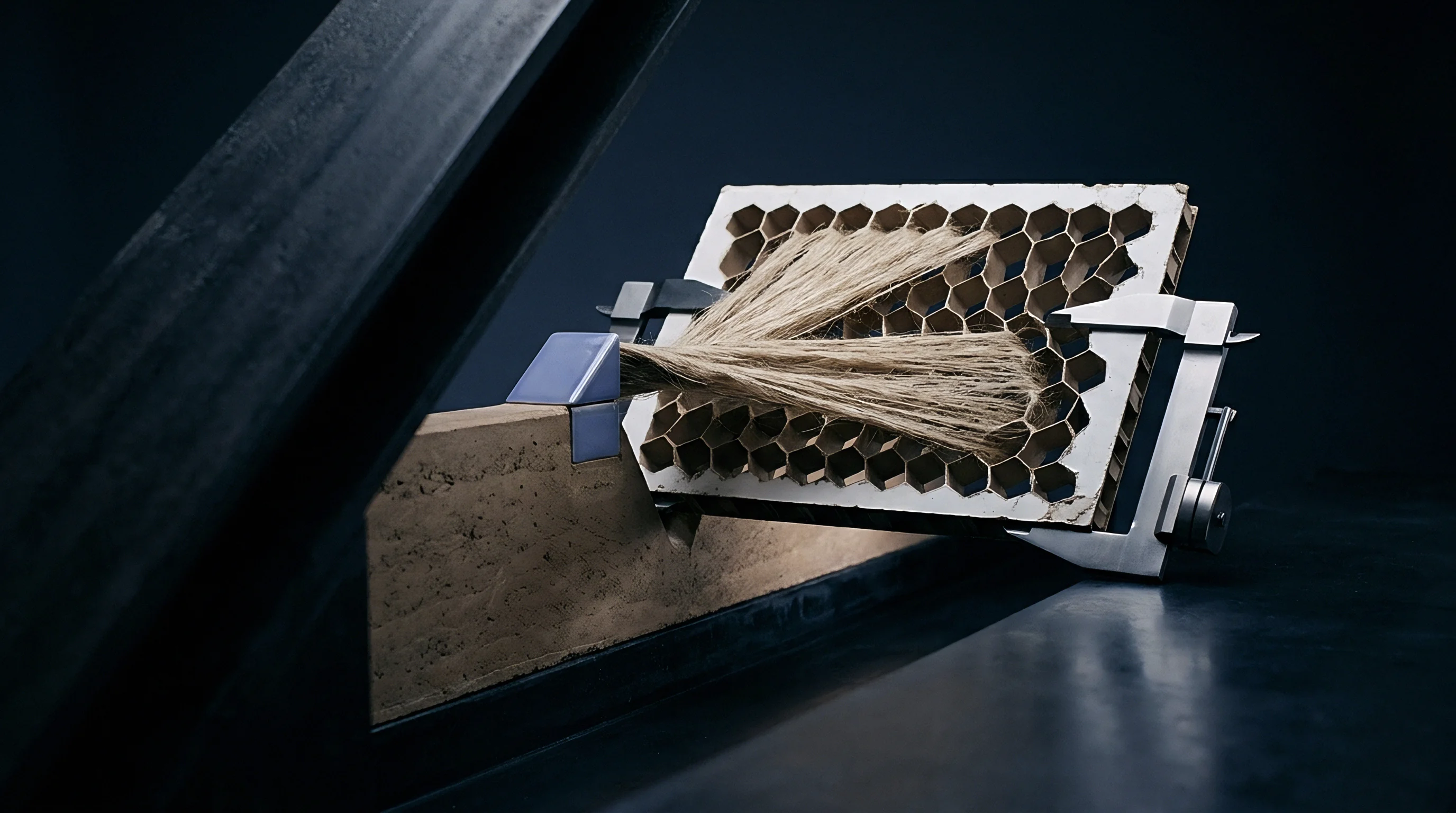
Flax fibers exhibit a steep stress-strain profile that distinguishes bast yarns from synthetics and combed cotton. The tensile behavior of linen yarn is defined by an extraordinarily high initial elastic modulus, ranging from 18 to 25 GPa in dry states, paired with negligible plastic yield prior to rupture. While spun cotton stretches between 6% and 9% before breaking, single linen yarns break at extensions as low as 1.5% to 2.2%.
This structural rigidity means that small mechanical displacements along the warp path generate immense axial force surges within the yarn body.
Yarn moisture content alters flax fiber mechanical properties significantly. Moist flax fibers display higher tensile strength and increased flexibility compared to dry fibers, caused by water molecules lubricating internal pectin networks between ultimate cell bundles. Relative humidity in the weaving shed must be maintained between 68% and 75% when processing linen warps.
Even under optimal atmospheric conditions, the fundamental elastic modulus remains exceptionally high, leaving no margin for mechanical miscalibration on the loom.
High Young’s modulus bast fibers translate minimal mechanical deformation into rapid tension spikes across the shedding cycle.

Linear Density and Twist Factor Metrics
Singles linen yarns spun from wet-spun flax (ranging from NeL 14 to NeL 50, corresponding to 71 tex down to 20 tex) possess high twist factors to bind short elementary fibers into continuous structures. High twist increases yarn density and surface hardness while reducing structural compressibility. Under axial tension spikes, high-twist linen yarns cannot absorb energy through mechanical fiber rearrangement.
Axial force translates directly into tensile strain along the outer fiber helix angles, accelerating stress concentration at thin yarn places and splice joints.
Structural yarn defects create weak links along the warp line. Slubs, thick places, and imperfect splices alter local yarn stiffness and friction coefficients through the heddles. When a high-modulus linen yarn encounters a peak tension surge exceeding 40 cN/tex, stress concentrates disproportionately at thin places where twist angle is lowest, triggering instant tensile breakage.
Calibrating the backrest spring rate to cap peak warp stress below 32 cN/tex preserves weak yarn segments, lowering loom stop frequencies significantly.

Yarn Crimp and Structural Compensation
Interlacing warp and weft threads creates crimp geometry that influences fabric stretch and mechanical hand. In dense canvas, duck, and upholstery constructions, warp threads bend around flat weft picks, generating high warp crimp percentages. High warp crimp increases friction inside the weaving zone, requiring higher static warp tension to maintain clean shed openings.
The interaction between high structural crimp and high yarn modulus demands precise control over backrest movement to avoid breaking warp threads during reed impact.
A backrest setting that yields under hand pressure without spring recoil will collapse at full operating speed, while a setting that resists manual deflection will break yarn before reaching top shed.
Attenuation
Tuning the dynamic response of a backrest assembly demands exact coordination between pre-tension torque and hydraulic damping. Calibration begins with installing electronic strain-gauge load cells along representative warp threads between the backrest roller and the drop wire bank. These load cells stream real-time tension data to an oscilloscope or loom diagnostic analyzer, capturing stress profiles across every degree of main shaft rotation.
Calibration aims to eliminate sharp tension spikes at shed crest and beat-up, replacing them with a smooth, sinusoidal tension curve.
Initial mechanical setup requires setting the backrest rocker arm neutral angle. The rocker arm must sit at approximately 45 degrees relative to the warp line vector when the shed is fully closed. This angle provides optimal mechanical advantage for the spring assembly during maximum displacement.
The static warp tension is then dialled in using the off-loom tensioning controls on the let-off motor drive. Once static tension reaches the target parameter for the specific yarn count and construction, spring preload adjustment begins.
At a loom operating speed of 380 picks per minute, reducing backrest spring stiffness from 36 N/mm to 16 N/mm lowers peak warp tension from 78 cN/tex to 32 cN/tex during shed opening.
Sequential Calibration Protocol
Executing precise calibration on high-speed weaving machinery demands a systematic approach to adjusting mechanical variables. Adjustments must be performed sequentially, testing warp line force profiles after each change to verify compliance with peak stress caps.
- Mount warp tension sensors across left, center, and right warp sheet zones between the backrest and harness frames.
- Set main drive shaft position to 0 degrees top dead center with harness frames fully leveled in the neutral shed position.
- Adjust let-off motor controls until baseline static tension reads exactly 3.5 cN/tex per warp end across all load cells.
- Loosen leaf spring lock bolts or torsion bar clamping blocks on both drive-side and non-drive-side rocker mountings.
- Adjust spring pre-load torque until backrest roller shows initial mechanical deflection at 105% of baseline static tension.
- Rotate loom manually to maximum shed opening position at 180 degrees main shaft rotation.
- Measure backrest displacement distance, ensuring total movement remains between 6.0 and 8.5 millimetres without reaching mechanical limit stops.
- Set hydraulic shock absorber valve to 30% damping capacity to suppress high-frequency spring bounce during fast shed closure.
- Run loom under power at target production speed for 500 picks, recording peak tension values during shed crest and beat-up.
- Fine-tune damping resistance until secondary tension ripples on load cell traces vanish completely following beat-up impact.

Validation via Electronic Load Cells
Analysis of real-time tension traces reveals specific fault signatures caused by improper calibration. A sharp force spike occurring right at beat-up indicates excessive spring stiffness or insufficient backrest stroke allowance, catching knots and turning them into greige faults. Conversely, a broad, dual-peaked tension curve accompanied by high tension fluctuations during shed closure signals inadequate hydraulic damping, allowing backrest bounce to distort the warp line.
Calibration success is confirmed when peak warp tension remains below 35 cN/tex throughout the entire 360-degree loom cycle, with peak tension variance across loom width holding under 5%. Proper calibration delivers consistent warp tension during high-speed operation, suppressing warp breakages caused by stress peaks.
Standard procurement agreements following ISO 13934 test criteria strip out peak stress indemnities unless the buyer specifies maximum allowable shed tension peaks on the mill’s loom setup sheet.

Shedding
Asymmetric clearance angles redistribute warp tension between top and bottom sheets during harness movement. In standard symmetric shedding, top and bottom warp sheets experience identical path extensions and tension increases during shed opening. While acceptable for uniform cotton fabrics, symmetric shedding creates severe problems in high-density linen weaving.
Raising the backrest roller above the horizontal warp line alters shed geometry, increasing bottom shed sheet tension while relaxing top shed sheet tension. This tension imbalance assists shed opening by preventing adjacent hairy flax yarns from clinging together, reducing warp end entrapment during rapier passage.
Backrest height adjustment changes yarn clearance angles over the raceboard and heddle eyes. Elevating the backrest roller by 15 to 25 millimetres above the breast beam plane creates unequal tension conditions during shed expansion. The taut bottom warp sheet maintains firm contact with the raceboard, establishing a clean floor for rapier guidance.
The slightly slacker top warp sheet allows threads to move around thick yarn slubs without triggering end breaks. This geometric configuration reduces harness frame friction, lowers heat generation in heddle eyes, and improves cloth surface appearance.
Does Dynamic Backrest Tuning Eliminate Beat up End Breaks?
Peak stress spikes during beat-up cause immediate break events when yarn defects enter the reed zone. Dynamic backrest tuning reduces beat-up tension peaks substantially, but cannot eliminate end breaks caused by mechanical reed abrasion, yarn slubs catching in drop wires, or improper shed timing. Beat-up occurs near front dead center of main shaft rotation, typically between 355 degrees and 5 degrees.
Dynamic tuning ensures the backrest absorbs yarn displacement at beat-up impact, reducing force transferred to warp threads. Eliminating beat-up breaks entirely requires combining dynamic backrest tuning with optimized dwell angles, polished reed dent surfaces, and precise shedding motion timing.
Shedding motion dwell angle selection influences backrest dynamic load requirements directly. A 120-degree dwell angle holds harness frames fully open for one-third of loom rotation, maximizing time available for weft insertion. However, extended dwell duration subjects warp yarns to prolonged peak tension.
A shorter 90-degree dwell angle reduces tension exposure duration, but requires faster harness frame acceleration, increasing peak inertial forces. Backrest spring rates must be calibrated to match harness motion profiles, ensuring springs yield smoothly during fast harness acceleration cycles.
| Backrest Offset (mm) | Dwell Angle (deg) | Shed Type | Break Rate (stops/10^5 picks) | Cover Factor (%) | Loom Efficiency (%) |
|---|---|---|---|---|---|
| 0.0 (Level) | 120 | Symmetric | 4.82 | 82.1 | 88.4 |
| +12.0 | 120 | Asymmetric | 2.15 | 84.5 | 93.2 |
| +20.0 | 120 | Asymmetric | 0.85 | 86.8 | 96.7 |
| +20.0 | 90 | Asymmetric | 1.12 | 85.9 | 95.8 |
| +30.0 (Over-elevated) | 120 | Asymmetric | 3.24 | 81.2 | 91.0 |

Shed Timing and Weft Insertion Clearance
Shed crossover timing determines the exact main shaft angle where top and bottom warp sheets cross paths to begin changing shed openings. Advanced shedding timing, where crossover occurs between 280 and 300 degrees before front dead center, traps the newly inserted weft pick tightly at the cloth fell before beat-up impact occurs. Advanced timing improves cloth cover and prevents pick slippage in loose plain weave structures.
However, early crossover increases beat-up force requirements dramatically because the reed pushes weft picks through an already closed shed.
Dynamic backrest spring rates must accommodate shed timing choices. When running advanced shed timing on dense linen constructions, the spring rate must be softened slightly, with spring pre-torque reduced by 10% to 15%. This adjustment allows the backrest to yield further during beat-up impact, accommodating the extra mechanical resistance caused by pushing weft picks through a closed warp shed.
Correct coordination between shed timing, backrest elevation, and dynamic spring rate protects yarn integrity while maintaining tight pick densities in technical linen textiles.
Whether ultra-fine flax yarns under NeL 50 can sustain high-frequency shedding without requiring active hydraulic servo-assisted backrests remains an open question across high-speed weaving sheds.

Throughput
Warp end break rates establish the hard ceiling on loom efficiency and weaver allocation across the shed floor. In commercial linen weaving, warp stops account for over 75% of unprogrammed loom downtime. When an end breaks, the automatic drop wire contacts the electrical stop motion bar, applying immediate brake torque to bring the main shaft to a halt within one loom revolution.
Every stop requires manual operator intervention to locate the broken thread end, draw it through drop wire, heddle eye, and reed dent, tie a weaver’s knot, and restart the loom. In high-cost manufacturing regions, frequent loom stops erode operating profit margins rapidly.
Accounting for loom downtime requires measuring lost loom picks and calculating landed cost impacts per linear metre of finished cloth. Operating a rapier weaving machine running NeL 25 100% linen warp at 380 picks per minute incurs fixed overhead costs including machine depreciation, shed floor energy, direct operator labor, and climate control maintenance. A standard weaving shed calculates operating expense at approximately $18.50 per loom hour.
Unplanned loom stops reduce output while fixed hourly costs remain unchanged, driving up production costs per woven metre.
Loom Hour Accounting Mechanics
Quantitative analysis demonstrates the economic impact of dynamic backrest spring rate calibration on high-density linen upholstery fabric production. Consider a representative contract run manufacturing 5,000 metres of 100% linen 240 g/m² upholstery cloth at 24 picks per centimetre on a 220 cm wide rapier loom.
- Uncalibrated Setup Base Performance running rigid backrest brackets produces 4.85 warp stops per 100,000 picks, yielding an average loom efficiency of 88.2% and requiring 157.8 total loom hours to complete the order.
- Calibrated Setup Improved Performance running dynamic spring rate tuning produces 0.85 warp stops per 100,000 picks, elevating loom efficiency to 96.7% and completing the order in 143.9 loom hours.
- Direct Loom Hour Savings equal 13.9 loom operating hours per 5,000-metre production batch, generating immediate shed floor cost reductions of $257.15 on machine time alone.
- Greige Defect Reduction Benefits lower manual knotting points by 4,800 events per order, saving 16 weaver labor hours and reducing greige cloth mend stops at the inspection frame.
| Operational Metric | Uncalibrated Setup | Calibrated Setup | Variance Unit |
|---|---|---|---|
| Warp Stop Rate (stops/10^5 picks) | 4.85 | 0.85 | -4.00 stops |
| Loom Operating Speed (PPM) | 380 | 380 | 0 PPM |
| Shed Floor Loom Efficiency (%) | 88.2 | 96.7 | +8.5 % |
| Total Loom Operating Time (Hours) | 157.8 | 143.9 | -13.9 Hours |
| Loom Overhead Cost ($18.50/Hr) | $2,919.30 | $2,662.15 | -$257.15 Saved |
| Manual Weaver Repair Hours | 19.4 | 3.4 | -16.0 Hours |
| Mending Labor Expense ($22.00/Hr) | $426.80 | $74.80 | -$352.00 Saved |
| Total Net Manufacturing Expense | $3,346.10 | $2,736.95 | -$609.15 Saved |
| Landed Cost Impact per Metre | $0.6692 | $0.5474 | -$0.1218 / Metre |
Defect Grading and Off-Quality Financial Claims
Beyond direct loom hour savings, reducing peak warp stress improves fabric surface quality and grading results. Continuous high tension spikes cause minor fiber breaks that do not stop the loom, but create micro-slubs and lint balls that get woven into the cloth fell. These greige faults appear as slub streaks, broken end tails, and surface fuzzing during fabric finishing.
Under ASTM D5430 four-point fabric inspection standards, minor defects add point penalties that can relegate finished rolls to second-quality status, forcing price markdowns of 30% to 50%.
Dynamic backrest spring rate calibration lowers fabric defect point counts significantly. Capping peak tension surges below yarn damage thresholds protects thread structure, producing smooth gray cloth with uniform pick spacing and clean surface appearance. Fabrics woven on calibrated looms show minimal end-streak defects, consistent warp crimp across full roll widths, and superior tensile performance during post-weave finishing and dyeing processes.
Allocating technician time to systematically calibrate backrest spring rates delivers measurable returns in loom productivity and fabric quality. Reducing peak warp stress transforms high-modulus linen weaving from a high-break, low-efficiency process into a stable, high-yield manufacturing operation. Mills that adopt rigorous dynamic spring rate tuning protocols achieve higher loom speeds, reduce labor costs, and protect profit margins across demanding bast fiber production runs.