Real Time Size Add on Sensing and Adaptive Squeeze Control in High Speed Bast Warp Sizing
Real time microwave sensing and adaptive squeeze roll pressure tuning stabilize bast warp size add-on to maximize loom efficiency and cut yarn breaks.

Physics
Bast filaments like wet-spun flax have a composite structure built around central lumens and pectin-rich spaces between fibers. Unlike uniform synthetics or consistently porous cotton, flax presents uneven capillary draw, thick cell walls, and lumen cross-sections that vary along the strand. When a warp sheet enters the sizing box at line speeds above eighty meters per minute, fluid dynamic forces compete directly with capillary sorption inside the yarn.
Sizing liquor has to reach the core of the bundle to bind loose ultimates while still leaving a uniform film on the surface to lay down protruding hairs.

Capillary Absorption and Core Viscosity Penetration
High-viscosity formulations struggle to enter the dense interstitial gaps between individual flax ultimates. The liquor stays on the outside of the strand instead, forming a heavy crust that cracks under the cyclical tension of high-speed weaving. Conversely, low-viscosity liquors draw into the core readily through capillary suction but fail to leave an adequate protective film on the bundle exterior.
When size drains inward, surface fibers remain loose and vulnerable to reed abrasion during beat-up.
Residual natural pectins inside raw or semi-bleached flax warps act as hydrophobic barriers, slowing aqueous size uptake. Vat temperature alters both liquor surface tension and pectin malleability. Running the sizing vat at eighty-five degrees Celsius lowers viscosity and cuts surface tension, speeding core penetration during the fraction of a second the yarn spends submerged.
| Fiber Type | Yarn Linear Density | Lumen Diameter Range | Viscosity Band | Target Wet Pick-Up |
|---|---|---|---|---|
| Wet-Spun Flax | Nm 26 (38.5 Tex) | 5 to 12 microns | 35 to 45 mPa·s | 85 to 95 percent |
| Dry-Spun Flax | Nm 14 (71.4 Tex) | 8 to 18 microns | 25 to 35 mPa·s | 90 to 105 percent |
| Hemp Tow Yarn | Nm 10 (100 Tex) | 10 to 22 microns | 20 to 30 mPa·s | 100 to 115 percent |
| Ramie Filament | Nm 40 (25 Tex) | 3 to 8 microns | 40 to 50 mPa·s | 75 to 85 percent |
Liquor Rheology and Fiber Swelling Mechanics
Blending native starches with modified carboxymethyl cellulose shifts fluid flow inside the vat. Bast fibers swell laterally when wet with aqueous size, expanding yarn diameter by up to fifteen percent and contracting slightly in length. This swelling tightens the packing density of the yarn bundle while submerged; as density rises, inter-fiber pores compress and restrict additional liquor uptake.
Under high warp velocity, sizing liquor undergoes intense shear within the narrow squeeze nip. Non-Newtonian mixes thin under high shear rates, which forces liquor deeper into the yarn core at the point of greatest mechanical load. Sizing machines without real-time viscosity adjustment end up with uneven encapsulation along the warp as line speed varies.
Cold sizing liquor fails to breach the internal pectin layer of long-staple flax.
Poor core penetration leads directly to end-breaks on high-speed air-jet looms, causing unscheduled downtime and degrading warp beam yield.


Probe
High-frequency electromagnetic fields pass through wet warp sheets to gauge water mass per unit area without touching the yarn. Microwave absorption sensors beam continuous radiation across the warp right after the final squeeze roll set. Water molecules absorb this energy selectively at specific frequencies, producing power attenuation that tracks total wet mass pick-up.

Microwave Attenuation and Near-Infrared Spectroscopic Sizing Sensors
Resonator heads track density variations across individual yarn bands by transmitting signals from above the sheet to receivers mounted underneath. This attenuation measurement isolates liquid water mass from dry fiber mass, assuming dry yarn tare is logged during warp loading. Slubs, knots, and thick spots common in long-staple flax create brief signal spikes that require digital low-pass filtering to reveal the real chemical add-on trend.
Near-infrared reflectance spectroscopy provides complementary surface data. NIR heads project specific wavelengths onto the wet sheet to read absorption bands for hydroxyl groups in starch and water. While microwave sensors scan the entire cross-section to capture total wet mass, NIR optics read chemistry at the surface.
Combining microwave density with NIR surface profiles lets control systems separate internal core absorption from outer film build.

Distrometric Refractometry for Concentration Monitoring
In-line optical refractometers in the circulation loops monitor dissolved solids in the main size supply. Concentration drifts over time as steam injection dilutes the bath or surface evaporation thickens it. Process refractometers use critical angle measurement to feed continuous Brix or refractive index values to the main terminal.
Sensing equipment requires isolation from mill conditions. High humidity, shedding lint, and size splashes foul optical windows and microwave guides. Automated air purges clear flax fly from optical surfaces, and dedicated heat exchangers keep sensor electronics within rated operating temperatures.
Sensor calibration performed on dry grey yarn yields inaccurate wet pick-up readouts once sizing liquor coats the fiber surface.
- High moisture signal drift resulting from unremoved pectin, lignin residuals, or shifting electrical conductivity in raw flax.
- Optical window fouling caused by cooking starch residues and lint accumulation on near-infrared reflection lenses.
- Spurious mass spikes produced by thick yarn slubs passing through microwave resonator gaps.
- Temperature sensitivity errors occurring when liquor temperature fluctuations alter dielectric properties before digital compensation.
Sensor inaccuracy can stem from inconsistent raw flax retractions as well as uncompensated thermal drift in the optical measurement head.


Nip
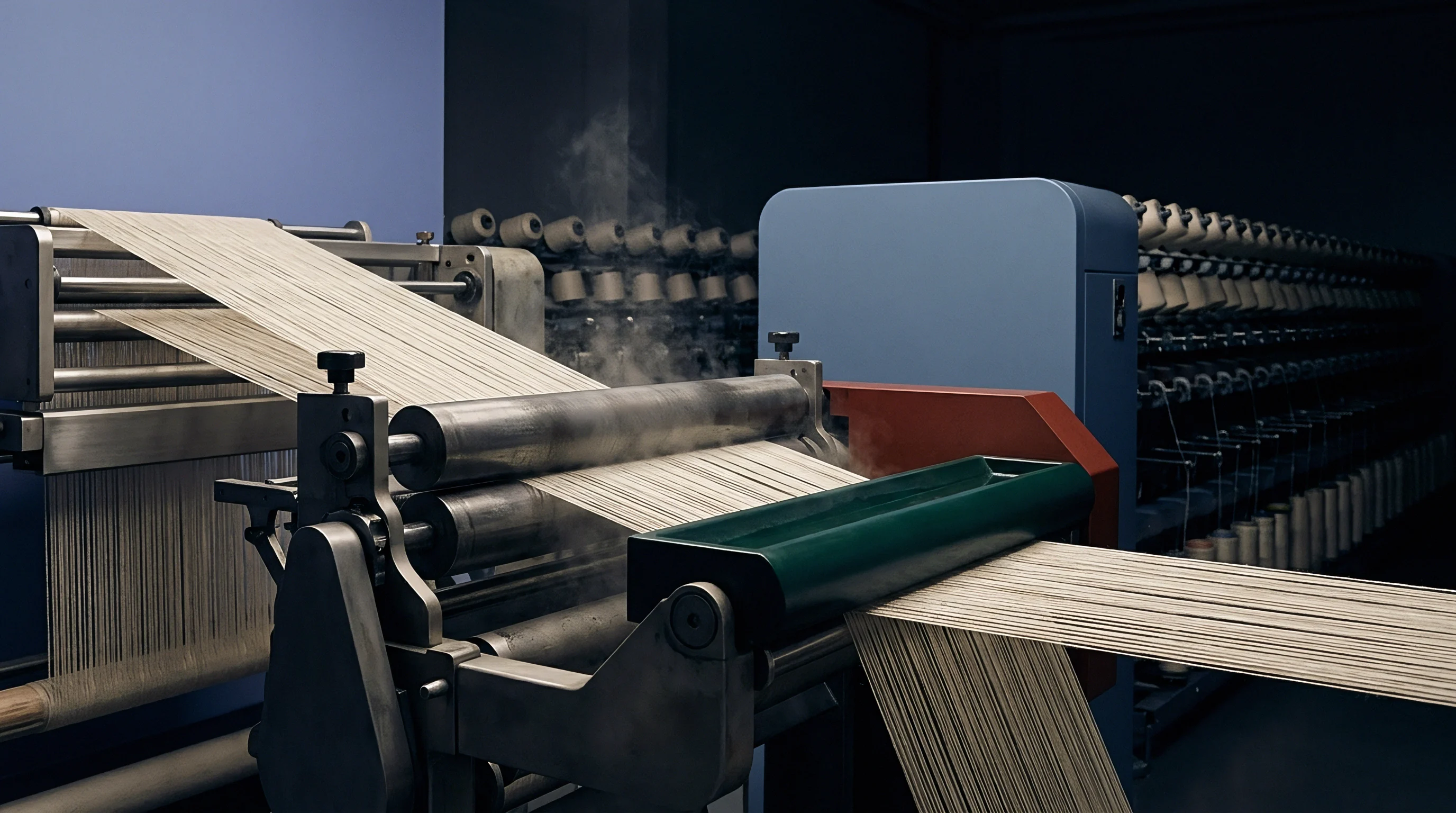
Synthetic rubber covers on top squeeze rolls deform under hydraulic loading, widening the contact area against the bottom steel roll. These rollers strip excess size from the yarn bundles while flattening the yarn cross-section. The applied load determines how much liquor stays trapped in the core versus how much gets scraped off the surface.

How Does Viscoelastic Roll Deformation Alter Squeeze Mechanics?
Elastomeric roll covers flatten as hydraulic or pneumatic pressure climbs, broadening the footprint in the nip. A wider contact patch increases yarn dwell time under load, allowing liquid size more time to press into the core while rolling surface liquor back into the vat. Cover hardness, rated in Shore A, governs this behavior.
Hard rolls around eighty-five Shore A create narrow contact zones with high peak pressures that scrape dense flax yarns clean. Softer sixty-five Shore A rolls create broader contact patches that preserve yarn roundness but leave a heavier coating.

Dynamic Pressure Compensation Equations for Ramping Speeds
Warp velocity shifts constantly during start-up, crawl sequences, and full production runs. Squeeze pressure has to counter hydrodynamic lift from the fluid film. At creep speeds, low dynamic pressure allows close roll contact, expressing more liquor from the warp.
Above one hundred meters per minute, fluid forces lift the top roll slightly, thickening the liquid film and raising wet pick-up unless loading increases.
Adaptive control systems calculate nip load from dynamic velocity curves. For an Nm 26 wet-spun flax warp running through a dual-squeeze box with a twelve percent solids starch mix, pneumatic cylinders are set to twelve kilonewtons per meter of roll face at a ten meter per minute crawl. Accelerating to the top speed of one hundred twenty meters per minute prompts the algorithm to ramp nip loading to thirty-eight kilonewtons per meter, countering hydroplaning and holding dry add-on at ten point five percent across the full speed range.
- Zero the electronic pressure transducers on upper squeeze roll pneumatic cylinders while rolls remain fully unloaded.
- Check rubber surface hardness across five points along the roller face using a Shore A durometer to identify uneven wear.
- Run a calibration warp sheet at creeping speed while recording baseline wet pick-up using microwave sensor signals.
- Ramp machine speed progressively to top velocity while adjusting proportional control valves to balance squeeze pressure against film thickness.
| Yarn Linear Density | Machine Velocity | Liquor Viscosity | Nip Load | Resulting Wet Pick-Up |
|---|---|---|---|---|
| Nm 26 (38.5 Tex) | 15 m/min (Crawl) | 35 mPa·s | 14 kN/m | 88 percent |
| Nm 26 (38.5 Tex) | 60 m/min (Mid) | 35 mPa·s | 26 kN/m | 87 percent |
| Nm 26 (38.5 Tex) | 110 m/min (High) | 35 mPa·s | 42 kN/m | 87 point 5 percent |
| Nm 39 (25.6 Tex) | 110 m/min (High) | 40 mPa·s | 38 kN/m | 82 percent |
ISO 105 requirements for sizing uniformities mandate that squeeze roll nip pressures remain within two percent of setting across the complete width of the warp beam.
Harder rubber roller coatings demand finer pressure adjustments to prevent fiber crushing on dense flax warps.


Telemetry
Automation controllers sample moisture gauge signals every ten milliseconds. Adaptive control loops combine feed-forward speed data with feedback size measurements to adjust pneumatic regulators on the squeeze stands. If sensors detect an increase in wet pick-up, the controller fires proportional valves to raise cylinder pressure and tighten the nip within milliseconds.

Closed-Loop PID Integration and Actuator Control Latency
Proportional-integral-derivative algorithms govern dynamic squeeze loading, where loop stability requires balancing response speed against mechanical hunting. Bast yarns have natural thickness variations that register as high-frequency sensor noise. Over-tuning the PID loop makes pneumatic actuators chatter, accelerating mechanical wear on roll bearings and causing pressure ripples down the warp.
Smoothing sensor signals with a two-second rolling window stabilizes actuator movement without missing actual add-on drift.
Actuator response limits overall control during fast speed ramps. Pneumatic lines introduce slight pressure delays due to air compressibility. Electro-hydraulic actuators cut this latency, delivering direct roll positioning during acceleration.
Pairing feed-forward speed curves with continuous feedback trim prevents sizing spikes while the machine comes up to speed.

Speed Ramping Loss Management during Beam Doffing
Crawl speeds during beam changes upset steady-state fluid dynamics in the squeeze nip. Sizing ranges drop to creep when doffing full beams or tying in broken ends. Without compensation, this slow travel causes severe over-sizing: yarns soak up excessive liquor, turning brittle and shedding heavily in the loom.
Adaptive systems drive squeeze rolls to maximum safe loading during creep phases, holding pick-up within tolerance until the range accelerates back to set speed.
- Proportional gain tuning to prevent pneumatic system hunting when processing coarse single flax yarns.
- Feed-forward speed integration to adjust roll pressure prior to physical velocity shifts during machine acceleration.
- Viscosity feedback override to restrict squeeze force increases whenever liquor solids exceed operational upper boundaries.
- Sensor cross-validation thresholds to disregard microwave spikes during beam tie-in steps.
- Continuous dry add-on log covering the full length of every warp beam recorded at one-meter intervals.
- Refractometer concentration histories verifying bath consistency across production shifts.
- Squeeze roller pressure profiles documenting real-time force adjustments during machine speed ramps.
- Desizing washability test sheets proving total size removal under standard industrial scouring conditions.
Whether high-frequency ultrasonic transducers can measure size film thickness directly on individual bast fibers inside the wet nip remains an open question for equipment developers.


Dossier
Linen warps show a direct link between size film mass and loom stop frequency. Reaching a stable ten percent dry add-on on wet-spun flax lifts air-jet weaving efficiency from eighty-two percent to ninety-four percent under standard mill conditions. Under-sized warps allow reed and drop wires to abrade surface fibers, generating fuzz balls that foul shed openings and trip warp stops.

Target Dry Add-On Percentages and Loom Efficiency Correlations
Applying too much size wastes chemistry and hurts fabric quality. Over-sized bast yarns lose their flex, making ends brittle under heavy beat-up. Excessive stiffness interferes with clean shed splits on dobby looms, causing warp floats and mispicks.
Flaking size also builds up on drop wires, reed dents, and stop motions, creating nuisance stops throughout the set.
Add-on targets follow the weave structure and loom type. High-density damasks run on fast rapier looms require twelve percent dry add-on to endure the friction of complex harness tie-ups. Open plain-weave glass toweling needs only eight percent, which also simplifies desizing during wet finishing.
| Yarn Construction | Target Dry Add-On | Squeeze Pressure Range | Loom Speed | Efficiency Level |
|---|---|---|---|---|
| Nm 26 Plain Weave | 10 point 0 percent | 20 to 35 kN/m | 600 ppm | 93 point 5 percent |
| Nm 39 Fine Linen | 9 point 0 percent | 18 to 30 kN/m | 700 ppm | 91 point 8 percent |
| Nm 14 Heavy Canvas | 12 point 0 percent | 28 to 45 kN/m | 450 ppm | 95 point 2 percent |
| Nm 60 Huckaback Towel | 8 point 5 percent | 15 to 25 kN/m | 750 ppm | 89 point 4 percent |

Loom-Hour Cost Accounting and Scouring Residue Penalties
Landed fabric cost models weigh slasher room expenses against weaving performance. Sizing chemicals make up five percent of warp preparation cost, but poor loom efficiency from irregular sizing inflates fixed loom-hour costs immediately. A two percent drop in weaving efficiency adds more per meter in loom overhead than the entire chemical cost of the size.
Desizing results dictate finishing charges. Dye houses reject greige goods with residual starch or insoluble binders, adding scouring surcharges or turning back entire rolls. Real-time telemetry logs provide the required audit trail, documenting that beams received correct bath solids, uniform squeeze loading, and washable chemistries.
A dry add-on deviation exceeding one percent from target increases air-jet loom warp stop rates by three stops per hundred thousand picks.
Correct alignment of squeeze roll pressure curves with real-time add-on telemetry protects both yarn integrity and mill profitability.