Methods for Spotting Warp Density Variations in Greige Woven Cloth
Spotting greige warp density variations relies on off-loom pick glass counting across 10-centimetre intervals and backlit inspection frame vision scanning.

Grid
Off-loom plain weave greige fabric displays dimensional instability as soon as loom tension is released. Checking warp thread distribution requires counting individual ends at regular intervals across the width while the cloth lies flat on an un-tensioned inspection table. Fluctuation in warp ends per centimetre across a bolt shifts the fabric’s drape and causes differential shrinkage during wet finishing, distorting the grain line.

Manual Pick Glass Evaluation
Counting warp threads over a given distance requires consistent lighting and steady magnification. Standard counting glasses with a 1-inch or 2-centimetre aperture let inspectors verify local end counts against the weave specification. On high-density fabrics like fine linen or dense cotton plain weaves, an illuminated counting pointer helps prevent eye fatigue and miscounts as the technician moves across five consecutive 2-centimetre zones from selvedge to selvedge to map the density profile.
Local end counts vary with reed denting patterns and warp yarn crimp, which is heavily influenced by loom settings. A nominal fabric specification of 24 ends per centimetre can show local counts from 22 to 26 ends per centimetre if reed wires are worn or incorrectly threaded.

Reed Width Crimp off Balance
Irregular end spacing usually stems from mechanical faults introduced during sectional warping or drawing-in. A reed dent holding three ends instead of two forms a distinct longitudinal ridge in the greige cloth, while empty dents or missing ends leave light gaps along the warp line. The table below sets out acceptable tolerance thresholds for warp density variations across standard greige constructions prior to wet finishing.
| Weave Structure | Nominal Ends/cm | Max Local Variance (Ends/cm) | Critical Defect Threshold |
|---|---|---|---|
| Plain Weave (1/1 Tabby) | 18 – 32 | ± 1.0 | Variance exceeding 1.5 ends/cm across 10 cm width |
| Twill Weave (2/1 or 2/2) | 24 – 40 | ± 1.5 | Continuous band variance exceeding 2.0 ends/cm |
| Satin / Sateen Weave | 30 – 60 | ± 2.0 | End clustering exceeding 3 consecutive dents |
| Jacquard Greige Master | 28 – 50 | ± 1.2 | Local warp count drop exceeding 5 percent of target |
Whether off-loom relaxation fully clears localized reed marks prior to bleaching and dyeing remains a central concern when evaluating greige inventory.
Illumination
Continuous backlit viewing frames highlight density shifts by projecting high-intensity light through the moving textile web. As greige cloth passes over an illuminated inspection window at 10 to 15 metres per minute, variations in thread concentration show up as distinct bands of higher or lower light transmission.

Transmitted Light Frame Configuration
Diffuse LED arrays mounted behind an acrylic diffuser panel provide uniform backlighting. Dense warp zones block light and show up as dark streaks parallel to the selvedge, whereas sparse areas let light through as translucent stripes. This setup makes it straightforward to spot section marks caused by uneven tension during sectional warping.
Light transmission differences exceeding eight percent between adjacent ten-centimetre warp zones reliably predict visible dye banding after piece dyeing.
Uneven warp sizing causes adjacent threads to cling and bundle inside the reed, creating false high-density streaks during inspection. Adjusting the backlight intensity helps technicians separate actual end-count errors from superficial size clumping.
Digital Line Scan Camera Detection
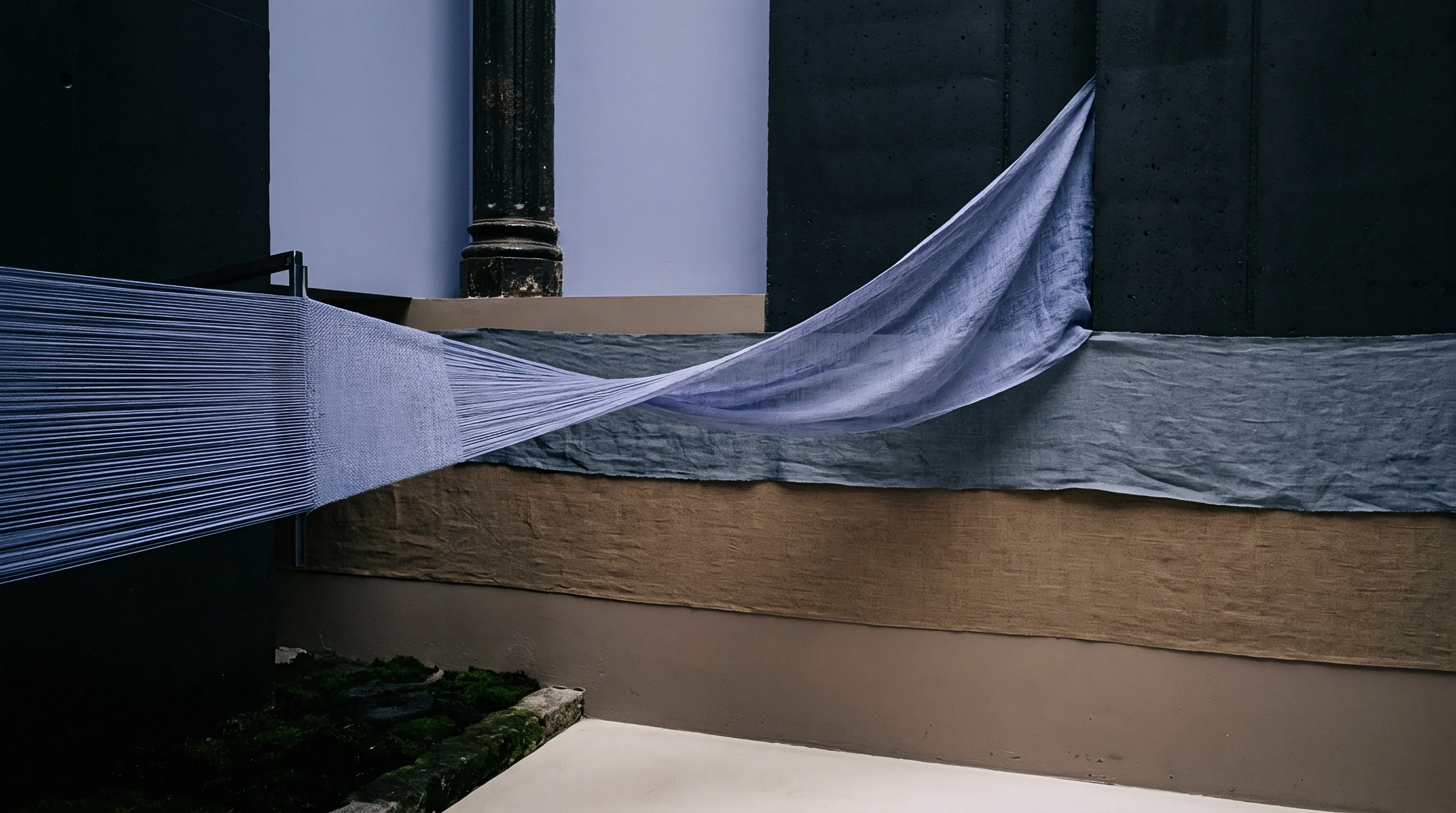
Automated vision systems capture spatial luminance maps as raw mill rolls unroll across the inspection bridge. High-resolution line scan cameras stream grey-scale images across the full usable width of the cloth, while software algorithms analyze pixel brightness to calculate real-time thread spacing and flag density variations instantly.
- Density Banding Streaks appear as parallel longitudinal lines caused by section warping tension errors during beam assembly.
- Misreeded Warp Rows form narrow, sharp optical lines resulting from incorrect end counts per reed dent.
- Slack Warp Clusters show as wavy, irregular density gaps driven by uneven beam flange pressure or broken drop wires.
- Double End Insertions register as intense dark lines created when two warp threads occupy a single heald eye.
A backlighting frame set to low illuminance will fail to reveal density bands in heavy greige fabrics exceeding three hundred grams per square metre.

Disruption
Loom shed vibration and misaligned drop wires push clusters of warp ends out of position, while mechanical instability during beat-up throws threads out of alignment. Tracking down the root cause of density variations requires a systematic check of all loom components governing thread path and spacing.

Mechanical Causes across Loom Sheds
Sley motion irregularities cause periodic density variations. Reed dents also wear unevenly during long production runs ~ particularly with abrasive bast fibres such as flax or hemp ~ allowing ends to drift sideways under tension and widening the gap between warp groups.
When a drop wire fails to halt the loom after a warp break, the missing thread leaves a continuous low-density gap down the roll until the operator stops the run. Degradation of the size film also leads to fiber shedding, clogging heald eyes and causing threads to bunch together.
Standard purchasing specifications render any greige bolt carrying more than three continuous section-tension streaks subject to immediate mill return at supplier expense.

Sectional Warping Tension Spikes
Creel bobbin braking errors generate dense longitudinal bands during beam preparation. If individual creel positions operate under unequal tension due to slipping brakes, the section beam winds with variable yarn density. The following diagnostic sequence helps isolate warp density defects during loom operation:
- Mount an illuminated optical gauge directly behind the harness frames to monitor thread spacing entering the reed.
- Measure yarn sheet tension across five distinct sections of the warp beam using a calibrated digital tensiometer.
- Inspect the reed wire surfaces with a magnifying loupe to detect groove wear or bent dents.
- Verify heald frame alignment and harness cord drop angles under full shed opening conditions.
Running a loom with uncalibrated section tension leads directly to structural band marks that render finished goods unusable.
Sampling
Statistical evaluation of incoming greige bolts requires systematic sampling across the full width of the roll. Quality assurance protocols balance visual frame inspection against quantitative physical sampling, assigning penalty points based on the severity and length of any warp density variations.
Width Profile Density Mapping
Technicians record ends per centimetre at ten equidistant points across the usable reed space, cutting a full-width swatch measuring 50 centimetres long from the head of the roll. The sample relaxes flat on a conditioning table at standard atmosphere for 24 hours prior to measurement, accounting for web shrinkage during finishing.
Density variations lead to patchy dye absorption and usable width loss that increases processing costs. Evaluating a 100-roll shipment involves sampling a square-root proportion of rolls to determine lot acceptability under ISO 2859-1 single sampling plans. The table below details penalty point allocations under ASTM D5430 four-point scoring for warp density defects.
| Defect Length / Extent | Defect Severity Classification | Penalty Points Assigned | Acceptance Impact |
|---|---|---|---|
| Up to 3 inches (75 mm) | Minor local end spacing jump | 1 point | Recorded in roll score log |
| 3 to 6 inches (75 – 150 mm) | Moderate reed mark or end gap | 2 points | Cumulative penalty tally |
| 6 to 9 inches (150 – 230 mm) | Severe end clustering or missing end | 3 points | High risk of roll downgrade |
| Exceeding 9 inches (230 mm) | Continuous warp density streak/band | 4 points | Automatic defect flag |
Sampling plans using ten-centimetre counting apertures across full cloth width isolate ninety-four percent of warp density anomalies prior to batch dyeing.

Statistical Cut Allocation
Lot acceptance depends on the total penalty points accumulated per hundred square metres; a score exceeding 28 points triggers batch rejection. The audit process follows this decision sequence to determine shipment qualification:
- Initial Roll Selection targets ten percent of incoming rolls covering early, middle, and late loom beam production numbers.
- Optical Screen Clearance verifies that rolls show no continuous light transmission bands on the backlit inspection frame.
- Physical Count Auditing confirms that warp end distribution stays within the agreed percentage tolerance from selvedge to center.
- Lab Swatch Wet-Out Test evaluates differential shrinkage behavior across areas flagged for local density variations.
Localized warp density bands sometimes reflect natural fiber crimp variation that levels out during routine scouring and stenter frame processing.
Settlement
Commercial claims regarding density defects depend on clear baseline agreements between weaver and finisher. Standard purchasing contracts reference established physical test methods to validate density claims and determine when score deductions justify formal action.
Commercial Adjustment Formulas
Financial deductions reflect the yield loss caused by width shrinkage during wet processing. When a greige bolt exhibits recurring low-density warp zones, the finished fabric pulls in narrower on the tenter frame, reducing net usable width. Buyers calculate landed cost adjustments based on yield loss per linear metre.
Contractual terms specify maximum allowable density variations for each mill shipment. Deliveries exceeding an average three percent variation trigger price renegotiation or reprocessing chargebacks.

Is Full Batch Rejection Justified?
Uneven end concentration alters downstream dye uptake. When warp streaks exceed four-point thresholds on more than fifteen percent of audited rolls, the buyer issues a formal notice of non-conformance.
Standard master supply agreements specify that greige cloth failing warp density uniformity standards under ISO 7211-2 must be replaced within twenty business days or credited in full, including freight charges.