Reconciling European Flax Fibre Certifications against US Customs Non Preferential Classifications
European Flax certificates verify raw fibre origin, but US Customs non-preferential classification derives strictly from the country where yarn spinning or fabric weaving occurs.


Scope
Importers bringing finished linen fabrics or yarn into the United States often conflate private fibre origin certifications with statutory country of origin rules enforced by United States Customs and Border Protection. The Alliance for European Flax-Linen and Hemp administers two primary certification frameworks: European Flax and Masters of Linen. The European Flax standard certifies that raw flax fibre was grown in France, Belgium, or the Netherlands without artificial irrigation and under traceable agricultural conditions.
This certification follows the physical fibre through intermediate trade, processing, and assembly across global boundaries. A scope certificate confirms that a facility possesses the operational capacity and administrative controls to handle certified materials, while individual shipments move under transaction certificates issued by accredited third-party auditing bodies such as Bureau Veritas or Control Union. When raw flax straw is retted and scutched in Western Europe, the resulting line fibre carries an unambiguous European Flax transaction certificate confirming its agricultural origin.
Fibre provenance does not determine statutory tariff origin.
Discrepancies occur when raw fibre carrying European Flax transaction certificates travels to manufacturing facilities outside Europe for hackling, spinning, or weaving. Under the administrative rules of the European Flax standard, a mill in Jiangsu or Zhejiang can process European Flax certified raw fibre into spun yarn or woven fabric while maintaining chain of custody documentation. The resulting intermediate or finished textile retains the European Flax certification mark, provided that every entity in the processing chain holds a valid scope certificate and reconciles input and output weights through official transaction certificates.
The certificate verifies the physical geographic location of the agricultural crop. It does not establish the legal country of origin for international customs classification, import tariff assessment, or statutory origin labelling in destination markets.
United States Customs and Border Protection determines non-preferential country of origin under statutory federal regulations evaluating where a product underwent its last substantial transformation. For textile and apparel products, including flax yarns and woven fabrics, these rules sit under Title 19 of the Code of Federal Regulations, specifically Section 102.21. Under these federal rules, raw flax fibre classified under Harmonized Tariff Schedule heading 5301 that is exported to China and spun into yarn under heading 5306 undergoes a change in tariff classification that confers Chinese origin.
When that yarn is woven into fabric under heading 5309 within the same or another non-European country, the fabric legally originates from the country where the weaving or spinning occurred. An importer entering woven linen fabric into the United States marked as originating in France or Belgium solely because the raw flax carried European Flax certificates commits misdeclaration of origin under Section 1592 of Title 19 of the United States Code.
Mapping the movement of raw flax shipments from European scutching plants to Asian spinning mills establishes the documentary handoff points where tariff origin shifts.
| Framework or Scheme | Covered Supply Chain Stage | Transformation Mandate | US Non-Preferential Origin Result | Section 301 Duty Exposure |
|---|---|---|---|---|
| European Flax Certification | Agricultural growth, retting, scutching, global processing | Global processing permitted under chain of custody | Derived from location of spinning or weaving | Subject to country-specific surcharges at port of entry |
| Masters of Linen Certification | Fibre growth, spinning, weaving, finishing within Europe | 100 percent processing within European territory | European country where spinning or weaving occurred | Exempt from Asian non-preferential trade remedies |
| US Customs 19 CFR 102.21 | Substantial transformation for textile products | Tariff shift or specific processing operation | Determined by processing location, not raw material growth | Applied based on statutory country of origin determination |
The Masters of Linen certification creates a contrasting framework by imposing strict geographical processing constraints directly into its governance standard. Unlike European Flax, which permits global processing under chain of custody oversight, Masters of Linen mandates that one hundred percent of the transformation steps, from raw European scutched fibre to spun yarn and finished woven fabric, occur exclusively on European territory. A woven fabric holding valid Masters of Linen certification automatically aligns with United States non-preferential origin criteria for European origin because the spinning and weaving operations took place within European Union member states.
The commercial challenge lies in capacity and price. European spinning capacity represents a fraction of global linen yarn production, leading many commercial brands to specify European Flax raw fibre that is subsequently converted into yarn and fabric in Asian mills.

Certifier Scope versus Legal Tariff Origin
Private standard bodies issue scope certificates to validate that an industrial site operates appropriate mass balance systems and physical separation procedures. An audit firm evaluating a spinning mill in Shandong checks whether incoming raw flax bales carrying European Flax transaction certificates match outgoing yarn volumes after subtracting standard processing losses. When the audit succeeds, the certifier issues a transaction certificate for the yarn batch.
This document satisfies commercial brand claims regarding sustainable agricultural sourcing and fibre traceability. It does not alter federal customs entry obligations. The transaction certificate documents fibre content, whereas the customs entry summary demands a statutory origin declaration based on industrial transformation steps.
Commercial transaction certificates document raw fibre traceability across global processors but carry zero legal authority in altering United States non-preferential customs origin rules.
Importers failing to distinguish between fibre provenance and legal origin face substantial commercial adjustments during entry audits. Customs inspectors review entry declarations against shipping manifests, bills of lading, and mill invoices. When a commercial invoice describes fabric as European Flax Linen originating in France, yet the bill of lading shows direct vessel loading from Shanghai without intermediate European processing, customs authorities flag the entry for origin verification.
The importer cannot defend the origin declaration by presenting a European Flax scope certificate. The certificate itself confirms that raw material moved from Europe to Asia, reinforcing the customs position that the textile underwent processing abroad that altered its legal country of origin.

Transaction Certificates across Intermediate Spinning Jurisdictions
Chain of custody protocols require unbroken documentary chains across every step of processing. When European scutched line flax arrives at a foreign port, the receiving hackling facility records the shipment in its certified inventory system. The facility inputs the transaction certificate reference number into the central certifier database to claim the incoming balance.
Processing yields are tracked from hackling sliver through drawing frames to ring spinning or wet spinning frames. If a mill mixes European Flax certified raw fibre with uncertified flax tow or conventional flax from other geographic regions, the chain of custody breaks unless a strict mass balance system is formally approved by the certifying body.
Commercial shipping invoices occasionally cite European Flax transaction certificates to claim European origin, despite conflicting United States customs regulations governing intermediate manufacturing.


Scutcher
Retting and scutching convert raw harvested flax straw into unspun textile fibres through mechanical separation. The harvested straw rests in field swaths where moisture and soil microorganisms break down the pectic substances binding the bast fibres to the woody core. Following field retting, straw bales move to the scutching mill where mechanical rollers crush the woody stem, known as shive, and turbine scutchers beat the stems to separate long line fibres from short tow fibres.
Scutching mills operating under European Flax certification record harvested acreage, field bale counts, weighbridge tickets, and scutched fibre yields. Each batch of scutched line fibre receives a unique bale tag containing lot tracking codes, producer group identification, and moisture content readings taken at packaging.
Bales enter the storage facility in an uncarded state.
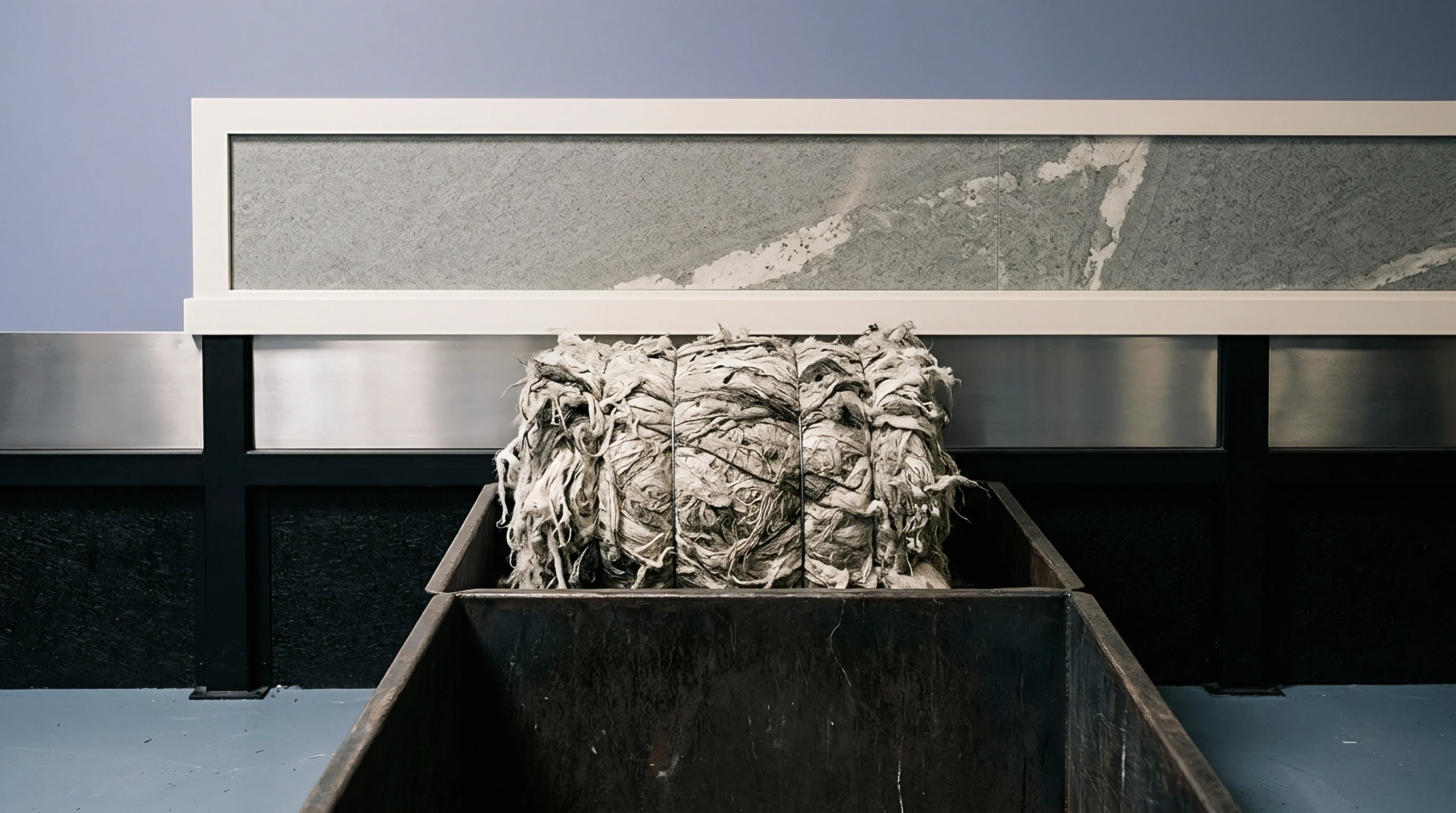
Process control at the scutching plant establishes the quantitative baseline for all subsequent chain of custody calculations. Raw flax straw yields approximately ten to twelve percent scutched long line fibre, eight to ten percent short tow fibre, and over fifty percent woody shive, with the balance consisting of moisture and soil dust. When scutched line fibre is pressed into high-density bales weighing approximately two hundred kilograms, the plant issues a weighbridge record and generates a European Flax scope-backed draft transaction certificate.
The mass balance ratio established at this initial mechanical stage acts as the reference parameter for downstream auditors testing whether downstream processors inflate certified fibre volumes.
Physical inspections of yarn warehouses indicate that uncertified sliver can be introduced before ring spinning takes place.
Mechanical hackling converts rough scutched line fibre into continuous parallel slivers suitable for spinning. Scutched fibre bales shipped to overseas spinning mills are opened, sorted, and fed through hackling machines that comb out remaining shives and short fibres while aligning long bast bundles. Hackling yields combed sliver along with combings classified as hackling tow.
Weight loss during hackling ranges between eighteen and twenty-four percent depending on raw fibre quality, dew-retting severity, and mechanical settings. An auditor tracking certified flax through an Asian mill must reconcile incoming scutched line fibre bale weights against outgoing combed sliver production registers, factoring in hackling tow recovery and moisture variations.

Straw Extraction and Yield Reconciliation Ratios
Reconciling mass balances requires strict accounting for natural moisture variations inherent in bast fibre processing. Scutched flax fibre absorbs or releases atmospheric moisture rapidly, altering measured bale weights without changing dry fibre mass. Industry standards establish normal moisture regain for flax at twelve percent, though ambient humidity variations during ocean transport or mill storage can cause measured weights to fluctuate by several percentage points.
Auditing rules mandate that mass balance calculations adjust recorded weights to standard dry mass equivalents before testing whether input volumes match output yields.
Yield calculations compare raw input masses against refined output masses at defined processing checkpoints. When an Asian spinning mill purchases twenty metric tons of European Flax scutched line fibre, hackling processing yields approximately fifteen point six metric tons of combed sliver and three point eight metric tons of hackling tow, with zero point six metric tons lost as dust and unrecoverable waste. The mill converts the combed sliver into wet-spun yarn, experiencing further yield losses during drawing, roving, wet spinning, drying, and winding stages.
The cumulative yield from raw scutched line fibre to finished wet-spun yarn on bobbins typically ranges between seventy-two and seventy-eight percent.
Mechanical scutching yields ten to twelve percent long line fibre from raw straw, establishing the baseline conversion ratio for downstream mass balance audits.

Mass Balance Auditing in High Volume Processing Facilities
High-volume spinning facilities processing certified and conventional flax simultaneously present systemic operational risks for chain of custody integrity. Mills operating continuous production lines frequently run certified European Flax lots on the same machinery used for conventional regional flax. Physical segregation requires total cleanouts of carding engines, drawing frames, and spinning frames between runs, or the establishment of dedicated certified production lines.
When physical segregation is unfeasible, certifiers permit mass balance accounting systems where the total weight of certified yarn sold cannot exceed the verified weight of certified raw fibre purchased, adjusted for standard process loss rates.
Auditors testing mass balance systems review electronic enterprise resource planning logs alongside physical floor records. They inspect raw bale stores, comb room weigh scales, roving frame logs, spinning frame allocation sheets, and finished yarn packaging inventories. Discrepancies between recorded raw material drawdowns and physical machine output indicate either unrecorded material substitution or inaccurate processing loss estimates.
If a facility shows a yarn yield exceeding seventy-eight percent relative to incoming scutched fibre weight without documented machine adjustments or exceptional raw material grades, the auditor rejects the mass balance claim and suspends transaction certificate issuance.
- Unlinked Batch Numbers occurs when internal mill production records fail to link raw bale inventory tags to specific comb sliver drawings and spinning frame allocations.
- Non Segregated Fiber Stores describes the storage of certified European Flax bales directly adjacent to uncertified flax without physical barriers or clear lot markers.
- Overstated Scutching Yields involves reporting output fibre weights that exceed physical mechanical extraction capacities to cover up uncertified material mixing.
- Uncertified Tow Blending represents the practice of blending cheap uncertified tow fibre into certified line fibre slivers during drawing operations to cut costs.
Higher processing yields than mechanical extraction limits permit signal unrecorded blending of lower-grade fibres.


Audit
Mill audits provide the primary mechanism for verifying whether raw material provenance claims hold true across complex intermediate manufacturing stages. Independent certification bodies operating under ISO 17065 accreditation send qualified auditors to inspect spinning mills, weaving sheds, and dye houses handling certified flax products. The audit protocol demands comprehensive access to administrative registers, physical warehouses, production machinery, and customs clearance files.
Auditors test whether the facility maintains an operational chain of custody management system capable of tracing a finished bolt of cloth back through yarn lot numbers to raw material transaction certificates.
Documenting process yield loss demands strict mass verification across stages.
Documentary reconciliation starts by compiling a complete ledger of all incoming European Flax transaction certificates issued to the facility over a specified audit period, usually twelve months. The auditor sums the certified net weight from these certificates to establish the maximum incoming certified fibre balance. Next, the auditor reviews all transaction certificates issued by the facility for outgoing yarns or fabrics during the same timeframe.
The cumulative weight of certified outgoing products, adjusted for documented process loss factors, cannot exceed the incoming certified fibre balance. Any positive balance remaining carries forward to the next audit cycle, whereas a negative balance indicates over-certification and triggers immediate corrective action procedures.
Standard mass balance verification applies an allowance for six percent normal moisture loss during mechanical hackling.
Physical inventory verification complements documentary auditing. Auditors execute physical counts in raw bale stores, carding halls, spinning rooms, and finished goods warehouses to cross-check real-world stocks against recorded database balances. They inspect yarn package labels, cone stickers, grey cloth roll tags, and shipping crate markings to verify that certification logos and chain of custody tracking numbers are applied correctly.
When physical inventory counts deviate from system balances by more than allowable measurement tolerances, the auditor places an administrative hold on all pending transaction certificate applications until the discrepancy is explained.

Document Reconciliation Protocols for Mill Evaluation
Mill evaluation protocols prioritize verifying the authentic linkage between commercial sales invoices, shipping documents, and official certifier databases. Certified facilities must maintain physical or digital copies of all purchase contracts, weighbridge tickets, ocean bills of lading, import customs declarations, and third-party transaction certificates. Auditors cross-reference the shipment details listed on European Flax transaction certificates against corresponding customs import clearance documents to ensure that the certified fibre physically entered the manufacturing country and arrived at the audited facility address.
| Processing Stage | Input Material Grade | Stage Input (kg) | Standard Loss (%) | Stage Output (kg) | Certified Balance (kg) |
|---|---|---|---|---|---|
| Bale Receipt | Scutched Long Line Flax | 10,000.0 | 0.0 | 10,000.0 | 10,000.0 |
| Hackling | Scutched Long Line Flax | 10,000.0 | 22.0 | 7,800.0 | 7,800.0 |
| Drawing & Roving | Combed Line Sliver | 7,800.0 | 3.5 | 7,527.0 | 7,527.0 |
| Wet Spinning | Roving Spools | 7,527.0 | 4.0 | 7,225.9 | 7,225.9 |
| Winding & Drying | Wet Spun Yarn Cones | 7,225.9 | 2.5 | 7,045.3 | 7,045.3 |
Discrepancies found during document reconciliation often expose common administrative tricks used to mask material substitution. Mills may present a valid transaction certificate covering a small volume of certified flax while using it to support commercial claims for a much larger batch of conventional yarn. Auditors counter this by comparing certified order quantities against total machine running hours, energy consumption logs, and chemical usage records.
If a facility claims to have spun ten metric tons of certified wet-spun linen yarn but electrical meters show insufficient power consumption for that production volume, the auditor flags the batch for intensive physical investigation.
Mass Balance Worked Calculations across Yarns and Fabric
Mathematical mass balance calculations require precise application of stage-specific waste factors. Consider a weaving order for 15,000 linear metres of 100% linen plain weave fabric with a target weight of 200 grams per square metre and a finished width of 1.5 metres. The total dry fabric weight equals 4,500 kilograms.
Accounting for sizing application, loom fly waste, remapping loss, and shearing waste, weaving process losses average eight percent. The required yarn input entering the weaving preparation stage equals 4,500 kilograms divided by 0.92, which yields 4,891.3 kilograms of spun linen yarn.
Tracing this yarn requirement back to raw scutched flax bales requires compounding cumulative processing losses. Spinners convert scutched line flax into yarn through hackling, drawing, roving, wet spinning, and winding. Using the stage loss percentages detailed in the reconciliation ledger, 10,000 kilograms of raw scutched flax yields precisely 7,045.3 kilograms of finished yarn, representing an overall yarn yield of 70.45 percent.
To supply 4,891.3 kilograms of yarn to the weaving mill, the spinning facility must draw down exactly 6,942.9 kilograms of certified European Flax raw scutched fibre from its certified balance.
Atmospheric humidity variations alter raw bale weights prior to mechanical opening.
If an importer requests a European Flax transaction certificate for the finished 15,000 metres of fabric, the certifying body verifies that the weaving mill possessed a valid transaction certificate covering at least 4,891.3 kilograms of certified yarn, and that the yarn mill possessed transaction certificates covering at least 6,942.9 kilograms of certified raw fibre. If any link in this documentary chain lacks sufficient mass balance credits, the certifier refuses to issue the transaction certificate for the finished fabric, leaving the importer unable to substantiate provenance claims to buyers.
Auditing continuous spinning lines requires tracking batch-specific machine running hours alongside electricity draw to detect unrecorded material substitution.
Failing an origin audit destroys commercial delivery schedules and leaves the buyer bearing complete financial responsibility for uncertifiable inventory.


Classification
Customs classification establishes the precise statutory regime governing duty rates, trade preferences, and country of origin requirements for imported merchandise. The Harmonized Tariff Schedule of the United States organizes textile products under a hierarchical structure based on raw material composition, degree of processing, and product type. Unprocessed flax straw sits under heading 5301, scutched long line flax and tow sit under subheadings 5301.21 and 5301.29, spun flax yarns fall under heading 5306, and woven fabrics of flax are classified under heading 5309.
Finished bed linen, table linen, and soft home goods move to Chapter 63 under heading 6302.
Mechanical spinning converts loose bast sliver into yarn packages.
Non-preferential origin determinations for merchandise imported into the United States follow the general rules set forth in 19 CFR 102.21 for textile and apparel products. These statutory rules apply a rigid, deterministic tariff shift matrix to establish which country conferred non-preferential country of origin upon the goods. Under Section 102.21(c)(1), origin is conferred in the single country where the goods underwent an operation that resulted in the specific change in tariff classification mandated by the regulations.
For flax yarn classified under heading 5306, the rule dictates that spinning raw fibre or tow under heading 5301 into yarn confers origin in the country where the spinning operation took place.
Statutory origin shifts to the country where the yarn is spun.
For woven linen fabrics classified under heading 5309, Section 102.21(c)(2) and Section 102.21(e) establish that weaving spun yarns into fabric confers country of origin in the country where the weaving operation occurred. If European Flax certified raw fibre grown in France is exported to China, spun into yarn in a Jiangsu mill, and woven into greige linen fabric on looms in the same country, the country of origin for United States customs entry purposes is unambiguously China. The physical movement of raw European flax across international borders does not exempt the resulting fabric from Section 301 ad valorem tariffs imposed on goods originating from China.

Tariff Classification Principles under Section 102 Rules
Customs entry specialists review the specific processing sequence of every textile consignment to determine appropriate origin markings and tariff lines. When a product undergoes multi-country processing, the statutory rules systematically evaluate each processing stage until a single origin country is identified. If raw flax fibre is grown in France, exported to India for spinning into yarn, and subsequently shipped to Vietnam for weaving into fabric, the tariff shift rule under 19 CFR 102.21 assigns the non-preferential country of origin to Vietnam, because the weaving operation that created the fabric under heading 5309 occurred on Vietnamese territory.
Weaving yarns into fabric shifts the product heading under tariff schedules.
Conflating origin rules between preferential trade agreements and non-preferential entry requirements causes frequent compliance errors. Preferential trade agreements, such as the United States-Mexico-Canada Agreement, utilize specific rules of origin that may include regional value-content requirements or yarn-forward provisions to qualify for duty reduction. Non-preferential origin, which governs basic column 1 duty rates, trade remedies, anti-dumping duties, and Section 301 tariffs, depends strictly on the application of 19 CFR 102.21 for textiles.
Importers cannot invoke European preference logic or European Flax raw material certificates to challenge a non-preferential origin classification made by United States Customs authorities.

How Do Intermediate Asian Spinning Stages Impact Origin?
Intermediate processing stages executed in non-European countries permanently shift the statutory non-preferential origin away from Europe. Hackling, carding, drawing, roving, wet spinning, weaving, and finishing each perform distinct physical modifications that move the material through successive Harmonized Tariff Schedule headings. When an Asian spinning mill receives raw European scutched line flax under 5301, the mechanical processing into yarn under 5306 constitutes a substantial transformation under United States customs law, fixing the legal origin of the yarn in that Asian jurisdiction.
- Determine the tariff classification under Harmonized Tariff Schedule Chapter 53 or 63.
- Apply 19 CFR 102.21 origin criteria to identify the single jurisdiction where substantial transformation occurred.
- Verify whether yarn spinning, fabric weaving, or assembly performed the required tariff shift.
- Compare the physical origin declared on commercial invoices against the legal tariff origin.
- Assemble entry documentation with explicit country of origin marking matching CBP requirements.
Marking requirements governed by Title 19 of the Code of Federal Regulations, Part 134, compel every imported article of foreign origin to be marked in a conspicuous place legibly, indelibly, and permanently to indicate to the ultimate purchaser the English name of the country of origin. A bolt of linen fabric woven in China using 100% European Flax certified fibre must be marked Made in China. While the importer may add true supplementary statements such as Woven from 100% European Flax Certified Fibre, the primary country of origin declaration must state China prominently, without ambiguity, and in equal or greater text size than any descriptive marketing text.
Section 102.21 of Title 19 of the Code of Federal Regulations fixes non-preferential textile origin strictly at the facility location where yarn spinning or fabric weaving took place.
Standard purchase order contract terms that mandate delivery of European Flax certified fabric without specifying non-preferential tariff origin allow suppliers to deliver Asian-spun textiles carrying heavy Section 301 duty surcharges.


Verification
United States Customs and Border Protection enforces origin compliance through systematic entry reviews, formal audit inquiries, and advanced laboratory testing protocols. Customs officials issue Requests for Information, using CBP Form 28, when entry summary documentation shows discrepancies between declared country of origin and commercial invoice descriptions. An importer receiving a CBP Form 28 regarding a linen fabric shipment must submit complete supply chain documentation, including mill invoices, bills of lading, yarn spinning records, weaving logs, and foreign entry declarations, within thirty days of issuance.
Statutory civil penalties apply directly to misdeclared origin entries.
Failure to provide comprehensive proof substantiating a declared European country of origin results in the issuance of a Notice of Action, using CBP Form 29. Customs authorities reclassify the shipment’s country of origin based on available processing data, assess supplemental Column 1 duties along with applicable Section 301 tariffs, and demand redelivery of released goods to customs custody. If the importer cannot redeliver the merchandise, customs assesses liquidated damages equal to the full entered value of the goods plus duties, taxes, and fees, while initiating civil penalty proceedings under Section 1592 of Title 19 of the United States Code.
Stable isotope signatures reflect specific regional soil chemistry.
Statutory civil penalties under 19 U.S.C. 1592 vary in severity based on the importer’s level of culpability. For simple negligence, penalties reach up to two times the lawful duties lost, or twenty percent of the entered value. For gross negligence, penalties escalate to four times the duty loss, or forty percent of the entered value.
When customs proves that an importer intentionally misdeclared country of origin by claiming European origin based on raw fibre certificates while concealing Asian spinning and weaving operations, the violation constitutes fraud, subjecting the firm to civil penalties equal to the full domestic value of the imported merchandise alongside potential criminal prosecution.

Customs Enforcement Mechanisms and Statutory Penalties
Customs auditors execute comprehensive entry reviews by examining internal importer records, payment receipts, and foreign supplier communication logs. They cross-check declared shipping routes against automated vessel tracking databases and container status records. If an entry summary asserts that finished linen fabric originated in France, but global shipping manifests show that the container was loaded in Ningbo and carried no transshipment records through European ports, customs auditors identify the entry as a fraudulent origin misdeclaration scheme.
| Analytical Technique | Target Measured Parameter | Geographic Precision | Legal Admissibility in CBP Inquiry |
|---|---|---|---|
| Stable Isotope Ratio Analysis (SIRMS) | Isotopic ratios of oxygen, hydrogen, carbon, strontium | Verifies region of agricultural crop growth | Admissible for verifying raw fibre growth location |
| DNA Barcoding and Molecular Profiling | Genetic markers specific to flax cultivars | Identifies plant cultivar and species purity | Admissible for confirming botanical raw material composition |
| Trace Element Spectroscopy (ICP-MS) | Rare earth element concentrations from local soil | Pins crop down to local geological soil profile | Admissible as supporting evidence for agricultural origin |
| Process Loss Microscopy and Spin Identification | Fibre cross-section, twist angle, mechanical draw lines | Identifies industrial spinning technology and process type | Admissible for verifying mechanical processing method |
The entry audit team reconciles every financial transaction against physical material movement. Importers operating under customs inquiries must present bank transfer records showing direct payment to European spinning and weaving mills to substantiate European origin claims. If payments flow to intermediate trading entities in Hong Kong or mainland China that lack European processing subcontracts, customs rejects the origin claim regardless of whether European Flax scope certificates exist for the original raw fibre purchase.

Analytical Fiber Testing and Soil Isotope Profiling
Customs forensic laboratories employ analytical chemical testing to verify whether physical textile samples match declared geographic origins. Stable Isotope Ratio Mass Spectrometry measures variations in stable isotopes of hydrogen, oxygen, carbon, nitrogen, and strontium bound within the cellulose structure of flax fibres. The isotopic composition of bast fibres reflects local environmental parameters, including rainwater isotopic ratios, soil geochemistry, distance from oceans, and altitude during the crop growing season.
Laboratory analysts compare sample isotopic profiles against global isotopic soil maps to verify whether flax fibre grew in Western Europe or alternative cultivation regions.
Targeted entry audits identify discrepancies in reported mill extraction yields.
Isotopic testing validates where the agricultural crop grew, proving invaluable for confirming raw fibre origin claims under European Flax certification protocols. Stable isotope testing cannot determine where yarn spinning, weaving, or finishing occurred. Chemical processing, scouring, bleaching, and dyeing alter surface chemical characteristics without shifting the core cellulose stable isotope ratios of oxygen and hydrogen locked within the plant cell wall.
An importer presenting isotopic test results proving French agricultural growth does not resolve a customs challenge centered on undeclared Asian spinning or weaving operations.
How can importers structure verification protocols that validate both raw material agricultural origin and statutory tariff transformation rules without incurring unsustainable administrative costs?

Warranty
Commercial procurement contracts must explicitly separate fibre certification mandates from customs country of origin declarations to protect buyers from tariff misclassification liability. Standard purchase contracts that rely on broad supplier representations such as Fabric shall be 100% European Flax Certified create severe legal ambiguity. Asian manufacturing suppliers interpret this clause as permitting the delivery of fabric woven on local looms using European-grown raw fibre, whereas United States buyers frequently assume the clause guarantees European tariff origin exempt from Section 301 duties.
Contractual warranties assign regulatory and financial exposure directly to suppliers.
Procurement agreements incorporate explicit contractual terms to distinguish between raw fibre certification and statutory tariff origin declarations.
Sourcing agreements require defined representations, warranties, and indemnification structures that assign explicit legal and financial responsibility for customs compliance. Purchase orders must require suppliers to declare both the raw fibre agricultural origin and the precise physical location of hackling, spinning, weaving, and finishing facilities. Contracts must include explicit provisions stating that the seller warrants that the country of origin declared on commercial shipping invoices complies strictly with Title 19 of the Code of Federal Regulations, Section 102.21, independently of any private environmental or sustainability scope certificates held by the mill.

Commercial Contract Clauses for Origin Compliance
Indemnification clauses must cover all direct and indirect financial costs resulting from customs origin reclassification, duty re-assessments, Section 301 surcharges, CBP redelivery demands, and statutory fines. A robust compliance clause obligates the supplier to reimburse the buyer for all supplemental duties, legal representation fees, customs audit expenses, and storage charges incurred if United States Customs reclassifies the country of origin away from the declared European jurisdiction due to unassigned foreign processing stages.
- Dual Origin Declarations requires purchase orders to list raw material growth country separately from statutory non-preferential tariff country of origin.
- Mandatory Transaction Certificate Attachment mandates that suppliers deliver third-party transaction certificates corresponding to the exact lot number before invoice payment.
- Indemnification for Tariff Reclassification establishes direct financial liability on the seller for all supplemental duties, tariffs, and fines resulting from incorrect origin marking.
- Right to Audit Mill Production Logs secures written access rights for buyer-designated independent auditors to inspect spinning, weaving, and inventory registers.
Clear contract terms prevent costly legal disputes regarding supplier performance and tariff allocation.

Landed Cost Surcharges and Financial Exposure Modeling
Calculating the true landed cost of imported linen fabrics requires evaluating base material costs, certified fibre premiums, processing costs, freight charges, column 1 duty rates, and non-preferential trade remedy surcharges. European Flax certified scutched raw fibre carries a price premium over conventional uncertified flax due to compliance auditing costs and sustainable farming practices. If an importer pays this premium expecting European origin status but receives fabric woven in China, the landed cost model breaks under the application of Section 301 ad valorem tariffs, which add up to twenty-five percent to the entered customs value.
Customs officials assess trade remedy surcharges directly at the point of entry.
Unreconciled origin declarations invalidate the submitted customs entry summary.
Consider a sourcing practice purchasing 20,000 metres of plain weave linen fabric at a contract price of $6.00 per linear metre, establishing a FOB purchase value of $120,000. If the fabric is spun and woven in Europe using European Flax raw fibre, the standard Column 1 tariff rate under HTS subheading 5309.19.00 applies at 2.7 percent, yielding $3,240 in import duties and a total landed material cost of $123,240, excluding ocean freight and port handling. If the same fabric is spun and woven in China using identical European Flax raw fibre, the non-preferential country of origin shifts to China.
The entry incurs the baseline 2.7 percent Column 1 duty plus the 25.0 percent Section 301 tariff surcharge under List 3, adding $30,000 in surcharges and driving the total import duty to $33,240. The landed material cost escalates to $153,240, representing a twenty-four point3 percent increase in total procurement expenditure.
Procurement practices that decouple fibre certification tracking from customs origin verification systematically expose their organizations to duty underpayment liabilities, supply chain disruptions, and customs penalty proceedings. Sourcing managers must implement dual-track verification frameworks that audit both private mass balance transaction certificates for brand provenance claims and statutory 19 CFR 102.21 transformation markers for legal port entries. Aligning purchase order warranties, foreign mill audit rights, and entry summary declarations protects corporate margins while establishing defensible compliance records across global textile operations.