Calibrating Bast Fibre Intake Tenacity Thresholds against Regional Climate Shift Variability
Dynamic intake tenacity calibration against climate-induced microfibril degradation requires Weibull-adjusted bundle testing to prevent severe hackling yield loss.
Stress
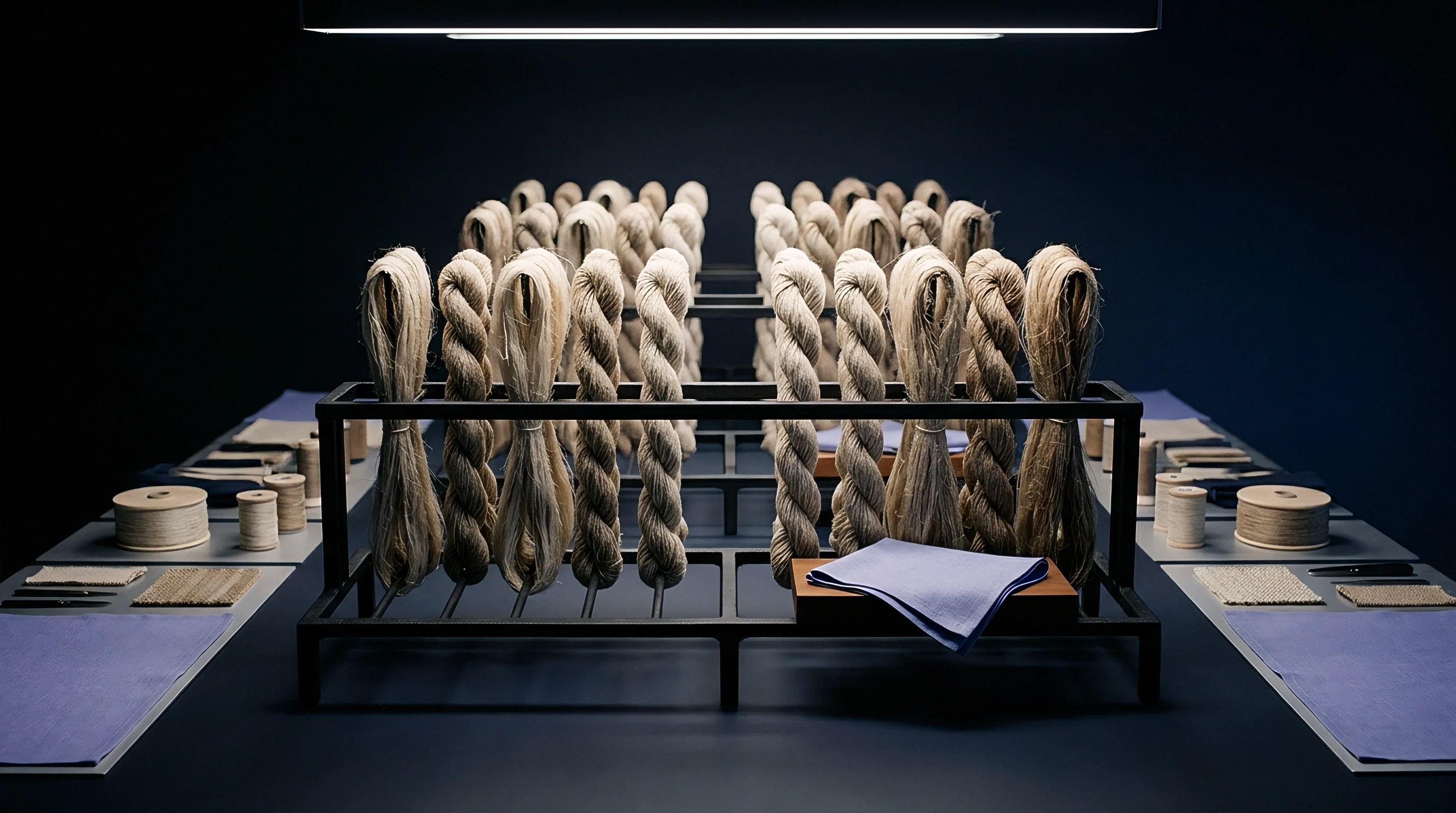
Thermal spikes during stem elongation disrupt secondary cell wall deposition within phloem bundle layers. In typical temperate conditions, flax secondary cell walls consist of crystalline cellulose microfibrils embedded in a pectin and hemicellulose matrix. Heat during the vegetative phase accelerates stem extension while suppressing cellulose synthase complex activity, forcing early cell wall closure and shifting the orientation of microfibrils relative to the fiber axis.
Microfibrillar angles that usually sit at 8 to 10 degrees off-axis in high-tenacity long line flax widen to 16 to 22 degrees when temperatures exceed 28 degrees Celsius. These wider angles reduce the axial load-bearing capacity of ultimate bast filaments, triggering early yield under mechanical tension during decortication and hackling.
Water deficits compound this structural impairment. Mid-season drought restricts sap movement and turgor pressure in phloem parenchyma tissue, cutting short the secondary wall thickening phase. Under combined heat and moisture deprivation, the average degree of polymerization of structural cellulose drops from its healthy baseline of 8,500 to 9,500 down to 4,800 to 5,500.
The resulting lower molecular weight distribution yields shorter, poorly aligned crystallites along the fiber wall. This reduction in polymerization directly degrades single-fibre tenacity, turning potential long-staple line flax into fragile material prone to transverse micro-cracking during mechanical processing.
Single-fibre tensile tests on dew-retted line flax exposed to three consecutive heat spikes above 30°C show a mean bundle tenacity drop from 52.4 cN/tex to 31.8 cN/tex at standard 65 percent relative humidity.
Pectin chemistry within the middle lamella also changes under volatile weather. Middle lamella pectins ~ mostly homogalacturonans cross-linked by calcium bridges ~ serve as the structural adhesive binding ultimate cells into commercial flax fiber bundles. Drought triggers premature lignification in surrounding parenchymal cells while altering methoxylation levels across the middle lamella.
Highly methoxylated pectins resist normal enzymatic cleavage during retting, while under-methoxylated zones degrade under even mild microbial action. This patchy pectin structure creates weak points along the technical fiber length, causing unpredictable breaks under tension.

Biochemical Alterations under Thermal Anomalies
Elevated temperatures during rapid growth disrupt microfibril organization inside the stem. Cellulose microfibrils laid down under heat shift from orderly crystalline sheets into disordered paracrystalline zones. Lacking the dense inter-chain hydrogen bonding needed to handle heavy tensile loads, these amorphous pockets concentrate stress when pulled rather than distributing it across the crystalline matrix.
At the same time, expanding lumen voids inside ultimate cells compromise structural stability, flattening the fiber cross-section from a rigid hexagon into a thin-walled ellipse that yields easily to lateral shear and bending fatigue.
Heavy rainfall after extended drought causes further structural damage. Sudden rain late in stem maturation drives a surge in cell expansion after cell wall thickening has ceased. This sharp rise in turgor pressure fractures the fresh secondary cell walls, forming micro-voids along the fiber axis that concentrate stress during tensile testing and cause shear failure at loads well below expected baselines.
Standard fineness metrics fail as a result: intake specifications based on gross linear density misread damaged, thin-walled filaments, which register high linear mass due to un-retted residual tissue despite carrying very low structural tenacity.
| Climatic Anomaly State | Secondary Wall Polymerization (DP) | Microfibrillar Angle (Degrees) | Mean Bundle Tenacity (cN/tex) | Defect Mode Manifestation |
|---|---|---|---|---|
| Temperate Baseline (Control) | 8,500 – 9,500 | 8° – 10° | 48.0 – 54.0 | Uniform plastic deformation, clean end breaks |
| Extended Heat Spike (>30°C) | 5,200 – 6,100 | 15° – 18° | 34.0 – 38.5 | Amorphous slippage, low yield point |
| Mid-Season Severe Drought | 4,500 – 5,300 | 18° – 22° | 29.0 – 33.0 | Transverse lumen wall collapse, brittleness |
| Drought Followed by Deluge | 5,800 – 6,800 | 12° – 16° | 32.0 – 36.5 | Inter-lamellar micro-fracturing, sliver split |

Cell Wall Polymerization Degradation
Severe water shortages shorten glucan chains in structural cellulose, reducing intermolecular hydrogen bonding per unit volume and directly lowering the fiber tensile modulus. Calibrated intake thresholds filter out compromised crops before bale opening. When combing fibers with a low degree of polymerization, mechanical stress triggers immediate transverse fractures instead of clean longitudinal splitting along pectin boundaries.
As a result, fiber lengths skew short, driving up tow yield at the expense of long line flax.
Failing to adjust intake thresholds for changing weather patterns causes substantial operational losses downstream. Mills that accept fiber lots without calibrated tenacity limits face high end-breakage rates during wet spinning, erratic slivers during drawing, heavy fiber drop under hackling frames, and permanent drops in finished fabric strength.

Gauge
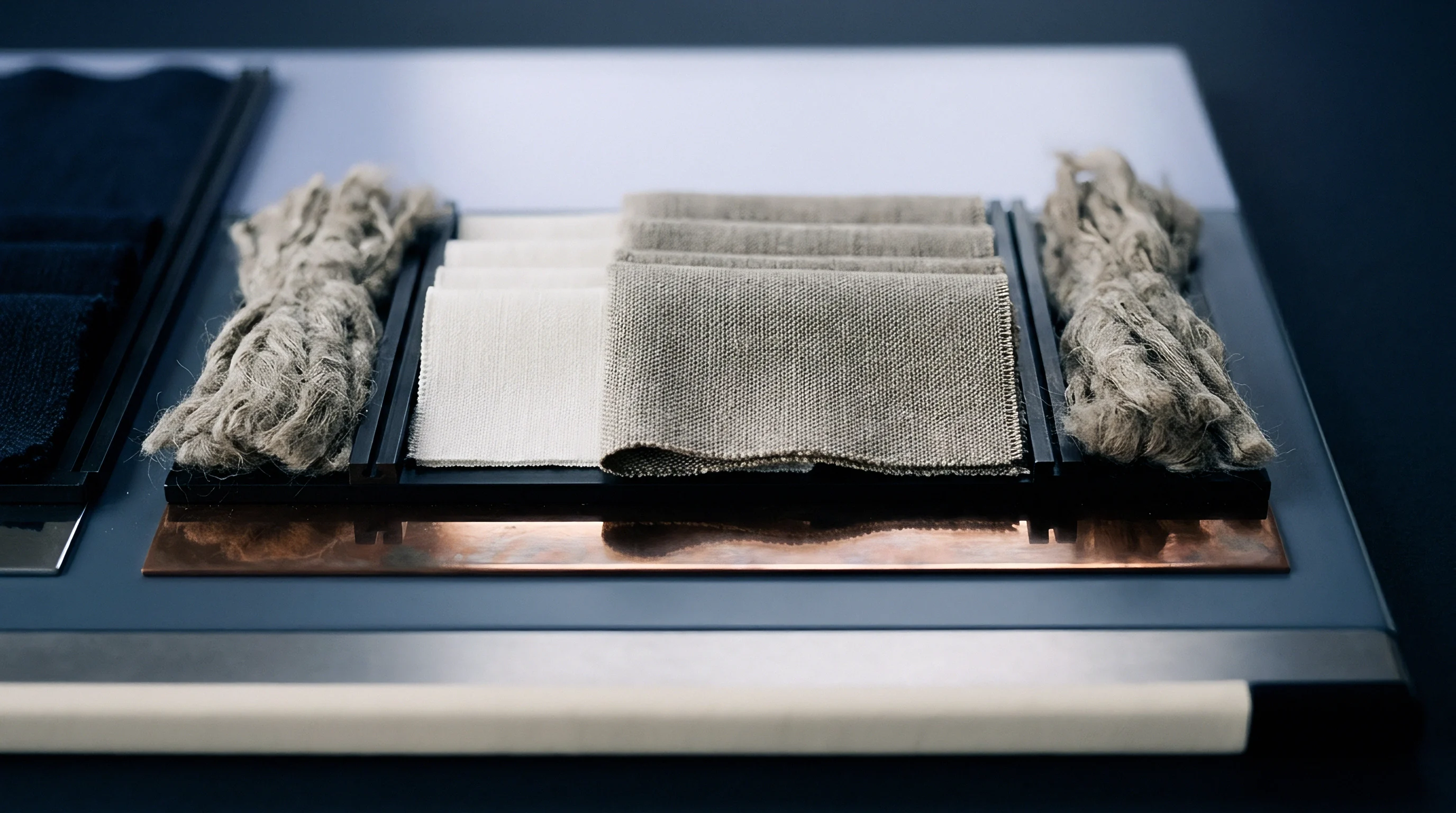
Tensile testing of raw bast filaments requires precise specimen mounting, as clamp distance dictates whether a test measures single-cell ultimate strength or aggregate bundle cohesion. A zero-gauge setup isolates intra-crystalline cell wall strength, bypassing pectin binders entirely. By contrast, a 3.2-millimeter gauge engages both cellulose microfibrils and middle lamella pectins, capturing true technical bundle behavior.
When weather stress weakens pectin cohesion, zero-gauge testing overestimates fiber utility, generating high cN/tex figures that fall apart during industrial drafting operations.
Data reliability depends heavily on equipment selection. Automated single-fibre testers isolate individual strands to measure breaking force, initial modulus, and linear density via micro-vibration. Bundle meters like Pressley instruments or Stelometers measure composite fiber groups, reporting tenacity in cN/tex or Pressley index units.
Converting breaking force into tenacity requires exact linear mass values, making precise linear density adjustments essential. Mass must be determined on high-precision microbalances after atmospheric conditioning to ISO 6741 standards at 20 degrees Celsius and 65 percent relative humidity. Skipping humidity equilibration distorts results, as absorbed moisture plasticizes cellulose chains, artificially inflating elongation while skewing breaking force readings.

Can Bast Fibre Intake Thresholds Absorb Severe Drought Shifts?
Shifting precipitation patterns introduce wide structural variability across crop regions. Intake thresholds historically relied on fixed tenacity cutoffs that assumed consistent growing conditions ~ an approach made obsolete by climate volatility. Single-fiber tenacity in drought-stressed crops shows wide variance, with individual lots exhibiting bundle strengths anywhere from 22 cN/tex to 48 cN/tex.
Dynamic intake calibration requires Weibull distribution modeling to assess cumulative failure probabilities across variable lots rather than relying on simple mean tenacity values.
Raw bast fibre lots require evaluation under standardized bundle tensile protocols with ambient atmospheric controls. Dynamic calibration sets lower tolerance limits using shape and scale parameters derived from Weibull distributions. A bundle with high average tenacity but a broad Weibull modulus carries high internal variance, leading to frequent yarn breaks on high-speed spinning frames.
Intake thresholds must adjust minimum cN/tex limits according to the delivery’s linear density profile, as finer fibers require higher baseline tenacity to endure equal drafting stresses.
Single Filament versus Bundle Measurement Dynamics
Testing aggregate fiber groups measures dynamic cohesion, which behaves differently from single strands. Single-filament testing reflects polymer chain integrity, while bundle testing incorporates friction, pectin adhesion, and inter-fiber slip. Under weather stress, pectin matrices degrade faster than crystalline cellulose; single filaments may test well while bundle tests reveal low cN/tex metrics due to premature inter-cellular slippage under load.
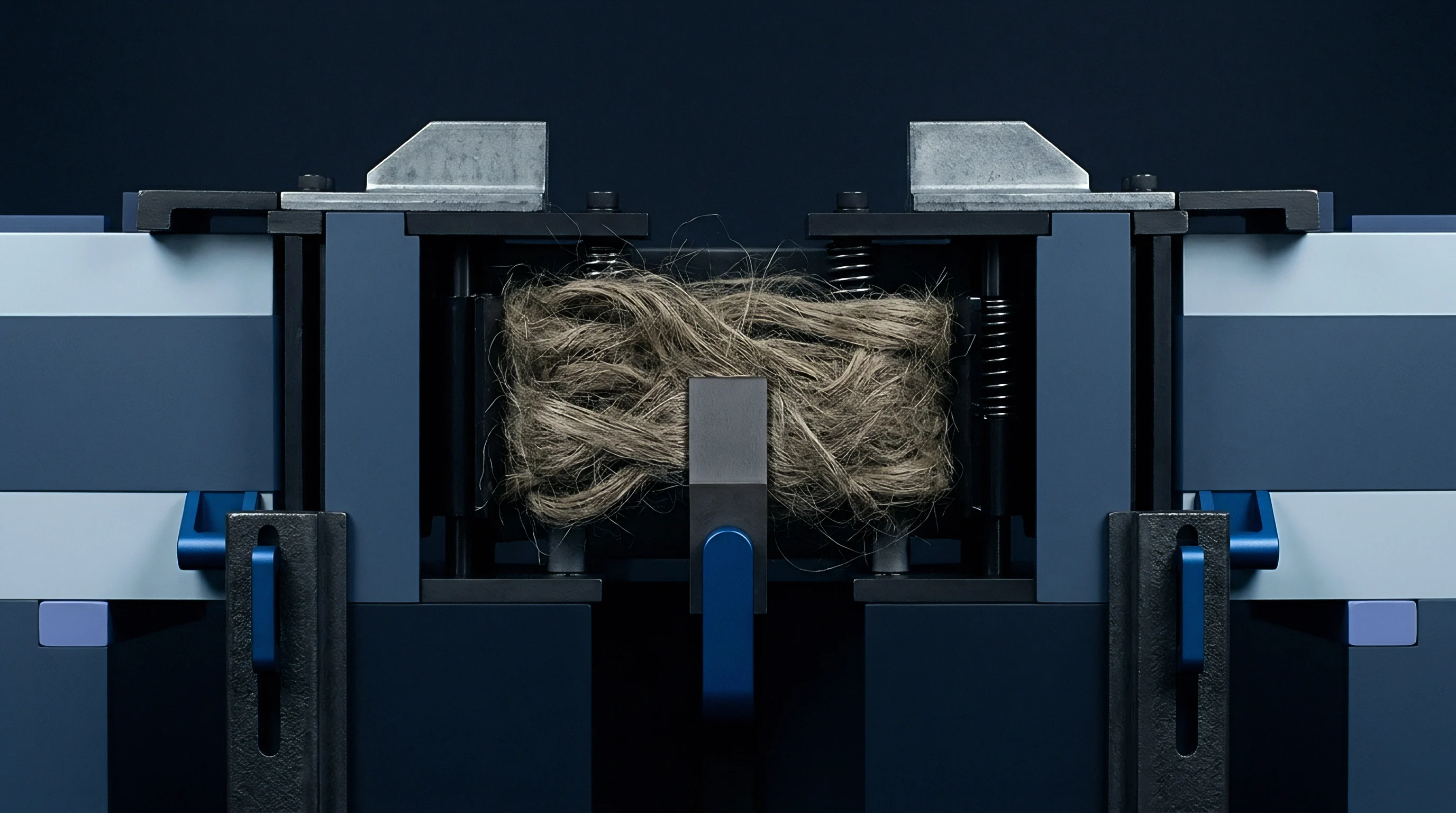
Clamp face design is equally critical. Smooth steel jaw faces permit slippage and distort elongation readings, while aggressive serrations create stress points that shear fibers at the jaw line. Vulcanized rubber faces operating under pneumatic clamping pressures between 0.4 and 0.6 MPa eliminate both slippage and jaw breaks.
Purchasing contracts mandating ISO 3060 bundle tensile verification at a 3.2 millimetre clamp distance reject any long-staple flax lot falling below 42.0 cN/tex after moisture equilibrium adjustment.
Measuring linear density calls for standardized testing protocols. The ISO 1973 vibrational method measures fundamental resonance frequencies of clamped fibers under fixed tension to determine precise decitex values for individual technical strands. Microscopic cross-sectional analysis complements this by highlighting lumen deformation, cell wall thinning, and outer diameter irregularities caused by drought.
Because fineness governs spinning limits, thin-walled, broad-lumen fibers from drought-damaged crops often yield misleadingly high dtex readings due to structural collapse, hiding low volumetric density and poor intrinsic tenacity.
Intake qualification protocol steps must execute in precise sequence to prevent invalid test data from entering raw material records:
- Bale Core Sampling Routine requires extracting ten distinct 50-gram core samples across a random selection of ten percent of bales per landed shipment lot.
- Atmospheric Conditioning Phase mandates equilibrating raw samples inside a climate chamber at 20°C ± 2°C and 65% ± 4% relative humidity for a minimum of 24 hours prior to mechanical testing.
- Linear Density Measurement utilizes resonant frequency vibrational determination under ISO 1973 to establish exact dtex values per individual technical strand.
- Bundle Tensile Verification executes pneumatic clamp breaking tests on a Stelometer at 3.2 mm gauge length following ISO 3060 methods to capture true technical bundle cN/tex.
- Weibull Modulus Calculation processes individual breaking force data points to determine lot uniformity and reject lots displaying a shape parameter below 3.5.
Worked Example: Dynamic Tenacity Calibration Workflow
Consider an incoming 20-metric-ton lot of dew-retted long line flax harvested during a regional drought. The buyer specification targets Nm 39 wet-spun yarn, requiring a baseline bundle tenacity of 45.0 cN/tex at 3.2 mm gauge length. Standard intake testing begins by selecting 10 bales and drawing 50 specimen bundles per bale, yielding 500 individual tensile tests.
Laboratory testing under standard conditions (20°C, 65% RH) yields an uncorrected mean breaking force of 210 N for a bundle linear mass of 4.5 tex. Dividing 210 N by 4.5 tex gives a raw tenacity of 46.67 cN/tex. Moisture regain testing via ISO 6741, however, reveals an actual regain of 14.2 percent from humid transit conditions, exceeding the standard 12.0 percent baseline.
The linear moisture correction applies as follows:
Corrected Tenacity = Raw Tenacity x (1 + (0.015 x (Standard Regain – Actual Regain)))
Corrected Tenacity = 46.67 x (1 + (0.015 x (12.0 – 14.2))) = 46.67 x (1 – 0.033) = 45.13 cN/tex.
Although the corrected mean tenacity of 45.13 cN/tex meets the nominal 45.0 cN/tex target, Weibull parameter analysis shows severe variance across the lot. Fitting the 500 breaking values to a two-parameter Weibull distribution gives a scale parameter of 47.2 cN/tex and a shape parameter of 2.65. A shape parameter below 3.5 indicates severe scatter from uneven cell wall degradation in heat-stressed fields.
Calculating cumulative failure probability shows that 18.4 percent of bundles drop below 32.0 cN/tex ~ the absolute minimum required to prevent yarn end-breakage during wet-spinning drafting. Even with calibrated clamp force during testing, the acceptable average tenacity is offset by this wide distribution spread, triggering lot rejection under the dynamic intake protocol.
Whether rapid high-volume mechanical testing instruments can replace manual bundle preparation without loss of tenacity precision under extreme climate variability remains an open question for industrial laboratories.


Retting
Moisture availability and fungal colonization rates during field exposure dictate middle lamella pectin dissolution. Dew-retting relies on native saprophytic fungi, mainly Cladosporium herbarum and Epicoccum nigrum, to secrete pectinolytic enzymes that isolate bast fiber bundles from surrounding stem tissue. Unseasonal weather disrupts this process: extended dry spells halt fungal metabolism, leaving fibers under-retted, stiff, and encrusted with residual epidermis and shive.
These under-retted fibers show high coarse bundle mass but lack drafting cohesion and cause severe stiffness during combing.
Excessive moisture causes the opposite failure mode. Heavy rain paired with warm ambient temperatures accelerates fungal growth into over-retting. Once middle lamella pectins are consumed, the fungi secrete cellulase enzymes ~ including endoglucanases and cellobiohydrolases ~ that cleave beta-1,4-glycosidic bonds in secondary cell wall cellulose.
Single-fibre intrinsic tenacity drops rapidly as retting duration alters cell wall structure. Fibers turn dark grey, lose lustre, and experience catastrophic loss of tensile strength, failing under light mechanical loads during decortication.

Microbial Degradation Protocols and Fiber Cohesion
Fungal populations break down inter-cellular pectin binders to release spinning-quality filaments from decorticated straw. Controlling microbial activity during field retting is nearly impossible in volatile weather, making enzyme-assisted tank retting and hot-water retting practical industrial alternatives. Controlled liquid retting uses specific doses of endo-polygalacturonase and pectate lyase enzymes at optimized pH (4.8 to 5.2) and temperature (45 degrees Celsius) parameters.
Controlled enzymatic extraction separates bundles uniformly while preserving core cellulose chain length, shielding raw fiber tenacity from weather extremes.
High processing costs limit enzymatic retting primarily to high-count specialty yarns. Field dew-retting remains standard commercially because it requires no energy or water treatment infrastructure. When erratic weather leads to inconsistent field retting conditions, classers must inspect raw lots for specific defect signatures that signal microstructural cellulose damage before accepting intake.
Field retting anomalies under climate shift manifest in four primary physical defect modes:
- Over-Retted Brittle Bundles exhibit severe fungal cellulase cleavage, characterized by dark grey discoloration, complete loss of surface lustre, and single-fibre tenacity drops exceeding 40 percent.
- Under-Retted Shive Retention results from moisture deprivation halting fungal pectinase secretion, leaving high wood fragment loads bonded to stiff, coarse technical bundles.
- Fungal Cellulase Cleavage Zones occur where localized water pooling on windrowed straw causes patchy cellulolytic destruction of crystalline cellulose chains within specific stem segments.
- Uneven Field Moisture Gradient creates wide tensile variance between top and root ends of the same flax straw, inducing erratic drafting behavior during mill processing.
Evaluating residual pectin content requires chemical titration or spectroscopic analysis. Fourier-transform infrared spectroscopy measures carboxylate absorption bands at 1600 cm⁻¹ and ester carbonyl bands at 1740 cm⁻¹ to determine exact residual pectin ratios. High ester ratios indicate under-retting, which demands harsher hackling settings.
Conversely, low pectin absorption paired with weak tensile strength confirms over-retting and polymer chain degradation, marking a lot that must be rejected or downgraded to low-tenacity coarse tow spinning.
Dark-grey, weakened fiber lots attributed to weather-driven color shifts during retting routinely fail laboratory tensile verification.


Drafting
Hackling converts raw scutched line into parallel slivers under heavy mechanical tension. Pin combs penetrate the flax bundles to extract short fibers, align long strands, and split coarse technical bundles into finer sub-units. When heat or drought compromises fiber tenacity, pin impact forces exceed the cell wall shear threshold, causing fibers to break across pinning zones rather than split cleanly along inter-bundle pectin lines.
Hackling yield drops sharply, shifting valuable long line flax into low-value hackling tow.
Processing heat-stressed long line stock can drive down hackling yield by six percent. This drop represents a direct financial loss, converting high-cost scutched flax into low-value comb waste and reducing spinner margin. Broken fibers generate neps and irregular length distribution in the drawn sliver.
Slivers with short broken fibers suffer from poor drafting tenacity on drawing frames, creating mass variations that carry through roving into spinning.
Pin Interaction and Fiber Cleavage Rates
Comb needles penetrating incoming line flax determine final strand alignment and tow generation. Pin density, penetration angle, and carriage speed must be adjusted when running low-tenacity fiber lots. High pin density on fine hackling fields strips out fragile filaments and increases waste ratios.
Lowering pin density and carriage speeds preserves long-staple fraction integrity, but leaves technical bundles coarser, limiting the spinnable yarn metric count.
Drafting dynamics on the drawing frame depend heavily on inter-fiber friction and bundle cohesion. Weakened pectins lead to unpredictable inter-fiber slippage under roller draft forces. When drafting rolls press on slivers made from damaged fiber, localized force spikes cause mass thinning and create thin spots in the roving.
Conversely, under-retted coarse bundle zones resist drafting rollers and form thick slubs, causing count consistency to degrade rapidly across dry and wet spinning.
| Tenacity Intake Tier (cN/tex) | Hackling Line Yield (%) | Max Spinnable Count (Nm) | Wet Spinning End-Break Rate (per 100 Spindle Hours) | Trough Temperature Requirement (°C) |
|---|---|---|---|---|
| Tier 1: High (>48.0) | 48.5 – 52.0 | Nm 60 – Nm 80 | 8 – 12 | 55 – 60 |
| Tier 2: Standard (40.0 – 47.9) | 42.0 – 48.0 | Nm 39 – Nm 50 | 14 – 20 | 60 – 65 |
| Tier 3: Degraded (32.0 – 39.9) | 34.0 – 41.5 | Nm 26 – Nm 36 | 28 – 42 | 70 – 78 |
| Tier 4: Sub-Standard ( | 55 | 80 – 85 |
Wet spinning passes line flax roving through a hot water bath before drafting and twist insertion. Trough temperatures between 60 and 75 degrees Celsius soften residual middle lamella pectins, allowing ultimate fibers to slide past one another during final drafting. When processing low-tenacity, heat-stressed lots, standard trough temperatures break down weakened pectin matrices entirely, causing roving to disintegrate in the trough.
Adjusting trough temperatures is essential when working with altered pectin matrices: dropping the bath to 50 degrees Celsius preserves basic binder integrity, but increases required drafting force and raises spindle end-breakage rates.
Higher trough temperatures in wet spinning soften resistant middle-lamella pectins, allowing degraded bast bundles to slide without breaking under drafting roller pressure.
End-breakage rates on wet-spinning frames serve as a real-time gauge of raw fiber intake quality. When breaks exceed 30 failures per 100 spindle-hours, mill efficiency collapses. Frame speeds must be cut, piecing labor rises, and higher splice counts degrade package quality while causing downstream defects in warp preparation and weaving.
Mill qualification of climate-affected incoming fiber lots follows a rigid sequential protocol:
- Mount raw sample bundles onto a laboratory hackling comb frame with reduced initial pin density.
- Pass fiber through five progressive hackling fields while recording mass drop at each comb stage.
- Collect comb waste to calculate net line flax yield percentage relative to raw scutched mass.
- Draw comb sliver across three drafting passages to evaluate mass variation coefficients.
- Process roving through a hot water wet-spinning trough at controlled 60°C temperature.
- Spin target count yarn across a 100-spindle test frame for two continuous operating hours.
- Record total end-breakage events and calculate breaks per 100 spindle-hours.
- Test spun yarn Lea Product and breaking tenacity under ISO 2062 tensile standards.
As a practical rule of thumb, every single cN/tex drop in raw fiber bundle tenacity below the 42 cN/tex threshold reduces maximum achievable wet-spun yarn count by two metric numbers while increasing hackling waste by over one percent.

Tariff
Commercial valuation models translate tensile variance directly into landed cost per linear meter of finished fabric. Raw flax pricing depends on declared grade, length, fineness, and certified bundle tenacity. When weather shifts cause incoming fiber to fall short of contract tenacity specs, static invoice pricing destroys mill margins.
Sourcing contracts must incorporate dynamic price deduction formulas to offset yield losses and processing inefficiencies from degraded raw material.
Raw fiber cost allocations must account for finished fabric parameters. Consider a standard 180 gram per square meter plain weave linen fabric woven at 150 centimeter width using Nm 39 wet-spun line flax in warp and weft. Producing one linear meter takes roughly 310 grams of yarn after accounting for micro-crimp and finishing shrinkage.
Spinning Nm 39 yarn requires Tier 1 or Tier 2 raw line flax with a baseline tenacity of at least 42.0 cN/tex. Procurement contracts typically incorporate sliding-scale penalties tied directly to cN/tex deficits.
Fibre lots purchased without tenacity discount schedules force spinning mills to absorb hackling yield losses directly into their operating margin.
When a delivered flax lot tests at 36.0 cN/tex due to heat stress microfibril degradation, the mill takes a double hit. Hackling yield drops from a 46 percent baseline down to 37 percent, requiring 24 percent more raw scutched flax to produce a kilogram of line sliver. Meanwhile, wet-spinning end breaks increase downtime, cutting room efficiency by 12 percent.
Without contractual price adjustments, raw fiber costs per linear meter of finished fabric rise by 0.68 EUR, erasing the weaver’s operating margin.
Intake contract documentation must include specific technical clauses to insulate buyers from climate-induced fiber degradation:
Deduction schedule parameters operate on continuous linear or stepped scales based on laboratory verification reports attached to specific bale lot numbers:
Tenacity Deficit Penalty = Contract Price x ((Specified Tenacity – Delivered Tenacity) / Specified Tenacity) x Penalty Factor
A standard penalty factor of 1.5 ensures price adjustments cover both volume yield losses and processing overhead. Specifications built on calibrated intake thresholds protect financial margins and product structural integrity alike.
Contracts specifying ISO 3060 bundle tensile compliance must state: “If delivered lot bundle tenacity falls below 42.0 cN/tex at 3.2 mm gauge length following ISO 6741 conditioning equilibrium, buyer retains the right to apply a 2.5 percent price reduction per cN/tex deficit down to 35.0 cN/tex, below which the entire lot is subject to immediate rejection at seller expense.”