Quantifying Frictional Abrasion and Weaver Workload Penalties in Fine Linen Weaving
Fine linen weaving requires optimized PVA-starch sizing, tight humidity controls, and calibrated loom allocations to limit frictional warp breaks and prevent severe landed cost workload penalties.
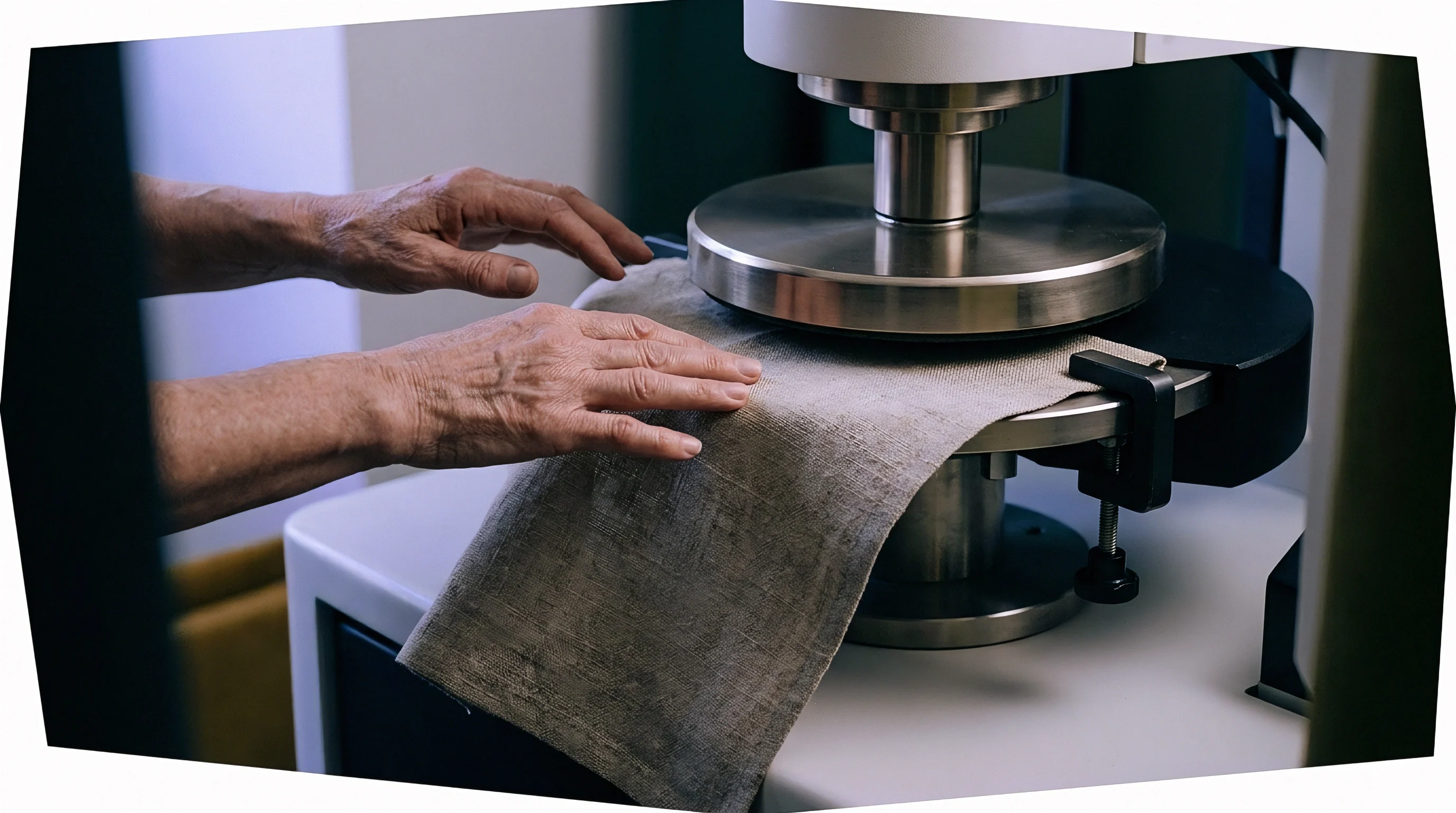

Drag
During shed opening, low-elongation flax yarns encounter both axial tension spikes and lateral abrasion. While wet-spun cotton yarns exhibit elastic recovery rates of six to eight percent, fine flax yarn breaks at an elongation of just 1.8 percent to 2.2 percent. In high-density constructions like NeL 66 plain weaves at 32 ends per centimetre, this rigidity shifts the mechanical strain of shed geometry directly onto the yarn surface.
Tensile forces peak continuously as the shed opens fully, dragging individual warp ends across steel heddle eyes, drop wires, and adjacent threads. Because bast fibers consist of ultimate fiber bundles bound by interlamellar pectin and lignin resins, repeated friction breaks these bonds and peels outer filaments away from the core strand. This increases yarn hairiness, generates loose fuzz, and weakens tensile strength before the thread even clears the reed.
Mechanical behavior at the contact zone follows modified Amontons friction dynamics, modeled by the exponential belt friction equation. Yarn tension accumulates as a function of the contact angle over metallic guide elements and the effective dynamic friction coefficient. In dynamic warp simulator testing, unsized wet-spun flax sliding against hardened nickel-plated heddle wire yields a dynamic interaction scalar of 0.28 to 0.35 in low relative humidity.
As sliding speeds accelerate to match modern rapier insertion rates of 420 picks per minute, surface temperatures at the eyelet interface rise rapidly. Heat softens residual plant waxes, driving up adhesive friction between the flax yarn and metallic contact points. On a Lawson-Hemphill thread tester over 120 cycles, the dynamic friction coefficient of NeL 66 unsized wet-spun linen against polished stainless steel reed dents measures 0.31 under 20 cN tension at 65 percent relative humidity; this climbs to 0.44 when relative humidity drops to 52 percent, or falls to 0.26 when 1.0 percent mass pick-up of liquid paraffin lubricant is applied.
Inter-yarn rubbing in high-density warps compounds this load, generating localized shear forces that snap outer fiber nodes.
Kinematics of the Fine Linen Warp Contact Zone
Mechanical stress concentrates where yarn bends over drop wire pins and passes through steel heddle eyes along the warp path. Drop wire movement causes steady, low-amplitude flexural fatigue, while passage through the eyelet exposes the thread to high-velocity sliding and sharp angular redirection during shedding. Depending on shed height, warp line height, and frame stroke depth, total contact angle across the harness eye ranges from 12 degrees to 22 degrees.
Lowering shed height narrows this contact angle and cuts normal force against the eye, but it also restricts clearance for rapier insertion, raising filling faults. Warp tension limits are calculated by measuring instantaneous strain across top and bottom shed sheets via piezoelectric load cells on the back rest roller. Peak warp tension during shed opening on a 220 cm rapier loom running NeL 66 linen at 420 picks per minute reaches 28.5 cN per end at 68 percent relative humidity.
Repeated flexural stress at the heddle eye induces transverse micro-cracks along flax fiber nodes, accelerating fiber loss and thread decay.
Peak warp tension during shed opening on a 220 cm rapier loom running NeL 66 linen at 420 picks per minute reaches 28.5 cN per end at 68 percent relative humidity.
Fiber debris stripped during shed movement builds up inside heddle eyes and drop wire slots. Compacted lint forms abrasive nodules that score incoming warp threads, turning smooth sliding contact into aggressive micro-plowing. Flax filaments possess high axial stiffness ~ elastic moduli reach 60 to 80 GPa ~ leaving them susceptible to brittle transverse shear under micro-plowing.
As outer fibers peel back, they gather into small bunches called fuzz slubs. These slubs move down the warp until caught in the reed or adjacent heddle eyes, causing local jams. High-density warps leave minimal clearance for these aggregates to pass, compounding entrapment and generating tension spikes that snap neighboring ends.

Coefficient of Friction across Metallic Shed Interfaces
Testing under ISO 11266 indicates that unsized wet-spun flax sliding against hardened nickel-plated heddle wire yields a dynamic interaction scalar between 0.28 and 0.35. Metallic surface topography determines how quickly fibers peel in fine linen warps. Rough heddle surfaces or microscopic burrs on reed dents shear outer bast filaments, causing immediate lint.
Under microscopic inspection, worn steel reed dents show longitudinal scoring from continuous contact with abrasive silica particles in un-scoured flax. Stainless steel reeds with surface roughness below Ra 0.10 micrometres curb abrasion by minimizing micro-groove cutting into bast fibers. Ceramic-coated heddle eyes offer lower friction, but high unit costs restrict their use in commercial plants.
Mill trials show that switching from standard flat steel heddles to mirror-polished thread-eye heddles extends unsized warp survival by 40 percent under equivalent tension loads. Maintaining smooth contact surfaces remains critical for controlling abrasion across long production runs.
Relative humidity in the shed directly modifies friction. Flax absorbs water vapor readily; moisture regain jumps from 7.0 percent at 50 percent relative humidity to 12.0 percent at 75 percent relative humidity. Internal moisture plasticizes the pectin matrix, boosting fiber flexibility and strain to break.
Excess moisture, however, increases surface friction when liquid water condenses on heddle wires. Condensation binds loose flax dust into pasty deposits that clog heddle eyes and spike sliding resistance. Holding relative humidity strictly between 68 percent and 72 percent at 22 degrees Celsius balances internal fiber ductility against surface adhesive friction.
Drifting outside this narrow window accelerates end breaks. Operations frequently attribute excessive fiber shedding to natural retting variation in raw flax rather than high warp tension or unpolished drop wire surfaces.


Sizing
The protective chemical coating applied during warp preparation determines whether fine flax yarn survives thousands of abrasive cycles in the shed. Because unsized fine linen lacks cohesive surface binding, individual fibers protrude from the core and raise yarn-to-yarn friction. Sizing coats the bundle, binding surface fibers to the core matrix and creating a smooth, abrasion-resistant film.
Sizing fine linen presents distinct chemical challenges because bast fibers do not stretch easily. Formulations designed for elastic cotton rely on starches with high film tensile strength but low ductility; on flax, these brittle starch coatings crack under cyclic tension spikes and flake off as dust. Effective fine linen sizing requires a composite recipe balancing film strength, flexibility, and strong adhesion to natural cell wall polymers.
Chemical formulations for fine flax blend modified low-viscosity starches with flexible synthetic polymers. Carboxymethyl cellulose offers chemical compatibility with natural cellulose, forming transparent, flexible films that adhere tightly to flax walls. Polyvinyl alcohol with a hydrolysis degree between 87 percent and 89 percent adds elastic toughness, letting the film yield under tension spikes without cracking.
Synthetic acrylic binders improve adhesion to residual hydrophobic waxes on unbleached flax. Lubricants like hydrogenated tallow emulsions or synthetic waxes drop the dynamic yarn-to-metal friction coefficient across heddles and reeds. Lubricant content must stay between 1.5 percent and 2.5 percent of total dry size mass ~ too much weakens film adhesion, while too little leaves surface friction high.
Size liquor viscosity must be held tightly between 25 and 35 seconds (number four Ford cup at 85 degrees Celsius) to ensure controlled penetration without over-stiffening the yarn core.
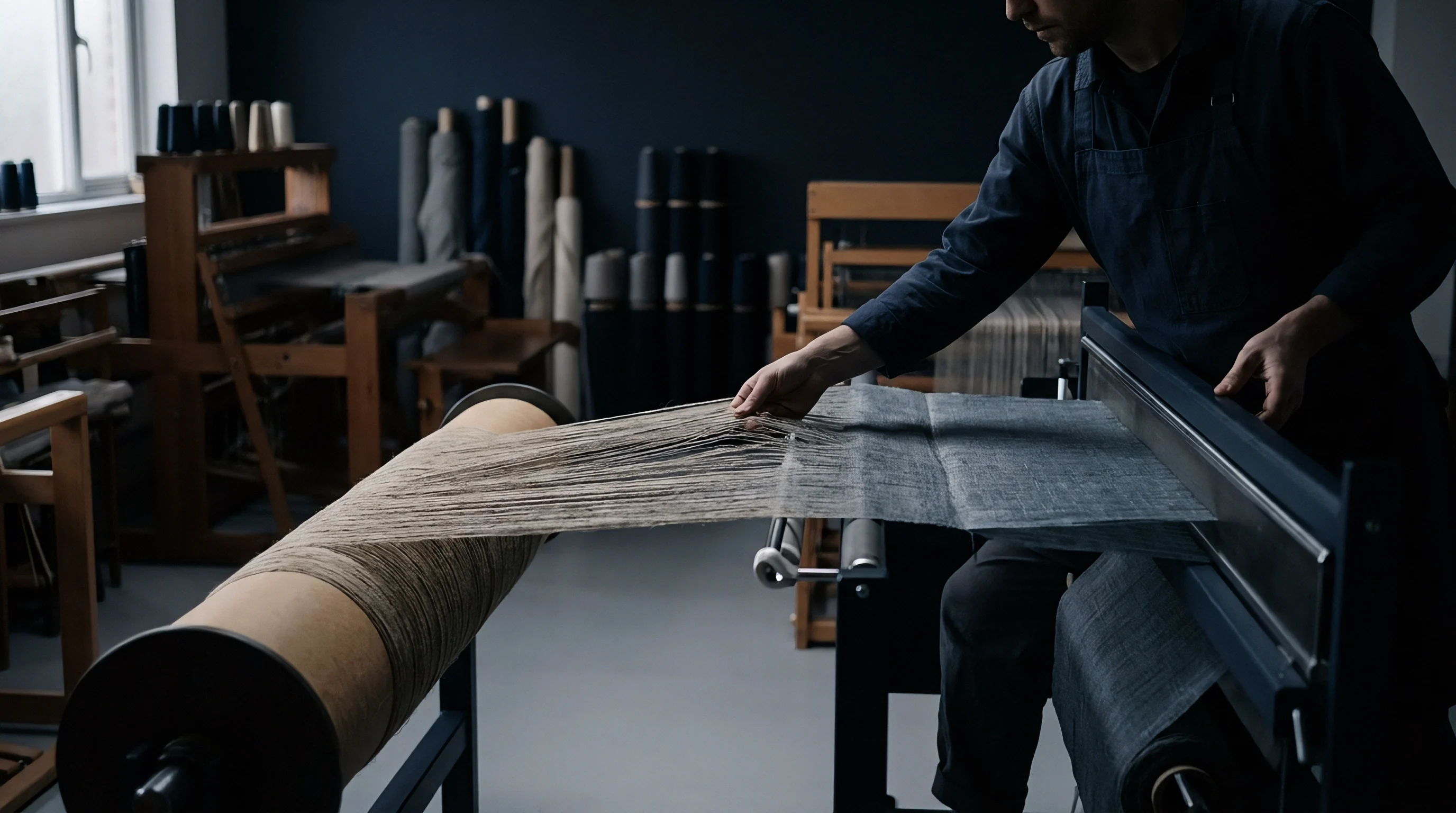
What Triggers Mass Migration of Fiber Fibrils?
Fiber ends detach from the yarn core when repeated friction breaks the pectin bonds binding individual flax ultimates. Fibril detachment accelerates rapidly if sizing fails to penetrate inner core fibers. When size liquor viscosity is too high, the protective coating stays on the outer surface, forming a rigid shell over an unbonded core.
Cyclic flexing in the shed cracks this shell off, exposing loose inner filaments to metallic friction. Conversely, insufficient size pick-up leaves protruding fibers bare, causing adjacent threads to tangle during shed opening. Mass fibril separation depends directly on the ratio of surface encapsulation to size liquor penetration.
Holding size liquor temperature at 85 degrees Celsius under precise squeeze roller pressure ensures penetration across 30 to 40 percent of the yarn cross-section, anchoring internal fibers while keeping outer films flexible.
Incorporating a mandatory sizing film rupture strain threshold of at least 3.2 percent into the warp beam purchase order prevents catastrophic yarn breakdown during rapier shed insertion.
Dry pick-up percentages must scale with yarn fineness and end density. Fine NeL 66 linen requires dry size add-on levels between 9.5 percent and 11.5 percent by weight, whereas coarser NeL 30 yarns need only 7.0 percent to 8.5 percent. Dense warps require higher add-on to shield threads from intense inter-yarn rubbing.
However, excessive pick-up causes boardiness, making the warp sheet stiff and prone to brittle fractures under tension peaks. Insufficient add-on leaves surface hairiness exposed, forming fuzz balls in the shed. Slasher speed, squeeze roll pressure, and drying cylinder temperatures must operate in closed-loop control to hold moisture content between 7.5 percent and 8.5 percent at exit.
Over-drying bakes starch films, making them brittle and destroying their abrasion resistance on the loom.
| Recipe Composition | Dry Add-On (%) | Film Strain to Rupture (%) | Hairiness Reduction (%) | Abrasion Cycles to Rupture (ISO 11266) |
|---|---|---|---|---|
| Native Corn Starch (100%) | 10.2 | 1.8 | 52 | 420 |
| Modified Potato Starch / CMC (70/30) | 10.5 | 2.9 | 78 | 890 |
| Modified Starch / PVA 17-88 / Acrylic (50/35/15) | 11.0 | 4.2 | 91 | 1,640 |
| Modified Starch / PVA / Wax Emulsion (50/40/10) | 9.8 | 3.6 | 86 | 1,380 |
| Testing conducted on NeL 66 wet-spun yarn (22.7 tex) at 68% RH, 22°C. Abrasion cycles recorded on dynamic yarn abrasion tester under 20 cN constant load. | ||||
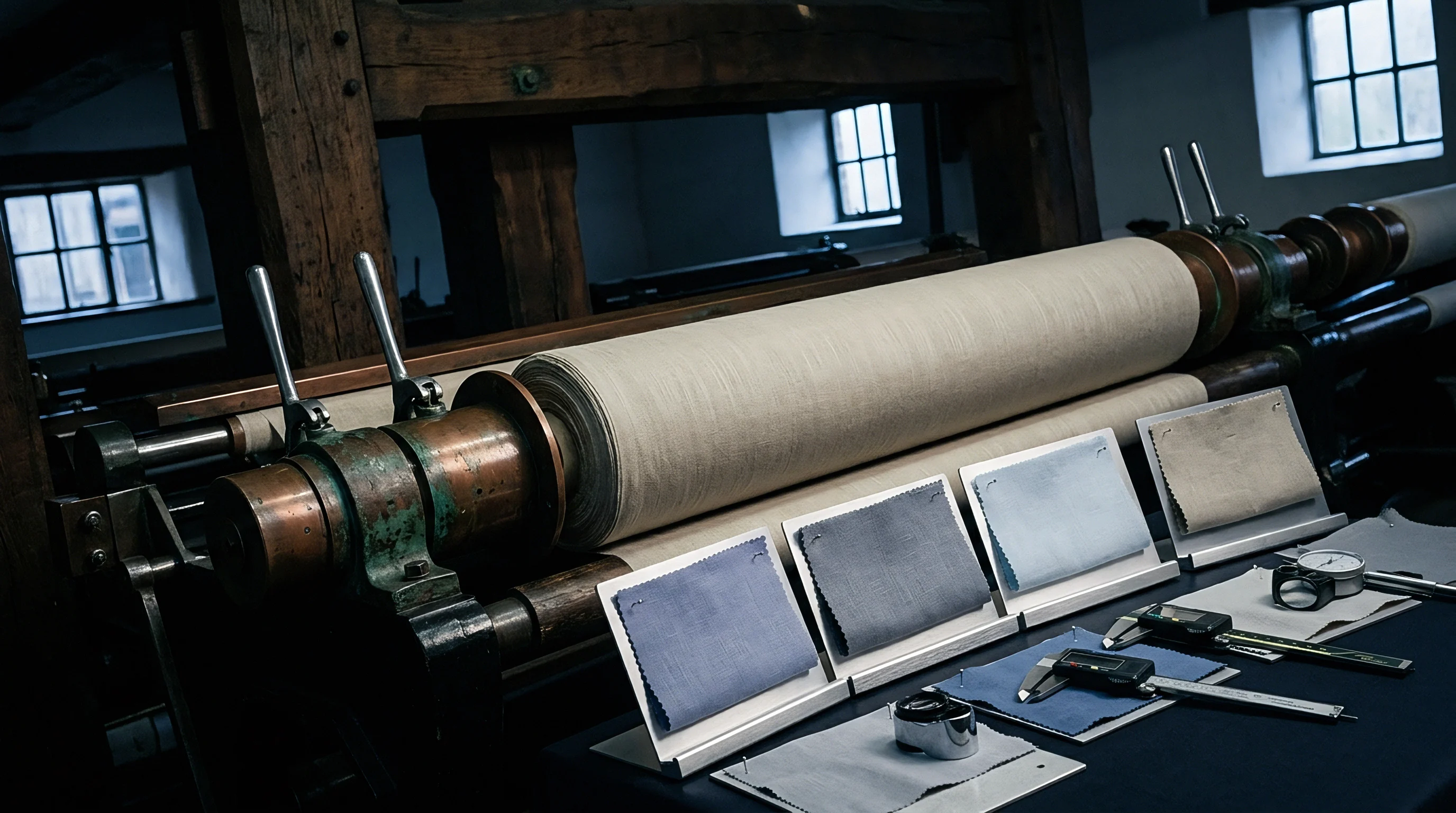
Formulation Balances for Low Elasticity Bast Fibers
Starch films designed for high-elongation synthetics fail on flax because their strain at rupture does not match the narrow elastic limit of bast fibers. High abrasion resistance requires matching the mechanical properties of the dry sizing film to the stress-strain curve of the linen thread. Polyvinyl alcohol polymers supply high tensile strength exceeding 45 MPa and elongation above 150 percent, creating a tough coating that absorbs movement during shedding.
Because pure PVA films resist removal in standard desizing, requiring hot alkaline washes, blending modified potato starch with partially hydrolyzed PVA yields high abrasion protection while dissolving smoothly in conventional equipment. Hydroxyethylated starches lower the gelation point, maintaining stable liquor viscosity during slasher stops and preventing heavy size marks on the warp beam.
Chemical cross-linking inside the sizing coating must be avoided on flax. Cross-linking agents harden the film, lowering flexural endurance and accelerating fiber breakage under high-speed reed impacts. Adding acrylic binders improves flexibility and adhesion to lignified bast regions, while micro-emulsified polyethylene wax drops dynamic friction against metallic reed dents to 0.22 without hurting size solubility during finishing.
Slasher operators must audit liquor refractometer Brix readings every two hours to catch evaporation or condensate dilution before pick-up drifts out of tolerance. A European mill using an unplasticized maize starch recipe caused complete warp dusting and shed breakdown within six hours of loom start, requiring a 14,200 USD air-freight surcharge to replacement-warp a 4,000-metre contract.


Stoppage
Warp break frequency is the definitive metric for yarn surface degradation during production. When abrasion strips surface fibers, detached lint clusters and bridges adjacent ends. As harness frames open to form the shed, these bridges pull neighboring threads out of alignment, obstructing the filling inserter.
In rapier systems, an incomplete shed causes insertion aborts, warp catching, and severe end breaks. Stoppages drop efficiency, require manual interventions, and leave restart marks on the fabric. Tracking stoppage rates per 100,000 pick metres provides a standard baseline for evaluating yarn quality, sizing performance, and loom precision across fine linen orders.
Breakage distributions show that fine linen warps are sensitive to specific zones along the weaving line. Continuous monitoring on rapier looms indicates that 62 percent of warp breaks occur in the harness zone between drop wires and heddles: heddle eye wear causes 24 percent of stops, while yarn-to-yarn rubbing in the open shed drives 38 percent of failures. Reed dent impacts account for 18 percent of breaks, concentrated near selvages where reed splay creates sharp angular friction; splices and knots cause the remaining 20 percent.
Standardizing air-splicing parameters during warping keeps splice diameters below 1.3 times normal yarn diameter, preventing mechanical snagging in heddle eyes. Baseline warp breakage data for NeL 80 plain weave establishing 1.85 stops per loom-hour rests on a 500-loom-hour observation run at 420 picks per minute under 70 percent relative humidity; this climbs to 3.90 stops per loom-hour if sizing pick-up drops from 10.5 percent to 7.8 percent or if loom speed increases to 480 picks per minute.
Classification of Shed Breakage Mechanics
Failures at the heddle eye stem from localized heating and high-frequency friction that shear weakened flax ultimates. Eyelet abrasion concentrates tension on tiny surface areas, fracturing outer filaments before overall yarn strength drops. Drop wire breaks occur through flexural fatigue as wires bounce against threads during shed reversal.
Dropper mass must match yarn count: using 0.7-gram drop wires on fine NeL 80 yarn causes severe fatigue, whereas 0.2-gram wires provide reliable electrical contact without damaging fine fibers. Harness frames must remain parallel within 0.5 mm across the reed width; misaligned frames increase lateral rubbing against heddle eyes, doubling stoppage rates across affected sections.
- Initial Hairiness Accumulation ~ Surface fibers lift from the yarn body under cyclic rubbing against heddle eyelets, expanding effective yarn diameter.
- Fuzz Ball Entanglement ~ Detached fibrils roll into small fiber balls that migrate down warp threads until caught between adjacent ends.
- Shed Shedding Blockage ~ Accumulated fuzz prevents clean separation of top and bottom warp sheets, obstructing the filling insertion corridor.
- End Snagging and Cleansing Break ~ Entangled threads tension beyond their elastic limit during harness separation, triggering simultaneous multi-thread rupture.
- Automated Drop Wire Stoppage ~ Dropper drops onto the contact bar as thread tension collapses, grounding the electrical circuit and activating the machine brake immediately.
Warp stop mechanisms rely on mechanical drop wires or optical sensors to detect thread loss instantly. Electromagnetic brakes stop the loom within 45 degrees of mainshaft rotation, keeping broken ends out of the fell line. While fast stopping limits defect length, it subjects the warp sheet to sudden deceleration.
High braking torque creates transient tension spikes across remaining ends, occasionally triggering secondary breaks on nearby weak threads. Fine-tuning brake torque balances rapid stopping against mechanical stress across fine linen warps.

Tension Spikes and Frequency Distributions
Dynamic load cells on the back rest roller show that cyclic shed opening generates tension peaks exceeding twice the baseline warp tension. Fine linen plain weaves running at 420 picks per minute produce spikes every 142 milliseconds. When peak tension coincides with localized thinning or a knot, instantaneous strain exceeds the 2.0 percent elongation limit of flax, causing an immediate break.
The exact proportion of micro-abrasion failures caused by static build-up in low-humidity sheds versus pure mechanical shear remains unquantified for counts finer than NeL 90; given this uncertainty, buyers specify a mandatory humidity floor of 68 percent relative humidity in weaving shed contracts. Modern back rest systems use spring-loaded or hydraulic easing motions that shift forward during shedding, cutting peak tension spikes by up to 35 percent.
A weaving shed that allows warp yarn fuzz to collect on drop wire contact bars converts manageable surface abrasion into continuous line stoppages.
Loom speed directly drives warp stoppage rates across fine linen constructions. Increasing rapier speed from 350 to 450 picks per minute raises yarn velocity through heddle eyes by 28 percent, pushing up dynamic drag and surface temperature. Machine vibration at higher speeds exacerbates drop wire flutter, accelerating wear.
Shedding cam profiles should use parabolic or modified sine acceleration curves to smooth harness movement and eliminate abrupt reversals. Asymmetrical shed settings ~ where the top sheet carries less tension than the bottom ~ clear filling insertion corridors, but increase friction on tighter bottom ends. Mill managers must balance loom speed, shedding geometry, and sizing to keep stoppage rates below 1.0 stop per loom-hour.
It remains unclear whether modified polyurethane sizing additives can prevent hairiness build-up without slowing down the rapid desizing cycles needed by finishing plants.


Allocation
Weave room labor efficiency depends on balancing repair time against operator patrol routines. Fine linen demands close attention because high end densities and low-elongation fibers lead to frequent stops and delicate piecing. When an end breaks, the loom sits idle while the weaver locates the thread, threads it through the drop wire slot, heddle eye, and reed dent, and attaches it to the fell line.
Repair duration determines total downtime and sets limits on operator assignments. Assigning too many looms leads to long queue times while stopped machines wait for service, dragging down shed efficiency.
Workload modeling splits operator duties into distinct tasks: manual repair time, routine patrol walking time, and interference waiting time. Fixing a broken fine linen end takes between 45 and 90 seconds depending on yarn count, harness complexity, and weaver skill. High end densities, like 36 ends per centimetre in NeL 80 damasks, lengthen repair times because weavers must isolate broken ends from dense warp sheets.
Routine patrol time covers inspecting greige cloth, checking filling packages, and clearing lint from drop wire banks. Interference time occurs when multiple looms assigned to one weaver stop at once, leaving machines idle until earlier breaks are fixed.

Mathematical Modeling of Weaver Labor Demands
Quantifying labor requirements involves splitting operator tasks into fixed patrol walks, manual piecing interventions, and forced waiting periods during simultaneous machine stops. The classic Enrick allocation model computes maximum loom set size per weaver based on allowable downtime and target shed efficiency. Set size follows the mathematical relationship:
N = (1 + K) / ((B Tr / 60) + P)
Where N is assigned looms per weaver, K is the allowable interference factor, B is warp breakage rate in stops per loom-hour, Tr is mean repair time in minutes per stop, and P is the patrol allocation fraction per loom-hour. For NeL 66 fine linen plain weave with a break rate of 1.2 stops per loom-hour, mean repair time of 1.1 minutes, patrol fraction of 0.025, and interference factor of 0.15, the formula yields a maximum set size of 18 looms per weaver. If poor sizing increases warp breaks to 3.5 stops per loom-hour, maximum set size collapses to 7 looms per weaver to keep efficiency above 85 percent.
High frictional abrasion on fine linen warps converts automated high-speed loom capacity into labor-constrained manual repair cycles.
High labor allocation ratios in high-speed sheds mirror the queuing dynamics seen in port container terminals during peak vessel arrival windows. High stoppage rates force management to reduce loom allocations per weaver, driving up direct labor costs per metre. Machine efficiency falls at the same time as longer interference delays keep looms stopped.
This combined cost impact inflates greige manufacturing expenses, creating landed price penalties that mills must absorb or pass to buyers via workload surcharges.
| Warp Break Rate (Stops/Loom-Hr) | Target Set Size (Looms/Weaver) | Actual Machine Efficiency (%) | Fabric Output (Metres/Loom-Hr) | Weaver Labor Cost (USD/Metre) | Machine Overhead Cost (USD/Metre) | Net Workload Penalty (USD/Metre) |
|---|---|---|---|---|---|---|
| 0.8 | 22 | 91.2 | 14.2 | 0.74 | 2.01 | 0.00 |
| 1.5 | 15 | 87.4 | 13.6 | 1.12 | 2.10 | 0.47 |
| 2.5 | 10 | 81.5 | 12.7 | 1.81 | 2.24 | 1.30 |
| 4.0 | 6 | 72.1 | 11.2 | 3.42 | 2.54 | 3.21 |

Interference Time and Multi-Loom Assignments
When several machines shut down simultaneously, unserviced looms sit idle while the operator repairs the first broken thread. Interference time scales exponentially with breakage rates and set sizes. Machine efficiency models use Poisson probability distributions to estimate multi-loom stoppage overlap.
At low breakage rates of 0.8 stops per loom-hour, interference accounts for less than 2.0 percent of downtime in a 16-loom set. When breakage rates spike to 3.5 stops per loom-hour, interference consumes 14.5 percent of machine time, pulling set efficiency below 75 percent. Mill managers must continuously adjust set allocations based on real-time stop counts from weave room monitoring systems.
- Patrol Cycle Starvation ~ High stop rates trap operators in constant thread repair, skipping routine inspection and letting minor lint accumulation turn into major fabric defects.
- Shed Interference Creep ~ Unserviced loom downtime expands rapidly when simultaneous stops outpace single-operator repair capacity across assigned sets.
- Micro-Stoppage Masking ~ Frequent short stops distort true efficiency figures by accumulating unrecorded downtime during automated shed resets.
- Operator Fatigue Cascades ~ Continuous manual piecing under high humidity and noise slows operator movement, increasing average repair times by up to 25 percent over an eight-hour shift.
Optimizing weaver walking paths reduces patrol time in large sheds. Arranging looms in face-to-face pairs along central aisles cuts walking distances between machines by 30 percent compared to single-row layouts. Equipping weavers with mobile pagers tied to the shed monitoring system alerts operators instantly to machine stops, identifying the exact loom and cause.
Rapid notification cuts reaction time from 0.18 minutes to 0.04 minutes per stop, recovering lost production on high-density fine linen warps. Adding looms to a weaver set when break rates are high reduces overall mill output while driving up greige fabric defects.
Scoring
Inspection frames evaluate raw greige quality by cataloging structural flaws from broken filaments and shed debris. Frictional abrasion creates surface defects that lower finished fabric grades under international standards. High warp breakage rates increase manual knot and splice density in finished rolls; untrimmed knot tails, loose ends, double ends, and repair mis-picks create prominent visual flaws on fine linen.
Fuzz balls drawn into the fell line are woven into the fabric structure as thick slub-like spots known as fuzz ball inclusions, ruining the smooth hand and causing dye resistance issues during finishing.
Standardized defect grading uses the ASTM D5430 Four-Point System to assign demerit points based on flaw length and severity. Under this protocol, defects up to 3 inches long receive 1 point; 3 to 6 inches receive 2 points; 6 to 9 inches receive 3 points; and over 9 inches receive 4 points. Multiple minor flaws within a single square metre accumulate points rapidly.
Total demerit points across 100 square metres determine overall roll grade. Fine linen intended for luxury shirting or bedding mandates Grade A quality, requiring total demerit points below 15 to 18 points per 100 square metres. High abrasion rates during weaving frequently push greige defect counts above 35 points per 100 square metres, triggering immediate downgrading and severe financial penalties.

Greige Surface Defect Taxonomy under Abrasion Load
Physical flaws on unwashed fine linen rolls map directly to mechanical breakdowns along the loom frame. Fuzz balls formed in drop wire banks appear as dense, irregular fiber clumps woven into filling channels. Reed galling streaks show up as continuous narrow warp-way shadow lines where fuzzy ends rub against burred reed dents.
Starting marks present as tight or loose horizontal bands across the cloth, caused by fell line displacement when looms stop and restart to fix breaks. Precise brake timing, main motor acceleration control, and automated fell line compensation reduce start-mark severity, but frequent stops inevitably increase overall start-mark density across the roll.
- Verify Fuzz Ball Demerit Limits ~ Audit greige rolls for fiber slubs woven into filling channels, assigning point penalties based on slub length and visual contrast.
- Inspect Reed Galling Streaks ~ Reject bolts with continuous longitudinal friction lines caused by abraded warp threads passing through damaged reed dents.
- Evaluate Starting Mark Frequency ~ Count dense or open pick lines caused by loom stops, enforcing a maximum limit of two minor start marks per fifty linear metres.
- Audit Splice and Repair Density ~ Enforce maximum limits on manual splices, rejecting rolls that exceed eight repair knots per one hundred square metres of finished fabric.
Calculating defect penalty costs requires correlating demerit points with price deductions. Greige rolls exceeding Grade A limits face contract discounts ranging from 15 percent to 40 percent off base metre prices. If demerit totals exceed 45 points per 100 square metres, buyers hold full rejection rights, leaving mills with off-grade stock.
Automated vision inspection systems mounted behind the reed catch abrasion defects within millimetres of formation, stopping the loom automatically when continuous fuzz streaks occur. Early detection prevents hundreds of metres of defective output, protecting mill margins on fine linen contracts.
Four-Point Penalty Calculations and Commercial Thresholds
Standardized assessment under ASTM D5430 assigns numerical points based on flaw length, normalizing defect density to a baseline area of 100 square metres. The formula for total demerit points per 100 square metres is:
Demerit Points = (Total Penalty Points Assigned 100) / (Inspected Roll Length in Metres Fabric Width in Metres)
For a fine linen roll measuring 120 metres long and 2.1 metres wide (a total area of 252 square metres), identifying 12 one-point flaws, 8 two-point flaws, 4 three-point flaws, and 2 four-point flaws results in 48 raw penalty points. Normalizing yields 19.05 demerit points per 100 square metres. This roll fails a strict 15-point Grade A specification, triggering commercial price penalties under standard supply contracts.
| Defect Nomenclature | Primary Shed Failure Mode | ASTM D5430 Point Class | Commercial Grade Impact |
|---|---|---|---|
| Fuzz Ball Inclusion | Fiber shedding and lint aggregation in drop wires | 1 to 2 Points | High accumulation triggers Grade B downgrade |
| Reed Galling Streak | Continuous metallic friction against damaged reed dent | 3 to 4 Points | Immediate rejection if length exceeds 1 metre |
| Dense Starting Mark | Fell line displacement during loom warp stop repair | 2 to 3 Points | Requires continuous automatic fell compensation |
| Double End Repair Flaw | Incorrect weaver drawing-in after warp break | 3 to 4 Points | Structural defect causing finishing striping |
Washing and finishing change how abrasion defects look. Wet processing collapses loose fuzz balls, but leaves permanent yarn density flaws in the cloth. Bleaching accentuates reed galling streaks by removing natural pigments and highlighting roughness differences between abraded and un-abraded warp ends.
Buyers should enforce inspection protocols at the raw greige stage before finishing alters defect signatures. Inserting ASTM D5430 Grade A compliance with a strict 15-point ceiling per 100 square metres forces mills to slow loom speeds and upgrade sizing recipes before running fine linen warps.
Tariff
Sourcing fine linen requires turning mill operational metrics into clear landed-cost line items. Fine flax yarns demand reduced loom speeds, specialized sizing chemistries, lower weaver allocations, and rigorous quality inspection. Mills quoting fine linen must account for high machine-hour rates and increased labor inputs per metre.
Buyers negotiating agreements need to evaluate total landed costs rather than relying solely on raw greige quotes. Understanding how abrasion penalties affect loom-hour rates, warp preparation surcharges, and labor overhead helps buyers secure fair contract pricing and avoid cost overruns.
Loom-hour rate structures reflect capital depreciation, power consumption, climate control loads, weaver labor, and overhead allocated per operating hour. Running a 220 cm rapier loom costs between 24.50 USD and 32.00 USD per operating hour depending on mill location and energy tariffs. When weaving standard cotton plain weave, loom efficiency reaches 92 percent at 500 picks per minute, generating high hourly output and spreading fixed costs over large volumes.
On NeL 80 fine linen plain weave, loom speed drops to 380 picks per minute and efficiency falls to 78 percent due to warp stops. Output per hour drops by 38 percent, driving up fixed machine overhead per finished metre.
Structuring Loom-Hour Base Rates for High-Risk Warps
Mills protect financial margins against abrasive yarns by building workload surcharges directly into machine time quotes. Fine linen orders with high warp densities require longer beam mounting times, complex harness drawing-in, and custom sizing. Sizing chemistry for fine linen runs 0.35 USD to 0.55 USD per kilogram of dry size, compared to 0.18 USD per kilogram for standard cotton starch mixes.
Warp preparation surcharges for fine flax add between 450 USD and 850 USD per beam mounted on the loom. Buyers should insist on transparent itemization of warp prep surcharges to prevent double-charging when re-ordering identical warps on established beams.
Weaver workload penalties appear on landed-cost sheets as direct labor surcharges per metre. When warp abrasion cuts weaver allocations from 16 looms to 8 looms per operator, direct labor expense per machine hour doubles. On a loom running at 400 picks per minute at 80 percent efficiency (producing 12.5 metres per hour), doubling labor cost adds roughly 0.48 USD per linear metre in labor penalties.
If high warp break rates drop machine efficiency further to 70 percent, overhead per metre rises by another 0.82 USD. Contract pricing must account for these operational variables to establish stable landed prices over long-term agreements.

Surcharge Formulas and Landed Cost Arithmetic
Calculating the true price per finished metre requires adding raw yarn expenses, warp preparation chemistry fees, machine occupancy costs, and defect allowance adjustments. Landed price per linear metre follows the commercial formula:
Price per Metre = (Yarn Cost + Warp Prep Fee / Beam Length) + (Loom-Hour Rate / Metres per Hour) + Workload Surcharge + Defect Risk Premium
For a NeL 66 plain weave with 32 ends per centimetre and 28 picks per centimetre at 210 cm grey width, yarn cost is 4.20 USD per metre; warp prep fees total 600 USD across a 3,000-metre beam (0.20 USD per metre); the loom-hour rate is 28.00 USD at an output of 13.0 metres per hour (2.15 USD per metre); weaver workload penalties add 0.45 USD per metre; and the defect risk premium adds 0.35 USD per metre. Total landed greige cost comes to 7.35 USD per linear metre. Understanding these underlying cost elements gives sourcing managers leverage during supplier negotiations.
- Establish baseline yarn lea count and measure unsized yarn hairiness on a laboratory tester.
- Require the mill to submit sizing recipe specifications, film strength data, and target size pick-up percentages.
- Set maximum contractual limits for warp breakage rates per 100,000 pick metres.
- Define weaver allocation caps and agree on machine efficiency benchmarks before mounting warp beams.
- Apply ASTM D5430 four-point inspection thresholds with contractual price deductions for excessive demerit points.
Negotiating fine linen weaving contracts requires clear baseline assumptions for loom speed, target efficiency, maximum stop rates, and demerit point caps. If a mill fails to meet efficiency targets due to poor warp preparation or improper humidity control, the contract should require the supplier to absorb workload surcharges. Conversely, if a buyer specifies an unusually high warp density or complex weave structure that naturally elevates friction, the buyer must accept higher loom-hour rates to cover reduced output.
Aligning technical parameters, sizing formulations, loom allocations, and defect limits in the purchase agreement ensures predictable landed costs without unexpected operational losses.