Predicting Dynamic Shed Tension Profiles to Eliminate Warp Stop Disruptions in Jacquard Fine Linen
Optimizing Jacquard shed depth and backrest synchronization caps dynamic tension below 60 percent yarn strength, eliminating warp breaks in fine linen.
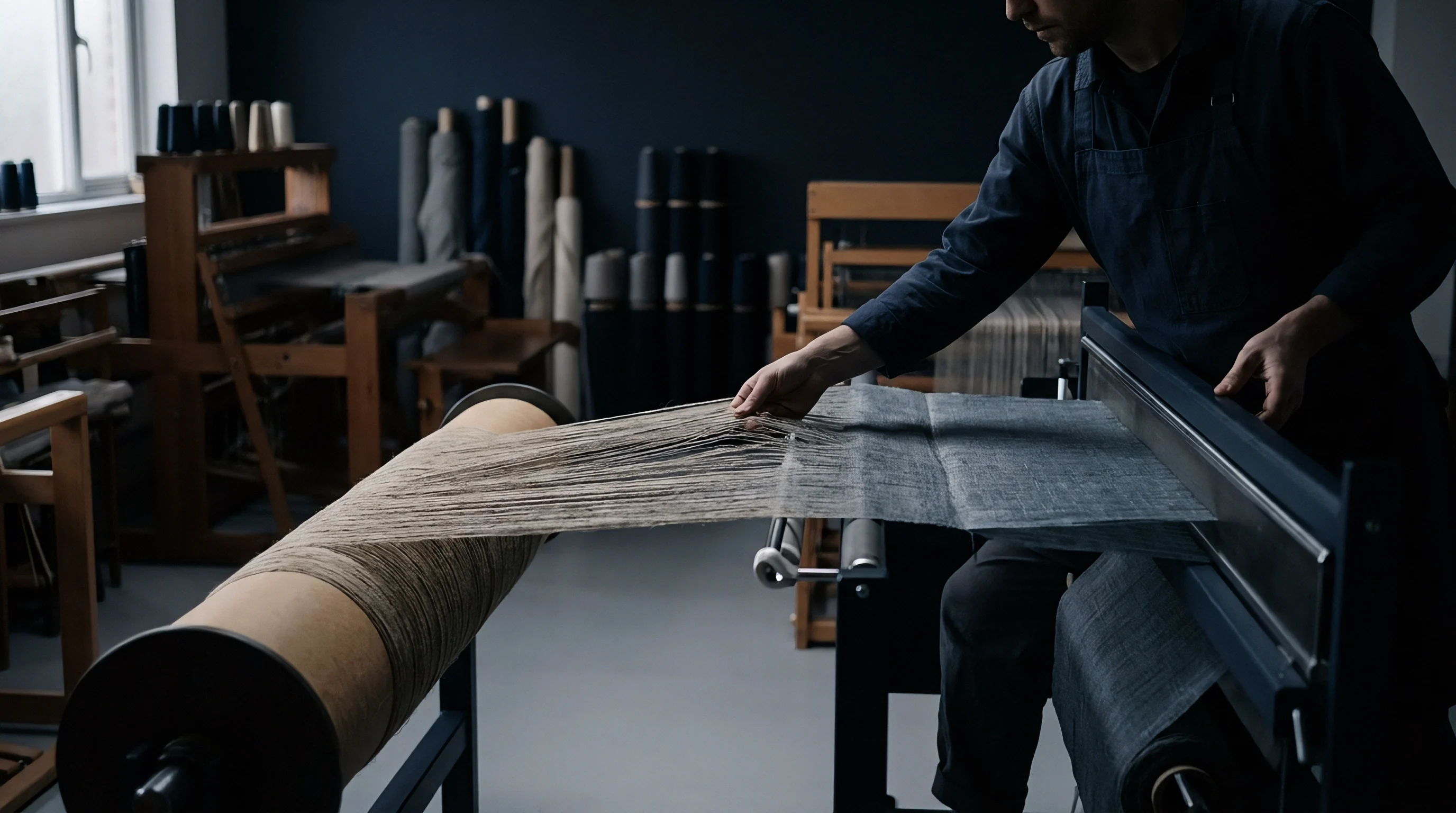

Flax
Fine wet-spun linen yarns present a distinct mechanical profile on Jacquard looms. Flax fibers have virtually no yield elasticity. Their high crystalline cellulose content results in an initial elastic modulus of 18 to 24 gigapascals, while ultimate tensile elongation rarely exceeds 2.2 percent.
When an NeL 60 (24.8 tex) wet-spun yarn encounters transient strain, it cannot stretch to absorb the shock. Wet spinning aligns short elementary fibers along the yarn axis, boosting dry strength at the expense of flexural endurance. As the Jacquard harness pulls thousands of ends into an open shed, tension surges occur within milliseconds.
These sudden spikes drive micro-cracks through thin spots in the yarn, triggering warp stops before beat-up.
Mapping dynamic tension requires tracking warp strain against harness movement, shaft rotation angle, and the local lift fraction of the pattern. While plain weaves and simple twills move heald frames in steady cycles, fine linen Jacquard constructions reset this baseline on every pick. Pattern repeats spanning 12,000 ends create density variations across the warp, with high-lift zones drawing yarn from the beam at different geometric rates than adjacent low-lift zones.
Conventional elastic deformation models for cotton or synthetics fail here because bast fibers undergo non-linear viscoelastic stress relaxation during rapid cyclic loading.
A wet-spun NeL 60 flax warp operating at 75 cN baseline static tension experiences dynamic stress peaks exceeding 220 cN per end when the Jacquard shed lift fraction crosses 70 percent within a 60-degree crank angle window.
Dynamic strain during shed opening combines two distinct stress components: geometric extension from heald eye displacement and frictional drag through harness cords, mail eyes, and reed dents. Geometric extension follows the Pythagorean change in arc length defined by shed depth and backrest geometry. Frictional drag grows exponentially per the belt friction equation, scaled by the contact angle at the mail eye.
Running fine linen at 450 picks per minute pushes heald velocity to 2.5 metres per second; at those accelerations, yarn-to-metal friction generates heat, strips protective sizing, and sharply increases thread breakage.
Unpredicted tension spikes primarily cause localized fatigue failure. Individual threads undergo hundreds of peak stress cycles every minute. Flax displays a steep fatigue curve under cyclic tension: peak stresses reaching 60 percent of ultimate tensile strength break filaments within 5,000 cycles, while keeping stress under 35 percent allows continuous running over entire beam lengths.
Unmodeled shedding peaks in complex weaves result in frequent loom stops, set marks in the greige cloth, reduced operator productivity, and degraded fabric appearance.
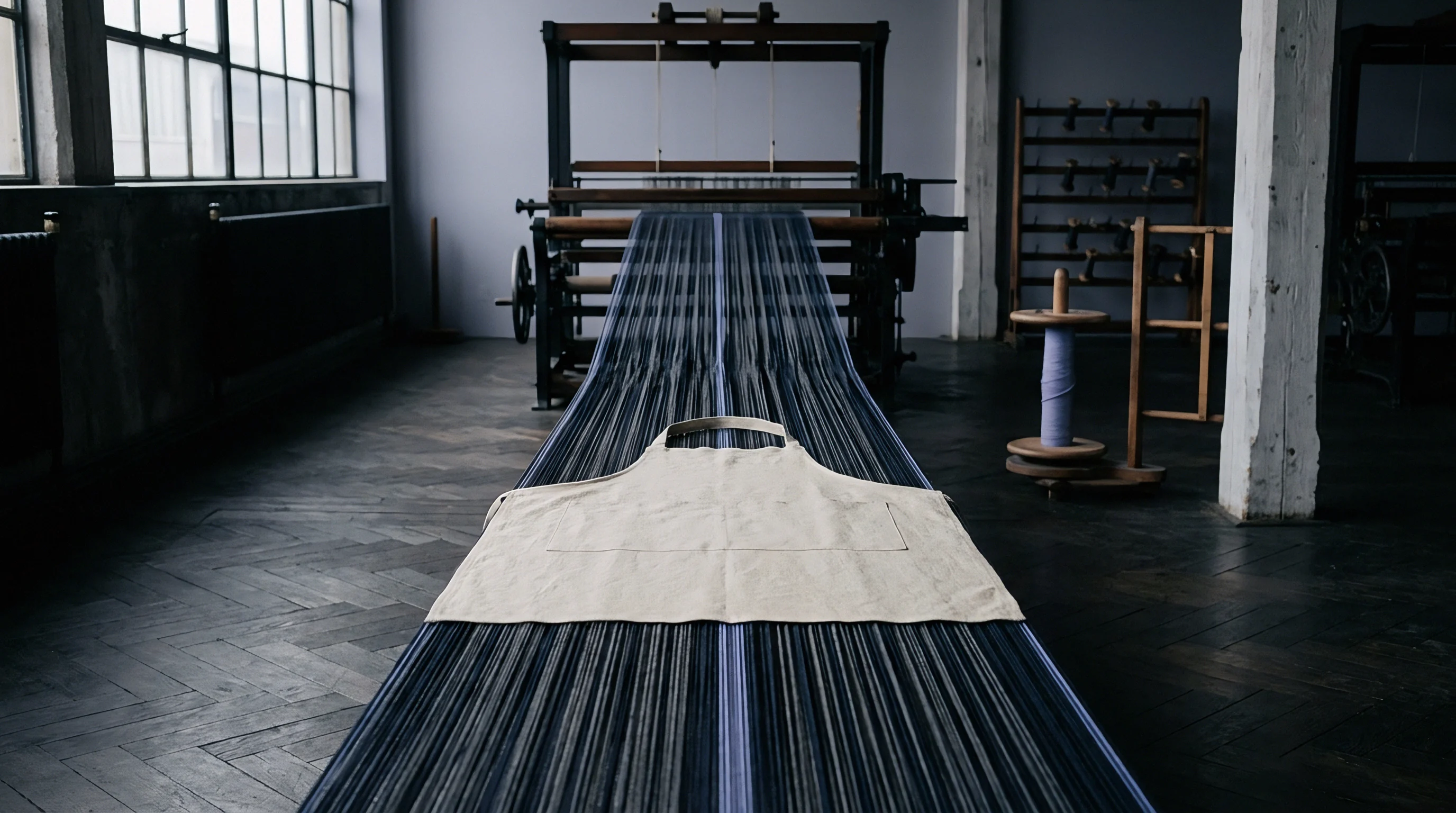
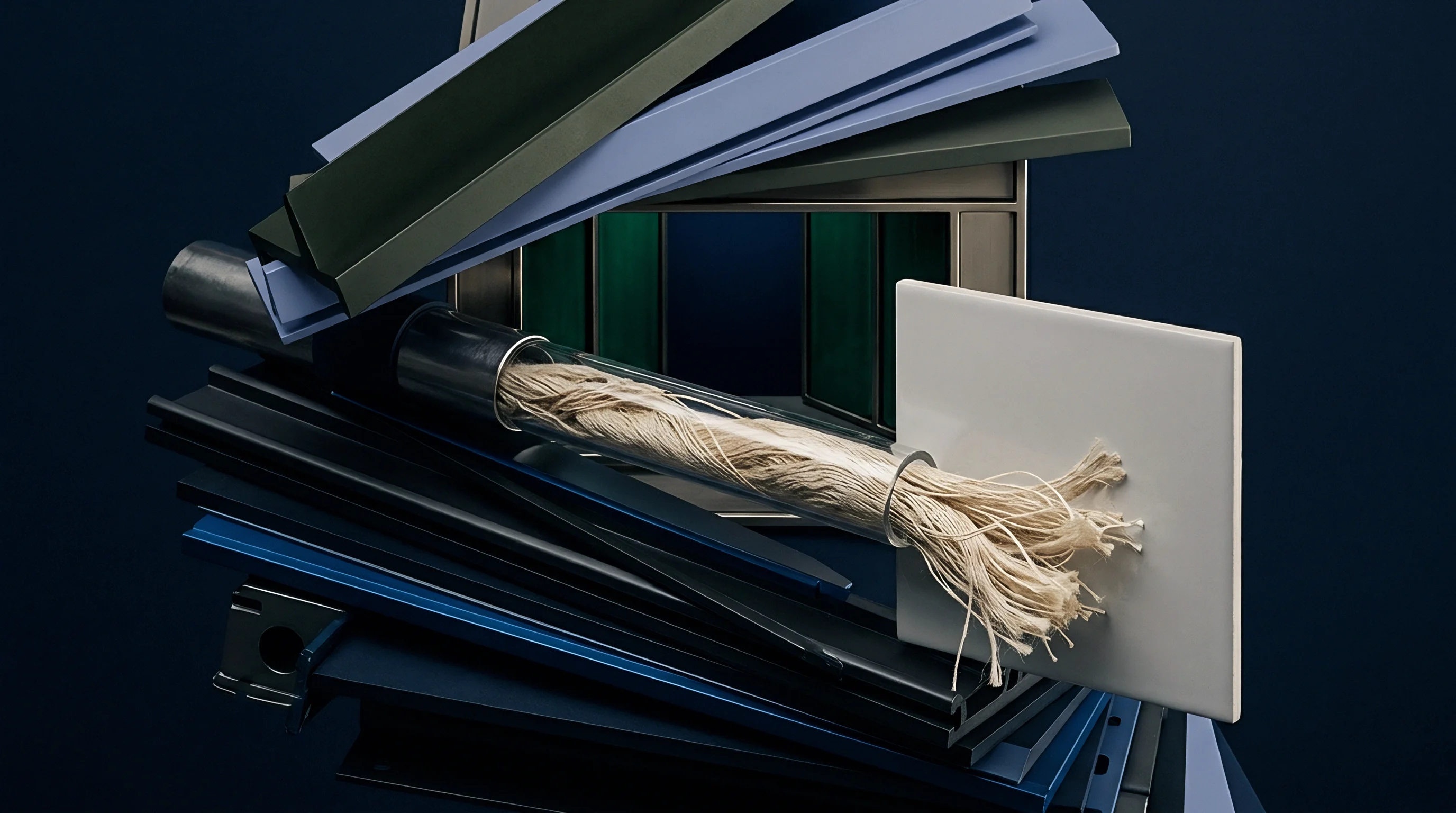
Geometry
Shed geometry determines the physical path length of each warp thread through the loom cycle. Electronic Jacquard heads give independent control over harness stroke, dwell timing, and shed symmetry. Symmetrical setups split total displacement evenly above and below the cloth fell line, minimizing peak elongation in the upper shed line.
Asymmetrical setups drive up top-shed tension exponentially, concentrating strain on lifted ends while leaving lowered ends slack.
Kinematic Variables in Fine Linen Shed Design
Shed depth needs only to clear the weft insertion element, whether rapier head or air-jet nozzle. Fine linen requires the tightest workable opening to protect yarn integrity. Each extra millimeter of shed depth increases warp elongation by roughly 0.15 percent, taking up a significant share of the yarn’s limited stretch.
Dwell angle sets how long the shed stays fully open during crank rotation. A standard 120-degree dwell reduces insertion errors, but holds taut warp ends under peak strain for longer. Trimming the dwell to 90 degrees cuts peak tension duration, giving flax fibers a few milliseconds to relax stress before the shed closes.
| Lift Fraction | Mean Shed Depth (mm) | Peak Dynamic Tension (cN) | Yarn Elongation (%) | Break Probability per 10k Picks |
|---|---|---|---|---|
| 0.20 | 42.0 | 85.4 | 0.82 | 0.04 |
| 0.40 | 44.5 | 112.0 | 1.15 | 0.18 |
| 0.60 | 47.0 | 148.6 | 1.54 | 0.92 |
| 0.80 | 50.5 | 195.2 | 1.98 | 4.15 |
| 0.95 | 53.0 | 238.0 | 2.35 | 14.80 |
Harness cord divergence introduces lateral forces that complicate pure axial tension models. On a 320 cm reed width loom weaving damask, cords at the outer selvedges pull warp ends at angles up to 18 degrees from the warp line. This angle increases friction in the mail eyes and unevenly loads the edges of the warp beam.
Harness elasticity causes mechanical hysteresis, creating a phase lag between solenoid actuation and heald eye lift that distorts dynamic tension across the loom width.
Structural yarn failure under dynamic shed movement manifests through four specific mechanical pathways:
- Abrasive Fuzzing Break occurs when surface flax fibrils strip off inside mail eyes, creating slubs that jam inside reed dents until tension snaps the thread.
- Brittle Tensile Snap occurs when localized dynamic shed tension exceeds the immediate ultimate breaking load of a thin yarn segment during peak lift acceleration.
- Cyclic Flex Fatigue Break happens when repeated bending around the drop wire and backrest roller degrades internal fiber cell walls without immediate tension spikes.
- Cross-Shed Cling Separation occurs when fuzzy fine linen warp ends cling together during shed opening, forcing lifting ends to pull adjacent stationary ends upward until mechanical overload breaks one or both threads.
Keeping shed depth at the minimum physical clearance for the rapier head preserves fine linen yarn through long production runs.

Harness
Electronic Jacquard harnesses use return elements to pull heald eyes down once lift solenoids disengage. Older looms used metal lingo weights, while modern high-speed machines rely on mechanical springs. These springs exert linear or progressive resistance, increasing downward force as the shed opens and compounding geometric tension on the warp thread.
Correct sizing provides the protective film required to withstand harness drag and spring return forces.
To quantify dynamic shed tension profiles, consider an engineering assessment on a 12,000-end Jacquard machine running NeL 60 wet-spun linen warp yarn (13.8 tex, average breaking force 320 cN, strain at break 2.0%). Loom operating parameters: 480 picks per minute (8 Hz shaft rotation), rapier insertion, symmetric shed geometry, total warp sheet length 1,250 millimeters from beam drop point to cloth fell.
The baseline static tension per warp end set at the let-off motion equals 65 cN. Geometric shed opening displacement causes an arc length extension of 18.5 millimeters on a lifted end. For a 1,250 millimeter warp length, this geometric extension corresponds to a strain increment of 1.48 percent.
Applying the elastic modulus of wet-spun flax (20 GPa, equivalent to roughly 14,000 cN per unit strain for 13.8 tex yarn), an uncompensated 1.48 percent strain increment demands a dynamic tension jump of 207 cN. Adding the baseline static tension yields a theoretical dynamic peak tension of 272 cN per end, which reaches 85 percent of the yarn breaking threshold.
Integrating an oscillating backrest roller dampens this peak load. Moving the backrest roller forward by 3.2 millimeters during shed opening releases 3.2 millimeters of warp path length, cutting net strain increment to 1.22 percent. Frictional drag through harness mail eyes and reed adds an additional 15 percent strain overload factor.
The corrected dynamic tension calculation produces a peak load of 188 cN per end, successfully lowering peak strain to 58 percent of yarn breaking strength and securing stable continuous operation.
Adjusting shed tension profiles requires executing a precise mechanical setup sequence on the loom floor:
- Set static warp let-off tension to the lowest value that maintains a clean fell line during beat-up, recorded via portable tensiometer.
- Calibrate backrest roller eccentric drive phase so peak forward movement coincides precisely with maximum Jacquard shed lift angle.
- Adjust Jacquard shed height control mechanisms to set minimal clearance above the rapier guide system across the full reed width.
- Modify electronic Jacquard lifting curves to implement a smooth sinusoidal acceleration profile, replacing harsh linear lift motion.
- Verify spring return stiffness ratings across all harness cords, replacing aged spring sets that show greater than 5 percent variance in rate.
- Balance harness board height relative to cloth fell level to eliminate asymmetric tension biases between top and bottom shed lines.
Oscillating backrest roller synchronization reduces dynamic warp tension surges in fine linen shedding by up to 35 percent when drive phase matches crank angle peak lift precisely.
Maintaining constant warp sheet tension via modern electronic let-off systems does not eliminate the need for dynamic harness modeling. Jacquard shedding creates localized strain, pulling hundreds of individual ends into high-strain lift while adjacent ends remain stationary on the lower shed line.
Frequency
Loom speed directly alters dynamic shed tension through mechanical vibration and acceleration harmonics. While beam tension sets the baseline load, running fine Jacquard linen at higher speeds transforms tension spikes from simple geometric events into complex harmonic oscillations. Resonance occurs when the shaft rotation frequency matches the natural frequency of the warp sheet, producing standing waves that locally amplify peak loads.

Harmonic Oscillations and Speed Control Mechanics
Under high dynamic tension, a warp thread behaves like a stretched string. Its natural frequency varies directly with the square root of warp tension and inversely with free warp length. Accelerating a rapier loom from 350 to 500 picks per minute raises excitation frequency from 5.8 Hz to 8.3 Hz. If an NeL 50 linen warp has a natural frequency around 8.2 Hz, resonance strikes the shed, causing severe bouncing in the lower warp sheet, harness mis-picks, drop wire chatter, and false warp stops.
| Stops per 100k Picks | Loom Efficiency (%) | Greige Output (m/loom-hr) | Set Mark Defects per 100m | Landed Cost (EUR/m) |
|---|---|---|---|---|
| 1.2 | 91.5 | 18.3 | 0.1 | 12.40 |
| 3.5 | 84.2 | 16.8 | 0.8 | 13.85 |
| 7.8 | 72.0 | 14.4 | 2.4 | 16.20 |
| 14.2 | 58.1 | 11.6 | 6.1 | 20.10 |
| 22.0 | 44.0 | 8.8 | 12.5 | 26.50 |
Controlling speed-induced dynamic peaks requires screening Jacquard pattern files before loading beams on the loom floor.
Evaluating pattern designs for dynamic stress risk demands clear engineering metrics:
- Float Distribution Index measures average float lengths across pattern repeats to prevent excessive structural loose ends that alter local tension balance.
- Maximum Lift Gradient checks the rate of change in lifted ends between consecutive picks to highlight sharp tension transitions.
- Cross-Shed Lift Symmetry Ratio verifies that top and bottom shed thread counts remain within an acceptable 40 to 60 percent balance window across 80 percent of the pattern repeat.
- Local Density Clustering Factor identifies high-density weave segments that concentrate thread strain within narrow reed sections.
Standard purchasing specifications for fine Jacquard linen mandate an operational warp stop rate under 3.0 stops per 100,000 picks to guarantee greige fabric structural uniformity.
Can real-time harness telemetry prevent linen end breaks?
Whether active piezo-electric sensor feedback can dynamically alter local harness stroke during rapid pattern transitions remains an unresolved engineering question for machinery designers.
Audit
Verifying dynamic tension control requires structured testing before committing production warp beams. Greige quality depends on eliminating stop marks, which occur whenever drop wires trigger a loom shutdown to repair a snapped warp end. High-angle light inspection tables reveal the set marks, reed lines, and localized fuzzing caused by peak shedding tension.
Implementing targeted qualification testing isolates latent shedding flaws early in the sampling phase:
- Continuous Tension Telemetry attaches mini piezoelectric strain sensors to representative high-lift warp ends during 10,000-pick sampling runs to map exact dynamic peak curves.
- High-Speed Video Motion Analysis records harness mail eye entry angles and warp end separation dynamics at maximum operating speeds to pinpoint cross-shed cling points.
- Sizing Extraction and Abrasion Testing measures size coat retention on warp ends sampled directly from behind the reed after 20,000 picks to ensure protective film survival.
- Fourier Transform Frequency Spectrum Analysis monitors warp beam vibration spectra across speed ramps to detect resonance windows before setting commercial loom speeds.
Quality management specifications must establish hard numeric thresholds for dynamic tension profiles during fabric development trials.
Single-end peak tension must not exceed 65 percent of certified yarn breaking tenacity under maximum pattern lift density during standard speed sampling runs.
Under standard international fabric procurement agreements, buyer acceptance of fine Jacquard linen lots hinges on certified loom inspection logs demonstrating an average warp stop rate below 2.5 stops per 100,000 picks, with any lot exceeding 5.0 stops per 100,000 picks subject to flat rejection or renegotiated contract pricing.
Settlement
Shed capacity economics dictate overall commercial viability when weaving high-density fine linen Jacquard fabrics. Loom hours represent fixed, non-recoverable operational costs. When dynamic shed tension causes frequent warp stops, machine efficiency plummets, directly inflating production costs per linear metre of cloth.
Financial calculations must balance loom running speeds against break-induced downtime costs.
Consider a commercial production model for fine damask linen (NeL 60 warp and weft, 44 ends/cm, 36 picks/cm, 300 cm grey width) woven on modern high-speed rapier looms. Machine capital cost, power, overhead, and direct labor sum to a fixed loom-hour cost of 28.50 EUR. Standard speed setting: 450 picks per minute, yielding a theoretical maximum production of 27.0 linear metres per hour at 100 percent efficiency.
Running under unoptimized dynamic tension profiles generates 12.5 warp stops per 100,000 picks. Average downtime per stop, including weaver response, end piecing, fell realignment, and restart verification, equals 2.5 minutes. In a 100,000-pick shift (3.70 theoretical loom hours at 450 ppm), 12.5 stops accumulate 31.25 minutes of dead downtime.
Actual shift time reaches 4.22 hours, dropping overall loom efficiency to 87.7 percent. Net production drops to 23.68 metres per hour, driving direct loom running cost to 1.20 EUR per metre.
Furthermore, 12.5 warp stops generate an average of 1.5 visible set marks per 100 metres, forcing second-quality fabric downgrades on 8 percent of total output. With prime greige priced at 18.50 EUR per metre and second-quality fabric discounted by 40 percent to 11.10 EUR per metre, the quality penalty adds an effective loss of 0.59 EUR per metre across the entire production run.
Implementing predictive dynamic shed tension optimization reduces warp stops to 2.2 stops per 100,000 picks. Downtime per shift drops to 5.5 minutes, raising loom efficiency to 97.6 percent. Net output increases to 26.35 metres per hour, dropping direct loom running cost to 1.08 EUR per metre.
Second-quality downgrades fall below 0.5 percent. Combined cost savings reach 0.71 EUR per linear metre, amounting to 21,300 EUR in direct financial value over a 30,000-metre commercial production contract.
Booking shed time on fine Jacquard linen warps demands pre-setting technical tolerances inside the master purchase order. Mills that validate pattern dynamic lift curves prior to warp mounting consistently hit delivery schedules while maintaining target margin structures across complex fabric programs.