Step Gradient Shedding Mechanics for High Hook Count Linen Damask Weaving
Step gradient shedding equalizes warp strain across deep jacquard harness boards, preventing end breaks and clearing rapier sheds in dense linen damask.
Harness
High hook count jacquard shedding systems operating above 6,000 hooks require precise mechanical alignment along the harness depth profile. In wet-spun linen damask weaving, where warp yarn elongation rarely exceeds 2.5 percent before deformation, the physical distance from the backrest roller to the cloth fell varies substantially across the harness board. Harness boards with 80 to 128 depth rows create a geometric discrepancy between front cords and back cords.
Front warp ends undergo acute angle deflections over shorter mechanical distances, whereas back warp ends travel across an elongated diagonal, requiring greater harness wire lift to clear the same rapier insertion tunnel.
Static shedding profiles attempt to equalize shed opening height across the entire comber board. However, uniform lift height forces front warp ends into excessive elongation while leaving back warp ends with insufficient shed clearance. This clearance failure produces rapier collisions, yarn split faults, and broken ends across the rear harness wire rows.
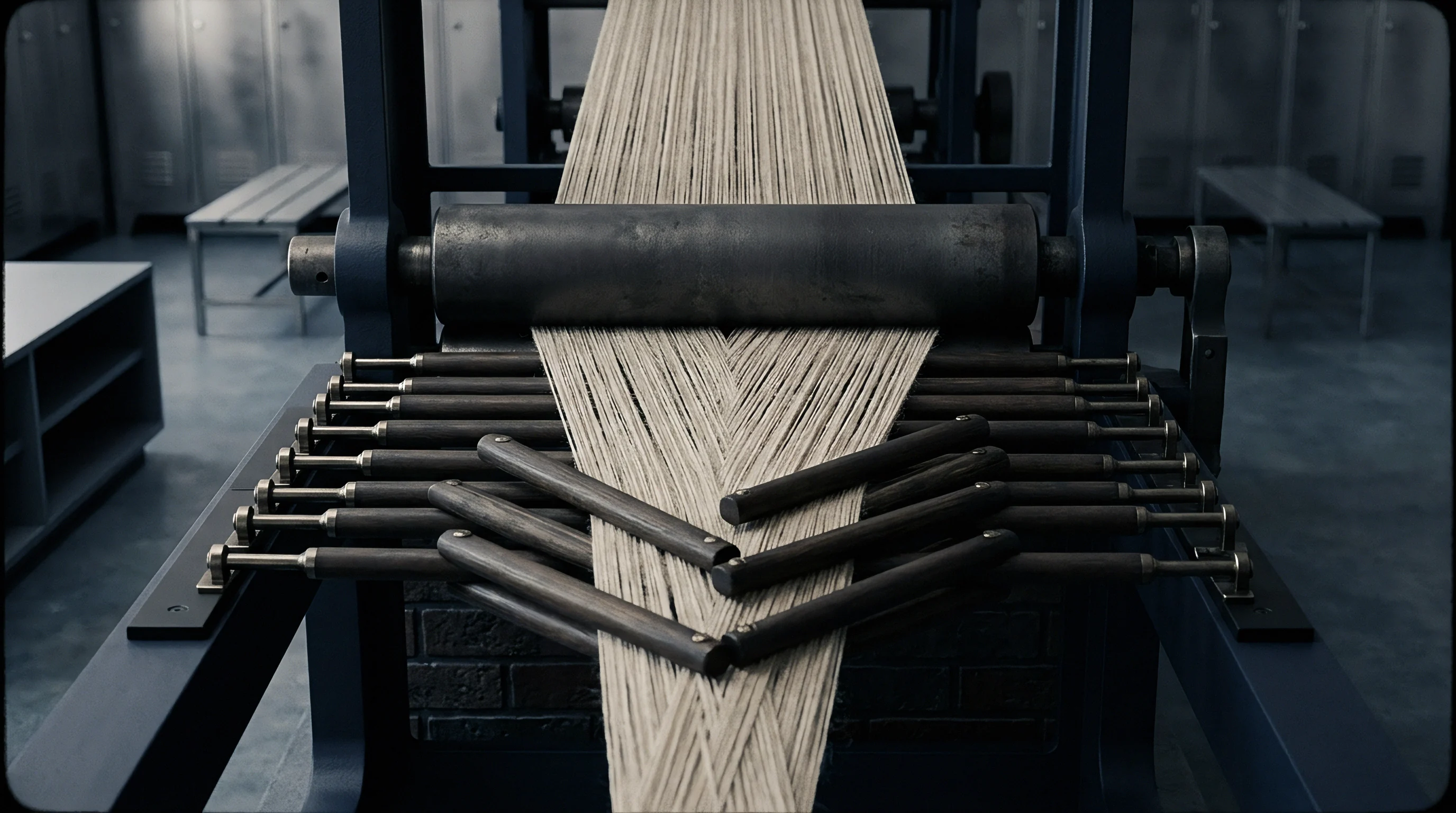
Step gradient shedding mechanics resolve this geometric variance by applying an inclined lifting plane across the jacquard knife frames. The stroke length increases progressively from the front harness row to the back harness row, creating an inclined shed angle that maintains constant dynamic tension across every warp thread regardless of harness row depth.
| Harness Row Position | Depth Distance from Fell (mm) | Static Lift Height (mm) | Step Gradient Lift Height (mm) | Peak Warp Strain (Percent) | Clearance Tunnel Height (mm) |
|---|---|---|---|---|---|
| Row 001 (Front Harness) | 280 | 68 | 52 | 2.10 | 42 |
| Row 032 (Mid-Front) | 360 | 68 | 58 | 2.12 | 42 |
| Row 064 (Center) | 440 | 68 | 64 | 2.15 | 43 |
| Row 096 (Mid-Rear) | 520 | 68 | 71 | 2.18 | 43 |
| Row 128 (Rear Harness) | 600 | 68 | 78 | 2.21 | 44 |
| Data observed on 10,240-hook electronic jacquard at 320 picks per minute using Nm 39 wet-spun linen warp at 38 ends per centimetre. | |||||
Calculations for harness board geometry assume a constant reed width and uniform warp count. When weaving heavy damask constructions with high end density, yarn-on-yarn friction amplifies the effect of improper shed gradients. Symmetrically lifted harness wires pull adjacent linen fibrils into contact, forming filament entanglements that resist opening.
The gradient step angle counteracts this friction by staggering the physical separation of adjacent warp sheets: front ends complete movement before rear ends reach full lift height, staggering the shed phase displacement across time and space.
A step gradient inclination offset of 0.43 millimetres per harness row maintains linen warp tension within a 0.15 centinewton per tex band across a 320 millimetre comber board depth.
Mechanical harness boards utilize adjustable double-acting knife frames to achieve the inclination angle. Electronic double-lift jacquards execute the gradient through individual knife-tilt settings or programmatic solenoid delay profiles. Achieving clean shed geometry requires balancing knife frame tilt limits against the mechanical clearance of the jacquard head supporting structures.
Improper setting of the harness gradient leads directly to mechanical failure during production.
- Front Harness Filament Rupture occurs when flat lifting profiles over-stretch frontwarp ends beyond their elastic limit during shed peak.
- Rear Shed Line Sag develops when insufficient lift height on back harness rows prevents lower thread sheets from reaching the race board line.
- Fell Line Oscillations emerge from asymmetric tension forces destabilizing the cloth fell location during beat-up.
- Comber Board Hole Chafing results from extreme harness cord deflection angles wearing against glass rod inserts.
Ignoring the geometrical relationship between harness depth and linen yarn strain leads to high end-breakage rates, forcing loom stoppage frequencies above four stops per loom hour and undermining weave room efficiency.
Clamp
Linen yarns lack the dynamic elasticity of wool or synthetic filament. Pure flax fibers exhibit an elastic recovery rate below 40 percent after experiencing 2 percent elongation. Managing clamp pressure at the warp beam backrest and maintaining precise heddle eye restraint during shed movement dictates greige quality.
A step gradient harness layout modifies the mechanical load distribution across the backrest roller assembly. Front harness lifts impose immediate force vectors on the whip roll, whereas rear harness lifts transfer force through a longer span of suspended yarn.
Spring-loaded backrest assemblies must damp the high-frequency tension spikes generated by high hook count jacquards. At speeds exceeding 300 picks per minute, the cyclic shedding motion creates harmonic resonance along the warp sheet. Linear dampeners clamped to the oscillating backrest frame absorb peak loading forces.
Without targeted damping, peak tension exceeds 28 centinewtons per tex, causing sudden end breakage near the lease rods.
Correct harness leveling establishes the baseline reference point for step gradient timing.
- Position the jacquard head knife frames at precise geometric dead center using mechanical locking pins.
- Adjust the main harness leveling bar until heddle wire eyes on row 001 align flush with the race board plane.
- Set the rear harness row 128 heddle eyes to sit exactly 8 millimetres below the race board plane to establish the initial negative gradient offset.
- Incline the lower knife frame support rails to match the target 0.43 millimetre per row pitch incline using digital feeler gauges.
- Rotate the loom main drive shaft to 180 crank degrees and verify upper shed line clearance across all harness rows using an optical alignment rail.
- Torque all knife frame tilt adjustment clamps to manufacturer specification before removing mechanical locking pins.
Lingo weights suspended from harness cords supply the downward force required to close the shed. In high hook count linen installations, lingo selection directly alters warp tension profiles. Light lingos fail to pull stiff linen warp threads through hairy sheds, generating false warp stops.
Heavy lingos apply continuous static load, accelerating fatigue in delicate flax fibers.
Linen warp sheets require lingo mass scaling based on harness depth position to balance cord return dynamics against fiber tensile strength limits.
Positioning heavier lingos on rear harness rows offsets the increased mechanical friction of longer harness cords running through dense board hole patterns. Front harness rows require lighter lingos due to shorter cord trajectories and lower movement resistance. Typical lingo allocations run from 14 grams per cord on row 001 up to 22 grams per cord on row 128.
This progressive weight gradient harmonizes harness cord return speeds, preventing cord slackness during rapid shed changes.
Relative humidity inside the weaving shed dictates yarn flexibility during clamping cycles. Flax fibers absorb water vapor, increasing tensile strength by up to 20 percent when humidity shifts from 50 percent to 75 percent. Dry linen yarn exhibits brittle behavior, snapping under minimal shear stress at the heddle eye.
Maintaining ambient shed conditions at 68 percent relative humidity prevents premature end failure during high-speed step gradient shedding operations.
Systematic calibration of harness wire leveling remains the absolute prerequisite for stable loom operation.

Dwell
Dwell timing defines the angular duration during which the jacquard shed remains fully open to allow rapier passage. In step gradient shedding mechanics for linen damask, dwell parameters interact directly with knife frame acceleration curves. Standard symmetrical eccentric shedding cams produce parabolic movement profiles with brief dwell windows around 110 crank degrees.
High hook count linen damask demands extended dwell profiles up to 140 crank degrees to prevent flexible rapier heads from contacting moving warp sheets.
Electronic jacquards achieve variable dwell profiles through servo-driven shedding mechanisms or optimized conjugate cam arrangements. Extending dwell duration reduces the time available for shed opening and closing movements. The resulting sharp acceleration spikes increase inertial stress on harness cords, comber boards, and warp yarns.
Step gradient setups mitigate acceleration spikes by staggering the start of shed movement across harness rows.
| Yarn Count (Nm) | End Density (ends/cm) | Dwell Angle (Degrees) | Front Row Lift Offset (Degrees) | Rear Row Lift Offset (Degrees) | Max Acceleration (m/s²) |
|---|---|---|---|---|---|
| Nm 26 | 30 | 120 | 0 (Baseline) | +12 (Lagging) | 42.5 |
| Nm 39 | 38 | 130 | 0 (Baseline) | +16 (Lagging) | 48.1 |
| Nm 50 | 44 | 135 | 0 (Baseline) | +18 (Lagging) | 52.8 |
| Nm 60 | 52 | 140 | 0 (Baseline) | +22 (Lagging) | 58.4 |
Staggered timing profiles initiate motion on front harness rows several crank degrees before rear harness rows. This phase shift smooths the aggregate torque load on the jacquard main drive shaft. Peak mechanical power draw drops by up to 25 percent when shed opening acceleration distributes across 20 crank degrees rather than occurring simultaneously.

When Does Gradient Lifting Trigger Yarn Abrasion?
Abrasion occurs when phase displacement delays exceed the structural friction threshold of adjacent linen warp yarns. If rear harness rows lag front rows by more than 22 crank degrees, the descending front warp sheet rubs violently against the ascending rear warp sheet. This contact shears off protruding flax surface fibrils, generating lint accumulation behind the reed.
Lint balls collect inside heddle eyes, causing wedge-shaped warp breaks and continuous loom stops.
Standard ISO 13934 tensile test procedures demonstrate that cyclically abraded wet-spun linen yarn loses up to 35 percent of ultimate breaking load before structural failure occurs.
Rapier tape trajectory must match the inclined tunnel profile generated by step gradient shedding. Left-hand and right-hand flexible rapier guides require precise height adjustment along the race board. If rapier guide plates remain flat while the shed opens on a gradient, the lower tape edge cuts into lower warp shed sheets on rear harness rows.
Lowering the rear tape tracks aligns the insertion path inside the step-inclined shed tunnel.
Shed clearance timing must synchronize with main drive resolver angles. Electronic jacquards monitor shaft positions through high-resolution encoders, triggering solenoid pull-in cycles within sub-millisecond tolerances. Misalignment between loom crank position and jacquard command signals causes knives to strike hooks during selection phases, damaging hook tips and mispicking pattern details.
Yarn fuzzing on rear harness rows often stems from raw flax lot variations that cause untreatable fiber cling during shed separation.

Defect
Weaving high hook count linen damask creates structural greige flaws when shedding mechanics diverge from specification. Surface damask effects rely on crisp satin block transitions where warp-face floats meet weft-face floats. Incomplete shed clearance distorts pattern contours, causing boundary blurs where warp floats bleed into adjacent ground weaves.
Optical grading systems rate damask quality based on boundary line sharpness and freedom from floating thread picks.
Loose warp ends create floats when lower shed sheets fail to sink cleanly below the rapier line. Step gradient shedding corrects floating end defects by providing adequate clearance on back harness rows. Excess gradient incline introduces opposite defects by over-tensioning front warp threads, leading to snap-offs that leave missing end lines along the cloth length.
Analyzing physical fault appearance pinpoints specific shedding setup errors quickly.
- Blurred Satin Boundaries stem from insufficient gradient incline leaving rear warp sheets partially lifted during weft insertion phases.
- Warp Line End Snaps develop from aggressive gradient angles over-stretching front harness ends beyond tensile limits.
- Reed Line Streaks result from unequal lingo weighting causing lateral harness wire vibration inside comber board holes.
- Weft Catch-In Loops indicate inadequate dwell angles allowing shed closure before rapier heads exit the cloth selvage.
- False Warp Stops originate from light lingo weights failing to pull slack linen threads clear of electronic drop wires.
Four-point fabric inspection systems (ASTM D5430) assign heavy point penalties to repeating structural defects in high-value linen damask. Penalty points compound rapidly when shedding errors create consistent horizontal or vertical defect stripes across finished bolts. Demotion from first-quality to second-quality cloth eliminates commercial profitability on high end density production runs.
Greige cloth inspection frames detect subtle tension faults using angled backlighting. Variable yarn sheen reveals dynamic strain differentials across the warp sheet. Stripes running parallel to the selvage indicate harness board zone tension errors caused by inconsistent gradient step profiling.
Unresolved questions remain regarding how micro-variations in flax fiber cross-sectional symmetry alter shedding resistance under shifting humidity environments.
Scale
Loom speed directly governs commercial viability in linen damask manufacturing. High hook count jacquards operating between 8,192 and 12,288 hooks represent substantial capital investments. Machine operation must maintain maximum achievable picks per minute without exceeding the mechanical threshold of linen warp yarn.
Implementing step gradient shedding permits speed increases between 12 and 18 percent over flat-shed baseline parameters on wide-width rapiers.
Loom efficiency calculations incorporate warp stop frequency, weft repair down-time, and mechanical maintenance intervals. Reducing warp end breakage through optimized shed gradient mechanics elevates net shed efficiency above 88 percent. Higher efficiency spreads fixed loom-hour costs across significantly greater linear meter production volumes.
| Shedding Configuration | Loom Speed (PPM) | Shed Efficiency (Percent) | Warp Stops per Loom Hour | Output (Metres/Hour) | Greige Cost (Euro/Metre) |
|---|---|---|---|---|---|
| Flat Shed (Un-inclined) | 260 | 76.5 | 3.8 | 14.8 | 18.40 |
| Moderate Step Gradient | 300 | 84.2 | 1.9 | 18.8 | 14.85 |
| Optimized Step Gradient | 330 | 89.5 | 0.8 | 21.2 | 13.15 |
| Aggressive Step Gradient | 350 | 81.0 | 2.9 | 18.9 | 15.20 |
Operating a high hook count linen loom requires balancing machine capacity against material degradation risks. Pushing loom speeds to 350 picks per minute under aggressive gradient angles increases warp stop frequencies, defeating the economic gain of higher velocity. The optimum operating window centers around 330 picks per minute, landing the lowest calculated greige cost per linear metre.
Commercial booking specifications for fine linen damask orders must define clear machine parameters to ensure contract compliance and weight consistency.
- Harness Hook Allocation defines exact comber board density and harness cord threading distribution across active hook zones.
- Shed Gradient Angle Offset mandates the millimeter-per-row lift differential from front row to back row across the board.
- Target Dwell Window Angle specifies required crank degree dwell duration for flexible rapier clearing paths.
- Humidity Control Limits establishes mandatory weaving shed environmental ranges between 65 and 72 percent relative humidity.
- Four-Point Acceptance Threshold caps allowable inspection penalty points at maximum 18 points per 100 square metres.
Landed metre costs depend on raw material yarn grades, loom hour allocations, and harness wire replacement overheads. Fine wet-spun linen warps (Nm 50 to Nm 60) represent over 55 percent of total greige manufacturing costs. Minimizing yarn waste from warp breaks directly protects gross margin targets on long production runs.
Fixed loom-hour capacity constraints dictate that high hook count jacquard sheds must produce maximum square metre output per scheduled shift to amortize machinery depreciation.
Contractual agreements incorporate standard delivery tolerances regarding fault allowances and width variations. Master supply contracts specify that greige cloth failing to comply with harness gradient parameters on technical specification sheets shall be subjected to full lot rejection under standard arbitration terms.