Mathematical Quantification of Machine Interference Penalties in High Density Flax Weaving Contracts
High-density flax weaving contracts require Ashcroft queueing models to adjust loom-hour rates for non-linear machine interference losses.
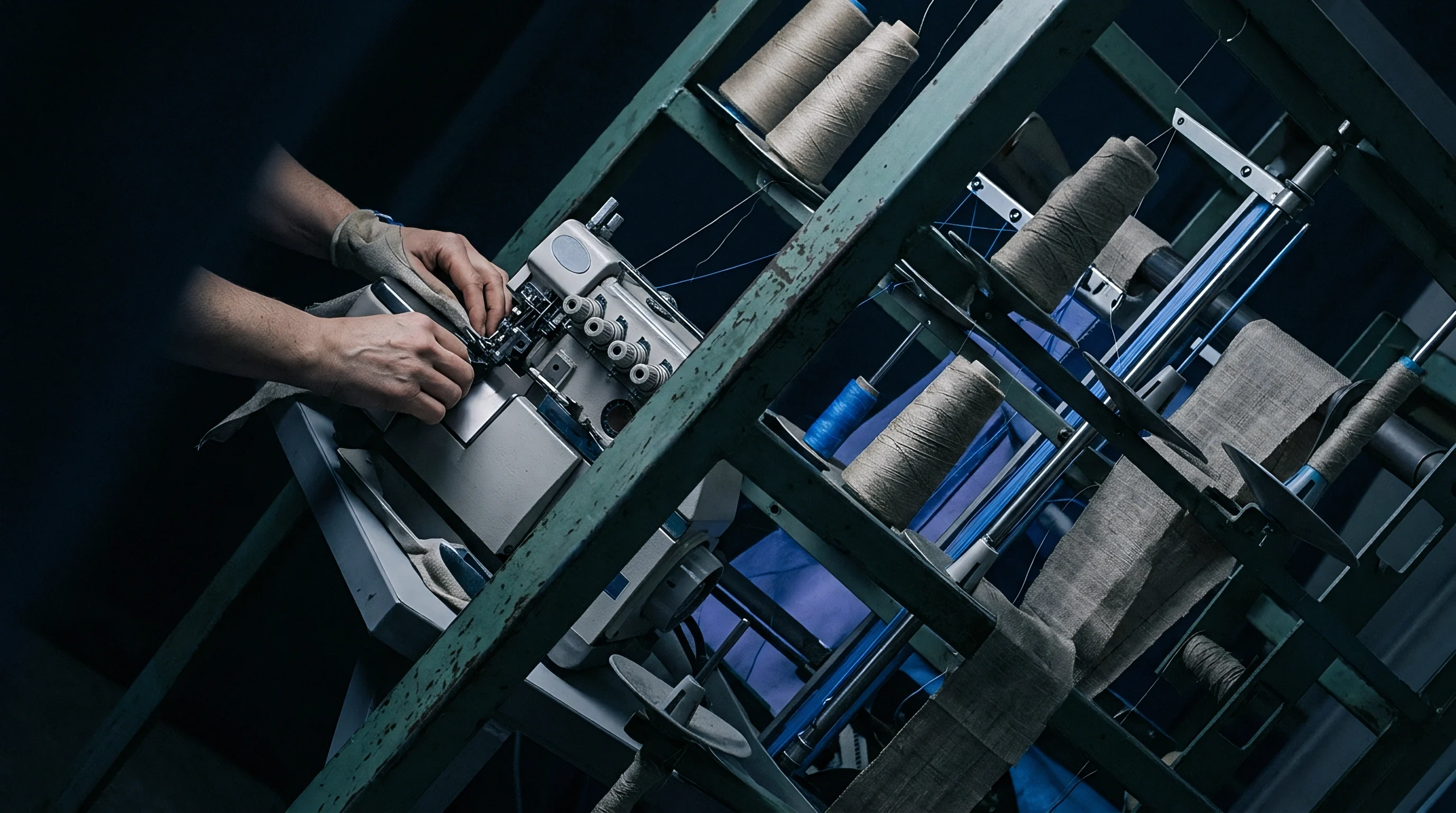
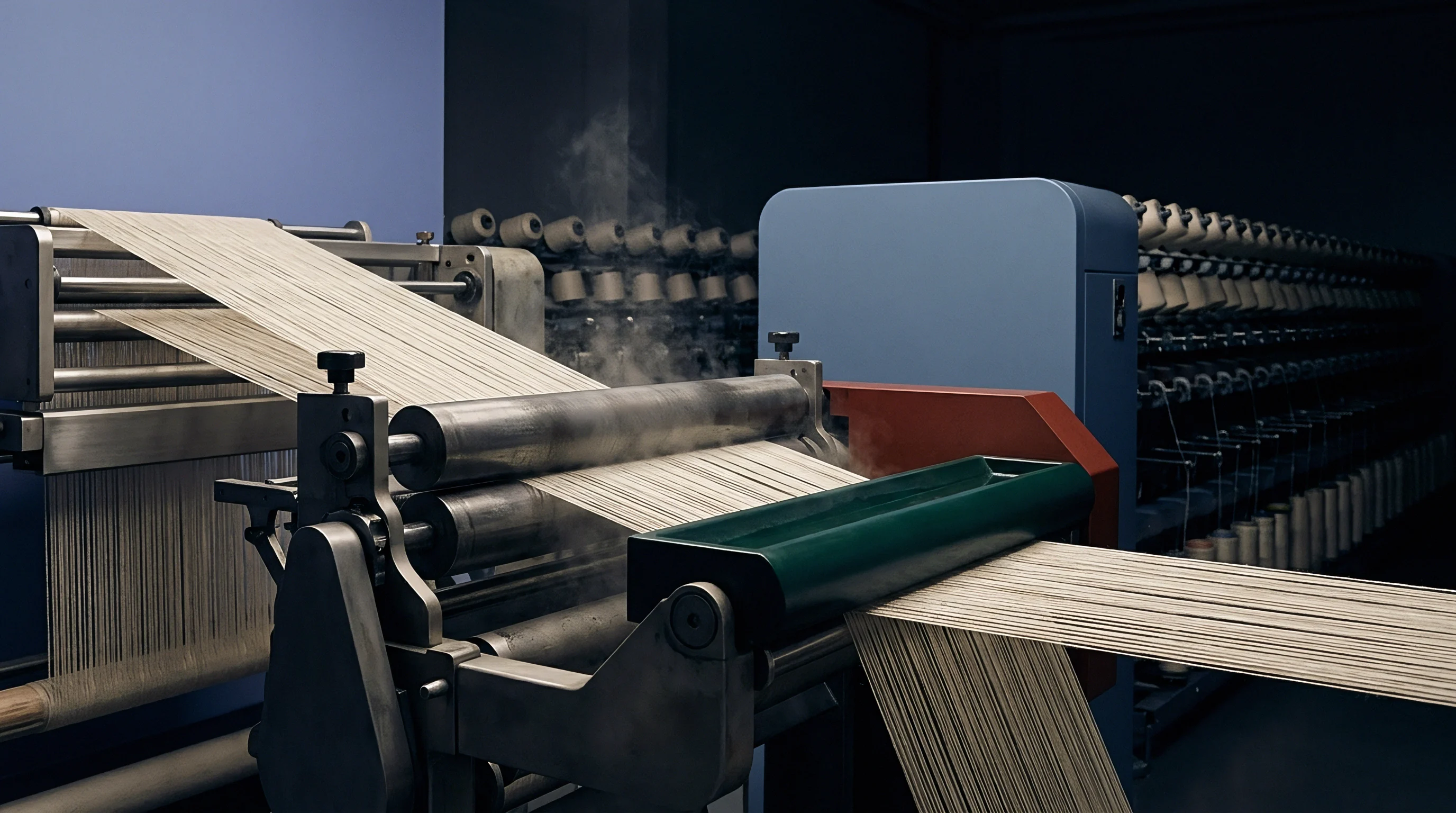
Stoppage
High-density linen weaving operates under strict tension boundaries dictated by the physical limits of wet-spun flax yarns. A loom shed running a plain weave fabric at twenty-eight ends per centimetre with count Nm 39 flax experiences frequent thread rupture events when shed opening angles create severe friction among adjacent warp ends. Flax fibers possess low strain-to-break values, frequently falling under two percent elongation at peak load.
When brittle threads snap under beat-up strain, the loom drops its drop wire, cut-out switches engage, and the machine halts immediately. Production capacity drops instantly.
Machine downtime during high-density linen weaving splits into two distinct categories: direct servicing time and queueing delay. Direct servicing time involves the physical actions of the weaver, including locating the broken thread, piecing the yarn end, threading the drop wire, passing the yarn through the heald eye and reed dent, and restarting the loom. Queueing delay arises when multiple machines in a weaver patrol halt simultaneously.
A single operator assigned to sixteen high-density rapier looms cannot attend to two broken warp threads at the same time. While the weaver repairs the first machine, the second machine stands idle, incurring interference loss.
ISO 7211 construction benchmarks combined with an end-break rate exceeding 4.2 stops per loom hour shift the tender allocation from sixteen machines down to eight.
Thread failures in high-density flax warps do not follow an even, predictable schedule throughout a shift. Machine halts occur in dense temporal clusters due to yarn unevenness, local sizing defects, and humidity fluctuations within the weave shed. When two or three looms in a single assignment stop within a thirty-second window, interference downtime accumulates exponentially.
Stoppage times accumulate quickly. Standard loom efficiency calculations that assume isolated, independent machine halts miscalculate actual shed output by failing to account for this multi-machine waiting penalty.
Weaver allocation alters output. In conventional cotton weaving, a weaver manages thirty to fifty looms because end-break rates remain below one stop per loom hour. In high-density flax weaving, warp end-break rates regularly range between three and eight stops per machine hour.
Assigning a weaver thirty looms under these high-density conditions causes machine interference downtime to exceed total direct repair downtime, depressing overall shed efficiency below sixty percent. Sourcing contracts that price fabric based on nominal shed efficiency without calculating interference penalties leave mills exposed to unrecoverable overhead expenditures.
Mill operators frequently cite batch-to-batch yarn slub variation and improper sizing solids percentage as unpredictable environmental factors that render machine queue modeling inapplicable to high-density linen runs.

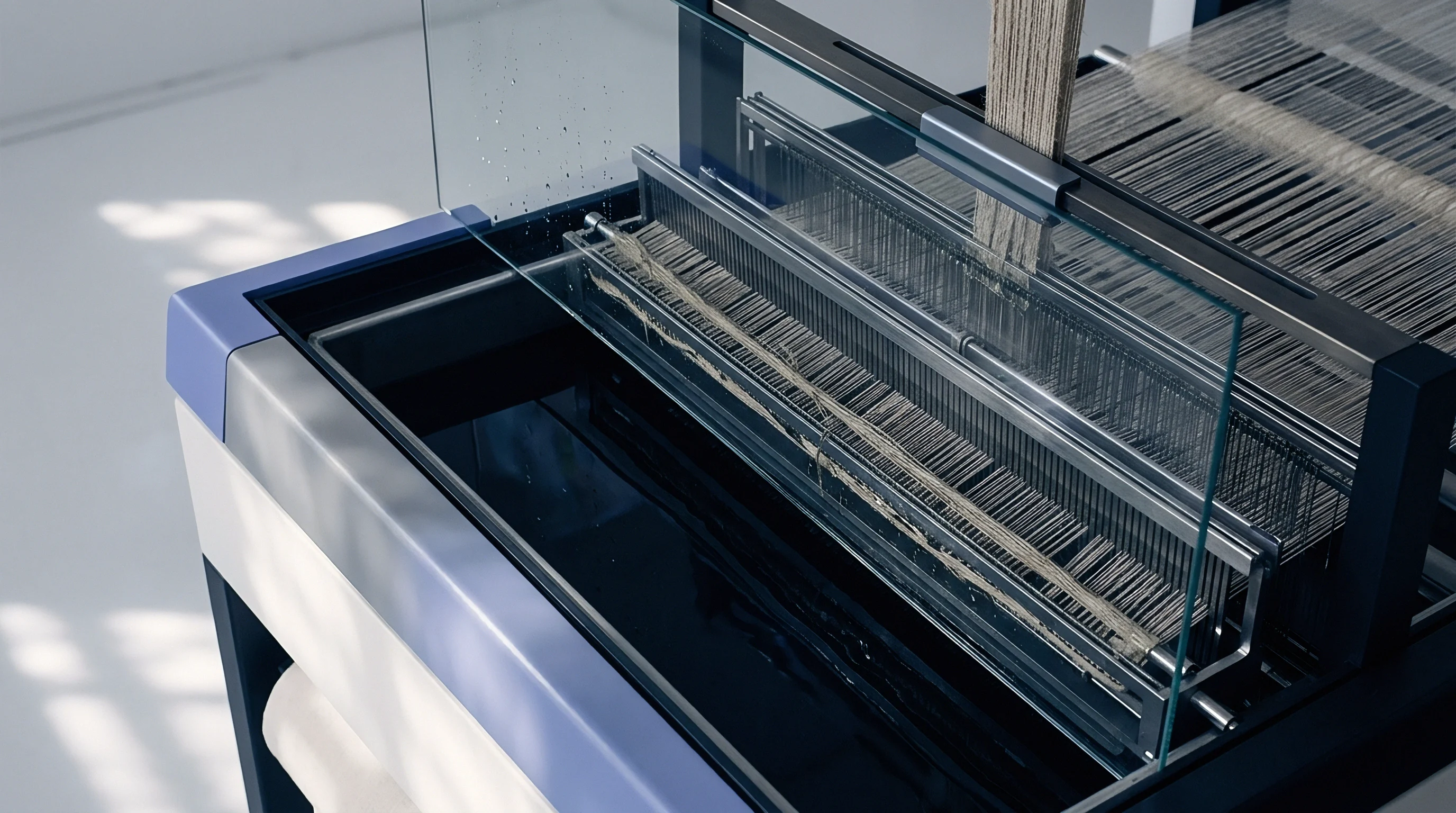
Queue
Mathematical quantification of machine interference relies on finite-source queueing models calibrated to shed operational metrics. The weaving shed functions as a closed servicing system where a fixed number of machines N generate service requests at a failure rate λ, expressed as stops per loom hour. A single weaver acts as the service channel, clearing each stop in average repair time Tr, measured in hours.
The ratio of repair time to mean running time between stops defines the service factor ρ, where ρ = λ · Tr. As weave density increases, λ rises, driving ρ higher and expanding the probability that a stopping machine finds the weaver busy.
Calculated machine interference loss follows probability distributions developed by Ashcroft and Wright for multi-machine assignments. Ashcroft models demonstrate that when service factor ρ exceeds 0.05 on an assignment of sixteen looms, machine interference downtime accounts for more than fifteen percent of total shed operating time. Queueing models calculate shed efficiency η using the ratio of actual operating time to total scheduled time, incorporating both direct repair downtime and interference waiting time.
| Weaver Allocation (N) | Stop Rate (λ stops/hr) | Repair Time (Tr min) | Service Factor (ρ) | Direct Downtime (%) | Interference Loss (%) | Shed Efficiency (η) |
|---|---|---|---|---|---|---|
| 8 Looms | 2.5 | 2.4 | 0.100 | 10.0% | 3.2% | 86.8% |
| 8 Looms | 5.0 | 2.4 | 0.200 | 20.0% | 8.5% | 71.5% |
| 12 Looms | 2.5 | 2.4 | 0.100 | 10.0% | 5.8% | 84.2% |
| 12 Looms | 5.0 | 2.4 | 0.200 | 20.0% | 16.2% | 63.8% |
| 16 Looms | 2.5 | 2.4 | 0.100 | 10.0% | 8.9% | 81.1% |
| 16 Looms | 5.0 | 2.4 | 0.200 | 20.0% | 24.7% | 55.3% |
| 24 Looms | 2.5 | 2.4 | 0.100 | 10.0% | 15.4% | 74.6% |
| 24 Looms | 5.0 | 2.4 | 0.200 | 20.0% | 38.1% | 41.9% |
| Data calculated using finite-source M/M/1/N queueing equations assuming exponential distributions for runtime and repair duration on 220 cm rapier looms weaving high-density flax plain cloth. | ||||||
High sett values multiply the arrival frequency of mechanical failure events. When a rapier loom runs Nm 36 flax yarn at thirty ends per centimetre, shedding friction increases warp break frequency to five stops per hour. Queues form at once.
If the weaver patrol stands at sixteen looms, table calculations indicate that interference downtime reaches 24.7 percent of available machine hours. Combined with twenty percent direct repair downtime, the actual achieved shed efficiency plummets to 55.3 percent. Ignoring the interference component leads a production planner to overestimate output by nearly thirty percent.
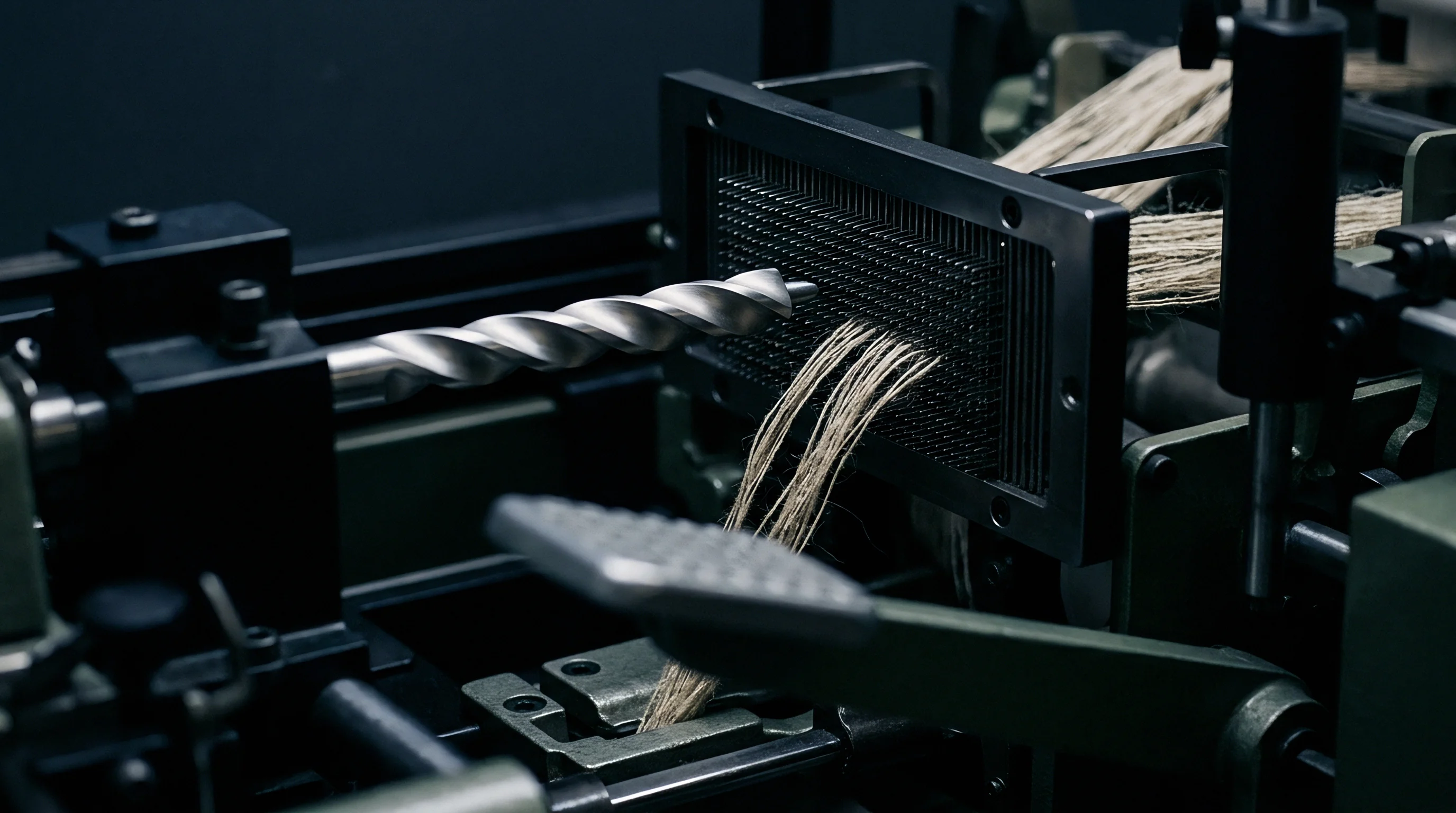
When Do Multiple Loom Stops Compound Interference Penalties?
Simultaneous loom stops compound financial penalties when yarn breakage rates push the service factor past critical thresholds where waiting time exceeds active repair duration. The inflection point occurs when the service factor ρ crosses 0.12 in sheds running wide-width rapier machinery. At this point, the probability of two or more machines demanding piecing service at the same instant rises above thirty-five percent.
The resulting queue length increases non-linearly, causing machine interference penalties to dominate the total downtime structure.
Mathematical adjustments must convert theoretical queueing losses into contractually binding penalty terms. Modern contract structures apply an Ashcroft-derived efficiency correction factor to the base loom-hour rate. When high weave density causes verified end-break rates to exceed pre-agreed contract limits, the interference loss formula automatically re-calculates the effective loom capacity, establishing an adjusted hourly machine rate that reflects actual shed throughput limits.
Modern air-jet flax weaving sheds introduce automated knotting units whose impact on queue variance under extreme warp density remains mathematically unverified across multi-shift production runs.
Beam
Warp preparation directly dictates machine interference behavior on the weaving floor. High-density flax warps require precise alignment, uniform thread tension, and consistent sizing encapsulation to withstand the cyclic mechanical stresses of rapier insertion. Flax fibers lack the natural twist-cohesion of cotton, making thread strength dependent on wet-spinning quality and starch-based size application.
Inadequate sizing allows surface fibers to fray during shedding, creating entanglement balls that trigger multiple warp stops across adjacent thread groups.
Friction multiplies strand failures. In high-density specifications where warp cover factor exceeds 21.5, shedding movement forces adjacent warp threads to rub continuously against each other and through drop wires, heald eyes, and reed dents. Tension spikes break ends.
Friction weakens yarn structure over time, causing failure rates to accelerate as the warp beam unwinds toward the core. Controlling warp tension on the weaving machine requires continuous let-off adjustment to maintain constant mechanical strain across the entire beam length.
Quantification of yarn interference behavior requires a standardized method for evaluating warp quality before committing high-density flax runs to full shed capacity.
- Mount sample yarn packages from the production lot onto a single-end yarn strength tester to establish baseline tensile strength and elongation metrics under standardized conditions.
- Measure yarn abrasion resistance using a reciprocating thread-on-thread friction analyzer to determine the cycles required to induce fiber breakdown.
- Inspect warper beams for thread density uniformity using optical width sensors, verifying that end-spacing variation stays within a three percent margin across the barrel.
- Sample sized yarn strands from the sizing machine delivery roll to test size pick-up percentage and hairiness reduction index under ISO 7211 guidelines.
- Execute a 100,000-pick trial run on a single test loom at target production speed, recording every automatic stop event alongside warp location coordinates.
- Calculate the baseline warp stop frequency parameter λ0 per loom hour to determine whether the yarn lot meets contract interference assumptions.
Wet-spun linen warps lacking sufficient sizing encapsulation fail through fiber entanglement inside the drop-wire box long before shed tension reaches ultimate tensile strength.
Shed formation parameters exert immediate structural control over warp failure frequency. High sett flax constructions require clean shed openings to prevent rapier head collision with stray warp ends. Increasing harness lift height provides cleaner clearance for weft insertion, but simultaneously raises cyclic peak tension on individual flax threads.
High sett drives breaks. The loom technician must balance shed opening height against yarn fatigue thresholds to minimize total machine downtime.
Lowering the shedding frame height reduces mechanical stress on brittle warp threads while increasing the likelihood of unformed sheds and weft insertion faults.

Variance
Empirical weaving shed data reveals significant divergence from classical theoretical Poisson models regarding machine stop arrivals. Standard queueing theory assumes random, independent failure events across operating machinery. High-density flax weaving violates this independence assumption due to environmental micro-climates inside the shed, lot-level yarn irregularities, and weaver patrol patterns.
End breaks tend to occur in cascades, where a initial stop on one machine delays patrol cycles, allowing neighboring looms to build up excess lint and reed heat that trigger secondary thread breaks.
Stochastic clustering of thread breakages swells actual interference downtime beyond traditional Ashcroft estimates. Weibull distribution analysis provides superior predictive accuracy for high-density flax failure populations by incorporating shape parameters that capture yarn fatigue accumulation over time. When Weibull shape parameters exceed 1.2, warp end breaks demonstrate clear aging characteristics, concentrating stops during specific periods of high cyclic stress during beat-up.
| Warp Sett (ends/cm) | Model Type | Mean Stop Frequency (λ) | Calculated Waiting Time (%) | Observed Interference (%) | Variance Delta (%) | Efficiency Impact |
|---|---|---|---|---|---|---|
| 26 ends/cm | Poisson M/M/1/N | 3.1 stops/hr | 5.4% | 5.8% | +0.4% | Minor (-0.4%) |
| 26 ends/cm | Empirical Weibull | 3.1 stops/hr | 5.7% | 5.8% | +0.1% | Negligible |
| 32 ends/cm | Poisson M/M/1/N | 6.4 stops/hr | 18.2% | 24.6% | +6.4% | Severe (-6.4%) |
| 32 ends/cm | Empirical Weibull | 6.4 stops/hr | 23.8% | 24.6% | +0.8% | Controlled |
Discrepancies between theoretical queueing predictions and floor observations stem from distinct operational root causes that disrupt steady-state shed assumptions. Shed capacity drops rapidly.
- Clustered end breakage cascades happen when yarn slubs pass through the drop wires, breaking multiple adjacent warp threads in a single beat-up cycle and drastically extending single-stop repair duration.
- Patrol path inefficiency occurs when weavers move non-linearly across the shed to handle distant machine halts, accumulating unmodeled walking time that inflates total interference delay.
- Thermal shed drift develops as weave room relative humidity drops below sixty-five percent, causing flax strands to lose moisture, turn brittle, and double failure rates within minutes.
- Lint accumulation faults emerge when flying flax fiber debris clogs drop wire contact bars, producing false stops that consume weaver time without actual yarn breakage.
A loom allocation set to twenty machines drops to fifty-eight percent operational efficiency when yarn break frequency rises from two to six stops per machine hour.
Quantifying these variance sources allows production engineers to calibrate contractual penalty clauses against empirical shed performance. Standard Poisson models consistently underestimate interference losses on high-density specifications, leading buyers and mills into pricing disputes over unachieved production quotas. Applying Weibull-adjusted interference metrics establishes a realistic baseline that protects both contracting parties.
Neglecting stochastic break clustering in capacity planning leads directly to severe delivery delays, unrecovered weaver overtime expenses, and underutilized capital assets.
Ledger
Loom-hour economics require direct integration of machine interference math into fabric costing models. Cloth pricing derived solely from raw yarn mass, pick density, and nominal loom speed ignores the substantial financial penalty incurred when high weave density depresses shed efficiency. Weaving costs are incurred per loom hour, while revenue is generated per finished metre.
Unplanned downtime costs money. When machine interference downtime reduces metre output per loom hour, the landed weaving cost per metre escalates proportionally.
Consider a representative high-density flax weaving contract executed on wide rapier machinery. A buyer specifies a 100% linen plain weave fabric, width 210 cm on reed, using Nm 36 wet-spun warp and weft yarns, sett at 30 ends per centimetre and 26 picks per centimetre. The loom operates at a mechanical speed of 380 picks per minute.
The weaving mill establishes a standard operational cost of 28.50 USD per loom hour. Under nominal baseline planning, the mill assumes an 82 percent shed efficiency, yielding 7.19 metres of greige cloth per loom hour and establishing a baseline weaving cost of 3.96 USD per metre.
Calculated losses alter invoices. Running this high-density specification generates an average warp stop frequency of 5.2 breaks per hour and a weft stop frequency of 1.1 breaks per hour, establishing a total stop rate λ of 6.3 stops per hour. With a weaver allocation N of sixteen looms and an average servicing time Tr of 3.0 minutes per stop, the service factor ρ reaches 0.315.
Queueing equations reveal that machine interference downtime accounts for 19.5 percent of total machine time, while direct repair downtime accounts for 31.5 percent. The actual achieved shed efficiency falls to 49.0 percent.
Real efficiency drops fast. At 49.0 percent efficiency, loom output drops to 4.30 metres per hour. Dividing the 28.50 USD hourly loom cost by 4.30 metres results in an actual weaving cost of 6.63 USD per metre.
This creates an unmodeled variance of 2.67 USD per metre. On a contract covering 10,000 metres of fabric, uncalculated machine interference penalties produce a 26,700 USD cost deficit that must be allocated between the mill and the buyer according to contractual terms.
Unadjusted machine interference downtime converts predictable loom capacity into unaccounted financial loss for the weaving shed.
Commercial risk mitigation demands structured evaluation of contract costing parameters prior to signing binding production orders for dense flax goods.
- Baseline break rate caps must establish the maximum allowable yarn stops per 100,000 picks before interference penalty surcharges apply to the buyer.
- Tender allocation limits restrict the maximum number of looms assigned to a single weaver when running high-density linen contracts.
- Humidity control requirements mandate strict maintenance of weave room relative humidity between 68 and 72 percent to minimize brittle fiber failures.
- Dynamic price escalation formulas re-calculate the finished metre price dynamically based on audited shed efficiency logs when yarn quality deviates from agreed specifications.
Tender ratios govern costs. Dynamic rate adjustments maintain commercial viability across high-density weaving runs by transferring unmodeled interference losses from shed operational overhead directly onto transparent contract line items. Quantitative interference modeling replaces arbitrary price negotiations with mathematical certainty derived from floor-verified production variables.
Clause
Contractual formalization of machine interference penalties requires precise legal phrasing integrated directly into master supply agreements. Standard textile procurement documents focus on physical cloth properties, such as weight per square metre, tensile strength, and color fastness, while omitting the operational capacity dynamics of high-density weaving. When high warp sett constructions cause shed efficiency to collapse, mills without explicit interference clauses often attempt to cancel orders or demand unilateral price increases mid-run.
Structured contract language prevents these commercial impasses by defining operational metrics and financial remedies before warp commitments occur.
Shed managers and buyers must establish explicit parameter thresholds governing interference penalties inside the contract dossier. The agreement defines standard warp break limits, target weaver allocation ratios, audited repair durations, and dynamic cost-sharing mechanisms. The table below outlines standard contractual terms for high-density flax weaving orders.
| Contract Parameter | Standard Limit | Verification Method | Commercial Consequence |
|---|---|---|---|
| Max Baseline Stop Rate (λmax) | 4.0 stops / loom hr | Automatic Loom Monitoring System (BMS) | Stop rates above limit trigger rate re-calculation |
| Max Weaver Allocation (Nmax) | 12 looms / weaver | Shift Allocation Schedule Audit | Exceeding allocation voids mill interference claims |
| Standard Repair Duration (Tr) | 3.0 minutes / stop | Time-Study Floor Audits (ISO 9001) | Slow repair times shift downtime cost to mill |
| Shed Humidity Bounds | 68% – 72% RH | Calibrated Data Logger Records | Out-of-bound humidity voids yarn quality guarantees |
| Interference Surcharge Cap | 15% of base metre price | Audited Shift Production Logs | Surcharge capped; buyer can re-allocate warps |
Sourcing contract provisions must explicitly dictate how unmodeled interference costs are handled when incoming yarn lots fail to meet agreed quality metrics. Yarn quality dictates speed. When a buyer supplies yarn that generates break rates exceeding contractual baselines, interference penalty models calculate the precise additional loom hours required to complete the run, adding these hours directly to the final invoice.
Inserting an Ashcroft interference escalation rider into the supply contract shifts loom downtime costs above the baseline break threshold back to the buyer when yarn specs are buyer-furnished, or triggers a mandatory unit-price penalty against the mill when yarn quality is mill-sourced.