Quantifying Micro Fibrillar Friction Spikes in Fine Wet Spun Flax Warps
Optimizing PVA starch sizing rheology suppresses micro-fibrillar friction spikes on fine wet spun flax warps, preventing clingage and raising loom efficiency.

Contact
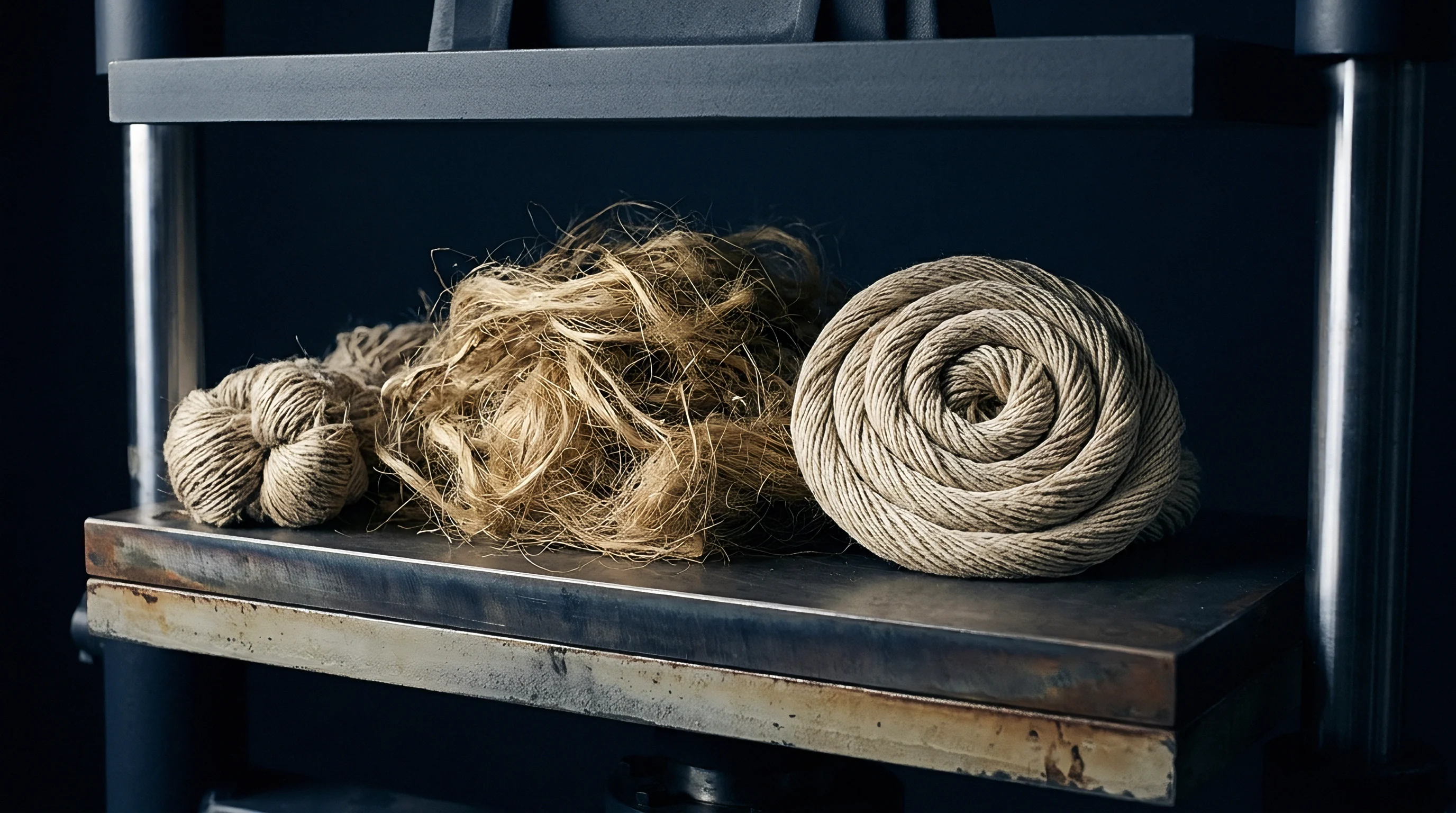
Fine wet spun flax yarns consist of highly crystalline cellulose ultimate fibers held together by a non-cellulosic middle lamella of pectin, hemicellulose, and residual lignin. During wet spinning, twisted bundles pass through a hot water bath at sixty to seventy degrees Celsius to soften these pectinous binders, allowing individual ultimate fibers to slip and consolidate under high draft. Surface elementary fibers frequently detach at one end while remaining anchored in the core yarn matrix, leaving sub-micron fibrils protruding from the main yarn body.
Inside the weaving shed, warp threads undergo rapid cyclic extension, flexure, and surface rubbing against heald eyelets, drop wires, and reed dents. When two adjacent fine wet spun flax warp threads pass each other during shed opening and closing, these protruding micro-fibrils interlock. This mechanical entanglement produces localized dynamic friction transients that exceed baseline sliding friction levels by three hundred percent.
Baseline kinetic friction coefficients between dry polished steel and size-treated wet spun flax yarn range between 0.22 and 0.28, but micro-fibrillar entanglement spikes push this coefficient to between 0.55 and 0.82 within two to five milliseconds.
Interfacial Shear Dynamics in Wet Spun Flax
The interfacial contact zone between a heald wire and a fine wet spun flax yarn experiences macro-scale yarn compression alongside micro-scale fibrillar shearing. As the harness frame moves to form the shed, warp tension rises from a static baseline of twenty grams per end up to peak dynamic loads exceeding forty-five grams per end on fine counts such as 36 Nm or 50 Nm wet spun flax. Tensile modulus in wet spun flax remains exceptionally high, ranging from eighteen to twenty-two centinewtons per tex, with minimal elongation at break between two and three percent.
Because wet spun flax yarn lacks elastic damping capacity, any friction spike generated by micro-fibrillar resistance converts directly into a sharp spike in yarn tension. High local shear stress causes protruding micro-fibrils to strip back further along the yarn shaft, forming compacted fiber clusters known on the shed floor as fuzz balls or nep structures.
Peak kinetic friction coefficients on wet spun 40 Nm flax warps increase from 0.24 to 0.68 when relative humidity drops below 58 percent in the weaving shed.
Accumulated fibrillar debris inside the harness wire eyelet generates cumulative mechanical resistance. When a fuzz ball reaches twice the diameter of the main yarn body, it can no longer pass through the heald eye or the reed dent gap. The warp thread binds, causing severe warp clingage where adjacent threads fail to separate cleanly at the shed line.
This incomplete shed opening leads to weft insertion failure, rapier mis-picks, or loom stops triggered by the warp stop motion.
Transient Peak Coefficients during Shedding Cycles
Quantifying these transient events requires high-frequency data acquisition capable of recording load cell variations above one thousand Hertz. Conventional yarn friction testers operating at continuous low sliding speeds average out these micro-scale peaks, masking the presence of dangerous friction spikes. Standard laboratory measurements report a single average coefficient of friction over hundred-meter yarn lengths, which gives a misleading impression of warp runnability.
A warp yarn exhibiting an acceptable average kinetic friction coefficient of 0.25 can still generate forty micro-fibrillar friction spikes per hundred meters, with each spike representing an instantaneous load exceeding the critical tensile threshold of the yarn. Fine linen warps running on modern rapier looms at three hundred fifty picks per minute subject every warp millimeter to over thirty abrasion cycles before the pick enters the cloth fell. Micro-fibrillar friction spikes occurring in early shedding cycles progressively degrade the sizing coating, accelerating yarn breakdown long before beat-up occurs.
Inadequate sizing encapsulation allows protruding micro-fibrils to peel under low mechanical forces, resulting in an average of 4.2 warp stops per loom hour on high-density linen plain weaves. Loom stoppages disrupt fabric structural uniformity, leave visible stop marks across the finished fabric width, and increase greige repair labor costs by 0.85 Euros per finished meter.

Film
Polymer sizing formulations applied to fine wet spun flax warps must balance film cohesion, elasticity, and surface slipperiness. Native flax yarns contain up to fifteen percent non-cellulosic impurities, natural waxes, and pectin residues that interfere with chemical bonding between aqueous starch molecules and the fiber core. Pre-treatment washing and sizing chemistry determine whether the applied film lays protruding micro-fibrils flat against the yarn core or allows them to pull free under harness abrasion.

Polymer Binder Chemistry and Cross Linking Integrity
Formulating a size recipe for fine wet spun linen warps requires a blend of modified starches, synthetic binders, and specialized lubricants. Native corn starch forms brittle films that crack under the tensile strain of rapier shedding. Chemically modified oxidized starches combined with low-viscosity polyvinyl alcohol provide superior film elongation, allowing the sizing layer to deform elastically without micro-cracking during cyclic shedding.
Adding carboxymethyl cellulose improves paste stability and film adhesion to flax fibers. Carboxymethyl cellulose molecules form hydrogen bonds with open hydroxyl groups on the flax ultimate fibers, bonding micro-fibrils down onto the yarn backbone.
Integrating micro-emulsified synthetic waxes or tallow-based lubricants lowers the static friction coefficient of the dried yarn surface. Excess lubricant addition, however, disrupts the internal cohesion of the starch binder film. Sizing recipes containing over four percent lubricant by weight show a marked drop in film tensile strength, leading to premature flaking and size dust shedding around the drop wires.
| Recipe Code | Primary Binder Ratio | Solids Content (%) | Size Add-On (%) | Baseline Friction (μ) | Spike Rate (per 100m) |
|---|---|---|---|---|---|
| ST-PVA-01 | 100% Native Potato Starch | 10.5 | 8.2 | 0.31 | 52.4 |
| ST-PVA-02 | 70% Oxidized Starch / 30% PVA | 11.0 | 9.5 | 0.25 | 14.1 |
| ST-PVA-03 | 50% Modified Starch / 50% PVA | 12.5 | 11.0 | 0.22 | 3.8 |
| ST-CMC-01 | 60% CMC / 40% Synthetic Resin | 9.8 | 8.8 | 0.26 | 11.2 |
Formulation Metrics for Fine Count Wet Spun Flax
Optimizing size add-on percentages for 36 Nm through 50 Nm wet spun flax warps requires maintaining exact viscosity boundaries inside the size box. High-viscosity sizing solutions fail to penetrate the compact core of fine wet spun yarns, leaving an overly thick surface layer that flakes off during weaving. Low-viscosity formulations penetrate completely into the core, leaving insufficient polymer film on the outer surface to anchor micro-fibrils.
- Viscosity Instability inside the size trough alters coat thickness across the warp sheet, causing variations in dynamic yarn friction between the selvedge and body ends.
- Inadequate Squeezing Pressure leaves excess surface moisture, creating stiff yarn-to-yarn bridging during cylinder drying that tears micro-fibrils open when lease rods split the warp sheet.
- Thermal Degradation of modified starch molecules occurs when size cooking temperatures exceed ninety-five degrees Celsius for prolonged periods, lowering film tensile strength.
- Retrogradation Of Starch during ambient warp storage causes film crystallization, converting flexible protective coatings into hard, abrasive surface scales.
Sizing film flexibility protects fine flax warps better than hard surface wax deposition during shed opening.
Natural flax fiber length variation produces surface micro-fibrillation that standard sizing chemistry often fails to contain, leading to elevated warp hairiness and shedding stop marks.
Gauging
Continuous dynamic tension measurement equipment provides direct data on transient micro-fibrillar friction events. Standard offline yarn testing instruments measure yarn tension at slow constant velocity, missing the rapid friction transients that occur during shedding. High-speed piezoelectric load cell arrays positioned directly along the yarn path quantify baseline sliding drag and dynamic micro-spike frequency under realistic shed-opening conditions.

Could Fast Strain Gauge Sampling Detect Fibrillar Entanglement?
Installing piezoelectric strain transducers along the yarn path between the lease rods and the harness eyelet allows mill technicians to record tension variations at sampling rates up to ten kilohertz. A constant yarn draft system pulls fine wet spun flax ends across a fixed ceramic pin at controlled sliding velocities ranging from fifty to three hundred meters per minute, with input tension held at fifteen grams by an adjustable magnetic disk brake.
Signal processing software isolates the steady-state kinetic friction baseline from transient high-frequency friction spikes. When a micro-fibril snag passes over the ceramic contact point, the output voltage jumps instantly. Fast Fourier Transform algorithms convert time-domain tension signals into frequency spectra.
Fibrillar friction spikes generate distinct spectral signatures in the two hundred to five hundred Hertz band, separating them from lower-frequency mechanical vibrations produced by loom frame motion or motor drive units.
- Mount the yarn spool onto the unwinding creel equipped with a closed-loop tension regulator set to exactly ten grams.
- Thread the fine wet spun flax yarn through the pre-tensioner, over the ceramic sensing pin attached to the piezoelectric transducer, and onto the variable-speed take-up drum.
- Initialize the data acquisition module to sample at a rate of five thousand readings per second with an analog low-pass filter threshold of one kilohertz.
- Run a five-hundred-meter test sample at a continuous speed of two hundred meters per minute while recording instantaneous friction values.
- Process the raw tension dataset through peak-detection algorithms set to count any tension excursion exceeding 1.5 times the moving average kinetic baseline.
Evaluating fine wet spun flax warps under ISO 10318 tensile stability parameters ensures that tested lots conform to specified modulus limits before commitment to the weaving beam.

Reed
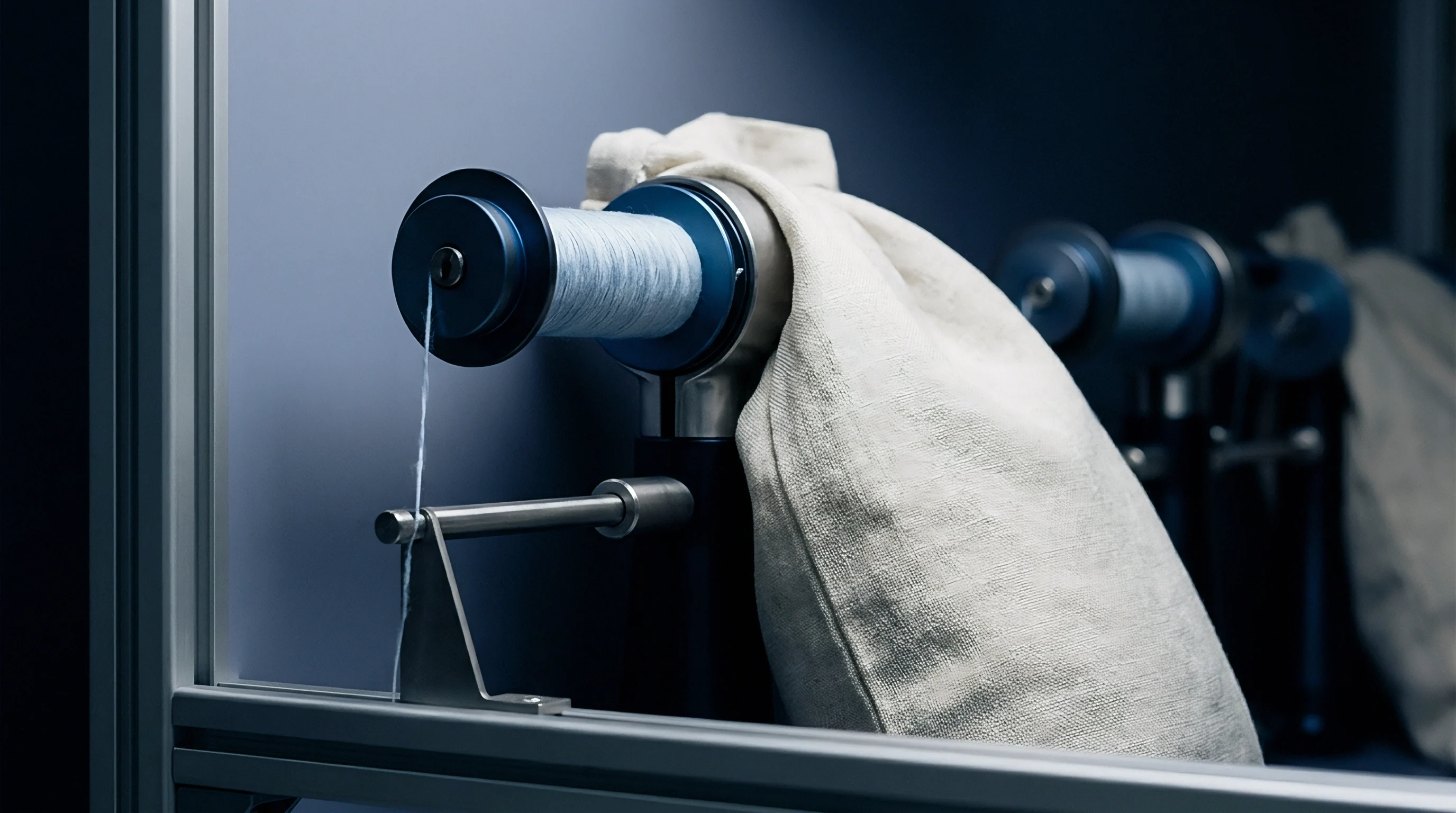
Denting plans and reed wire geometry dictate the mechanical clearance available to fine wet spun flax warp ends during beat-up. Standard stainless steel reed dent wires feature flat side profiles with stamped edges. Under high weaving tension, flax warp threads rub forcefully against these edges, where microscopic wire burrs catch yarn micro-fibrils, rapidly stripping the size film and triggering localized friction spikes.
Wire Surface Finish and Harness Eye Materials
Upgrading reed wire technology reduces micro-fibrillar entanglement inside the shed. Specially polished dent wires treated with Diamond-Like Carbon or Titanium Nitride coatings present an ultra-smooth surface with friction coefficients below 0.10. Ceramic-coated heald eyes offer similar low-friction performance compared to traditional nickel-plated steel mail eyes, eliminating the micro-grooving caused by abrasive flax fiber dust over extended loom operational hours.
| Harness Equipment Profile | Loom Speed (PPM) | Reed Dent Wire Type | Heald Eye Material | Warp Stop Rate (per 10^5 picks) | Efficiency (%) |
|---|---|---|---|---|---|
| Standard Industrial Setup | 320 | Standard Stainless Steel | Nickel-Plated Steel | 8.4 | 78.2 |
| Polished Wire Upgrade | 360 | Polished Stainless Steel | Nickel-Plated Steel | 5.1 | 84.5 |
| Coated Premium Setup | 400 | DLC Coated Wire | Ceramic Insert Eyelet | 1.2 | 92.8 |
| High Speed Trial | 450 | DLC Coated Wire | Ceramic Insert Eyelet | 3.7 | 88.1 |

Shed Kinematics and Loom Velocity Thresholds
Loom speed directly impacts the severity of fibrillar friction spikes. Accelerating a rapier loom from three hundred to four hundred picks per minute increases shed-opening velocity by thirty-three percent. Because micro-fibrillar friction contains a viscous shear component linked to the sizing binder, higher rubbing speeds generate non-linear spikes in yarn drag.
Adjusting shed timing parameters mitigates these velocity-induced friction peaks. Asymmetrical shed opening schedules, where the top and bottom shed lines reach maximum separation at different mechanical angles, reduce thread-to-thread contact density. Splitting the shed line lowers the probability of adjacent micro-fibrils interlocking simultaneously.
- Asymmetrical Shedding Alignment shifts top warp thread tension away from bottom warp thread tension, eliminating thread-to-thread rubbing during shed crossover.
- Dwell Angle Reduction shortens the duration warp ends remain under peak tension at full shed opening, limiting structural sizing film fatigue.
- Optimized Drop Wire Mass prevents excessive bouncing on fine wet spun yarns, maintaining uniform warp tension during sudden loom stops.
- Active Warp Let-Off Control compensates for cyclic peak tension loads during beat-up, preventing local tension excursions from exceeding elastic limits.
Fibrillar entanglement between adjacent warp threads causes delayed shed clean-opening on high-density linen looms.
Anchoring surface micro-fibrils without altering the classic crisp hand of fine wet spun linen fabrics requires careful structural adjustments within the sizing polymer matrix.
Settlement
Financial calculations for fine wet spun linen weaving balance the increased cost of premium sizing formulations against saved loom hours and reduced greige defect rates. A single loom stop on a high-speed rapier loom costs approximately 0.45 Euros in direct labor time and lost loom production capacity. When micro-fibrillar friction spikes cause warp stop rates to rise from 1.5 to 6.0 stops per loom hour, overall weaving shed efficiency drops below eighty percent, severely inflating landed fabric costs.

Efficiency Losses from High Stop Frequency
Consider a standard production lot of 100% fine wet spun linen fabric woven at 180 centimeters finished width, using 36 Nm warp and weft yarns, with a construction sett of 22 ends per centimeter and 20 picks per centimeter. Running on a rapier loom at 380 picks per minute, a target mill operating efficiency of ninety percent yields 10.26 meters of greige cloth per loom hour.
When unoptimized sizing allows high micro-fibrillar friction spikes, warp breakage rates increase. Operating efficiency falls to seventy-six percent, reducing output to 8.66 meters per loom hour. Fixed loom overhead costs, calculated at 14.50 Euros per operating loom hour, spread over fewer meters of cloth, jumping from 1.41 Euros per meter to 1.67 Euros per meter.
Unit Cost Calculations for Fine Linen Greige Cloth
Calculating the total financial impact of micro-fibrillar friction management requires analyzing both sizing formulation costs and loom efficiency figures. The following worked calculation assumes a warp length of three thousand meters running on twenty rapier looms over a thirty-day production window.
Standard sizing recipe ST-PVA-01 costs 1.10 Euros per kilogram of dry size chemical, resulting in a sizing material cost of 0.04 Euros per warp meter. Advanced friction-suppressing recipe ST-PVA-03 costs 2.30 Euros per kilogram, raising sizing material cost to 0.09 Euros per warp meter, an added formulation cost of 0.05 Euros per meter.
| Cost Component | Standard Sizing (ST-PVA-01) | Optimized Sizing (ST-PVA-03) | Cost Variance (€/m) |
|---|---|---|---|
| Sizing Chemical Material Cost | €0.04 / m | €0.09 / m | +€0.05 / m |
| Fixed Loom Overhead Cost | €1.67 / m | €1.41 / m | -€0.26 / m |
| Greige Cloth Mending / Burling Labor | €0.32 / m | €0.08 / m | -€0.24 / m |
| Landed Greige Cost Per Meter | €4.88 / m | €4.43 / m | -€0.45 / m |
Investing in sizing chemistry that eliminates micro-fibrillar friction spikes yields a net savings of 0.45 Euros per finished meter. Reduced warp breakage rates minimize stop marks, elevating first-quality cloth yield from eighty-eight percent to ninety-seven percent under commercial four-point fabric inspection standards.
Mastering fine flax warp preparation involves keeping sizing solids high enough to anchor micro-fibrils while preserving yarn flexural yield for smooth shed formation.