Thermodynamic Moisture Loss Dynamics in High Speed Rapier Weaving of Wet Spun Fine Linen
High-speed rapier friction accelerates evaporative desiccation in wet spun linen, requiring targeted shed micro-climates to maintain eleven percent regain.
Vapor
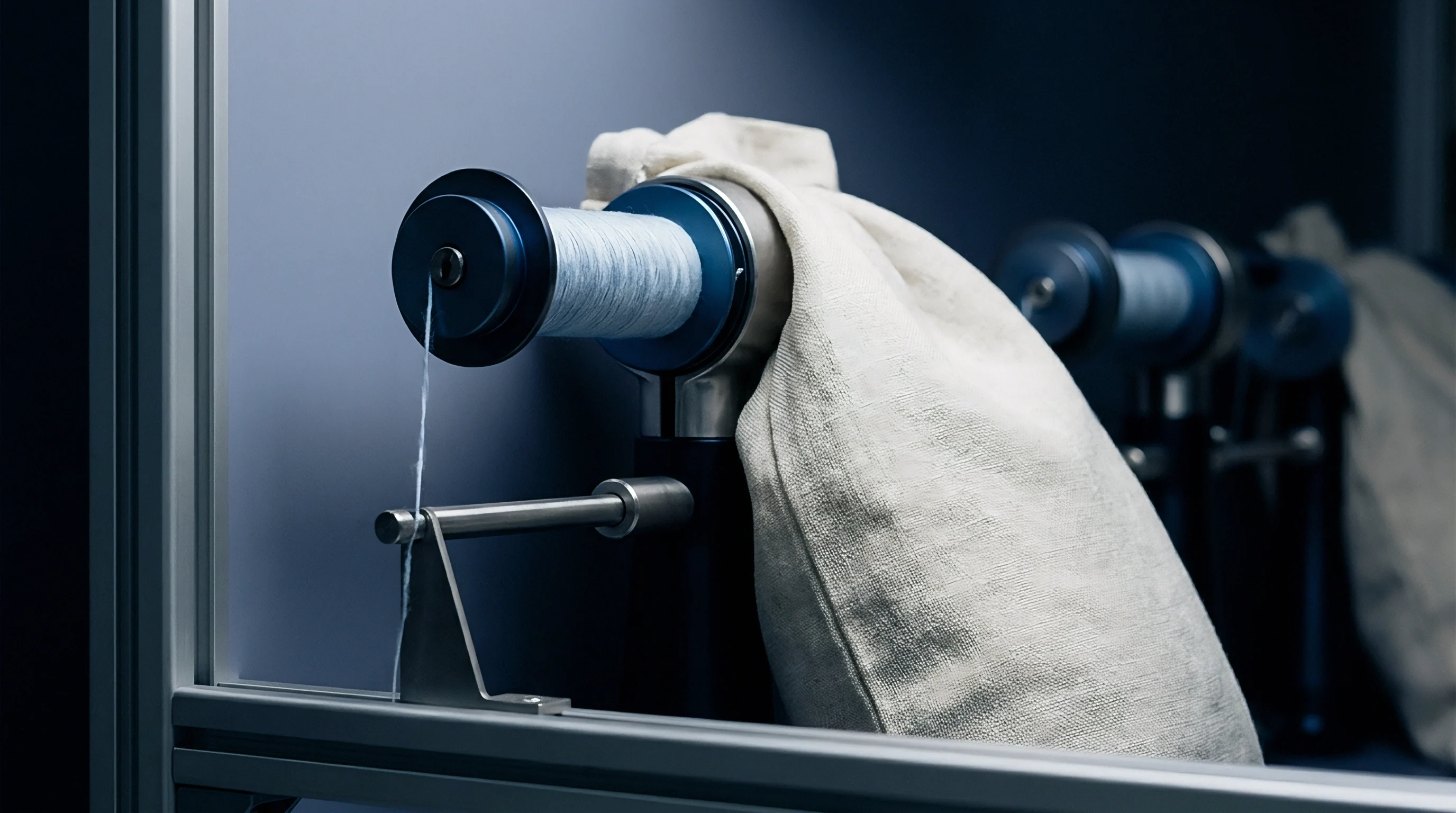
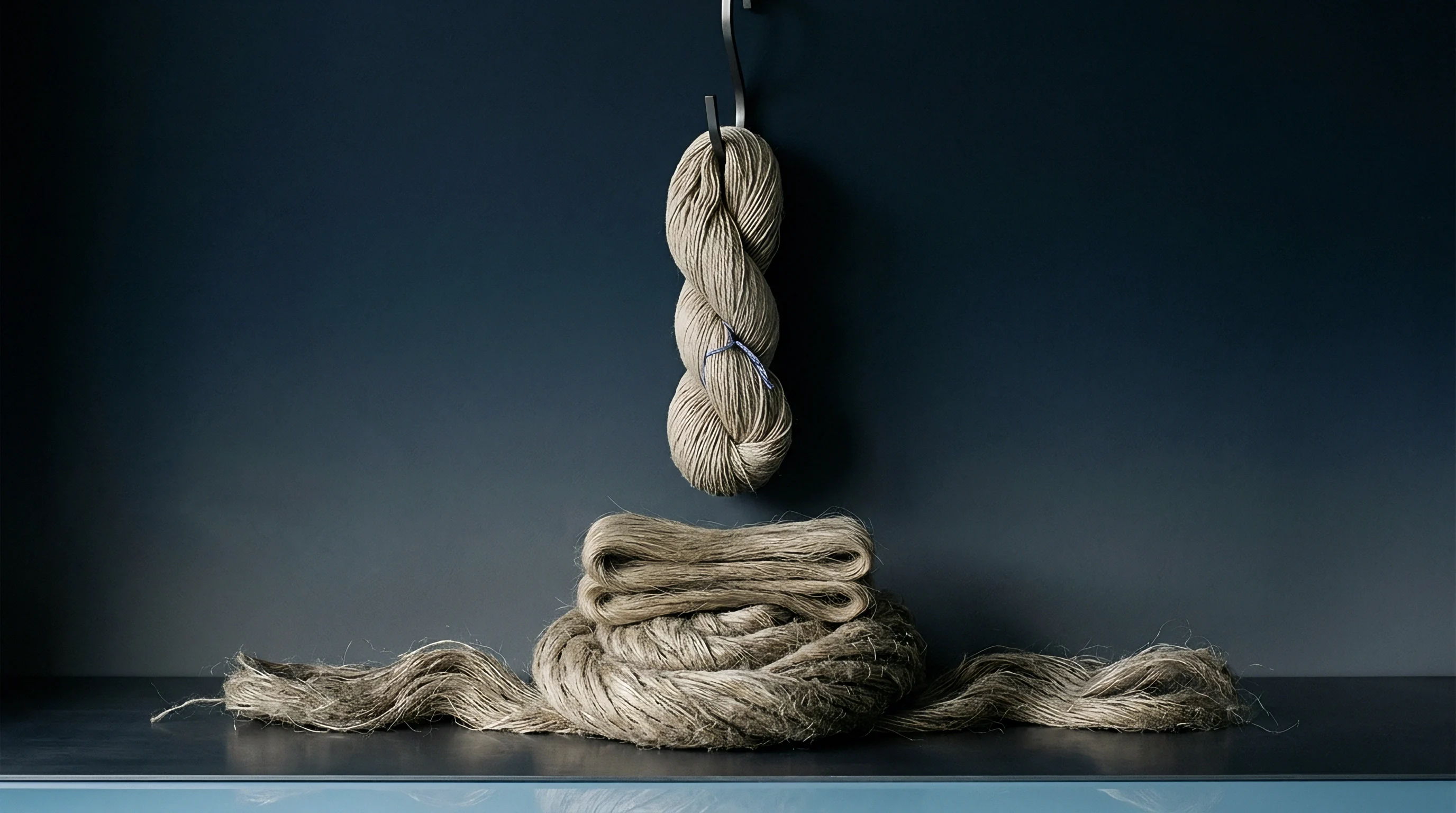
Fine wet spun linen yarns running at six hundred picks per minute shed their capillary moisture in fractions of a second as they leave the back rest. Convective air currents driven by reciprocating rapier tapes strip the protective boundary layer from individual flax bundles, pulling yarn moisture regain down from an optimal twelve percent to eight percent before reaching beat-up. This sudden loss transforms flexible cellulosic fibers into brittle, glass-like columns.
Forced convection accelerates evaporative flux across the shed floor. Ambient air at twenty-two degrees Celsius and sixty-five percent relative humidity establishes a distinct vapor pressure differential across the boundary layer. Once rapier speeds surpass ten metres per second, laminar air flow collapses into turbulent vortices around the warp ends, transferring heat into the yarn core and rapidly vaporizing its remaining moisture.
Surface desiccation below eight percent regain increases bending modulus by forty percent under standard testing conditions.
Flax fibers exhibit steep hysteresis along their desorption isotherms. As water escapes the secondary cell wall, hydrogen bonds re-form between adjacent cellulose microfibrils in rigid crystalline alignments, stripping the yarn of its natural compliance. Cyclic tension from heddle movement then shears these unplasticized cellulose chains right at the harness eyelets.
Unless the evaporative mass transfer coefficient is stabilized along the warp line, the greige lot suffers higher warp breakage, uneven pick density, and heavy reed marks.
Pectin
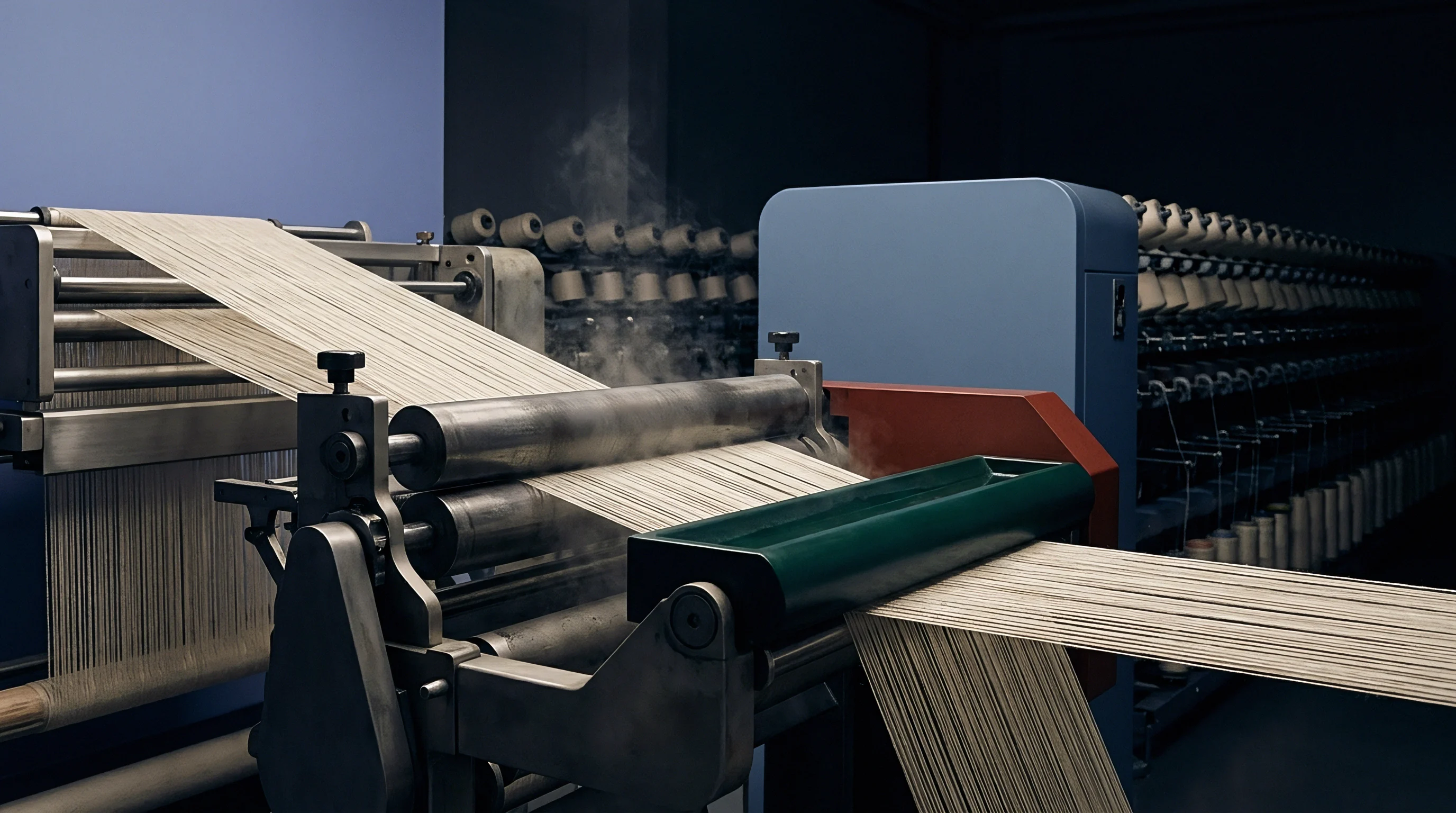
Individual flax cells rely on an amorphous pectin matrix to distribute stress and hold fibers together. When fully hydrated in wet spun yarn, this non-cellulosic middle lamella acts as a viscoelastic dampener: water intercalates between rhamnogalacturonan chains, allowing elementary fibers to slide smoothly under dynamic warp tension. As moisture evaporates, those polymer chains lock into rigid structures.
Dehydration compromises flexural endurance well before any drop in tensile strength becomes measurable. Passing through drop wires and heddles subjects the yarn to cyclic two-dimensional bending, driving shear failures along the dry pectin interface. Microfibrils rupture at the primary cell wall, leaving loose surface fuzz to collect inside the reed dents and form slubs that obstruct the shed.
- Inter-Fiber Delamination occurs when the dry middle lamella fractures during harness shedding, peeling individual cells away from the main yarn bundle.
- Axial Splitting opens fissures along the fiber axis as lateral cohesion breaks down, leaving splits that snag adjacent warp ends at shed crossover.
- Abrasive Fibrillation builds dense nests of lint behind the reed wires, blocking the rapier and causing loom stops.
| Moisture Regain Percentage | Tensile Tenacity (cN/tex) | Elongation at Break (%) | Work to Break (mJ) | Loop Tenacity Ratio |
|---|---|---|---|---|
| 12.5 | 42.8 | 2.85 | 14.2 | 0.72 |
| 10.0 | 39.4 | 2.40 | 11.1 | 0.64 |
| 8.0 | 33.1 | 1.85 | 7.6 | 0.51 |
| 6.0 | 26.5 | 1.30 | 4.2 | 0.38 |
Linen yarns running at low moisture regain can no longer distribute localized stress across neighboring fibers. The outer sheath takes the full force of beat-up while the core remains unengaged, leading to progressive failure across the weave plane.
Wet flax retains flexibility only while capillary water plasticizes the amorphous pectin core.
Without that moisture, dry fibers snap cleanly across the middle lamella.
Stroke
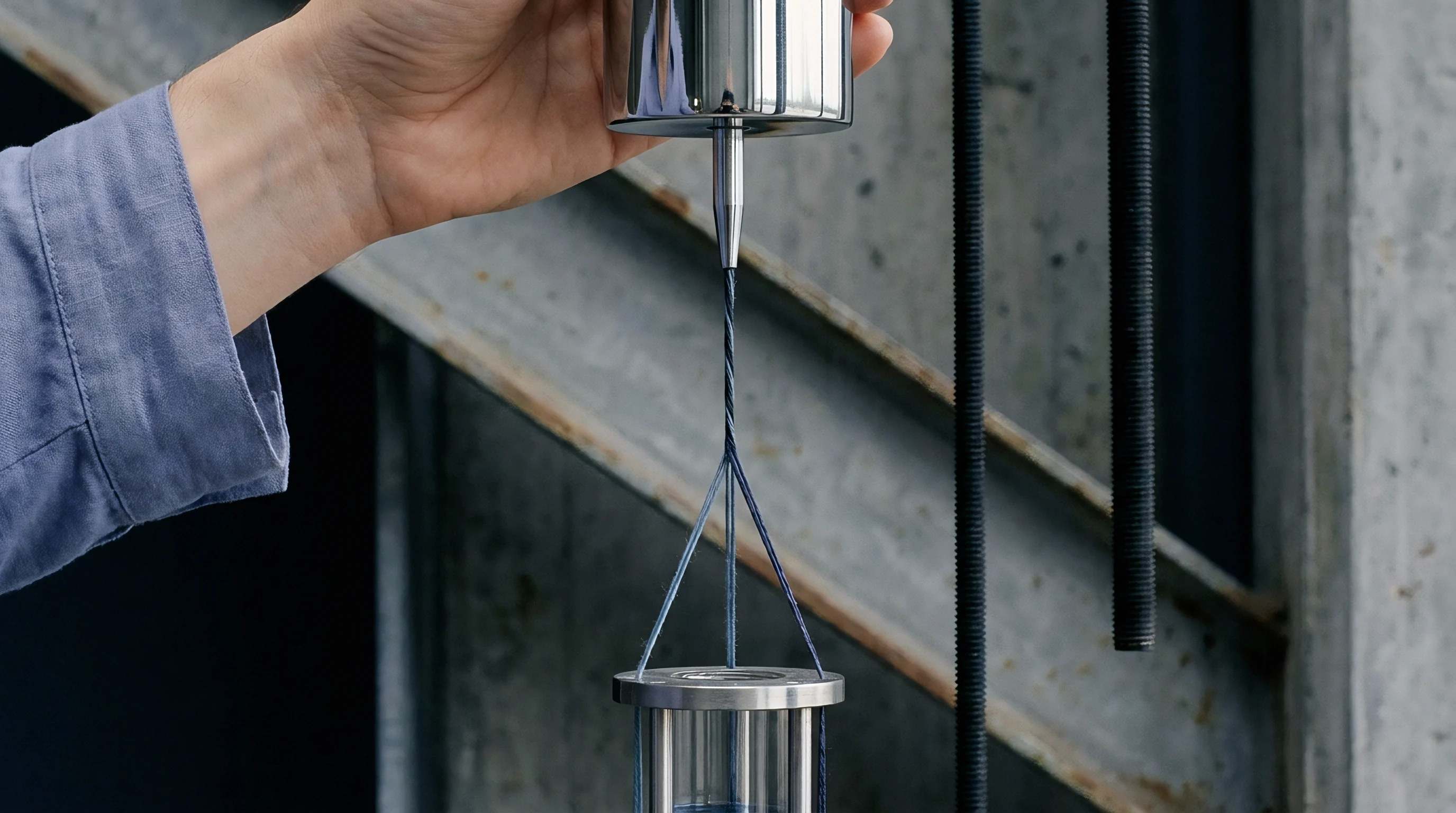
Rapier insertion subjects fine linen warps to heavy thermal and mechanical stress. Modern wide-width frames push positive and negative rapier heads through the shed at speeds up to thirty metres per second. Friction between the guidance hooks, the lower warp sheet, and the carbon-composite tape creates intense local heating, pushing surface temperatures on the raceboard past forty-five degrees Celsius during long runs.
This localized heat accelerates evaporation right at the point of maximum abrasive contact. Each insertion sweeps warm, turbulent air across the open yarn sheet, removing moisture faster than central air systems can restore it, while tension spikes sharply as the rapier enters, transfers, and withdraws.
| Loom Speed (PPM) | Tape Surface Temp (°C) | Yarn Moisture at Beat-up (%) | Warp Breaks / 100k Picks | Weft Insertion Rate (m/min) |
|---|---|---|---|---|
| 420 | 28.5 | 11.2 | 1.8 | 798 |
| 500 | 34.0 | 9.8 | 3.4 | 950 |
| 580 | 39.2 | 8.1 | 7.9 | 1102 |
| 650 | 46.8 | 6.4 | 16.5 | 1235 |
Tape temperature scales directly with insertion speed. Raising loom speed from 420 to 650 picks per minute on a 190 cm reed width nearly doubles convective mass transfer coefficients, causing flax yarn in the heddle eyes to dry out before the rapier reaches the center transfer position while scuffing the shed floor continuously.
Excessive loom stops often stem from uneven sizing application or substandard yarn count CV percentages rather than rapid shed desiccation.
Enthalpy
Maintaining moisture equilibrium during high-speed linen weaving requires direct control over the micro-climate inside the shed. Room-wide air handling at seventy percent relative humidity cannot prevent localized drying along the rapier path, as rapid air turnover on modern looms scatters moisture faster than central systems supply it.
Dedicated micro-climate systems channel humidified, temperature-controlled air directly onto the warp line between the harness frames and the reed. This direct adiabatic delivery reduces vapor pressure deficits within the active shed. Transducers atomize demineralized water into sub-five-micron aerosol droplets that absorb instantly into the yarn without leaving liquid deposits.
- Target Dew Point Calibration maintains psychrometric balance along the warp line, preventing condensation on metallic reed wires while keeping fiber regain above eleven percent.
- Localized Velocity Damping reduces air turbulence near the raceboard to preserve a stable, protective moisture envelope over the moving warp sheet.
- Thermal Dissipation Scavenging clears sensible heat from electronic dobby drives and rapier gearboxes before rising thermal plumes touch the lower shed.
ASTM D5430 inspection protocols penalize desiccation stop marks as major continuous defects.
Standard international supply contracts mandate a minimum delivered regain of eleven point five percent measured immediately at cloth take-up, holding suppliers responsible for tensile damage caused by weaving in an unconditioned shed.
Costing
Moisture loss translates directly into lost loom capacity and higher fabric costs per linear metre. On fine wet spun linen, unmanaged desiccation drops rapier weaving efficiency from eighty-four percent to sixty-one percent, with warp stop frequency climbing sharply once regain falls below nine percent.
Consider an industrial run of Nm 50 wet spun linen warp and Nm 50 wet spun weft in a plain weave: twenty-eight ends per centimetre, twenty-four picks per centimetre, at a reed width of one hundred and seventy centimetres. The greige fabric balances at one hundred and sixty grams per square metre. At six hundred picks per minute, a standard hundred-metre roll requires two hundred and forty thousand picks.
Without micro-climate conditioning, the job averages twelve warp stops per one hundred thousand picks. With each stop taking roughly two point five minutes to repair and restart, total production time per hundred metres rises from six point three to eight point seven loom hours. At a fixed overhead rate of thirty-five euros per loom hour, that delay adds eighty-four euros per hundred-metre roll ~ or eighty-four euro cents per linear metre.
- Direct Labor Inefficiency grows as knotting technicians spend time handling four times the typical stop volume across active looms.
- Greige Defect Deductions accumulate during automated inspection due to start marks and filament breaks caused by frequent stops.
- Secondary Mending Surcharges pile up at burling inspection whenever dry fiber snaps require manual drawing and hand repair.
Whether ultrasonic micro-climate conditioning can fully counter frictional heating from carbon-composite rapiers above seven hundred picks per minute remains an open question in modern flax weaving.