Mass Balance Reconciliation in Asian Long Staple Flax Spinning Mills
Reconciling mass balance in Asian flax wet spinning demands strict dry-mass tare auditing, tow yield accounting, and certified credit ledger validation.


Inventory
Transaction Ledger Reconciliation Mechanics
Incoming European long staple flax shipments arrive at Asian ports under certified container seals. Mills in Jiangsu and Zhejiang receive hackled line flax as tied stricks inside dense bales, bound with polypropylene strapping or steel wire. The receiving warehouse logs gross weighbridge intake against the bill of lading, phytosanitary transit documentation, and seller invoice.
At this physical intake gate, the mill logs raw fiber lots into its enterprise software under discrete receipt batch identifiers. Mass balance accounting tracks certified raw material credits from these receipts, matching input volumes against downstream yarn output to maintain certification integrity.
European Flax certification relies on either physical segregation or a book-and-claim mass balance system throughout spinning. Physical segregation isolates certified fiber lots on dedicated carding, combing, roving, and ring spinning lines, preventing physical co-mingling with uncertified Russian, Chinese, or non-certified French bobbins. Mass balance permits physical blending inside production machinery while enforcing strict credit accounting within the site ledger.
The mill cannot dispatch more certified yarn mass than the volume of certified flax fiber consumed, calculated through verified industrial yield factors. The operational ledger closes quarterly.
Under European Flax Standard rules, an administrative ledger balance expires twelve calendar months after the issuance date of the incoming raw fiber transaction certificate.
Credit balances do not accumulate indefinitely; an administrative balance lapses when processing runs exceed annual validity windows. Auditors inspect the site ledger to ensure incoming transaction certificates match customs clearance declarations down to the individual Harmonized System code. European long staple line flax enters under HS code 5301.21, whereas scutched tow enters under 5301.29.
A mass balance discrepancy surfaces immediately when a facility credits long staple line inputs while booking finished yarn outputs derived from cheaper carded tow fractions.
Discrepancies between Scope and Transaction Certificates
Auditors inspecting Jiangsu spinning facilities cross-reference annual processing capacity against total incoming raw fiber weight. A scope certificate confirms an independent third party audited the facility and approved its material tracking procedures under ISO 17065 accredited guidelines. The document names the facility, specifies certified processing stages from drawing to wet spinning, and establishes annual operational validity.
A scope certificate does not prove the origin of a specific physical lot sitting in the warehouse ~ transaction certificates serve that commercial role.
A transaction certificate links an exact delivery mass to an authorized seller, detailing the consignee, invoice reference, nett weight, and farming lot origin. Mills processing both certified European fiber and uncertified Heilongjiang or Egyptian flax frequently show documentation gaps between scope validity dates and transactional transfers. If an Asian spinning plant holds a valid scope certificate but runs out of active transaction certificate credits, spinning planners face an administrative shortfall.
Unscrupulous operations attempt to roll uncertified domestic fiber into certified mass balance credits, betting that auditor sampling rates miss the uncredited production window.
Transaction records must align with container shipping timelines. Ocean transit from Antwerp or Le Havre to Shanghai or Ningbo consumes thirty-five to forty-five days. A mill claiming immediate processing of a European Flax consignment whose transaction certificate dates match port discharge dates by fewer than five days reveals documentary falsification.
Transit time represents an immutable physical reality, and customs clearance at maritime border inspection posts adds another three to seven operational days for bast fiber fumigation and bio-security clearance.
Batch Credit Allocation across Parallel Production Lines
Spinners running wet frames allocate raw fiber weight across parallel production tracks. An Asian spinning mill operating sixty wet ring frames typically divides capacity between high-count apparel yarns and coarser home-textile counts. European line flax with high hackling yields feeds wet spinning frames producing metric yarn counts between Nm 26 and Nm 60.
Coarser counts below Nm 20 rely on dry spinning or blending with flax tow and cottonized bast fibers.
- Gross intake tare weight verification validates container tare declarations against weighbridge scale tickets to uncover water-logged pallets or excess packing material before booking raw mass.
- Transaction certificate volume deduplication prevents the dual-booking of single raw material invoices across multiple client production orders or internal brand programs.
- Moisture-adjusted dry mass reconciliation converts as-received commercial scale weights into conditioned fiber mass using calibrated hot-air drying ovens.
- Hackling comb yield deduction separates the valuable hackled line sliver from extracted short tow and noil fractions prior to wet drawing.
When physical segregation lapses on the spinning floor, mass balance rules govern how credits flow across finished yarn packages. The spinner records yarn mass leaving the winding frame and deducts accumulated spinning wastes. Production planners must credit the highest quality long staple outputs strictly against genuine line flax receipts, assigning tow byproduct credits exclusively to coarse dry-spun products, with the mill absorbing any variance.
Documentation gaps often occur when European scutchers dispatch raw material lots weeks before issuing digital transaction certificates, leaving production teams to process physical bales against informal dispatch notes.


Comb

Mechanical Fractionation through Hackling and Drawing
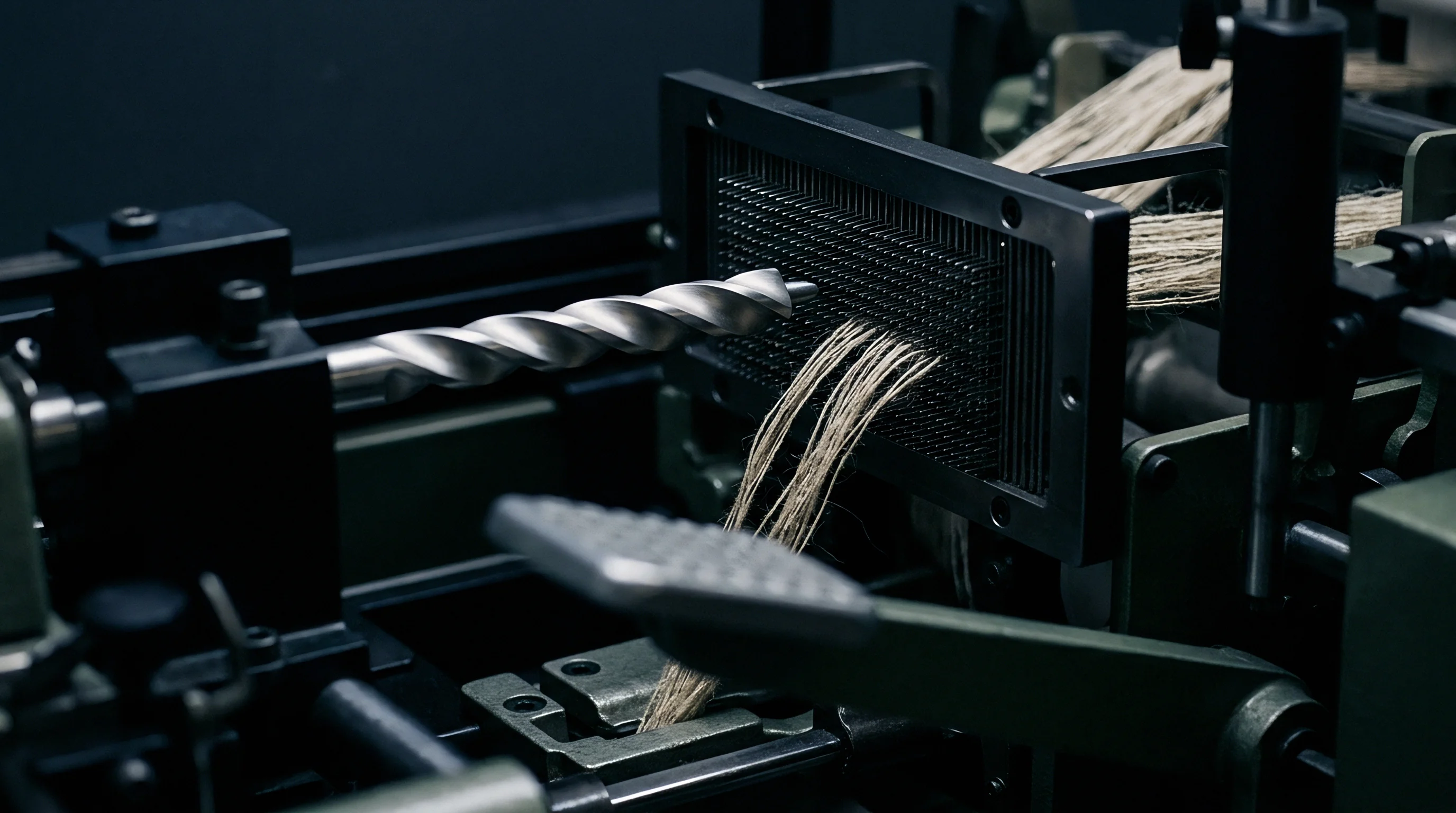
Raw scutched flax undergoes pin-based separation to split bundled bast fibers into spinnable stricks. In hackling, mechanical combs carry rows of steel pins that penetrate flax bundles, pulling away woody shives, coarse cortical tissue, and entangled short fibers. This mechanical treatment fractionates intake fiber into two distinct commercial streams: long line flax slivers and hackled tow.
Long line flax represents the parallelized, unbroken bast bundles that proceed to gill drawing, roving, and wet ring spinning, while hackled tow comprises the shorter fiber fragments stripped out by the comb pins.
Industrial long staple flax spinning depends entirely on maximizing long line yield. Scutched flax entering the comb from high-grade Western European farms yields between fifty-two and sixty-two percent long line sliver. The comb pulls out thirty to thirty-eight percent hackled tow, with the remaining six to ten percent dropping out as unrecoverable woody waste, soil dust, and micro-shive fragments.
Fiber quality varies with agricultural retting conditions; over-retted flax fractures excessively under the pins, depressing long line sliver yields below fifty percent and generating disproportionate tow fractions that disrupt mass balance allocations.
Because spinning tension breaks weak strands and short fibers drop as noil, intersecting draw frames in the gill room comb slivers repeatedly through faller bars equipped with fine steel pins. Drawing straightens individual flax filaments, refines sliver linear density, and blends multiple slivers to achieve weight uniformity. Each drawing passage generates sliver waste and pneumatic filter waste, while mill sweepings collect broken fibers that cannot return to the long staple wet line.
Auditors track these mechanical losses across every preparation stage to confirm that finished yarn production figures do not exceed raw line intake volume allowances.
| Processing Stage | Input Material | Output Stream | Nominal Mass Yield (%) | Waste Mass Allocation (%) |
|---|---|---|---|---|
| Hackling Preparation | Scutched Line Flax | Hackled Line Stricks | 54.0 – 62.0 | 30.0 – 38.0 Tow, 6.0 – 8.0 Dust |
| Gill Drawing (3 Passages) | Hackled Line Stricks | Drawn Line Sliver | 95.0 – 97.5 | 2.5 – 5.0 Sliver Ends and Laps |
| Combing (Optional Fine) | Drawn Line Sliver | Combed Line Sliver | 82.0 – 88.0 | 12.0 – 18.0 Combing Noils |
| Roving Frame | Combed Line Sliver | Wet Spinning Roving | 96.0 – 98.0 | 2.0 – 4.0 Roving Flyer Waste |
| Wet Ring Spinning | Boiled/Bleached Roving | Wet Spun Ring Bobbins | 88.0 – 93.0 | 7.0 – 12.0 Basin Sludge and Snarls |
| Winding and Clearing | Ring Bobbins | Finished Yarn Cones | 97.0 – 98.5 | 1.5 – 3.0 Splicer Cuts and Off-Cops |

Tow Byproduct Recovery and Secondary Yield Losses
Short entangled strands extracted during gill drawing move immediately to dry spinning or non-woven carding units. Hackled tow contains broken bast fibers mixed with residual shive tissue. Asian spinning mills operating integrated sites run secondary tow carding lines to convert these extraction products into carded slivers for low-count yarns or industrial twines.
In a transparent chain of custody, the mass balance accounting system balances line yarn output against tow yarn output simultaneously; a mill cannot claim one hundred tonnes of imported European Flax line produced eighty-five tonnes of fine wet-spun linen yarn, as physical mechanics make that conversion impossible.
Tow byproducts generated during combing and drawing carry certified European Flax credits, but these belong strictly to the byproduct category. Certification rules forbid upgrading tow credits into long staple line yarn credits. If a spinner generates thirty-five tonnes of hackled tow from one hundred tonnes of imported line flax, those thirty-five tonnes can only support transaction certificates for tow-derived yarns or be sold downstream to paper makers and insulation manufacturers.
Misallocating tow recovery credits to disguise losses on wet spinning line frames constitutes a direct breach of scheme guidelines.
- Bale opening and mechanical conditioning exposes pressed bast bundles to ambient workshop humidity, releasing compressed packing forces and shedding coarse surface dirt.
- Hackling table feeding and pin combing separates long line stricks from short tow through graduated pin fields, dropping heavy shives into collection bins below the comb bed.
- Sliver formation and autoleveller drafting condenses parallel bast fibers into continuous sliver coils, monitoring weight per meter through mechanical displacement sensors.
- Roving twist insertion and package winding adds low rotational twist to the drafted sliver, providing tensile cohesion for package immersion inside hot water spinning baths.
Carding removes remaining woody shives. When tow lines run without autolevelling or electronic clearers, short fiber shedding increases substantially. Mill floor sweepings, pneumatic collector lint, and floor drop waste carry zero commercial credit value, and auditors require mills to write off mechanical waste categories directly against input volumes to determine salable credit volume.
Wet Spinning Roving Loss Benchmarks
Acidified hot-water troughs soften inter-fiber pectin matrices before ring spindles twist individual filaments into yarn. Long staple wet spinning differs fundamentally from dry spinning. The roving passes through a heated water bath maintained between fifty and seventy degrees Celsius.
Hot water softens the calcium-pectinate gums binding elementary flax cells together, allowing individual ultimate fibers to slide past each other during high-draft roller elongation. This sliding mechanism enables the production of fine, smooth linen yarns impossible to spin on dry systems.
A wet spinning trough running at sixty degrees Celsius leaches water-soluble pectins and hemicelluloses, stripping between three and six percent of bone-dry fiber mass into the process effluent.
Leaching causes unavoidable mass loss as pectins, water-soluble hemicelluloses, and residual lignins dissolve directly into the bath water. Over an eight-hour shift, spinning troughs accumulate dark, gummy sludge that workers purge into industrial wastewater systems. Wet spinning ring frames also generate flyer waste, spinning snarls, and broken end laps that wrap around drafting rollers, consuming raw fiber mass without generating salable yarn cones.
Winding machines equipped with optical clearers cut out thick slubs, thin spots, and foreign polypropylene fibers, generating winding waste with each cut. Across a typical high-count wet spinning sequence, finished cone yield rarely exceeds forty-five to fifty-two percent of original raw scutched flax bale mass. Spinners claiming conversion efficiencies above fifty-five percent for pure long line wet spun yarns are either under-reporting comb waste or substituting uncertified short fiber streams.
Coarse comb pins produce heavy tow loss, whereas fine pins break fragile line stricks.
Moisture

Commercial Regain versus as Received Invoice Mass
Bales unloaded in warm maritime climates deviate substantially from the standard twelve percent moisture allowance. Flax is an exceptionally hygroscopic bast fiber, featuring a porous cell structure rich in hydrophilic cellulose, hemicellulose, and amorphous pectin polymers. Under standard atmospheric conditions of twenty degrees Celsius and sixty-five percent relative humidity, flax exhibits a commercial moisture regain set internationally at twelve percent under standard trade provisions.
Real-world shipping conditions depart from standard laboratory atmospheres, as ocean containers traversing tropical routes experience high internal humidity cycles that cause dry bast fibers to absorb atmospheric water vapor through container breathing effects.
Because dry fiber absorbs atmospheric water, raw flax loaded in European warehouses at ten percent moisture content arrives at Asian discharge ports weighing two to four percent more due to absorbed moisture alone. A consignment shipped at fifty thousand kilograms invoice mass can register fifty-one thousand five hundred kilograms on the mill weighbridge without containing a single extra gram of real cellulose fiber. If the receiving mill records intake weight using raw weighbridge mass without correcting for elevated moisture, its mass balance ledger gains unearned certified fiber credits.
The inverse dynamic occurs during prolonged dry storage inside conditioned Asian mills. In winter heating seasons or dry continental weather, stored flax dries down to eight or nine percent moisture content. Spinning this dry fiber directly produces excessive fiber breakage and dust.
Processing facilities run humidification systems in preparation rooms to bring fiber moisture up to twelve to fourteen percent before gill drawing. Failure to standardize moisture content across all weighbridge tickets, internal lot transfers, and outbound yarn invoices introduces systematic calculation errors into mass balance calculations.

Desiccation Testing under Controlled Oven Regimes
Core samples extracted via pneumatic coring tubes face convective heated air at one hundred five degrees Celsius until mass stabilization. Determining true fiber mass demands gravimetric oven desiccation following ISO 6741 standards. Technicians sample ten percent of received bales using rotating serrated coring tubes, extracting core plugs through the entire bale depth to capture internal moisture gradients.
Samples transfer immediately into airtight, moisture-sealed containers to prevent atmospheric exchange during transport to the mill laboratory.
The oven test measures initial as-received weight on analytical balances accurate to three decimal places. The drying apparatus circulates heated air at one hundred five degrees Celsius plus or minus two degrees, evaporating free moisture and loosely bound capillary water from the bast cell walls. The technician weighs the sample repeatedly at twenty-minute intervals until two consecutive weighings show a mass change below zero point zero five percent, confirming bone-dry condition.
The dry fiber mass forms the absolute physical baseline for all mass balance accounting.
| Measurement Metric | Direct Scale Reading | Absolute Dry Mass | Calculated Commercial Weight | Ledger Variance Impact |
|---|---|---|---|---|
| Port Intake (Elevated Moisture 14.8%) | 20,000 kg | 17,422 kg | 19,513 kg | +487 kg Virtual Credit Surplus |
| Standard Regain Baseline (12.0%) | 19,513 kg | 17,422 kg | 19,513 kg | Zero Accounting Baseline |
| Dry Warehouse Storage (Moisture 8.5%) | 19,040 kg | 17,422 kg | 19,513 kg | -473 kg Artificial Deficit |
| Wet Spinning Bobbin (Water Saturated) | 26,500 kg | 17,422 kg | 19,513 kg | Not Spinnable without Hot Air Drying |
| Finished Cones Post-Conditioning (11.8%) | 19,478 kg | 17,422 kg | 19,513 kg | -35 kg Natural Moisture Deficit |
Commercial conditioned weight equals absolute dry mass multiplied by one point one two. This mathematical standardization strips away environmental moisture fluctuations. If a twenty-tonne shipment arrives at fourteen point eight percent moisture content, its true commercial conditioned weight is only nineteen thousand five hundred thirteen kilograms.
Crediting the mill with twenty thousand kilograms generates four hundred eighty-seven kilograms of phantom raw material credits, allowing the mill to blend uncertified fiber downstream while showing a clean balance on paper.
Even where customs declarations stand, moisture verification at Asian long staple spinning mills requires continuous laboratory oversight. Without independent core sampling and standardized oven desiccation logs attached to every receipt batch, mass balance accounts drift away from physical reality. Auditors verify whether a spinner calculates outbound yarn weights using invoice mass, actual net scale weight, or conditioned mass.
In wet spinning, yarn packages emerge from ring frames soaked with water and dry inside heated chambers before winding. If yarn cones pack for shipment with fourteen percent residual moisture, the spinner bills the buyer for water while over-reporting mass balance fiber consumption.
Auditors face practical limits when deducting excess moisture before suppliers challenge laboratory oven calibrations.


Dilution
Substitution Risks in Blended Wet Spun Lots
Mill ticket records frequently mask the introduction of cheaper domestic Chinese or Russian long line fibers into European runs. Commercial linen markets command substantial price premiums for European Flax certified yarns over uncertified fiber grown in the Heilongjiang province of China or imported from Egypt and Russia. This price differential creates powerful financial incentives for spinning operations to substitute lower-cost fibers into certified runs or dilute certified lots through covert blending during drawing.
The long staple wet spinning sequence provides multiple junctures for unauthorized material substitution. At the gill box, an operator feeds twelve to twenty-four individual slivers into faller pins to produce a single combined sliver. An unmonitored mill can feed sixteen slivers of genuine European line flax alongside four slivers of domestic Chinese line flax.
The resulting sliver exhibits near-identical visual appearance, linear density, and mechanical behavior. Chemical and DNA tracing tests struggle to distinguish European flax from Asian-grown flax of the same species, making documentary reconciliation the only practical tool to uncover mechanical dilution.
A substitution of ten percent uncertified bast sliver into a long staple drawing set reduces raw material input costs by several thousand dollars per truckload without changing yarn counts.
Carded tow presents another dilution risk. Mills possess machinery to cottonize flax tow, cutting long fibers into short staple lengths and chemically removing pectins to allow processing on standard rotor or ring cotton spinning frames. In true long staple wet spinning mills, uncertified line flax or bleached tow slivers slip into preparation lines when European Flax order books outstrip physical raw material inventory.
Mass balance ledgers conceal this dilution when auditors fail to verify spinning efficiencies against physical machine waste outputs.
Mass Balance Worked Balance Sensitivity Model
A baseline forty-tonne wet spinning contract demonstrates how minor unaccounted shrinkage distorts certified yarn output. Consider a contract requiring the delivery of fine wet-spun linen yarn of count Nm 39 from certified European line flax. The spinning mill books forty thousand kilograms of hackled line flax under valid transaction certificates, registering the delivery in its internal warehouse ledger.
Processing forty tonnes of line flax through industrial wet spinning generates specific material flows and byproduct fractions.
Assuming standard industrial parameters across processing, hackling comb operations achieve sixty percent line sliver recovery, yielding twenty-four thousand kilograms of drawn sliver and fourteen thousand four hundred kilograms of hackled tow, with one thousand six hundred kilograms lost as dust and micro-shive waste. The twenty-four thousand kilograms of line sliver pass to wet preparation and ring spinning. In the hot water trough, pectin leaching dissolves four percent of dry mass, removing nine hundred sixty kilograms.
Wet spinning mechanical breaks and ring rail wastes consume seven percent of roving mass, totaling one thousand six hundred eighty kilograms, while winding clearers excise two percent of yarn mass, removing four hundred twenty-six kilograms. The actual output of certified Nm 39 long staple yarn equals twenty thousand nine hundred thirty-four kilograms.
| Processing Scenario | Genuine Line Input | Substituted Input | Declared Yarn Output | Effective Dilution Rate |
|---|---|---|---|---|
| Pure European Line (Nominal Run) | 40,000 kg | 0 kg | 20,934 kg | 0.0% Baseline Authenticity |
| Minor Sliver Blending (Gill Box 10%) | 36,000 kg | 4,000 kg | 20,934 kg | 10.0% Uncertified Content |
| Moderate Line Substitution (25%) | 30,000 kg | 10,000 kg | 20,934 kg | 25.0% Uncertified Content |
| High Dilution with Tow Credits (40%) | 24,000 kg | 16,000 kg | 20,934 kg | 40.0% Physical Non-Conformity |
| Full Paper Balance Balancing Run | 18,000 kg | 22,000 kg | 20,934 kg | 55.0% Complete Commercial Fraud |
If the spinning mill reports twenty-four thousand kilograms of finished Nm 39 yarn from the original forty-tonne input, the numbers fail to match physical capabilities. Delivering twenty-four thousand kilograms of finished yarn requires either an impossible one hundred percent conversion of hackled sliver through wet drawing and ring spinning, or the covert addition of three thousand sixty-six kilograms of uncertified bast fibers. Dilution alters commercial balances; when a mill runs parallel shifts, night crews can feed uncertified roving bobbins onto ring frames designated for certified production.
With Chinese wet spinning mills running continuously and price differentials persisting, auditors discover dilution by tracking chemical bath disposal and machine maintenance cycles. If spinning frames log running hours producing Nm 39 yarn that exceed the mechanical throughput capacity supported by incoming certified roving lots, uncertified material filled the gap. Unaccounted inventory surpluses in raw fiber warehouses prove the mill used cheaper domestic stock while banking certified transaction credits for later paper-only sales.
Accepting unverified conversion efficiencies allows unauthorized bast fiber to dilute genuine origin lots, exposing brands to public product recalls and false advertising penalties under international trade consumer protection statutes.

Margin

Commercial Surcharge Dynamics in Certified Flax Yarns
Spinning mills bill European origin yarn at a premium of two to four dollars per kilogram over uncertified Asian equivalents. This markup reflects the higher acquisition price of European scutched flax, the administrative overhead of maintaining certified chain-of-custody documentation, and the cost of independent third-party audits. Long staple wet spun yarn of count Nm 36 commands wholesale prices between twenty-four and twenty-eight dollars per kilogram, depending on market swings and energy tariffs, with the certified origin claim accounting for ten to fifteen percent of that total invoice price.
A buyer purchasing forty tonnes of certified wet spun yarn pays eighty to one hundred sixty thousand dollars specifically for verified origin status. If the spinning mill relies on mass balance credit trading without rigorous bale-level batch tracking, the buyer pays certified prices for physically unverifiable fiber. Sourcing desks must scrutinize whether an Asian mill’s certified fiber surcharge reflects actual raw material purchase receipts or represents an arbitrary profit margin added to standard domestic yarn output, requiring full visibility into input-output transformation ledgers.
Weighing records provide commercial leverage during contract negotiations. When an incoming audit establishes that an Asian wet spinning facility incurs fifteen percent fiber loss during hackling and wet spinning but claims eighty percent output efficiency on mass balance certificates, the buyer holds grounds to renegotiate. Unjustified mass balance claims invalidate origin surcharges, and professional sourcing practices withhold final payment tranches until transaction certificates pass thorough documentary cross-checks against bills of lading, customs entry papers, and independent oven-dry test certificates.
Enforcement Realities under Destination Labelling Statutes
Customs authorities in importing jurisdictions reject textile shipments carrying unverifiable geographical origin claims. United States Customs and Border Protection enforces strict supply chain tracing requirements under the Uyghur Forced Labor Prevention Act, requiring comprehensive documentation proving imported goods contain no raw materials originating from specific restricted regions. Flax yarns spun in Asian mills face intense customs detention risks if their mass balance ledgers show blending with undocumented domestic bast fibers.
European Union customs authorities and competition regulators apply stringent standards under Regulation 1007/2011 on textile fiber names and related labelling. Stating that a finished linen garment contains European Flax requires proof that the physical raw flax was cultivated in Western Europe and that transformation stages maintained unbroken traceability. False labelling triggers heavy civil fines, commercial product seizures at border ports, and mandatory product recalls that damage brand reputation ~ a paper-only mass balance credit exchange does not satisfy customs investigators demanding physical lot isolation.
United States Federal Trade Commission regulations under the Textile Fiber Products Identification Act mandate accurate fiber content and origin disclosures on retail consumer labels. If a brand markets apparel as pure European linen based on an Asian mill’s diluted mass balance declaration, regulatory bodies treat the product as misbranded. Legal liabilities fall squarely on the importer of record, and brands cannot deflect enforcement penalties onto overseas spinning subcontractors when audit trails fail to demonstrate physical and documentary reconciliation.
Contracts specify that unverified mass balance documentation nullifies the seller’s commercial invoice, compelling the spinning mill to refund the certified origin surcharge and indemnify the buyer against regulatory penalties.