Managing off Loom Crimp Contraction in Sized Flax Warps
Managing off-loom flax warp crimp contraction requires precise reed denting allowances, ELO tension tuning, and size solubility control to hit target grey widths.


Reed
The path geometry of warp yarn across the loom establishes the direct relationship between physical reed width and finished fabric width. Flax fibers carry a high initial modulus with very little tensile stretch, breaking at 1.5 percent to 2.5 percent elongation. In the sizing trough, long-staple flax yarn absorbs chemical films that bind its outer fibrils, raising flexural rigidity by up to four hundred percent.
These sized ends pass through drop wires and steel reed dents under constant static strain ~ typically twenty-five to forty centinewtons per end on high-speed rapier looms ~ holding the warp taut while shuttleless systems drive picks through the open shed. Driven into the fell by the reed, warp yarn bends around the circular cross-section of the filling pick, starting the crimp interlace. The stiff starch or synthetic matrix initially resists bending, but once the woven roll is cut from the take-up roller, warp tension drops to zero, releasing stored stress and triggering rapid lateral crimp contraction.
Calculating the exact entrance width in the steel reed requires accounting for both grey contraction and subsequent finishing changes. A frequent mistake in linen design is applying crimp formulas intended for cotton or synthetic filaments. Flax warps do not stretch into weave interlaces; pick threads simply force warp ends to shift laterally, pulling yarn spacing inward across the full reed space.
Because stiffer yarns demand wider reed settings, targeting a grey width of one hundred and sixty centimeters in a plain weave flax at twenty ends per centimeter often requires more than a one hundred and sixty-six centimeter reed setting. Contraction in sized linen grey goods occurs in two stages: immediate elastic relaxation upon tension release, followed by a slower adjustment toward crimp equilibrium over twenty-four hours of room conditioning.

Dimensions of the Loom Wire
Denting width calculations must account for actual ends per dent, wire thickness, and compressed yarn diameter. Plain weave flax using wet-spun Nm 26 yarns requires precise reed density to prevent crowding and warp striping. When two warp ends share a dent in a heavy wire reed, the bulk of sized flax creates uneven spacing as the shed opens.
Steel wire thickness cuts into open space inside each dent, squeezing adjacent warp threads together during beat-up and forcing filling yarn into higher crimp waves to stabilize, which manifests as steep width contraction off the loom.
Selecting a reed number depends on matching calculated dent pitch with yarn linear density. Wet-spun yarns feature smooth, compact cross-sections, whereas dry-spun flax carries an irregular, hairier profile demanding wider denting. A dry-spun Nm 14 warp at fifteen ends per centimeter exerts significantly greater lateral force on filling threads than a wet-spun Nm 39 warp at twenty-eight ends per centimeter.
Setting backrest heights high on rapier looms maintains balanced shed tension during beat-up, smoothing out uneven crimp near the selvedges. The outer ten centimeters of warp space absorb extra pick length as selvedge ends draw filling yarn from catch selvedges or leno binders, compounding local narrowing off the loom.
Standard purchasing agreements mandate a minimum usable greige width tolerance of plus or minus one percent before wet processing.

Denting Plans for Rigid Bast Warps
An effective denting arrangement balances warp coverage against lateral squeezing at beat-up. Drawing two ends per dent through a forty-dents-per-inch reed yields an even structure for medium-weight linen sheeting. Reconfiguring that construction to three ends per dent in a coarser reed restricts thread movement, driving off-loom crimp contraction up by as much as 1.8 percent across the bolt width.
Packing additional ends into each dent forces filling yarn to bend deeper around clusters, raising warp crimp amplitude as soon as tension releases.
Table 1 provides mill-verified values for reed space planning across four standard flax yarn counts, tracking the shift from off-loom relaxation to final grey cloth dimensions.
| Yarn Count (Nm) | Weave Structure | Loom Reed Density (dents/cm) | Target Reed Width (cm) | Off-Loom Grey Width (cm) | Total Crimp Contraction (%) |
|---|---|---|---|---|---|
| Nm 14/1 dry-spun | Plain 1/1 | 10.5 (2 ends/dent) | 178.0 | 164.2 | 7.75 |
| Nm 26/1 wet-spun | Plain 1/1 | 14.0 (2 ends/dent) | 174.5 | 162.8 | 6.70 |
| Nm 39/1 wet-spun | 2/1 Twill | 18.0 (2 ends/dent) | 171.0 | 161.5 | 5.55 |
| Nm 50/2 wet-spun | 2/2 Satin | 22.0 (2 ends/dent) | 168.5 | 160.4 | 4.80 |
Weave structure establishes the upper limit for off-loom contraction. Plain weave maximizes interlace frequency ~ every warp end crossing over and under every pick ~ which maximizes yarn deflection. Twill and satin weaves reduce crossings, allowing warp floats to lie parallel without driving deep pick crimp.
Plain weave linen warps consequently shrink off the loom at rates thirty to fifty percent higher than satin weaves made from identical yarn counts. Miscalculating reed width on a plain weave flax warp leaves grey fabric narrow, forcing finishing plants to over-stretch goods on stenter frames and baking severe laundering shrinkage into finished products.

Desizing
Stripping protective size coatings from flax grey goods restores the mobility of individual warp ends. Sizing formulas for linen warps typically combine high-viscosity native starches, modified potato starches, polyvinyl alcohol (PVA), and carboxymethyl cellulose (CMC), plus lubricants such as hydrogenated tallow or synthetic wax emulsions. The dried film coats the yarn bundle while soaking into its core to lock micro-fibrils together.
This stiff shell prevents yarn bending during weaving, temporarily suppressing full geometric crimp under beat-up pressure. Once greige fabric enters the continuous desizing range, hot water and enzymes break down the starch matrix, removing the mechanical backing that kept warp ends stretched flat.
As water and enzymes break starch down into soluble maltose, flax yarn flexural rigidity falls back to raw fiber baseline levels. Natural hemicelluloses and pectins in flax absorb water quickly, expanding radially up to fifteen percent while shortening axially. Released from the stiff size film, warp threads bend around filling picks, pushing crimp amplitude up sharply.
This transition triggers a second contraction phase, often pulling desized grey fabric inward by another three to six percent in width and reducing woven roll length by up to eight percent.
Film Solubility and Polymer Removal
The rate at which polymers dissolve governs how fast warp tension drops in the wash range. Cold-water-soluble sizes break down immediately upon immersion, causing rapid, uneven contraction that can leave permanent running creases or rope marks in continuous washers. Hot-water-soluble PVA requires bath temperatures above eighty-five degrees Celsius to dissolve fully; if temperatures drop during a run, gelling PVA becomes trapped inside the yarn core, retaining residual strain and causing width variations down the bolt.
Desizing pure starch coatings with enzymes demands steady bath pH and temperature to preserve alpha-amylase activity. Incomplete starch removal leaves stiff spots along the warp, creating areas of suppressed crimp right next to fully relaxed fabric. Grey width losses above seven percent occur when sizes lack sufficient softeners, since brittle starch films shatter unevenly under loom beat-up before wet processing.
Sizing recipes designed for high-speed looms must balance film toughness during weaving against quick solubility in finishing to keep contraction predictable.
- Starch Film Crystallization creates brittle yarn segments that resist crimp contraction on the loom but undergo sudden, localized collapse upon contact with aqueous desizing baths.
- PVA Hydrolysis Deficiencies leave sticky polymer residues inside the yarn core, locking warp ends in non-uniform geometric wave paths that distort finished pick counts.
- Inadequate Softener Content increases fiber-to-fiber friction within the warp yarn core, preventing smooth micro-sliding during structural relaxation in wet washers.
- Bath Temperature Fluctuations disrupt enzyme digestion rates, causing variable size removal across long production runs and generating bolt-to-bolt width gradients.
Mechanical Softening in Wet Washers
Continuous open-width washers rely on mechanical agitation, fluid shear, and heat to remove size remnants while allowing the structure to relax. As fabric runs through roller-guided washer tanks, it undergoes alternating cycles of tension and slack. Heat, water lubrication, and mechanical flexing work together to release stresses built up during high-tension warping and weaving.
As warp ends relax, they pull filling picks closer, raising the pick count past the off-loom greige specification.
Greige inspection shows that sized flax warps initially exhibit good width stability, though that stability is temporary. Measurements taken right behind the loom take-up roller often record compliant dimensions, only for the fabric to fall short after industrial desizing and scouring. While sizing chemical vendors tend to attribute excessive contraction to improper finishing tension rather than film formulation, controlling total contraction requires monitoring dimensional changes step by step: from the reed, through grey off-loom conditioning, to the final desized washer output.

Contraction
Mathematically modeling warp take-up depends on clear geometric descriptions of yarn interlace paths. In flax weaving, warp take-up ~ usually expressed as warp crimp percentage ~ measures the length of warp yarn needed to produce a given length of woven cloth. Because flax fibers have almost no elastic stretch, take-up derives almost entirely from geometric wave formation around filling picks.
Peirce’s classic model assumes round yarn profiles, but tight linen weaves flatten both warp and filling threads into ellipses at crossing points. Beat-up force squeezes sized warp ends against unsized picks, shifting thread spacing and crimp amplitude ratios.
Finding the true off-loom warp crimp percentage requires measuring unraveled thread length against finished fabric length under standardized tension per ISO 7211-3. Let woven sample length be L sub c, and the straightened length of warp yarn unraveled from it be L sub w. Warp crimp percentage C sub w follows the basic equation:
C sub w = ((L sub w – L sub c) / L sub c) 100
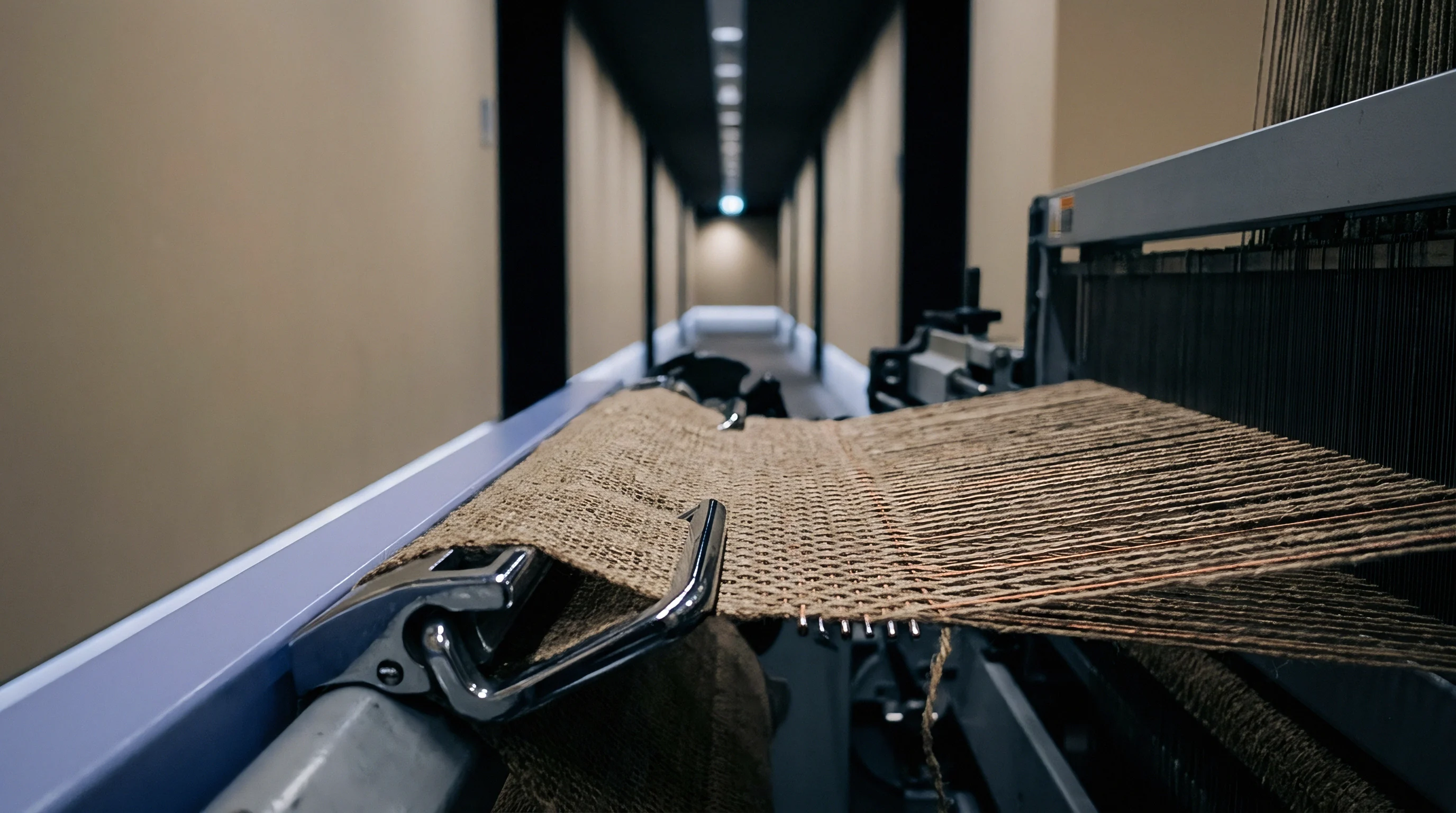
Closely tied to take-up is the warp contraction factor, which governs raw yarn purchasing needs. Sized flax warps routinely show crimp values between six percent and fourteen percent depending on weave, pick density, and size stiffness. Grey width contraction occurs simultaneously as filling yarn develops pick crimp C sub p, pulling the selvedges inward toward the centerline.
How Does Pick Density Drive off Loom Crimp Takeup?
Pick density is the primary driver of warp crimp amplitude in woven flax. Raising picks per centimeter forces warp ends to bend around more filling threads per unit length. In a plain weave Nm 26 fabric, increasing pick density from sixteen to twenty-two picks per centimeter drives warp crimp contraction from 6.2 percent up to 9.8 percent at constant loom tension.
Each extra pick acts as a fulcrum, forcing stiff warp ends along longer vertical wave paths through the shed.
High pick counts create strong beat-up resistance at the fell. As the reed pushes the newest pick into place, earlier picks resist compaction and push lateral force back into the warp sheet. Sized flax yarns resist this packing up to a critical tension limit.
Once off the loom, stored strain releases, pulling picks closer and shortening the fabric along the warp axis until it hits equilibrium.
Flax warp take-up expands non-linearly when pick density exceeds seventy percent of maximum theoretical yarn packing limits.

Structural Geometry Equations for Flax
Predicting off-loom contraction accurately means adjusting standard textile geometry equations for the stiffness and flattening of flax yarns. Standard cover factor formulas use yarn count and thread density to estimate surface cover and interlace geometry. Warp cover factor K sub w and filling cover factor K sub f are calculated from thread densities d sub w and d sub f (in ends or picks per centimeter) and yarn linear densities N sub w and N sub f (in tex):
K sub w = d sub w sqrt(tex sub w) / 10
K sub f = d sub f sqrt(tex sub f) / 10
Total fabric cover factor K sub t combines these values to predict structural tightness:
K sub t = K sub w + K sub f – (K sub w K sub f / 100)
When total cover factor K sub t rises above twenty-two in plain weave linen, warp crimp contraction jumps sharply off the loom. Table 2 details cover factors, crimp percentages, and measured contraction across three weave structures using Nm 26 wet-spun flax warps.
| Weave Pattern | Warp Density (ends/cm) | Pick Density (picks/cm) | Total Cover Factor (Kt) | Warp Crimp (Cw %) | Pick Crimp (Cp %) | Off-Loom Length Loss (%) |
|---|---|---|---|---|---|---|
| Plain 1/1 | 18.0 | 16.0 | 19.8 | 6.8 | 5.2 | 6.40 |
| Plain 1/1 | 18.0 | 20.0 | 21.9 | 9.4 | 4.6 | 8.85 |
| 2/1 Twill | 22.0 | 18.0 | 21.2 | 5.9 | 6.8 | 5.60 |
| 2/2 Twill | 24.0 | 20.0 | 22.5 | 5.4 | 7.1 | 5.15 |
| 2/2 Matt (Basket) | 22.0 | 20.0 | 21.5 | 4.8 | 5.5 | 4.50 |
Evaluating warp contraction requires systematic checks prior to beaming yarn. Calculating beam allowance factors before loading yarn on the creel prevents shortfalls during high-density plain weave runs.
- Establish Baseline Fiber Parameters by measuring raw yarn tensile modulus, moisture regain, and cross-sectional ellipticity across ten sample bobbins from the delivered yarn lot.
- Formulate Sizing Film Properties to achieve an optimum elongation at break of no less than 1.8 percent while maintaining yarn hairiness reduction above eighty-five percent.
- Determine Loom Reed Width Parameters using empirical crimp tables adjusted for target pick density, adding minimum 2.5 percent width margin for high-density plain weaves.
- Configure Electronic Let-Off Systems to maintain warp sheet static tension within a tight plus or minus five percent band from full beam to bare core.
- Measure Greige Dimensions Immediately Cut Off and repeat measurement after twenty-four hours of standard conditioning at twenty degrees Celsius and sixty-five percent relative humidity.
A reliable rule of thumb for linen warp planning is to add one percent extra warp length for every two picks per centimeter increase in plain weave density above sixteen picks per centimeter.
Tension
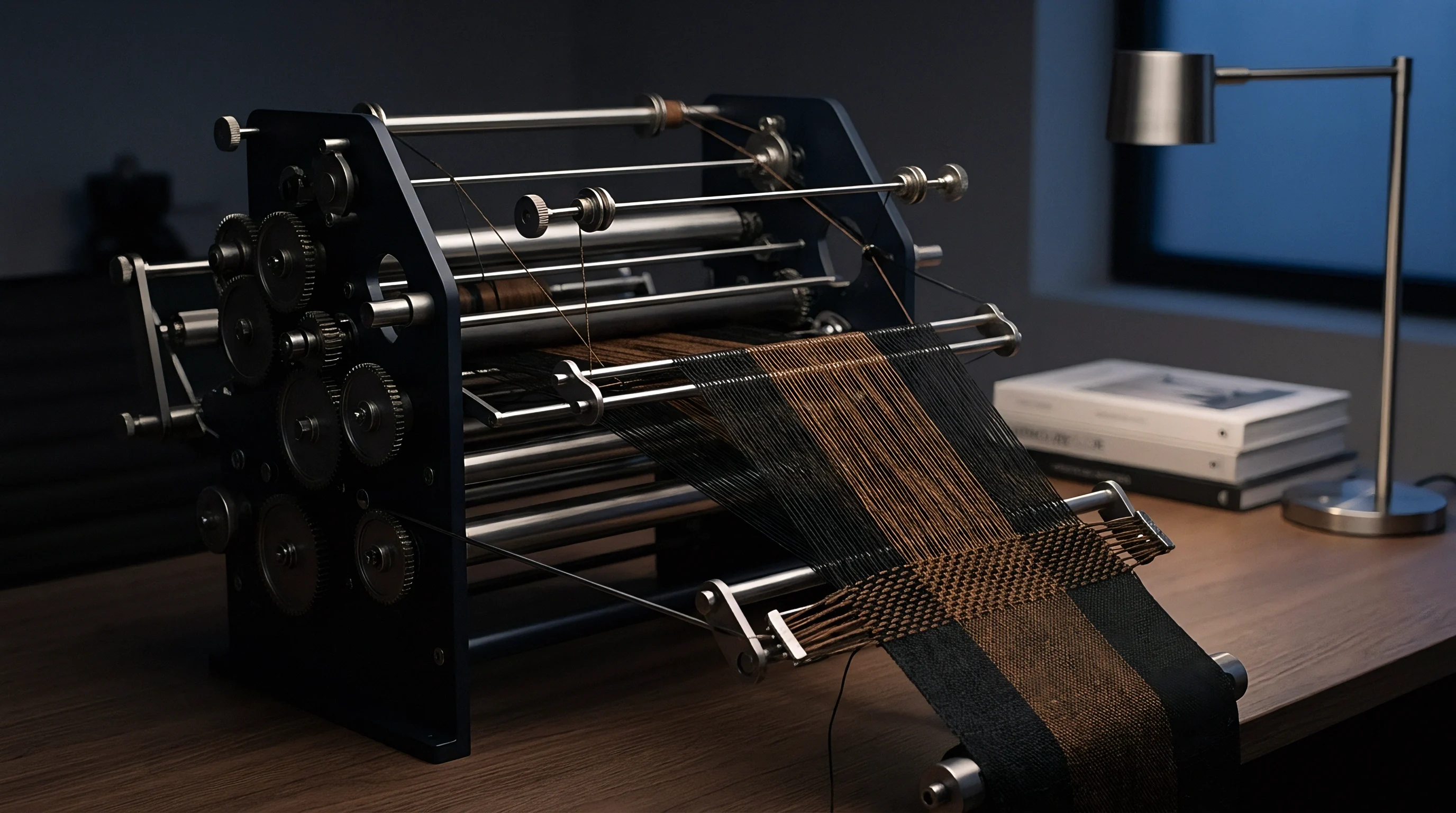
Dynamic tension changes across the loom shed directly govern where sized flax warps reach crimp equilibrium. High-speed rapier and projectile looms cycle flax warps between peak tension at shed opening and lower tension during beat-up. Flax lacks the elasticity to absorb sudden pulls smoothly, so peak shedding forces can permanently stretch or micro-fracture the size film.
When that film fractures, localized yarn sections lose their stiffness on the loom, leading to erratic crimp take-up and uneven fabric width along the roll.
Warp beam let-off systems must maintain steady tension as the beam shrinks from eight hundred millimeters down to the bare core. Mechanical let-offs using weights or springs often react too slowly to prevent tension spikes at shed opening, causing end breaks and inconsistent contraction. Modern electronic let-off (ELO) systems use load cells under the backrest roller to monitor tension constantly, adjusting motor speed in milliseconds.
Proper ELO calibration dampens tension spikes, keeping strain uniform across the full length of the beam.
Shed Opening Dynamics and Elastic Strain
Heddle movement and shed geometry determine peak tensile forces on sized flax threads. When heddles lift ends to form the shed, the yarn path between backrest roller and breast beam lengthens along the hypotenuse of the opening. Since sized flax stretches less than two percent before damaging, backrest whip rolls must yield dynamically to compensate.
Spring-loaded or pneumatic backrest systems flex inward during shed opening, taking up extra length demand without over-stretching warp ends.
Setting the backrest roller above the flat warp line creates asymmetric shed tension, raising lower shed tension at beat-up while easing upper shed strain. That imbalance drives filling picks deeper into the lower warp sheet, shifting the ratio between top and bottom warp crimp. Flax warps woven this way show uneven off-loom relaxation, often leading to fabric curling, face-to-back skewing, or severe diagonal bowing after desizing.
Maintaining backrest load cell calibration within two centinewtons per end prevents bolt-to-bolt width variations across long loom runs.
Let off Mechanism Tuning
Optimizing loom settings for rigid flax warps requires watching beat-up resistance and harness timing closely. Early shed closing ~ where heddles cross before the reed reaches front beat-up ~ traps the filling pick inside a closed, high-tension shed, forcing warp ends into tight crimp waves around the pick. Late closing lets the reed push the pick against open ends, lowering warp crimp amplitude and reducing off-loom contraction.
- Mount precision electronic load cells under both ends of the loom backrest roller assembly.
- Zero the load cell sensors with warp tension fully released before drawing in new beam ends.
- Set target static warp tension to thirty centinewtons per end for Nm 26 wet-spun flax warps.
- Adjust backrest whip roll spring pre-load to restrict dynamic tension spikes to less than forty-five centinewtons per end during maximum shed opening.
- Synchronize heddle frame crossing timing to occurrence at three hundred and ten degrees of loom main shaft rotation.
- Calibrate electronic take-up roller movement to match electronic let-off speed within 0.1 percent accuracy.
Questions remain about how ambient humidity micro-fluctuations in the shed alter the immediate elastic modulus of starch-sized flax warps across multi-shift production runs.
Shrinkage
Distinguishing off-loom crimp contraction from residual laundering shrinkage is critical in linen contracts. Off-loom contraction is the physical relaxation of fabric moving from stretched loom state to relaxed greige. Residual laundering shrinkage, tested under standards like ISO 5077 or ASTM D2259, measures dimensional change in finished fabric after repeated hot washing and tumble drying.
If off-loom contraction is mismanaged during weaving, finishing plants end up over-stretching grey goods on stenter frames to meet target widths, creating high residual shrinkage later on.
Dimensional changes during washing come from fiber swelling, yarn crimp relaxation, and stress release. Flax fibers swell radially when wet, expanding in diameter while shortening along their axis. This radial swelling increases yarn packing density, forcing warp ends and filling picks into deeper crimp paths around one another.
If fabric leaves the loom with unrelaxed warp strain, later laundering releases it, causing severe warp shrinkage that standard finishing cannot undo.
Standard Testing under ISO 5077
Accurate dimensional testing requires strict adherence to conditioning and testing protocols. ISO 5077 sets the procedure for measuring fabric dimensional changes in washing and drying, with specimen preparation governed by ISO 3759 and wash procedures by ISO 6330. Test specimens are marked with benchmark pairs at least fifty centimeters apart along warp and filling, conditioned for twenty-four hours at twenty degrees Celsius and sixty-five percent relative humidity, and measured prior to wet processing.
Table 3 presents comparative ISO 5077 test data for flax fabrics across three manufacturing stages, contrasting sized greige, unsized relaxed, and over-stretched stenter-finished materials.
| Processing State | Fabric Width (cm) | Pick Count (picks/cm) | ISO 5077 Warp Shrinkage (%) | ISO 5077 Fill Shrinkage (%) | Total Area Change (%) |
|---|---|---|---|---|---|
| Fresh Off-Loom (Sized) | 164.5 | 18.0 | -8.50 | -4.20 | -12.34 |
| Desized & Relaxed Wash | 158.0 | 19.6 | -2.10 | -1.50 | -3.57 |
| Stenter Over-Stretched | 166.0 | 17.8 | -11.20 | -6.80 | -17.24 |
| Sanforized Compressive Shrink | 160.0 | 19.2 | -1.20 | -0.90 | -2.09 |
The data shows that pulling grey fabric out on stenter frames only masks geometric contraction temporarily. When over-stretched linen is laundered, it snaps back to structural equilibrium, resulting in warp shrinkage that can exceed eleven percent. Mechanical compressive shrinking ~ Sanforizing ~ uses rubber belt compaction to force warp crimp into the fabric before finishing, bringing residual shrinkage below two percent.
Finishing Wash Corrections
Fixing dimensional instability means matching mechanical finishing to the underlying crimp balance of the cloth. Continuous open-width washers with beaters or air-jet tumbling zones let sized warps relax completely without warp tension. Industrial tumble dryers handle desized linen in loose rope or open-width form, using high-velocity hot air to break internal hydrogen bonds in the flax fiber so yarns can settle into stress-free crimp geometries.
Specifying reed width targets on mill production sheets ensures grey cloth contracts naturally to the correct pre-finishing width without over-stretching. Evaluating off-loom relaxation after twenty-four hours of ambient conditioning confirms whether warp crimp matches mathematical models. Standard commercial supply contracts carry strict remedies for non-compliant width: any grey fabric delivered more than two percent below specified width or showing post-wash warp shrinkage over three percent under ISO 5077 testing subjects the supplier to full batch rejection and financial indemnification for lost finishing capacity.

Allowance
Calculating loom capacity and yarn procurement financially relies on accurate warp crimp contraction allowances. Loom hours are a fixed capital cost, typically twelve to twenty-eight Euros per operating hour depending on automation, width, and power rates. When miscalculated contraction causes excessive length loss off the loom, mill yield per hour drops, driving up landed cost per linear meter.
A warp beam prepared with one thousand meters of sized flax yarn that yields only eight hundred and eighty meters of grey cloth carries a twelve percent contraction penalty that has to be built into initial sales quotes.
Yarn purchasing allowances require adding waste and take-up percentages directly to theoretical fabric weight calculations. Sized flax warps lose yarn weight during creeling, warping, sizing, and loom tying, on top of geometric take-up. Failing to put enough warp allowance on the beam leads to early run-out, leaving costly filling yarn sitting on bobbins and causing unplanned downtime for beam changes.
Costing the Warp Length Factor
Calculating true landed cost per linear meter of woven linen requires accounting for warp consumption against finished yield. Theoretical warp consumption W sub w in grams per linear meter is calculated using warp density d sub w (ends per centimeter), total fabric width W sub f (in meters), yarn count N sub w (in Nm), and warp take-up factor C sub w (warp crimp percentage):
W sub w = (d sub w 100 W sub f (1 + (C sub w / 100))) / N sub w
Consider a practical commercial scenario: weaving a plain weave flax cloth with twenty ends per centimeter across a 1.65-meter finished width using Nm 26 wet-spun yarn. If warp crimp contraction C sub w is calculated at six percent, theoretical warp consumption equals 133.6 grams per meter. If actual off-loom and desizing contraction pushes true take-up to ten percent, actual warp consumption jumps to 138.6 grams per meter ~ a five-gram deficit per meter.
Over a ten-thousand-meter run, that error uses an extra fifty kilograms of sized flax yarn while cutting total delivered fabric yield by four hundred meters, wiping out weaving profit.
Incorporating a standardized 3.5 percent warp length safety margin on beam orders protects weaving sheds against unexpected yarn take-up variations during seasonal humidity shifts.
Commercial Margin Calculations
Setting commercial fabric specifications means defining clear yield loss limits in purchasing contracts. Mills operating high-speed rapier sheds book capacity months ahead based on target pick-per-minute speeds and efficiency rates ~ typically eighty-two to eighty-eight percent for flax warps. Unexpected warp contraction forces mills to pack in additional picks per centimeter to hit fabric weight targets, reducing linear output per hour and driving up conversion costs.
Fabric procurement specifications should tie yarn take-up allowances directly to invoice payment terms. Landed cost models that evaluate raw yarn input costs without adjusting for structural crimp contraction expose buyers to severe margin erosion upon delivery. Managing off-loom crimp contraction in sized flax warps takes continuous coordination across textile draughting, sizing chemistry, shed tension tuning, and yield accounting throughout production.