Calculating Multi Machine Allocation Penalties in High Density Flax Weaving
Calculating multi-machine allocation penalties in high-density flax weaving requires auditing loom sensor response times against interference efficiency formulas to penalize unabsorbed overhead and defect downgrades caused by operator overburden.
Beam

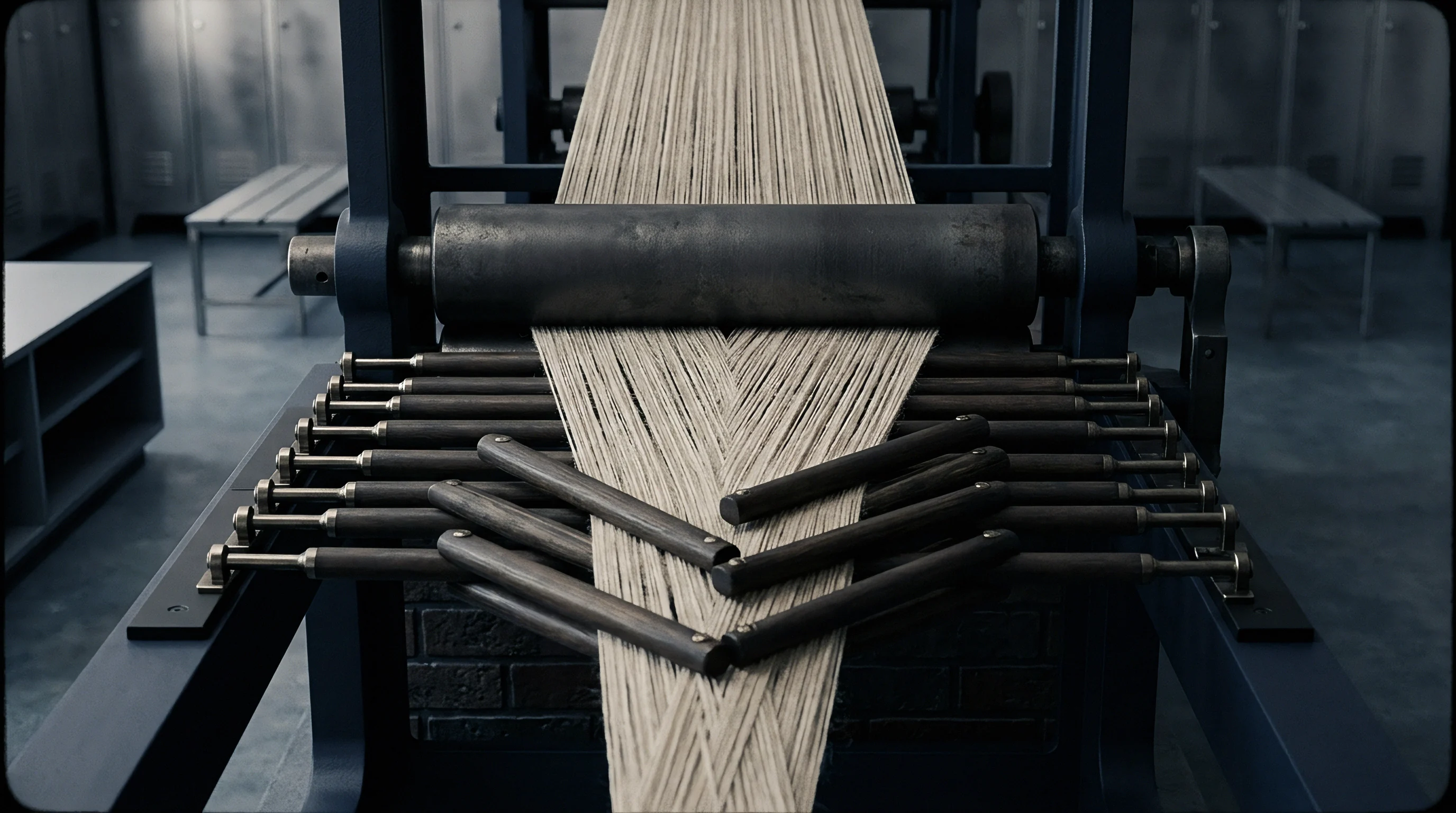
Yarn Mechanics and High Cover Factors in Linen Shedding
Because wet-spun flax filaments break at an ultimate strain between 1.5 percent and 2.2 percent with almost no stretch, little room remains for elastic recovery when the shed opens. As a rapier loom inserts picks into a dense warp sheet, tension spikes sharply when the harness frames reach maximum lift. In high-density flax fabrics ~ warp setts over 24 ends per centimetre with yarn counts finer than 50 lea ~ these peak tensile loads multiply across thousands of ends.
Every beat-up pushes the cloth fell against heavy structural resistance, which requires precise, continuous warp let-off.
Loom performance is largely set during warp preparation, long before the beam ever reaches the shed. Uneven size penetration or irregular moisture creates weak spots with poor abrasion resistance. Flax fibers have a naturally rough surface covered in pectin nodes and micro-fibrillar ridges.
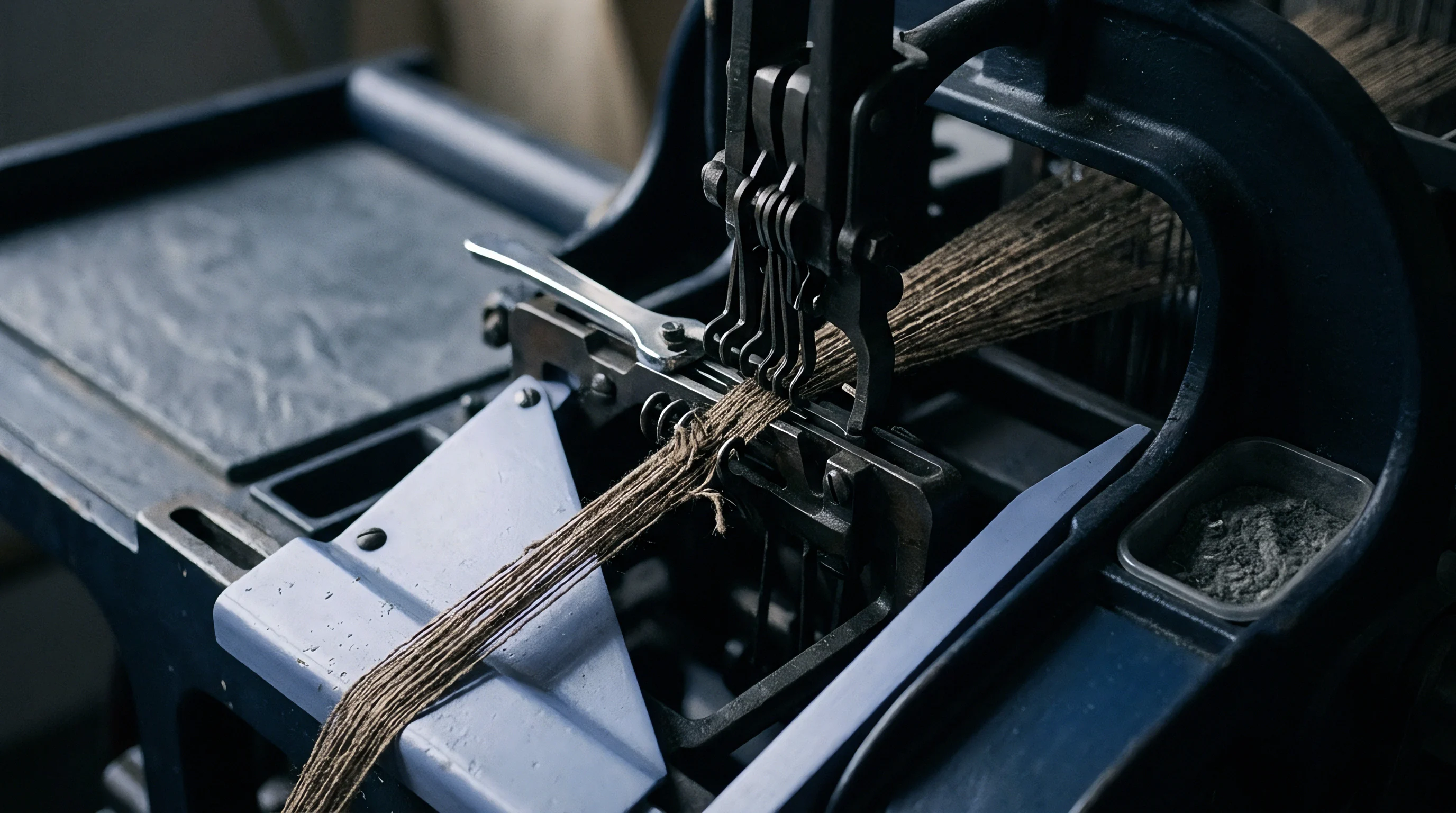
Running dense warp ends through reed dints at speed generates friction, static heating, and micro-fibril shedding. As fluff accumulates in the reed wires, shed resistance rises and adjacent warp threads start clinging to one another as the harness moves.
When warp tension drops below what is needed to pull clinging ends apart, the shed will not open cleanly and dense weaves suffer. The insertion element collides with trapped warp ends, snapping individual yarns or causing multi-end breaks. Keeping tension balanced takes strict control over beam construction, flange alignment, and let-off sensitivity.
In a 28 end per centimetre construction, tension increments during shedding scale non-linearly with reed depth. Set the backrest roller too high, and top-shed slackness increases while the bottom shed is over-tensioned. This asymmetry causes selective thread fatigue: bottom-shed ends break three to four times more often than top-shed ends.
Mill planners often misjudge these physical stresses by underestimating how yarn properties interact with loom kinematics.
Wet-spun flax yarn woven at 26 ends per centimetre under 70 percent relative humidity demonstrates a 35 percent increase in warp break frequency when shed angle expands from 18 degrees to 22 degrees.

Structural Load Dynamics across Warp Sheets
Warp density dictates how much mechanical energy hits the cloth fell during beat-up. High pick counts paired with heavy warp setts yield high cover factors, often calculated between 1.25 and 1.45. Under these conditions, the fabric fell recedes slightly toward the reed during beat-up, so higher warp tension is needed to lock each pick.
That extra tension increases stress across every reed wire and drop wire in the loom’s motion sequence.
Setting loom speed is a balance between output and yarn wear. Modern rapier machines weaving high-density flax typically run between 350 and 480 picks per minute ~ much slower than they would run synthetic filaments or continuous cotton yarns. Pushing past these speeds accelerates yarn fatigue, causing micro-splits in flax bundles that lead to sudden end breaks during harness transit.
Humidity control in the weaving shed is vital for keeping flax mechanical properties stable. Flax fibers absorb up to 12 percent of their dry weight in moisture under normal ambient conditions. Keeping shed humidity strictly between 68 percent and 74 percent relative humidity maintains pliable pectin binders, reducing yarn stiffness and surface friction.
If shed humidity dips below 60 percent, warp break rates surge exponentially within thirty minutes.
Managing mechanical stress during high-density flax warping relies on several key preparation variables:
- Warping Tension Uniformity requires yarn tension variation across the section warp beam to stay within plus or minus 1.5 grams per end, preventing structural striping.
- Sizing Recipe Viscosity maintains film integrity over surface fibers without soaking into the yarn core, preserving natural filament flexibility under beat-up impact forces.
- Beam Flange Deflection Limits prevent lateral warp sheet compression, avoiding tight edge ends during high-density let-off cycles.
- Moisture Content Retention ensures sizing drying cylinders leave exactly 10 percent residual moisture in the flax yarn bundle before beam winding.
Flaws in beam preparation show up as constant stops once mounted on the loom. A single misaligned warp end creates persistent friction points inside the harness eyes, forcing frequent operator intervention and ruining scheduled loom efficiency.
Thorough warp beam preparation is essential to keep yarn behavior predictable throughout high-density runs.

Interference
Multi-Machine Queuing Models in High Density Linen Sheds
Operator assignment models set how many looms one weaver can handle without causing excessive machine downtime. When a loom stops for a warp break, it sits in a queue until the weaver attends to it. In standard cotton or synthetic weaving, low stop rates permit high allocations of 16 to 24 looms per weaver.
High-density flax completely alters that balance because warp breaks happen far more often and take longer to fix.
Stop rates climb quickly in dense flax weaving, typically running 1.5 to 4.5 warp breaks per loom-hour. Repairing a broken wet-spun flax end means locating the tip, threading it through drop wire, heddle eye, and reed dint, then tying a weaver’s knot smooth enough to pass through dense reed wires without catching. That takes 1.2 to 2.5 minutes per end, compared to under 45 seconds for continuous filament yarns.
When several looms assigned to one operator stop around the same time, machine interference occurs ~ the cumulative downtime a loom spends waiting while the weaver is busy on another machine. As allocations rise, interference downtime increases non-linearly, dragging down overall shed efficiency.
Mapping operator allocation against stop frequencies isolates true interference. Classic Benson-Cox or Wright multi-machine queuing formulas show that assigning eight high-density flax looms to a single weaver causes substantial capacity loss. Even if individual machine efficiency calculates to an 85 percent theoretical maximum, long interference queues pull real output below 65 percent.

Which Allocation Ratios Minimize Machine Interference Penalties?
Finding the optimum loom-to-weaver ratio requires balancing labor costs against machine downtime penalties. Adding more operators reduces interference hours but increases direct labor cost per woven metre. Cutting staffing lowers payroll expense, but unabsorbed fixed overhead and missed loom-hour targets quickly trigger steep allocation penalties.
Shed supervisors typically establish allocation strategies through five steps:
- Log baseline warp and weft stop frequencies across at least 48 continuous loom hours using integrated monitoring sensors.
- Calculate average repair times by stop type, separating warp breaks, weft mispicks, and let-off adjustments into discrete task profiles.
- Apply multi-server queuing algorithms to model expected interference downtime across allocation ratios from three to ten looms per operator.
- Identify the interference threshold where machine waiting time exceeds 8 percent of booked shed hours.
- Set the allocation ratio at the point that minimizes combined costs per clean loom hour.
Machine interference harms fabric quality as well as total output. When a loom sits idle after a warp break, tension on the static cloth fell decays as yarn stress relaxes. When restarted, the loom delivers an uneven beat-up force on the first pick, creating a distinct defect known as a starting or stop mark.
The table below summarizes performance metrics across machine allocation ratios for a 26 end per centimetre high-density flax fabric on rapier looms running at 420 picks per minute:
| Looms per Weaver | Average Stop Rate (Stops/Loom-Hr) | Operator Utilization (%) | Interference Downtime (%) | Actual Shed Efficiency (%) |
|---|---|---|---|---|
| 3 | 2.8 | 44.8 | 2.1 | 84.2 |
| 4 | 2.8 | 59.7 | 4.3 | 81.5 |
| 6 | 2.9 | 87.0 | 12.8 | 71.4 |
| 8 | 3.1 | 98.2 | 24.6 | 59.8 |
| 10 | 3.2 | 100.0 | 36.4 | 48.1 |
High operator utilization looks good on paper, but high utilization inevitably creates machine queues. An operator working at 98 percent capacity cannot handle natural clusters of warp breaks, leaving multiple looms standing idle across the floor.
Mill management often blames unexpected yarn lot variations for efficiency drops that were actually caused by poor multi-machine scheduling.

Stoppage

Mechanical Fault Accumulation under Operator Overburden
Lost loom hours cannot be recovered. When multi-machine allocations cause extended downtime, fabric defects accumulate right alongside lost production. Tension relaxation while a machine waits leads to immediate defects upon restart.
High-density flax yarns ~ stiff and unyielding ~ do not recover their original crimp state smoothly after sitting under static load for ten or fifteen minutes.
Beat-up marks are the main structural defect tied directly to interference delays. While a loom is stopped, the warp sheet remains stretched across the harness frames and backrest roller. Over time, flax fibers undergo viscoelastic creep, dropping local warp tension by up to 15 percent.
When the weaver completes the repair and restarts the machine, the main drive motor takes several cycles to reach full speed while let-off and take-up resume instantly. The reduced warp tension prevents the reed from pushing the first pick fully into the fell, creating a loose, light-density pick gap.
Tackler response times directly affect yield. If a stop involves harness misalignment or reed damage, the weaver has to call a tackler. In over-allocated sheds, tacklers cover 30 to 50 looms at once.
Waiting for them extends downtime from minutes to hours, compounding tension relaxation and drying out warp threads in the open shed.
Over-allocation creates several predictable failure modes across dense woven linen:
- Starting Marks and Fell Slippage occur when decaying warp tension causes pick placement variations at restart, failing visual grade limits under ASTM D5430.
- Warp Float Formation occurs when clinging threads remain stuck together in an uncleared shed, sending rapier heads over warp threads instead of under them.
- Continuous End Abrasion Marks result from reed wires rubbing against stationary warp threads while waiting for operator knotting service.
- Weft Tension Surges develop when weft packages dry out on stopped looms, triggering filling breaks during initial acceleration.
Quality degrades in direct proportion to stoppage time. A mill running dense linen constructions cannot hide over-allocation; every long machine pause leaves a physical record on the finished bolt.
Standard commercial contracts based on ISO 7211 construction audits enforce automatic price rejections when stop-mark defect frequencies exceed 1.5 instances per 100 linear metres of high-density flax cloth.

Flax Fibre Splitting and Micro-Fibrillar Abrasion
Friction inside dense reed dints causes microscopic damage long before a thread breaks. As warp ends move through heddle eyes and reed wires, surface fibers undergo constant lateral abrasion. Wet-spun linen yarns consist of technical fibers bound by pectin.
Repeated friction strips off surface sizing, causing individual ultimate fibers to peel away from the main yarn trunk.
These peeled fibers form small knots or slubs behind the reed. During beat-up, the reed pushes the fiber clusters toward the cloth fell. If the shed opening is clear and tension is high, the cluster gets forced into the weave structure as a surface defect.
If tension is low from poor let-off control, the cluster catches an adjacent end and triggers a multiple end break.
Four-point grading systems penalize friction-induced faults heavily. High-density linen with frequent fiber clusters and stop marks quickly drops from First Quality to Second Quality, wiping out projected gross margins for the run.
The link between stoppage duration, tension decay, and fault generation comes down to physical mechanics. Stretching multi-machine allocations beyond practical limits guarantees both volume losses and fabric downgrades.
Ignoring warp stop dynamics in allocation planning leads straight to contract penalties and rejected material.
Calculation
Mathematical Formulation of Multi-Machine Allocation Penalties
Calculating the financial impact of multi-machine misallocation requires modeling three distinct costs: unabsorbed machine overhead, lost production yardage, and fabric quality downgrades. Total allocation penalty per loom hour (Ptotal) is the sum of unabsorbed fixed loom hour cost (Cfixed), lost contribution margin (Cmargin), and fabric downgrading penalty (Cquality).
The equation for unabsorbed fixed loom hour cost is:
Cfixed = Rloom × (1 – fracEactualEtarget)
Where Rloom is the baseline fixed cost rate per loom hour (including depreciation, floor space, power, and supervisory overhead), Eactual is achieved shed efficiency under the assigned allocation ratio, and Etarget is target efficiency under optimized allocations.
Lost contribution margin covers unproduced fabric yardage during interference downtime. In this model, shifting allocation from four to eight looms per weaver causes a 14.2 percent drop in machine efficiency. That output loss cannot be recovered without running unscheduled loom hours.
Lost contribution margin per loom hour is calculated as:
Cmargin = (Pmetre – Vmetre) × left( fracPPM × 60PPC × 100 right) × (Etarget – Eactual)
Where Pmetre is the contract selling price per metre, Vmetre represents variable costs per metre (yarn supply, sizing chemistry, and power), PPM is loom speed in picks per minute, and PPC is picks per centimetre.
Fabric downgrading penalties capture lost value when stop marks and high break rates force First Quality fabric down to Second Quality pricing:
Cquality = left( fracPPM × 60PPC × 100 right) × Eactual × Drate × (Pfirst – Psecond)
Where Drate is the percentage of produced yardage downgraded from allocation defects, Pfirst is the First Quality price per metre, and Psecond is the discounted Second Quality price.
Calculating capacity loss without accounting for machine interference queues understates true landed metre costs by 18 to 28 percent on high-density flax runs.

Worked Example: High-Density Linen Allocation Penalty Sensitivity
As a practical example, consider a contract for a 260 g/m² high-density linen fabric woven at 26 ends per centimetre and 22 picks per centimetre. The loom runs at 400 picks per minute with a fixed hourly loom rate (Rloom) of 14.50 per hour. Contract terms set First Quality fabric ($Pfirst) at 12.80 per metre, variable maνfacturing costs ($Vmetre) at 7.20 per metre, and Second Quality fabric ($Psecond) at 6.40 per metre.
Target shed efficiency ($Etarget) is 82.0 percent.
The table below models performance across three allocation scenarios for a 10,000-metre production run:
| Allocation Scenario | Looms / Weaver | Actual Efficiency (%) | Production Rate (Metres/Loom-Hr) | Downgrade Rate (%) | Penalty Cost ($/Loom-Hour) | Total Contract Penalty ($) |
|---|---|---|---|---|---|---|
| Scenario A (Optimal) | 4 | 81.5 | 8.89 | 1.2 | $0.37 | $415.73 |
| Scenario B (Stretched) | 6 | 71.4 | 7.79 | 4.8 | $3.98 | $5,109.11 |
| Scenario C (Overburdened) | 8 | 59.8 | 6.52 | 11.5 | $9.24 | $14,168.71 |
Shifting from four to eight looms per weaver increases cumulative contract penalties from $415.73 to $14,168.71 across a 10,000-metre order. That sharp increase is driven mainly by unabsorbed fixed loom overhead and higher downgrade rates from prolonged machine interference.
Calculating multi-machine allocation penalties in high-density flax weaving requires full transparency into mill staffing ratios and machine logs. Without continuous loom sensor feeds, buyers cannot tell whether delays stem from raw material defects or poor shed scheduling.
What allocation adjustment threshold should trigger an automatic renegotiation of contract rates when raw yarn break rates exceed baseline assumptions?

Verification

Audit Mechanisms and Loom Sensor Log Reconciliation
Verifying building management system signals against physical weaver logs isolates genuine machine performance from operator-induced downtime. Modern weaving sheds use centralized Building Management Systems (BMS) connected directly to loom microcontrollers. Sensors track main shaft rotation, warp stop drop wires, weft feelers, and let-off motor loads in real time.
Audit procedures analyze raw signal logs to calculate exact stop durations and operator response times. When a warp break occurs, the control board logs an immediate stop signal with the precise timestamp and drop wire zone. The time between the stop and the first manual reset button actuation gives the exact operator response time.
Subtracting standard knotting time from total stop duration isolates the interference waiting time.
Cross-referencing these timestamps against shift rosters reveals whether allocation ratios met contract commitments. If average operator response times exceed 3.5 minutes across a shift, the shed was understaffed or assigned improper allocation ratios.
Technical documentation and sensor verification logs must include several critical data streams:
- Microcontroller Timestamp Files capture millisecond-accurate records of machine stops, restart signals, and speed ramp-up profiles for every loom on the order.
- Warp Stop Motion Sensor Records categorize stops by physical location, distinguishing front-zone harness breaks from back-zone let-off tension drops.
- Weaver Assignment Schedules document actual operator allocations per shift, cross-checking weaver and tackler floor assignments against capacity planning sheets.
- Fabric Roll Inspection Summaries map defect locations from four-point inspection frames directly to timestamped loom stops recorded by the BMS.
Data integrity checks prevent mill management from altering recorded stop durations or response metrics prior to buyer audits. Secure digital log exports stop historical performance metrics from being edited after the fact.
Audit standards governing automated loom monitoring data require raw binary sensor logs to be archived continuously without modification, carrying cryptographically verified shift timestamps.
Reconciling Four-Point Quality Grading with Downtime Events
Linking physical fabric defects to specific downtime events is central to buyer qualification audits. Inspection frames equipped with digital length counters record the exact linear position of each defect. When an inspector logs a major starting mark at meter mark 142.5, audit software cross-references that position against the loom stop log for that warp roll.
Matching a physical starting mark to a documented 12-minute interference stop proves the defect resulted from operator over-allocation rather than faulty yarn. Under standard weaving capacity contracts, that distinction places financial liability directly on the mill.
Reconciling sensor logs gives clear proof of how multi-machine allocation was managed, establishing solid grounds for enforcing financial penalty clauses.
Standard capacity supply contracts include an explicit verification clause: “If audit logs reveal that average operator response time exceeds 180 seconds across any continuous eight-hour shift, the weaver forfeits all rights to claim yarn-related efficiency relief, and unit prices for all fabric produced during that shift undergo an automatic 15 percent contract penalty reduction.”

Clause

Commercial Contract Terms and Allocation Surcharges
Commercial contracts for high-density flax weaving must clearly lay out operator allocation limits, baseline efficiency targets, and penalty structures. Mill operators often try to stretch loom-to-weaver ratios after signing, passing the operational risk of machine interference onto the buyer through late deliveries and lower-grade fabric.
Drafting strong procurement contracts requires clear operational limits on shed staffing. Contracts should specify maximum allocation ratios for specific weave constructions, capping weaver assignments at four or five looms for high-density linen runs. Exceeding those limits without prior written authorization constitutes a material breach of capacity terms.
Liquidated damages clauses set clear financial remedies for allocation failures. Tiered penalty schedules link directly to achieved shed efficiency and downgrade percentages. If shed efficiency drops below agreed thresholds due to understaffing, the buyer deducts allocation penalties directly from invoice payments.
Allocation agreements also address downtime cost distribution during yarn quality issues. When poor yarn causes genuine spikes in stop rates, the mill may request allocation adjustments or temporary surcharges, provided verified BMS sensor logs prove operator response times stayed within contract limits.
Enforcing strong contract terms aligns incentives between buyers and weaving mills, ensuring shed managers maintain realistic allocation ratios throughout high-density flax runs.