Loom Stoppage Telemetry and Basics of Weaver Allocation Ratios
Weaver allocation balances labor wages against machine interference losses, where optimal loom-to-operator ratios maximize amortized shed efficiency.


Signal
Modern rapier and air-jet machines isolate loom downtime through electronic telemetry buses wired directly into individual drop-wire banks and pick detectors. Every stoppage generates a discrete event timestamp, an angular position from the main drive encoder, and an electrical circuit termination that classifies the interruption before the loom motor completes its braking arc. A shed running 100 percent wet-spun linen at 550 picks per minute exposes yarn to cyclical peak tensions exceeding 1.8 centinewtons per tex during shed opening.
The physical properties of flax, specifically its low elongation at break of 2.0 to 3.0 percent and irregular bundle cross-sections, produce failure profiles distinctly different from continuous filament or ring-spun combed cotton. Telemetry systems capture these disruptions as specific binary states across dedicated sensory channels.
Drop-wire banks detect warp breaks through mechanical contact. Electrically live contact bars carry serrated drop wires suspended on individual warp ends. Yarn separation eliminates upward tension.
Gravity pulls the steel wire down onto the contact rail within 15 milliseconds. The machine logic controller reads the closed circuit, fires the mechanical main brake, and logs a warp stop. Encoder tracking records the crank angle of the break, identifying whether the end failed under peak shed tension at 120 degrees or beat-up compression at zero degrees.
Telemetry boards capture these events through serial interfaces, streaming pick counts, downtime tallies, and stoppage locations to central production management servers.
A six-contact drop-wire bank logs contact closure within twelve milliseconds of linen yarn separation.
Weft insertion failures follow alternate detection channels. Optical infrared transceivers or piezoelectric sensors positioned at the receiving side of the cloth fell track yarn arrival. If the pick fails to reach the outer edge within the planned insertion window, the controller aborts beat-up.
Modern air-jet machines utilize dual digital pick detectors to distinguish between tip breaks, short picks, and trailing slack yarn. Tension drops instantly. The telemetry module records the exact nozzle pressure, insertion timing in degrees of rotation, and the spool pre-winder status for that machine cycle.
- Optical Pick Sensor Failure logs an interrupted light curtain when a broken weft tip blocks the receiver housing during rapier transfer.
- Drop Wire Contact Short flags an electrical continuity closure across the warp rail when a broken flax end collapses.
- Rotary Encoder Mismatch registers a discrepancy between drive motor degrees and mainshaft position during emergency braking cycles.
- Feeder Tension Trip records excessive unwinding resistance from package build faults or slub entrapment at the accumulator eyelet.
Manual machine interruptions alter the telemetry stream through dedicated override buttons. Weavers hit pause bars to inspect suspicious yarn slubs, dress tangled ends, or clean accumulated lint from heald frames. Telemetry configurations must not lump these operator pauses into generic mechanical downtime registers.
Correct shed telemetry scripts assign distinct codes to manual interventions, separating mechanical unreliability from deliberate operator maintenance.
| Telemetry Code | Triggering Hardware | Mean Duration Seconds | Root Mechanical Cause |
|---|---|---|---|
| ST-WRP-01 | Drop-wire bank bar 1-3 | 58.4 | Warp yarn break under shed opening tension |
| ST-WRP-02 | Drop-wire bank bar 4-6 | 72.1 | Heddle abrasion or tangle in rear harness |
| ST-WFT-01 | Primary optical detector | 24.3 | Weft break inside shed during insertion |
| ST-WFT-02 | Secondary optical detector | 18.6 | Short pick or nozzle pressure drop |
| ST-SEL-01 | Leno motion rotary switch | 36.8 | Selvedge yarn separation or bobbin runout |
| ST-MAN-01 | Front operator rail push | 45.0 | Manual inspection or slub removal |
Distinguishing between real breakage and false telemetry closures preserves operational data integrity. Dirty drop wires accumulate conductive sizing debris and linen lint. Debris bridges the gap between the wire inner edge and the contact bar, generating phantom warp stop alarms on running yarn.
Advanced telemetry systems track stop frequency spikes per loom hour. When a machine reports ten warp stops within five minutes with zero operator mending time recorded, diagnostic algorithms raise a sensor fault flag. The shed halts.
Misclassifying electrical shorts as mechanical yarn defects distorts the entire historical record, corrupting the production targets and skewing subsequent workload allocations.

Knot
Operator mending time begins when the weaver arrives at the stopped machine and identifies the separated end among thousands of parallel warp yarns. In linen production, the physical nature of flax fiber dictates specific repair manipulation. Flax lacks the natural coil and elasticity of wool or long-staple cotton.
When a warp end breaks under tension, the severed tail springs back through the harness assembly, snapping free of the drop wire and curling behind the heddle eyes. The operator traces the empty dent in the reed, locates the fallen drop wire, draws a replacement yarn from the auxiliary repair spool mounted on the loom arch, and executes a weaver knot or mechanical splice.
Piecing demands manual dexterity. Clearance takes time. The operator draws the fresh flax end through the specific drop wire eye, threads it through the corresponding heald frame eyelet using a wire reed hook, and pulls it through the tight spaces of the stainless steel reed.
A standard 150-centimeter plain linen canvas running 18 ends per centimeter in the warp contains 2,700 individual yarn ends across the reed width. Locating the exact missing dent without crossing adjacent yarns occupies up to 40 percent of total mending duration. Crossing warp ends creates double ends in a single dent, causing structural fabric blemishes and immediate re-breakage within five centimeters of forward cloth advancement.
- The weaver scans the indicator beacon atop the loom harness to identify the machine stop category.
- The operator walks the perimeter gangway to the rear beam zone or front fell area depending on signal color.
- The broken yarn tail is recovered from the drop-wire bank, or a spare spool yarn is pulled down from the loom superstructure.
- The fresh yarn is drawn through the dropped wire, threaded across the steel heddle eye, and passed through the correct dent space with a drawing-in knife.
- The weaver ties an offset knot against the cloth fell, resets the mechanical warp stop rail, and presses the slow-inch forward button to verify shed clearance.
Weft repairs follow an entirely different physical sequence. A broken filling yarn requires the weaver to open the main shed, extract the partial pick with a pneumatic vacuum tube or manual tweezers, and verify that the yarn passage inside the rapier clamp or air guide is clear of lint. If the pick separated prior to shed entry, the weaver rethreads the yarn accumulator, feeds the strand through the main insertion nozzle, and triggers an automated pick-finding cycle.
Modern dobby machines cycle the harness backwards to align the shed geometry with the exact pick counter position, preventing starting marks and thick-and-thin bars in the woven cloth.
Under standard mill conditions, wet-spun linen warp breaks consume an average of sixty-five seconds of direct manual intervention per occurrence.
Operator physical stamina directly governs mending speed across an eight-hour shift. Weaver movement involves continuous walking across concrete shed floors, bending over beam stands to inspect drop wires, and squinting into high-density harness sets under overhead task lighting. Wet-spun linen shedding generates fine particulate matter that settles on yarn guides and reed teeth, increasing abrasive friction on adjacent ends.
Operators frequently apply wax cakes or water misting bottles to dry warp sections to suppress yarn fuzzing during knotting. Manual handling speed degrades as shift duration advances, expanding mean repair times during the final two hours of a production run.
Flax yarn quality parameters directly establish the physical frequency of these manual interventions. Coarse linen yarns containing irregular thick places, unretted bark remnants, or poorly formed spinning splices fail repeatedly when entering the narrow passages of the drop wires and reed dents. A lot of 36 Nm linen spun from poorly hackled flax delivers an uneven breaking tenacity profile, driving stoppage rates from a standard 1.5 stops per 100,000 picks up to 6.0 stops per 100,000 picks.
A single brittle package on the weft creel can stop a machine thirty times in a single shift. High-twist yarns produce snarls that wedge tightly inside drop-wire guides, requiring the weaver to manually extract distorted fiber bundles before tying the replacement knot.
A high density of warp knots impairs subsequent wet processing. Every knot pulled through the fabric fell creates a localized point of elevated yarn bulk. During downstream scouring and rotary bleaching, large weaver knots catch on processing rollers or resist dye liquor diffusion, producing light-colored specks on the finished cloth face.
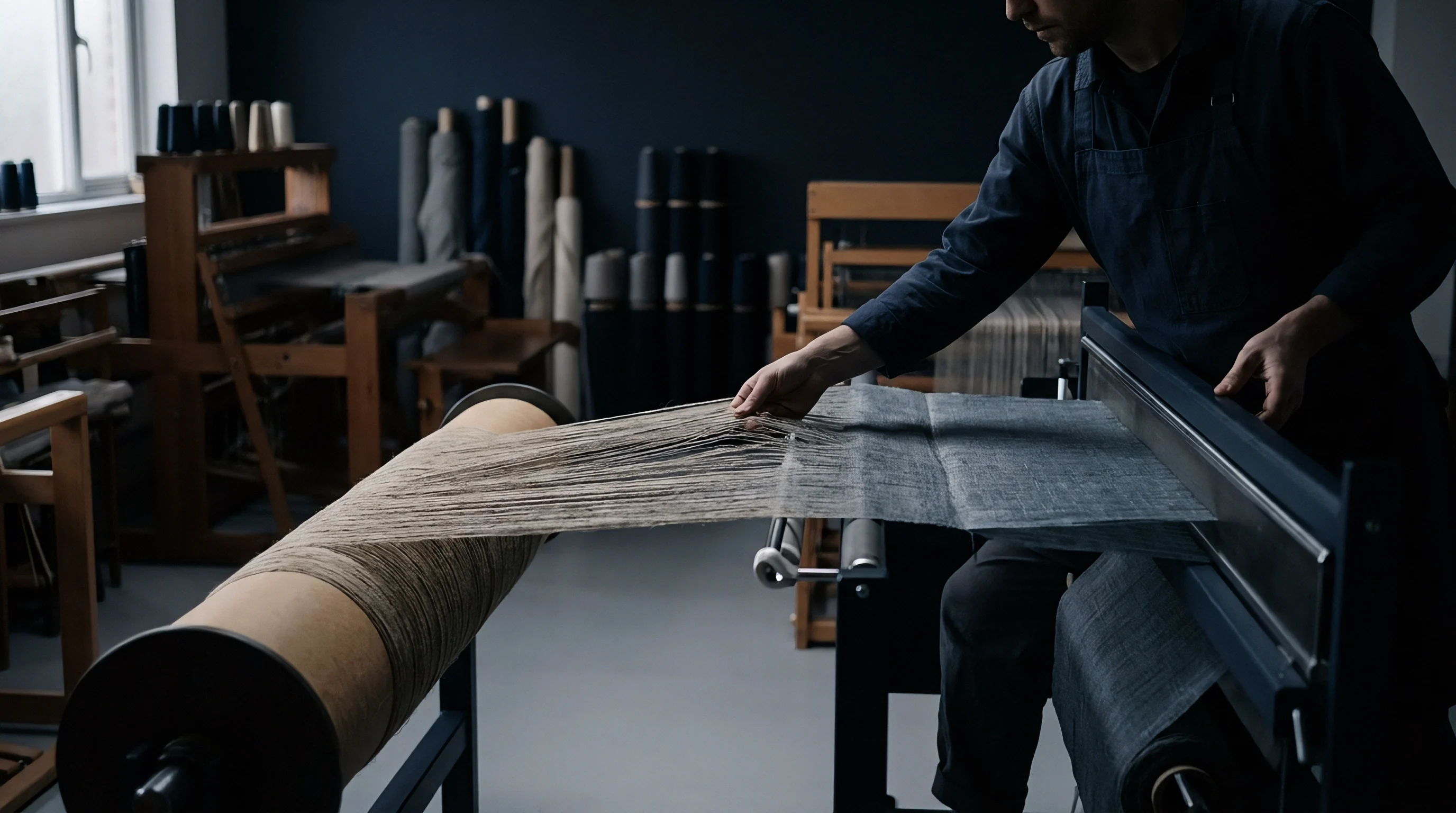
Clean weavers tie compact weaver knots with tail ends trimmed under three millimeters. Slovenly mending produces long knot tails that weave into adjacent sheds, forming double picks and structural blemishes that fail visual inspection at the greige perching table.

Queue
When multiple looms stop concurrently within a single operator assignment, unattended machines stand dormant waiting for human hands. This phenomenon represents machine interference. Machine interference forms the primary loss mode in high-speed automated weaving sheds.
In an ideal deterministic setup, an operator mends machine A, finishes the knot, and moves to machine B precisely as it shuts down. Real weaving sheds operate under stochastic breakdown distributions. Warp and weft disruptions behave as random arrivals governed largely by Poisson statistical distributions.
The beam empties. Idle time accumulates.
What Dictates Weaver Interference Severity?
Interference severity depends directly upon the ratio of service time to machine running time, combined with the total quantity of looms assigned to the individual. In queuing nomenclature, the loom represents a customer requesting service, the weaver acts as the single server, and the shed gangway forms the waiting line. If an operator manages a bank of ten looms, and each loom experiences an average of 4.0 stops per hour with an average repair duration of 1.0 minute, each machine demands 4.0 minutes of service per hour.
The service factor, denoted as rho, equals 0.0667. While this low individual factor implies an operator workload of only 40 minutes per hour, random stop overlaps force machines to wait in an idle state while the weaver attends to an earlier failure.
Standard interference tables project a ten percent machine waiting time penalty whenever an operator service factor exceeds sixty percent on multi-loom assignments.
Ashcroft numbers and Fry queuing models quantify this interference penalty. The classic Ashcroft formulation calculates the expected number of running machines, the average waiting time per stop, and the resultant shed efficiency drop based on the assignment size and the ratio of running time to servicing time. When an assignment scales from six looms to twenty looms per weaver, machine interference increases exponentially rather than linearly.
Two looms stopping within ten seconds of each other force the second machine to remain unproductive for the entirety of the first machine repair cycle plus the weaver transit time between machines.
Walking paths dictate delay. Modern weaving halls arrange machines in face-to-face configurations along wide central alleys to minimize transit distances. A weaver attending a bank of sixteen rapier looms walks along an alley measuring up to thirty meters in length.
If loom 1 and loom 16 stop simultaneously, transit time alone adds twenty to thirty seconds of pure machine dead time before mending can start. Mill planners design patrol routes, either fixed circular patrols or bidirectional priority patrols based on illuminated indicator towers, to compress walking delays. Signal beacons flash colored lights across high-bay aisles: red indicates a warp stoppage, yellow signals a weft break, and blue summons the shed overlooker for mechanical drive breakdowns.
Weft stops and warp stops create distinct queuing footprints. Weft failures resolve quickly, averaging 15 to 25 seconds for an experienced operator on automated pre-winder setups. Warp failures consume 60 to 90 seconds.
A machine waiting behind a warp stoppage accumulates substantial dead picks. If an operator encounters two warp breaks simultaneously in their set, total shed output drops rapidly over that ten-minute block. When coarse linen yarns generate frequent slub jams, multiple machines sit dark simultaneously.
The shed floor transforms into an uncoordinated holding zone where machine utilization crashes despite high mechanical line speeds.
Environmental stability inside the weaving shed heavily alters breakdown probability and queuing volume. Linen yarns are hygroscopic, requiring relative humidity maintained strictly between 65 and 75 percent at 20 to 22 degrees Celsius to preserve elongation and softness. If the air-handling units suffer a local duct failure, relative humidity drops below 55 percent.
The flax ends lose moisture rapidly, turning brittle within thirty minutes. Warp breakage rates quadruple. Loom queues surge instantly, overwhelming the allocated weaver force and leaving half the shed standing idle.
Whether real mill scheduling systems can dynamically adjust operator assignments to compensate for localized microclimate fluctuations remains an active engineering dilemma.

Staffing
Determining how many rapier or air-jet frames one weaver runs depends upon the combined cycle of machine running minutes and manual servicing minutes. The mathematical foundation rests on work-study time standards and capacity optimization formulas. An allocation ratio that assigns too few machines leaves the weaver idle between occasional breaks, inflating direct labor costs per woven meter.
An allocation that assigns too many looms triggers excessive machine interference, driving down overall shed efficiency and destroying capital equipment amortization schedules. Mill engineers calculate optimal allocation through the Benson and Cox equations or tabulated Ashcroft ratios adjusted for yarn-specific breakage profiles.

When Does Workload Exceed Ergonomic Recovery?
Calculating the maximum allocation begins with establishing the complete work cycle. The total time budget for an operator comprises four distinct operational components: running inspection, manual repair intervention, transit walking time, and relaxation allowance. In ergonomic engineering for industrial textile sheds, a personal fatigue and relaxation allowance of 10 to 15 percent must factor into the baseline hour.
If an engineer models an allocation assuming 100 percent continuous physical intervention during the shift, operator fatigue drives up repair durations within four hours, creating runaway interference queues.
Consider a practical shed scenario running 100 percent plain linen fabric with a reed width of 160 centimeters, 18 warp ends per centimeter, and 16 weft picks per centimeter, running on rapier looms operating at 450 picks per minute. Telemetry records historical averages across three consecutive months: warp breakage sits at 1.8 stops per 100,000 picks, weft breakage records 2.2 stops per 100,000 picks, and other mechanical or manual stops account for 0.5 stops per 100,000 picks. Total stoppage frequency reaches 4.5 stops per 100,000 picks.
At 450 picks per minute, a loom inserts 27,000 picks per operational hour at 100 percent theoretical speed. Expected stops per machine hour equal 1.215 events.
Manual repair times derived from industrial time-motion study establish the following values: mean warp mending consumes 65 seconds, weft clearing averages 20 seconds, and miscellaneous clears take 30 seconds. Weighted mean servicing time per stop computes to 41.5 seconds. At 1.215 stops per loom hour, direct repair time amounts to 50.4 seconds per machine hour.
Walking and patrol time adds an estimated 15 seconds per stop, bringing total handling time to 68.6 seconds per machine hour. The machine service factor equals approximately 0.019, representing an exceptionally clean yarn run. Under these specific conditions, an operator could theoretically manage 24 to 28 machines while maintaining weaver workload below 75 percent of the shift hour.
| Cloth Construction | Yarn Count Warp / Weft | Picks / Min | Total Stops / 100k Picks | Optimal Looms / Weaver | Projected Shed Efficiency |
|---|---|---|---|---|---|
| Plain Sheeting (135 gsm) | 36 Nm / 36 Nm | 550 | 3.8 | 18 | 88.5% |
| Heavy Duck Canvas (380 gsm) | 10 Nm / 8 Nm | 380 | 7.2 | 8 | 82.1% |
| Jacquard Damask (220 gsm) | 26 Nm / 26 Nm | 420 | 5.5 | 10 | 84.7% |
| Loose Open Scrim (85 gsm) | 48 Nm / 48 Nm | 600 | 2.4 | 24 | 91.2% |
Air-jet weaving shifts allocation equations significantly. Air-jet machines run at 700 to 1,000 picks per minute, consuming picks far faster than rapier counterparts. A linen yarn running at 800 picks per minute generates machine hours packed with higher raw pick totals.
Even with lower breakage rates per pick, the absolute count of breaks per clock hour escalates. Furthermore, air-jet sheds feature higher ambient decibel levels and rapid weft insertion velocities that produce micro-dust fragmentation. Machine allocations on air-jet equipment are frequently constrained to smaller banks of 12 to 16 machines to protect against sudden multi-loom dropouts that paralyze section output.
Jacquard weaving of damask table linens introduces mechanical density variables that compress allocation ratios. A high-density jacquard machine carries up to 10,000 individual harness cords descending from the gantry to the reed fell. Tangled cords, heddle spring failures, and intricate pattern mispicks demand prolonged diagnostic time from the operator.
While a plain rapier weaver steps easily behind the frame to pull a drop wire, a jacquard weaver must inspect complex pattern repeats across multiple pattern cards or digital solenoid controllers. A single warp break in an intricate damask figure consumes over two minutes of meticulous threading to preserve weave structure. Allocations for jacquard linen sheds drop to 6 to 10 machines per operator.
When questioned about lagging efficiency figures, shed overlookers routinely claim that poor spinning lots and humidification instability rendered assigned machine batteries impossible to service within scheduled shift hours.

Tariff
Converting weave shed telemetry into financial numbers exposes the precise monetary penalty of machine idle time against operator wage allocations. Cloth buyers purchase finished meters, but weaving mills sell machine capacity quantified in loom hours. Every minute a machine stands idle waiting for a weaver knot burns unrecoverable overhead.
Shed costs split into fixed hourly machine burden, capital depreciation, power, floor rent, administrative charges, and variable operating expenses, consisting primarily of direct weaver labor, compressed air energy, and consumable parts. Calculating the economic threshold between labor staffing and machine efficiency establishes the landed meter price.
Consider a European mill operating a shed of 96 rapier looms. Fixed machine burden calculates at 18.50 euros per loom hour based on five-year straight-line depreciation of modern high-speed machinery and shed infrastructure. Direct weaver wages, including social contributions, average 26.00 euros per clocked labor hour.
The financial model evaluates two staffing strategies for running a 220 gram per square meter linen upholstery twill requiring 20 picks per centimeter at 450 picks per minute.
Under Strategy A, the mill implements conservative staffing: one weaver operates 8 looms. With low allocation, machine interference drops to 2.8 percent. Average loom running efficiency reaches 89.2 percent.
An efficiency of 89.2 percent at 450 picks per minute yields 2,408 picks per loom hour, generating 1.204 meters of greige cloth per hour. Labor cost distributes across 8 looms, adding 3.25 euros per machine hour. Combined hourly cost equals 21.75 euros per loom hour.
Dividing 21.75 euros by 1.204 meters produces a direct manufacturing cost of 18.06 euros per greige meter.
Under Strategy B, the mill pushes aggressive staffing: one weaver operates 16 looms to halve direct labor payroll. With high allocation, machine interference jumps to 11.4 percent. Machine running efficiency collapses to 78.5 percent.
Output drops to 2,119 picks per loom hour, yielding only 1.059 meters of greige cloth per hour. Direct labor cost cuts in half, adding 1.63 euros per machine hour. Combined hourly cost equals 20.13 euros per loom hour.
Dividing 20.13 euros by 1.059 meters produces a manufacturing cost of 19.01 euros per greige meter. The aggressive labor reduction backfires, raising greige manufacturing cost by 0.95 euros per finished meter due to unamortized capital overhead on idle frames.
Air consumption stays constant. Power grids charge baseline distribution tariffs regardless of whether an air-jet loom is inserting picks or waiting for mending. Central compressors cycle power to maintain manifold pressure, losing thermal energy continuously.
Idle time accumulates waste across all supporting facility lines. Direct wages reflect shed geography. In low-wage production basins, spreading weavers thinly across large machine batteries yields financial savings because direct labor accounts for a tiny slice of total costs.
In modern European or American domestic operations, capital equipment expense dominates, dictating tight weaver allocation to keep spindle and beat-up utilization above 85 percent.
Contracts for technical linen procurement frequently contain explicit clauses tying raw meter pricing to verified machine allocation schedules. Buyers of certified aerospace flax composites or institutional contract linens include audit provisions verifying that the supplier maintains maximum operator-to-loom ratios not exceeding twelve frames per weaver on designated production lots. Incorporating this specific staffing restriction guarantees that delivered fabric lots contain minimal stop marks, consistent tension across piece lengths, and structural pick integrity verified through shed telemetry logs.