Scope Certificate Verification in European Flax Supply Chains
Scope certificate verification requires matching facility address scopes with batch-level transaction certificates and mass-balance yield audits.


Credential
A scope certificate validates that a processing facility possesses the operational capability, administrative systems, and physical segregation infrastructure to handle certified materials under a specific standard. Under the European Flax certification scheme, managed by the Alliance for European Flax-Linen & Hemp, the Scope Certificate (SC) acts as the baseline gatekeeper. Paperwork outlives batches.
An SC does not prove that a specific consignment of yarn, roving, or woven fabric delivered to a port contains European flax fiber. The scope document establishes only that the audited facility underwent an on-site audit by an accredited third-party certification body, such as Bureau Veritas or Control Union, and met the standard criteria on the date of audit.
Verification begins by parsing the explicit details printed on the scope certificate face. The document names the certified entity, physical operating addresses, covered product categories, processing steps, and formal validity window, which spans twelve months from issuance. A buyer reviewing an SC presented by a mill in Jiangsu or Zhejiang verifies the listed facility address against the exact site performing the spinning, retting, or scutching.
Subcontracted weaving sheds or external dye houses operating outside the certified address fall outside the scope. Goods processed on external equipment lose their chain of custody unless those subcontractors hold independent scope certificates linked to the primary contract.
The presence of a valid Scope Certificate allows a facility to receive certified flax fiber but guarantees nothing about the physical composition of an unnumbered shipping lot.
Chain of custody relies on the direct pairing of the Scope Certificate with Transaction Certificates (TCs). While the SC establishes facility eligibility, the TC confirms the physical transfer of a specific quantity of certified flax between two commercial entities. A mill presenting an SC without matching TCs for the specific raw flax bale numbers used in a yarn lot provides no proof of origin.
The audit checks the timeline sequence. A TC issued on October 12 cannot validate raw flax purchased for a yarn shipment spun in August of the same year. The issuing body validates TCs only when the seller held an active SC during the entire production timeframe of the lot.
Different industry credentials cover distinct points of the transformation pipeline. Misinterpreting the boundaries of these schemes opens commercial exposure when customer claims meet regulatory enforcement.
| Certification Scheme | Issuing Authority | Geographic Scope | Transformation Boundary | Primary Audit Document |
|---|---|---|---|---|
| European Flax | Alliance for European Flax-Linen & Hemp | Farming in France, Belgium, Netherlands; processing global | Scutching, hackling, spinning, weaving, finishing | Scope Certificate and Transaction Certificate |
| Masters of Linen | Alliance for European Flax-Linen & Hemp | 100% European production at all stages | Spinning, weaving, finishing within Europe only | Annual Site Certificate and Lot Audit Record |
| OEKO-TEX Standard 100 | OEKO-TEX Association Laboratories | Global processing facilities | Chemical testing on finished textile products | Laboratory Test Report and Certificate |
| Global Organic Textile Standard | GOTS Approved Certifiers | Global organic supply chains | On-farm organic growth through final product | Scope Certificate and Transaction Certificate |
Auditing incoming scope documentation requires direct confirmation through the public databases maintained by certification bodies. Fraudulent documentation often takes the form of altered PDF documents, extended expiry dates, or scope additions written in fonts that differ from the master template. An auditor inputs the certificate license number directly into the issuer verification portal to cross-check status, facility names, and permitted processing activities.
Discrepancies in scope documentation emerge through specific structural failures during document reviews:
- Mismatched Operating Locations occur when the production address listed on the commercial invoice differs from the audited site address printed on the Scope Certificate.
- Lapsed Validity Windows surface when spinning or processing occurred during a gap between annual certificate renewal dates.
- Omitted Process Steps appear when an SC covers yarn spinning but the facility sells fully finished, dyed woven fabric without scope approval for wet processing.
- Unregistered Subcontractors emerge when raw yarn travels to external commission weavers lacking independent certification credentials.
When questioned about a missing transaction certificate for an incoming yarn shipment, spinning mill sales representatives frequently claim that the annual scope certificate covers all flax running through their ring frames regardless of lot-level documentation.

Yield
Reconciling physical fiber volumes against output documentation forms the technical backbone of chain-of-custody verification. A valid scope certificate means nothing if a mill inputs 50 metric tonnes of certified European flax fiber and ships out 120 metric tonnes of yarn labeled as European Flax. The difference represents uncertified flax, cotton, or synthetic fiber introduced into the blend.
Mass balance reconciliation tests whether the physical raw material entering a plant matches the finished tonnage leaving the gate, accounting for verified processing losses.
Scutching and hackling transform raw flax straw into long line flax fiber and short tow fiber. Scutcher notes record green mass. Raw straw yields approximately 12 to 15 percent long line fiber and 8 to 10 percent tow fiber by weight, with the remainder lost to shives, dust, and moisture.
When a spinning mill purchases certified line fiber, the mass-balance calculation tracks the yield from hackling sliver to spun yarn. Spinning losses vary by yarn count and machinery type. Wet spinning wet-spun line fiber into fine metric counts (Nm 26 to Nm 39) generates a process loss between 8 and 12 percent through combings, fly, and yarn waste.
Dry spinning long tow fiber into coarse yarns (Nm 6 to Nm 14) incurs higher waste factors, often exceeding 15 to 18 percent. Auditors apply strict conversion factors when testing mill ledger entries against delivered yarn weights.
| Processing Stage | Input Fiber Type | Output Material | Standard Yield Range (%) | Normative Waste Factor (%) |
|---|---|---|---|---|
| Hackling | Scutched Long Flax | Hackled Sliver & Combings | 78.0 – 84.0 | 16.0 – 22.0 |
| Wet Spinning (Fine) | Hackled Sliver (Line) | Single Wet-Spun Yarn (Nm 26-39) | 88.0 – 92.0 | 8.0 – 12.0 |
| Dry Spinning (Coarse) | Carded Tow Fiber | Single Dry-Spun Yarn (Nm 6-14) | 82.0 – 85.0 | 15.0 – 18.0 |
| Weaving Preparation | Spun Yarn on Cones | Woven Greige Fabric | 96.5 – 98.0 | 2.0 – 3.5 |
| Wet Finishing & Bleaching | Greige Woven Cloth | Finished Linen Fabric | 90.0 – 94.0 | 6.0 – 10.0 |
Moisture regain shifts total weight measurements significantly across commercial flax shipments. Official commercial regain for flax fiber sits at 12.0 percent under international trade customs, governed by IWTO and BISFA testing standards. Flax exposed to ambient humidity during ocean transit absorbs water, increasing gross weight without adding fiber volume.
An auditor adjusts all mass balance records to oven-dry mass plus official moisture regain. Comparing unadjusted weighbridge scale tickets against conditioned yarn weights creates false variances that mask raw material substitution.
Consider a practical mass-balance verification scenario for a mill producing 10,000 kilograms of Nm 26 pure linen yarn. The calculation starts with the target dry fiber mass. Assuming a standard wet-spinning loss factor of 10 percent, the mill requires 11,111 kilograms of hackled sliver on a dry basis.
If incoming raw flax bales arrive at 14 percent measured moisture content, the gross weight on the scale must equal 11,309 kilograms. The mill ledger must show incoming European Flax Transaction Certificates matching or exceeding 11,309 kilograms for that specific production run. If TCs account for only 8,000 kilograms, 2,309 kilograms of the finished yarn batch consists of unverified material.
Mass balance calculations that ignore moisture regain adjustments allow mills to disguise up to four percent uncertified fiber substitution per shipment.
Spinners buy mixed bales to manage fiber length distributions and spin limits. Tow blends dilute provenance when uncertified short fiber is introduced into certified long line slivers. Audit reconciliation tracks lot numbers from warehouse receipt logs, carding room laydown sheets, frame assignment records, and cone-winding weight logs.
The audit matches physical lot tags attached to fiber bales in storage with the batch codes stamped on outbound yarn cases.
If a spinning mill processes certified European flax and conventional uncertified flax on parallel production lines within the same shed, how does the auditor prove physical segregation without continuous chemical marker tracking?

Bolt
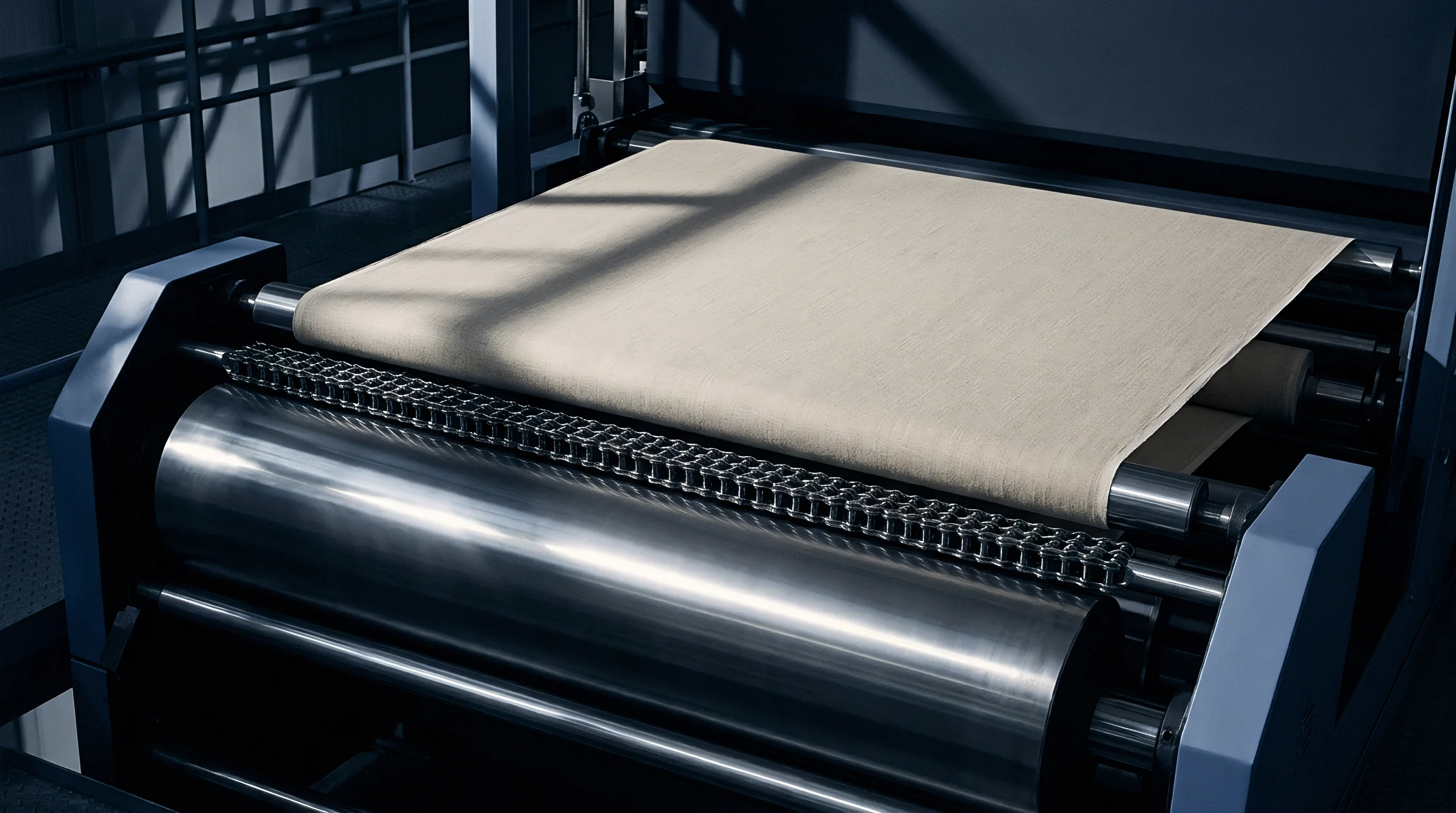
The transformation from yarn package to a finished bolt of woven fabric presents multiple points where chain-of-custody documentation fractures. A weaving mill accepts yarn cones, loads creels, beams warps, and runs looms to produce greige fabric rolls. Each greige roll receives a piece number stamped on the selvedge or marked on a durable barcode end-tag.
Traceability depends entirely on maintaining the link between individual cone lot numbers and the final bolt identification mark.
Loom-shed logs record warp and weft yarn allocations per weaving frame. When a loom runs a 100 percent European flax warp paired with an uncertified flax or cotton weft, the resulting fabric can no longer be sold under a 100 percent European Flax claim. The fabric becomes a blended construction.
The weaving mill must issue a Transaction Certificate that explicitly states the percentage composition of certified fiber by weight, backed by warp and weft consumption logs.
Finishing operations further complicate the verification trail. Wet processing involves desizing, scouring, bleaching, dyeing, and soft-finishing. These chemical operations reduce fabric mass through the removal of residual natural waxes, pectins, and shive fragments.
Scouring and bleaching reduce dry greige weight by 6 to 10 percent depending on the intensity of the treatment. An auditor tracking a 500-meter finished bolt back to its greige roll accounts for this mass reduction along with warp and filling shrinkage.
Auditing the physical records on the weaving floor requires a direct review of production tracking points:
- Yarn Lot Assignment Sheets tie specific yarn box batch numbers directly to loom beam numbers in the warping section.
- Beam Inspection Cards document the exact yarn weight, end count, and fiber origin codes loaded onto each warp beam.
- Loom Production Logs record daily pick counts, operator shifts, fabric defect stops, and cut-mark roll separations.
- Finishing Route Cards accompany physical bolts through dye kettles, stenters, and tumbler dryers, tracking net weights before and after processing.
Physical batch verification at the finished bolt stage relies on laboratory analysis to validate documentary claims. Fiber composition tests, performed according to ISO 1833 guidelines, confirm fiber content percentages. High-performance liquid chromatography (HPLC) and microscopic fiber profiling analyze lignin residual signatures and elementary fiber dimensions.
These analytical tests detect the inclusion of hemp, jute, or ramie fiber substituted for flax.
Simple visual inspection fails to identify sophisticated fiber blending. Traceability labels stay attached to the bolt end.

Origin
Fiber origin and legal country of origin operate under entirely different legal frameworks. A scope certificate for European Flax certifies that the raw fiber was grown in France, Belgium, or the Netherlands. It confirms agricultural origin.
When that raw fiber ships to China, undergoes hackling, wet spinning, warping, and weaving, the resulting finished fabric does not possess European legal origin for customs classification and marking purposes.

Why Does Fiber Scope Fail at Customs?
Customs authorities determine country of origin based on non-preferential origin rules laid down in legal codes such as the Union Customs Code (UCC) in the European Union or Title 19 of the Code of Federal Regulations in the United States. Under these rules, origin is conferred upon the country where the last substantial, economically justified processing took place, resulting in the manufacture of a new product or representing an important stage of manufacture. For textile products, substantial transformation rules generally require a tariff classification change at the four-digit Harmonized System (HS) heading level, or specific process thresholds like spinning or weaving.
Converting raw flax fiber into spun yarn represents a substantial transformation. Raw scutched flax falls under HS heading 5301. Spun flax yarn falls under HS heading 5306.
When a Chinese mill buys raw European flax fiber (HS 5301) and wet-spins it into linen yarn (HS 5306), the legal country of origin of the yarn becomes China. Importing that yarn into Europe or the United States requires declaring Chinese origin on customs entry documents, regardless of the European Flax Scope Certificate accompanying the shipment.
| HS Code | Tariff Description | Substantial Transformation Step | Legal Origin Determination |
|---|---|---|---|
| 5301.10 | Flax, raw or retted | Agricultural harvesting & retting | Country of farm location (e.g. France) |
| 5301.21 | Flax, broken or scutched | Mechanical fiber extraction | Country of scutching mill |
| 5306.10 | Single flax yarn | Hackling and wet/dry spinning | Country of spinning mill (e.g. China) |
| 5309.11 | Woven fabrics of flax, unbleached | Warping, sizing, weaving | Country of loom-shed location |
| 6302.22 | Bed linen of flax fiber | Cutting, sewing, hemstitching | Country of cut-and-sew assembly |
Labelling rules enforce strict distinction between fiber provenance and product origin. The US Federal Trade Commission (FTC) Textile Fiber Products Identification Act and EU Regulation 1007/2011 mandate accurate fiber content labelling. A company may state on a garment tag “Made in China from 100% European Flax Fiber.” A tag stating “Made in Europe” for a garment cut and sewn in Asia from Chinese-woven cloth containing European fiber violates trade laws and exposes the importer to civil penalties.
Customs audits demand proofs that extend beyond private voluntary standards. When border agencies challenge an origin declaration or preferential duty claim, they reject private scope certificates as standalone proof of legal origin. Customs officers demand commercial invoices, bills of lading, freight manifest routes, mill processing logs, and official certificates of origin issued by recognized chambers of commerce.
Standard purchase contracts protect importers by embedding mandatory customs compliance requirements directly into supply specifications:
The seller warrants that all goods supplied under this contract shall be declared accurately for customs purposes in accordance with the non-preferential origin rules of the destination country, and that voluntary private standard certificates shall not supersede statutory origin determination criteria.
Importers failing to align voluntary sustainability claims with statutory customs origin definitions face shipment detention, customs seizure, and retroactive duty assessments.

Surcharge
Certified flax carries a measurable commercial premium over uncertified fiber. This surcharge flows through every transaction node from the scutcher cooperative to the final retail product. Understanding the exact cost distribution across the supply chain allows sourcing managers to evaluate whether a supplier’s quote reflects genuine certification expenses or commercial margin inflation.
Raw European flax long line fiber commands a premium ranging from 0.40 EUR to 0.85 EUR per kilogram over non-certified long line flax of equivalent grade and staple length. This price differential accounts for annual farm-level certification audits, physical segregation controls at the scutching facility, administrative compliance overhead, and licensing fees paid to the scheme management body. When this fiber moves to a spinning mill, the surcharge compounds through process waste losses.
Calculating the true landed cost of certified fiber in finished woven cloth requires factoring in yield cumulative losses, audit fees, and transaction certificate issuance fees. Issuing bodies charge administrative fees for every individual Transaction Certificate generated, typically ranging from 35 EUR to 75 EUR per document depending on volume and certifier structure.
| Supply Chain Stage | Base Material Cost (EUR/kg or m) | Certification Surcharge | Document & Audit Overhead | Compounded Cost Increase (%) |
|---|---|---|---|---|
| Scutched Long Line Fiber | 4.50 / kg | +0.60 / kg | 0.02 / kg (Farm/Mill Audit) | +13.8 % |
| Spun Yarn (Nm 26) | 8.20 / kg | +0.85 / kg | 0.05 / kg (TC Issuance) | +11.0 % |
| Greige Woven Cloth | 4.10 / m | +0.45 / m | 0.03 / m (Weaving Audit) | +11.7 % |
| Finished Dyed Linen | 6.80 / m | +0.65 / m | 0.04 / m (Finishing Scope) | +10.1 % |
Consider a practical cost calculation for a 5,000-meter order of finished linen fabric weighing 200 grams per square meter at 1.5 meters width. Total weight equals 1,500 kilograms of finished fabric. Accounting for cumulative processing waste from raw long line fiber to finished fabric at an overall yield factor of 72 percent, the order requires 2,083 kilograms of raw certified flax fiber.
The direct raw material surcharge equals 2,083 kilograms multiplied by 0.60 EUR per kilogram, totaling 1,249.80 EUR. Adding four transaction certificates across spinning, weaving, finishing, and export trading at 50 EUR per document adds 200 EUR. On-site annual facility audit allocation costs add approximately 300 EUR to the production run allocation.
The total direct certification premium for the order reaches 1,749.80 EUR, or 0.35 EUR per linear meter of finished fabric.
If a mill quotes a 1.50 EUR per meter price increase for certified European Flax over standard linen, the markup exceeds the physical and documentary cost of compliance by over 300 percent. Invoices carry legal weight.
Accepting unverified scope claims to avoid the certification surcharge exposes buyers to severe financial liability when downstream brand clients run DNA or isotope verification tests on incoming inventory and demand full order chargebacks.

Warranty
Mitigating provenance exposure requires transferring financial and legal responsibility back to the manufacturing supplier through explicit contractual warranties. A supplier who insists that their European Flax scope certificate guarantees total compliance must back that claim with enforceable contract terms. Reliance on informal commercial email assurances offers zero legal protection when a regulatory authority impounds goods or a client rejects a delivery for missing documentation.
Verification protocols must be executed in a structured sequence prior to authorizing financial payments to offshore mills:
- Request the Scope Certificate directly from the primary supplier, verifying that the legal entity name, operating facility address, and validity dates match the contract parameters.
- Authenticate the Document against the issuing certifier’s public registry database to verify that the license status remains active and unrevoked.
- Cross-Check Process Categories printed on the scope certificate face to ensure explicit authorization for the exact transformation steps ordered, such as spinning, weaving, or wet finishing.
- Require Batch-Specific Transaction Certificates for every discrete shipment, ensuring the TCs reference the exact invoice numbers, net weights, and bill of lading numbers.
- Audit Mass-Balance Ledgers during on-site inspections for high-volume orders, reconciling fiber input volumes against outbound yarn or fabric shipments.
- Execute Physical Laboratory Testing on incoming lot samples using fiber analysis to confirm composition percentages prior to final invoice settlement.
Contractual risk transfer relies on precise warranty drafting within the commercial purchase order. The buyer includes specific indemnity clauses that trigger financial compensation if the supplier fails to supply valid, authenticated Transaction Certificates within a set number of days following shipment arrival at the destination port. The clause defines explicit damages, including full refund of purchase price, reimbursement of freight and import customs duties, and coverage of independent laboratory testing fees incurred during dispute resolution.
The contract specifies that failure to deliver valid TCs matching the exact lot weight within fifteen calendar days of port discharge constitutes a material breach of contract, entitling the buyer to reject the consignment at the seller’s expense. The seller agrees to indemnify the buyer against all third-party commercial claims, regulatory fines, and legal expenses arising from inaccurate origin or fiber content declarations attributable to unverified supplier documentation.