Establishing Isotopic Soil Baselines for European Flax Provenance
Establishing isotopic soil baselines for European flax requires measuring bioavailable strontium and oxygen ratios to verify fiber origin against document claims.


Strata
Geological variations across Western European agricultural zones establish specific bioavailable isotope baselines in long-staple flax tissue. The primary flax-growing belt ~ extending across coastal Normandy, Hauts-de-France, Flanders, Wallonia, and Zeeland ~ overlies distinct sedimentary and basement formations that yield characteristic strontium isotope ratios, expressed as radiogenic strontium-87 relative to non-radiogenic strontium-86. Weathered minerals from the Cretaceous chalks and Tertiary marls of the Paris Basin impart a narrow bioavailable strontium signature between 0.7082 and 0.7095.
This radiogenic ratio moves directly from soil water through the taproot of Linum usitatissimum without metabolic fractionation, embedding the bedrock’s isotopic fingerprint into the primary cell walls of the bast fiber bundle.
Geographic origin is easily distinguished when comparing European coastal soils to major flax-growing regions elsewhere. Non-European production zones ~ such as the alluvial plains of Heilongjiang in Northeastern China, the granitic soils of Inner Mongolia, and the basaltic sediments of the Nile Delta ~ exhibit fundamentally different geochemical profiles. Granitic and ancient metamorphic basements in Northern China produce bioavailable strontium ratios that consistently exceed 0.7120, whereas the basaltic influence of the Upper Nile catchment keeps Egyptian soil water ratios below 0.7055.
Because strontium substitutes for calcium in the crystalline lattices of plant pectins and cell walls, raw flax fiber retains this radiogenic marker through scutching and hackling without change. Soil cores from active European plots confirm that local clay fractions maintain these baselines over decades of farming.
| Cultivation Region | Geological Substrate | Bioavailable 87Sr/86Sr Ratio | Delta 18O Cellulose (per mil) | Delta 13C Cellulose (per mil) |
|---|---|---|---|---|
| Normandy (France) | Upper Cretaceous Chalk / Loess | 0.7082 – 0.7091 | +27.5 to +29.8 | -26.8 to -28.2 |
| Flanders (Belgium / Netherlands) | Cenozoic Marine Sands / Silt Loam | 0.7088 – 0.7096 | +26.8 to +28.9 | -26.5 to -27.9 |
| Heilongjiang (China) | Quaternary Alluvial / Black Soils | 0.7118 – 0.7145 | +21.2 to +24.0 | -24.2 to -25.8 |
| Bayannur (Inner Mongolia, China) | Arid Sedimentary / Granitic Wash | 0.7130 – 0.7162 | +18.5 to +21.5 | -23.0 to -24.8 |
| Nile Delta (Egypt) | Volcanic Ash / Nile Silt | 0.7048 – 0.7062 | +31.0 to +34.5 | -25.0 to -26.2 |
| Willamette Valley (United States) | Missoula Flood Basaltic Silts | 0.7068 – 0.7080 | +24.5 to +26.8 | -26.0 to -27.5 |

Geochemical Foundations of Northern European Silt Loams
Soil parent material across the maritime European flax belt consists mainly of windblown loess accumulated during the Weichselian glaciation. These deep silt loams contain finely ground quartz, feldspars, and micas overlying thick Cretaceous chalk strata. Bioavailable cations reside within the exchangeable soil complex, accessible to root exudates via active ion transport.
Soil water extractions from test plots in the Seine-Maritime and Somme departments show stable bioavailable calcium-to-strontium mass ratios between 150 and 220. The rapid weathering of the underlying fine-grained carbonate matrix buffers strontium in the soil solution, maintaining isotopic equilibrium across varying rainfall conditions.
Other growing regions lack this specific carbonate-loess configuration. In the Songnen Plain of Asia, soil minerals derive from the weathering of ancient granitic crust, accumulating radiogenic argon and strontium over geological timescales. As a result, the bioavailable strontium pool in Heilongjiang topsoil shows a heavy isotope excess that creates a clear statistical gap when measured against European baselines.
Tracing bioavailable strontium through groundwater tables across coastal Normandy confirms that seasonal irrigation and heavy downpours do not shift the bedrock’s radiogenic signal beyond established confidence intervals.
Soil bioavailable strontium ratios within European coastal chalk loess maintain a tight range between 0.7082 and 0.7096 under standard agricultural leaching conditions.

Radiogenic Strontium Signatures across Western European Basements
Spatially resolved radiogenic analysis across the European maritime flax region demonstrates minimal local drift, offering a solid basis for geographical classification. The Hercynian granitic massifs bordering Brittany mark a sharp western boundary where bioavailable strontium jumps above 0.7110. Within the main agricultural belt running from Caen to Antwerp, uniform Cretaceous chalk and Paleogene clay cover prevents false positives.
This isotopic consistency along the maritime corridor allows clear separation from imported fibers grown in continental climates.
Differences in soil depth and farming practices do not alter the radiogenic strontium ratio recorded in the plant’s structural tissue. Field trials show that deep-rooting flax assimilates strontium almost entirely from the top sixty centimeters of the soil profile, where bioavailable mineral fractions remain in an isotopic steady state. While synthetic fertilizers contain trace minerals, standard European application rates introduce far too little strontium mass to displace the dominant native mineral signature.

Precipitation Signals and Oxygen Isotope Distribution
Stable oxygen isotope values, expressed as delta oxygen-18 relative to Vienna Standard Mean Ocean Water, offer a secondary geographic marker tied to local hydrology and climate. Maritime air masses from the North Atlantic drop rain enriched in oxygen-18 over Western Europe compared to the depleted rainfall of inland Eurasia. As flax plants absorb soil water, transpiration enriches leaf and stem tissue during peak summer growth, pushing cellulose oxygen-18 values into a reliable range of +26.5 to +29.8 per mil.
Atmospheric moisture patterns over continental Asia produce noticeably different oxygen-18 baselines in precipitation. Across inland China, winter-dominated precipitation and wide continental temperature swings yield depleted groundwater, keeping stem cellulose oxygen-18 values below +24.0 per mil in almost all cases. Conversely, high evaporation in irrigated arid regions leads to strong isotopic enrichment.
Pairing radiogenic strontium ratios with stable oxygen isotope measurements forms a dual-coordinate baseline that separates Western European flax fiber from foreign alternatives.
Atmospheric transport of coastal European precipitation during the spring growth window does not shift Asian long-staple crop oxygen values into European baseline ranges.


Ratio
Stable isotope ratios in raw bast fibers reflect direct geochemical uptake from soil water during vegetative growth. The isotopic matrix of flax fiber incorporates carbon-13, nitrogen-15, oxygen-18, hydrogen-2, and strontium-87. In C3 plants such as flax, carbon isotope values depend directly on stomatal conductance, photosynthetic rate, and relative humidity during stem elongation.
Under temperate maritime conditions in Europe, carbon dioxide assimilation generates fiber delta carbon-13 values tightly constrained between -26.5 and -28.5 per mil. Hotter, drier climates force stomata to close, enriching carbon-13 and shifting fiber signatures toward -24.0 per mil.
Dew retting introduces surface environmental markers without altering the underlying cellulose structure. During field retting in Western Europe, fungi and bacteria break down pectin matrices while stems lie exposed to rain, dew, and soil contact. Bioavailable ions in surface moisture and local dust interact with the fiber exterior, but thorough laboratory cleaning removes these surface contaminants to expose the undamaged structural core.
Analysis of purified alpha-cellulose confirms that this core preserves the plant’s original growth-stage isotope ratios.
Purified alpha-cellulose extraction eliminates fungal biomass interference to preserve pristine growth-stage oxygen and carbon isotope ratios.

Plant Uptake Dynamics and Bioavailable Strontium Fractionation
Divalent cation transport across root membranes absorbs strontium alongside calcium without discriminating between strontium-87 and strontium-86. Passive apoplastic flow carries dissolved mineral ions from the soil solution through the root cortex into xylem streams. Because biological transport processes do not fractionate heavy radiogenic elements, the strontium ratio measured in harvested fiber matches the bioavailable soil fraction exactly.
Soil extractions using ammonium acetate at neutral pH mirror this bioavailable fraction by selectively stripping exchangeable cations from clay lattices and organic complexes. By contrast, total acid digestion breaks down insoluble silicate minerals that plants never absorb, yielding misleading radiogenic values. Baseline calibration depends strictly on ammonium acetate or weak acid extractions that represent the active root-zone nutrient pool.

Dew Retting Alterations to Surface Isotopic Composition
Field exposure during dew retting subjects harvested flax straw to rainwater leaching, saprophytic growth, and windblown dust. Fungal hyphae growing within stem tissues introduce non-plant carbon and nitrogen from atmospheric and micro-environmental sources. Isolating pure alpha-cellulose removes non-endemic lipids.
Uncleaned raw fibers exhibit variable delta nitrogen-15 values because of localized fungal residue, whereas isolated cellulose consistently returns the plant’s baseline physiological signature.
Water used in industrial tank retting can alter surface strontium signatures if processing vats rely on non-local water sources. Modern European production uses field dew retting almost exclusively, avoiding the cross-contamination risks of centralized water tanks. When sampling raw scutched tow, protocols must include surface cleaning to strip ambient dust and processing oils before taking isotopic measurements.
- Residual Pectin Contamination leaves non-cellulosic oxygen and carbon fractions that shift delta values away from structural baselines.
- Lipid Fractionation Artifacts alter carbon-13 distribution if hydrophobic surface waxes are not extracted with organic solvents.
- Surface Dust Retention introduces soil mineral particles with extraneous strontium signatures into combustion vessels during analysis.
- Thermal Oxidation During Drying degrades cellulose structural integrity if preparation temperatures exceed eighty degrees Celsius.
- Excessive Acid Wash Depletion strips structural cations from cell walls when aggressive mineral acids replace mild ammonium acetate reagents.

Cellulose Isolation Protocols for Spectrometric Analysis
Analytical preparation requires systematic removal of non-cellulosic compounds to ensure repeatable spectroscopic results across laboratories. Raw fiber bundles undergo sequential extraction with toluene and ethanol mixtures to remove lipophilic waxes, resins, and chlorophyll residue. Running raw, uncleaned fibers directly through mass spectrometry introduces noise from volatile surface compounds, corrupting both light stable isotope ratios and heavy element measurements.
Subsequent delignification with acidified sodium chlorite solution breaks down residual lignin without cleaving structural glucan chains. Alkaline purification using sodium hydroxide then dissolves hemicelluloses and pectins, leaving an isolated alpha-cellulose residue that is over ninety-eight percent structural cellulose. Isotopic values measured on this purified fraction show tight intra-lot standard deviations, typically within +/- 0.15 per mil for delta carbon-13 and +/- 0.25 per mil for delta oxygen-18.
Samples showing elevated heavy isotope values combined with depleted light surface signals usually indicate mixed field harvests processed through secondary retting tanks.

Grid
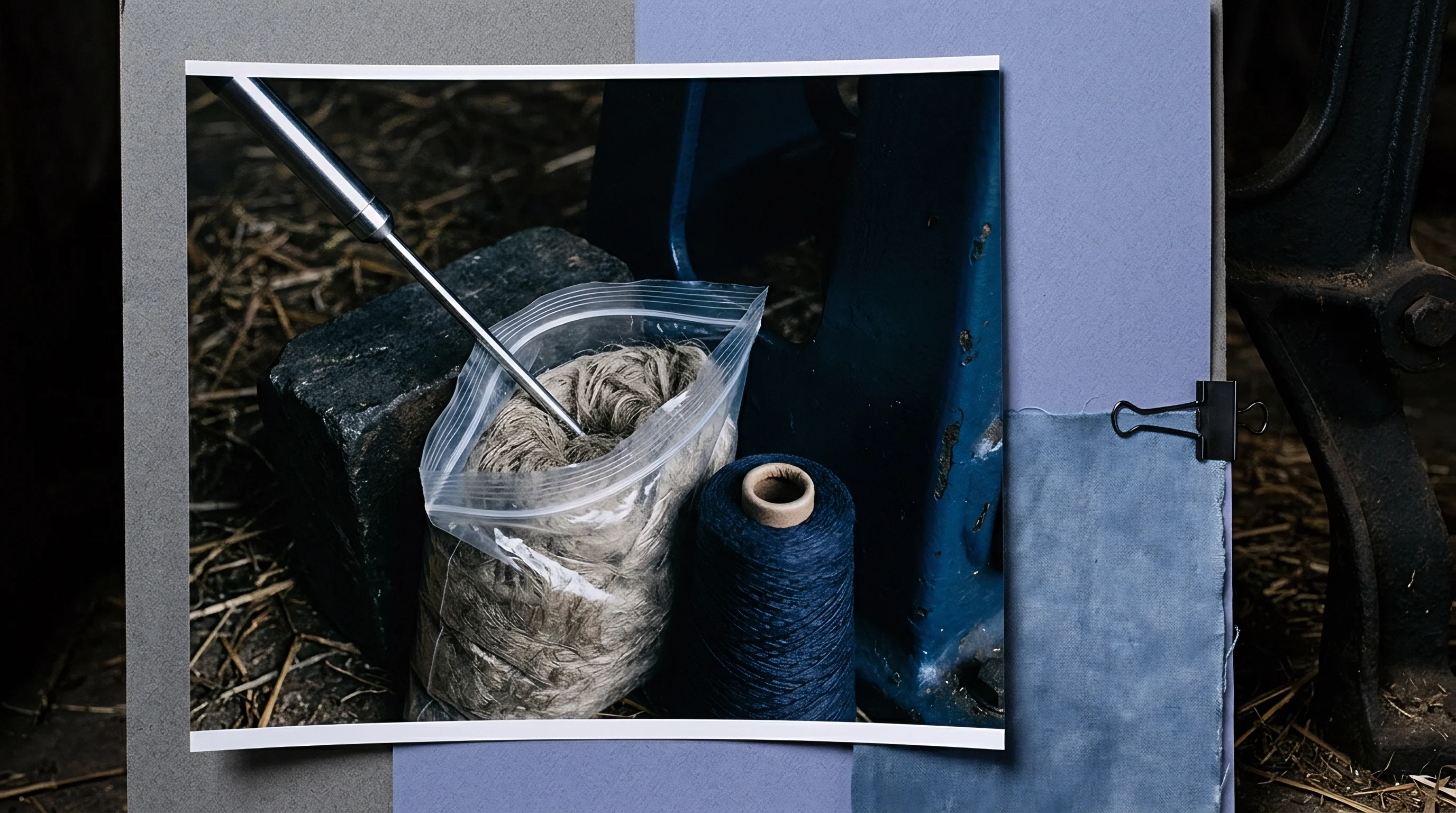
Spatial interpolation mapping connects discrete soil cores into continuous geographic profiles across European growing regions. Building a reliable baseline requires systematic soil and fiber sampling across fixed geographic grids. High-density sampling in Normandy, Picardy, Flanders, and Wallonia captures sub-regional variations in soil geochemistry and local hydrology.
Integrating these data points creates an interactive soil isoscape map that serves as a legal benchmark for provenance verification, with satellite-logged grid coordinates linking each core sample directly to land registries.
Sampling depth must align with the active root system of flax crops to capture true bioavailable signatures. Standard collection protocols require dual-depth sampling: topsoil cores from zero to twenty centimeters target the primary root zone, while deeper cores from twenty to fifty centimeters assess subsoil cation reservoirs. Sampling at these set depths prevents false baseline shifts caused by surface evaporation or recent fertilizer application.
| European Flax Proportion (%) | Asian Flax Proportion (%) | Calculated 87Sr/86Sr Ratio | Predicted Delta 18O (per mil) | Statistical Detection Probability |
|---|---|---|---|---|
| 100% European | 0% Non-European | 0.7088 (+/- 0.0004) | +28.2 (+/- 0.5) | Baseline Calibration |
| 90% European | 10% Non-European | 0.7093 (+/- 0.0004) | +27.6 (+/- 0.5) | 68% Confidence Interval |
| 80% European | 20% Non-European | 0.7098 (+/- 0.0005) | +27.0 (+/- 0.6) | 95% Confidence Interval |
| 70% European | 30% Non-European | 0.7104 (+/- 0.0005) | +26.4 (+/- 0.6) | 99% Confidence Interval |
| 50% European | 50% Non-European | 0.7115 (+/- 0.0006) | +25.1 (+/- 0.7) | 99.9% Confidence Interval |
| 0% European | 100% Non-European | 0.7132 (+/- 0.0008) | +22.5 (+/- 0.8) | Definite Non-Compliance |

Spatial Density and Sampling Core Protocol
The required spatial sampling frequency depends on geological variation across the targeted zone. Uniform alluvial basins allow core collection at ten-kilometer intervals, whereas complex terrain bordering crystalline massifs requires tighter five-kilometer grids. Collecting soil samples of at least five hundred grams ensures adequate material for exchangeable cation extraction and soil texture analysis, reflecting clear radiogenic divergence between Paris Basin chalks and Asian alluvial soils.
Georeferencing every core sample creates a spatial database supporting automated provenance scoring. Laboratory mass spectrometry measurements feed into spatial kriging models that calculate local isotopic probability fields. If an audited fiber sample falls outside the ninety-five percent confidence ellipse for its claimed grid coordinate, the tracking system flags an immediate provenance alert.
- Collect topsoil cores at depths between zero and twenty centimeters across target agricultural zones.
- Extract soil samples using ammonium acetate to isolate bioavailable strontium fractions.
- Measure isotopic mass ratios using multi-collector inductively coupled plasma mass spectrometry.
- Normalize isotopic values against international reference standards IAEA-CH-6 and NBS 987.
- Log spatial coordinates into the regional geographic baseline registry.

What Threshold Exposes Flax Blending in Yarn?
Detecting physical blending of European flax with cheaper foreign fiber relies on linear isotopic mixing equations. When lower-cost fiber carrying a high strontium-87 ratio is mixed with European fiber, the resulting yarn exhibits an intermediate radiogenic signature proportional to the blend ratio. Multi-isotope mathematical models show that a twenty percent inclusion of Asian long-staple flax shifts the measured strontium ratio beyond the upper boundary of the Western European baseline, providing a ninety-five percent statistical detection probability.
Light isotope markers provide complementary verification when heavy radiogenic shifts fall near threshold boundaries. Blending unverified continental flax into European lots lowers the composite delta oxygen-18 value because of the depleted isotopic profile of continental rain. Combining strontium ratios with delta oxygen-18 values in a bivariate linear discriminant model reduces false negatives for twenty percent foreign blends to under one percent.
Incorporating mandatory isotopic baseline compliance clauses into raw fiber purchase agreements eliminates supplier substitution risk at the point of spinning.

Interannual Variation in Climate and Groundwater Signals
Climatic fluctuations between growing seasons introduce measurable shifts in stable light isotope baselines that require annual calibration updates. Drought years increase evaporative transpiration in flax leaves, shifting seasonal delta oxygen-18 averages upward by as much as 1.2 per mil across Western Europe. Conversely, heavy rainfall during the May-to-July growth window depresses seasonal oxygen-18 values.
Maintaining baseline accuracy over time requires harvesting annual control samples from designated reference fields across Normandy, Flanders, and Wallonia. These control crops establish annual offsets that adjust the primary isoscape database for weather anomalies. Radiogenic strontium ratios remain unaffected by climate, providing a stable geological foundation that anchors the multi-isotope matrix regardless of weather conditions.
Inserting a standard ISO 17065 baseline match specification clause into purchase orders transfers the financial risk of false provenance directly to the primary fiber merchant.


Assay
Mass spectrometry requires detailed chemical pretreatment to strip non-cellulosic plant components prior to combustion or fluorination. High-throughput testing protocols evaluate both light stable isotopes and radiogenic ratios from isolated fiber cellulose. Light isotopes are analyzed using Isotope Ratio Mass Spectrometry coupled to an Elemental Analyzer or High-Temperature Conversion Elemental Analyzer, while heavy isotopes require complete wet acid digestion followed by column ion exchange separation before measurement on a Multi-Collector Inductively Coupled Plasma Mass Spectrometer.
Sample intake protocols enforce strict quality controls to prevent analytical bias. Cleaned cellulose samples are vacuum-dried at sixty degrees Celsius for twelve hours to eliminate moisture before weighing. Microgram-precision balances then measure exact sample aliquots into tin or silver capsules for combustion, preventing mass variations from distorting ion beam intensity in the spectrometer.

Instrumentation Thresholds for Isotope Ratio Mass Spectrometry
Analyzing delta carbon-13 and delta nitrogen-15 values requires quantitative flash combustion of cellulose aliquots inside an elemental analyzer furnace heated to 1020 degrees Celsius under pure oxygen. Sample gases pass through reduction tubes to yield carbon dioxide and nitrogen, which enter the spectrometer ion source through an open split interface. Ion beams corresponding to atomic mass-to-charge ratios 44, 45, and 46 are then measured simultaneously in Faraday cups.
Determining delta oxygen-18 and delta hydrogen-2 requires high-temperature pyrolysis inside a carbon-rich reaction tube above 1400 degrees Celsius, breaking down cellulose into carbon monoxide and hydrogen gas without atmospheric contamination. Continuous calibration against international reference materials ensures precision better than +/- 0.1 per mil for carbon and +/- 0.3 per mil for oxygen.

Multi-Collector ICP MS Workflows for Heavy Elements
Determining strontium isotope ratios requires full sample oxidation using ultra-pure concentrated nitric acid and hydrogen peroxide in closed microwave digestion vessels. Digested solutions pass through crown-ether resin columns to isolate strontium cations while eluting matrix elements such as rubidium, calcium, and potassium. Removing rubidium-87 is essential to prevent isobaric interference at atomic mass 87 during mass spectrometry; duplicate resin passes confirm zero rubidium carryover.
Purified strontium extracts are aspirated into the plasma torch of a Multi-Collector Inductively Coupled Plasma Mass Spectrometer. Multiple Faraday collectors record ion intensities for masses 88, 87, 86, and 84 simultaneously, applying exponential mass fractionation corrections based on the internal strontium-88 to strontium-86 ratio of 8.3752. Laboratory accuracy is checked continuously using international standard NBS 987, keeping measured ratios within 0.710248 +/- 0.000012.
- Chain of Custody Sealing prevents sample tampering during transit between the scutcher bale store and the laboratory.
- Cellulose Purity Verification confirms complete pectin and lipid removal using Fourier-transform infrared spectroscopy prior to mass spectrometry.
- Reference Material Calibration corrects for mass spectrometer drift using international standards IAEA-CH-6 and NBS 987 every ten samples.
- Duplicate Sample Processing runs ten percent of lot submissions in duplicate to confirm analytical variance remains within tolerance.

Analytical Precision and Inter Laboratory Variance
Cross-laboratory calibrations maintain consistency between independent testing facilities evaluating commercial flax orders. Inter-laboratory comparison trials show that standardized cellulose extraction protocols keep inter-lab variance for delta oxygen-18 below 0.35 per mil. Standard reference materials derived from European flax straw allow laboratories across Europe and Asia to align baseline calibration scales reliably.
Commercial testing costs depend on throughput and testing scope. Combined light isotope analysis runs approximately 85 to 120 Euros per sample, while high-precision radiogenic strontium analysis via multi-collector instrumentation costs between 220 and 350 Euros per sample. Standard turnaround times take five to eight working days from intake to certificate issuance.
The remaining analytical question is whether industrial bleaching protocols selectively leach heavy radiogenic trace elements from wet-spun yarns enough to shift isotopic signatures beyond baseline limits.


Margin
Relying solely on paper scope certificates leaves buyers vulnerable to fraudulent substitution during secondary spinning. Scutched flax harvested in Western Europe under European Flax certification is frequently exported to overseas spinning mills for yarn production. Once raw fiber enters international re-export channels, paper mass-balance records become susceptible to volume inflation, allowing uncertified low-cost flax to be blended into certified lots without a paper trace.
Adding physical isotopic testing to commercial chain-of-custody protocols bridges the gap between paper claims and material reality. Transaction certificates can be corroborated by analytical results matched against field isoscape baselines. When yarn samples undergo multi-isotope testing before customs clearance, non-compliant lots are identified and rejected before reaching inventory.
| Provenance Route | Verification Mechanism | Testing Cost per Metre | Customs Detention Exposure | Financial Penalty Risk |
|---|---|---|---|---|
| Fully Certified European (EU Spun) | Isotopic Screening + Masters of Linen TC | EUR 0.02 – 0.04 | Negligible ( | Low (Standard Commercial Warranty) |
| Certified European Fiber (Asia Spun) | Isotopic Batch Screening + European Flax TC | EUR 0.03 – 0.06 | Moderate (5% – 10%) | Moderate (Batch Rejection Exposure) |
| Unverified Re-Export Fiber | Paper Scope Certificate Only | EUR 0.00 | High (> 35%) | Severe (Customs Seizure / Relabeling) |
| Blended Fiber (Undeclared) | Post-Import Isotopic Audit | EUR 0.08 (Audit Cost) | Critical (> 80%) | Maximum (Regulatory Fines + Recall) |

Documentary Reconciliation against Spectrometric Proof
Reconciling mill mass balances against certified fiber inputs requires simple verification arithmetic. A spinning mill purchasing one hundred metric tons of European Flax certified scutched tow yields a proportional volume of certified yarn after accounting for processing losses. Standard dry-spinning losses average eight to twelve percent, while wet-spinning losses range between fourteen and eighteen percent.
When a mill outputs one hundred metric tons of finished yarn from a one hundred metric ton raw fiber input, uncertified fiber substitution has taken place.
Physical sampling protocols call for taking random fiber samples from incoming bale lots before blending on the carding line. Drawing five fifty-gram composite samples from opposing corners of a bale store provides representative material for testing. Incorporating isotopic baseline limits directly into supply agreements provides clear legal recourse.

Customs Origin Enforcement and Import Risk Exposure
Customs authorities in North America and Western Europe enforce non-preferential origin verification standards to prevent false claims. Under Union Customs Code rules and United States Customs regulations, origin declarations must reflect genuine country-of-harvest facts rather than secondary processing. Importers making unverified provenance claims face inventory detention, mandatory relabeling, and civil penalties.
Isotopic baseline testing offers defensible evidence during customs audits and origin disputes. Importers presenting certified laboratory reports that align with European soil baselines establish clear proof of compliance. This documentation helps bypass administrative holds and secures customs clearance for high-value linen shipments.

Financial Liability Structures in Flax Sourcing Contracts
Commercial purchase contracts should incorporate liability clauses that transfer non-compliance costs back to suppliers. Standard raw material agreements can specify that any lot failing physical isotopic screening triggers immediate contract cancellation at the seller’s expense, with the seller assuming all testing costs, return freight, and downtime penalties incurred by the buyer.
Including clear financial penalties deters secondary mills from attempting fraudulent blending. Sourcing practices that enforce both document audits and physical isotopic verification protect brand equity while securing genuine European flax quality. Managing supplier risk through scientific testing transforms provenance verification from a marketing claim into an enforceable quality assurance protocol.
Accepting unverified origin declarations leaves importing brands vulnerable to regulatory forfeiture of landed inventory and mandatory public relabeling penalties under international customs enforcement.