X-Ray Diffraction Azimuthal Peak Deconvolution for Climate-Impacted Bast Fiber Sourcing Verification
Azimuthal XRD peak deconvolution isolates microfibril angle and crystallite alignment, exposing climate-degraded bast fibers before mill processing.
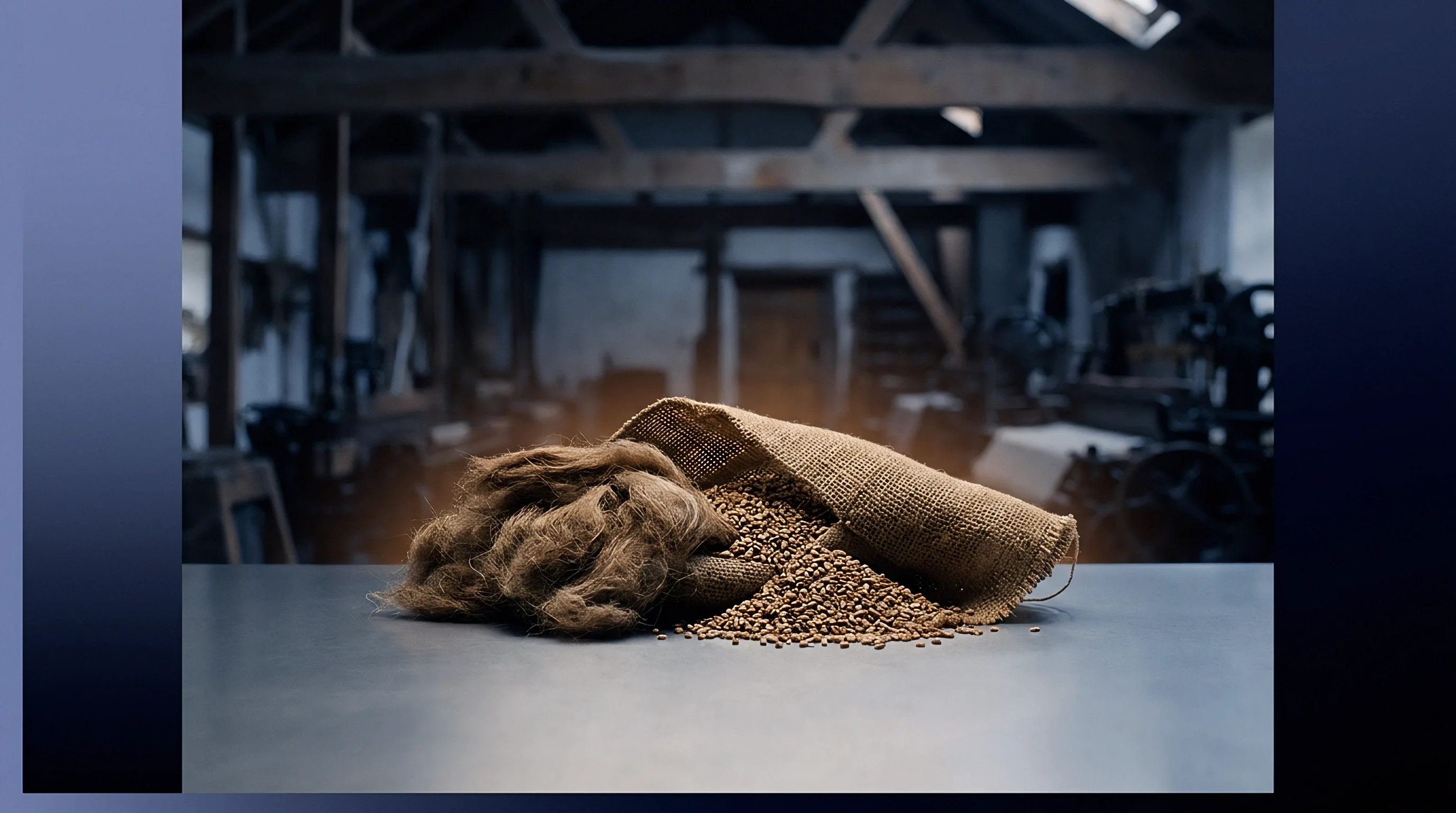

Signal
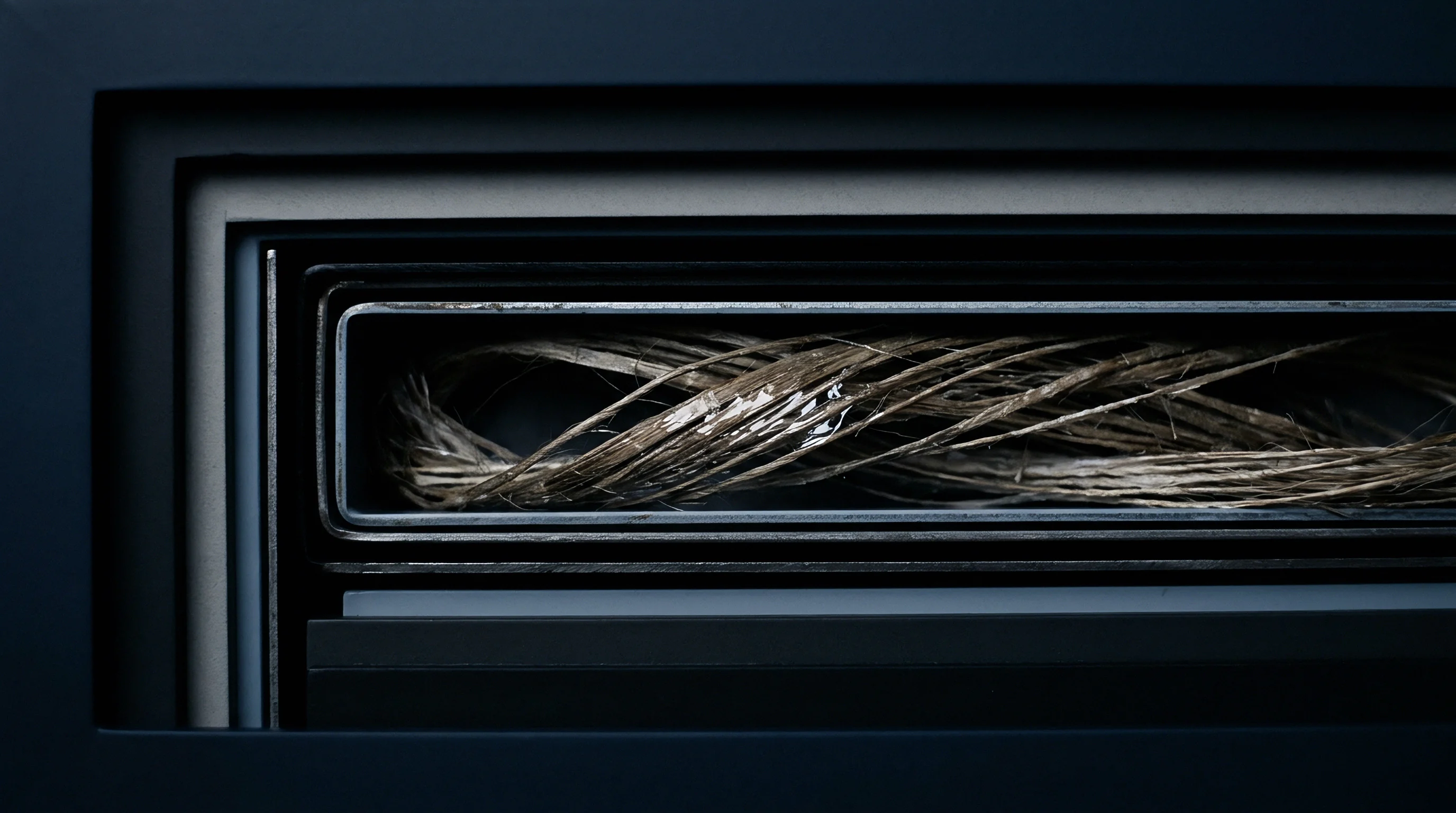
Microfibril Angle Extraction from Azimuthal Profiles
Diffraction patterns from unoriented bast bundles yield broad rings, while parallel mounts produce discrete equatorial reflections. The primary diagnostic reflection for native cellulose Iβ in flax and hemp occurs at the (200) crystallographic plane, centered near a 2θ Bragg angle of 22.6 degrees under copper K-alpha radiation (λ = 0.15418 nm). Azimuthal intensity distributions extracted along this Debye-Scherrer ring map the orientation distribution of cellulose microfibrils relative to the fiber axis.
Drought stress during vegetative growth disrupts secondary cell wall thickening, creating erratic microfibril angles (MFA) that lower dry-spun and wet-spun yarn tenacities. The raw azimuthal profile I(φ) combines contributions from crystalline alignment, non-crystalline background, amorphous cellulose, and disordered non-cellulosic polysaccharides like rhamnogalacturonans and xyloglucans. Measuring the azimuthal half-width directly without subtracting this background overestimates microfibrillar deviation by up to 8 degrees.
An uncorrected raw azimuthal profile overestimates the mean microfibril angle by four to eight degrees due to air scatter and Compton drift.
Transmission geometry requires thin bundle cross-sections between 0.2 mm and 0.5 mm to avoid beam attenuation and multiple scattering. The primary beam passes through the sample perpendicular to the fiber axis, recording intensities on a two-dimensional area detector set at a calibrated distance of 100 mm. Integrating the intensity along the azimuthal angle φ across the full 360-degree circle yields two dominant, symmetric equatorial peaks separated by 180 degrees.
Drought truncates cell expansion and restricts secondary wall deposition in European long-line flax, elevating mean MFAs above the 6 to 10 degree baseline typical of temperate seasons. High ambient temperatures during fiber maturation encourage disordered cell wall packing, broadening the azimuthal distribution. When incoming raw scutched flax carries this unresolved microfibrillar spread, standard mill draft settings cause frequent drafting breaks at the roving frame.
Deliveries offered as standard Grade 4 line fiber sometimes shear prematurely under normal mill tension. Confirming structural degradation in the laboratory requires deconstructing the azimuthal profile into distinct mathematical distributions. The full width at half maximum (FWHM) of the deconvoluted crystalline component correlates directly with the true orientation parameter.
Misclassifying high-MFA, drought-impacted fiber as premium stock leads to heavy combing losses during preparation.


Stem
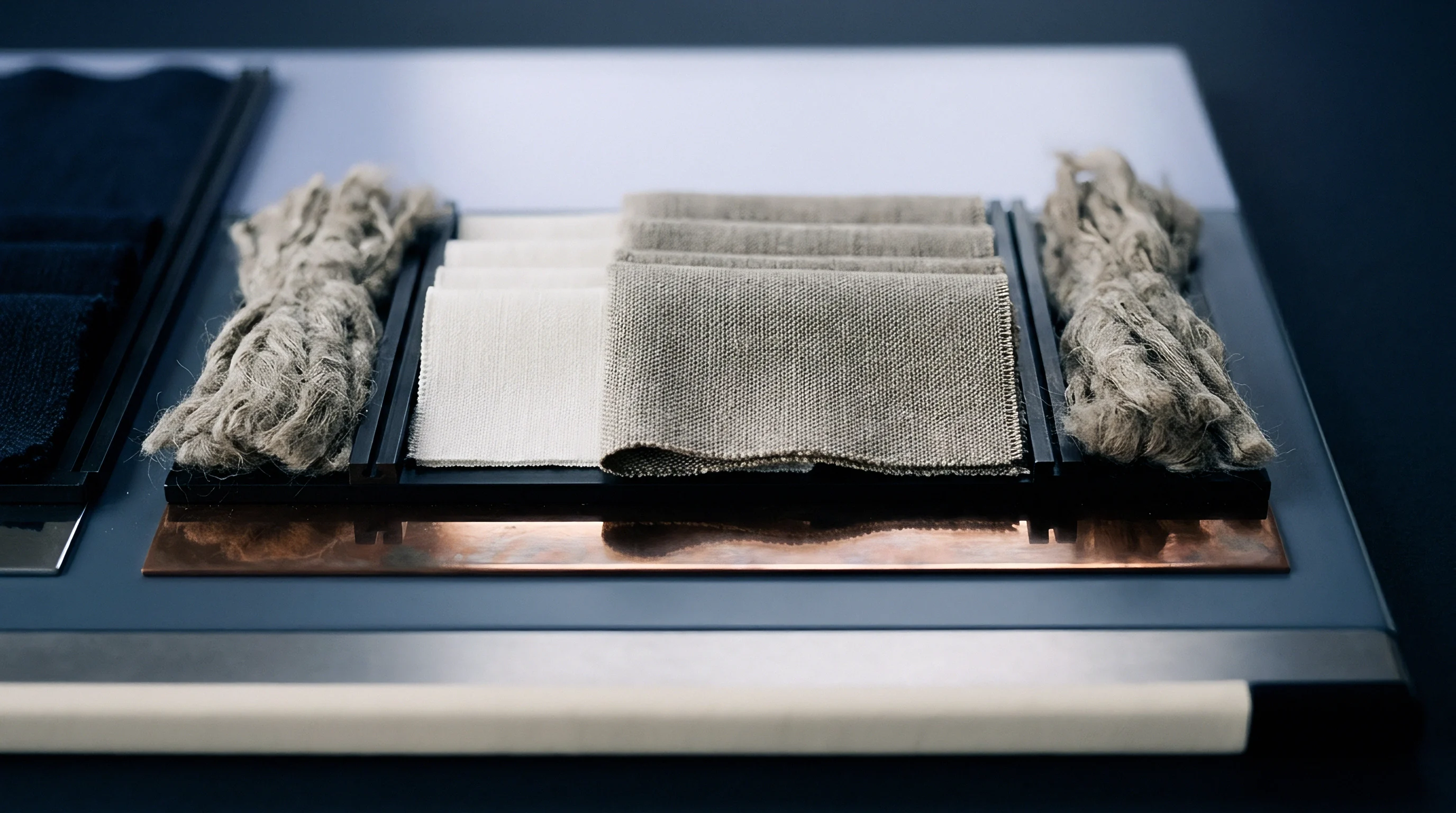
Secondary Cell Wall Deposition under Thermal Deficit
Bast fibers develop in the phloem tissue of dicotyledonous stems, forming peripheral bundles of elementary fibers bound by middle lamellae. Under balanced rainfall and moderate daytime temperatures, flax stems lay down dense, well-aligned secondary cell walls consisting of roughly 70 to 80 percent cellulose, 12 to 15 percent hemicellulose, and 2 to 5 percent pectin. Heat above 30 degrees Celsius during wall synthesis disrupts cellulose synthase complex activity, reducing chain length and crystallite coherence dimensions.
In healthy flax, cellulose microfibrils align in steep helical spirals with MFAs between 6 and 10 degrees. Water stress triggers early stem lignification, forcing premature growth arrest and thinner secondary walls. These compromised walls exhibit irregular microfibrillar trajectories, with local MFAs widening to 14 to 22 degrees.
Consequently, elementary fiber breaking tenacity drops from normal line flax values around 60 cN/tex down to 32 cN/tex.
Growing conditions across agricultural zones leave distinct morphological signatures on stem development. Scutching mills processing drought-impacted straw see lower long-fiber yields and excessive scutching tow generation, as elementary fiber properties shift with regional climate profiles.
| Growth Condition | Mean MFA (deg) | Cellulose Fraction (%) | Crystallite Size (200) (nm) | Tenacity (cN/tex) |
|---|---|---|---|---|
| Temperate Baseline (Maritime Western Europe) | 7.2 ± 0.8 | 78.4 | 3.8 | 62 ± 5 |
| Moderate Thermal Stress (Eastern Europe) | 11.4 ± 1.3 | 73.1 | 3.2 | 46 ± 4 |
| Severe Drought and Heat (Continental Basin) | 16.8 ± 2.1 | 66.5 | 2.6 | 31 ± 6 |
| Intermittent Flood and Saturated Retting | 9.5 ± 1.5 | 70.2 | 3.4 | 41 ± 5 |
Secondary cell wall defects limit drawing performance. Fiber classers relying solely on manual pull tests and hand feel frequently miss internal microfibrillar misalignment. Dew retting introduces more variability in climate-stressed stalks: dry field retting under low humidity slows colonization by filamentous fungi, leaving pectin bridges intact between elementary fibers within the bundle.
Scutching then requires harsher mechanical action, inducing transverse dislocations along the fiber.
These dislocations ~ kink bands or slip planes ~ act as stress concentrators. Under wide-angle X-ray diffraction (WAXD), damaged fibers exhibit widened azimuthal spreads from local lattice rotation. During hackling, defective bast bundles split unevenly, raising short-fiber fractions and degrading the metric count potential of the roving sliver.
Contract specifications set minimum hackling line yields at 48 percent by mass, allowing formal shipment rejection whenever laboratory X-ray deconvolution confirms a mean microfibril angle above 13.5 degrees.
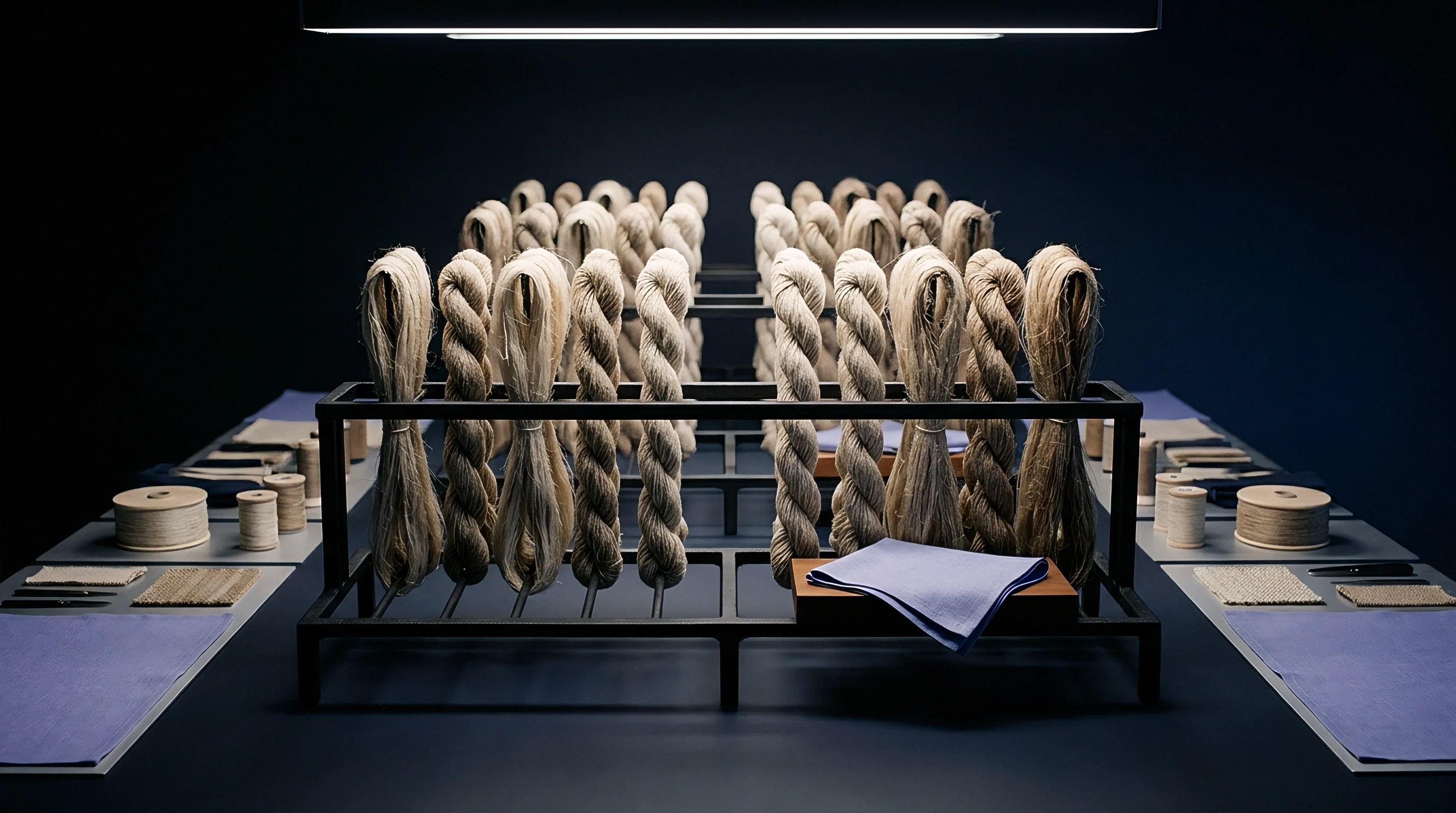

Deconvolution

Gaussian, Lorentzian, and Voigt Profile Separation
Separating overlapping scattering contributions from the raw azimuthal scan I(φ) requires a structured mathematical approach. The primary (200) reflection consists of crystalline domain scattering superimposed over an isotropic background and an oriented amorphous halo. Here, the background function B(φ) accounts for baseline instrument noise, detector dark current, and air scatter.
Diffraction line broadening stems from two physical sources: finite crystallite size along the transverse direction and crystallite orientation dispersion. A pure Gaussian function models instrumental broadening and orientation variance, while a Lorentzian function captures finite domain size effects. Fitting raw azimuthal peaks with a Voigt or pseudo-Voigt profile allows analytical separation into these underlying components.
The total intensity model follows an additive formulation across the scanned angle φ:
I_total(φ) = B(φ) + I_amorphous(φ) + Σ I_crystalline(φ)
Iterative non-linear least-squares fitting minimizes the residual sum of squares between experimental data and the synthetic profile. The background baseline is established using blank scans with identical sample frames and exposure settings. Because the oriented amorphous component shows broader azimuthal dispersion than the crystalline core, it requires a separate Gaussian distribution with a wider standard deviation.
A composite pseudo-Voigt peak fit separating crystalline core reflections from the oriented amorphous background isolates true microfibrillar orientation from broadening artifacts.
Crystalline orientation distribution functions (ODF) are derived from the resolved (200) crystalline profile. The mean microfibril angle θ relates directly to azimuthal variance or half-width at half-maximum (HWHM) through standard orientation parameters. Cave’s method estimates average microfibril angle from the angular offset T at the inflection point, where θ = 0.6 × T. More rigorous evaluations calculate Hermans orientation parameter f_c:
f_c = (3 × ⟨cos² φ⟩ – 1) / 2
The parameter f_c ranges from 0 for isotropic arrangements to 1 for perfect axial alignment. Climate-degraded bast fibers show f_c values between 0.72 and 0.84, whereas premium line flax reaches values above 0.92.
- Baseline background subtraction eliminates constant instrumental dark current and diffuse air scattering through an empty beam calibration run.
- Polar angle correction adjusts intensities for fiber tilt relative to the goniometer rotation axis using geometric intensity transformation factors.
- Amorphous halo deconvolution fits a broad Gaussian component centered at the equatorial plane to account for non-crystalline polysaccharide scattering.
- Crystalline peak deconstruction isolates the (200) reflection into paired pseudo-Voigt distributions representing symmetric fiber wall faces.
- Microfibril angle computation calculates the angular orientation parameter and crystallite coherence length from the isolated crystalline profile width.
Numerical deconvolution precision depends heavily on chosen background boundary conditions. Selecting an artificially low baseline truncates peak tails, underestimating highly misaligned microfibrils. Setting an elevated baseline cuts into true amorphous scattering, distorting the calculated crystallinity index.
The extraction leaves an inherent ambiguity: azimuthal broadening can stem either from uniform helical inclination across all cells or from localized wall buckling at kink bands.


Draft

Mill Processing Limits for Distorted Bast Lots
Fiber lots with elevated microfibril angles process poorly in the spinning mill. During hackling, high-MFA bundles fracture laterally instead of splitting longitudinally along middle lamellae. This lateral snapping increases noil production, converting valuable long-line fiber into lower-value tow.
Spinning mills configure drafting parameters based on declared fiber fineness and bundle strength. Line flax with a nominal metric count of Nm 18 (55.5 tex per bundle) and an 8-degree average microfibril angle runs smoothly through screw-gill drawing frames at draft ratios between 8 and 12. Feeding drought-stressed lots with MFAs above 15 degrees leads to sliver breaks under normal pin draft tension due to reduced elementary fiber strength.
The economic penalty is immediate. A spinning line producing Nm 39 wet-spun yarn incurs steep cost escalation when working with climate-stressed fiber.
| Lot Identifier and Provenance | Azimuthal MFA (deg) | Hackling Line Yield (%) | Frame End Breakage (per 1000 sp/hr) | Raw Fiber Cost (USD/kg) | Delivered Yarn Cost (USD/kg) | Finished Fabric Cost (USD/m at 145 g/m²) |
|---|---|---|---|---|---|---|
| Lot A (Normandy Coastal Dew-Retted) | 7.5 | 52.4 | 18 | 6.20 | 14.80 | 4.45 |
| Lot B (Inland Drought Dew-Retted) | 13.8 | 41.2 | 54 | 5.40 | 17.10 | 5.02 |
| Lot C (Adulterated Tow/Line Blend) | 17.2 | 34.0 | 96 | 4.60 | 20.85 | 5.95 |
Lot B appears 0.80 USD per kilogram cheaper than Lot A on paper. However, an 11.2 percentage point drop in hackling yield and a threefold increase in spinning frame end breakages completely wipe out that discount. Wet spinning requires immersing roving in a hot water bath at 60 to 70 degrees Celsius to plasticize pectin binders prior to roller drafting.
High-MFA fibers swell excessively in the wet-spinning bath and lose structural integrity. As drafting rollers pull the material, elementary fibers shear along misaligned crystalline slip planes, producing irregular linear density, elevated CV% (Uster), and excessive yarn hairiness.
Harsh scutching can reduce bundle tenacity independently of climate stress, though softening drafting settings rarely restores target yarn yields once internal cell wall structure is damaged.

Arbitration
Sourcing Qualification and Defect Diagnostics
Cross-border flax procurement requires enforceable technical specifications to settle disputes. Traditional hand-grading cannot detect crystallographic defects caused by weather stress. Modern sourcing agreements therefore combine X-ray diffraction protocols with standard airflow fineness (ISO 2370) and bundle tenacity testing.
Standard inspection calls for sampling representative bundles from at least 10 percent of opened bales in a 20-tonne container. Laboratories mount parallelized bundles and record WAXD diffractograms across three locations per bundle to determine the mean azimuthal profile.
A lot failing the azimuthal orientation threshold cannot be rectified by enzyme baths or drawing adjustments and produces sub-standard yarn counts.
Commercial contracts rely on specific rejection criteria linked to deconvoluted XRD parameters. Multi-peak splitting or excessive broadening in the azimuthal profile pinpoints specific structural defects:
- Microfibril angle compliance limits reject lots displaying a deconvoluted (200) mean azimuthal FWHM greater than 14 degrees for line flax grades.
- Hermans orientation factor thresholds mandate minimum f_c values of 0.88 for Nm 39 wet-spun allocations and 0.82 for Nm 26 dry-spun allocations.
- Crystallinity index verification requires a minimum 68 percent crystalline fraction calculated via peak deconvolution, excluding fiber degraded by severe drought.
- Blend adulteration detection identifies secondary azimuthal shoulder peaks indicating low-grade tow or regenerated cellulose mixed into long-line slivers.
Failing to identify elevated microfibril angles before processing results in heavy combing waste, spinning downtime, and yarn that misses tensile targets. Implementing strict diffraction screening prior to customs clearance establishes liability and prevents compromised fiber from reaching the spinning floor.