Determining Non Preferential Origin Criteria for Imported Woven Linen Fabric
Non-preferential origin for woven linen fabric assigns strictly to the country where yarn is woven into greige cloth on industrial looms under tariff shift rules.


Jurisdiction
Customs authorities determine non-preferential origin for imported woven linen fabric using statutory criteria set out in national laws and multilateral customs codes. Unlike preferential trade agreements that offer lower tariffs under negotiated rules, non-preferential origin dictates general duty rates, anti-dumping duties, embargoes, quotas, and mandatory country-of-origin labels. Importers frequently confuse raw fiber provenance with legal fabric origin, assuming Western European flax automatically makes Asian-woven fabric European.
Customs frameworks do not work that way. Non-preferential origin turns on where the specific manufacturing step took place that turned raw material into a distinct commercial product.
International trade rules classify woven linen fabric under Chapter 53 of the Harmonized Commodity Description and Coding System. Raw flax fiber falls under HS heading 5301, spun yarn under 5306, and woven fabric under 5309. The central legal question is whether processing in an intermediate country counts as a substantial transformation.
Where work is split across multiple territories, non-preferential origin goes to the country carrying out the last substantial, economically justified processing in a facility equipped for the job, producing a new product or marking an important stage of manufacture.

Statutory Baselines for Non Preferential Fabric Importation
National customs administrations use their own legal frameworks to evaluate textile origin. In the European Union, Article 60(2) of the Union Customs Code (Regulation 952/2013) sets the baseline, alongside Delegated Regulation 2015/2446 Annex 22-01. For woven linen under HS 5309, EU rules require complete weaving: origin attaches to the territory where yarn becomes greige cloth.
Wet processing, bleaching, or dyeing in a second country will not confer origin unless paired with specific structural changes set out in Annex 22-01.
United States customs law governs non-preferential origin under 19 CFR 102.21, which covers textiles and apparel. Under 19 CFR 102.21(c)(2), a woven fabric originates in the single country, territory, or insular possession where it was woven. If weaving happens in one country using yarn spun in a second from fiber harvested in a third, U.S. Customs and Border Protection still treats the country of weaving as the origin.
Basic finishing work ~ like washing, calendering, or mechanical softening ~ never changes this.
The non-preferential origin of woven flax cloth under tariff heading 5309 attaches to the country of weaving when yarn classification shifts from 5306 to 5309 regardless of fiber cultivation origin.
In an audit of a regional distributor in Antwerp, customs authorities rejected 42,000 metres of greige linen after the importer claimed French origin based on European Flax certificates, even though the yarn was woven in Zhejiang province. Entry declarations require strict alignment with statutory origin tests, not commercial marketing badges. Misdeclaring origin brings administrative seizures, back-duty claims, and civil penalties under customs enforcement statutes.

Tariff Heading Shifts across Chapter 53 Processing Stages
The Change in Tariff Classification rule provides an objective baseline across major customs jurisdictions. Goods pick up origin in the country where processing forces a shift from one 4-digit HS heading to another. The table below lays out the classification hierarchy for flax products and the origin triggers at each production stage.
| Manufacturing Stage | HS Code | Tariff Description | Tariff Shift Trigger | Non-Preferential Origin Status |
|---|---|---|---|---|
| Raw & Scutched Flax | 5301.10 – 5301.29 | Flax, raw or processed but not spun | Harvesting & Scutching | Country of agricultural harvest and scutching mill location |
| Flax Yarn | 5306.10 – 5306.20 | Flax yarn, single or multiple | Shift from 5301 to 5306 | Country of hackling, carding, drawing, and spinning mill location |
| Unbleached Linen Fabric | 5309.11 – 5309.21 | Woven fabric containing ≥85% or <85% flax | Shift from 5306 to 5309 | Country where loom operation converts yarn into woven cloth |
| Dyed or Finished Linen Fabric | 5309.19 – 5309.29 | Woven fabric, dyed, printed, or finished | Same heading (5309) | Retains weaving origin; finishing alone fails tariff shift rule |
Moving from HS 5306 to HS 5309 satisfies the tariff shift requirement. Spinning line flax into yarn yields a 5306 product, but spinning alone does not confer origin on the finished fabric if weaving happens elsewhere. Weaving that yarn into greige cloth on industrial looms is the step that triggers the shift.
Origin sits firmly at the loom shed.
Comparative Customs Rule Application across Major Import Markets
Jurisdictions differ on how they treat secondary processing. Some customs regimes apply quantitative value-added thresholds or specific lists of processing steps alongside the tariff shift rule. Importers need to verify the destination market’s rules before filing declarations.
Duty claims break down at port when filings rely on the wrong country’s standards.
European authorities apply strict secondary processing conditions to blended fabrics containing less than 85% flax by weight. If non-originating yarns enter during weaving, those components generally cannot exceed 10% to 15% of the fabric’s total weight if the primary weaving site is to retain origin status. US CBP follows a strict hierarchy under 19 CFR 102.21, evaluating sections 102.21(c)(1) through (c)(5) in order.
If multi-country weaving prevents classification under the single-country rule, origin falls to the country where most of the weaving occurred.
Every commercial invoice for imported woven linen fabric must include an origin statement grounded in the destination country’s statutory rules, formatted as: “Seller certifies that the goods covered by this invoice were produced through complete weaving operations executed in , satisfying non-preferential origin criteria under.”

Loom
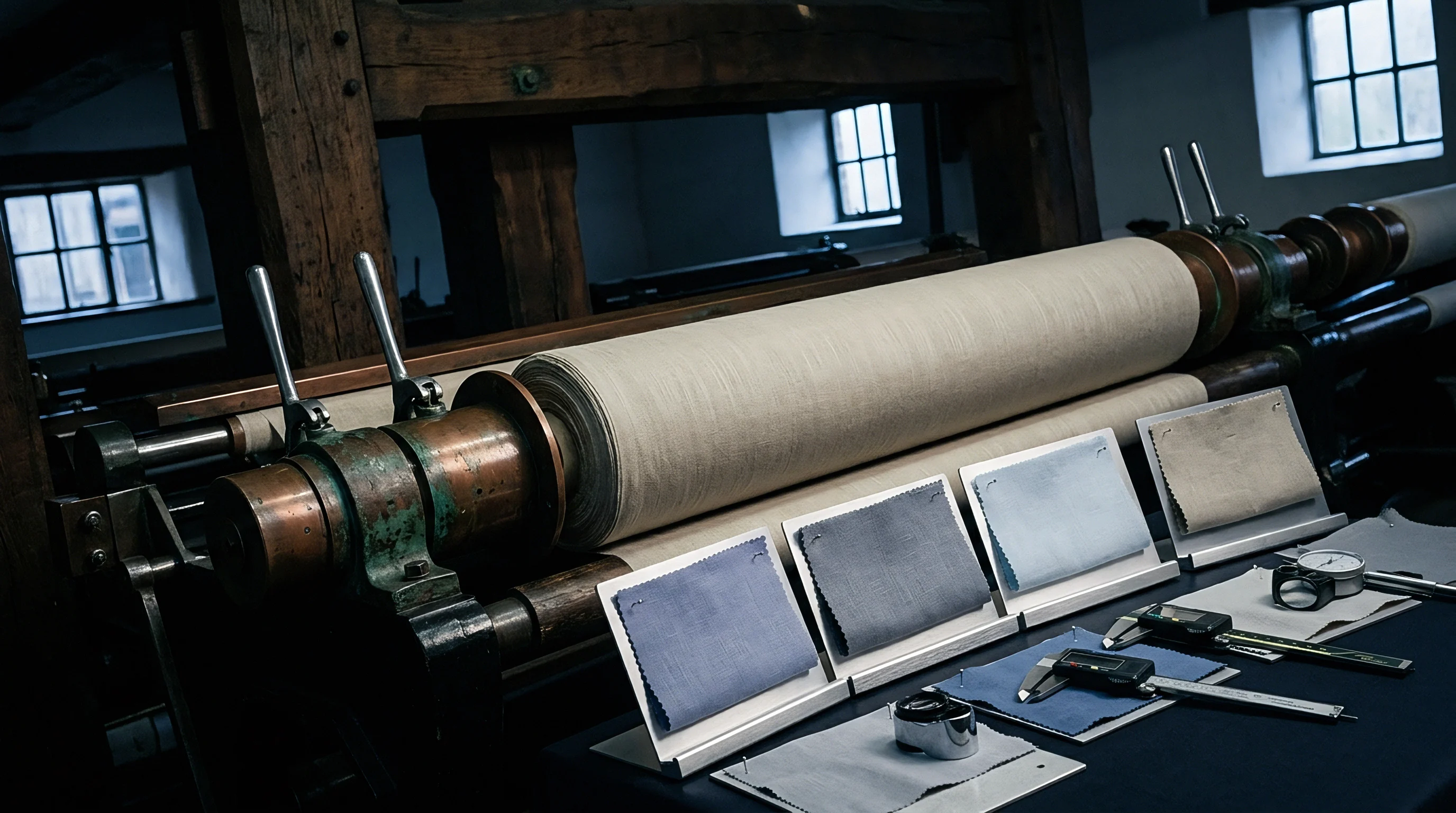
Woven fabric formation is the core mechanical step that confers non-preferential origin on linen. Greige fabric carries this weaving origin. Raw flax goes through hackling, carding, drawing, and spinning to produce yarn of a specific count (in Lea or Nm).
Converting that yarn into fabric involves warping, sizing, drawing-in, and weaving on rapier, air-jet, or projectile looms. This structural transformation turns individual yarns into an interlaced matrix with defined warp and weft densities.
Substantial transformation happens at the loom shed because the fabric’s physical properties are set during weaving. Tensile strength, tear resistance, cover factor, and weave architecture (plain, twill, satin, or dobby) stem directly from loom settings and reed selection. Processing prior to weaving only yields intermediate yarn packages (HS 5306), which lack the physical structure and functional capability of woven cloth (HS 5309).

Mechanical Transformation from Spun Yarn to Greige Linen
Loom operations interlace thousands of warp yarns with continuous weft insertions under controlled tension. The process leaves traceable physical features in the fabric structure. Warp preparation requires beaming yarn packages onto a weaver beam and applying sizing compounds, like polyvinyl alcohol or modified starches, to protect against abrasion when the shed opens at high speeds.
Weaving interlocks warp and weft at right angles. Air-jet looms run at insertion rates above 600 picks per minute for lighter fabrics, whereas rapier looms work coarse or slubbed yarns slower to prevent end breaks. Selvedges, reed marks, and specific pick counts leave physical proof of how the loom was set up.
In audits, inspectors match total declared yardage on shipping dockets against known loom production capacities to verify where weaving occurred.
Physical mill inspections match yarn dockets against loom vibration logs and energy consumption metrics. A facility running 20 rapier looms cannot produce 500,000 metres of heavy 240 gsm linen in a month. Verifying physical capacity protects importers against transshipment schemes, where fabric from one country is routed through a second facility to obtain fraudulent origin papers.

Finishing Operations and the Substantial Transformation Threshold
Wet processing turns stiff greige cloth into finished commercial fabric through desizing, scouring, bleaching, mercerizing, dyeing, printing, or mechanical softening. While these steps alter appearance, hand-feel, color, and dimensional stability, customs frameworks treat wet finishing as secondary processing.
Under EU UCC Annex 22-01, dyeing or printing greige fabric confers non-preferential origin only when paired with two or more substantial preparation or finishing steps ~ such as desizing, scouring, mercerizing, or heat setting ~ AND where the greige cloth was either woven in the EU or imported under specific non-originating rules. Taking greige fabric woven in Country A and sending it to Country B for dyeing and softening leaves origin in Country A. US rules under 19 CFR 102.21 explicitly state that dyeing, printing, and finishing cannot confer origin on woven linen under HS 5309.
Contracts have to account for these rules. A mill in Portugal that buys Chinese greige linen and applies high-value reactive dyeing, enzyme washing, and aero-softening cannot legally label the product “Made in Portugal” for non-preferential entry into North America or Europe. Legally, the origin remains Chinese.
Physical Audit Trail inside the Mill Shed
Proving mechanical transformation requires auditing operational mill records on site. Independent inspectors verify origin by tracing sequential logs generated throughout the weaving run.
- Yarn Receipt Log: Register incoming spun flax yarn shipments, noting yarn lot numbers, spinner identity, weight in kilograms, Lea count, and bill of lading references.
- Warp Beaming Sheet: Record warp beam identification numbers, total yarn ends, sizing chemical batch codes, and beaming machine operator logs.
- Loom Allocation Docket: Tie specific weaver beam serial numbers to individual loom IDs, specifying warp density, target picks per inch, and total planned metreage.
- Greige Roll Production Tag: Attach permanent barcode labels to fabric rolls directly upon doffing from the loom, recording roll number, loom ID, shift time, gross weight, and woven length.
- Grey Store Entry Ledger: Transfer doffed rolls into greige inventory tracking systems prior to inspection, grading, or dispatch to wet processing houses.
Gaps between yarn consumption weights and finished roll weights point to unrecorded fabric substitution. Loom fly and selvedge trimmings account for normal mass loss, but unexplained weight jumps indicate outside fabric was mixed in. Reconstructing the trail requires raw weighbridge dockets.
Commercial finishing houses frequently claim that proprietary enzyme softening and piece-dyeing confer local origin, but customs authorities routinely reject these claims during post-clearance audits.
In a 2023 verification review, an entry filed on the grounds that value added from dyeing and softening Belgian-spun yarn in Jiangsu exceeded forty percent of total fabric cost was rejected, with customs authorities assessing full non-preferential duties based on the Chinese weaving location.


Traceability
Establishing non-preferential origin requires continuous physical and documentary traceability from raw material intake through to export. Fiber growth does not determine origin. Verification falls apart when mill-floor records show broken lot links, unverified mass balance calculations, or missing weighbridge slips.
Compliance depends entirely on audit-proof chain of custody files.
Mass balance modeling supplies the mathematical check for origin verification. A mill must demonstrate that the volume of processed yarn matches the total mass of finished fabric, taking expected waste factors into account. Yields that exceed theoretical limits expose undocumented fabric blending or fraudulent origin claims.

Mass Balance Reconciliation from Raw Bale to Finished Bolt
Linen manufacturing involves predictable weight changes across mechanical and chemical stages. Wet spinning long line flax loses mass during hackling and drafting, whereas sizing adds dry weight before weaving. Desizing and scouring then strip out natural waxes, pectins, and sizing agents, reducing weight until dyeing and finishing add solids back in.
The table below lays out a standardized mass balance model tracking a 10,000 kilogram batch of raw flax yarn through production to final packaged bolts.
| Processing Stage | Input Weight (kg) | Process Yield Factor (%) | Mass Loss / Gain (kg) | Net Stage Weight (kg) | Cumulative Yield (%) |
|---|---|---|---|---|---|
| Yarn Receipt & Rewinding | 10,000.0 | 99.5% | -50.0 (Yarn waste) | 9,950.0 | 99.5% |
| Warp Beaming & Sizing | 9,950.0 | 105.0% | +497.5 (Sizing agents) | 10,447.5 | 104.5% |
| Loom Shed Weaving | 10,447.5 | 96.0% | -417.9 (Fly & selvedge) | 10,029.6 | 100.3% |
| Desizing & Scouring | 10,029.6 | 92.0% | -802.4 (Size & wax loss) | 9,227.2 | 92.3% |
| Bleaching & Piece Dyeing | 9,227.2 | 102.0% | +184.5 (Dye & finish fix) | 9,411.7 | 94.1% |
| Final Inspection & Shearing | 9,411.7 | 98.5% | -141.2 (Cropping & seams) | 9,270.5 | 92.7% |
An initial batch of 10,000 kilograms of yarn yields about 9,270 kilograms of finished woven linen under standard operating conditions. Deviations beyond 3% point to batch substitution or faulty weighing. Auditors check these numbers against weighbridge receipts and laboratory moisture determinations under standard atmospheric conditions (20 deg C, 65% relative humidity).

Documenting Yield Losses across Spinning and Weaving
Spinning raw tow produces yarn, but substantial mass loss happens earlier during scutching, where preparation separates long line flax from short tow fibers and shives. Scutching raw retted straw yields roughly 12% to 15% line fiber, 10% to 12% tow, and over 70% waste shives and dust. When buying spun yarn (HS 5306), an importer starts chain-of-custody tracking at yarn receipt rather than raw straw processing.
Loom operations generate measurable waste during warp setup, weft insertion, and fabric doffing. Air-jet looms produce fringe waste along selvedges, consuming up to 4% of total weft yarn weight depending on reed width and construction. Weave shed logs must record these waste percentages to support mass balance calculations shown to auditors.
Mass balance reconciliations showing zero scrap loss across weaving and wet processing indicate fabricated production logs that fail customs scrutiny.
When an intermediary supplier could not provide matching weighbridge tickets for raw yarn transfers between a spinning mill in Huzhou and a weaving facility in Shaoxing, European customs authorities rejected the origin claim and assessed a duty adjustment and penalty totaling 38,400 Euros. Continuous physical lot tracking is non-negotiable.

Single Consignment Reconciliation Walking Raw Flax Inputs
Evaluating an imported consignment of 15,000 metres of dyed 100% linen fabric (200 gsm nominal weight, total mass 3,000 kg) requires tracing documentation backward step by step through production. Proof hinges on linking specific records at each stage.
- Commercial Export Invoice links the finished fabric shipment to the overseas supplier, specifying fabric construction, weight, HS code 5309.19, and declared country of origin.
- Finishing House Delivery Docket matches finished roll numbers to raw greige lot identifiers, recording width shrinkage (typically 5% to 8%) and length shrinkage (typically 8% to 12%).
- Greige Dyeing Transfer Note confirms movement of specific greige roll numbers from the loom shed to the wet processing plant, showing net grey weight.
- Loom Production Log ties greige roll barcodes to specific loom IDs, weaver beam numbers, and yarn lot numbers spun at the spinning mill.
- Yarn Purchase Invoice and Delivery Note documents transfer of spun linen yarn (HS 5306) from spinner to weaver, stating Lea count, single/ply structure, gross/net weight, and spinner lot numbers.
- Raw Fiber Certificate of Origin identifies the agricultural source of the scutched flax or tow fiber used by the spinning mill.
A single break in this chain destroys origin verification. If the weaving mill cannot connect incoming yarn lots to outgoing greige roll numbers, customs authorities treat the whole consignment as non-originating and apply the highest general tariff rate.


Scope
Private voluntary standards and sustainability certifications often mislead sourcing managers on origin compliance. Certificates do not change customs law. Schemes like European Flax, Masters of Linen, OEKO-TEX Standard 100, and GOTS serve commercial and environmental ends, but their scope certificates carry no legal weight under non-preferential origin rules.
Importers frequently present European Flax certificates to customs inspectors to claim European origin. But European Flax only certifies that raw flax fiber grew in France, Belgium, or the Netherlands, while tracking that fiber through global supply chains. Yarn spun in China from European Flax fiber and woven on Chinese looms carries Chinese origin under both EU UCC Article 60 and US 19 CFR 102.21.

Does Certification Guarantee Non Preferential Customs Origin?
Private schemes operate outside customs frameworks. Customs officers evaluate origin strictly against statutory definitions written into law. A private certificate shows compliance with that scheme’s internal standards, but carries no legal weight for customs origin.
Masters of Linen is a partial geographic exception, since its standard requires all processing from fiber to finished fabric to happen within Europe. A valid certificate indicates that spinning and weaving took place in Europe. Even so, customs authorities insist on official government Certificates of Origin or underlying mill dockets, not private scheme badges.
The table below outlines the scope and legal relevance of major textile certifications.
| Certification Scheme | Issuing Body | Covered Production Stages | Geographic Boundary | Customs Origin Validity |
|---|---|---|---|---|
| European Flax | Alliance for European Flax-Linen & Hemp | Agriculture, Scutching, Chain of Custody | Western Europe (Fiber growth only) | Invalid for fabric origin; proves fiber source only |
| Masters of Linen | Alliance for European Flax-Linen & Hemp | Fiber, Spinning, Weaving, Finishing | 100% European Territory | Corroborative evidence; requires statutory dockets |
| OEKO-TEX Standard 100 | OEKO-TEX Association | Chemical testing of finished product | Global (Any certified facility) | Zero origin value; addresses human ecology safety |
| GOTS (Organic) | Global Standard gGmbH | Agriculture, Processing, Social Criteria | Global (Certified supply chains) | Zero origin value; addresses organic status |
Sourcing teams must separate sustainability credentials from tariff compliance files. European Flax certification confirms premium long-staple fiber input, but origin classification follows the location of the loom.

Field to Fiber Schemes versus Customs Transformation Criteria
Understanding the gap between fiber traceability and fabric transformation requires looking at scheme audit rules. European Flax uses mass-balance transaction certificates from ISO 17065 accredited bodies to trace fiber volumes across borders. A spinning mill in Jiangsu buys European Flax certified line flax, spins it into yarn, and hands transaction certificates to a local weaving mill.
The resulting fabric keeps its European Flax certification because fiber chain-of-custody was maintained. Yet the transformation from yarn (5306) to woven fabric (5309) took place in Jiangsu, so legal non-preferential origin belongs strictly to China. Relying on the fiber certificate leads to false declarations, holds at the port, and steep penalties.

Commercial Misreadings of Private Provenance Credentials
Importers take on heavy financial liability when they mistake marketing badges for legal proof. Compliance files must categorize certificates by their actual legal function.
- European Flax Scope Certificate verifies agricultural fiber source in France, Belgium, or the Netherlands, but gives no authority for European country-of-origin billing or customs clearance.
- Transaction Certificate (TC) tracks certified fiber mass transferred between processing entities, confirming batch volume without altering statutory origin rules based on manufacturing site.
- OEKO-TEX Test Report confirms chemical residue compliance below Annex 4 thresholds, carrying no weight in customs origin audits.
- Chamber of Commerce Certificate of Origin provides administrative documentation issued by non-customs bodies, which customs authorities regularly challenge and override if underlying mill dockets fail statutory transformation tests.
Customs officers look at original mill dockets. Private certificates serve commercial branding, while mill logs satisfy legal requirements.
What documentary evidence remains sufficient to defend an origin declaration when an intermediary mill blends European Flax certified line flax with uncertified regional tow yarn prior to wet spinning?


Verification
Customs authorities use testing and administrative audits to verify declared origin. When paperwork looks suspect or incomplete, laboratory testing supplies objective data on fiber provenance and processing history. Verification combines chemical testing, on-site mill audits, and binding ruling mechanisms.
Stable Isotope Ratio Mass Spectrometry (IRMS) is the primary analytical tool for testing geographic fiber origin. During growth, flax plants take up carbon, hydrogen, oxygen, nitrogen, and strontium isotopes from local rainfall, soil chemistry, and climate. These isotopic profiles create a geographic fingerprint embedded in the cellulose.

Isotopic Mass Spectrometry and Physical Microstructure Profiling
IRMS testing measures isotope ratios in delta notation against international reference standards. Oxygen (delta 18O) and hydrogen (delta 2H) ratios correlate with latitude, altitude, and rainfall patterns relative to the coast. Strontium ratios (87Sr/86Sr) reflect the geological age and mineral composition of the underlying bedrock where the flax was grown.
Customs laboratories compare isotopic signatures from fabric samples against global geo-location reference databases. If an importer declares French origin for linen, but IRMS analysis yields oxygen and strontium ratios typical of inland East Asia, customs will issue a formal notice challenging the entry. The table below outlines common testing methods used in origin verification.
| Testing Technique | Targeted Parameter | Analytical Precision | Customs Verification Objective |
|---|---|---|---|
| IRMS (delta 18O / delta 2H) | Precipitation & Climate Isotopic Ratios | High (±0.5 per mil) | Verifies geographic latitude/climate zone of flax growth |
| IRMS (87Sr / 86Sr) | Soil Bedrock Geology Signatures | Ultra-High (±0.0001) | Determines geological provenance of agricultural soil |
| Trace Element Analysis (ICP-MS) | Rare Earth Element Distributions | PPM / PPB Levels | Matches soil mineral uptake profiles to specific regions |
| Cross-Section Microscopy | Fiber Lumen & Cell Wall Morphology | Microscopic Resolution | Identifies retting method (dew vs water retting) and fiber quality |
| Yarn Twist & Weave Analysis | Mechanical Construction Parameters | Structural Mapping | Verifies specific machinery type used for spinning and weaving |
Lab tests confirm geographic isotopes. While IRMS shows where the plant grew, it cannot reveal where the fabric was woven. Officers combine isotopic data with mechanical weave analysis to evaluate the whole production chain.

Customs Administrative Audits and Evidentiary Dossier Standards
Formal audits require importers to produce a Non-Preferential Origin Dossier within strict deadlines, usually 30 days from notice. An incomplete file leads to immediate origin rejection, triggering standard tariff rates plus administrative fines.
Importers submit binding origin applications before the first container leaves port. A complete dossier contains verified copies of raw material purchase orders, spinning production sheets, loom vibration logs, greige doffing tags, dye house batch records, commercial invoices, bills of lading, and mill-floor mass balance reconciliations. Every document must show linked batch numbers that build an unbroken paper trail.
Administrative Challenges and Binding Origin Ruling Procedures
To eliminate tariff risk before shipping, importers apply for formal administrative rulings. In the EU, national authorities issue Binding Origin Information (BOI) decisions. In the United States, CBP issues ruling letters under 19 CFR Part 177.
A Binding Origin Information decision provides legal certainty, binding customs authorities across all EU member states for three years from issuance. The application requires detailed manufacturing descriptions, exact HS classification determinations, mill location certifications, and physical fabric samples. Securing BOI rulings before committing capital protects sourcing programs against sudden shifts in enforcement.
Binding Origin Information rulings protect importers against unexpected tariff reclassifications provided the physical manufacturing process matches the submitted dossier exactly.
A reliable rule of thumb in origin verification is that physical mill records generated at the moment of weaving carry far more legal weight during an audit than any post-facto declaration from a trade association.


Contract
Commercial sourcing contracts must allocate origin risk explicitly between buyer and seller. Standard purchase terms with vague guarantees like “supplier guarantees high quality European linen” leave buyers exposed to enforcement actions, back-duties, and inventory seizures. Rigorous agreements convert customs criteria into enforceable obligations backed by financial indemnities.
The contract must define origin using the statutory rules of the destination market. Sourcing managers should insist on full visibility into sub-tier manufacturing locations, establishing unannounced audit rights for spinning mills, loom sheds, and wet processing facilities.
Structuring Non Preferential Origin Warranties in Sourcing Agreements
Origin warranties should operate as absolute conditions rather than simple representations. A breach must trigger immediate default remedies, including rejection, full refunds, return freight coverage, and complete reimbursement of customs duties, penalties, and legal fees incurred by the buyer.
Contracts should require the seller to supply complete origin documentation before dispatch. Payment terms should link final invoice settlement to successful customs clearance and dossier verification. Holding 20% of the invoice value in escrow until clearance provides real leverage against non-compliant suppliers.

Financial Exposure Allocation and Duty Penalty Indemnification
Failing to comply with non-preferential origin rules carries severe financial penalties under enforcement statutes. In the United States, 19 U.S.C. 1592 permits civil penalties for false origin declarations, ranging from double the lost duty for negligence up to 100% of the domestic value for fraud. European authorities can recover back-duties retroactively for up to three years, alongside administrative fines and interest.
Sourcing agreements need explicit indemnification clauses to protect buyers from these liabilities. Standard terms should state: “Seller warrants that all woven linen fabric delivered under this Agreement complies strictly with non-preferential origin criteria established under. Seller agrees to defend, indemnify, and hold harmless Buyer from all customs duties, back-assessments, civil penalties, administrative fines, and legal costs arising from any inaccuracy in Seller’s origin declarations or documentation.”
Contracts incorporating strict origin definitions, mandatory dossier delivery, audit access rights, and financial indemnities insulate importers from regulatory exposure. Sourcing teams that set up rigorous verification systems before placing mill orders protect operational margins and ensure compliance across global supply chains.