Forensic Microscopic Quantification of Chemical Degumming Residuals in Non-European Linen Spinning Entries
Forensic microscopic and spectroscopic testing quantifies chemical degumming residuals, exposing invalid provenance claims on non-European linen yarn entries.

Stain
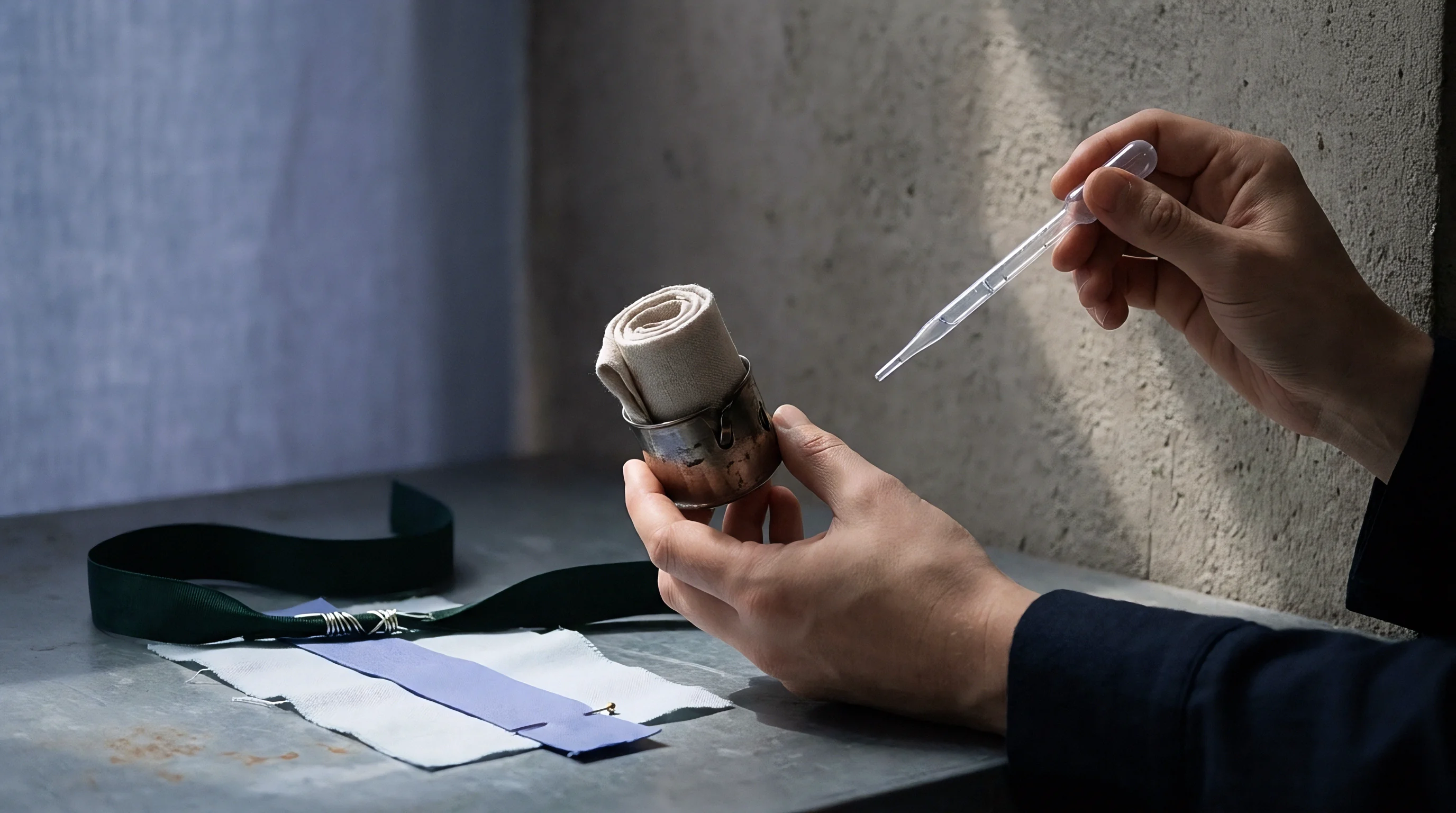
Evaluating imported flax yarn under an optical microscope begins with differential histochemical dyeing of cross-sectional and longitudinal mounts. Fiber bundles sourced from non-European spinners frequently carry severe structural damage from aggressive chemical digestion rather than traditional field retting. Natural dew-retting in Western Europe relies on soil fungi and bacteria to break down pectic substances in the middle lamella, preserving the native cellulose microfibril arrangement and leaving distinct residual matrix polysaccharides intact between cells.
When Asian mills process unretted green tow or low-grade decorticated ribbon, they substitute strong alkaline boiling baths to free spinnable fibers ~ a shortcut that leaves recognizable histochemical traces across the fiber wall and central lumen.
Selective histochemical staining separates biological retting from chemical extraction by targeting carboxylated pectins, non-cellulosic hemicelluloses, and residual lignin. Dual-staining with Astra Blue and Basic Fuchsin produces clear chromatic boundaries inside intact technical bundles. Astra Blue binds selectively to non-lignified, hydroxyl-rich cellulosic walls, while Basic Fuchsin stains polyuronic acids and phenolic lignin remnants.
Biologically dew-retted flax fibers exhibit uniform red-purple staining along the middle lamella, reflecting intact pectic acid linkages and preserved phenolics. Chemically degummed fibers show no stain retention in the middle lamella; their ultimate fiber boundaries turn a washed-out blue, broken only by patchy crimson flecks where residual sodium hydroxide saponified outer pectic layers without penetrating dense fiber nodes.

Optical Histochemistry and Selective Dye Binding Mechanisms
Brightfield evaluation with Ruthenium Red yields an immediate measure of residual pectic acids across individual ultimate fibers. As an inorganic complex, Ruthenium Red intercalates specifically into unesterified galacturonan sequences within the pectic matrix. Cross-sections embedded in methacrylate resin at a 4-micrometer thickness permit direct photometric measurement of stain intensity.
Intact dew-retted ultimate fibers show a continuous ring of deep red absorption at the outer primary wall, generating optical densities between 0.65 and 0.88 absorbance units. By contrast, chemically degummed fibers register optical density values under 0.15 absorbance units across 80 percent of measured perimeters, confirming that pectic substances were stripped during processing.
Fluorochrome staining under UV illumination sharpens the distinction between biological and chemical processing. Calcofluor White binds to beta-1,4-glucans in cellulose, fluorescing bright blue at 365-nanometer excitation. In sound flax, native surface pectins shield these cellulose binding sites and keep fluorescence intensity moderate.
Chemical degumming dissolves this pectic sheath, exposing raw crystalline microfibrils to the dye. Under digital micro-fluorometry, chemically degummed fibers exhibit a threefold increase in integrated fluorescence intensity over standard dew-retted controls, signaling complete cuticular stripping.
Under cross-polarized ultraviolet illumination at 365 nanometers, chemically degummed flax ultimate fibers exhibit a 45 percent reduction in middle lamella fluorescence emission compared to dew-retted European flax strands.

Polarized Light Photomicrography of Cell Wall Microfibrillar Distortions
Polarized light microscopy documents the cell-wall damage caused by aggressive alkaline boiling. Sound ultimate fibers maintain a regular spiraling microfibrillar structure with a helical angle of roughly 10 degrees relative to the long axis. Under crossed polarizers, native fibers show uniform extinction positions and sharp dislocation marks ~ kink bands ~ spaced at regular intervals of 80 to 150 micrometers.
These nodes arise naturally from mechanical flexure during growth and scutching. Chemically degummed fibers from non-European mills show widespread microfibrillar disruption instead: high temperatures and concentrated alkali swell the cell wall locally, opening micro-voids and triggering fibrillar delamination.
Kink band frequency per unit of fiber length serves as a direct gauge of heavy chemical treatment. Cell wall dislocations evaluated under cross-polarized light with a 40x oil-immersion objective reveal distinct structural profiles: chemically degummed fibers consistently register over 38 kink bands per millimeter, compared to 14 to 18 in standard European dew-retted flax. Degummed samples also show a diffuse, irregular extinction angle that drifts up to 6 degrees from normal values as native Cellulose I degrades partially into amorphous regions.
| Microscopic Evaluation Parameter | European Dew-Retted Scutched Flax | Water-Retted High-Grade Flax | Non-European Chemical Degummed Tow | Diagnostic Reagent Standard |
|---|---|---|---|---|
| Ruthenium Red Optical Density | 0.65 to 0.88 ABS | 0.72 to 0.95 ABS | 0.08 to 0.18 ABS | ISO 2076 / Quantitative Histochemistry |
| Astra Blue / Basic Fuchsin Ratio | 1.2 to 1.5 Chromatic Index | 0.9 to 1.1 Chromatic Index | 3.8 to 5.2 Chromatic Index | ASTM E2105 Spectrophotometric Transmittance |
| Calcofluor White Intensity | 180 to 240 RFU | 150 to 210 RFU | 580 to 740 RFU | UV Fluorometry at 365 nm Emission |
| Dislocation Node Frequency | 14 to 18 nodes / mm | 11 to 15 nodes / mm | 38 to 52 nodes / mm | Crossed Polarized Light Microscopy |
| Lumen Residual Silicate Crusts | Absence confirmed | Absence confirmed | Dense focal crystallites | SEM-EDS / Polarized Optical Micrography |
Sample preparation requires a rigorous mounting routine to prevent mechanical artifacts from compromising cross-sectional data. Technicians follow a structured protocol to isolate optical metrics for compliance reporting.
- Specimen Selection Extract twenty representative 50-millimeter yarn segments from randomly drawn cones across the imported consignment to ensure statistical integrity.
- Resin Impregnation Dehydrate yarn segments in a graded ethanol series and embed them in a low-viscosity acrylic resin, curing at 60 degrees Celsius for 24 hours.
- Microtome Sectioning Slice ultra-thin cross-sections at a nominal thickness of 3.5 micrometers using a diamond knife on a precision rotary microtome.
- Histochemical Staining Submerge mounted sections in a 0.05 percent aqueous Ruthenium Red solution for exactly twelve minutes at 20 degrees Celsius, followed by a controlled deionized water rinse.
- Image Acquisition Capture digital micrographs under calibrated illumination using a high-resolution monochrome CCD camera coupled to a polarized light microscope.
- Densitometric Quantification Calculate mean optical density across thirty ultimate fiber cell wall boundaries per field of view using calibrated image analysis software.
Whether non-European mills can re-introduce synthetic pectic coatings after chemical degumming to mask middle lamella stripping during optical inspection remains an open question.


Alkali
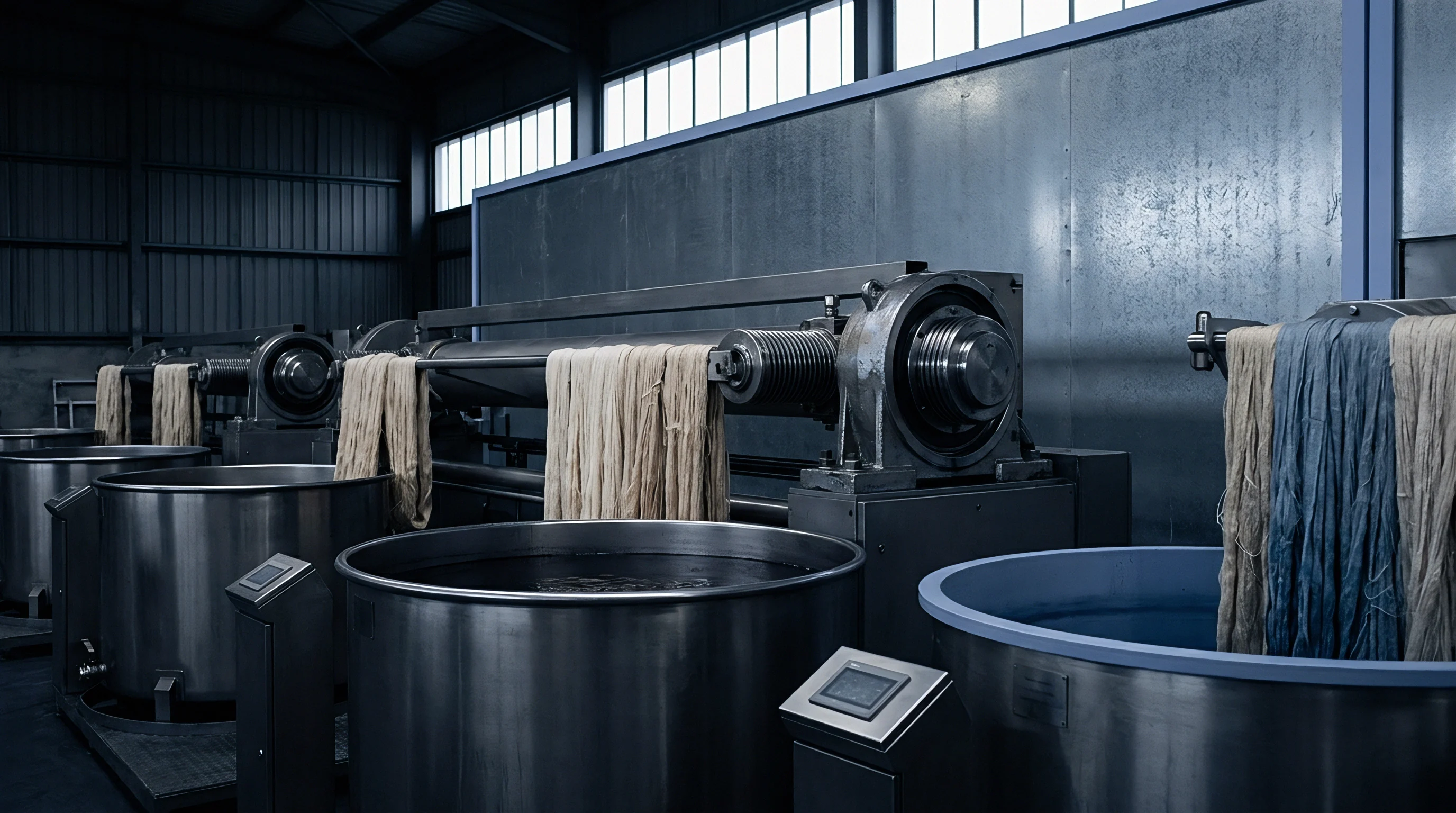
Chemical degumming in non-European spinning facilities uses rapid alkaline digestion to break down pectic substances, bypassing the four to six weeks required for European field retting. Mills in China, India, and Vietnam frequently purchase low-cost unretted green tow, decorticated fiber ribbons, or scutcher waste. Running this raw material on high-speed wet-spinning frames requires pressure-boiling the fiber bundles to strip non-cellulosic encrustants.
Industrial formulations generally combine sodium hydroxide concentrations between 8 and 14 grams per liter with sodium carbonate, sodium sulfite, hydrogen peroxide bleaches, and sodium silicate as a stabilizer and sequestrant. The resulting bath alters both the structure and the chemical profile of the fiber.
Alkaline digestion targets the ester bonds that link galacturonan chains within the pectic matrix. Hydrolysis converts insoluble protopectin into soluble sodium pectate salts that leach into the boiling liquor, while the hot alkali simultaneously saponifies natural waxes and fats in the primary cell wall. Although this treatment separates coarse technical bundles into individual ultimate fibers, it lacks the enzymatic selectivity of biological retting.
Sodium hydroxide attacks accessible hemicelluloses, degrading xylan and glucomannan polymers while partially dissolving structural lignin. Total non-cellulosic mass drops from an initial 18 to 25 percent down to under 3 percent, leaving an over-purified, brittle cellulosic core.

Alkaline Digestion Kinetics and Pectic Substance Removal Limits
Pectic extraction in hot alkaline liquor follows pseudo-first-order kinetics, accelerated by temperatures between 105 and 130 degrees Celsius inside pressurized vessels. Over extended cycles, the liquor penetrates deep into the secondary walls of individual ultimate fibers. Excessive sodium hydroxide exposure induces mercerization, shifting the crystalline lattice of native Cellulose I toward Cellulose II and forcing fibers to swell laterally while shrinking along their longitudinal axis.
Under the microscope, this partial conversion is evident in cross-sectional distortion: naturally round or polygonal fibers collapse into irregular kidney-bean shapes with pinched lumens.
Prolonged alkaline boiling also reduces fiber tenacity. Single-fiber micro-tenacity testing measures this structural degradation directly. European ultimate fibers retted naturally maintain a mean tenacity between 58 and 72 centinewtons per tex because their crystalline domains remain aligned.
In chemically degummed fibers, tenacity drops to between 32 and 44 centinewtons per tex; loss of the inter-fibrillar hemicellulose matrix impedes stress transfer across microfibrils, resulting in early micro-void formation and brittle fractures under load.
Purchasers invoking ISO 2076 fiber identification standards automatically reject yarn lots where residual silicate ash concentrations exceed 0.12 percent by dry weight.

Silicate Builder Entrapment and Inorganic Ash Morphology
Commercial degumming baths routinely incorporate sodium silicate to prevent suspended soil from redepositing and to buffer hydrogen peroxide during combined scouring and bleaching operations. Under high alkalinity, sodium silicate reacts with calcium and magnesium ions leached from the plant tissue, precipitating insoluble mineral silicates. These precipitates form dense micro-crystalline crusts that adhere to fiber surfaces and lodge inside lumen cavities.
Because standard washing cycles cannot dissolve or dislodge these entrapped deposits, their presence serves as a durable microscopic indicator of chemical processing.
Scanning electron microscopy with energy-dispersive X-ray spectroscopy (SEM-EDS) readily identifies these residues in yarn cross-sections. Energy spectra taken from the lumen interiors of chemically degummed fibers show pronounced silicon and sodium peaks, yielding silicon concentrations between 1.4 and 3.8 weight percent of dry ash mass. Natural dew-retted European flax contains only trace silicon below 0.08 weight percent, restricted to outer epidermal cells.
Localized silica crusts embedded within the central lumen under SEM-EDS confirm that yarn was processed in an alkaline bath containing silicate builders.
| Chemical Component / Fiber Metric | European Dew-Retted Yarn Standard | Chemically Degummed Chinese Tow Yarn | Chemically Degummed Indian Tow Yarn | Analytical Test Method |
|---|---|---|---|---|
| Residual Pectin Content | 2.8 to 4.5 wt% | 0.3 to 0.7 wt% | 0.2 to 0.6 wt% | HPLC / Carbazole Colorimetric Assay |
| Hemicellulose Fraction | 12.5 to 16.0 wt% | 3.1 to 5.4 wt% | 2.8 to 4.9 wt% | Gas Chromatography / Alditol Acetates |
| Lignin Mass Content | 2.2 to 3.8 wt% | 0.6 to 1.2 wt% | 0.4 to 0.9 wt% | Acetyl Bromide Spectrophotometry |
| Lumen Silicon Concentration | < 0.08 wt% | 1.45 to 3.20 wt% | 1.80 to 3.75 wt% | SEM-EDS Micro-chemical Analysis |
| Total Inorganic Ash Content | 0.8 to 1.2 wt% | 2.4 to 4.1 wt% | 2.9 to 4.8 wt% | ISO 11566 High-Temperature Calcination |
| Cellulose II Lattice Ratio | 0.00 (Pure Cellulose I) | 0.14 to 0.28 Ratio | 0.18 to 0.35 Ratio | X-Ray Diffraction / Wide-Angle XRD |
Residual non-cellulosic artifacts span physical, structural, and chemical parameters, providing several independent markers for identifying non-European wet-spinning treatments.
- Lumen Crystalline Deposits Insoluble calcium and sodium silicate precipitates aggregate in central lumen channels, forming solid mineral cores visible under backscattered electron imaging.
- Cuticular Fibrillation Stripping Stripping the protective waxy cuticle exposes underlying S1 microfibril layers, causing extensive longitudinal splitting during mechanical flexure.
- Cellular Profile Collapse Polygonal fiber cross-sections flatten into distorted profiles as hot alkaline extraction removes supporting inter-cellular pectins.
- Lignin Remnant Aggregation Residual phenolics aggregate into irregular electron-dense droplets along inner cell wall surfaces instead of staying evenly distributed across middle lamellae.
- Micro-void Formation Extracting hemicellulose networks leaves sub-micron longitudinal voids within secondary wall structures, increasing fiber porosity and dye uptake rates.
Heavy alkaline boiling is often defended as a necessary conditioning step for running fiber on high-speed spinning frames, though in practice it replaces biological field retting.


Photometry
Micro-spectroscopic analysis connects optical observations to underlying chemistry by measuring molecular absorption spectra at sub-micron resolution within fiber cross-sections. Combining Attenuated Total Reflectance Fourier Transform Infrared spectroscopy with optical microscopy (FTIR-ATR) maps functional group distributions across individual cell walls. Degummed yarns show clear depletion patterns in specific chemical bonds, providing analytical confirmation of aggressive digestion.
FTIR-ATR analysis focuses on absorption bands associated with non-cellulosic matrix components. The ester carbonyl stretching band at 1735 reciprocal centimeters serves as the primary diagnostic peak for native pectic polysaccharides and acetylated hemicelluloses. In natural European flax, this band remains prominent relative to the cellulose backbone reference peaks.
Sodium hydroxide degumming hydrolyzes these ester linkages into carboxylate salts, eliminating the 1735 reciprocal centimeter band and producing a broad, asymmetric carboxylate absorption centered near 1600 reciprocal centimeters.

Micro-Spectroscopic Mapping of Hemicellulose and Lignin Infrared Band Ratios
Quantitative spectroscopy measures absorbance ratios between diagnostic non-cellulosic peaks and stable cellulosic reference bands. The C-O-C pyranose ring vibration at 1030 reciprocal centimeters provides an internal reference for total cellulose content. Dividing peak height at 1735 reciprocal centimeters by peak height at 1030 reciprocal centimeters yields a normalized pectin-hemicellulose index: European dew-retted yarns consistently register between 0.22 and 0.38, whereas chemically degummed yarns from Asian mills fall below 0.03.
Infrared micro-spectroscopy tracks delignification in the same manner. Aromatic ring stretching at 1510 reciprocal centimeters and guaiacyl C-O stretching at 1245 reciprocal centimeters reflect residual lignin content. In sound flax, lignin concentrates in the middle lamella and at cell corners.
Chemical degumming strips a large share of this material, lowering the 1510 to 1030 reciprocal centimeter ratio from native values of 0.12 ~ 0.18 down to below 0.04. Residual lignin in treated fibers also carries oxidation signatures, visible as broad shoulder bands between 1650 and 1680 reciprocal centimeters caused by conjugated carbonyls formed during alkaline scouring.
Clean biological retting retains cohesive pectin structures along the fiber lumen while chemical degumming strips inter-cellular binders and deposits discrete inorganic crystalline crusts.

Raman Laser Scanning and Silicate Salt Micro-Localization
Confocal Raman micro-spectroscopy provides spatial resolution down to 250 nanometers, enabling non-destructive depth profiling of chemical residues within fiber walls. Using a 532-nanometer laser, Raman scans target the Si-O-Si symmetric stretching vibration of sodium silicate at 1080 reciprocal centimeters. Cross-sectional line scans of degummed samples demonstrate elevated silicon spectral intensity localized in the central lumen and along outer primary wall remnants.
Raman mapping also evaluates the structural order of crystalline cellulose inside the cell wall. The sharp Raman band at 1095 reciprocal centimeters corresponds to C-C and C-O ring stretching along cellulose chains. Measuring the full-width at half-maximum (FWHM) of this band provides a metric for microfibril alignment and crystallinity: native European dew-retted fibers produce narrow FWHM values between 8.5 and 10.2 reciprocal centimeters, while chemically degummed fibers show broadened values between 14.8 and 18.5 reciprocal centimeters, documenting lattice distortion and partial amorphous conversion induced by hot alkaline baths.
Laboratory auditors use a structured checklist when evaluating micro-spectroscopic datasets from imported flax consignments.
- Ester Carbonyl Peak Ratio Calculate the 1735 to 1030 reciprocal centimeter FTIR absorption ratio; values below 0.05 confirm industrial chemical hydrolysis of native pectic esters.
- Carboxylate Salt Transformation Verify the appearance of broad 1600 reciprocal centimeter bands indicating saponification of pectic acids by sodium hydroxide.
- Silicate Si-O-Si Band Detection Scan fiber lumens for 1080 reciprocal centimeter Raman peaks matching inorganic silicate sequestrant residues.
- Cellulose Crystallinity Width Measure the 1095 reciprocal centimeter Raman FWHM line width; broadening beyond 14 reciprocal centimeters proves crystalline lattice swelling.
- Aromatic Lignin Index Compute the 1510 to 1030 reciprocal centimeter infrared ratio; values below 0.04 indicate aggressive chemical delignification.
Any sample exhibiting under two percent residual pectin in infrared mapping has undergone chemical degumming, regardless of claims on accompanying field certificates.

Qualification
Chain-of-custody verification for linen yarn requires matching physical fiber characteristics against recorded processing steps. Trade standards including European Flax and Masters of Linen require certified yarn to originate from flax grown in Western Europe and converted via approved mechanical retting and spinning methods. Non-European spinners sometimes import unretted European green tow or raw scutcher waste, degum it chemically in local mills, and re-export the finished yarn under European scope certificates.
Microscopic testing for chemical degumming residuals detects this break in provenance directly.
A scope certificate confirms only that a given volume of raw scutched flax was harvested in an approved region; it does not verify that downstream processing outside Europe followed certified mechanical methods. When an overseas mill boils green scutched tow in sodium hydroxide to spin yarn, the material transitions from a naturally retted fiber into a chemically altered product. Transaction certificates issued for such shipments violate program rules whenever chemical digestion replaces biological retting to work around unretted stock.

Does Chemical Degumming Invalidate Non-European Flax Scope Certificates?
Subjecting European-grown raw flax to chemical degumming during overseas spinning invalidates the chain-of-custody claim. Program rules restrict allowable transformation to traditional mechanical scutching, hackling, carding, and wet spinning, where fiber separation depends on field retting and mechanical drafting. Chemical boiling replaces that biological breakdown with industrial digestion, altering the fiber’s fundamental physical and chemical identity.
Consequently, a scope certificate issued for raw European fiber cannot cover yarn that carries microscopic residues of chemical degumming at import.
Enforcement pairs micro-spectroscopic analysis with raw material delivery records. Auditing spinning mill mass-balance ledgers alongside residual testing exposes fraudulent certificate recycling. When laboratory evaluation detects silicate lumen crusts, cellulose lattice distortion, and pectin depletion in yarn entered under a European Flax scope certificate, the certifying body revokes the transaction certificate for that lot.
The importer loses access to preferential origin or sustainability declarations, exposing the shipment to commercial claims and customs seizure.
Scope certificates issued for raw European scutched flax lose all chain of custody validity when imported fiber undergoes unapproved chemical boiling in non-European mills.

Mass Balance Verification across Non-European Spinning Mill Input Logs
Reconciling raw fiber inputs against finished yarn production provides operational proof of chemical degumming. Biological dew-retting combined with mechanical spinning produces predictable mass yields: scutched flax fed into a standard wet-spinning line loses 12 to 18 percent of its initial dry weight through hackling short tow removal, carding fly loss, and comb waste. In contrast, chemical degumming of unretted green tow results in dry mass losses between 22 and 35 percent as pectins, hemicelluloses, waxes, and water-soluble extractives leach into the liquor.
Mills attempting to conceal chemical degumming often enter inflated yields in their mass-balance records to mimic mechanical conversion rates, an anomaly that auditing quickly flags. If a mill logs 100 metric tons of raw unretted European tow and claims 82 metric tons of finished yarn, but laboratory testing shows residual pectin at 0.4 weight percent, the mass balance fails. Accounting for the actual 28 percent mass loss caused by chemical digestion means 100 metric tons of green fiber could yield at most 72 metric tons of spinnable fiber.
The missing 10 metric tons of declared output indicates that the facility either blended uncertified local fiber or manipulated records to mask digestion losses.
| Supply Chain Route / Origin Claim | Declared Certification Scope | Observed Microscopic Residual Marker | Actual Processing Operation | Audit Status / Risk Flag |
|---|---|---|---|---|
| Direct European Mechanical Wet Spinning | Masters of Linen / 100% European | Pectin 3.8%, Ester Ratio 0.31, No Silicates | Biological Dew Retted / Mechanical Hackling | Fully Compliant / Certificate Valid |
| Asian Spinning of European Scutched Tow | European Flax Scope Certificate | Pectin 0.4%, Ester Ratio 0.02, Lumen Silicates | Alkaline Boiling / Chemical Degumming | Non-Compliant / Certificate Revoked |
| Asian Spinning of Local Green Tow Blend | Falsified European Origin Claim | Cellulose II Ratio 0.22, Kink Nodes 44/mm | Pressure Scouring / Bleach Digestion | Fraudulent Entry / Customs Seizure Risk |
| European Dry Spinning of Long Line Flax | European Flax Scope Certificate | Pectin 4.2%, Ester Ratio 0.34, Low Dislocation | Biological Dew Retted / Mechanical Spinning | Fully Compliant / Certificate Valid |
When customs brokers present origin certificates for imported linen yarn, specific standard clauses govern the validity of the declaration.
Under section 4.2 of the European Flax Standard Governance Rules, any chemical treatment applied to unretted or partially retted flax straw, tow, or fiber that reduces the natural non-cellulosic polymer ratio below the 2.0 percent dry mass threshold terminates the scope certificate immediately and permanently disqualifies the yarn from European origin labeling.


Penalty
Financial and regulatory exposure from unauthorized chemical degumming affects importers, brand owners, and intermediaries across the supply chain. Mills using chemical boiling to convert cheap green tow often invoice yarn at standard long-line retted prices, capturing the margin between certified European goods and low-grade byproduct. When forensic testing identifies chemical degumming residuals in delivered yarn, the resulting liabilities include tariff reclassification, customs penalties, customer chargebacks, and breach-of-contract claims.
Customs authorities in major import markets enforce tariff classifications according to physical fiber condition and declared provenance. Under Harmonized System nomenclature, raw or scutched flax falls under HS heading 5301, while spun linen yarn enters under HS heading 5306. Tariff schedules maintain distinct classifications for true retted flax yarns versus chemically modified or bleached products.
Importers declaring chemically degummed flax yarn under preferential European agreements risk reclassification into non-preferential categories, triggering retroactive duty assessments, anti-dumping duties, and administrative fines reaching up to three times the landed value.

Tariff Reclassification Exposure under Customs Nomenclature Schedules
Customs actions depend on analytical testing to challenge disputed classifications. When customs laboratories detect total pectin depletion, cellulose lattice distortion, and elevated silicate ash in yarn samples, authorities invalidate the declared origin and fiber description. Customs officers then reclassify the entry from preferential linen yarn headings into categories for chemically modified or blended fibers carrying higher baseline duties.
For a shipment of 25 metric tons of fine linen yarn imported into North America from an Asian mill, declared as 100 percent European-retted flax yarn at $28 per kilogram, the base invoice value equals $700,000. If customs testing uncovers chemical degumming residuals and invalidates the origin certificate, zero-duty preferential treatment is revoked. Reclassifying the entry under standard non-preferential schedules with an 8.8 percent general duty rate creates an immediate retroactive duty liability of $61,600.
Civil penalties for negligent misdeclaration can reach 100 percent of landed value, adding another $700,000 in exposure for the importer of record.

Contractual Origin Warranties and Rejection Liability Arithmetic
Commercial purchase contracts must include explicit technical thresholds for residual chemical markers to protect buyers from unretted, chemically boiled stock. Standard purchase orders specifying only “100 percent linen yarn” leave buyers unprotected against degummed tow. Enforceable quality assurance agreements establish clear quantitative limits for pectin mass fraction, ester carbonyl peak ratios, and lumen silicate ash, backed by mandatory third-party laboratory verification before shipment.
The financial impact of lot rejection compounds when chemical degumming residuals surface post-delivery. If a weaving mill receives 10 metric tons of chemically degummed flax yarn, converts it into 45,000 meters of greige fabric, and subsequently experiences fabric strength failure during wet finishing due to microfibrillar degradation, losses extend far beyond the raw yarn invoice.
The direct financial arithmetic of this quality failure encompasses several compounding expense lines:
Yarn procurement cost (10,000 kg at $26/kg): $260,000. Weaving conversion cost (45,000 meters at $4.50/meter): $202,500. Finishing laboratory testing and forensic assay fees: $14,800.
Scrap disposal and environmental compliance fees: $8,500. Total direct financial loss: $485,800.
If the underlying supply agreement lacks clear chemical residue warranties and defined arbitration jurisdiction, recovering these losses from an overseas spinning mill is difficult, leaving the buyer to absorb the full financial loss.
Failing to verify chemical residue levels prior to customs entry leaves importers exposed to total shipment forfeiture, severe customs penalties, and unrecoverable downstream losses when degraded yarns fail during weaving and finishing.