Stable Isotope Ratio Identification of Primary Flax Origin
Stable isotope ratio analysis of carbon, oxygen, and strontium authenticates primary flax origin by matching fiber isotopic signatures to regional isoscapes.


Soil
During growth, plant tissue absorbs heavy and light isotopes directly from its surroundings. Rainwater, atmospheric carbon dioxide, and soil minerals leave persistent atomic ratios fixed within the cell walls of Linum usitatissimum. Weather systems over coastal Western Europe deposit meteoric water depleted in heavy oxygen, whereas dry continental interiors produce enriched isotopic condensation.
Reviewing raw fiber declarations against these geographical baselines gives buyers a physical check that paper shipping dockets cannot provide.

Geographic Isotopic Baselines in Primary Sourcing Regions
Regional precipitation determines the oxygen-18 to oxygen-16 ratio in growing crops. Atlantic rain moving across Northern France, Belgium, and the Netherlands carries depleted oxygen isotope ratios between minus five and minus eight per mil relative to Vienna Standard Mean Ocean Water. Transpiration through leaf stomata in temperate coastal fields moderately enriches stem water, yielding fiber cellulose values from plus nineteen point five to plus twenty-two point five per mil.
In contrast, continental growing areas like Heilongjiang or interior Kazakhstan feature low relative humidity. High evapotranspiration in those drier regions forces stem water to concentrate heavier oxygen isotopes, pushing cellulose values above plus twenty-five per mil.
Photosynthetic carbon fixation in flax follows the C3 Calvin cycle. Under humid conditions with low vapor pressure deficits, open stomata take in carbon dioxide freely, producing carbon-13 depletion values between minus twenty-seven point five and minus twenty-nine point zero per mil relative to Vienna Pee Dee Belemnite. Aridity or irrigation in areas like the Tarim Basin in Xinjiang forces stomata to close to conserve water, restricting internal carbon gas availability and shifting cellulose carbon-13 ratios up to minus twenty-three point five per mil.
Local elemental ratios depend directly on underlying geology. Strontium isotopes move from weathered soil minerals into plant tissue without enzymatic fractionation, so bio-available strontium-87 to strontium-86 ratios reflect the age and composition of bedrock. Marine limestone and Mesozoic chalk across the Paris Basin and Flemish coastal plains produce strontium ratios between 0.7078 and 0.7102, whereas ancient granite shields and volcanic formations in Western Canada or Northern China produce values above 0.7145.
Measuring strontium alongside light element isotopes separates soil geology signals from atmospheric weather effects.
| Growing Region | Delta 13C (per mil VPDB) | Delta 18O (per mil VSMOW) | Delta 2H (per mil VSMOW) | Strontium 87Sr/86Sr |
|---|---|---|---|---|
| Western Europe (France, Belgium, Netherlands) | -29.0 to -27.5 | +19.5 to +22.5 | -110 to -90 | 0.7078 to 0.7102 |
| Heilongjiang (Northeast China) | -26.5 to -25.0 | +24.5 to +27.5 | -85 to -65 | 0.7140 to 0.7175 |
| Xinjiang (Northwest China) | -25.0 to -23.0 | +26.5 to +30.5 | -60 to -40 | 0.7115 to 0.7135 |
| Saskatchewan and Alberta (Canada) | -26.8 to -24.8 | +23.0 to +26.0 | -125 to -105 | 0.7150 to 0.7200 |
| Nile Delta (Egypt) | -24.5 to -22.5 | +28.0 to +32.0 | -30 to -10 | 0.7065 to 0.7085 |

Elemental Ratios as Geo-Location Fingerprints
Combinations of five stable isotopes create a multi-dimensional spatial coordinate system for agricultural crops. Latitude dictates hydrogen isotope ratios in groundwater according to the Global Meteoric Water Line. Distance from oceanic coasts controls the progressive rain-out of heavy water molecules, producing predictable inland isotopic gradients.
Nitrogen-15 values reflect agricultural soil management rather than climate alone. Synthetic nitrogen fertilizers derived from atmospheric ammonia generate soil nitrogen-15 values near zero per mil. Animal manure and crop rotation practices elevate soil nitrogen-15 values to plus eight per mil.
Combining hydrogen, oxygen, carbon, nitrogen, and strontium isotopic measurements prevents origin falsification. A supplier attempting to re-bag non-European fiber cannot alter the structural atomic ratios inside the cellulosic cell walls. Importers auditing supplier claims match laboratory isotope values against spatial isoscapes built from multi-year harvest samples.
Inaccuracies in primary origin identification lead directly to customs rejections, tariff penalties, and mandatory supply chain audits at entry ports.


Dew
Dew retting uses natural moisture and native saprophytic fungi to break down the pectin holding harvested straw together. Laid out in windrows, the stems are colonized by microorganisms over three to six weeks, depending on local rain and dew. Fungal enzymes degrade middle lamella pectins to detach bast fiber bundles from the outer bark and inner shives.
While soil microbes consume mobile carbohydrates, the structural alpha-cellulose retains its original isotopic profile intact.

Biochemical Transformation during Field Retting
Breakdown of non-cellulosic matter leaves the structural cell walls unharmed. Fungal species such as Cladosporium herbarum feed on soluble hemicelluloses, proteins, and sugars while the stems lie exposed in the field. Fungal enzymes also digest plant lipids, which are depleted in carbon-13 compared to structural cellulose ~ sometimes by as much as six per mil due to acetyl-CoA fractionation during lipid synthesis.
Analyzing raw fiber without removing non-cellulosic components introduces clear analytical errors. Residual plant waxes, pectins, and fungal biomass distort carbon and oxygen isotope ratios during elemental analysis. Isolating pure alpha-cellulose extracts only structural glucose polymers, clearing variable lipid and pectin contributions from the matrix.

Chemical Extraction Steps for Cellulosic Isolation
Isolating structural cellulose from raw scutched fiber or processed yarn requires laboratory purification. Analysts cut fiber strands into two-millimeter segments before chemical washing, using sequential solvent extractions and digestions to strip away non-cellulosic material without disturbing internal glucose ether bonds.
- Solvent extraction in toluene and ethanol strips away lipophilic plant waxes.
- Acidified sodium chlorite solution oxidizes remaining lignin compounds at seventy degrees Celsius.
- Sodium hydroxide washing separates pure alpha-cellulose from matrix hemicellulose.
- Triple rinsing with deionized water removes residual reagents.
- Lyophilization dries the purified cellulose before microbalance weighing for mass spectrometry.
Extracting purified alpha-cellulose yields carbon isotope precision within 0.15 per mil once lipid residues drop below 0.05 percent by dry weight.
Tank or river retting affects isotope ratios differently than field retting. Submerged bacterial fermentation leaches soluble minerals while exchanging hydrogen between the water and cellulose hydroxyl groups. Surface water in industrial retting basins imparts local oxygen and hydrogen signatures to exposed hydroxyl sites.
During laboratory purification, acid washing exchanges labile hydroxyl hydrogen back with standard laboratory water, ensuring final measurements reflect structural C-H bonds rather than processing water.
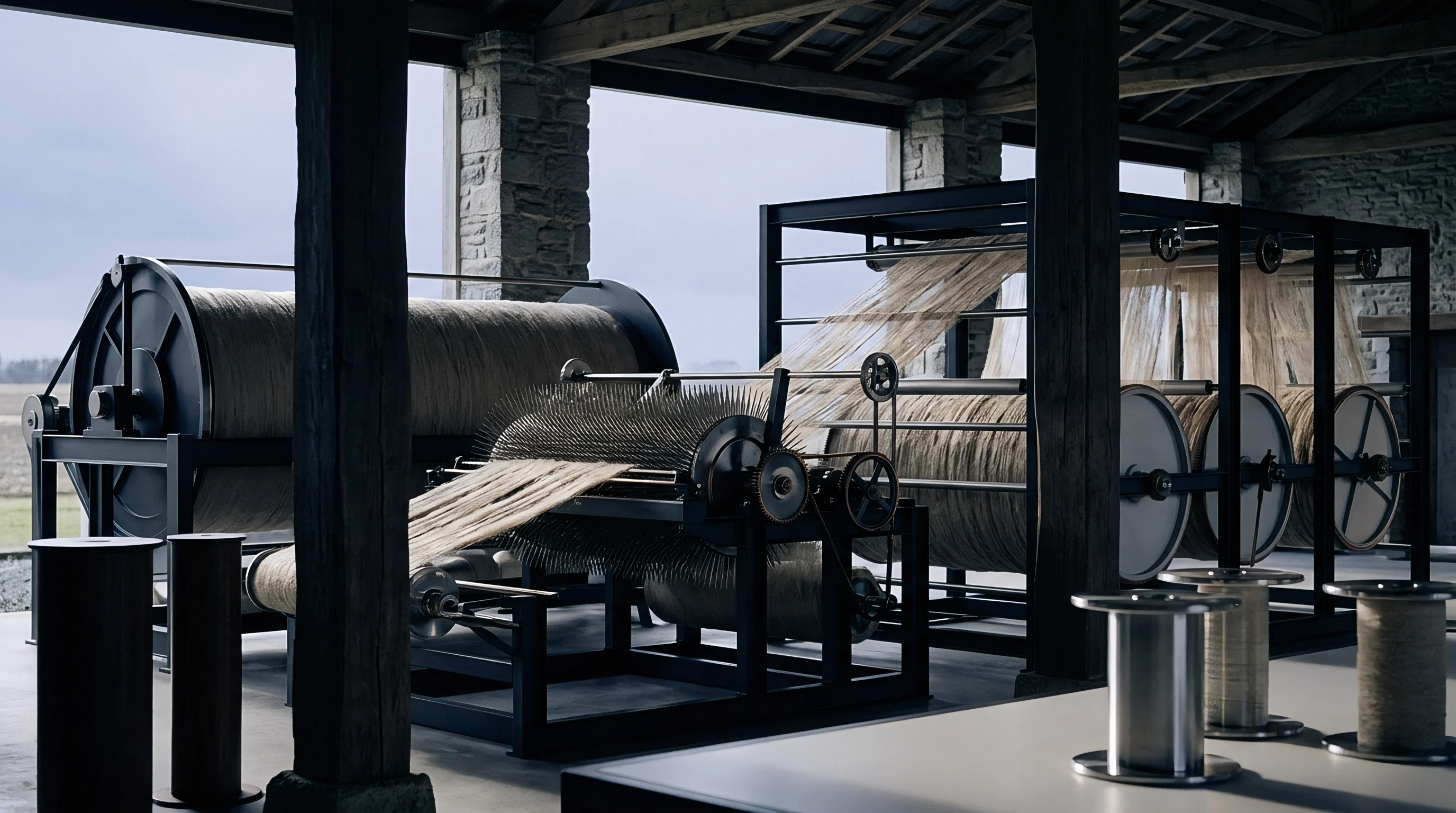

Isotope
Isotope ratio mass spectrometry measures relative differences in heavy and light stable isotopes by deflecting ion beams through magnetic fields. High-temperature conversion units first reduce organic cellulose into simple gases ~ carbon dioxide, carbon monoxide, and hydrogen ~ prior to ionization. Mass spectrometers then evaluate ion beam currents against standard reference gases calibrated to international measurement scales.

How Does Mass Spectrometry Isolate Flax Fiber?
Combustion elemental analyzers linked to isotope mass spectrometers burn cellulose samples at one thousand and twenty degrees Celsius in injected oxygen. Full oxidation converts organic carbon to carbon dioxide gas, which passes through gas chromatography columns to separate it from nitrogen before entering the ionization chamber. Carbon dioxide containing carbon-13 produces ion currents at mass-to-charge ratio forty-five, whereas carbon-12 generates signals at mass forty-four.
Oxygen and hydrogen isotope ratios are measured via high-temperature pyrolysis. Reactors running at fourteen hundred degrees Celsius over glassy carbon beds convert cellulose into carbon monoxide and hydrogen. Gas chromatography then isolates the carbon monoxide for mass spectrometry, determining oxygen-18 to oxygen-16 ratios at mass-to-charge ratios thirty-four and thirty-two.
Strontium isotope ratios are measured separately using thermal ionization or multi-collector inductively coupled plasma mass spectrometry after digesting samples in concentrated nitric acid and isolating strontium on targeted resin columns.
Analytical precision hinges on proper standard reference materials. Laboratories calibrate internal working gases against International Atomic Energy Agency reference standards, such as IAEA-CH-6 sucrose for carbon and VSMOW2 for oxygen. Routine measurement of homogeneous cellulose standards preserves analytical repeatability within zero point one per mil for carbon and zero point two per mil for oxygen.

Worked Isotopic Mass Balance Calculation
Mass balance calculations readily uncover concealed fiber blending. Take a commercial consignment of twenty tonnes of grey flax yarn declared as one hundred percent Western European origin. An audit draws representative samples across ten yarn packages for alpha-cellulose isolation and oxygen-18 analysis.
Regional baselines indicate that Western European flax cellulose carries an oxygen-18 value of plus twenty-one point zero per mil VSMOW (within a margin of plus or minus zero point five per mil), whereas continental Asian substitute fiber averages plus twenty-eight point five per mil VSMOW.
Laboratory testing on the delivered yarn cellulose returns a measured oxygen-18 value of plus twenty-four point zero per mil VSMOW. Using a simple linear mass balance model determines the proportion of authentic European fiber in the consignment:
Measured Delta = (European Fraction European Delta) + (Asian Fraction Asian Delta)
Substituting known values into the mass balance equation:
24.0 = (f 21.0) + ((1 – f) 28.5)
24.0 = 21.0f + 28.5 – 28.5f
-4.5 = -7.5f
f = 0.60
The calculation reveals that the yarn consignment contains sixty percent authentic European fiber and forty percent substituted continental Asian fiber ~ directly contradicting the supplier transaction certificate attached to the shipment.
A marked elevation in cellulose oxygen isotope values points to cultivation under arid continental conditions rather than maritime rainfall.
Simultaneous shifts across both carbon and oxygen isotopic profiles confirm that raw fiber substitution took place before wet processing.


Isoscape
Spatial mapping models integrate field isotope measurements with climatic and geographic raster data. These isoscapes convert discrete sampling points into continuous probability maps across agricultural zones. Building baseline isoscapes involves interpolating Global Network of Isotopes in Precipitation data alongside digital elevation models, coastal proximity, and surface temperature records.
Multivariate algorithms then map unknown fiber sample values against these surfaces to calculate origin probabilities.

Statistical Classification via Linear Discriminant Analysis
Pattern recognition models classify unknown fiber samples using multi-isotope vectors. Linear discriminant analysis projects five-dimensional isotopic data onto lower-dimensional axes to separate reference regional groups. For correlated variables such as oxygen and hydrogen, partial least squares discriminant analysis generates clear decision boundaries between coastal European and interior Asian growing regions.
Cross-validation routines confirm model accuracy, with training sets built from audited harvest samples reaching classification accuracy rates above ninety-five percent. Random forest classifiers handle complex non-linear isotopic interactions, successfully isolating geographic origin even when individual isotopic ranges overlap across neighboring regions.
| Origin Region | Primary Isotopic Discriminants | Classification Model | True Positive Rate (%) | False Positive Rate (%) |
|---|---|---|---|---|
| Western Europe (Maritime) | Low Delta 18O, Depleted Delta 13C, Low 87Sr/86Sr | Linear Discriminant Analysis | 97.2 | 1.8 |
| Heilongjiang Basin | Enriched Delta 18O, High 87Sr/86Sr | Partial Least Squares DA | 95.8 | 2.4 |
| Xinjiang Basin | Enriched Delta 13C, High Delta 18O | Random Forest | 98.5 | 0.9 |
| Canadian Prairies | Depleted Delta 2H, High 87Sr/86Sr | Linear Discriminant Analysis | 94.6 | 3.1 |

Regional Signature Discrimination Anomalies
Isotopic anomalies happen whenever microclimates or local practices stray from macro-regional baselines. Deep groundwater irrigation introduces fossil water signatures distinct from seasonal rain, while extreme heatwaves during stem elongation alter stomatal conductance and shift isotopic ratios in a single harvest. Laboratories compensate for year-to-year weather fluctuations by continually updating reference isoscapes with control samples from each harvest year.
- Unfractionated oxygen shifts point to post-harvest water addition rather than natural transpiration during growth.
- Depleted carbon ratios accompanied by high nitrogen values suggest greenhouse cultivation with organic waste fertilizers.
- Strontium ratio mismatch demonstrates growth on entirely different bedrock, regardless of matching atmospheric moisture.
- Hydrogen isotope drift reveals processing in municipal water supplies with unique isotopic signatures.
Spatial interpolation models calculate conditional assignment probabilities for submitted fiber samples, where a score above ninety-five percent supplies legally defensible proof of origin for compliance dossiers. How changing climate patterns will alter coastal precipitation isoscapes over the coming decade remains an evolving challenge for baseline reference databases.


Probe
Sound sampling protocols ensure fiber collected from commercial shipments is representative and unbiased. These procedures adapt standard acceptance sampling tables to analytical testing workflows. Field auditors collect increments across multiple positions within raw bale stacks, sliver cans, yarn packages, or fabric rolls, using clean tools and sealed containers to prevent contamination from synthetic oils or skin lipids.

Sampling Protocols across Supply Chain Stages
Core samplers pull internal fiber specimens from dense scutched flax bales, with inspectors drawing five core samples per twenty-tonne lot to create a composite sample. Greige fabric rolls are sampled by cutting full-width strips at least one meter in from the outer end to avoid edge contamination. Before extraction, lab technicians homogenize the composite samples in cryogenic mills.
Chain-of-custody protocols track every sample from collection to the mass spectrometer. Tamper-evident barcoded seals secure sample bags at the site, while shipping manifests record weights, collection dates, and GPS coordinates to verify physical origin prior to laboratory intake.

Chain of Custody Document Matching
Isotopic evidence reinforces traditional paper records. Auditors cross-reference transaction certificates, weighbridge receipts, and mill logs against mass spectrometry results, using mass balance calculations across scutching and hackling to spot unrecorded fiber additions during yarn preparation.
- Extract representative cores from five separate bales across every twenty-tonne raw fiber consignment.
- Verify tamper seals on sample containment bags before dispatching material to the analytical laboratory.
- Match spinning lot numbers against mill bale release dockets to prevent lot substitution during sliver drafting.
- Reconcile transaction certificates with physical shipping manifest weights to confirm lot mass consistency.
Standard purchase contracts with isotopic verification clauses allow buyers to reject lots whenever the origin assignment probability drops below ninety-five percent.
Paper documentation quickly falls apart when physical mass balances do not line up. Spinning mills in China purchasing Western European scutched flax frequently run regional fiber on adjacent production lines. Without lab assays, buyers cannot determine whether finished yarn packages contain pure European fiber or mixed stock.
Inserting ISO 17025 testing clauses into purchase orders shifts analytical fees to vendors whenever laboratory testing refutes declared origin claims.


Customs
International trade framework rules enforce origin compliance for imported textiles. Section 307 of the United States Tariff Act of 1930 and the Uyghur Forced Labor Prevention Act establish a legal presumption that goods from designated regions involve forced labor. Similarly, European Union Digital Product Passport mandates require traceable origin data across textile supply chains, leaving importers with the burden of proof to establish compliant origin through hard evidence.
Regulatory Enforcement under International Trade Rules
Customs agencies routinely hold shipments when paper records lack scientific backing. Submitting stable isotope analysis gives importers verifiable empirical proof of the primary harvest site. Mass spectrometry results showing coastal European isotopic profiles effectively counter claims of illegal transshipment through intermediary spinning facilities.
Under Union Customs Code non-preferential origin rules, agricultural origin stays tied to the country of primary harvest when raw materials cross multiple borders. Mechanical processing like scutching, hackling, and wet spinning does not confer new origin under Harmonized System Chapter 53 rules if the underlying flax straw originated in a restricted region.
| Analytical Technique | Target Isotope System | Commercial Cost per Sample (USD) | Turnaround Time (Days) | Primary Provenance Indicator |
|---|---|---|---|---|
| Combustion EA-IRMS | Delta 13C and Delta 15N | 180 to 250 | 7 to 10 | Photosynthetic stress and fertilizer type |
| High-Temperature TC/EA-IRMS | Delta 18O and Delta 2H | 220 to 320 | 7 to 10 | Precipitation latitude and evapotranspiration |
| Thermal Ionization / MC-ICP-MS | Strontium 87Sr/86Sr | 450 to 650 | 12 to 18 | Bedrock geology and soil age |
| Full Multi-Element Package | C, N, O, H, Sr Ratios | 750 to 1100 | 14 to 21 | Definitive spatial isoscape matching |

Commercial Testing Economics and Risk Allocation
Analytical expenses represent a small fraction of total landed product value. A comprehensive five-isotope assay costing nine hundred dollars protects a container load of linen yarn worth over two hundred thousand dollars. Importers routinely embed isotopic testing into quality assurance protocols, spot-checking five percent of incoming production lots.
Commercial contracts allocate the financial risks of failed verification. Purchase order terms can specify that non-conforming isotopic results trigger immediate rejection, a full refund of advance payments, and vendor reimbursement of testing fees. Running routine baseline tests on incoming greige fabric creates a clear compliance record that helps prevent costly customs detentions at arrival ports.