Tensile Resistance
Flax bast material arriving at the spinning facility undergoes mechanical grading to establish fiber bundle tenacity before wet drafting commences. This physical metric calculates the breaking force divided by linear density, determining how much pulling stress a technical strand withstands prior to rupture. Technicians clamp prepared specimens into constant rate extension dynamometers, pulling each sample until catastrophic failure occurs across the gauge length.
The resulting mill record governs subsequent draft roller settings and determines whether raw lots qualify for fine yarn production or coarse packing twine. Lower breaking thresholds force adjustments in twist multipliers during spinning frames to prevent excessive filament breakage along the drafting zone. Quality auditors separate raw material lots into specific yarn spinning categories based entirely on these breaking load results.
Fabric grades emerge from downstream weaving operations where warp tension depends heavily on preliminary spinning parameters. Mill internal quality standards frequently exceed buyer acceptance criteria to compensate for moisture fluctuations during long maritime shipping voyages.
Breaking Load
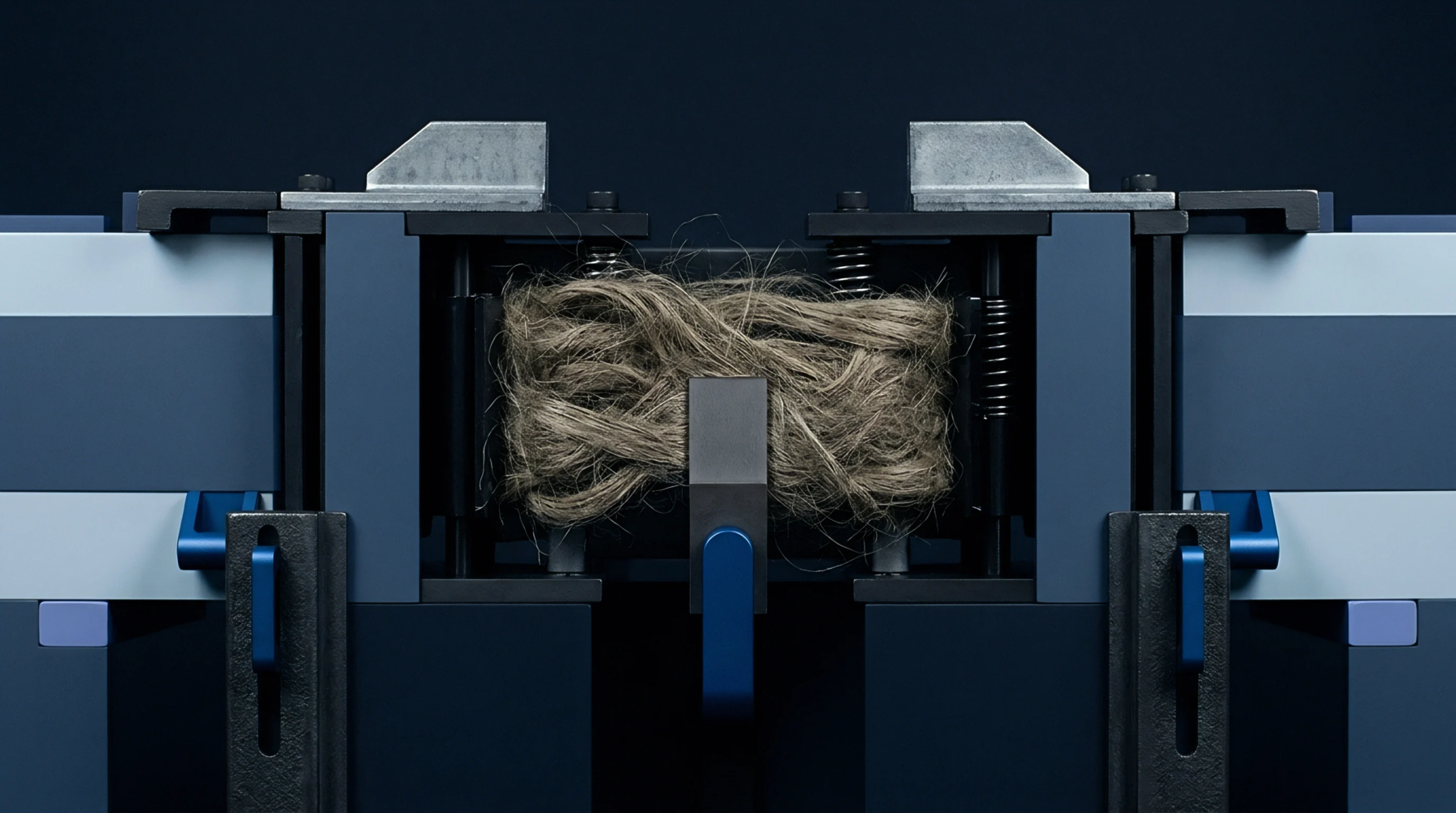
Clamp jaws grip conditioned flax strands across a specific gauge length while electric motors pull the lower jaw downward at a constant velocity. Load cells register continuously increasing force values until the last individual elementary filament snaps completely apart. Computer software captures maximum force peaks and divides those numerical figures by the gravimetric density of the tested specimen.
Ambient humidity inside the testing laboratory alters moisture regain percentages within the bast material, changing recorded force outcomes significantly. Operators maintain strict climatic controls around twenty degrees Celsius and sixty five percent relative humidity during all testing cycles. Mechanical drawing frames exert parallel stress that aligns cellulose microfibrils along the long axis, directly influencing subsequent resistance values during laboratory pulls.
Draft Limit
Excessive drawing speeds generate high frictional heat between adjacent elementary filaments, causing premature structural degradation before optimal elongation occurs. Spinning technicians reduce drafting ratios whenever incoming raw material lots exhibit inconsistent cellulose orientation along individual stems. Heavier roving weights compensate for lower breaking thresholds during wet spinning operations, preventing yarn thinning on the bobbins.
Export documentation records final classification grades to satisfy international textile standards demanded by overseas buyers. Correct determination of ultimate breaking limits prevents catastrophic yarn failures during high speed loom operations.