Quantifying Wet Spinning Limits for Low Cohesion Bast Fiber Slivers
Low cohesion flax slivers collapse under high draft ratios, requiring reduced trough temperatures, higher roving twist, and tight ratch settings to hold count.


Draft
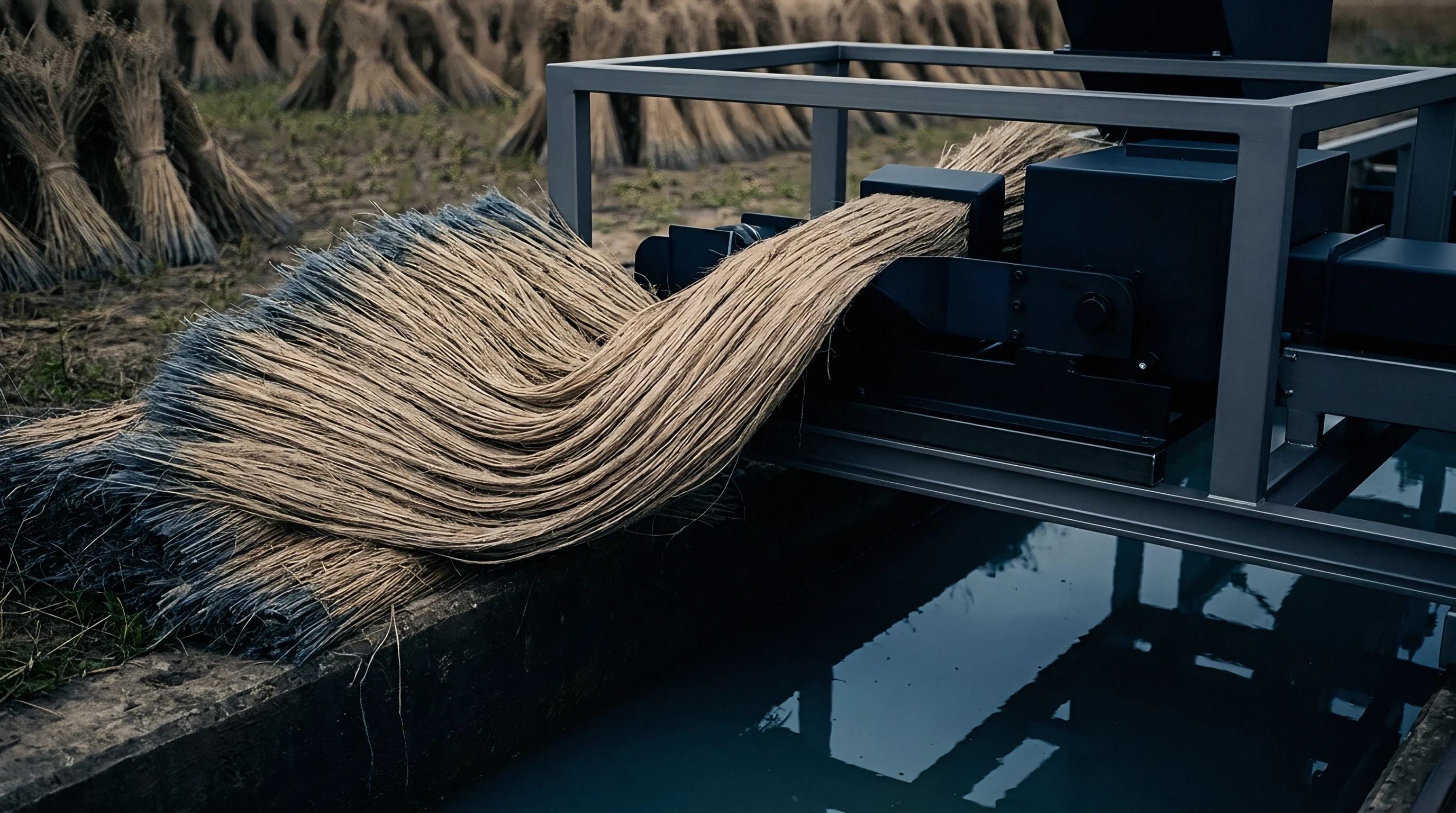
Drafting Mechanics and Dynamic Friction Limits
Low-cohesion bast fiber slivers fail in the drafting zone whenever peak dynamic drafting force exceeds total inter-fiber friction. In long-staple flax processing, slivers made from dew-retted or partially decorticated fibers exhibit stick-slip movement between adjacent bundles. Fiber cohesion depends heavily on surface wax, residual middle-lamella pectins, and crimp frequency.
As mechanical attenuation draws these fibers past one another, drafting force spikes rapidly. In a typical roller drafting assembly operating at a draft ratio between 10 and 20, the pull on individual fiber tails can dislodge unanchored bundles simultaneously, producing thick and thin places across the output web.
Friction within the drafting field follows a modified Coulomb model where contact pressure varies with pinned field density and sliver bulk. Low-cohesion slivers present a low initial static friction coefficient, frequently falling below 0.18 under standard laboratory conditioning at 20 degrees Celsius and 65 percent relative humidity. As the front rollers accelerate fibers out of the main nip, the force required to draw a fiber bundle from the back-roller grip fluctuates widely.
When dynamic drafting force varies by more than 25 percent around the mean value, attenuation degrades into uncontrolled slippage.
Low fiber cohesion increases dynamic drafting force variance, directly inducing thin spots that sever the strand under high spindle tension.
Stable attenuation across low-cohesion stock requires precise mechanical pinning and dynamic speed control. Pins set on faller bars or gills physically restrain bundle movement, supplying artificial inter-fiber pressure where natural binder is missing. The distance from the front roller nip line to the nearest pin tip governs the floating fiber zone.
Slivers with broad length distributions undergo uncontrolled acceleration across this unpinned gap, generating high short-term mass variation.
Friction Coefficients and Pinning Resistance
Dynamic drafting force is evaluated using direct piezoelectric transducer measurements taken at the front drafting roll bracket during processing. Comparative laboratory profiling across three long-staple flax lots demonstrates how dynamic force stability governs fiber extraction behavior.
| Sliver Batch ID | Rettiing Method | Mean Fiber Fineness (tex) | Static Friction Coefficient | Drafting Force CV (%) | Maximum Stable Draft Ratio |
|---|---|---|---|---|---|
| FLX-2023-A | Dew Retted | 2.10 | 0.24 | 11.2 | 18.5 |
| FLX-2023-B | Water Retted | 1.75 | 0.19 | 18.6 | 14.0 |
| FLX-2023-C | Enzyme Treated | 1.45 | 0.15 | 28.4 | 10.2 |
Higher variation in drafting force directly reduces the maximum achievable draft ratio before strand collapse occurs. Operating low-cohesion stock above its dynamic draft ceiling pushes unattenuated slubs through the nip line. In production, this causes yarn failure at the flyer or ring traveler, raising frame end-breakage rates and lowering line efficiency.
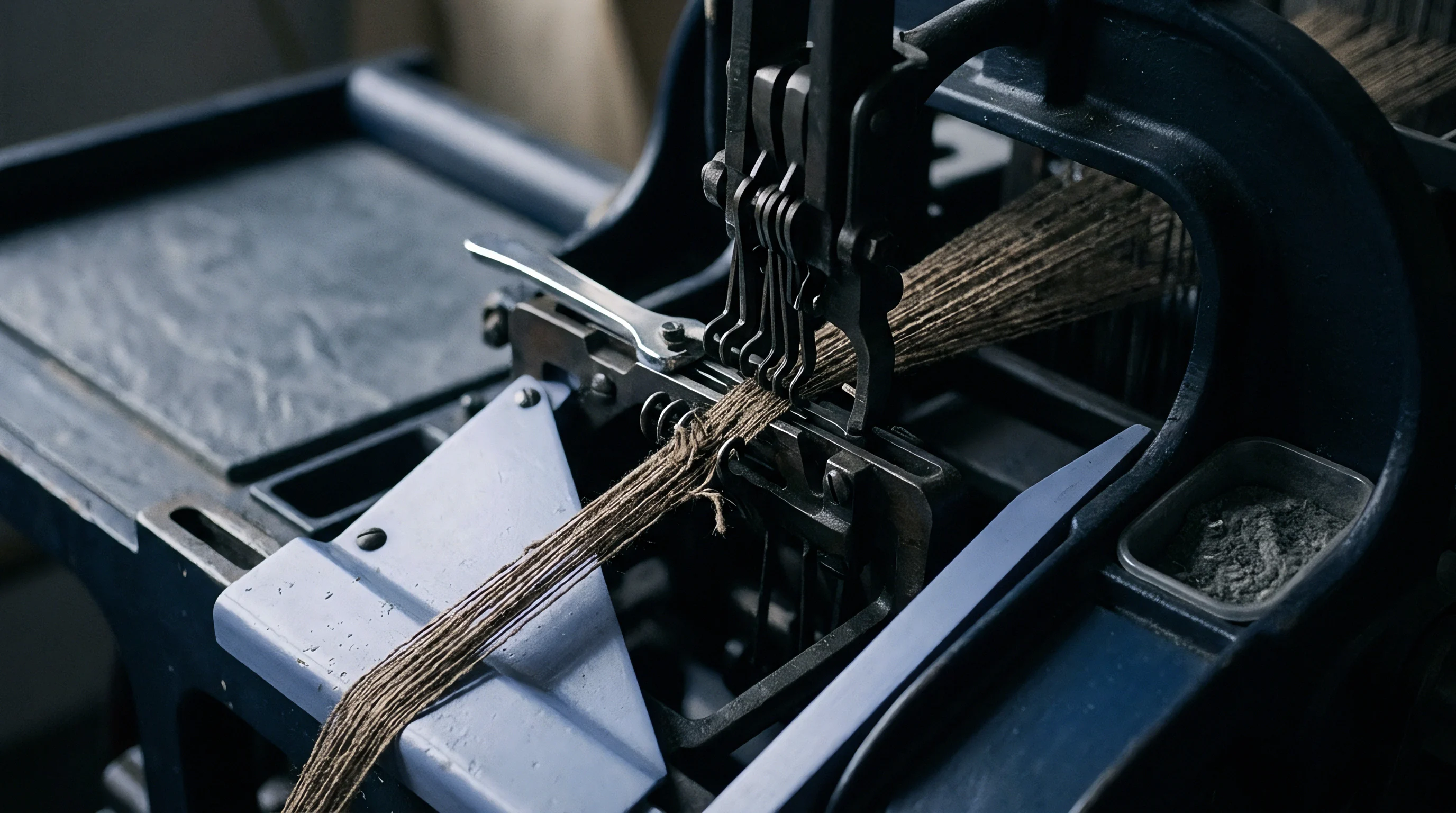

Pectin
Chemical Architecture of Inter-Bundle Adhesion
Bast fiber cohesion originates in the complex polysaccharide matrix of the plant stem cortex. Middle lamella structures consist mostly of branched polygalacturonic acid sequences cross-linked by divalent calcium cations. During retting, microorganisms consume these pectins alongside hemicelluloses, breaking technical fiber bundles into finer elementary fibers.
Over-retted flax shows severely reduced residual pectin, dropping below 1.2 percent by weight compared to 3.5 percent in under-retted material. This loss of binder directly reduces bundle cohesion in carded and drawn sliver.
Elementary flax fibers possess high individual tensile strength, often exceeding 60 centinewtons per tex, but lack intrinsic crimp or surface scales. Inter-fiber shear strength within a sliver depends entirely on residual pectin matrices and surface wax films holding technical bundles together. When chemical treatments or aggressive water-retting remove these binders, individual technical bundles separate prematurely during drawing.
Without cross-linking ions, the smooth fiber surfaces slide under tensile load rather than transferring stress across adjacent fibers.
Standard measurement of residual pectin uses enzymatic hydrolysis followed by spectrophotometric determination of galacturonic acid content. High-performance liquid chromatography isolates monomeric sugars to quantify the degree of esterification. A degree of esterification below 40 percent indicates extensive enzymatic breakdown during stem retting.
Fiber lots with this chemical profile yield slivers with minimal inter-bundle tack, requiring altered mechanical settings during spinning.

Pre-Treatment Chemical Extraction Dynamics
Warm water boiling or alkaline pre-treatments alter sliver cohesion before material reaches the wet spinning frame. Soaking slivers in hot water leaches soluble pectins, lowering structural integrity while swelling cellulose crystalline regions. Removing surface waxes further reduces static friction, leaving the stock highly sensitive to draft speed adjustments.
Raw fiber shipments meeting metric specifications can fail during drafting if subjected to undisclosed hot-water washing at the scutching mill. Warm water rinsing lowers shive content and meets brightness specifications, but the loss of cohesive binder is an unavoidable side effect of that cleaning.

Roving

Twist Factor Optimization for Low-Binder Stocks
Converting low-cohesion sliver into printable roving requires precise mechanical twist insertion to build temporary structural tenacity. The roving operation imparts protective twist, holding technical bundles together without blocking downstream drafting at the wet spinning frame. For weak or over-retted flax stocks, standard twist multipliers prove insufficient, resulting in false drafting during package winding or draft zone failure on the creel.
Roving twist factor calculations rely on the relationship between turns per meter and the square root of roving linear density in kilotex. Standard long-staple flax roving uses a twist factor between 18 and 22. When processing stock with a static friction coefficient below 0.18, the twist factor must be raised to between 24 and 28.
This added torsional force compresses outer fibers inward, increasing normal contact forces across internal sliver cross-sections to generate artificial cohesive shear resistance.
Twist factors above 28 bind short technical fibers permanently, preventing uniform drafting in the wet spinning trough zone.
Higher roving twist prevents unwinding breaks, but it increases drafting resistance during final spinning. Over-twisted roving enters the wet spinning nip without fully softening, causing mechanical drafting rolls to skid across the strand. This skidding generates periodic mass variations, known as drafting waves, that degrade final yarn evenness.
Mechanics balance package tension against draft zone resistance by testing roving tenacity on laboratory tensile instruments under ISO 6741 conditioning protocols.
- Roving Linear Density Control confirms mass variation stays below 4.5 percent CVm across ten consecutive 100-meter skeins to prevent sudden cross-sectional thinning.
- Twist Multiplier Calibration adjusts flyer speed relative to front roll delivery, locking tensile yield strength between 1.2 and 1.8 centinewtons per tex.
- Bobbin Winding Tension Adjustment lowers package build pressure, eliminating structural stretch on low-cohesion strands during flyer deposition.
- Creel Draft Minimization reduces tension draft settings on the spinning frame creel below 1.02 to avert unexpected strand rupture prior to trough immersion.
Do Lower Pectin Slivers Require Tighter Ratch Settings?
Ratch setting defines the physical distance between the back intake rolls and the front drafting rolls on the spinning frame. For low-cohesion slivers depleted of structural pectin, tight ratch settings compensate for missing inter-fiber friction. Setting the ratch equal to the mean fiber length plus 5 millimeters maintains mechanical control over floating fibers.
If the ratch opens wider than 10 millimeters past the mean bundle length, uncontrolled drafting slippage instantly destroys yarn count uniformity.
Setting the ratch tighter than the effective bundle length causes fiber breakage rather than drafting separation. Technical flax bundles clamp in both roller nips simultaneously, severing individual cellulose filaments and creating localized neps. Continuous monitoring of fiber length distributions using comb sorter diagrams provides the baseline needed to establish precise ratch geometry before running degraded sliver batches.
When fiber cohesion drops, mechanical pin control and tight ratch spacing must substitute for natural chemical adhesion.
Trough
Fluid Plasticization and Solvation Temperatures
Wet spinning uses hot water immersion in the spinning trough to plasticize residual pectins and hemicelluloses holding technical fiber bundles together. Water enters the trough at controlled temperatures, penetrating the roving body as it passes under submerged guide rods. Heat and fluid absorption soften the intercellular binder, allowing technical fibers to divide into finer elementary sub-units under drafting tension.
For low-cohesion slivers with depleted pectin content, fluid immersion acts as both enabler and hazard.
Water temperature within the trough determines how quickly binder solubilizes. Standard operation keeps trough water between 60 and 70 degrees Celsius. Operating below 50 degrees Celsius fails to soften residual pectins, forcing stiff bundle structures through the drafting nip and yielding heavy yarn.
Raising water temperature to 80 degrees Celsius accelerates pectin dissolution, causing low-cohesion roving to lose structural integrity before reaching the front roller nip line.
| Trough Water Temp (°C) | Immersion Time (s) | Additive Concentration (%) | Strand Dissolution Status | Target Yarn Count (Nm) | Achieved Spinning Limit (Nm) |
|---|---|---|---|---|---|
| 50 | 2.5 | 0.0 (Pure Water) | Under-Plasticized | 36 | 24 |
| 65 | 2.5 | 0.0 (Pure Water) | Optimal Splitting | 36 | 38 |
| 80 | 2.5 | 0.0 (Pure Water) | Over-Solubilized | 36 | 18 |
| 65 | 3.8 | 0.2 (Surfactant) | Accelerated Softening | 50 | 54 |
Fluid drag inside the trough exerts hydrodynamic tension on the submerged roving strand. Roving traveling faster than 15 meters per minute encounters fluid friction that scales exponentially with delivery speed. Low-cohesion roving often lacks the internal strength to overcome this resistance, causing underwater strand breaks before drafting is complete.
Chemical modification of trough water alters surface tension and wetting speed. Adding non-ionic surfactants at concentrations of 0.1 to 0.2 percent by weight lowers surface tension, accelerating core wetting in dense roving strands. Rapid hydration allows lower water temperatures, preserving fragile pectin bonds while maintaining uniform elementary fiber division.
The balance between chemical dissolution, water temperature, and mechanical tension dictates the operating window for low-cohesion stock.
Surfactant additions lower water surface tension, achieving full core hydration without destroying critical pectin bonds.
Testing continues on whether online ultrasonic agitation in the fluid trough can split low-cohesion bundles uniformly without increasing tension-induced strand ruptures.

Breakage
Spindle End-Breakage Modeling and Limit Counts
End breakage during wet spinning sets the practical limit for maximum spinnable yarn count. Spindle breakage rates depend on the balance between dynamic spinning tension and instantaneous strand tenacity at the delivery nip. Spinning tension stems from traveler friction, balloon drag, and package winding geometry.
In low-cohesion bast fiber stock, strand strength shows high variance and a low Weibull modulus.
A low Weibull modulus reflects a broad distribution of localized weak points along the yarn strand. These weak points form where low fiber cohesion causes thinning during drafting. When instantaneous spinning tension exceeds localized strand strength, the yarn snaps at the thread guide or flyer tip.
Commercial targets generally require end-breakage rates below 50 breaks per 1,000 spindle hours; exceeding this limit drives up labor costs and drops frame efficiency below viable levels.
Calculating the maximum limit count (Nm) requires evaluating mean elementary fiber fineness and length distribution within the prepared sliver. The minimum number of fibers needed in a cross-section to maintain stable spinning varies directly with fiber cohesion. High-cohesion long-staple line flax spins reliably with as few as 25 fibers per cross-section, whereas low-cohesion, over-retted, or short-staple tow stock demands 45 to 50 fibers to prevent tension-induced slippage.
- Drafting Zone Creep Failure occurs when low inter-fiber friction permits fibers to slide apart gradually under sub-critical tension, producing extended thin zones prior to rupture.
- Balloon Tension Rupture occurs when traveler friction surges due to ring wear, exceeding the immediate tensile threshold of an uncohesive strand at the guide wire.
- Trough Delivery Washout takes place in the fluid bath when excessive temperature dissolves soluble pectins completely, causing the roving body to disintegrate before drafting rolls clamp the strand.
- Package Unwinding Separation arises at the creel when low-cohesion roving lacks sufficient torsional strength to unroll the bobbin, tearing the undrafted strand under static creel tension.
Under ISO 2062 testing protocols, single-end breaking tenacity tests on low-cohesion wet-spun yarns routinely show bimodal load-elongation curves. The first peak marks initial inter-fiber friction failure, while the second represents elementary fiber breakage. Yarns governed by friction failure exhibit low elongation at break, typically dropping below 1.5 percent total extension.
Commercial contracts specify that if a delivered fiber lot fails to achieve the agreed limit count at standard frame settings, the mill calculates a yarn yield penalty using ISO 2370 fineness verification metrics. Standard contractual clauses require the fiber supplier to reimburse the mill for lost frame efficiency whenever end-breakage exceeds 75 breaks per 1,000 spindle hours during verified qualification trials.
Settlement

Yield Arithmetic and Commercial Financial Penalties
Valuing low-cohesion flax sliver requires converting raw fiber cost into finished wet-spun yarn yield per meter. Low cohesion reduces hackling and carding yields while increasing waste across every drawing passage. When buying 10 metric tons of scutched flax or prepared sliver, the landed cost per kilogram of usable yarn reflects the cumulative material loss incurred to process fragile stock.
A commercial example illustrates this by comparing high-cohesion line flax against a low-cohesion, over-retted sliver lot processed for wet spinning. The model tracks a 10,000-kilogram fiber lot processed into Nm 26 wet-spun yarn for mid-weight linen apparel fabric.
| Processing Parameter | High-Cohesion Line Stock | Low-Cohesion Tow Stock | Variance Impact |
|---|---|---|---|
| Raw Sliver Landed Price ($/kg) | 4.80 | 3.60 | – 1.20 |
| Hackling / Preparation Yield (%) | 82.0 | 68.0 | – 14.0 |
| Combing and Drawing Waste (%) | 6.5 | 14.2 | + 7.7 |
| Spinning Frame End-Breakage Waste (%) | 1.5 | 5.8 | + 4.3 |
| Total Usable Yarn Produced (kg) | 7,515 | 5,510 | – 2,005 |
| Effective Fiber Cost per Yarn kg ($) | 6.39 | 6.53 | + 0.14 |
| Spinning Labor & Overhead ($/kg) | 2.10 | 3.45 | + 1.35 |
| Finished Yarn Landed Cost ($/kg) | 8.49 | 9.98 | + 1.49 |
The yield figures show that lower-grade, low-cohesion sliver produces higher landed yarn costs per kilogram. Higher preparation waste, elevated combing noil extraction, and frequent spinning end-breakage invert the initial price advantage. Running fragile stock also requires slower frame speeds, increasing energy use and direct labor hours per bobbin.
Translating yarn cost to fabric weaving completes the commercial picture. A standard plain-weave linen fabric measuring 1.5 meters wide with a finished weight of 180 grams per square meter consumes approximately 0.27 kilograms of Nm 26 yarn per linear meter, accounting for crimp and warp sizing loss. High-cohesion stock yields a fabric material cost of 2.29 USD per linear meter.
Low-cohesion stock raises that cost to 2.69 USD per linear meter, adding 0.40 USD per meter directly to the weaver’s baseline cost.
Uncertainty in laboratory friction testing often complicates contract disputes. Current bench instruments measure static friction on small parallel bundle samples, but static values fail to predict dynamic draft behavior under high-speed wet spinning conditions. Buyers address this gap by inserting mandatory pilot spinning trial clauses into purchase contracts.
These clauses permit rejection of entire shipments if a 200-kilogram sample lot fails to maintain specified draft ratios without exceeding predefined end-breakage thresholds on commercial frames.