Warp Tension Dynamics and High Density Flax Weaving Mechanics
High-density flax weaving requires precise active warp tension control, asymmetric shedding, and 10 percent size add-on to prevent peak load breaks.

Elasticity
Flax fibers exhibit a steep modulus curve that governs their resistance to elongation under mechanical load. Cellulosic bast bundles possess a crystalline polymer structure with minimal extensibility compared to cotton or synthetic filaments. Operational elongation at rupture for wet-spun flax yarn ranges between 1.5 percent and 2.8 percent, whereas carded cotton typically achieves 6 percent to 9 percent.
Because the yarn yields so little under tension, any sudden increase in length along the warp path causes an immediate, non-linear tension spike instead of elastic deformation. In high-density weaving, where ends per centimeter approach maximum cover limits, tension shifts sharply across shed opening, beat-up, and shed closure during every loom cycle.
When a high-speed rapier or projectile loom opens the shed, warp ends are pulled vertically out of the cloth fell plane. This geometric path elongation requires length compensation from either the backrest roller assembly or the intrinsic elasticity of the yarn. Because flax cannot stretch without exceeding its yield point, uncompensated geometric extension generates local stress peaks above 45 cN/tex.
Under these loads, individual fiber nodes shear, producing micro-fibrillar rupture and end breaks behind the drop wires.

Mechanical Behavior of Bast Fibers under Cyclic Load
Bast fibers consist of technical bundles held together by middle lamellae composed of pectin and lignin. Under cyclic tensile stress at 350 to 500 pick cycles per minute, these binder compounds experience progressive fatigue. Repeated tensioning at open shed weakens inter-fiber cohesion whenever mechanical strain remains above 1.2 percent of static length.
Wet-spun yarns provide higher tensile strength because long flax fibers align during the hot-water drafting process, reaching an ultimate tensile force of up to 35 cN/tex for Nm 26 yarns. Dry-spun yarns, formed from shorter tow fibers, show tensile limits near 18 cN/tex alongside wider cross-sectional variation.
Static tension settings on the weaver beam must accommodate this structural rigidity. Setting baseline warp tension too low leads to poor shed clearance, allowing protruding surface fibrils to interlock adjacent ends and trigger false warp stops or insertion faults. Setting baseline tension too high accelerates mechanical fatigue, driving up stop frequencies in the back-alley zone between the harness frames and lease rods.
Dynamic peak loads during beat-up exceed baseline static warp tension by a factor of three in high-density linen constructions.

Strain Limits and Structural Stiffness
In dense plain weave or twill constructions, the movement of the reed against the fell establishes a compression zone. The force required to drive a pick into an already crowded structure rises exponentially as pick counts per centimeter near the geometric limit set by yarn diameter. This resistance translates directly back into the warp sheet as an axial tension pulse during the final 15 degrees of mainshaft rotation before front dead center.
Rigid loom frame configurations lacking active tension compensation sustain extreme peak forces during beat-up. Active backrest rolls, driven by mechanical linkages or servo motors, must advance during shed opening and beat-up to release measured lengths of the warp sheet, holding peak strain below the 1.5 percent threshold. Backrest timing errors expose the yarn to repeated over-extension, causing permanent deformation, micro-slubbing, and structural weakening before ends reach the heddle eyes.
Operating outside the narrow elastomeric limits of bast fibers results in higher warp breakage rates, increased greige cloth inspection points per hundred meters, pronounced reed marks, and accelerated wear across loom heddle eyes and droppers.
Sett
Calculating the maximum thread density for linen fabric requires accurate values for yarn solid diameters and packing factors. Flax yarn cross-sections present an elliptical profile rather than a true circle due to irregular grouping among ultimate fibers within the strand. A wet-spun yarn of Nm 26 (38.4 tex) has a theoretical minor axis diameter of roughly 0.205 millimeters, which flattens further under weaving pressure.
Maximum theoretical end density is derived using classical geometric models adjusted by a fiber packing density coefficient of 0.72 for wet-spun flax and 0.61 for dry-spun tow yarns.
When ends and picks per centimeter force yarns into lateral contact throughout the structure, crimp interchange reaches its physical limit. Cover factors calculated from yarn density formulas regularly exceed 85 percent for both warp and weft systems in high-density specifications. Attempting to insert high pick counts into an over-sett warp sheet produces beat-up resistance that forces the cloth fell to bounce back, preventing the pick from locking into place.

Jamming Boundaries and Cover Factor Arithmetic
The mechanical limit of fabric tightness depends on yarn count, weave structure, and crimp distribution. In a standard plain weave (1/1), each yarn intersection imposes a bending angle that displaces adjacent ends by one yarn diameter. For twill (2/1, 2/2) and satin weaves, longer float lengths reduce the number of crossing points per unit area, accommodating higher thread counts before mechanical jamming occurs.
| Yarn Count (Nm) | Yarn Linear Density (tex) | Spun Type | Theoretical Diameter (mm) | Max Sett Plain (ends/cm) | Max Sett 2/2 Twill (ends/cm) | Max Cover Factor (%) |
|---|---|---|---|---|---|---|
| Nm 14 | 71.4 | Dry Spun Tow | 0.312 | 18.0 | 23.5 | 86.5 |
| Nm 26 | 38.4 | Wet Spun Long | 0.205 | 26.5 | 34.0 | 89.0 |
| Nm 36 | 27.8 | Wet Spun Long | 0.174 | 31.0 | 40.0 | 91.2 |
| Nm 40 | 25.0 | Wet Spun Long | 0.165 | 33.0 | 42.5 | 91.8 |
| Nm 60 | 16.7 | Wet Spun Long | 0.135 | 40.0 | 51.0 | 92.5 |
As thread counts approach cover factors above 88 percent, crimp distribution shifts heavily toward the weft. The stiffer, high-tension warp ends remain relatively straight while the more pliable weft picks deform around them. This asymmetric balance increases fabric tear strength along the warp while lowering weft-direction tear resistance, producing an anisotropic mechanical profile across the finished greige cloth.
Balancing these forces requires specific structural decisions before beam warping. The checklist below defines construction criteria for validating high-density flax specifications prior to assigning loom capacity.
- Yarn Spinning Route Selection Verification that only wet-spun long flax yarn is assigned to warp beams intended for thread densities exceeding 85 percent cover factor.
- Crimp Balance Ratio Determination Calculation of target warp and weft crimp percentages to prevent excessive fell movement and maintain stable fabric width across the temple zone.
- Reed Denting Pattern Calculation Specification of three or four ends per dent to break up reed wire grouping while avoiding excessive friction on warp fibers inside the dent air gaps.
- Shed Geometry Alignment Calibration of the backrest height above the breast beam level to create asymmetric warp shed tension, easing pick entry at maximum density settings.
Warp tension must increase non-linearly to force each subsequent pick into a high-density structure as the fell zone approaches maximum density.

Shedding
Shedding kinematics determine the cyclic stress applied to high-density flax warps during each mainshaft rotation. Heddle frame motion timing must provide clear openings for unimpeded pick insertion while limiting peak tension to avoid fiber fracture. A symmetric shed, where top and bottom warp sheets undergo equal vertical displacement, distributes strain evenly across all ends.
However, it hinders pick beating in dense constructions because both sheets meet the reed under identical tension, causing picks to bunch.
Configuring an asymmetric shed by raising the backrest roller 15 to 30 millimeters above the neutral center line increases tension on the bottom warp sheet while easing tension on the top sheet at full open shed. This path length differential creates a split fell during beat-up, allowing the reed to push incoming picks past the slackened top ends with lower frictional resistance.

Where Does Peak Warp Tension Occur during Shedding?
Peak warp tension occurs at the intersection of maximum shed opening and the initial impact of beat-up. When harness frames reach their full stroke limit, geometric path extension peaks. If the reed meets the cloth fell at or immediately after this point, total tensile stress combines path elongation with fell displacement resistance.
| Loom Cycle Phase | Mainshaft Angle (Deg) | Symmetric Shed Tension (cN/end) | Asymmetric Shed Top Tension (cN/end) | Asymmetric Shed Bottom Tension (cN/end) | Recommended Limits (cN/end) |
|---|---|---|---|---|---|
| Closed Shed (Neutral) | 0 / 180 | 120 | 90 | 130 | 140 |
| Shed Opening Phase | 60 / 240 | 210 | 160 | 240 | 260 |
| Maximum Shed Opening | 110 / 290 | 310 | 220 | 370 | 380 |
| Pick Beat-Up Impact | 355 / 175 | 420 | 310 | 460 | 480 |
| Shed Closure Phase | 30 / 210 | 150 | 110 | 170 | 180 |
Rigid heddle frames flex under these dynamic load swings, particularly on wide looms weaving fabrics wider than 280 centimeters reed space. This frame deflection reduces shed clearance through the center of the warp sheet, concentrating weft insertion strikes and warp breaks in the middle third of the reed space.
Standard mill supply contracts specify maximum dynamic warp peak tension limits of 500 cN per end for Nm 26 wet-spun flax, above which lot rejection clauses take effect.
Electronic positive dobby systems permit adjustable dwell angles. Extending shed dwell to 120 degrees of mainshaft rotation stabilizes the opening for wide rapier entry, but prolongs yarn exposure to peak tension. Shortening dwell to 90 degrees reduces total tensile exposure on the fibers, though it requires higher rapier acceleration and tighter timing tolerances on pick arrival sensors.
Loom machinery warranties regularly mandate active warp tension monitoring on the let-off system to record dynamic loads, voiding drive component claims if average tension exceeds 550 cN per end over 100 consecutive pick cycles.

Sizing
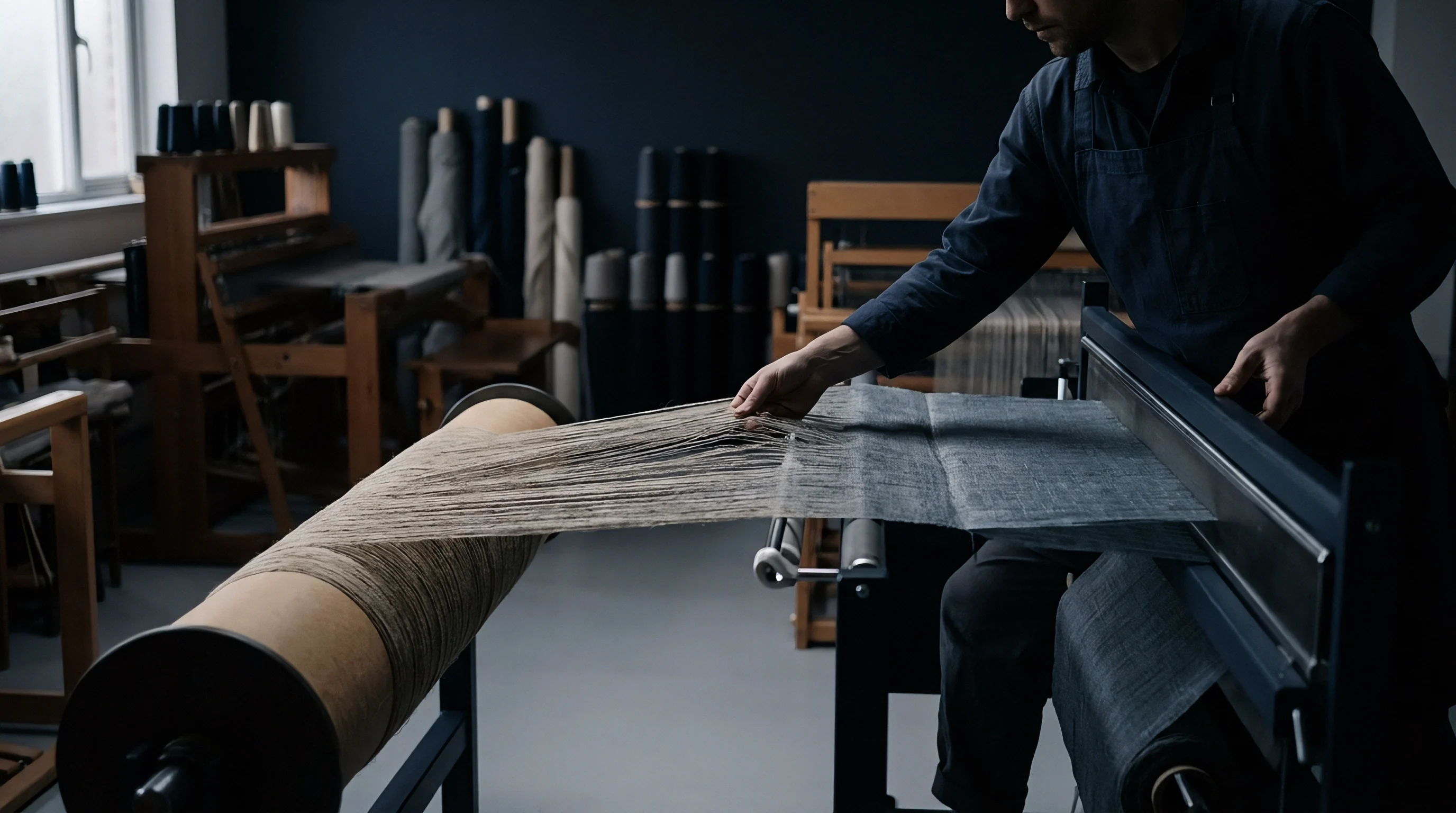
Flax warp yarns require protective chemical coatings to withstand the abrasion and tension spikes encountered in dense weaving. Surface fibrils on raw bast fibers protrude from the yarn core, causing ends to cling during shed opening. Effective sizing formulations encapsulate the core and bind loose surface fibers without forming a brittle outer shell that fractures during shed flexing.
Native flax fibers show maximum flexibility and tensile toughness at relative humidity levels between 65 percent and 75 percent. Sizing applied in the slasher box must yield flexible films matching the low elongation profile of the underlying flax substrate. Formulations for dense linen warps rely primarily on modified starches blended with synthetic polyacrylic binders or polyvinyl alcohol (PVA).
Formulation Pick up and Film Continuity
Size pick-up percentage ~ the dry weight of applied size solids relative to bare yarn weight ~ determines the warp sheet’s abrasion resistance. For fine to medium wet-spun flax (Nm 26 to Nm 40), target dry size add-on ranges from 8 percent to 12 percent. Under-sizing leaves surface fibrils unbonded, creating fuzz balls behind the reed that entangle adjacent ends and cause warp breakouts.
Over-sizing increases yarn stiffness beyond workable limits. Excessive size locks fiber bundles so rigidly that internal stress distribution fails, making ends brittle and prone to shear failure inside the heddle eyes. Slasher speed, squeeze roll pressure, bath viscosity, and drying cylinder temperature profiles require consistent regulation throughout warp preparation.
Size add-on targeted at 10.5 percent dry weight yields a 40 percent reduction in loom stop rates compared to unsized wet-spun flax warps tested under identical shed tension.
Atmospheric Relative Humidity and Regain Control
Weave room atmospheric conditions govern the mechanical performance of sized flax. At 70 percent relative humidity, the moisture regain of flax yarn in equilibrium with ambient air stands between 10 percent and 12 percent. If room humidity drops below 60 percent, the yarn loses moisture rapidly, embrittling the size film and stiffening natural fiber pectins.
Maintaining shed conditions between 68 and 72 percent relative humidity at 22 degrees Celsius preserves necessary plasticization in both the size film and the fiber core. Lower humidity increases static charge buildup and yarn brittleness, elevating warp stop frequencies.
The sequence below details the operational sizing calibration protocol required before running high-density linen warps on high-speed air-jet or rapier weaving frames.
- Dry yarn weight measurement taken from baseline beam spools to establish dry reference mass.
- Viscosity adjustment of the hot size solution inside the cook kettle to a standard 14 to 16 seconds range measured via Zahn Cup No. 4 at 85 degrees Celsius.
- Calibration of slasher squeeze roller pressure to achieve uniform wet pick-up across the entire width of the warp sheet.
- Graduated drying cylinder temperature profile management, running from 90 degrees Celsius on the initial entry cans up to 130 degrees Celsius on final drying passes to prevent size film skinning.
- Moisture content verification at the headstock using microwave moisture sensors, target setting locked at 11 percent wet regain.
- Lease rod spacing alignment to break size bridges cleanly without generating fiber loss or surface hairy fibrils.
Increased warp breakage is often attributed to inconsistent raw yarn spinning lots rather than poor size viscosity control, even when sizing bath logs reveal unchecked solid concentration fluctuations across shifts.

Flaws
High tension and high thread counts amplify structural defects during weaving, driving up greige rejections. Reed marks remain among the most persistent defects in dense linen fabrics. Appearing as continuous vertical lines running warp-wise down the cloth, they result from warp ends remaining grouped as they leave the reed wires.
While ends in looser constructions redistribute evenly during wet finishing, high pick density and elevated warp tension lock yarns into their dent groupings before structural relaxation can take place.
When broken warp ends are rejoined using bulky knots or mechanical crimps, the enlarged splice cannot clear high-density reed dents. The resulting obstruction either snaps adjacent ends or pulls the knot directly into the fell, producing a localized thick bar and distinct warp streak.

Structural Distortion Modes under Excessive Tension
Uneven tension across the beam width creates geometric distortions in the greige roll. Center-to-selvedge tension variations lead to bow and skew during pick insertion. If selvedge ends carry higher static tension than center ends, newly placed picks curve inward through the middle, setting a permanent parabolic bow across the full fabric width.
The list below outlines primary structural fault modes encountered when weaving high-density flax fabrics under non-optimized tension profiles.
- Starting Marks and Stop Bars Transverse density variations across the fabric width caused by fell creep and mechanical backlash when the loom stops and restarts under high warp tension.
- Reed Marks and Dent Lines Permanent vertical groupings of ends locked into position by high pick counts, preventing uniform lateral yarn distribution across the dent gap.
- Warp Striping and Slub Streaks Longitudinal tension bands resulting from non-uniform beam winding or localized variation in yarn sizing pick-up percentages.
- Picked-Up Fuzz Balls Clusters of abraded fibers stripped from under-sized warp ends, collected behind the reed and forced into the shed during beat-up to create embedded defects.
- Smile and Fell Wave Distortion Parabolic bowing of the cloth fell zone during beat-up, occurring when temple tension fails to hold fabric width against intense weft crimp contraction forces.
Inspection systems operating under ISO 4586 or ASTM D5430 four-point standards heavily penalize recurring defects along the roll. Continuous reed marks running more than one meter relegate a 100-meter greige roll from First Quality to Second Quality, resulting in substantial commercial markdowns on lot values.
Localized tension spikes alter the microscopic orientation of bast fiber cell walls at the fell point during maximum beat-up resistance, accelerating structural fatigue.

Outlay
Shed efficiency and loom speed govern the manufacturing economics of dense linen fabrics. Machine operating costs accrue on a loom-hour basis, so any speed reduction required to protect delicate warp yarns directly raises the landed cost per linear meter. Standard rapier looms running light cotton constructions operate at 550 to 700 picks per minute (PPM).
Machinery running high-density flax (cover factors above 88 percent) must run between 320 and 420 PPM to manage peak tension and avoid excessive end breaks.
High-density linen weaving generates higher stop frequencies from raw yarn slubs, size breakdown, and beat-up resistance. While standard cotton sheds run at 92 percent to 95 percent efficiency, dense linen operations typically achieve between 78 percent and 86 percent. Every 5 percent loss in efficiency adds roughly 0.35 USD to 0.50 USD per linear meter in amortized machine overhead on modern rapier equipment.
Loom Speed Adjustments and Machine Efficiency
Evaluating commercial feasibility requires detailed modeling of machine hours, pick density, operating speed, and projected efficiency. The table below outlines the cost structure for four high-density linen constructions produced under controlled shed parameters.
| Construction Profile | Yarn Count (Warp / Weft) | Density (Ends/cm x Picks/cm) | Speed (PPM) | Shed Efficiency (%) | Output (Meters / Loom Hour) | Target Overhead Cost (USD / Meter) |
|---|---|---|---|---|---|---|
| Heavy Plain Canvas | Nm 14 / Nm 14 | 18.0 x 16.0 | 340 | 80 | 10.2 | 2.85 |
| Medium Density Linen | Nm 26 / Nm 26 | 26.0 x 24.0 | 380 | 84 | 8.0 | 3.62 |
| High Density Shirting | Nm 36 / Nm 36 | 30.0 x 28.0 | 420 | 85 | 7.6 | 3.80 |
| Ultra-Dense Jacquard Damask | Nm 40 / Nm 40 | 34.0 x 32.0 | 320 | 78 | 4.7 | 6.15 |
For a worked operational scenario, assume a procurement order for 10,000 linear meters of Medium Density Linen (Nm 26/26, 26.0 x 24.0 ends/picks per cm, finished width 150 cm). Total pick count per linear meter equals 2,400 picks. At an operational loom speed of 380 PPM and an efficiency rating of 84 percent, effective output equals 319.2 picks per minute, or 19,152 picks per loom hour.
Dividing 19,152 picks per hour by 2,400 picks per meter yields a production rate of 7.98 linear meters per loom hour.
Producing the 10,000-meter batch demands 1,253 loom hours. At a fixed loom-hour cost of 28.80 USD (inclusive of power, operator labor, climate control, and machinery depreciation), total machine cost stands at 36,086 USD, translating to 3.61 USD per linear meter in weaving charges alone. If warp quality forces a speed reduction down to 320 PPM and drops efficiency to 76 percent, effective output plunges to 6.08 meters per loom hour.
Total loom hours required climb to 1,644 hours, increasing weaving charges to 47,347 USD, or 4.73 USD per linear meter, representing an unbudgeted cost overrun of 31 percent.
Fixed loom-hour cost structures penalize poor warp preparation, making size optimization direct insurance against machine margin erosion.
To protect production budgets against unexpected cost increases, supply agreements must specify clear technical parameters. Sourcing dossier documentation for high-density flax contracts must incorporate the specific clauses defined below.
- Baseline Yarn Quality Minimums Formal requirement for wet-spun long flax yarn conforming to Uster Classimat standards for low defect counts and minimum single-end tensile strength limits.
- Mandatory Sizing Pick-Up Targets Specification of dry size add-on percentages and moisture regain limits verified via laboratory extraction prior to loom loading.
- Loom Speed and Efficiency Commitments Contractually locked operational speed floors and minimum acceptable efficiency thresholds used to calculate standard metre pricing.
- Four-Point Quality Inspection Limits Maximum allowable point penalty thresholds per 100 square meters, specifying lot rejection criteria for recurring tension-induced flaws.
Commercial viability in high-density linen manufacturing relies on precise control of warp tension dynamics, where small adjustments in sizing chemistry and loom mechanics prevent costly efficiency losses.