Inter-Yarn Friction Modulation and Crimp Balance Tuning in High-Density Weaving
Tuning inter-yarn friction via boundary size lubricants and adjusting backrest elevation shifts crimp to the weft, enabling maximum pick density without loom stops.
Mechanics
Structural density in woven textiles depends directly on the force required to drive warp and fill yarns into a compact matrix. During beat-up, the reed pushes the freshly inserted pick against the cloth fell, generating high contact pressure at every intersection point. Inter-yarn friction resists this sliding motion, creating a barrier to compaction.
When pick density reaches eighty-five percent of the theoretical jammed limit, the force transferred to the fell line scales non-linearly, shifting yarn deformation from elastic bending to transverse compression and altering the contact area between warp and fill yarns.
As the contact area expands, boundary friction mechanisms dominate the inter-yarn interface. Static friction coefficients determine the initial force spike required to shift the pick into position, while kinematic friction coefficients dictate resistance during the remaining stroke of the reed. High static friction leads to beat-up instability, where the fell line bounces rather than accepting the pick cleanly.
Frictional Interlock at the Fell Line
The resistance of an inserted pick to final positioning depends on the dynamic friction coefficient between warp and weft, yarn tension, and shed geometry. At high densities, contact angles exceed sixty degrees, transforming sliding friction into mechanical interlock. Surface hairs and free fiber ends mesh into micro-scale anchors that require substantial shearing force to release.
This interlock causes the fell line to move forward with the reed during beat-up and recede during shedding ~ a phenomenon known as fell drift.
The dynamic coefficient of yarn-on-yarn friction rises from 0.22 to 0.41 when size add-on drops below seven percent on combed cotton warps running at six hundred picks per minute.
Fell drift distorts pick spacing across the weaving width, producing cyclic density variations. Maintaining target picks per centimetre without damaging warp ends requires modulating inter-yarn friction through surface sizing, chemical lubricity agents, and optimized shed timing. Reducing the ratio of static to dynamic friction prevents stick-slip behavior at the fell line, allowing smooth compaction without excessive peak loads on the reed drive.

Shedding Kinematics and Interfacial Resistance
The movement of warp yarns passing each other during shed opening creates secondary friction points behind the drop wires and heald wires. High-density setts experience yarn-on-yarn drag that generates localized tension spikes, weakening the yarn before it reaches the fell line. Staggering shedding angles reduces simultaneous contact between adjacent warp sheets, spreading friction loads across the cycle.
Picks lock at front dead center. If the harness crossing occurs too late, warp tension fails to trap the pick before the reed recedes, allowing yarn elasticity to push the pick back from the fell line. Setting the shed to cross prior to beat-up uses warp tension to clamp the inserted pick, overcoming sliding resistance through structural trapping.
Inadequate friction control in the beat-up zone causes irreversible warp abrasion, localized filamentation, and frequent shedding stops that severely reduce operating efficiency.

Crimp
The interchange of thread curvature between warp and weft systems governs structural stability and hand in dense fabrics. Crimp balance defines how structural bending distributes between warp ends and weft picks. In dense constructions, one yarn system typically dominates path curvature, forcing the intersecting system to stay flat.
Achieving maximum cover requires transferring crimp from warp to fill during beat-up, forcing weft picks to bend around tightly tensioned warp ends.
The balance of crimp determines directional tensile capacity, tear resistance, and thickness in the finished greige roll. Unbalanced crimp causes preferential thread failure under diagonal shear stresses.
Backrest Elevation and Asymmetric Tensioning
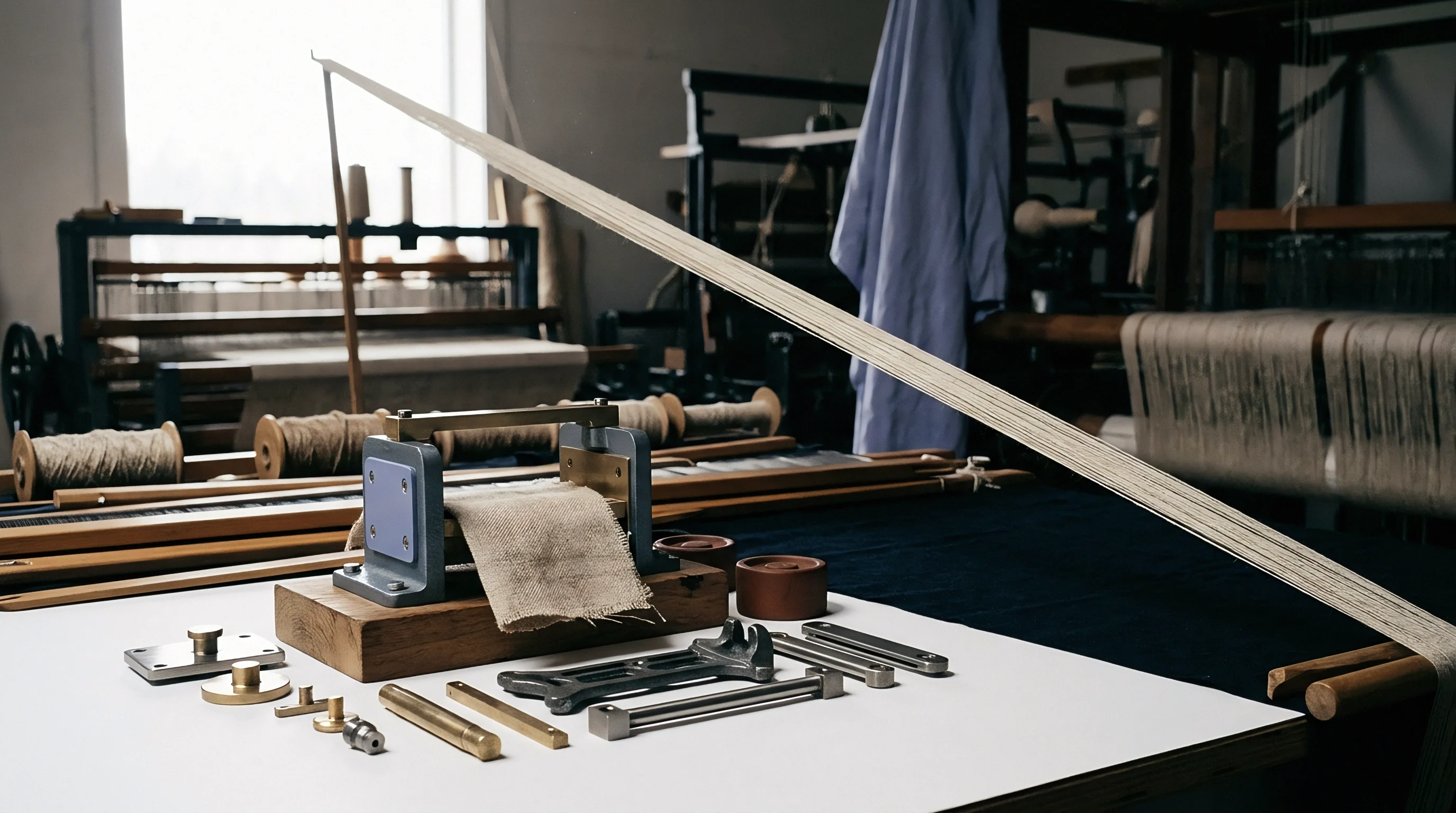
Modulating backrest roller height alters the path length difference between upper and lower shed sheets. Raising the backrest increases tension on the lower shed line while slackening the upper line during shed opening. This unequal tension forces the inserted pick to bend over the tight lower warp ends, inducing high fill crimp while flattening the warp path.
The resulting crimp shift lowers mechanical beat-up resistance, enabling higher pick densities on light-to-medium weaving frames.
Unequal shed tension also splits the beat-up load into two distinct stages. The tight lower warp ends lock the pick in place first, followed by the upper warp ends as the shed completes its crossing. This phased locking sequence prevents the pick from rebounding off the fell line.
- Warp Strip-Back occurs when high fill crimp creates excessive frictional resistance during beat-up, causing warp surface filaments to push back into dense slubs behind the reed.
- Reed Mark Banding develops when uneven warp crimp distribution across adjacent dent wires forces warp ends to bundle into visible structural gaps.
- Weft Loop Formation happens when low fill crimp causes the inserted pick to snap back and buckle before fell lock-in occurs.
- Off-Loom Skewing emerges when unbalanced crimp ratios between warp and fill generate asymmetrical residual stress in finished greige rolls.
Structural Jamming Thresholds and Off-Loom Relaxation
The theoretical limit of pick density occurs when adjacent picks touch and warp crimp reaches its maximum geometric packing limit. At this threshold, known as the Peirce jammed state, further pick insertion requires permanent cross-sectional flattening of the yarns. If warp ends cannot flatten under high tension, fine ends snap and beat-up force transfers into structural strain, causing fell bounce and machine overload.
Off-loom relaxation restores mechanical equilibrium to jammed constructions. As the tension of the loom beam releases, stored elastic energy causes the warp ends to contract, increasing warp crimp while reducing total finished length. Wet finishing processes further shift crimp balance as fiber swelling alters yarn diameters and contact friction.
Standard quality protocols mandate measuring crimp balance after forty-eight hours of ambient relaxation following off-loom doffing.
A raised backrest roller shifts structural curvature into the weft system and clears the beat-up fell without requiring higher warp beam load.


Lubrication
Chemical surface modifiers applied during warp preparation establish the boundary film that protects fiber bundles from mechanical degradation. Warp sizing acts as both an adhesive binder and a surface lubricant. While primary starch or synthetic polymers encapsulate loose surface fibers to increase yarn tenacity, secondary additive lubricants modify the coefficient of surface friction.
Formulations must balance yarn-on-yarn sliding capability during beat-up against yarn-on-metal friction across heald eyes and reed wires.
Excessively tacky sizing films increase static friction, causing adjacent warp ends to cling together during shed opening. This prevents clean shed formation and leads to weft insertion aborts on air-jet and rapier machines.

Sizing Chemistry for Low Static Friction Coefficients
Polyvinyl alcohol formulations combined with refined wax emulsions yield smooth, low-friction surface films. Blending water-soluble polyester resins into the size liquor improves film flexibility on fine combed cotton and flax warps. The addition of micro-wax emulsions lowers the static friction coefficient by forming a thin hydrophobic boundary coating over the polymer shell.
| Sizing Base Formula | Add-On Weight (%) | Static Friction (μs) | Dynamic Friction (μk) | Abrasion Cycles to Break |
|---|---|---|---|---|
| Native Potato Starch Base | 10.5 | 0.38 | 0.29 | 1,420 |
| Modified Thin-Boiling Starch + Synthetic Wax | 9.8 | 0.28 | 0.21 | 2,150 |
| PVA / Acrylic Copolymer Blend | 8.0 | 0.24 | 0.18 | 3,800 |
| PVA / Acrylic + Micro-Wax Emulsion | 8.2 | 0.19 | 0.14 | 4,600 |
Synthetic lubricants outperform tallow-based additives by maintaining consistent viscosity across varying drying temperatures. Over-lubrication, however, reduces the cohesive strength of the internal fiber bundle, allowing core fibers to slip past one another under lower tensile loads. Sizing audits verify that wax contents remain strictly between two and four percent of dry size weight.

Topical Wax Applicators at the Warping Creel
Applying liquid wax via kiss-rollers during beam assembly provides targeted surface lubricity without saturating the yarn core. This surface-focused application concentrates friction reduction at the outer hair layer where yarn-on-yarn rubbing occurs during shedding.
Desizing efficiency guarantees specified in supply contracts become void if synthetic wax additives exceed three percent of dry size weight without pre-approval from the finishing plant.
Topical waxes must emulsify fully during industrial desizing cycles. Incomplete wax removal leaves hydrophobic spots on the greige cloth, causing blotchy dye absorption during subsequent finishing operations.
Higher wax application masks poor raw material strength behind temporary surface lubricity, but does not compensate for inherently low fiber tenacity.


Reed
The metallic grid of the beat-up element compresses inserted picks into the fell while maintaining uniform warp end distribution across the weaving width. Reed selection governs the distribution of open area available for warp passage. Heavy densities require high reed counts to prevent multiple warp ends from crowding inside a single dent.
Dent wire thickness directly alters the spatial clearance; ultra-thin flexible wires maximize open space while reducing friction and shedding abrasion.
Excessively rigid dent wires exert high shearing forces on warp ends during shed opening, generating fiber dust that clogs reed channels.

Denting Density and Yarn Shearing Forces
Passing three or four warp ends per dent distributes total warp density across fewer dents, simplifying reed manufacturing. High ends-per-dent arrangements, however, cause warp yarns within the same dent to rub forcefully against each other as the shed changes. Single or double denting distributes warp yarns more uniformly, minimizing internal yarn-on-yarn friction at the expense of higher dent wire surface area contact.
- Lower the backrest roller to neutral alignment with the breast beam to establish equal warp tension across top and bottom shed lines.
- Advance the harness crossing angle to fifteen degrees before front dead center on the main drive shaft.
- Increase warp beam baseline tension in increments of twenty Newtons until yarn flutter vanishes during insertion.
- Measure beat-up displacement at the fell line using an optical sensor to confirm uniform pick displacement.
- Raise the backrest roller by fifteen millimeters to induce asymmetric tension differential between open shed sheets.
Calibrating harness drop timing prevents warp ends from dragging across reed wires during insertion, preserving filament integrity on un-sized filament warps.

Beat-Up Force Spikes and Machine Speed Limits
Peak beat-up force increases exponentially as the distance between adjacent picks approaches the yarn diameter. Sensor arrays mounted on the reed drive record load profiles throughout the beat-up cycle. Peak forces above five hundred Newtons per metre of reed width indicate severe structural jamming at the fell line.
Running high-density constructions at high speeds increases machine thermal stress and accelerates dent wire wear, damaging outer filaments. When peak force limits are reached, machine operating speeds must be reduced to allow adequate time for energy dissipation at the fell line.
Standard ISO 7211-2 denting tolerance clauses require re-inspection of the entire warp lot when reed-mark frequency exceeds two occurrences per fifty linear metres.


Sett
Thread frequency per unit length determines maximum achievable cover factor before structural resistance halts pick insertion. Cover factor calculations utilize yarn diameter and thread density to predict the packing percentage of the cloth surface. Down-proof poplins, dense canvas, and high-specification filtration fabrics require combined cover factors exceeding twenty-five point five.
At these values, the space between yarns drops below thirty percent of yarn width, creating extreme contact pressures during weaving.
High sett values demand precise tuning of yarn friction and crimp ratios to avoid catastrophic loom stops.

Cover Factor Limits for Down-Proof and Technical Structures
Constructing down-proof textiles requires tight thread packing to prevent feather feather-stem penetration through inter-yarn voids. A standard construction running 110 ends per centimetre and 90 picks per centimetre with 80s Ne combed cotton yarn pushes the limit of standard air-jet shedding. Achieving this pick density without structural damage depends on maintaining low boundary friction and precise crimp balancing.
Operating high-sett warps requires reducing loom insertions per minute to limit yarn temperature buildup and prevent friction-induced size breakdown.

Worked Calculation of Energy Consumption and Yarn Abrasion
Consider a production run of 50,000 metres of high-density down-proof cotton cloth on a 220-centimetre-wide air-jet loom running at 850 picks per minute. Construction A utilizes standard sizing with a dynamic friction coefficient of 0.28, operating at a baseline warp tension of 3800 Newtons. Construction B utilizes a low-friction PVA/micro-wax sizing formulation yielding a dynamic friction coefficient of 0.16, allowing a reduced baseline warp tension of 2900 Newtons.
Under Construction A, high friction causes a fell bounce of 1.8 millimetres per beat-up, requiring a beat-up energy input of 410 Joules per metre of woven cloth. Mechanical stop frequency averages 4.2 stops per 100,000 picks, primarily driven by warp breakage from abrasion behind the reed. Machine running efficiency settles at 78 percent, resulting in an effective output of 41.5 metres per loom hour.
Under Construction B, reduced dynamic friction drops fell bounce to 0.4 millimetres. Beat-up energy consumption drops to 290 Joules per metre. Warp break stops decrease to 0.8 stops per 100,000 picks, lifting loom operating efficiency to 91 percent.
The output increases to 48.4 metres per loom hour, dropping the energy requirement per finished metre by twenty-nine percent while reducing total loom hours needed for the order by 152 hours.
| Construction Parameter | Specification A (Standard Friction) | Specification B (Tuned Friction) |
|---|---|---|
| Warp Sett / Weft Sett (ends/cm) | 110 / 90 | 110 / 90 |
| Yarn Count Warp / Weft (Ne) | 80/1 / 80/1 | 80/1 / 80/1 |
| Dynamic Friction Coefficient (μk) | 0.28 | 0.16 |
| Beat-Up Force Peak (N/m) | 480 | 310 |
| Warp Crimp (%) | 8.5 | 5.2 |
| Weft Crimp (%) | 4.1 | 7.8 |
| Loom Speed (RPM) | 850 | 850 |
| Loom Efficiency (%) | 78.0 | 91.0 |
| Data measured on 220cm air-jet weaving machinery under standard climate conditions (20 deg C, 65% RH). | ||
Shifted crimp balance in Specification B transfers structural bending into the weft system, maintaining high cover while lowering warp stress. Lowering warp stress directly extends the working life of drop wires, heald wires, and reed dents.
- Yarn Tenacity Verification requires minimum single-end strength testing across twenty cops per spinning batch before sizing commitments are signed.
- Sizing Dry Add-On Audit demands gravimetric desize testing on greige retain samples prior to approving full production beam runs.
- Loom Speed Adjustment dictates reducing insertion rate by twelve percent when cover factor calculations exceed twenty-six point five.
- Fell Line Optical Monitoring mandates installing continuous linear camera arrays to detect micro-instability in high-density pick placement.
Increasing pick density beyond the jammed geometry limit forces the warp yarns to stretch rather than flex, transferring beat-up energy directly into frame vibration and loom stops.
Whether real-time acoustic sensors can continuously predict fell line displacement before tension spikes cause micro-filament fracture remains an open question across high-speed air-jet sheds.

Valuation
Financial calculations for dense high-specification fabrics incorporate loom capacity degradation alongside raw material costs. Operating at high cover factors slows production output, increases spare parts consumption, and inflates electrical power charges per metre. Calculating landed cost without incorporating loom efficiency loss leads to severe margin erosion on contract manufacturing orders.
High friction levels increase warp break rates, converting direct labor hours into unproductive downtime spent re-threading dropped ends.

Loom Efficiency Loss Rates under High Contact Friction
Loom stop logs track performance breakdown across three major failure categories: warp breaks, weft aborts, and mechanical stops. High inter-yarn friction primarily elevates warp break frequency. When stops exceed three per loom hour, one weaver can manage fewer machines, forcing the shed operator to reassign labor allocations and raise machine time rates.
Machine stop frequency increases exponentially once the combined fabric cover factor crosses the theoretical threshold of twenty-seven.
Unplanned machine stops also generate greige defects known as start-up marks or stop marks. Dense constructions show start-up marks prominently due to the immediate shift in fell position during machine deceleration and re-start. Scrapping or discounting cloth containing start-up marks adds a secondary cost burden that directly hits contract profitability.

Capacity Booking and Machine Time Charges
Mill capacity is booked in loom hours rather than linear metres. High-density warps consume more loom hours per hundred metres than standard constructions due to reduced running speeds and lower efficiency percentages. A buyer committing to a high-density order accepts that mill capacity billing scales with total shed occupancy time.
Friction modulation techniques and crimp balance tuning mitigate efficiency losses, bringing production rates back into viable operational windows. Sourcing contracts that specify strict size formulations and backrest settings secure predictable loom efficiency, protecting both the buyer and the mill from unforeseen capacity surcharges.
A mill that prices dense poplins or technical down-proofs on simple yarn weight and nominal machine running time without accounting for reduced speed and increased stop rates absorbs the efficiency loss directly into operating margins.