Quantifying Dynamic Shed Strain and Cyclic Tension Fatigue Limits in Ultra High Speed Air Jet Linen Weaving
Optimizing air-jet linen weaving requires reducing heald stroke height and dampening peak shedding tension to prevent dynamic fatigue breaks in low-elongation flax warps.


Flax
Unlike staple cotton or continuous synthetics, wet-spun bast fibers tighten up almost immediately under tension. In a spun yarn, these flax bundle structures carry a high initial Young’s modulus ~ typically between 18 and 35 GPa ~ with an ultimate elongation at break that rarely passes 2.2 percent. Running these warps on high-speed air-jet looms at 600 to 850 picks per minute leaves very little margin for error.
Where standard synthetic warps absorb shock loads by stretching, spun linen concentrates dynamic tension spikes along microscopic fiber cell walls. Under rapid shed opening, the yarn’s mechanical response becomes non-linear and heavily dependent on minor structural variations.
Irregularities in linear density worsen shed opening stresses. Spun flax inherently varies in thickness, carrying slubs, neps, and thin necked sections where the cross-sectional fiber count dips sharply. A yarn sample might show adequate tenacity in a static tensile test, measured in centinewtons per dtex, yet fail rapidly under 12 Hertz shedding cycles right where the linear density drops below nominal count.
Wet spinning twist locks ultimate fibers into a rigid helix. While higher twist improves yarn cohesion, it locks down internal fiber sliding ~ preventing the yarn from shedding energy through micro-shear shifts during fast shedding cycles.
Air-jet looms need a clear shed path so the main jet can blow the pick through the reed profile without catching warp ends, requiring a minimum heald frame stroke. On wider machines ~ especially from 190 to 340 centimeters in reed width ~ the opening movement generates severe tension spikes across the warp line. As the shed opens, the path length between the backrest roll and the cloth fell grows.
Because flax yields or plastically deforms past two percent stretch, peak tension at full shed aperture rises sharply, driving the yarn toward its breaking threshold in milliseconds.
Dynamic testing of NeL 30 wet-spun linen warps under high-speed shedding cycles establishes baseline tension limits. Peak dynamic loads at shed opening regularly reach three times the static warp tension programmed at the let-off system. With static tension set at 0.5 centinewtons per dtex to keep trailing ends from sagging into the air nozzle track, dynamic tension spikes reach 1.7 centinewtons per dtex during shedding.
If beat-up aligns with final shed closure, those tension transients jump even further. Over thousands of cycles, linen yarn cannot absorb these recurring peaks without suffering permanent fatigue.
Under high-speed shedding, linen breaks down through several distinct structural degradation modes:
- Fibrillar Decoupling occurs when repeated tension cycles break down the pectin matrix that binds ultimate fibers inside the strand structure.
- Slub Shear Separation happens where abrupt density changes concentrate stress at the neck of yarn irregularities.
- Nodal Micro-Buckling forms during rapid tension release, cracking the cellulose wall transversely.
- Abrasion Mass Thinning strips away outer fibers as the yarn cycles rapidly through drop wire apertures and steel reed dents.
Matching yarn structure to dynamic mechanical strain is critical before loading flax warp beams onto air-jet looms. Conventional cotton sizing and shedding setups fail on wet-spun flax. Because bast fibers stretch so little, every millimeter of excessive heald stroke directly translates into unnecessary warp stress.
Without tight control over shed geometry and dynamic tension, high-speed linen weaving quickly devolves into high end-break rates, low loom efficiency, and poor fabric quality.
A 40 Nm wet-spun warp yarn subjected to a peak tension of 2.1 centinewtons per dtex at 750 picks per minute loses 64 percent of its cycle life compared to static tensile testing thresholds.
Spinners often blame high shed break rates on un-lubricated loom parts or bad shedding angles rather than variations in ultimate fiber elongation.

Stroke
Adjusting the shedding mechanism kinematics sets how far warp ends move between the top and bottom shed positions. On air-jet looms with electronic dobby or positive cam motions, heald frame stroke is continuously adjustable. Every extra millimeter of stroke used to clear the jet insertion channel adds strain to the warp sheet.
Geometrically, half the shed forms a right triangle: the base is the distance from cloth fell to heald frame, and the height is half the total lift. The hypotenuse gives the extended warp length at full opening. With low-elongation flax, even slight increases in shed height push yarn strain past its elastic limit.
Backrest roller setup directly alters these strain surges. Fixed backrests force the full strain of shed opening onto the free length of warp between beam and cloth fell. Dynamic backrests ~ whether spring-loaded or hydraulically dampened ~ pivot inward as the shed opens, feeding extra warp length into the zone and dampening peak tension spikes.
In mill trials, dynamic backrests reduced peak tension spikes by 28 percent relative to rigid backrests, keeping overall warp strain within safe limits for spun linen.
Asymmetrical shedding gives another point of control over stroke geometry. By altering backrest height relative to the heald frames, technicians can set different tensions in the top and bottom sheds. Raising the backrest slightly above the cloth line slackens the top shed while keeping the bottom shed taut.
That tight bottom sheet stops warp ends from sagging into the reed tunnel so the air jet pick clears cleanly, while the slacker top sheet absorbs less total strain over the run.
Dwell angle dictates how long warp yarns stay fully extended. Longer dwell gives the main and relay nozzles more time to blow the pick across wide reed widths, but holding stiff linen yarn under peak strain for 120 degrees of crank rotation speeds up tension fatigue. Shortening the dwell to 90 or 100 degrees limits peak strain exposure during each cycle.
That narrows the insertion window ~ demanding tighter nozzle timing and higher air pressure ~ but protects the warp from prolonged stress.
Setting up shed stroke for wet-spun linen requires a precise sequence to protect the yarn while maintaining clearance for the pick:
- Mount the backrest roller 15 millimeters above the central cloth line to equalize tension across top and bottom sheds during pick insertion.
- Adjust heald frame height so the minimum shed clearance clears the main nozzle profile by 2.5 millimeters at full opening.
- Set whip roll spring dampening load to absorb transient shock load spikes at the 180-degree crank angle phase.
- Lock shed dwell angle at 105 degrees, reducing peak tension duration while leaving enough time for air-jet insertion.
Loom speed directly affects dynamic shed strain. At lower speeds, dampening springs react fast enough to absorb tension spikes. As speed increases from 500 to 800 picks per minute, tension pulse frequency approaches the warp sheet’s natural resonance.
Mechanical dampeners begin to lag, failing to yield at maximum shed opening. When that dampening response falls behind loom kinematics, unmitigated strain goes straight into the yarn. Machine speed and stroke geometry must be tuned together to keep the warp out of resonance zones that snap threads.
| Frame Stroke (mm) | Loom Speed (RPM) | Shed Lift Angle (deg) | Peak Tension Spike (cN/dtex) | Warp Break Rate per 100k Picks |
|---|---|---|---|---|
| 24.0 | 600 | 22.5 | 1.15 | 1.4 |
| 26.0 | 650 | 24.0 | 1.38 | 2.8 |
| 28.0 | 700 | 26.2 | 1.67 | 6.2 |
| 30.0 | 750 | 28.5 | 2.05 | 14.1 |
| 32.0 | 800 | 31.0 | 2.48 | 31.5 |
Shed stroke, loom speed, and warp tension together set the working limits for linen weaving. Increasing stroke height to fix pick insertion faults can trigger a sudden spike in end breaks if strain limits are passed. Operational balance relies on finding the minimal shed height that still guarantees clean pick passage while keeping yarn elongation comfortably below the fiber’s elastic threshold.
Equalizing tension between top and bottom sheds protects yarn structure far better than cranking up backrest height to clear mispicks.
Keeping heald frame movement to a minimum protects warp ends far better than tweaking backrest spring tension after breaks start occurring.
Rupture
Cumulative damage in cellulosic fibers follows a standard S-N curve: repeated tension pulses well below ultimate tensile strength eventually cause abrupt end breaks. Spun linen has little fatigue tolerance compared to synthetics or continuous filaments. In an air-jet loom, a single warp thread experiences 10,000 to 50,000 shedding cycles per operating hour.
Even when peak dynamic tension stays below half the static breaking strength, cyclic stretch degrades the microstructure ~ expanding micro-voids between ultimate fibers, cracking cell wall nodes, and stripping outer surface fibrils under continuous cycling.
Fatigue life drops exponentially as dynamic strain increases. When testing spun flax across variable strain amplitudes at 12 Hertz, modest increases in stretch severely cut cycle endurance. At 1.0 percent dynamic strain, standard NeL 30 wet-spun yarn lasted over 500,000 cycles before failing.
Raising dynamic strain to 1.8 percent dropped average fatigue life below 40,000 cycles. On a high-speed loom, a 300-meter warp beam undergoes hundreds of thousands of cycles, making it essential to hold dynamic strain within high-cycle fatigue limits.
Cyclic Load Accumulation and Wöhler Curves for Linen
Mapping fatigue life in linen requires stress-life curves calibrated across operational speeds. Flax behaves viscoelastically, with properties that shift based on ambient humidity and loading rates. At air-jet speeds, tension relaxes far too slowly to dissipate during the millisecond window of a shed opening stroke.
Instead, the yarn responds like an elastic-brittle solid, building up un-released internal energy cycle after cycle. That micro-strain breaks down pectin bonds between fibers, causing pull-out failure long before overall tension approaches theoretical breaking strength.
Beat-up adds a second axial load pulse at shed closure. As the reed strikes the cloth fell to drive the pick into place, warp tension spikes momentarily. If beat-up coincides with early shed opening for the next pick, these tension peaks overlap and routinely exceed the yarn’s yield point.
Setting shedding kinematics so beat-up occurs during the flat tension window at shed crossover prevents peak overlap and preserves yarn fatigue reserves.
Do Higher Peak Loads Accelerate Linen Micro-Friction Breakdown?
High-speed shedding causes continuous micro-frictional wear as warp ends slide back and forth through drop wires, heald eyes, and reed dents under heavy contact pressure. Frictional heating breaks down protective sizing coatings, exposing raw flax. Fiber-to-metal contact then generates localized shear forces that strip outer fibrils from the core, rapidly thinning the yarn’s load-bearing cross-section.
Break rates reach 14 per 100,000 picks when peak tension exceeds 1.8 centinewtons per dtex. Broken ends collected from the loom show distinct fatigue profiles: instead of clean, sharp breaks from sudden tensile overload, the tips are frayed and broom-like with deep fibrillar separation along the axis. That frayed signature confirms the ends failed from accumulated fatigue and friction rather than single spikes in tension.
| Yarn Count (NeL / Nm) | Static Tenacity (cN/dtex) | Peak Shed Tension (cN/dtex) | Fatigue Limit (Cycles to Failure) | Primary Failure Mode |
|---|---|---|---|---|
| 25 / 42 | 2.10 | 1.10 | 450,000 | Surface Abrasion Thinning |
| 30 / 50 | 1.95 | 1.30 | 210,000 | Fibrillar Decoupling |
| 40 / 67 | 1.80 | 1.50 | 85,000 | Slub Shear Separation |
| 50 / 84 | 1.65 | 1.70 | 32,000 | Nodal Micro-Buckling |
| 60 / 100 | 1.50 | 1.90 | 11,000 | Instantaneous Yield Fracture |
Before running linen lots on the warping floor, yarn should be screened against several core structural and dynamic targets:
- Count Uniformity Index requires that thin sections under 50 percent of nominal diameter occur fewer than 5 times per 1,000 meters.
- Splice Tensile Retain Factor specifies that pneumatic splices maintain at least 85 percent of original strength under dynamic stretching.
- Minimum Elongation Floor sets an absolute rejection limit for any yarn lot with total elongation below 1.6 percent.
- Slub Frequency Ceiling limits thick places over 200 percent diameter to prevent heald eye jams during fast shedding.
Testing yarn fatigue before starting production runs prevents expensive loom downtime. Static tensile tests show baseline strength, but they tell you very little about how yarn holds up under high-frequency shedding stress. Dynamic cyclic fatigue testing lets mill engineers identify and reject brittle or uneven yarn lots before they ever reach the warper.
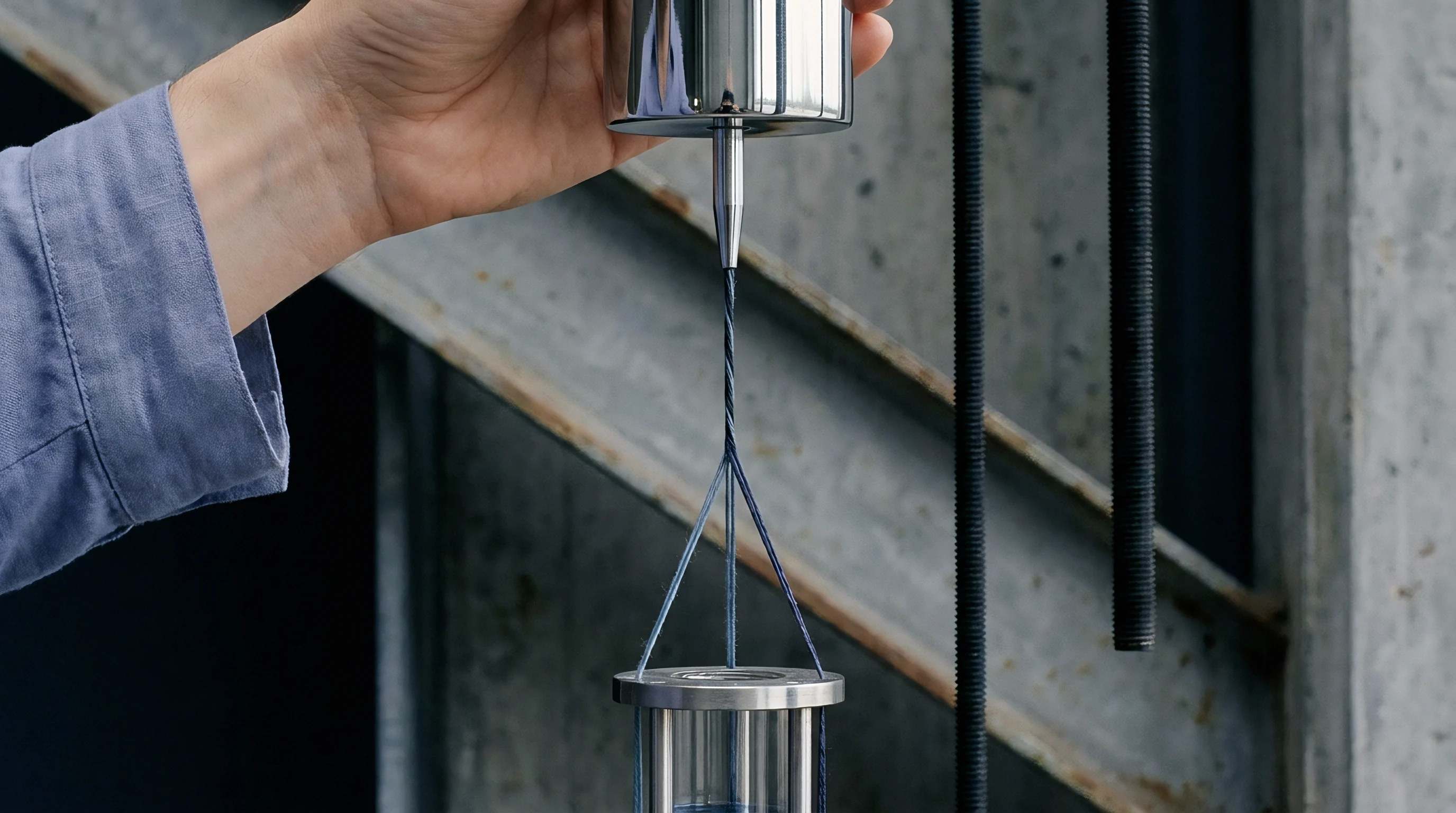
Static ISO 13934 tensile testing cannot reliably predict air-jet weaving performance unless cyclic extension testing at 10 Hertz is added to yarn QA checks.
An uninspected yarn lot averaging thirty-two end breaks per hundred thousand picks at seven hundred revolutions per minute resulted in a forty-thousand-dollar downtime penalty.
Sizing
Applying protective sizing to spun bast warps is the main defense against surface abrasion and tension fatigue in air-jet weaving. Raw linen yarn lacks the smoothness and internal cohesion needed to survive continuous rubbing against drop wires, heald eyes, and reed dents. Loose surface fibers tangle between adjacent warp threads to form clings, which obstruct shed opening and cause the air jet stream to hit crossed ends.
Sizing glues those hairy fibers down to the core while binding internal fiber bundles together.
Formulating size for high-speed linen requires balancing coating strength against flexibility. Pure native starch forms a strong film, but it gets brittle under low relative humidity and shatters under dynamic shed strain ~ generating size dust that clogs heald eyes and jet nozzles. Blending high-fluidity modified starches with flexible synthetic polymers, like polyvinyl alcohol or acrylic copolymer esters, produces an elastic film that stretches with the flax fiber during shed opening.
The polymer additive acts as an internal plasticizer, stopping the coating from micro-cracking under rapid cyclic extension.
Dry solids add-on percentage determines how well the warp sheet is protected. For spun linen counts between NeL 25 and NeL 50, target a dry add-on of 11 to 14 percent by weight. Drop below 9 percent, and loose surface fibers invite severe abrasion damage in the drop wires.
Go above 16 percent, and the yarn becomes overly stiff, increasing friction through the heald eyes. Squeeze roll pressure must be adjusted to press size deep into the core while keeping a uniform coating across the outer surface.
Controlling humidity in the weave room directly affects sizing performance. Spun flax performs best at 68 to 74 percent relative humidity and 22 to 24 degrees Celsius. Proper humidity softens both the natural pectin inside the fiber and the applied starch-polymer film, boosting elongation at break by up to 15 percent over dry conditions.
If shed humidity falls below 60 percent, size films dry out and harden, causing dynamic shed strain to snap warp ends at a much higher rate.
Warp preparation control relies on verifying several physical targets before moving beams to the weave room:
- Film Elongation Capacity requires the dry size film to handle at least 4.5 percent extension without cracking.
- Abrasion Resistance Coefficient verifies sized yarn can take 5,000 double strokes on a standard warp abrasion tester without shedding size dust.
- Residual Moisture Regain ensures warp beams leave the sizing machine with 9.5 to 11.0 percent water content by mass.
- Penetration Depth Ratio checks that size anchors into the outer 30 percent of yarn cross-section without fully soaking the core.
Adding lubricants to the size bath helps lower dynamic shedding stress. Emulsified hydrogenated tallow or specialized synthetic waxes drop the static friction coefficient between sized warp ends and metal heald eyes. Lower yarn-to-metal friction reduces shear stress during rapid frame movements, working alongside mechanical shed adjustments to keep dynamic yarn strain within safe fatigue limits.
Enforcing a sizing spec clause that rejects or requires re-sizing for lots under twelve percent dry pick-up shifts financial accountability for shed breaks back to the slasher room.

Ledger
Air-jet weaving economics depends on balancing loom speed against the cost of warp stops. Machine builders advertise top pick insertion rates, boasting speeds up to 1,000 picks per minute. With synthetics or continuous filaments, higher speeds directly mean more production.
But with spun linen, pushing speeds to maximum without factoring in cyclic fatigue leads to a sharp spike in warp breaks. Each break stops the loom, requiring a weaver to mend the end, clear any mispicks, and restart.
Calculating landed fabric cost shows that running at top speed often squeezes net margins. Take an air-jet loom weaving plain-weave linen, 190 centimeters wide at 22 ends per centimeter with NeL 30 wet-spun yarn. Running at 780 picks per minute increases dynamic shed strain, causing 14 warp stops per 100,000 picks.
With each stop averaging 2.5 minutes of downtime for repairs, real loom efficiency drops to 74 percent while compressed air consumption stays elevated as nozzles blow during pick fixes.
Dropping speed to 640 picks per minute improves shed dynamics significantly. At 640 RPM, peak dynamic tension stays below the fatigue threshold, cutting warp stops to 2.1 per 100,000 picks. Loom efficiency jumps to 92 percent.
Even at lower speed, the machine produces more top-grade fabric per 24-hour shift. Compressed air use per woven meter drops by 18 percent, lowering room overhead.
Loom booking contracts written based on maximum allowed stop rates rather than peak machine revolutions protect operating margins. True loom-hour cost must include weaver labor, power, compressed air, and downstream defect mending. Fabric from looms with frequent stops develops start marks and defects that force price downgrades during final grading.
Running within yarn fatigue limits improves fabric grade yields while reducing total manufacturing cost.
| Loom Speed (RPM) | Warp Stop Rate (per 100k picks) | Loom Efficiency (%) | Daily Output (Metres / 24 hrs) | Air Power Cost per Metre ($) | Landed Cost per Metre ($) |
|---|---|---|---|---|---|
| 600 | 1.2 | 94.5 | 386.7 | 0.31 | 2.45 |
| 640 | 2.1 | 92.0 | 401.4 | 0.29 | 2.38 |
| 700 | 5.8 | 84.5 | 403.9 | 0.34 | 2.52 |
| 750 | 11.2 | 76.0 | 389.1 | 0.41 | 2.78 |
| 800 | 22.5 | 62.0 | 338.2 | 0.55 | 3.35 |
Commercial success in high-speed linen weaving depends on matching machine setup to actual fiber limits. Driving looms past what spun bast yarns can take damages yarn structure and wastes money through downtime, compressed air loss, and fabric seconds. True profitability comes from balancing speed, shed geometry, and size formulation to deliver maximum first-quality yards at the lowest cost per hour.
Running an air-jet loom ten percent below maximum rated speed often yields a lower landed cost per meter by cutting down on tension fatigue breaks.
Whether dynamic tension dampening systems can overcome the low elasticity of wet-spun flax above eight hundred picks per minute remains an open question for future loom design.