Predictive Stochastic Queueing Models for Dynamic Weaver Interference in Ultra High Density Linen Sheds
Dynamic weaver interference in dense linen sheds collapses loom efficiency unless predictive queueing models optimize operator routing to control warp break downtime.

Gang
High-density linen production breaks standard loom allocation tables the moment warp sett exceeds thirty-four ends per centimetre. In a conventional mill weaving mid-weight cotton or continuous filament synthetics, one weaver manages twenty to forty high-speed rapier or air-jet machines without severe capacity loss. Wet-spun flax, however, operates under physical limits that throw off these assignment ratios.
Because long-staple flax is stiff and its total elongation at break stays below two percent, minor tension variations quickly turn into thread ruptures. When a shed runs high-density constructions like forty ends per centimetre using sixty-lea wet-spun flax, warp stops jump from an acceptable zero-point-five breaks per loom-hour to three or four breaks per loom-hour across every active machine.
Assigning a static block of looms to a single operator under these breakage rates creates an immediate queueing bottleneck. While the weaver repairs one machine, adjacent looms break threads and drop their harnesses into automatic stops. The time a stopped loom sits waiting for someone to walk down the aisle and re-thread the heddle is pure weaver interference loss.
Standard capacity models usually assume an operator arrives immediately when a machine fails. Real floor conditions involve actual walking distances, fatigue, and sudden clusters where several looms in a gang stop within seconds of each other.
Fixed patrol loops in ultra-high density linen sheds can cut up to twenty-five percentage points from target efficiency. If four looms in a sixteen-loom gang stop at once, three sit completely idle while the weaver carries out a manual warp draw-in on the first. At four stops per loom-hour across sixteen machines, repair calls easily overwhelm a single weaver during peak tension windows.
The resulting queue creates compounding production losses that faster loom speeds will not fix ~ cranking up velocity on dense flax warps only increases strain on the yarn, raising breakage rates and deepening the bottleneck.
A sixteen-loom allocation running forty ends per centimetre on sixty-lea linen drops from eighty-eight percent mechanical efficiency to sixty-two percent operational efficiency when weaver arrival delays exceed three minutes per stop.
Static allocations fail in dense linen sheds because they treat loom stoppages as predictable, evenly spaced events. Management schedules staffing around average stop rates per shift, overlooking the natural clustering that occurs during flax weaving. Tension spikes from shedding, small variations in yarn diameter, and drops in humidity affect the warp sheet all at once.
A shift of just five percent in relative humidity can cause multiple looms on the same yarn lot to snap warp ends simultaneously. Static assignments pin weavers to fixed zones, keeping them from stepping over to help adjacent operators hit by sudden stoppage cascades.
Linen yarn forces a rethink of how operator labor interacts with loom capacity. Flax fibers lack the natural spiral crimp of wool or the elasticity of cotton, so tension spikes cannot be absorbed by stretching. Each tension peak during beat-up transfers directly to any knot or splice in the warp thread.
As density increases, clearance between warp ends inside the reed blades narrows to fractions of a millimetre. Neighboring ends rub and cling, which stops drop wires from falling cleanly and delays the automatic stop trigger. These mechanical quirks yield stoppage patterns that basic queueing assumptions cannot handle.
- Micro-abrasion end-clinging occurs when loose surface fibers on adjacent wet-spun warp threads entangle inside the reed, preventing clear shed opening and causing multi-end breaks.
- Shedding tension spikes develop during heavy harness lifts when high-density warps lack sufficient back-rest roller compensation, snapping threads at the heddle eye.
- Weft insertion rebounds happen when rigid linen picks bounce back inside the shed geometry, triggering false stop sensors and inflating non-structural operator servicing calls.
- Sizing film fractures result from insufficient moisture regain in the warp sheet, turning protective starch layers brittle and causing catastrophic multithread shear failures.
Dynamic interference modeling adapts to floor realities by treating the weaver gang as a fluid resource dispatched across the shed through algorithms. Rather than pacing a fixed oval loop down a loom row, weavers respond to live priority queues built from continuous machine telemetry. The system considers which machine is down, but also balances estimated repair duration against remaining pattern run time.
Deploying these models requires factoring in how repair times vary by fault: a basic weft stop takes twenty seconds of effort, while a broken warp thread tangled behind the drop wires can demand up to three minutes of manual draw-in.
Floor data shows uncoordinated movement accounts for nearly forty percent of total loom interference time. Weavers often walk past a stopped machine with a quick fault to reach one they spotted first, wasting steps across a shift. In ultra-high density linen sheds, walking time is dead capacity.
Dynamic allocation restructures floor movement, directing weavers to high-priority stops based on proximity and expected repair time. This turns random pacing into structured routes that cut machine wait times across the bay.
Moving from static assignments to dynamic routing meets real physical constraints on the floor. Layout, machine spacing, aisle width, and obstructed sightlines around high-profile jacquard or heavy dobby gantries limit how quickly an operator can navigate to a downed loom. The noise and vibration in a dense linen shed also mean visual signaller trees and wearable dispatch units are essential for live direction.
Without immediate alerts, weavers revert to routine loop patrols, recreating the interference queues dynamic routing was built to solve.
Physical fatigue also alters repair times over an eight-hour shift. After hours of fine draw-ins on wet-spun yarns, eye strain and loss of dexterity slow down the baseline repair speeds assumed by queueing software. Whether predictive models can adjust service expectations for shift elapsed time without overworking operators remains an open issue for modern facilities.

Stochastics
Standard manufacturing queueing models break down when applied directly to ultra-high density linen sheds without adjusting arrival distributions. Classical birth-death models assume exponential distributions for both failure arrivals and repair times. In flax weaving, warp breaks do not follow a memoryless Poisson process over longer periods.
Failures cluster over time due to cyclic mechanical stress, variations between yarn lots, and shifts in room environment. The risk of a warp thread snapping rises sharply at certain points in the beam unwinding cycle, especially near the core where yarn curl and structural memory raise tension.
Modeling weaver interference accurately in dense linen sheds requires using non-homogeneous Poisson processes or renewal processes with Weibull-distributed inter-arrival times. The shape parameter of the Weibull distribution captures cumulative yarn fatigue from repeated reed beat-up forces. In dense plain weaves or damasks with over thirty-eight ends per centimetre, stress buildup causes sudden clusters of breaks.
Five minutes of smooth running are often followed by three snapped ends on neighboring looms, causing queue surges that standard M/M/c models fail to predict.

Mathematical Formulation of Repair Queues
Service times for loom stoppages are also non-exponential. A weft stop takes a brief, predictable fix, but a warp break requires a full sequence: locating the broken end on the beam, threading it through the drop wire, passing it through the heddle eye, and pulling it through the narrow reed slit with a hook. This multi-step task produces a service time distribution better described by a Log-Normal or Erlang distribution.
As a result, shed queueing must be formulated using M/G/c/K or G/G/c/K models, where service times show real variance and have physical lower limits set by human dexterity.
In an M/G/c/K system, c is the number of active weavers in a floating bay, and K is the total number of looms they cover. System state probabilities follow integro-differential equations that track elapsed repair times. Finding the steady-state probability of n looms sitting stopped in a bay of K machines under dynamic allocation means integrating remaining service time distributions across active repairs.
When stoppage arrival rates approach the gang’s combined repair capacity, queue length spikes quickly, driving up interference losses and cutting shed output.
| Yarn Count (Lea) | Sett (Ends/cm) | Mean Break Rate (Stops/Loom-Hr) | Weibull Shape Parameter (k) | Mean Repair Time (Seconds) | Service Time Variance (sec²) |
|---|---|---|---|---|---|
| 40 Lea Wet-Spun | 32 | 1.85 | 1.12 | 78 | 145 |
| 60 Lea Wet-Spun | 36 | 2.60 | 1.34 | 92 | 310 |
| 80 Lea Wet-Spun | 40 | 3.95 | 1.58 | 115 | 620 |
| 100 Lea Wet-Spun | 44 | 5.40 | 1.82 | 142 | 1150 |
Predictive modeling relies on calculating expected interference time per loom-hour, tracked as machine wait duration. This is the time between an automatic stop sensor tripping and the weaver starting the repair. Combining wait duration with actual repair time gives the total efficiency loss from interference.
In ultra-high density setups running 80 Lea yarn at 40 ends per centimetre, wait duration under static allocation can make up sixty-five percent of total machine downtime, dwarf-ing the time spent fixing the thread.
Adding spatial factors to the queueing matrix requires mapping walking delays between machine coordinates. The shed floor is structured as a spatial grid where distances between loom centers, aisle widths, and crossovers set transit times. When a weaver finishes at position A, the engine determines the best next loom by balancing transit delay against machine priority.
Priority scores update continuously based on real-time estimates of financial loss rates for specific warp line stops.

Priority Schemes and Non-Markovian Arrivals
Priority algorithms keep difficult repairs from causing massive queue backlogs. In high-density damask, a warp break inside a tight Jacquard harness zone takes far longer to repair than a break near the selvedge. If the engine handles stops purely first-come, first-served, minor weft stops get stuck behind complex warp entanglements, delaying easy machine restarts.
A Preemptive-Resume or Non-Preemptive priority framework clears quick repairs first, keeping more looms running across the bay.
Dynamic priority models must watch for machine starvation. If the system constantly sends weavers to fast weft fixes to keep machine count numbers up, looms with complex warp breaks sit idle too long. Extended downtime on dense linen warps allows the un-woven warp sheet to lose tension.
When that loom restarts after sitting for forty minutes, tension differences between the idle section and the rest of the beam create a starting mark or stop mark, ruining the commercial value of the bolt.
Determining queue stability limits requires calculating traffic intensity ~ the ratio of arrival rate to total available repair capacity. In dense linen weaving, traffic intensity must stay strictly under zero-point-seven-five to avoid runaway queue growth. Crossing this threshold means minor fluctuations in break rates cause exponential spikes in wait times.
Keeping intensity within limits requires bringing in floating weavers or slowing loom speeds when yarn lot quality drops below standard.
Laplace-Stieltjes transforms allow closed-form analysis of general service time distributions in these networks. By converting Laplace equations back into time-domain metrics, the engine projects the probability of interference cascades over fifteen-minute lookahead windows. This gives management time to deploy relief weavers before a bay gets overwhelmed by stops.
Allocation calculations need to balance loom counts against yarn structural risk instead of giving every operator a uniform number of machines. High-density wet-spun linen sheds require shifting bay boundaries whenever warp yarn lot properties change during sizing.
Stiffness
Flax fiber mechanics under dynamic tensile loads drive warp stoppage rates in dense linen sheds. Flax has a high tensile modulus and almost no elastic recovery. Unlike cotton, which has natural convolutions that yield under stress, wet-spun flax bundles are rigid, crystalline structures bound by pectin networks.
When the harness opens to form the shed, warp threads stretch rapidly. At forty ends per centimetre, clearance between adjacent threads disappears, forcing them to rub against each other and against the heddle eyes.
Micro-defects in flax yarn concentrate stress along the thread. Slubs, thin spots, and neps disrupt even tension distribution. During shedding, tension peaks quickly exceed the strength of thin spots, snapping the thread cleanly.
Sizing applied to high-density warps encapsulates these defects and glues down surface fibers. Starch size coats the yarn to resist abrasion, but if the film is not plasticized enough, the flexing action of moving heddles cracks the shell, exposing bare fibers to high-friction chafing.
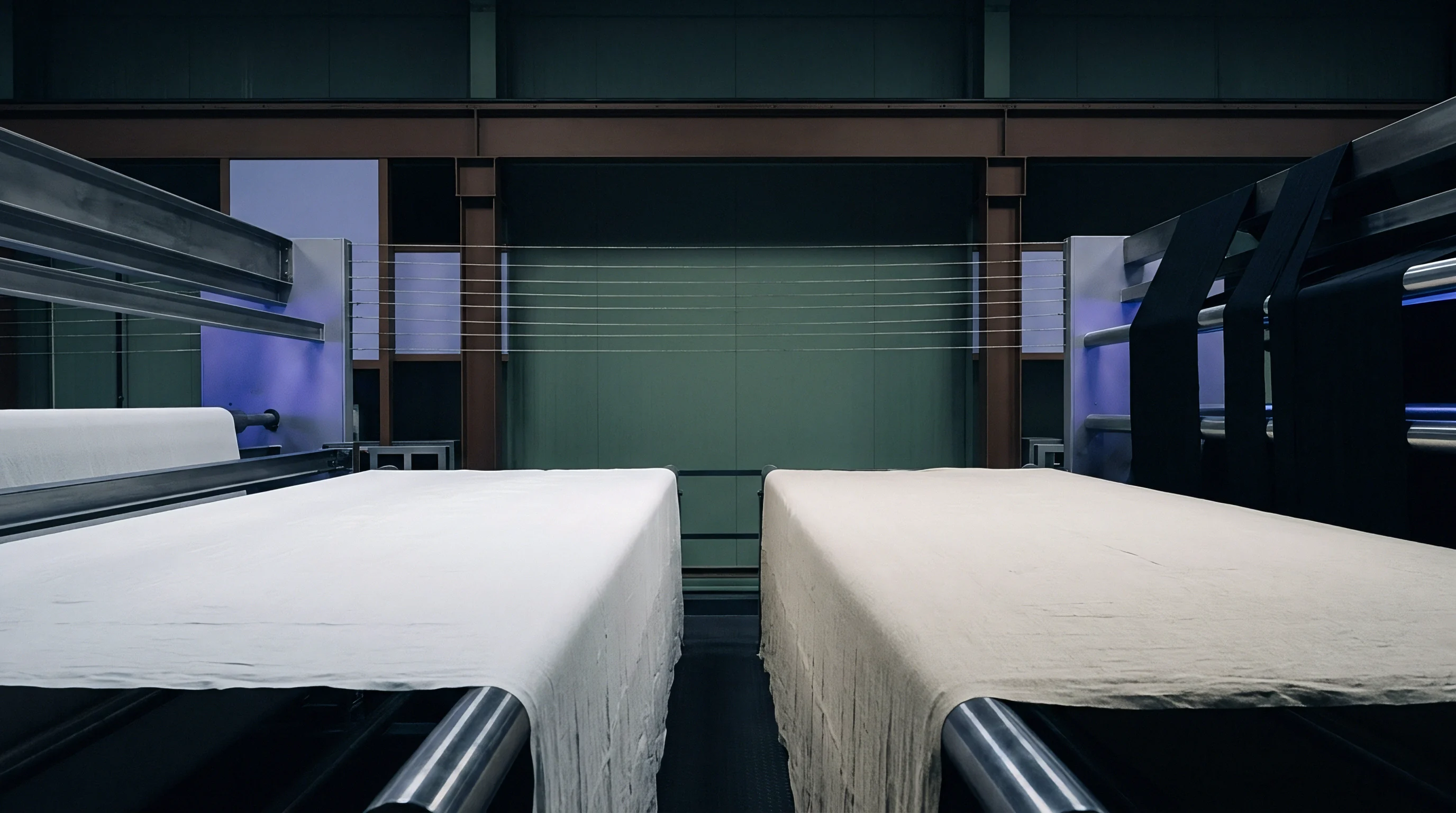
Shed Geometry and Dynamic Strain Profiles
Warp strain during weaving depends directly on shed height, back-rest roller placement, and harness timing. High-density linen requires a lower shed height to limit thread stretch during movements. But a lower shed restricts weft insertion clearance, raising the risk of rapier tape contacting the warp.
This presents a direct trade-off: tightening shed height reduces tensile breaks from stretching, but increases chafing breaks as insertion elements scrape through the dense warp.
A qualification trial on forty-two ends per centimetre, ninety-lea wet-spun warp running on high-speed negative rapier looms demonstrated this trade-off. Initial machine setups used a standard thirty-five-millimetre shed opening, which produced an average warp break rate of five-point-two breaks per loom-hour. Dropping the shed opening to twenty-nine millimetres cut tensile break rates by forty percent.
Rapier head interference inside the tighter shed increased weft stops, however, multiplying short repair calls. Net machine efficiency improved only after dynamic queueing models were adjusted to prioritize quick rapier fixes over long draw-ins.
Dynamic tension readings show that stress peaks vary across the loom beam. Edge warp ends experience uneven diagonal strain from the reed’s splay angle toward the selvedges. In dense linen, this splay drives up friction against the outer reed dents.
Without selvedge motion compensation, edge ends fail at three times the rate of body warp ends. These localized break clusters distort basic spatial queueing, pulling weavers to the sides of looms while main body breaks wait.
Flax moisture content dictates flexural stiffness and tensile strength. Dry flax is extremely brittle, while overly moist fibers suffer pectin softening, stretching without recovering cleanly. Sheds running dense linen must hold ambient relative humidity within a narrow band of sixty-eight to seventy-four percent at twenty-two degrees Celsius.
Any humidity drop degrades the size film, causing fast spikes in end-clinging. When climate controls drift, break rates climb quickly, pushing the queueing model from a stable state into a severe backlog.
Relative humidity drops below sixty-six percent in dense linen weaving increase warp micro-clinging failures by over two hundred percent within twenty minutes of environmental drift.
Sizing chemistry determines friction between high-density warp ends. Modified potato starches blended with synthetic wax emulsions supply film flexibility without making threads sticky. Applying too much wax lowers surface friction but blocks moisture pickup from the room air, keeping the inner flax core brittle.
Sizing pick-up rates must be held strictly between twelve and fourteen percent by dry yarn weight. Under-sized yarn degrades rapidly under reed abrasion, while over-sized yarn sticks to drop wires, triggering false stop signals that throw off queue management.
The interaction between yarn defects and machine settings is summarized in the structural decision matrix used by technical staff during construction changes.
- Lowering harness frame height reduces peak warp tensile strain but increases weft insertion shuttle or rapier clearance faults across dense warp sheets.
- Advancing back-rest roller timing evens out peak shedding tension across the warp sheet but increases total friction exposure time inside the drop wire box.
- Increasing size pick-up percentage improves thread abrasion resistance against reed blades but elevates drop-wire mechanical sticking risks under high humidity.
- Tightening reed denting density permits wider finished cloth constructions but forces aggressive multi-end grouping that amplifies inter-thread friction breaks.
Wear on reed blades and heddle eyes also shifts breakage patterns over time. High-density linen acts like an abrasive cord because of silica particles picked up during retting and scutching. Wet-spun yarn sliding through metal heddle eyes cuts micro-grooves into nickel-plated steel within six to eight months of continuous running.
These grooves form sharp edges that cut warp threads during shedding, producing sudden, non-stochastic breakage spikes.
Swapping steel heddles for polished carbide or ceramic-coated eyes eliminates micro-grooving. Retrofitting full machine frames with ceramic parts, however, takes substantial capital. Sourcing teams need to check heddle and reed maintenance schedules when auditing mill qualification dossiers.
Running dense linen on worn shedding elements guarantees heavy interference, no matter how advanced the shed’s predictive queueing software is.
A three-thousand-metre delivery contract for high-density upholstery linen suffered severe commercial losses when a mill substituted standard steel reeds across a bay of twenty looms. Unnoticed micro-grooving on the aged reed blades sliced fine filaments off the wet-spun warp yarn, forming fuzz balls behind the reed. These accumulated until they dragged adjacent warp threads into the shed opening, causing massive multi-end breaks.
Weaver wait times climbed to twenty-two minutes per incident, driving output down to forty-five percent of capacity and missing the shipping window by three weeks.
Because dense flax warps are vulnerable under continuous cyclic loading, machine maintenance and yarn preparation set the baseline for floor performance. Predictive queueing models cannot save a shed running poor sizing or worn heddle hardware ~ the software only calculates how quickly degraded inputs tear up the production schedule.

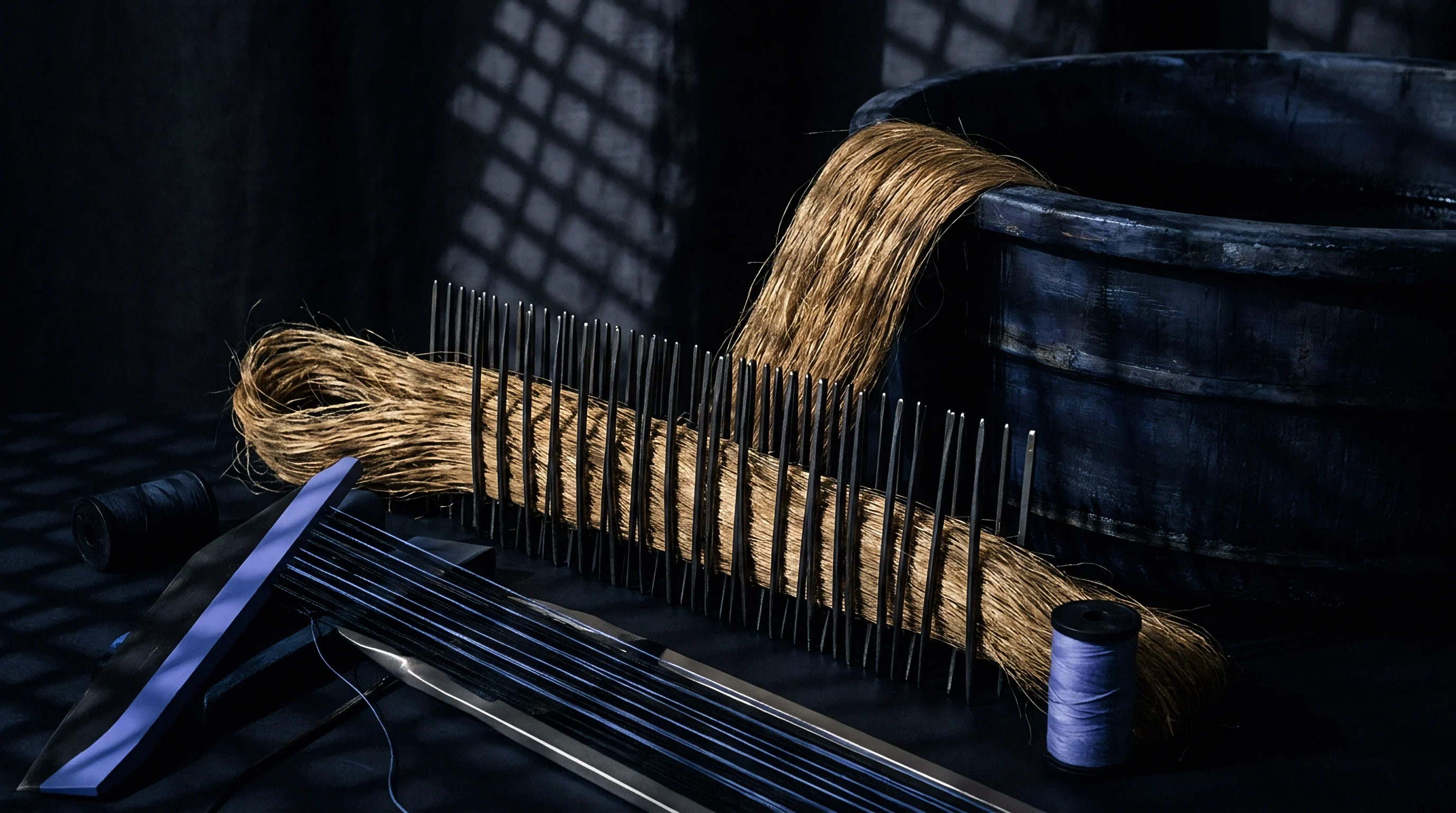
Routing
Dynamic routing turns weaver dispatch into an algorithmic path optimization process instead of a reactive walk. In a traditional shed with static allocations, a weaver moves down a row in a fixed loop. If a loom stops behind them, it sits unserviced until the patrol circuit finishes.
Where stoppage rates are high, fixed-loop patrolling guarantees maximum interference loss, with weavers spending up to thirty percent of their shift walking past running machines to stick to a set path.
Algorithmic routing relies on live data feeds from sensors on every machine. When a stop sensor trips, the system logs the loom’s spatial coordinates, the fault code from drop-wire or weft-sensor circuits, and the run-state of adjacent looms. The central engine then calculates an optimal dispatch vector for the nearest available weaver, weighing walk distance, expected repair time, and the likelihood of secondary stops on nearby running machines.

Spatial Floor Grids and Walk-Time Calculations
The floor layout of a weave room is modeled as a weighted graph network. Vertices represent looms, rest areas, and material stations, while edges represent aisles. Distance converts to transit time based on an average walking speed of one-point-one metres per second in clear aisles.
Obstructions like roll carts, beam trucks, and storage racks add dynamic weight to graph edges, forcing the engine to continuously recalculate transit times.
The routing model’s objective function minimizes total machine wait time across the bay while keeping operator workload within safe physical limits. The underlying math combines Travelling Salesperson elements with Pick-up and Delivery constraints under stochastic arrivals. Since calculating global optimal routes across sixty looms in real time is too heavy for high-frequency environments, edge servers run heuristics like Nearest-Neighbor with Priority Windows or Ant Colony Optimization.
| Allocation Strategy | Looms per Weaver | Mean Machine Wait Time (min) | Weaver Walking Distance (km/shift) | Interference Loss (%) | Net Operational Efficiency (%) |
|---|---|---|---|---|---|
| Static Fixed Patrol Loop | 12 | 4.85 | 12.4 | 22.4 | 64.2 |
| Static Pair Allocation | 16 | 3.90 | 10.8 | 17.8 | 70.1 |
| Dynamic Nearest-Neighbor Routing | 16 | 2.10 | 8.2 | 9.6 | 79.5 |
| Predictive Stochastic Priority Routing | 20 | 1.25 | 6.5 | 4.2 | 86.8 |
Predictive stochastic routing moves beyond reactive dispatch by factoring failure probabilities into the spatial routing matrix. By evaluating live warp tension streams and historical break clusters, the engine estimates whether Loom X is likely to stop within three minutes while a weaver services Loom Y nearby. If Loom X shows high break probability, the system keeps the weaver in that zone, avoiding a sixty-metre walk across the hall to clear a single weft stop that a floating operator could take.
Executing dynamic routing requires clear hardware interfaces mounted on loom displays or wearable industrial wrist terminals. Once a dispatch route is calculated, the target machine’s signal tower lights up in a specific color code, while the weaver’s terminal shows a vector pointing toward the loom along with the expected fault type. This removes path planning decisions from the operator so they can focus strictly on repairs.

Worked Example: Dynamic Routing in a 48-Loom High-Density Linen Bay
Consider a weave shed bay containing forty-eight rapier looms weaving eighty-lea wet-spun linen at thirty-eight ends per centimetre. The bay is organized into four rows of twelve looms each, with an inter-loom spacing of two-point-five metres center-to-center and an aisle width of four metres. Three primary weavers cover the bay.
Performance across an eight-hour shift reflects a measured average arrival rate of three-point-two stops per loom-hour ~ eighty percent short-duration weft stops (thirty seconds repair time) and twenty percent long-duration warp breaks (one hundred and twenty seconds repair time).
Under static allocation, each weaver is assigned sixteen looms across one and a half rows. The patrol path requires walking the full sixteen-loom circuit continuously, covering fifty-eight metres per loop. At one-point-one metres per second, walking takes fifty-two-point-seven seconds per circuit, excluding repairs.
When two warp breaks happen at opposite ends of a sixteen-loom block, the second loom waits for the weaver to finish the first draw-in (one hundred and twenty seconds) plus walk back down the aisle (twenty-five seconds). Machine wait time for that second loom hits one hundred and forty-five seconds.
Under predictive stochastic routing, all forty-eight looms form a single dynamic servicing zone covered by the three weavers as a team. Suppose the floor engine receives a warp break signal from Loom 14 (Row 2, Position 2) alongside simultaneous weft stop signals from Loom 18 (Row 2, Position 6) and Loom 42 (Row 4, Position 6). The engine checks weaver positions: Weaver A is at Loom 10 finishing a draw-in; Weaver B is at Loom 36 reloading a bobbin; Weaver C is at Loom 48 changing a roll.
- The system assigns Weaver A to Loom 14 based on a five-metre distance, giving a transit time of four-point-five seconds and an estimated repair duration of one hundred and twenty seconds.
- The system checks Loom 18 and Loom 42 for Weaver B at Loom 36. Distance to Loom 42 is fifteen metres versus twenty-six metres to Loom 18. Weaver B goes to Loom 42, arriving in thirteen-point-six seconds to execute the thirty-second weft fix.
- Loom 18 remains. Weaver C, wrapping up at Loom 48, is twelve metres away. Weaver C is routed to Loom 18, arriving in ten-point-nine seconds to clear the weft stop.
- Total cumulative wait time across all three stopped looms under dynamic team routing equals twenty-nine seconds, compared to two hundred and ten seconds under static row allocations.
Rerouting weavers based on proximity and repair type cuts machine wait time across the forty-eight loom bay by eighty-six percent. Net operational efficiency rises from sixty-eight-point-four percent under static patrols to eighty-five-point-two percent under dynamic routing. This thirteen-point-eight percentage point gain yields nine hundred and eighty additional finished metres of high-density linen per day from the same bay, with no change in staffing.
Implementing dynamic routing means scheduling machine maintenance alongside weaver dispatches. Warp beam run-outs, roll doffing, and lubrication cycles belong in the priority matrix. If a loom is within five minutes of finishing a cloth roll, the system sends a technician to meet the weaver, avoiding separate downtime events.
Coordinating tech support with weaver routing keeps machines running during peak production.
Dynamic spatial routing reduces machine wait times by re-allocating floating operator teams across pooled loom bays using proximity-weighted repair priorities.
Mill managers often push back against dynamic routing, arguing that accountability drops when weavers are not assigned to specific machine sets. Supervisors complain that shared responsibility leads weavers to bypass complex warp draw-ins, leaving tough repairs for shift partners while grabbing quick weft fixes. Overcoming this resistance requires tracking performance through the dispatch system ~ recording repair execution times, transit efficiency, and quality verification logs for each task.
Dynamic routing depends heavily on the reliability of sensor data feeding the server. If vibration sensors or tension drop wires feed flawed failure probabilities to the model, weavers get dispatched along inefficient routes, driving interference losses above static baselines. Sheds must keep to strict sensor calibration schedules to keep the routing engine working from valid physical inputs.


Logs
Verifying actual shed performance requires auditing machine telemetry logs, stop-motion records, and inspection frame data. Manufacturer datasheets list nominal loom speeds and efficiency numbers achieved under ideal test runs with continuous synthetics. Load those same looms with eighty-lea wet-spun flax at thirty-eight ends per centimetre, and real metrics diverge sharply from published figures.
Sourcing technologists need raw log files to establish real baseline capabilities before signing purchase orders.
Loom monitoring systems log every interruption to the millisecond, classifying stops by circuit: warp drop-wire, weft sensor, selvedge thread motion, or manual stop button. Checking downtime distributions in raw logs reveals the exact impact of weaver interference. A healthy shed under dynamic allocation shows warp repair downtime tightly clustered between ninety and one hundred and thirty seconds.
A shed plagued by interference displays a long tail of downtime, with warp repairs stretching from eight to thirty minutes of total machine standstill.

Fault Mapping and Mechanical Traces
Long downtime events in machine logs map directly to physical defects on the inspection frame. When a loom sits idle for twenty minutes under full tension, the warp sheet relaxes while the woven fabric on the cloth roll creeps under take-up tension. When the loom restarts, the first beat-up hits an improperly tensioned fell line, leaving a horizontal bar across the fabric width.
Automated optical scanners flag these stop marks as major structural faults, causing point deductions under ASTM D5430 four-point standards.
Digital inspection logs mapping fault coordinates across finished bolts can be cross-referenced directly against telemetry timestamps. A cluster of stop marks spaced at ten-metre intervals along a bolt points to systematic interference during shift changeovers or break windows. Without dynamic routing software, weavers leave their bays at the same time, leaving looms idle during stoppage cascades.
Sourcing teams use cross-referencing during audits to uncover hidden inefficiencies that average output figures conceal.
Machine logs also expose non-random spatial clustering of warp breaks across harness frames. If logs show Loom 12 suffering eighty percent of its warp breaks on Harness Frame 3, the issue is not yarn variation ~ it is mechanical misalignment of the lifting rod or abrasive grooving on that frame’s heddles. Diagnostic algorithms parse log files to flag maintenance needs before mechanical issues overwhelm the repair queue.
Telemetry from electronic warp let-off and fabric take-up systems offers detailed visibility into yarn strain profiles during shedding. Continuous tension logs sample warp line strain at rates over one hundred Hertz. Analyzing these high-speed traces pinpoints when peak shedding tension exceeds the tensile limit of the wet-spun yarn.
Sourcing engineers review tension traces to verify whether a mill has correctly configured back-rest roller dynamics and shed timing for dense constructions.
Inspection logs showing stop mark clusters at regular ten-metre bolt intervals confirm unmanaged weaver interference during operational break windows.
Evaluating raw telemetry requires separating brief operator intervention stops from longer technical maintenance holds. Mechanical breakdowns or warp beam changes belong in technical holds and must be filtered out of weaver interference metrics. The key metric here is Net Operator Wait Duration ~ the total duration of all stoppage events minus the net repair time executed by the weaver.
If Net Operator Wait Duration exceeds fifteen percent of total logged standstill hours, the weaver allocation model is failing.
The following contract clause defines telemetry access requirements written into high-density linen production agreements to enforce transparency and verify operational standards.
The seller agrees to provide raw, unedited loom telemetry log files in standardized CSV format for all machine bays committed to the buyer’s production order within forty-eight hours of a written request. These files must include millisecond-stamped event logs containing machine identification numbers, stoppage classification codes, stop durations, operator intervention timestamps, and continuous warp tension sensor data. If audit analysis of these telemetry logs reveals that Net Operator Wait Duration exceeds sixteen percent of total machine downtime over any forty-eight-hour production window, the buyer reserves the absolute right to impose a three percent unit price deduction per finished metre to compensate for elevated stop-mark fabric defect risks.
Audits that rely only on final bolt inspection reports miss underlying operational vulnerabilities. A mill can pass visual grading by mending stop marks and shearing surface fuzz during finishing. But high weaver interference rates in weaving logs point to internal stress.
Mills operating with heavy interference inevitably run into delivery delays, batch-to-batch variation, and sudden yield drops whenever yarn lot quality falls slightly.


Settlement
Every structural decision, allocation scheme, and queueing algorithm on the weave floor leads back to the landed cost per metre. Linen fabric is not just raw fiber and dye ~ it is reserved machine time on high-precision weaving equipment. When interference drops operational efficiency from eighty-five percent to sixty-two percent, loom-hour yield falls right along with it.
To survive, the mill has to spread fixed overhead ~ equipment depreciation, power, climate control, and floor rental ~ over fewer metres, driving up prices and making dense linen uncompetitive.
Translating loom time into landed cost requires calculating the full cost of an active weaving bay. Running a modern two-point-two-metre-wide rapier loom on dense wet-spun linen incurs a base operational cost of fourteen to eighteen Euros per loom-hour, excluding yarn. That hourly rate covers direct labor, climate control energy, sizing overhead, drop-wire repair labor, and equipment depreciation.
At three hundred and sixty picks per minute and eighty-five percent efficiency, the loom yields eight-point-six finished metres per hour of a dense thirty-eight pick per centimetre cloth. At eighteen Euros per loom-hour, machine allocation alone accounts for two Euros and nine Cents per finished metre.

Cost Mechanics of Weaver Interference
If unmanaged interference drops machine efficiency to sixty-five percent on that same loom, hourly production falls to six-point-five finished metres per hour. The fixed machine operating cost stays at eighteen Euros per hour, raising allocation costs to two Euros and seventy-seven Cents per finished metre. That sixty-eight Cent per metre increase is pure waste from poor queue management.
In competitive procurement, a sixty-eight Cent per metre penalty wipes out margins on high-volume upholstery or luxury apparel lines.
Labor cost accounting in these sheds involves a careful balance. Management often tries to trim direct labor by expanding machine-to-weaver ratios to twenty-four or thirty looms per operator. While that reduces hourly payroll on paper, it drives up weaver interference losses exponentially.
Savings on headcount are wiped out by revenue losses from idle machines and damaged cloth. Optimizing for total landed cost demonstrates that paying higher wages or adding relief weavers to keep machine-to-weaver ratios lower results in a lower cost per finished metre.
| Efficiency Level (%) | Metres Produced / Loom-Hour | Loom Allocation Cost (€/m) | Labor Overhead Cost (€/m) | Stop Mark Defect Penalty (€/m) | Effective Landed Conversion Cost (€/m) |
|---|---|---|---|---|---|
| 90 (Ideal Maximum) | 9.10 | 1.98 | 0.45 | 0.00 | 2.43 |
| 85 (Dynamic Routing Target) | 8.60 | 2.09 | 0.52 | 0.12 | 2.73 |
| 75 (Moderate Interference) | 7.58 | 2.37 | 0.58 | 0.45 | 3.40 |
| 65 (Static Allocation Baseline) | 6.57 | 2.74 | 0.68 | 0.98 | 4.40 |
| 55 (Severe Queue Saturation) | 5.56 | 3.24 | 0.82 | 1.85 | 5.91 |
Defect penalties from weaver interference add another hidden cost to landed pricing. Fabrics woven during high-interference shifts show frequent stop marks, mis-picks, and micro-abrasion fuzz. When these bolts hit the inspection frame, point counts force the mill to downgrade prime cloth to second-grade stock, which sells at a forty to sixty percent discount.
To offset downgraded inventory, the mill inflates quotes on prime-grade metres, passing the cost of floor queue inefficiencies straight to the buyer.
Contracts between sourcing desks and linen mills need to spell out the financial penalties for queue-induced defects and delays. Procurement files should mandate certified minimum loom efficiency levels backed by telemetry access rights. When buying ultra-high density linen, technical managers require qualification dossiers that confirm fiber origin and yarn spin specs, along with operator allocation ratios and real-time routing capabilities.
To secure transparent commercial terms, procurement contracts written by high-density linen buyers mandate specific documentation before purchase order funds are released.
- Loom Allocation Master Schedules defining exact machine-to-weaver ratios, operator bay boundaries, and floating relief staffing levels committed to the production run.
- Shed Environmental Telemetry Records proving continuous relative humidity and temperature stability inside the weaving hall within specified technical tolerances.
- Raw Downtime Log Files providing millisecond-stamped machine stoppage parameters, operator response latency, and Net Operator Wait Duration metrics for audit verification.
- Four-Point Inspection Certificates linking specific fabric roll serial numbers to corresponding loom telemetry log windows to ensure defect traceability.
Calculating the true landed cost of high-density linen means tracing the entire supply chain from raw flax beam preparation through loom allocation down to finished bolt inspection. Buyers evaluating quotes purely on fabric weight or yarn cost repeatedly fall into the interference trap, contracting with mills operating cheap, under-staffed sheds. These facilities suffer constant queue saturation, delivering off-spec cloth three weeks late with stop-mark defect rates that destroy downstream margins.
Predictive stochastic queueing models offer the mathematical framework needed to align floor reality with commercial contracts. By mapping the physical interactions between flax yarn stiffness, shed strain geometry, operator walk paths, and queueing dynamics, sourcing teams build resilient supply networks capable of delivering high-density linen fabrics at predictable prices.