Quantifying Warp Stress Reduction Limits on High Speed Air Jet Looms Weaving Fine Linen
Air jet weaving of fine linen requires active back rest dampening and controlled sizing to hold dynamic tension peaks below yarn elastic limits.
Flax
Mechanical Strain Thresholds in Wet-Spun Linen Yarns
Fine linen yarns spun from wet-processed flax fibers show a steep initial modulus and extremely low elongation at break, typically between 1.5% and 2.2%. Unlike staple cotton or continuous synthetic filaments, flax has little viscoelastic recovery under rapid cyclic extension. On a high-speed loom, the mechanical work loaded onto the warp thread must be absorbed within a narrow elastic band before permanent micro-structural slip occurs between elementary fiber bundles.
Dry tenacity for high-grade wet-spun linen yarn in counts from Ne 40 to Ne 60 (approximately 14.7 to 9.8 tex) averages 28 to 34 cN/tex. Moisture inside the yarn core changes these mechanical parameters considerably. Flax fibers gain up to 20% in tensile strength when conditioned to 75% relative humidity, where water molecules fill amorphous regions between crystalline cellulose microfibrils and lubricate internal chain realignments.
Too much moisture, however, increases yarn linear density and swelling, raising frictional drag through the reed and drop wires.
Relative humidity maintained between 70% and 75% in the weaving shed maximizes wet-spun linen tenacity while suppressing brittle fiber micro-fractures.
Irregular mass distribution creates localized stress points along the warp sheet. Thin places in wet-spun linen often show a 40% to 50% drop in cross-sectional area relative to mean yarn diameter. During shedding, peak tension distributes unevenly across these dips.
Failure happens preferentially at thin points where local strain exceeds breaking elongation, regardless of average strength figures from static tensile tests.
Yarn Stress Vectors Operating on the Warp Sheet
Mechanical loading on a single warp end on an air-jet loom comes from several distinct dynamic forces interacting across every machine revolution.
- Shedding extension force arises from the vertical displacement of heald frames pushing warps into top and bottom shed positions.
- Beat-up impact force occurs as the reed strikes the cloth fell, transferring momentum to pack the pick while pulling the warp sheet forward against the back-rest.
- Warp let-off surge reflects the mechanical lag in the electronic let-off motor response during shedding movements.
- Frictional abrasive drag develops as warp ends pass through drop wires, heald eyes, and reed dents at speeds exceeding 700 picks per minute.
The friction coefficient of the sizing formulation determines how quickly outer fibril bundles fray under repeated movement. Unsized slubs and loose surface fibers can bind adjacent warp ends together during the shed pass, causing clinging faults. When the air jet drives the weft pick through a partially obstructed shed, the pneumatic force pushes against these trapped ends, spiking tension and snapping brittle linen threads.
Low elastic recovery is the core failure mechanism. When wet-spun linen undergoes repeated cyclic loading at 80% of its yield point, it progressively work-hardens. Fiber bundles lock, micro-voids expand, and total strain capacity decays over hours of operation.
To avoid breaks, dynamic peak tension must stay strictly below the elastic limit during every millisecond of the weaving cycle.
Dry flax fibers snap under rapid impact.
Impulse
Kinematic Profiling of Shedding and Beat-Up Cycles
Air-jet looms running at main-shaft speeds between 600 and 800 picks per minute complete a single pick cycle in 75 to 100 milliseconds. Within this window, warp yarn undergoes sharp accelerations and decelerations from the shedding motion and sley kinematics. Conjugate cam shedding gives optimized dwell periods for filling insertion, but as the heald frame leaves the dwell zone, its acceleration curve delivers a heavy inertia-driven stress impulse to the warp ends.
Piezoelectric load cells on individual warp threads record two distinct tension spikes in each loom cycle. The primary peak hits at the fully opened shed, where geometric stretch is highest. The secondary peak, often just as large, occurs at beat-up when the reed drives the weft into the cloth fell.
On fine linen, beat-up peak stresses can exceed 0.45 cN/dtex if the back-rest fails to compensate for fell displacement.
| Speed (PPM) | Back-Rest Mode | Mean Static Tension (cN/end) | Peak Shed Tension (cN/end) | Peak Beat-Up Tension (cN/end) | Total Stress Range (cN/end) |
|---|---|---|---|---|---|
| 600 | Rigid Fixed Bar | 22.5 | 41.0 | 46.2 | 23.7 |
| 600 | Passive Spring Loaded | 22.5 | 33.8 | 35.1 | 12.6 |
| 750 | Passive Spring Loaded | 24.0 | 39.5 | 42.8 | 18.8 |
| 750 | Active Servo Compensated | 24.0 | 30.2 | 31.5 | 7.5 |
Peak tension rises sharply at higher loom speeds because of inertial forces in the yarn mass and back-rest assembly. Passive spring-loaded back-rest rollers have natural resonance frequencies that can match operating speeds. When that happens, the roller moves out of phase with shedding, amplifying tension spikes instead of dampening them.
Active motorized systems track main shaft angles via rotary encoders, driving the whip roll forward during shed opening to give slack and pulling back during closure to maintain control.
Is Active Back-Rest Control Mandatory for Fine Linen?
Fine linen woven on modern high-speed air-jet machines relies heavily on active electronic back-rest dampening. Because wet-spun linen yarn has so little elongation, passive systems cannot compress or react fast enough to damp out tension transients above 700 picks per minute. Active compensation cuts total tension amplitude by up to 60%, keeping dynamic stress well within the safe elastic margin.
Shed height geometry also alters warp stress vectors. Larger openings allow clean clearance for relay nozzles and reduce insertion stops, but they sharply increase geometric strain on the top and bottom warp sheets. Dropping shed height from 32 millimeters to 26 millimeters reduces peak shedding tension by over 25%.
Fine linen weaving requires the smallest shed opening that still clears the profile reed height and air channel geometry.
Asymmetric shed settings offer further relief to stressed warp ends. Setting the closed shed position slightly above the horizontal centerline redistributes tension unevenly between the top and bottom sheets during beat-up. The looser top sheet absorbs fell movement, avoiding simultaneous peak loading across every thread.
High-speed video confirms that asymmetric shedding reduces end breakage on Ne 50 linen by up to 35% compared to symmetric setups.
Misaligned back-rest timing causes immediate warp thread snapping at the selvedge.

Sizing
Polymer Film Formulations and Moisture Regain Management
A protective size film is the primary shield against warp abrasion and cyclic stress fatigue on high-speed air-jet looms. On wet-spun linen, the size must combine film flexibility, strong adhesion to cellulosic microfibrils, and easy water solubility for desizing. Standard starch-only formulations are too brittle for fine linen, cracking under the high-frequency flexing of air-jet shedding.
Modern high-performance size recipes for fine linen blend low-viscosity modified starches with flexible synthetic co-binders like polyvinyl alcohol (PVA) and acrylic copolymers. Carboxymethyl cellulose (CMC) improves elasticity and reduces shed dusting. A typical recipe for Ne 50 wet-spun linen balances dry-solid ratios to maximize toughness without making the yarn brittle.
Size add-on rates between 10% and 12% dry weight provide optimum abrasion resistance without sacrificing the native flex fatigue resistance of fine linen.
The cooking process sets size viscosity and dictates penetration depth into the yarn structure. Deep penetration cements internal fibers, turning flexible yarn into a stiff rod. Shallow penetration leaves the coating on the surface, where drop wires strip it off as flakes.
Proper sizing encapsulates protruding fibrils while penetrating only the outer 15% to 20% of the yarn cross-section.
Managing sizing machine parameters requires tight control of squeeze-roll pressure, size box temperature, and drying cylinder tension profiles.
- Pre-wetting the warp sheet with hot water at 85 degrees Celsius dissolves surface impurities and swells fibers, allowing uniform size uptake.
- Maintaining size box temperature at 92 degrees Celsius stabilizes formulation viscosity and prevents surface skinning.
- Calibrating squeeze roll pressure ensures target dry add-on percentages while stripping excess liquid back into the bath.
- Zone drying across multiple teflon-coated cylinders reduces tension gradients and prevents thermal degradation of the polymer film.
- Applying a fine water mist spray or cold-wax post-lubrication unit at the headstock restores target yarn moisture regain before beam winding.
Moisture regain in the sized warp beam directly governs performance on the loom floor. Sized linen stored or woven below 65% relative humidity dries out, causing micro-fractures in the size film during tension spikes. Storing warps at 70% to 72% relative humidity retains film flexibility.
Applying cold wax at the headstock drops static friction below 0.18, letting adjacent warp threads glide past each other during shed opening.

Abrasive Resistance and Fibril Encapsulation
Abrasion testing on fine sized linen uses continuous cyclic rubbing under tension to gauge thread endurance, simulating friction from heald eyes, drop wires, and reed dents. Test results confirm that adding 1.5% micro-wax lubricant to an acrylic-PVA-starch matrix increases flexural fatigue life by 40% over unlubricated sized yarn.
Reducing hairiness is essential when sizing fine linen for air-jet looms. Wet-spun linen has stiff, protruding fiber ends that do not lie flat naturally. On the loom, these loose fibers cause clinging sheds that disrupt the main air stream and destabilize weft insertion.
A smooth, encapsulated size film binds surface fibrils down, keeping the shed channel clear for high-speed picking.
Film hardness alone does not prevent fiber shedding; overly hard coatings shatter under high-frequency shedding, showering the sley with destructive dust.
Pneuma

Air Flow Kinematics and Reed Channel Dynamics
Air-jet filling insertion uses a main nozzle to shoot the weft yarn into a profiled reed, supported by relay nozzles spaced across the loom width. Air velocity inside the reed channel reaches 80 to 120 meters per second. This fast-moving stream creates local pressure drops and turbulent boundary layers that directly affect the warp threads forming the top and bottom shed walls.
The profile reed creates a channel to guide the air-weft package. Stiff, hairy linen threads poking into this tunnel disrupt the pneumatic boundary layer, causing turbulence. That turbulence slows the air stream down, forcing higher relay nozzle pressure to ensure full pick arrival.
But raising relay pressure sends high-velocity air directly into the upper warp sheet, causing thread flutter and mechanical abrasion.
| Main Nozzle Pressure (bar) | Relay Nozzle Pressure (bar) | Relay Blowing Angle (deg) | Air Consumption (Nm3/h) | Warp Flutter Amplitude (mm) | Warp End Stops per 100k Picks |
|---|---|---|---|---|---|
| 3.5 | 2.8 | 0 | 18.2 | 0.4 | 14.2 |
| 4.2 | 3.5 | 0 | 23.5 | 1.2 | 28.6 |
| 4.2 | 3.5 | 15 | 23.5 | 0.6 | 9.8 |
| 4.8 | 4.0 | 15 | 28.1 | 1.8 | 42.1 |
Relay nozzle timing and alignment determine how severely air streams disturb the warp threads. Standard timing opens the valve just before the weft tip arrives and closes after it passes. Leaving valves open too long wastes compressed air and subjects warp threads to persistent high-pressure jets that unravel surface fibers.
Angling relay nozzles slightly toward the back wall of the reed stabilizes the flow and keeps air streams from blasting warp ends directly.

Aerodynamic Forces Acting on the Warp Shed Channel
As the air-jet stream passes, it exerts aerodynamic drag on warp ends bounding the shed tunnel. On fine linen constructions with high reed counts (above 20 dents per centimeter), narrow thread spacing restricts air dissipation. Trapped air builds local pressure inside the shed, forcing top and bottom warp sheets apart dynamically and distorting shed geometry.
Air pressure fluctuations can drive fine warp threads under high static tension into resonance. When relay nozzle firing frequency hits the natural frequency of the stretched thread, standing waves form between the heald eye and reed dent. These standing waves concentrate stress at the edges of the reed dent, accelerating shear and causing sudden fatigue failure.
Profile reed dent design directly affects boundary layer conditions. Dents polished to a mirror finish with rounded entry edges lower friction and air turbulence. Specialized ceramic-coated dents minimize static buildup and resist abrasive cutting from flax fibers, maintaining smooth surfaces across millions of insertion cycles.
Does the aerodynamic lift created by high-velocity relay jets systematically induce micro-delamination in acrylic size films along the selvedge region?

Tolerances
Measurable Thresholds for Machine Speed and Sett Parameters
Running fine linen warps on air-jet looms requires balancing machine speed against acceptable stop rates. Faster running increases output but raises dynamic stress levels sharply. Operating parameters must stay within strict boundaries to protect weave room efficiency and fabric quality.
Warp breakage rates are the main operational metric for tracking stress limit violations. Target benchmarks for fine linen on air-jet looms require under 2.0 warp stops per 100,000 picks per machine. Crossing 3.5 stops per 100,000 picks ruins weaving economics as operator output drops and defects exceed commercial specs.
| Warp Count (Ne) | Sett (ends/cm) | Loom Speed (PPM) | Cover Factor (Warp) | Stop Rate (/100k picks) | Shed Efficiency (%) |
|---|---|---|---|---|---|
| 40 | 24 | 750 | 15.2 | 1.1 | 93.5 |
| 40 | 28 | 750 | 17.8 | 2.4 | 88.2 |
| 50 | 26 | 700 | 14.8 | 1.4 | 92.1 |
| 50 | 30 | 700 | 17.1 | 3.8 | 82.4 |
| 60 | 28 | 650 | 14.6 | 1.8 | 90.6 |
| 60 | 32 | 650 | 16.7 | 4.5 | 79.8 |
Cover factor calculations set the geometric limit for warp density in the reed. High warp cover factors crowd the dents, increasing thread-to-thread friction during shedding. When combined warp cover factor passes 17.5 on fine linen, clinging threads disrupt shedding and drive tension-related breakage up exponentially.
Quantitative Optimization Rules for Weaving Limits
Achieving stable runnability requires precise tuning of loom timing and physical parameters.
- Maximum speed selection caps main shaft rotations at the point where dynamic tension peaks remain below 70% of mean yarn breaking force.
- Shedding movement angle allocates a minimum of 120 degrees of main shaft rotation to the closed shed phase to allow tension relaxation.
- Reed dent selection mandates single-end denting in ultra-fine reeds to eliminate thread-on-thread friction during shed crossovers.
- Drop wire weight distribution specifies ultra-light 2.5-gram stainless steel drop wires for counts finer than Ne 50 to prevent static sag.
Standard quality protocols govern greige fabric grading. Under ASTM D5430 four-point inspection rules, defect points for warp breaks, end alignment streaks, and loose floats cannot exceed 28 points per 100 square meters for premium linen.
Contractual specifications under ISO 13934-1 require dry tensile strength compliance to remain within a plus or minus 5% tolerance band across the entire width of the batch beam.
Exceeding tension limits causes widespread micro-cracking across the size film, leaving the grey cloth vulnerable to major warp-way strength losses during subsequent wet bleaching and finishing.
A standard quality specification clause mandates that any warp beam yielding more than 3.0 stops per 100,000 picks over a continuous 10,000-pick sampling window must be demoted to low-speed rapier production, shifting all capacity charges directly to the yarn supplier.

Settlement

Loom-Hour Costing and Financial Impact of Stoppages
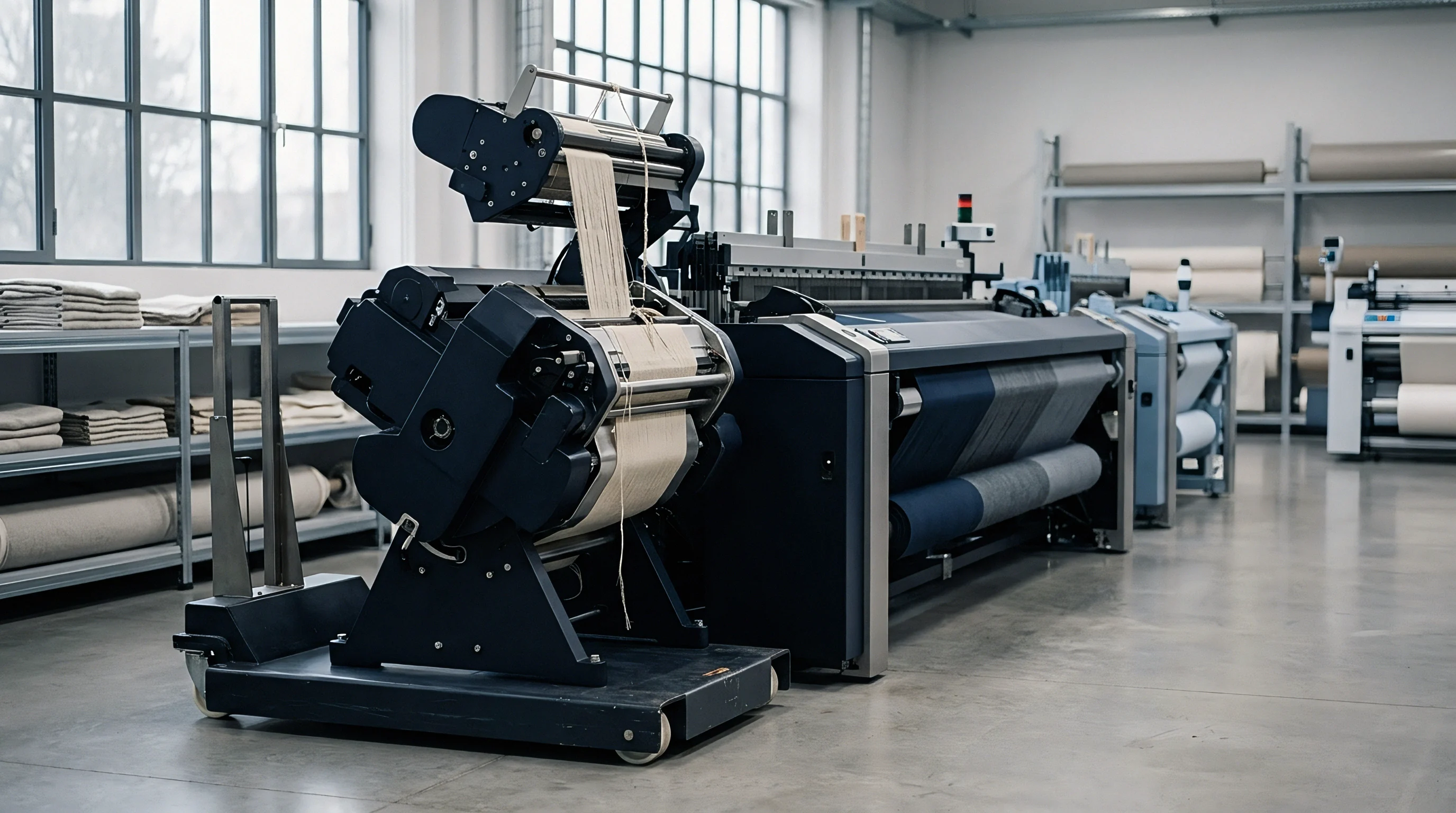
Air-jet weaving economics center on maximizing output per loom-hour while controlling capital depreciation, power consumption, and labor. High machinery costs and constant compressed air usage create substantial fixed hourly expenses. Stoppages from warp stress failures cut into margins by consuming machine time without producing billable fabric.
A standard air-jet weaving shed running fine linen draws about 2.5 to 3.2 kilowatts for the loom drive and another 12 to 18 kilowatts for compressed air generation per machine-hour. When a warp end snaps under tension, drop wire sensors trigger an immediate automatic stop. The machine stays down until an operator finds the broken thread, draws it through the drop wire, heald eye, and reed dent, and restarts the loom.
Repairing a warp break takes 45 to 90 seconds on average. At 700 picks per minute on a 28 pick/cm fabric, each minute of downtime loses 25 centimeters of production. If a loom averages 4.0 stops per hour from warp stress, lost production reaches 1.0 meter per loom-hour.
Across a 100-loom shed on continuous 24-hour operation, that adds up to 2,400 meters of lost fabric daily.
Financial models demonstrate how sensitive per-meter costs are to machine speed and efficiency losses. Consider a contract for 50,000 meters of Ne 50 fine linen (120 g/m2, 160 cm finished width, 26 ends/cm, 24 picks/cm). The baseline shed plan books production at 700 PPM at 90% target efficiency, with an amortized loom-hour operating cost of 18.50 USD covering power, labor, and plant overhead.
| Scenario Parameter | Baseline Target | High-Speed Stress Failure | Speed Reduction Strategy |
|---|---|---|---|
| Loom Speed (PPM) | 700 | 700 | 600 |
| Shed Efficiency (%) | 90.0 | 78.5 | 94.2 |
| Actual Output (m/loom-hour) | 15.75 | 13.74 | 14.13 |
| Loom-Hour Cost (USD) | 18.50 | 18.50 | 17.10 |
| Warp Stop Rate (/100k picks) | 1.2 | 4.8 | 0.6 |
| Direct Machine Cost per Metre (USD) | 1.17 | 1.35 | 1.21 |
| Quality Penalty Allowance (USD/m) | 0.00 | 0.18 | 0.00 |
| Total Landed Weaving Cost per Metre (USD) | 1.17 | 1.53 | 1.21 |
The figures show that pushing an air-jet loom to 700 PPM without adequate warp stress management increases stop rates, dropping efficiency to 78.5%. Landed weaving cost jumps from 1.17 USD to 1.53 USD per meter through lost loom time and four-point quality penalties. Dropping speed to 600 PPM keeps dynamic peak stresses below the fiber yield threshold, raising efficiency to 94.2% and reducing compressed air demand.
The lower speed produces fabric at 1.21 USD per meter, saving 0.32 USD per meter compared to running over-stressed at full speed.
Commercial Capacity Allocation and Speed Management
Capacity allocation terms in commercial weaving contracts must account for speed limits when handling low-elongation natural fibers. Mills quoting fine linen rates against synthetic or cotton performance metrics consistently see severe margin erosion in production. Buyers pressing for aggressive target prices often get fabric woven on over-stressed looms where speed was prioritized over warp integrity, resulting in goods with hidden structural damage.
Managing fine linen warp stress requires treating machine speed as a variable set by yarn quality rather than a fixed operational constant. Sourcing specifications ought to include dynamic stress limits, sizing quality metrics, and clear stop-rate thresholds. Aligning financial incentives around sustained shed efficiency rather than raw loom speed yields better structural integrity, consistent fabric width, and lower landed costs per delivered meter.