Calibrating Electronic Let off Compensation Parameters for High Speed Linen Weaving
Calibrating electronic let off parameters requires tuning PID loops and phase offsets to manage flax fiber rigidity and prevent dynamic tension spikes.
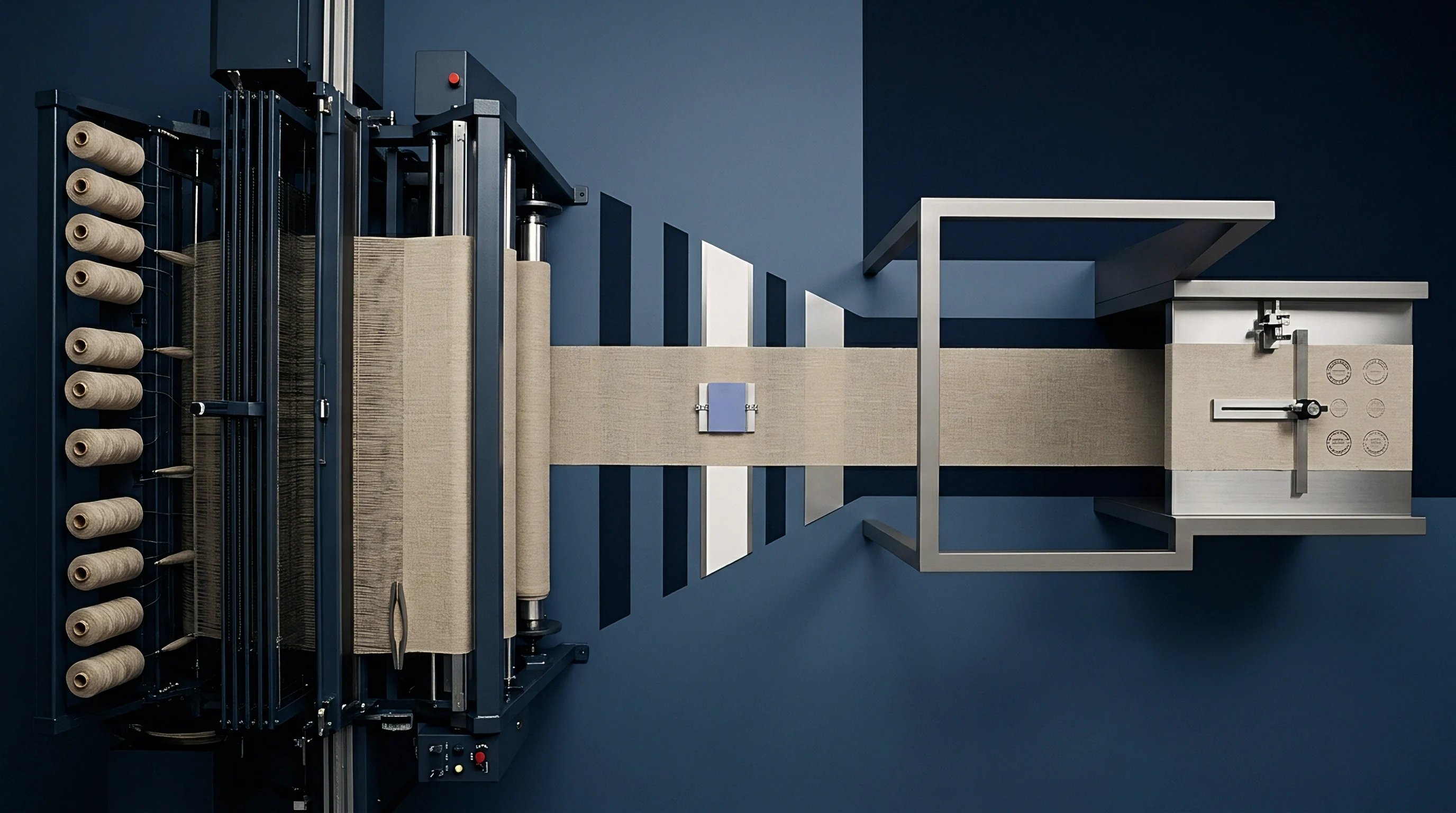

Dynamics
High-speed linen weaving hits warp yarns hard during rapid shed opening and reed beat-up cycles. Flax fiber features a steep initial elastic modulus paired with low ultimate elongation, typically breaking between 1.5% and 2.8% strain depending on spinning method and moisture content. Unlike cotton or synthetic filaments that yield elastically under peak loads, flax translates shed displacement straight into tension spikes.
A rapier loom running at 600 picks per minute yields a harness cycle time of 100 milliseconds. Inside that window, warp yarn goes from flat to full shed opening in under 30 milliseconds. If the let-off mechanism fails to feed yarn in step with this geometric expansion, transient warp tension instantly exceeds the tensile limit of Nm 26 wet-spun flax yarn.
Flax gets its structural rigidity from internal cell geometry. Long crystalline cellulose microfibrils run parallel to the fiber axis, embedded in a rigid lignin and pectin matrix. Wet spinning aligns the molecules further, raising tenacity while cutting strain tolerance even lower.
Dry-spun linen exhibits greater irregularity, leaving structural weak points down the strand. When the shed opens, tension climbs non-linearly. The force pulling on the backrest roller during shed movement combines three distinct factors: geometric extension demand, friction over warp stops and lease rods, and the inertial resistance of the warp beam itself.
Flax yarns exhibit less than two percent ultimate elongation, transferring warp shed opening displacement directly into peak tension forces within three milliseconds.
Electronic let-off systems manage these forces by driving the warp beam through an independent servomotor coupled to a gear reducer. Their main job is maintaining uniform baseline thread tension as beam diameter drops from a full 1000 millimeter flange down to a 150 millimeter steel barrel. As yarn runs off, the angular displacement required to deliver a constant length per pick increases inversely with beam radius.
A full beam turns a tiny fraction of a degree per pick; an almost empty beam has to accelerate much faster to feed the same yarn volume. Mechanical let-off systems rely on friction bands and weight levers prone to hysteresis and slow response. Electronic systems replace those friction levers with active closed-loop motor drives driven by strain-gauge tension sensors.
| Yarn Type | Tenacity (cN/tex) | Elongation at Break (%) | Initial Modulus (cN/tex) | Moisture Regain (%) |
|---|---|---|---|---|
| Wet-Spun Linen (Nm 26) | 38.5 | 2.1 | 680 | 12.0 |
| Dry-Spun Linen (Nm 14) | 22.0 | 1.8 | 450 | 11.5 |
| Combed Cotton (Ne 30) | 26.5 | 6.8 | 220 | 8.5 |
| Textured Polyester (167 dtex) | 42.0 | 18.5 | 140 | 0.4 |
Warp yarn stiffness changes the mechanical transfer function between motor movement and yarn tension. On cotton warps, minor let-off response lag absorbs harmlessly into yarn stretch. On linen warps, that same lag causes filamentation: individual elementary flax fibers shear off under localized stress, creating micro-fuzz that clogs the loom harness.
High-speed electronic let-off compensation has to account for yarn modulus directly inside the drive algorithm instead of treating the warp bed like an elastic spring.
Setting static baseline tension means balancing a clear shed opening against thread survival rates. Too low, and threads do not separate cleanly, causing rapier heads or air-jet fill strands to collide with loose warp ends and trigger filling stops. Too high, and yarns break instantly at beat-up.
On a 190 centimeter reed width weaving 100% linen plain weave at 22 ends per centimeter, total warp end count equals 4,180 threads. Setting baseline tension to 35 grams per thread creates a total static force of 146.3 kilograms on the backrest roller. Dynamic shedding spikes push this total load beyond 300 kilograms twice every mainshaft revolution.
Flawed compensation parameters will destroy warp yarn structure long before the beam runs empty.
Feedback
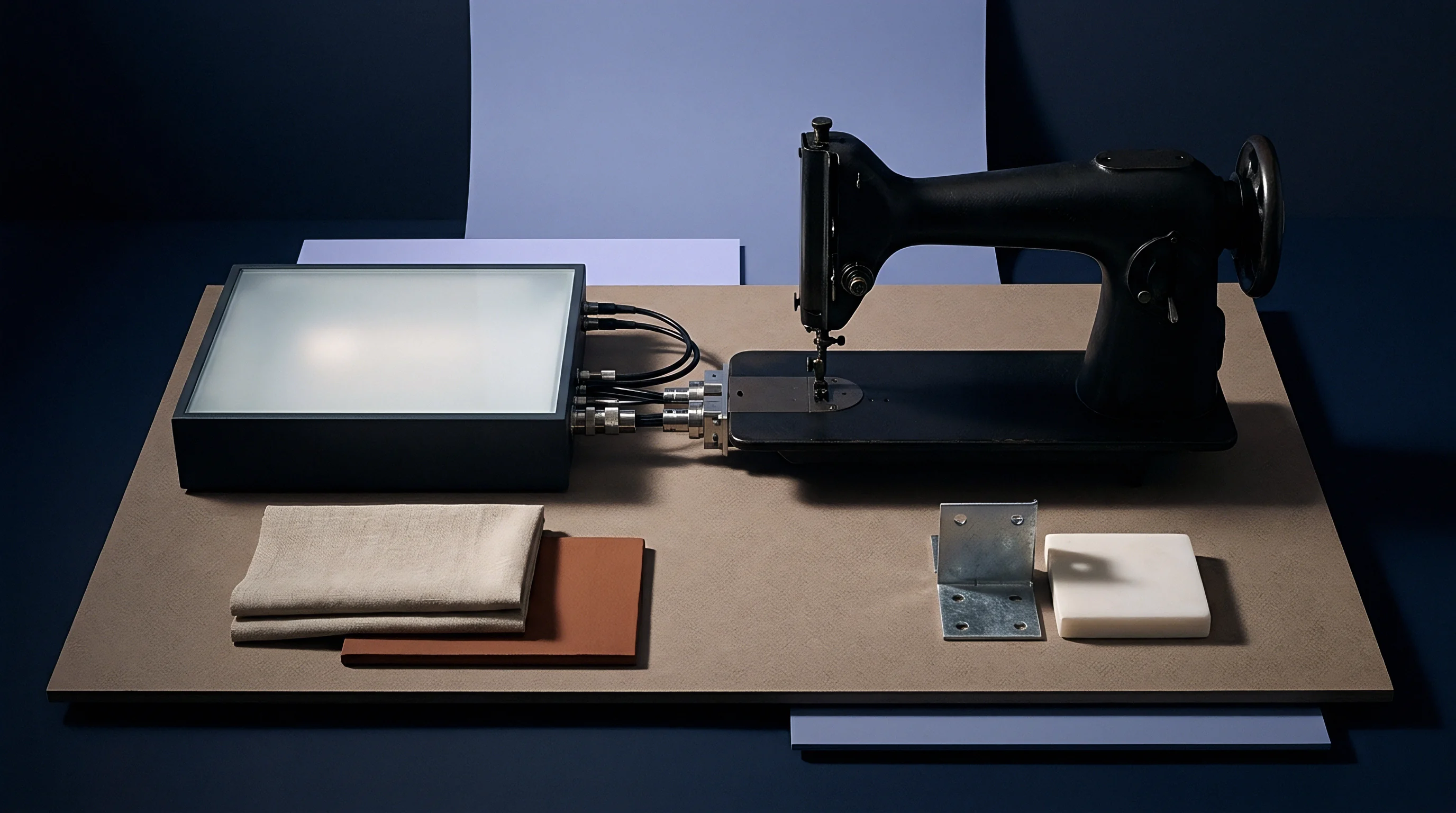
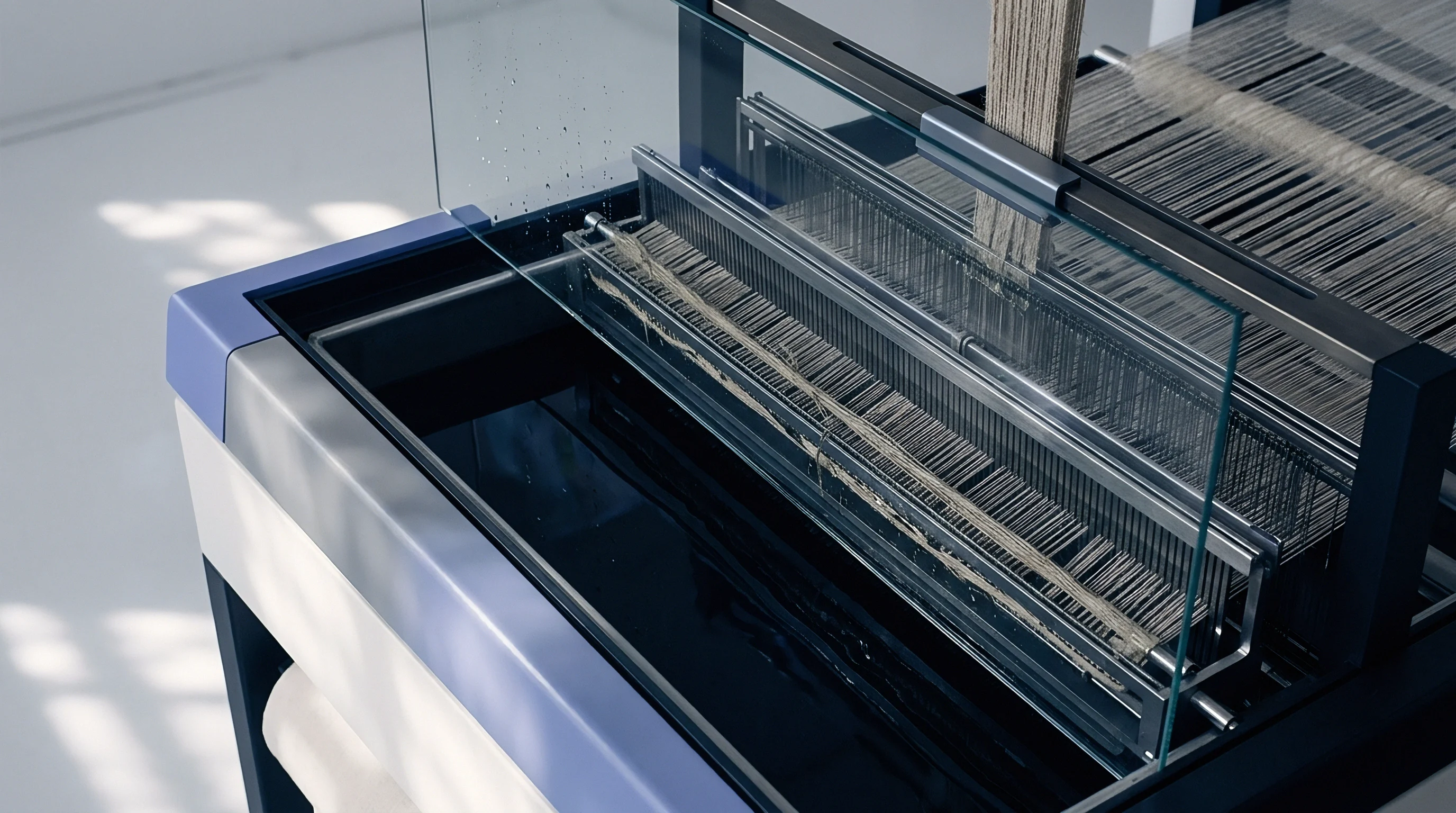
Sensory feedback on high-speed weaving machinery depends on load cell transducers mounted on the backrest roller support arms. These sensors measure the net vector force created as warp yarns pass over the roller assembly. Piezoelectric and foil strain-gauge sensors dominate modern weaving setups.
As warp tension shifts, minute deflections generate proportional millivolt signals sent directly to the electronic let-off control unit. System accuracy hinges on sensor response speed, signal filtering, and the mechanical dampening built into the backrest mounting rig.
Load cells operate under heavy mechanical vibration. Mainshaft rotation, harness frame acceleration, and sley motion drive continuous structural noise through the loom frame. Raw signal output from strain gauges carries high-amplitude noise spikes that obscure true yarn tension trends.
Electronic let-off controllers run low-pass digital filters to clean up raw load cell inputs, but over-filtering adds phase lag into the loop. If filtering delays tension detection by even 15 milliseconds at 600 picks per minute, the controller commands motor movement after the shed has already closed, compounding tension errors instead of fixing them.
What Dynamic Tension Threshold Prevents Linen Warp Shear?
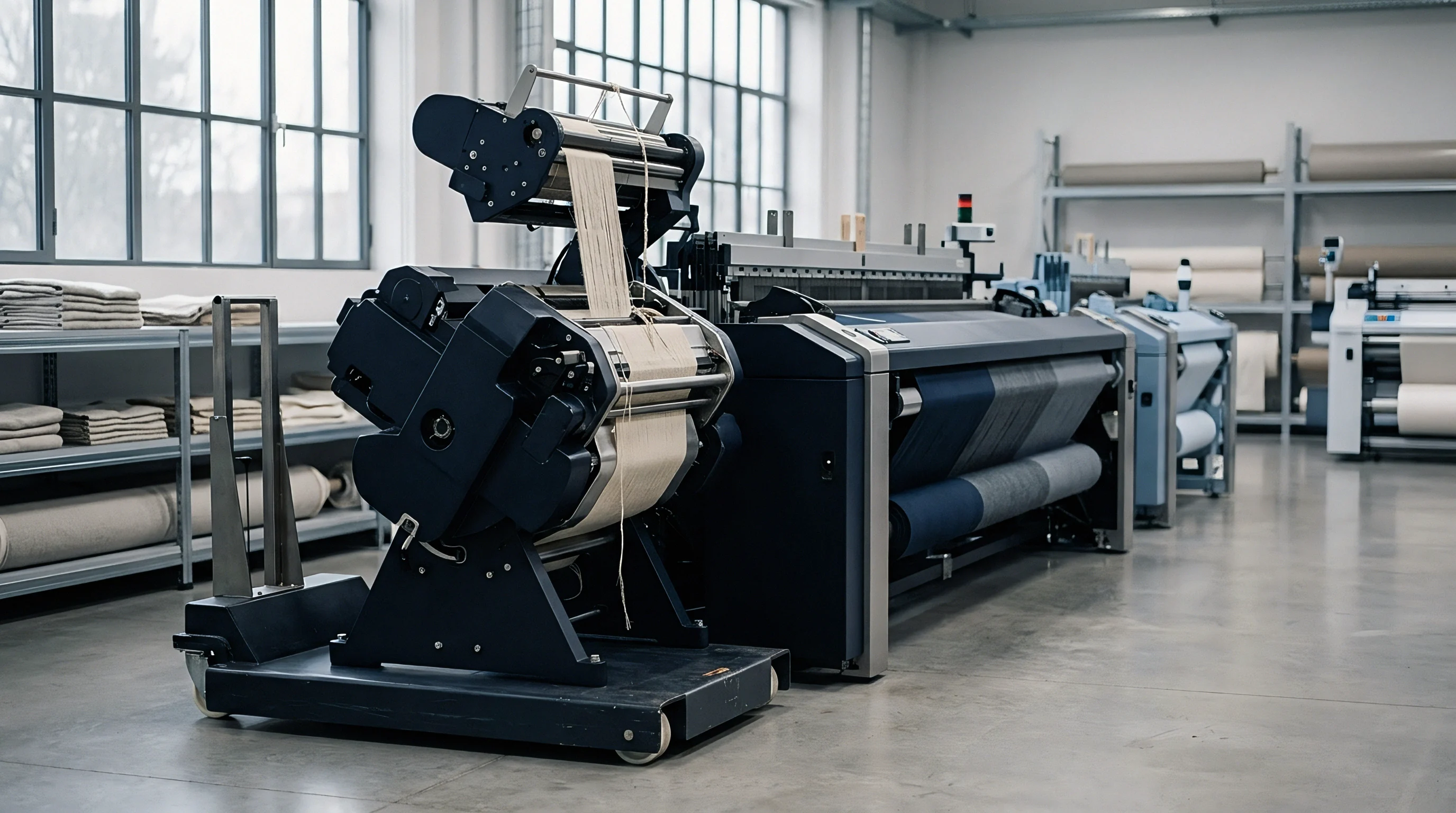
Keeping dynamic tension below 3.5 centinewtons per tex prevents structural fiber shear during shedding. Effective control requires separating static beam decay compensation from dynamic shedding pulse absorption. Dancer roller assemblies provide physical yarn storage, acting as a mechanical buffer that yields against spring or pneumatic resistance during shed movement.
Dancer systems absorb transient peak demands without forcing the let-off motor to accelerate instantaneously. By contrast, fixed backrest systems with strain-gauge load cells offer zero physical yarn accumulation, relying completely on spring-loaded pivot arms paired with fast motor torque adjustments.
Standard ISO 7211 testing confirms that uncompensated tension spikes exceeding 3.5 cN/tex produce immediate micro-filamentation in wet-spun linen.
Beam inertia creates an evolving control problem throughout the warp run. A fully loaded weaver’s beam carrying 800 meters of linen yarn weighs up to 400 kilograms, and that mass moment of inertia resists quick speed changes. When the loom stops on a filling break, the let-off motor must apply immediate braking torque to prevent beam over-run.
Over-run leaves slack yarn loops behind the lease rods, entangling the warp on restart. Conversely, as beam diameter approaches the core, total mass drops by 80%, altering system response kinetics. Control loops tuned only for a full beam will oscillate as the beam runs down.
Modern electronic let-off software tracks beam diameter in real time using ratio tracking between mainshaft encoder pulses and motor encoder feedback. Every mainshaft rotation pulls a set length of yarn through the reed based on the electronic take-up setting. Comparing mainshaft revolutions against angular displacement of the beam shaft lets the controller continuously update effective beam radius.
This radius scales proportional control gain and motor torque acceleration profiles on the fly. Any error in diameter tracking skews yarn feed rates, producing visible density bands in the woven fabric.
Shedding geometry swings tension profiles twice per mainshaft revolution. When harness frames cross at a 180 degrees mainshaft angle, warp tension drops to baseline. When frames hit maximum opening at 0 degrees and 360 degrees, tension peaks.
Fixed load cell systems sample tension during specific angular windows to separate shedding noise from baseline beam decay. Synchronizing these sampling windows stops the controller from treating a brief shedding peak as a permanent rise in baseline tension. If sampling windows slip out of alignment, the motor over-feeds yarn during peak shedding, dropping baseline tension until loose threads cause mis-picks.
Equipment documentation often blames stop marks on mechanical backrest slippage instead of motor control loop lag. Troubleshooting guides routinely suggest tightening physical spring stops when tension drifts. In practice, field measurements show improper digital signal filtering causes over 80 percent of let-off response delays on linen warps.
Tightening mechanical springs on a misconfigured control loop only worsens peak tension spikes, ruining yarn integrity within minutes of loom startup.
Gauge
Calibrating electronic let-off parameters requires systematic tuning with warp threads at standard ambient temperature and humidity. Linen warps need relative humidity between 65% and 75% inside the weave shed to remain pliable. Setting up drive electronics in a dry room yields invalid parameters once humidity rises to normal operating levels.
Calibration starts with mechanical zeroing, moves to static tension scaling, and finishes with dynamic PID gain tuning while running target fabric constructions.
Zero-point calibration sets the baseline sensor voltage for zero yarn tension. Mechanical strain gauges drift over time from thermal expansion and structural relaxation. With warp threads slacked completely off the backrest roller, zero-point calibration is run from the controller interface to clear residual offset voltages.
Target static tension is then set based on yarn count, warp end density, and fabric structure before entering proportional gain (Kp), integral time (Ti), and derivative time (Td) values into the drive menu.
Parameter optimization relies on step-response disturbance testing. With the loom running at low crawl speed, applying a brief manual force to the load cell assembly introduces an artificial tension error. The response curve recorded on a diagnostic screen shows system stability.
An under-damped setting triggers multi-cycle tension ringing, creating visible waves in pick spacing. An over-damped setting causes slow error recovery, leaving thin bands in the cloth after speed changes. Proper tuning restores target tension within a single mainshaft revolution without overshooting baseline.
Backrest roller spring pre-load works alongside motor compensation. The mechanical spring absorbs sudden shedding peaks that exceed motor acceleration limits. Spring stiffness must match the yarn’s elastic modulus.
Stiff springs meant for continuous filament polyester transfer shedding impact directly into flax threads, breaking the warp. Overly soft springs bottom out under shed opening load, losing dampening ability and exposing the load cell to sharp force spikes. Variable spring adjusters must be set with dial gauges to match specific cover factors.
| Parameter Description | Full Beam (1000 mm) | Mid Beam (550 mm) | Empty Beam (180 mm) | Adjustment Unit |
|---|---|---|---|---|
| Proportional Gain (Kp) | 12.5 | 8.2 | 4.1 | Dimensionless Ratio |
| Integral Time (Ti) | 180 | 120 | 60 | Milliseconds |
| Derivative Time (Td) | 25 | 15 | 5 | Milliseconds |
| Motor Torque Limit | 95 | 65 | 35 | Percent Max Torque |
| Load Cell Filter Cutoff | 15 | 15 | 15 | Hertz |
| Backrest Spring Pre-load | 4.5 | 4.5 | 4.5 | Millimeters Compression |
Phase-angle compensation syncs let-off motor acceleration pulses with mainshaft position. Modern let-off drives receive timing signals directly from the main motor resolver. The phase offset setting determines exactly where in the 360-degree cycle the let-off motor gets its velocity command.
Feeding yarn slightly before maximum shed opening cuts peak tension substantially. Advancing let-off motor torque by 15 to 20 degrees ahead of peak harness frame displacement smooths tension spikes on stiff flax warps.
Calibration procedures follow a strict operational order on high-speed rapier machinery running linen warps:
- Zero load cells with warp threads completely slacked to establish baseline millivolt readings.
- Set static target tension based on yarn count and sett, adjusting mechanical spring pre-load on the backrest assembly.
- Inject step-response disturbance by manually displacing the tension sensor to record dampening oscillations.
- Increase proportional gain until tension recovers within two mainshaft revolutions without ringing.
- Apply derivative dampening to suppress high-frequency beat-up spikes during shedding.
- Verify diameter tracking ratio by comparing physical beam radius measurements against controller display values.
Fine tuning relies on real-time tension traces recorded during full-speed production. A balanced setup shows a clean, repeating waveform with consistent amplitude across every shed revolution. Broad peaks point to backrest spring binding, while asymmetrical troughs indicate incorrect phase-angle offset.
Once parameters stabilize, log them into the loom pattern memory for repeatable batch setups.
As a practical rule, proportional control gain should be halved for every 50 percent reduction in weaver beam diameter to stop control loop hunting.

Surge
Beat-up forces present a major challenge for electronic let-off performance. As the reed drives newly inserted fill yarn into the cloth fell, warp threads are pulled sharply toward the breast beam. This impact sends a backward force pulse through the warp sheet toward the let-off roll.
High-density linen fabrics ~ like heavy upholstery canvas or fine damask ~ create intense beat-up resistance from friction between rigid flax fibers. The let-off system must withstand this surge without letting warp threads slacken and disrupt pick density.
Dampening beat-up peaks depends on tight synchronization between the Electronic Let-Off (ELO) and Electronic Take-Up (ETU). Both drives communicate over a high-speed internal CANbus network. As the sley advances, the ETU controller holds fabric position while the ELO manages warp strain.
If the ELO loop reacts too passively to beat-up impact, the cloth fell shifts backward and picks per centimeter drop. If it reacts with excessive rigidity, warp threads snap right at the reed wire.
Stop marks are the most common quality defect arising from mismanaged tension surges during loom stops. When the machine stops for a broken filling yarn or warp end, warp threads undergo stress relaxation, shedding tension as yarn settles across lease rods and drop wires. At the same time, structural frames cool slightly, altering dimensions.
On restart, the first pick beat-up occurs under changed conditions. If the ELO fails to adjust static tension for dwell-time relaxation, the first three picks will be spaced incorrectly, leaving a visible light or dark bar across the fabric.
Electronic stop mark compensation works by executing precise beam movements right before the main motor accelerates. The controller calculates stop duration and applies a programmed reverse rotation (back-step) to re-tension relaxed warp threads. If the loom sat idle for less than 30 seconds, a small back-step restores target tension.
If idle for over ten minutes, creep relaxation requires a larger back-step paired with a modified take-up start sequence. Stop mark parameters must fit the yarn; wet-spun linen demands far higher back-step precision than elastomeric blends.
- Patterned stop marks occur when ELO motor holding torque decays during long shed dwell periods.
- Warp filamentation develops when excessive proportional gain causes cyclic tension overshoot at beat-up.
- Shed opening slackness appears if derivative action reacts slowly to rapid harness frame movement.
- Reed mark streaking occurs when dynamic backrest movement fails to equalize top and bottom shed tensions.
- Fell positioning creep stems from unsynchronized acceleration profiles between electronic let-off and take-up drives.
Stop marks on high-grade linen trigger immediate rejections during four-point fabric inspection under ASTM D5430 standards. A single major stop mark per 100 linear meters cuts commercial fabric value by 20 percent. Miscalibrated anti-stop mark settings cause recurring defects that force mills to sell first-quality output as remnant stock at or below landed yarn cost.
| Observed Cloth Fault | Root Cause Mechanism | ELO Controller Parameter Shift | Mechanical Corrective Action |
|---|---|---|---|
| Dense Horizontal Bands | Over-active proportional motor response causing yarn over-feed | Reduce Kp by 20 ~ 30%; increase Ti integral time | Check load cell mount for mechanical looseness |
| Warp End Snap at Beat-up | Inflexible backrest response failing to yield under pick impact | Decrease derivative gain Td; advance phase offset angle | Decrease backrest roller spring pre-load compression |
| Light Restart Lines | Insufficient pre-tensioning back-step following loom dwell time | Increase anti-stop mark back-step pulse duration | Inspect ELO motor brake pad for mechanical slipping |
| Cyclic Pick Density Waves | Diameter tracking mismatch causing gain control loop hunting | Recalibrate beam core ratio limits; reset diameter sensor | Verify warp beam flange alignment and arbor trueness |
Whip roll easing systems offer supplementary mechanical compensation during extreme shedding surges. Driven by eccentric cams or independent servos synchronized with the main shaft, easing motion physically shifts backrest position in step with harness movement. Nudging the backrest forward at maximum shed opening reduces peak yarn strain without turning the let-off motor.
Integrating electronic easing controls directly into the ELO menu allows fine stroke adjustments down to tenths of a millimeter. Proper synchronization enables weaving brittle linen warps at speeds once limited to filament synthetic yarns.
What unmeasured friction variable remains inside the lease rod shed zone when ELO control loops maintain stable sensor readings at the backrest roller?

Economics
Capacity planning on high-speed linen looms comes down to balancing loom speed, warp break rates, and landed fabric unit costs. Operating a rapier loom at its maximum mechanical capacity of 750 picks per minute increases output per loom hour, but only if efficiency stays high. High weaving speeds increase dynamic warp tension dramatically.
On linen warps, pushing speed from 550 to 700 picks per minute drives warp stop frequency up exponentially whenever yarn quality or sizing falls short.
Loom efficiency measures actual output against theoretical capacity over an operational shift. Every warp stop requires a weaver to find the broken end, thread it through drop wires, heddles, and reed dents, and restart the loom. The average repair time for a linen warp end break is 1.5 minutes.
At 4 stops per loom hour, total downtime reaches 6 minutes per hour, capping maximum efficiency at 90 percent. High break rates also overwhelm staffing: a weaver who easily handles 16 looms running at 1.5 stops per hour gets bogged down when stop rates hit 4.0 stops per hour, causing compound idle time as stopped machines wait for attention.
A simple economic assessment illustrates the financial impact of let-off calibration on loom-hour profitability. Take a weave shed operating 50 rapier looms running 100% linen fabric (210 cm reed width, 20 picks/cm, target fabric weight 220 g/m²). Operating cost per loom hour ~ covering capital depreciation, overhead, direct labor, and energy ~ totals 18.50 USD.
Raw material costs for wet-spun linen yarn run 12.20 USD per kilogram.
In Scenario A, an uncalibrated ELO setup runs at 620 picks per minute. Dynamic tension spikes drive the break rate to 3.8 stops per loom hour, dropping operational efficiency to 83%. Actual output is 15.37 linear meters per loom hour, yielding a landed manufacturing conversion cost (excluding yarn) of 1.20 USD per meter.
Frequent stops generate 2.4% second-quality fabric with restart marks, which must be discounted by 35%.
In Scenario B, the ELO setup is optimized with dynamic parameter calibration, phase compensation, and spring pre-load matching. Loom speed is trimmed slightly to 580 picks per minute to reduce strain on the yarn. Improved tension stability cuts the warp stop rate to 0.9 stops per loom hour, lifting operational efficiency to 94.5%.
Actual output climbs to 16.44 linear meters per loom hour despite lower machine speed, bringing landed conversion cost down to 1.12 USD per meter. Second-quality fabric output drops below 0.3%, protecting prime fabric revenue.
Loom stops on linen warps cost three times more in lost efficiency than stops on equivalent cotton constructions due to restart mark prevention procedures.
Sizing chemistry directly influences let-off calibration targets. Polyvinyl alcohol (PVA) and modified starch blends coat flax fibers to raise tensile strength and lay down surface hairiness. Excessively rigid size formulations increase yarn stiffness, requiring lower Kp gain settings and higher backrest spring compliance to prevent brittle breaks.
Soft size formulations improve flex resistance but reduce abrasion resistance, demanding precise tension control so heddle wire friction does not strip the coating. Sizing quality must remain consistent across batches, as variations in size pick-up force technicians to recalibrate ELO parameters with every beam change.
- Calculate allowable stop limits per loom hour using target weaver workloads and mill efficiency thresholds.
- Evaluate warp break records against yarn count variation to separate ELO tuning issues from yarn strength deficits.
- Measure actual greige fabric pick density across the full beam length to confirm long-term let-off stability.
- Calculate landed cost per linear meter under reduced speed parameters versus high-stop, high-speed running.
Mill management should treat electronic let-off calibration as a strategic capacity lever rather than routine maintenance. Investing technician time in systematic PID optimization, load cell verification, and anti-stop mark tuning improves throughput without capital expenditure on new looms. Establishing standardized let-off dossiers for every fabric style ensures consistent metrics across shift changes, stabilizing landed meter costs while protecting high-value flax warps.