Quantifying Yarn Waste Cascades across High Speed Rapier Loom Sheds
Optimizing rapier clamping timing, catch cord width, and active pre-winder braking reduces total weft waste cascades below six percent on high speed linen sheds.

Fringe
A 190-centimetre flexible rapier loom running 100 percent wet-spun linen at 580 picks per minute generates yarn scrap continuously before a single metre of fabric reaches the batcher. Every hundred milliseconds, the right-hand cutter box spits trimmed yarn segments into the suction duct. These waste ends stem directly from gripper insertion geometry.
Neither flexible nor rigid rapiers can interlock weft threads right at the warp boundary ~ they must hold, transport, and release each pick outside the woven selvage. The donor rapier draws yarn from an electronic accumulator pre-winder, carries the loop to the centre of the warp shed, and hands the tip off to the acceptor rapier. The acceptor rapier then pulls the pick across the right selvage, where mechanical clamps hold it under tension until the reed beats it into the cloth fell.
Rotary or scissor cutters sever the weft on both sides, leaving short fringes that drop into the waste chute.
Shed engineers divide this loss into structural and operational scrap. Structural scrap covers the fixed yarn lengths required for thread transfer, catch cords, and selvage trimming. Operational scrap comes from yarn breaks, accumulator tail fly, shedding mispicks, and rapier gripper slippage.
Catch cords, running as independent leno or tucking threads outside the fabric body, stabilize weft insertion tension during beat-up. They are cut away during cloth finishing, converting hundreds of metres of high-grade yarn into unrecoverable fibrous waste.

Mechanics of Rapier Left and Right Waste Fringe
Left-hand insertion geometry differs mechanically from right-hand arrival. On the left side, yarn runs from the supply cone through pre-winder brakes, tension discs, and the main weft selector needle before reaching the donor gripper. The distance from the selector eyelet to the active warp ends dictates the minimum left fringe tail length ~ typically between 35 and 65 millimetres on high-speed rapier sheds.
Shortening this span below 35 millimetres risks missed picks, as the donor gripper requires that distance to accelerate and clamp the yarn before entering the warp sheet.
Right-hand tail lengths depend on acceptor rapier stroke length and catch cord placement. As the acceptor rapier exits the right selvage, it extends past the outer warp ends to maintain tension until the shed closes, leaving a waste tail between 45 and 85 millimetres long. When weaving high-density linen, shedding managers add dual catch cords to prevent weft snapback ~ where elastic recoil pulls the cut end back into the cloth body, causing loose picks or short tails.
Dual catch cords add another 20 to 30 millimetres of waste width per pick.
Fixed waste fringes remain an inescapable physical requirement of high-speed mechanical weft insertion.
Yarn count directly scales the mass loss from fixed fringe scrap. A 26 Tex (Ne 22.5) wet-spun flax yarn running at 500 picks per minute across a reed width of 190 centimetres consumes 1.9 metres of weft per pick inside the fabric body. Combined left and right fringe waste, including dual catch cords, adds up to 130 millimetres per pick.
That puts the structural waste fraction at 6.4 percent of the total weft yarn pulled off the supply package. Switching to a heavier 42 Tex yarn without adjusting reed width or cutter positions drives the waste mass per loom hour from 380 grams up to 614 grams. Waste mass scales linearly with yarn linear density, even though linear metres of woven fabric stay the same.

Accumulation Dynamics at High Weft Insertion Rates
Increasing loom speed accelerates waste generation through non-linear kinetic mechanisms. At 400 picks per minute, peak insertion velocity reaches around 18 metres per second; at 620 picks per minute, it exceeds 28 metres per second. These high speeds produce sudden kinetic energy shifts as the yarn decelerates inside the acceptor rapier clamp.
The resulting tension spike stretches the weft, forcing electronic pre-winders to dump excess loop length to avoid snapping the yarn.
Accumulator pre-winders store yarn on a stationary drum using a rotating spooling arm, unwinding it over the front head of the drum during insertion. At higher speeds, the unwinding balloon angle changes, increasing aerodynamic drag against the surrounding air envelope. This causes the yarn to scrub against the housing ring, shedding short fibers as tail fly scrap.
Flax fibers have rigid crystalline cell walls that embrittle under rapid bending; the resulting fine lint clogs pre-winder optical sensors and triggers false stop-motion trips.
Machine vibration at high speeds induces micro-slippage inside mechanical yarn clamps. When the donor rapier grips an uneven flax yarn with thick slubs, the clamp jaws fail to seal uniformly across the fiber diameter. The yarn slips during acceleration, leaving an elongated tail sticking out from the left selvage.
The cutter trims this extended tail, adding 10 to 25 millimetres to left-hand fringe length on affected picks. This accumulated irregular tail scrap distorts yield calculations, turning prime raw material into low-value suction waste.
Shed supervisors often treat these high fringe volumes as an unavoidable cost of doing business. Technicians on one mill floor widened the catch cord distance by 15 millimetres to curb selvage breakouts on dry-spun linen warps. That modification dropped warp stop frequency by 18 percent, but the wider setting pushed weft scrap mass up by 1.2 percent across the entire run.
Pneumatic waste systems streamline handling, but they cannot restore the unrecoverable yarn mass dumped into collection bins.

Cascade
A yarn failure inside the rapier loom shed triggers secondary waste cascades that routinely outweigh the primary scrap of the broken pick itself. A single weft break trips the stop motion, but inertia carries the main shaft through one or two full revolutions before the main brake stops the machine. During those coasting revolutions, the rapier drives keep cycling through the warp shed without active insertion or under partial tension.
The donor rapier grabs empty air or drags a severed thread across the open warp sheet, tangling with moving ends and causing multi-end abrasion and friction breaks.
Optical or piezoelectric sensors near the right selvage detect the missing pick and signal the controller to start an automated pick-finding cycle. The pick-finder disengages the main shaft, reverses the dobby or jacquard shedding motion, and turns the loom backward to expose the mispick. The weaver or robot then pulls the defective pick from the fell line.
Manual extraction removes the full width of the inserted weft along with extra yarn damaged by beat-up impact ~ converting 2 to 5 linear metres of weft yarn into tangled scrap per event.
Structural Propagation of Weft Tension Spikes
Weft tension spikes travel as longitudinal stress waves along the yarn during insertion. When the acceptor rapier grips the tip at mid-shed, deceleration generates a tension transient that shoots back toward the pre-winder accumulator at speeds over 1,200 metres per second. In yarns with low ultimate elongation ~ like wet-spun flax or high-modulus filaments ~ peak tension easily exceeds single-thread tensile strength.
Tension spikes shear yarn at thin spots or slub interfaces, producing clean snaps or frayed bursts. If the break happens near the donor rapier, the rest of the pick remains trapped inside the shed. When the shed closes at beat-up, it packs the loose weft tail into the cloth matrix.
Extracting an embedded pick like this damages adjacent warp ends, forcing the weaver to repair three or four warp breaks before restarting. Those secondary repairs drain loom time and multiply overall yarn loss.
Secondary waste cascades follow documented operational failure sequences on high-speed sheds:
- Accumulator Tension Spikes generate transient peak loads exceeding single-yarn break thresholds during initial rapier acceleration cycles.
- Rapier Exchange Slippage lets the weft tail snap backward into mid-shed, causing double picks and loose fiber nests.
- Warp Shed Snagging occurs when hairy yarn fibers interlock, blocking clean shed opening and severing passing rapier heads.
- Cutter Timing Misalignment severs yarn before the acceptor clamp seals, causing total pick loss across the active reed width.
- Pick Finder Reversal Scrap results from manually extracting damaged weft picks during loom stop recovery.

Warp Shed Geometry and Mechanical Interference
Warp shed clearance dictates how passing rapier tape guides interact with the upper warp sheet. Tight clearance lowers warp end tension during shedding, but it raises the risk of the rapier head colliding with stray threads. When a rapier hits a high-tension warp end, that thread snaps instantly.
The loose tail falls into the incoming weft path, wraps around the donor head, and jams the gripper jaw.
Mechanical interference quickly causes compound waste events. A blocked gripper jaw might fail to transfer weft for six consecutive picks during coasting deceleration, leaving six partial picks interleaved with tangled warp ends inside the shed. Clearing a fault like this forces the operator to peel back up to 50 millimetres of beat-up fabric, destroying finished cloth and wasting significant warp and weft.
The yarn lost in a single compound event often equals the scrap generated across 200 metres of fault-free weaving.
| Yarn Type and Count | Loom Speed (PPM) | Primary Weft Stops (per 100k picks) | Secondary Waste Mass per Stop (g) | Total Cascade Loss Ratio (%) |
|---|---|---|---|---|
| 26 Tex Wet-Spun Linen | 550 | 14.2 | 8.65 | 2.15 |
| 42 Tex Dry-Spun Linen | 480 | 22.8 | 14.10 | 3.85 |
| 15 Tex Combed Cotton | 620 | 4.1 | 3.20 | 0.62 |
| 33 Tex Linen / Cotton Blend | 580 | 8.7 | 6.40 | 1.28 |
Accumulator Tail Fly and Stop Motion Delays
Electronic weft stop motions rely on optical light barriers or piezoelectric impact sensors to check weft arrival. Optical sensors look for yarn at the right selvage within a tight window ~ usually 15 to 25 degrees of main shaft rotation. Accumulator tail fly, made of loose fiber clusters stripped during high-speed unwinding, can drift into the sensor path and block the light beam, triggering a false arrival signal even when the pick broke mid-shed.
That false signal delays loom shutdown by three or four picks while the controller assumes insertion succeeded. The rapiers keep laying down picks over the broken yarn, packing multiple loose ends into the fell. Fixing a delayed stop requires extensive pick reversal and manual thread pulling.
As the table above shows, secondary waste mass jumps quickly as yarn strength drops and stop frequency rises; dry-spun linen yields three times the cascade waste mass of combed cotton because of high yarn irregularity and lower elongation.
Pick extraction during stop recovery generates up to five times the yarn scrap mass of the original broken pick.
The total scrap volume from stop recovery depends heavily on weaver reaction time and automated clearance settings. Electronic pick finders reduce manual extraction errors, but they cannot prevent physical fraying when steel reed wires beat broken picks into the fell line line. Does optimal shed clearance timing reduce this secondary waste propagation without increasing warp thread fatigue?


Metrics
Quantifying yarn waste across high-speed rapier sheds requires separating primary structural scrap from secondary operational loss. Primary scrap calculates directly from cloth specs ~ reed width, finished width, pick density, yarn linear density, and selvage fringe geometry. Secondary loss draws on empirical distributions for break frequency, coasting revolutions, pick-finder extraction lengths, and accumulator spooling waste.
Total weft mass consumed per linear metre of fabric combines net fabric weft content, primary fringe scrap, and secondary failure loss. Sourcing managers who base raw material budgets strictly on finished fabric weight per square metre underestimate actual yarn requirements by 8 to 15 percent, depending on loom speed and yarn quality.
Primary Trim Scrap versus Secondary Break Loss
Primary trim scrap mass per linear metre depends on total reed width and fringe tail dimensions. Let Wr represent total reed width in metres, Wc finished fabric width in metres, Lf left-hand fringe length in metres, Lr right-hand fringe length in metres, and Lcc total catch cord tail length per pick in metres. Primary structural weft length inserted per pick, Ltotal, is calculated as:
Ltotal = Wc + (Wr – Wc) + Lf + Lr + Lcc
Simplifying the geometrical relationship yields:
Ltotal = Wr + Lf + Lr + Lcc
The net weft length remaining inside commercial fabric equals Wc. The primary trim scrap ratio, Rscrap, is expressed as:
Rscrap = frac(Wr – Wc) + Lf + Lr + LccLtotal
Secondary break loss mass per metre, Msec, depends on average weft breaks per linear metre of production, Nbreak, and average yarn scrap extracted per break event, Lbreak. It also includes an empirical factor, Kfly, for spooler tail fly and pre-winder cone residue (typically 0.005 to 0.015 of total yarn mass). The secondary waste mass equation is:
Msec = left( Nbreak × Lbreak × fracTex1000 right) + left( Mgross × Kfly right)
Where Tex represents yarn linear density in grams per 1,000 metres, and Mgross is the total gross weft yarn pulled from supply packages per linear metre of fabric.

Worked Calculation of Metre Waste Mass
Consider a 100 percent linen plain weave specified at 220 grams per square metre finished weight, using 26 Tex wet-spun flax yarn in warp and weft. Sett parameters specify 22 ends per centimetre and 20 picks per centimetre. Loom reed width Wr is 1.95 metres, and finished cloth width Wc is 1.80 metres.
Mechanical settings dictate a left fringe length Lf of 0.045 metres, right fringe length Lr of 0.055 metres, and dual catch cord tails Lcc totaling 0.040 metres per pick. Operating logs report an average weft break frequency Nbreak of 0.28 breaks per linear metre of fabric (14 breaks per 100,000 picks), with each break requiring an average extraction length Lbreak of 3.8 metres during pick reversal.
First, calculate total weft yarn length inserted per pick:
Ltotal = 1.95 + 0.045 + 0.055 + 0.040 = 2.09 metres per πck
Next, calculate total picks per linear metre of fabric:
text{Picks per metre} = 20 text{ picks/cm} times 100 text{ cm/m} = 2,000 text{ picks/m}
Calculate primary weft yarn length pulled per linear metre of fabric:
L_{primary} = 2.09 text{ m/pick} times 2,000 text{ picks/m} = 4,180 text{ metres/m}
Convert primary yarn length to primary gross weft mass per linear metre:
M_{primary} = 4,180 text{ m} times left( frac{26 text{ g}}{1,000 text{ m}} right) = 108.68 text{ grams/m}
Calculate net weft mass retained within the finished fabric width (1.80 metres):
L_{net} = 1.80 text{ m/pick} times 2,000 text{ picks/m} = 3,600 text{ metres/m}
M_{net} = 3,600 text{ m} times left( frac{26 text{ g}}{1,000 text{ m}} right) = 93.60 text{ grams/m}
Calculate primary structural waste mass per linear metre:
M_{trim} = M_{primary} – M_{net} = 108.68 – 93.60 = 15.08 text{ grams/m}
Now, calculate secondary break waste mass per linear metre, assuming Kfly = 0.01 (1 percent spooler scrap):
M_{break_extract} = 0.28 text{ breaks/m} times 3.8 text{ m/break} times left( frac{26 text{ g}}{1,000 text{ m}} right) = 0.0277 text{ g/m}
M_{fly} = 108.68 text{ g/m} times 0.01 = 1.0868 text{ g/m}
M_{sec} = 0.0277 + 1.0868 = 1.1145 text{ grams/m}
Total weft yarn mass required per linear metre of fabric equals:
M_{gross} = M_{primary} + M_{sec} = 108.68 + 1.1145 = 109.79 text{ grams/m}
Total weft waste percentage across the shed equals:
text{Total Weft Waste %} = left( frac{109.79 – 93.60}{109.79} right) times 100 = 14.75 %
| Reed Width (m) | Finished Width (m) | Pick Sett (picks/cm) | Net Fabric Mass (g/m) | Trim Waste Mass (g/m) | Break & Fly Mass (g/m) | Total Waste Share (%) |
|---|---|---|---|---|---|---|
| 1.95 | 1.80 | 16 | 74.88 | 12.06 | 0.89 | 14.73 |
| 1.95 | 1.80 | 20 | 93.60 | 15.08 | 1.11 | 14.75 |
| 1.95 | 1.80 | 24 | 112.32 | 18.10 | 1.34 | 14.76 |
| 2.40 | 2.20 | 20 | 114.40 | 21.84 | 1.42 | 16.89 |
| 3.40 | 3.20 | 20 | 166.40 | 25.48 | 1.98 | 14.16 |
Widening the reed to 2.40 metres to produce 2.20-metre wide linen bedding fabric pushes total waste share to 16.89 percent. The wider shed demands longer catch cord extensions and increases left-to-right transfer distance, accumulating structural scrap faster than net fabric mass grows. On one contract run, a 4,200 euro cost adjustment was absorbed simply because raw material budgets were built on standard 1.90-metre shed metrics while production ran on wider 2.40-metre frames.
Wider reed frames increase absolute fringe scrap mass faster than net cloth area increases.
These models show that yarn linear density and pick sett scale absolute scrap mass, but the reed width ratio drives the waste percentage itself. Running narrow fabric on wide rapier frames burns yarn capital straight into the suction boxes without adding a cent of value to the finished bolt.

Clamp
Containing weft waste cascades takes precise mechanical calibration of rapier clamps and tight electronic braking on pre-winder accumulators. Gripper clamps use spring-loaded tungsten carbide or ceramic jaws to catch the yarn tip during transfer. If clamping force drops below 4.5 Newtons, insertion acceleration causes yarn slippage, lengthening tail waste or dropping picks entirely.
Go above 8.5 Newtons and the jaws crush soft spun linen fibers, creating localized pinch fractures that snap at beat-up.
Technicians align clamping profiles with micro-dial gauge fixtures before loading a beam, keeping the clamping surface parallel to the yarn path within 0.02 millimetres. Over time, abrasive flax fibers cut wear grooves into the jaws and alter pressure distribution. Swapping out worn gripper inserts across a 60-loom shed every 90 operational days restores insertion stability and keeps left-hand fringe lengths consistent.
Rapier Gripping Dynamics and Micro-Slippage
Micro-slippage happens during mid-shed handoff between the donor and acceptor rapiers. The donor rapier decelerates sharply as it hits the transfer position, while the acceptor rapier accelerates in the opposite direction. For a dwell window under 3 milliseconds, both rapiers match speeds.
The yarn loop moves from donor hook to acceptor clamp under active tension held by an upper leaf spring.
Tuning that leaf spring tension prevents tail elongation. Loose settings allow 10 to 30 millimetres of yarn to slip through the acceptor jaw during handoff acceleration, leaving an erratic right-hand fringe and driving up break rates. Technicians verify spring tension with dynamic strain gauge rapiers during test runs at full production speed.
Catch Cords and Leno Motion Minimization
Tucking units and leno mechanisms hold weft tails secure against beat-up forces. Traditional leno setups use dedicated heddle wires to twist two doup threads around inserted picks. These doup threads bind the selvage, but the waste fringe outside the leno wire still has to be trimmed flat.
Modern looms use electronic leno devices (ELX) so operators can program binding cycles independently of shaft motion.
Programmable leno cycles make it possible to drop catch cord yarn counts. Replacing standard 30 Tex polyester catch cords with fine 15 Tex high-tenacity monofilament reduces selvage bulk, allowing cutters to move 8 millimetres closer to the ground warp ends. That shift alone cuts fringe scrap mass by 12 percent across long production runs.
Can Active Accumulator Braking Reduce Weft Losses?
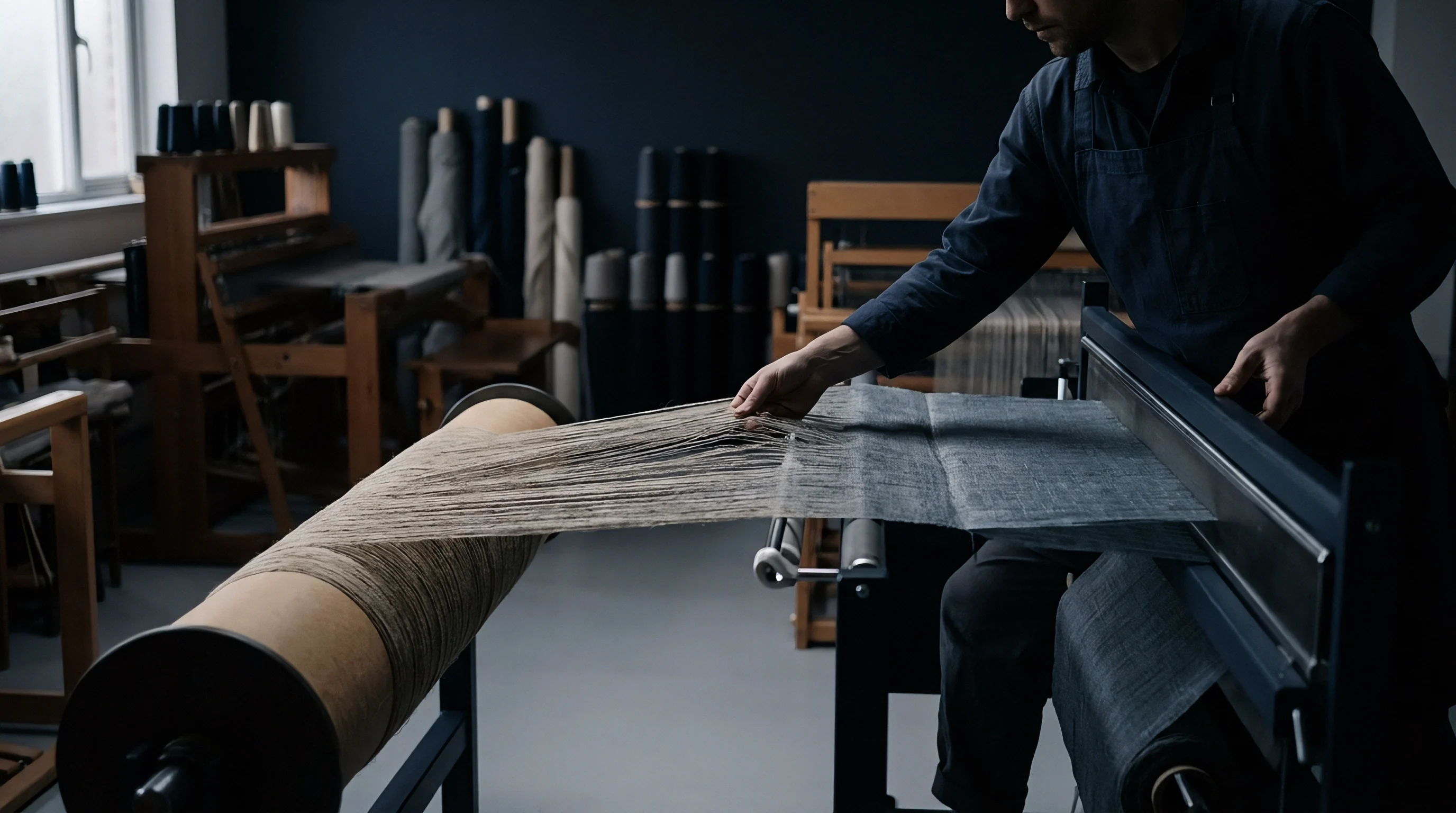
Active electronic pre-winder brakes use motorized ceramic discs to adjust yarn tension dynamically during insertion. Static magnetic brakes apply constant friction, creating too much drag at low speeds and not enough during peak acceleration. Active brakes sync with main shaft encoder signals ~ releasing pressure during acceleration and clamping down precisely as the acceptor rapier reaches the right selvage.
This synchronized braking cuts the end-of-stroke tension spike by 40 percent. Lower peak tension keeps yarn from stretching, so shedding managers can run rapiers at full speed without triggering tension breaks. That reduction in break frequency sharply cuts secondary waste cascades on low-strength linen and carded wool runs.
- Mount dynamic strain gauge sensors onto the donor rapier tape to measure peak insertion tension across ten full shaft revolutions.
- Adjust electronic pre-winder brake activation angles to engage 15 degrees prior to acceptor rapier mid-shed transfer.
- Calibrate donor jaw clamping force to exactly 6.0 Newtons using a digital push-pull force gauge inserted between ceramic plates.
- Align left selvage cutter blades to achieve a 0.5 millimetre clearance from active ground warp ends.
- Verify optical weft sensor signal windows to eliminate tail fly detection errors during coasting deceleration.
Following this check procedure stabilizes insertion parameters and stops fringe extension from drifting out of control. Running through these checks routinely keeps shed efficiency within target operating bands.
Dynamic yarn braking reduces peak insertion tension transients by forty percent on high-speed rapier cycles.
Standard quality covenants in fabric supply agreements typically cap total yarn scrap allowances at 8.0 percent of purchased yarn mass. When shed settings drift and waste ratios creep past 12 percent, the mill absorbs raw material cost overruns. Writing mandatory clamp maintenance schedules into production orders protects buyers against unexpected landed cost adjustments.

Tally
Translating waste cascades into financial line items means auditing purchasing variances against bill-of-materials fabric weights. Buyers contract for finished cloth by linear or square metre, while mills buy yarn by weight on paper cones. The spread between purchased yarn mass and delivered cloth mass is total shed waste.
Left unmeasured, waste cascades eat away mill gross margins and spark contentious disputes over greige yields.
With a 14.75 percent total weft waste cascade, purchasing 1,000 kilograms of raw weft yarn yields only 852.5 kilograms of net fabric weft. To deliver 1,000 metres of reference plain weave linen (which contains 93.6 grams of net weft per metre), a mill has to buy 109.8 kilograms of raw weft yarn instead of the theoretical 93.6 kilograms. That 16.2 kilogram gap is pure structural fringe scrap, catch cord waste, and stop recovery loss.
Yarn Purchase Mass versus Net Greige Fabric Weight
Raw yarn pricing for wet-spun flax averages 14.50 euros per kilogram for high-grade 26 Tex yarns. Net fabric weft cost works out to 1.357 euros per metre (0.0936 kg × 14.50 €/kg). Factoring in the 14.75 percent waste cascade raises actual weft expenditure to 1.592 euros per linear metre, tacking 0.235 euros of unrecoverable material cost onto every metre produced.
Scrap recycling offers little financial relief. Suction ducts pull mixed fringe waste, fiber fly, and clipped tails into loose bales, which textile recyclers buy for non-woven insulation or paper pulp at around 0.35 euros per kilogram. That scrap credit recovers less than 2.5 percent of original yarn purchase value, leaving the mill to swallow the rest.

Loom Hour Cost Penalties of High Weft Failure Rates
Secondary waste cascades hit mill economics beyond direct material loss by destroying loom hour capacity. Each weft break stops production for an average of 1.5 minutes when an operator has to intervene manually. On a 190 cm loom operating at 550 PPM with 28 weft stops per 100,000 picks, that downtime adds up fast.
Calculate loom operational output loss per loom hour:
text{Picks per hour at 100% efficiency} = 550 text{ PPM} times 60 text{ minutes} = 33,000 text{ picks/hour}
text{Expected stops per hour} = left( frac{33,000}{100,000} right) times 28 = 9.24 text{ stops/hour}
text{Downtime per hour} = 9.24 text{ stops} times 1.5 text{ minutes/stop} = 13.86 text{ minutes}
text{Actual running efficiency} = left( frac{60 – 13.86}{60} right) times 100 = 76.9 %
At 76.9 percent efficiency, the loom produces 12.68 metres of fabric per hour (25,377 picks / 2,000 picks/m). Bringing insertion stability back to cut failure rates to 8 stops per 100,000 picks boosts efficiency to 93.4 percent and output to 15.41 metres per hour. Overhead costs across standard rapier sheds average 18.50 euros per loom hour, covering depreciation, energy, floor space, and labor.
Dividing loom hour overhead by linear metres produced yields overhead cost per metre:
text{High stop rate overhead cost} = frac{18.50 text{ euro}}{12.68 text{ m}} = 1.459 text{ euro/m}
text{Optimized stop rate overhead cost} = frac{18.50 text{ euro}}{15.41 text{ m}} = 1.201 text{ euro/m}
Uncontrolled weft failure cascades add 0.258 euros per metre in overhead penalties on top of the 0.235 euros per metre in raw material waste. That brings total cost degradation to 0.493 euros per metre ~ a 14.2 percent landed cost spike on a fabric budgeted at a 3.47 euros per metre base greige cost.
| Operating Metric | Uncontrolled Cascade Shed | Standard Base Shed | Optimized Low-Waste Shed |
|---|---|---|---|
| Loom Speed (PPM) | 580 | 550 | 520 |
| Primary Trim Scrap (%) | 8.20 | 6.40 | 5.10 |
| Secondary Cascade Scrap (%) | 6.55 | 1.35 | 0.45 |
| Total Weft Waste Share (%) | 14.75 | 7.75 | 5.55 |
| Weft Stops per 100k Picks | 28.0 | 14.0 | 5.0 |
| Loom Efficiency (%) | 76.9 | 89.5 | 96.25 |
| Yarn Cost per Metre (€) | 1.592 | 1.471 | 1.436 |
| Overhead Cost per Metre (€) | 1.459 | 1.253 | 1.155 |
| Total Greige Weft Landed Cost (€/m) | 3.051 | 2.724 | 2.591 |
Sourcing buyers must structure purchase contracts with clear scrap boundaries to avoid paying for mill inefficiency. Three main contract terms protect buyers from waste cascade price creep:
- Raw Yarn Allowance Floor defines maximum bill-of-materials weft scrap percentages permitted in landed metre pricing calculations.
- Efficiency Penalty Caps prohibit mills from passing overhead cost variances caused by low loom efficiency onto the buyer.
- Fringe Width Specifications limit allowable left and right selvage fringe tail dimensions on delivered greige bolts.
- Pick Reversal Loss Limits restrict billable secondary waste mass generated during automated loom pick-finding cycles.
- Scrap Credit Allocation mandates that raw yarn scrap salvage credits apply directly against gross material invoice lines.
Running rapiers at top mechanical speed does not guarantee minimum production costs. As the table above demonstrates, dropping machine speed from 580 to 520 picks per minute eases dynamic tension spikes, cutting break frequency from 28 down to 5 stops per 100,000 picks. Higher efficiency and reduced scrap lower total landed weft cost from 3.051 euros to 2.591 euros per metre ~ saving 0.460 euros per metre despite the lower machine speed.
Modeling landed costs for a 50,000-metre linen apparel order across three weaving mills showed that Mill A quoted low weaving rates but ran aging rapiers with 15 percent waste cascades. Mill B quoted higher hourly loom rates on modern electronic-brake rapier sheds with 5.5 percent waste cascades. In the end, Mill B delivered finished fabric at a 0.28 euro per metre lower landed cost because tighter waste control more than offset its higher hourly machine rates.
Controlling yarn waste cascades turns shed management from reactive maintenance into active cost engineering. Technicians who calibrate rapiers, optimize catch cords, and manage insertion speeds protect both raw material investment and loom capacity.