Chemical Matrix Extraction and Moisture Balance Control in High Speed Linen Warping Operations
Controlled chemical matrix extraction and continuous moisture regain balance lower dynamic friction, preventing warp breaks during high speed linen warping.
Pectins
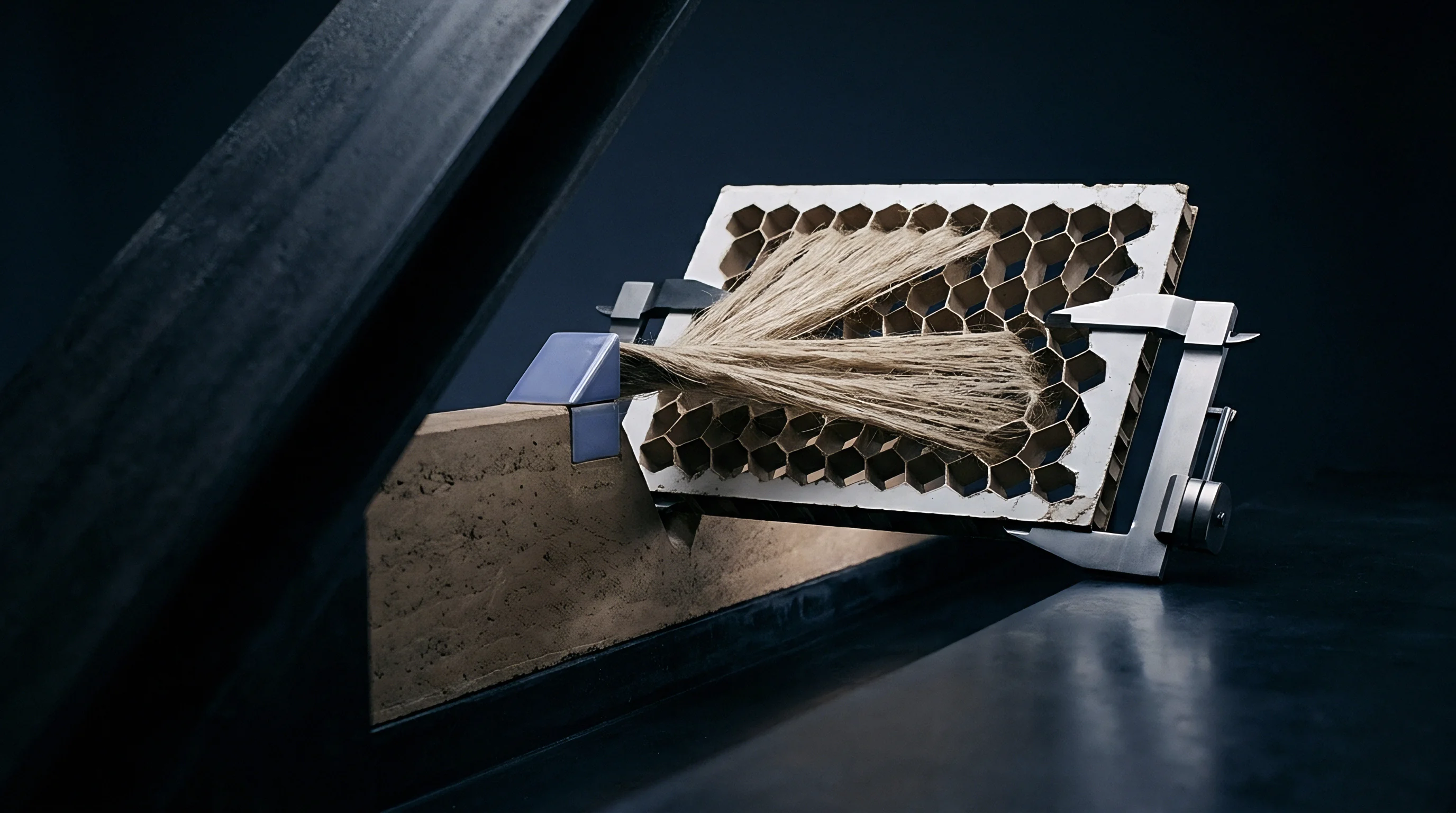
Flax fibers depend on a non-cellulosic intercellular glue to hold individual ultimate cells together in structural bundles. In raw flax, these complex polysaccharides make up five to eight percent of dry fiber mass, sitting alongside lignin, hemicellulose, and lipophilic waxes in the compound middle lamella. At warping speeds over six hundred meters per minute, yarn performance hinges on how well this matrix holds up.
Moving through tension discs, ceramic guides, and reed dents, friction creates quick thermal spikes past eighty degrees Celsius. That heat softens waxes and degrades pectin, triggering microscopic shear failures inside the bundle. If pre-warping scouring or bleaching strips or damages these non-cellulosic components, yarn strength drops off fast and fiber fly surges.
Bast fibers are built differently from seed hairs like cotton. Flax ultimates ~ fifteen to twenty-five millimeters long and twelve to thirty micrometers across ~ lay in overlapping parallel bundles joined by the pectin-lignin matrix. High-speed warping subjects these bundles to rapid tension cycles between fifteen and forty centinewtons per tex.
When the matrix keeps its natural elasticity and moisture, strain spreads evenly across the bundle cross-section. Stripping methyl-esterified galacturonans during harsh alkaline prep destroys that load-sharing ability, leaving the yarn brittle and prone to splitting along its length under dynamic stress.
Managing matrix extraction requires tight control over wet prep before yarn hits the warping creel. Stripping pectins entirely leaves a degummed fiber with too little inter-fiber cohesion for high-speed handling. Aiming for partial extraction leaves two to three percent residual pectin ~ enough cohesion to hold the bundle together while removing the low-melting epicuticular waxes that would otherwise smear onto ceramic guides and cause sticky deposits, tension spikes, and end breaks.
Non Cellulosic Fractions in Bast Fiber Bundles
The structural polymers in a flax stem are mostly alpha-cellulose microfibrils embedded in an amorphous matrix of hemicellulose, lignin, and lipids. The cellulose supplies axial tensile strength, while the matrix absorbs shear stress and stops cracks from traveling across the fiber. Neutral sugars like rhamnose, galactose, and arabinose form the branched side chains of the pectin network.
Because these side chains are hydrophilic, they trap water to form a gel cushion that protects ultimate cells from mechanical shock at high drawing speeds.
Scouring wet-spun flax alters esterification along the polygalacturonan backbone. Unesterified carboxyl groups bind with calcium and magnesium in process water, forming the rigid ionic bridges described by the egg-box model. These cross-links stiffen the matrix and cut down elongation at break.
When a warping machine accelerates from zero to eight hundred meters per minute in under three seconds, stiffened fibers cannot stretch fast enough for the sudden inertial load, causing clean breaks right at the creel peg.
Relative humidity drops below fifty-five percent elevate yarn-to-metal friction by thirty-two percent at six hundred meters per minute.
Stripping lipophilic components without altering the pectin skeleton changes the yarn’s surface energy. Native flax waxes ~ mostly primary alcohols, fatty acids, and phytosterols ~ melt between sixty-two and seventy-eight degrees Celsius. At speed, friction against stationary guide pins pushes pin surfaces past that temperature.
The wax melts, runs down the thread, and gathers loose pectin fragments and cell debris. This tacky buildup settles inside eyelets, narrowing the path and steadily driving up unwinding tension across the beam.

Enzymatic and Chemical Scouring Effects on Fiber Friction
Dewaxing strips away hydrophobic epicuticular layers, exposing high-energy hydroxyl sites on the thread surface. Traditional caustic boiling extracts almost all pectin and wax, leaving behind a rough, porous cellulose frame. Mills now run bio-scouring with pectin lyase and polygalacturonase enzymes between forty-five and fifty-five degrees Celsius.
By targeting only galacturonan linkages, this enzymatic treatment leaves structural lignin and a controlled share of natural waxes in place, keeping essential surface lubricity intact.
Direct comparisons between caustic boiling and targeted bio-scouring show clear differences in dynamic friction. Caustic-boiled Nm 26 linen yarn moving against alumina ceramic guides at six hundred meters per minute has a kinetic friction coefficient of zero point forty-two. Bio-scoured yarn of the same count in identical ambient conditions measures zero point twenty-eight.
That friction drop reduces warp breaks on the warping machine from four point five stops per million meters wound down to zero point eight. This shift appears consistently across high-speed sectional and direct warping lines.
Over-extracting the intercellular matrix severely hurts downstream weaving. When pectin falls below one point two percent by weight, yarn cohesion drops until individual ultimate fibers pull away from the core under tension. These loose fibers gather into small knots ~ fuzzballs or slubs ~ behind the warping reed.
As the yarn sheet moves forward, these slubs snag neighboring ends, causing multi-thread breaks, mispicks, and heavy reed marks at the loom.
Damp
Moisture equilibrium in bast yarns drives both viscoelastic behavior and static dissipation during fast warping operations. Flax is highly hygroscopic, taking on up to twelve percent water by weight at twenty degrees Celsius and sixty-five percent relative humidity without feeling damp. But at high linear unwinding speeds, turbulence around creel pegs and tension units strips moisture out quickly.
Losing internal water turns flexible pectin gels into unyielding crystalline structures, stiffening the yarn modulus and cutting down elongation at break.
Managing regain requires steady atmospheric control in the warping room. If ambient relative humidity drops below sixty percent, linen yarn loses zero point fifteen percent moisture per minute at speed. On a ten-minute run winding a two-thousand-meter beam, yarn moisture drops from twelve percent to below nine point5 percent.
Dry linen builds up static quickly, causing threads to balloon off the creel, push apart, cross channels, and hit ceramic guides at sharp angles ~ scratching the yarn surface and degrading thread integrity.
Over-hydration creates its own processing problems. Pushing past fourteen point five percent moisture softens the pectin matrix too far, reducing tensile strength and smearing wet fibers onto guide surfaces. Those pectin deposits bake dry on machine rollers, building hard, sharp ridges that slice through passing threads.
Keeping moisture in range takes continuous monitoring and live adjustments to room humidity and direct application systems.
Thermodynamics of Fiber Moisture Exchange at High Velocity
Fast linear motion creates a boundary layer of air around the yarn that accelerates evaporation from the core. Friction heat from tension discs transfers into the fiber, driving bound water out of amorphous cellulose regions in milliseconds. As water leaves these spaces, hydrogen bonds reform directly between adjacent cellulose chains, locking internal stress into the yarn unless moisture is replaced immediately.
Airflow around an Nm 39 linen yarn running at eight hundred meters per minute strips surface moisture three times faster than still air diffusion. Without re-humidification, steep moisture gradients form across the thread: the outer sheath falls to four percent moisture while the core holds ten percent. This split profile creates uneven internal strain during winding, making the dry outer sheath snap during tension spikes as the beam builds.
To counteract rapid evaporation, high-speed creels use air-water atomizing zones along the delivery path. High-pressure nozzles produce droplets between three and five micrometers across. Droplets this small evaporate instantly within the yarn boundary layer without dripping on machinery, boosting local relative humidity to seventy-five percent right along the moving sheet.

Can Regain Sprays Prevent Statics at High Speeds?
Ultrasonic atomizers mounted above the creel deliver a fine mist directly onto the moving thread sheet. The moisture acts as a conductor to discharge static built up against synthetic components. Holding moisture regain at thirteen percent drops the surface resistivity of raw linen from ten to the twelfth power ohms per square down to ten to the eighth power, preventing thread repulsion during unwinding.
Automated spray units link delivery rates directly to machine tachometers. As the warper ramps up from creeping speed to full operating velocity, spray delivery scales linearly to keep moisture pick-up steady. If the machine trips, nozzles shut down in under twenty milliseconds, preventing localized soaking that would cause damp spots, mildew, and uneven yarn contraction on the beam.
The following failure modes illustrate the technical consequences when moisture balance and matrix integrity diverge from specified tolerances during high-speed warping:
- Sheath Splitting occurs when core moisture drops below eight percent while surface friction raises temperature above sixty degrees Celsius, causing outer ultimate fibers to shear away from the yarn core.
- Package Crushing develops when yarn is wound at high regain above fifteen percent and subsequently dries on the beam, exerting massive inward compressive forces that collapse steel warp beam flanges.
- Fuzzball Accumulation results from degraded pectin binding combined with dry static attraction, pulling loose short fibers into sticky agglomerations behind the lease rods.
- Tension Wave Propagation manifests when variable moisture profiles produce fluctuating elasticity along the thread length, inducing standing mechanical waves between the creel and headstock.
Process stability rests on a tight balance: room moisture must be high enough to bleed off static and keep fiber bundles elastic, but low enough to avoid softening the matrix and smearing pectin onto guides. Running between sixty-five and seventy-five percent relative humidity at twenty-two degrees Celsius gives the best mechanical efficiency. Moving outside that window increases downtime, drives up waste, and causes expensive repairs at the loom.
| Ambient Relative Humidity (%) | Target Yarn Regain (%) | Warping Velocity (m/min) | Kinetic Friction Coeff. (µ) | Breakage Rate (Stops/10^6 m) |
|---|---|---|---|---|
| 50 | 8.5 | 400 | 0.41 | 5.2 |
| 50 | 8.2 | 800 | 0.48 | 8.7 |
| 65 | 11.8 | 400 | 0.31 | 1.8 |
| 65 | 11.2 | 800 | 0.34 | 2.4 |
| 75 | 13.5 | 600 | 0.27 | 0.9 |
| 75 | 13.1 | 1000 | 0.29 | 1.3 |
| 85 | 15.8 | 600 | 0.36 | 4.1 |
Maintaining tight control over moisture parameters stabilizes the friction profile across the warp beam package. Table 1 outlines the operational relationship between yarn moisture regain, ambient humidity, warping speed, dynamic friction, and observed stop rates for an Nm 26 wet-spun pure linen yarn.
Non-compliance with ISO 13934 break-elongation minimums voids supplier liability for high-speed warping breakage claims.
At high speeds, dry linen acts like an abrasive wire, cutting grooves into steel reed wires and ceramic guides in just a few hundred operating hours. Wet-spun linen needs higher moisture retention than dry-spun yarn because its highly crystalline structure is more rigid. Keeping regain in balance protects guide components while preserving thread strength.

Slick
Surface lubrication cuts down wear as yarn unwinds rapidly from creel bobbins. Raw flax starts with a natural wax layer that gives baseline slipperiness, but carding, combing, and spinning strip away most of it. High-speed warping requires synthetic or modified wax lubricants to restore surface slickness and protect threads from shear forces.
These lubricants form a thin liquid or semi-solid film over projecting surface fibers, smoothing out microscopic roughness and lowering kinetic friction.
Lubricants used in prep must meet strict compatibility requirements. Synthetic waxes cannot interfere with downstream sizing agents like polyvinyl alcohol, starch esters, or carboxymethyl cellulose. If an incompatible lipophilic wax coats the yarn, sizing liquor cannot penetrate the bundle during slashing.
The size film then fails at the loom, causing heavy powder shedding, tangled ends, and frequent stops.
Water-soluble or self-emulsifying formulations solve this compatibility issue. Waxes built on polyoxyethylene monostearates or ethoxylated fatty alcohols give good lubricity during cold warping, then wash out completely in hot-water desizing. These chemistries drop yarn-to-metal dynamic friction below zero point twenty-two, allowing stable warping speeds past nine hundred meters per minute without heat damage to the fiber matrix.

Lubricant Film Dynamics during Rapid Creel Draw
Applying synthetic emulsions to moving thread forms a hydrodynamic barrier over surface irregularities. As yarn runs through a lick-roll applicator or wax-disc feeder, pressure pushes liquid lubricant into microscopic gaps between ultimate fibers. This lays loose fiber ends back against the yarn core, lowering hairiness and reducing yarn-to-yarn clinging in the reed and comb splits.
Hydrodynamic film thickness modeling shows that lubricant viscosity dictates pick-up efficiency across operating speeds. Emulsions below fifteen centipoise fail to maintain a continuous film above six hundred meters per minute, bringing metal directly against fiber. Conversely, high-viscosity formulations over one hundred centipoise produce heavy viscous drag, raising unwinding tension until thin spots stretch or break.
Keeping lubricant pick-up between zero point five and one point five percent dry add-on gives sufficient slickness without sling-off at high speeds. Centrifugal force around guide pins at eight hundred meters per minute flings excess liquid onto creel frames. Dosing through micro-metering gear pumps linked to machine speed ensures the lubricant absorbs into the yarn sheath within milliseconds.
Wax Emulsion Formulations for Bast Yarns
Paraffin-based liquid dispersants blended with non-ionic surfactants protect the thread sheath under dynamic tension. Adding anti-static agents ~ usually quaternary ammonium compounds or alkyl phosphate esters ~ allows the formulation to dissipate static charge as well. This dual action controls both mechanical friction wear and electrostatic ballooning in one step.
The operational sequence for preparing and applying chemical wax emulsions in high-speed linen warping lines follows a rigid series of mechanical steps:
- Dilute concentrate wax emulsions with demineralized water at fifty degrees Celsius to achieve a active solids concentration of ten percent by weight.
- Transfer prepared solution into the warping headstock supply reservoir and initiate continuous recirculation through a five-micrometer inline cartridge filter.
- Adjust thermal heating jacket controls to maintain bath temperature at forty-five degrees Celsius, preventing wax precipitation or emulsion separation.
- Calibrate the variable-speed drive on the lick-roll applicator to run at a speed ratio of zero point zero eight relative to main warp yarn linear velocity.
- Verify liquid pick-up weight on yarn samples using gravimetric moisture balance analysis before initiating full-speed warping runs.
- Inspect guide eyelets and tension discs after five thousand meters run to confirm zero wax buildup or sticky chemical residue accumulation.
Quantifying the effectiveness of surface wax application requires evaluating changes in yarn-to-guide dynamic friction coefficients alongside resulting yarn breakage rates. Table 2 presents comparative performance data across diverse chemical wax application rates for an Nm 39 fine wet-spun linen yarn running at eight hundred meters per minute.
| Chemical Formulation Type | Active Wax Add-on (% Weight) | Viscosity at 40°C (mPa·s) | Kinetic Friction Coeff. (µ) | Creel End Breaks (Stops/10^6 m) |
|---|---|---|---|---|
| Unlubricated (Control) | 0.00 | N/A | 0.44 | 6.8 |
| Refined Paraffin Emulsion | 0.50 | 22 | 0.28 | 2.1 |
| Ethoxylated Fatty Alcohol | 0.80 | 35 | 0.21 | 0.7 |
| PEG-400 Monostearate | 1.20 | 48 | 0.19 | 0.5 |
| PEG-400 Monostearate | 2.00 | 110 | 0.26 | 3.4 |
| Silicone Micro-Emulsion | 0.70 | 15 | 0.18 | 0.4 |
Chemical suppliers often argue that applying more lubricant guarantees lower friction and cleaner running. High-speed video diagnostics show otherwise: excess wax creates liquid bridges between adjacent threads at the warping comb. This capillary attraction increases the force needed to split threads into individual ends, causing tension spikes that trip warp-stop sensors at full speed.
Protecting the chemical matrix during warping requires matching lubricant selection to fiber chemistry. Over-lubricated yarn slips on warp beam barrels at start-up, causing alignment shifts and uneven selvedge tension. Applying exact doses protects structural integrity while ensuring clean performance through sizing and weaving.
Optimizing lubricant chemistry cuts physical stress on delicate bast strands during fast acceleration. Uniform distribution shields individual ultimate fibers from thermal degradation. In turn, clean extraction during desizing leaves the cloth with its intended pure linen hand and absorbency.


Drift
Tension variance across the warping reed destabilizes thread alignment during beam winding. In creels holding up to eight hundred bobbins, yarn drawn from the back row travels over twenty meters farther than yarn from the front. That path difference, coupled with cumulative ceramic guide friction, creates tension drift across the sheet.
Outer ends pull tight and stretch past their yield point, while inner ends run slack ~ causing sags, cat-tails, and uneven density across the beam.
Speed compounds tension drift rapidly, as dynamic friction increases with the square of linear velocity. A tension disc set for ten centinewtons of drag at two hundred meters per minute delivers over twenty-five centinewtons at eight hundred meters per minute due to air resistance and centrifugal whip. Without automated tension compensators, variance across the sheet can top thirty percent ~ damaging tight ends while slack ends overlap on the beam.
Controlling drift requires steady mechanical balancing and active electronic regulation across the creel. Modern high-speed creels use motor-driven tension units that open disc gaps automatically as warping speed rises. This speed compensation flattens the tension curve, holding end-to-end tension within plus or minus zero point five centinewtons across the speed range.
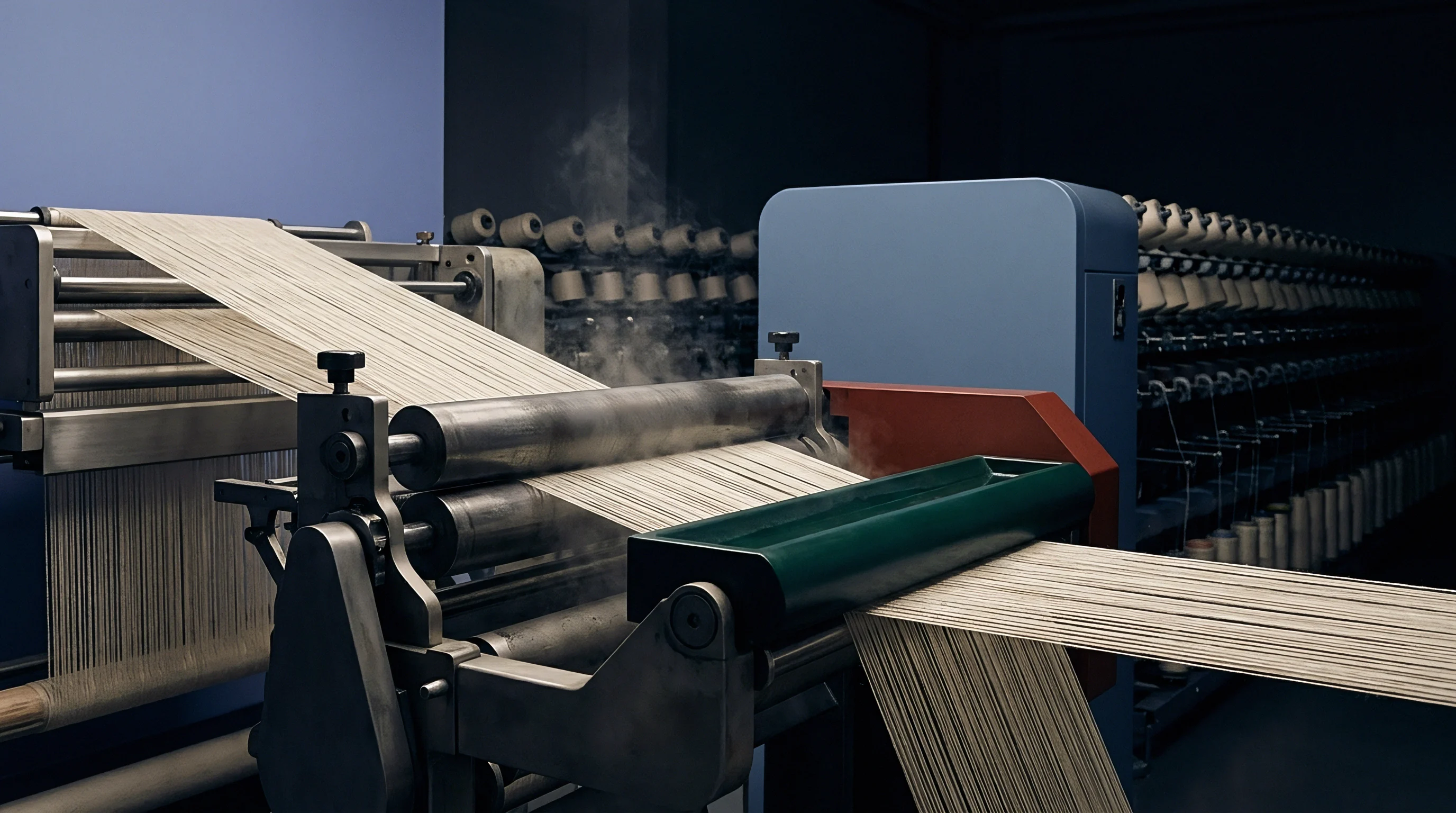
Tension Profiles across the Warping Reed
Yarn paths from outer creel wings face more friction than those from center positions. Direction changes around guides build cumulative drag according to Euler’s capstan equation: output tension equals input tension times e raised to the power of the friction coefficient multiplied by the total wrap angle in radians. An outer end navigating five ninety-degree guide bends builds up double the tension of an inner end negotiating only two bends before entering the expansion reed.
Calculations for an Nm 26 linen warp highlight this progressive tension buildup. An initial unwinding tension of five centinewtons at the bobbin reaches twelve centinewtons at the front creel guide and climbs to twenty-two centinewtons at the headstock reed for an outer end. If the yarn’s elastic limit is thirty centinewtons, acceleration surges can easily push outer ends past their yield point, permanently ruining yarn elasticity.
Balancing sheet tension requires strategic creel threading alongside step-variable disc loading. Setting outer tension discs lighter than inner ones offsets cumulative path friction. Engineers map the exact friction profile for each creel section with handheld electronic tension meters before approving high-speed production runs.
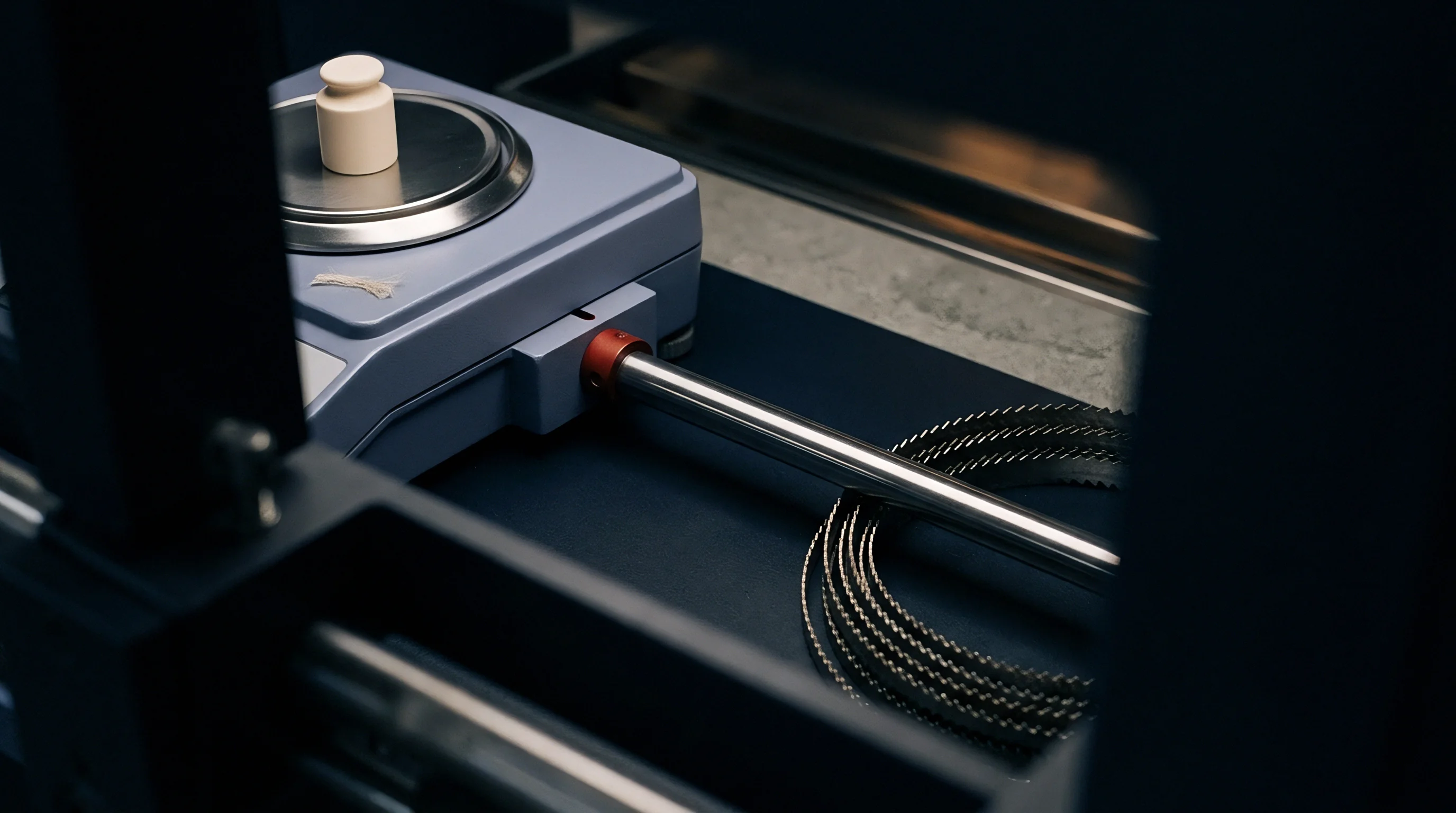
Beam Density Uniformity and Moisture Migration
Uneven winding hardness creates pressure gradients that squeeze internal moisture toward the outer package layers. When ends run under unequal tension, tight threads bite into lower beam layers, displacing looser neighboring threads and building dense bands. These hard bands drive water outward toward the flanges, leaving the center of the beam dry.
Consider a sectional warping setup running an eleven-thousand-end Nm 39 linen warp over a beam width of two hundred and twenty centimeters. Winding speed is set to eight hundred meters per minute, targeting a beam density of zero point sixty-five grams per cubic centimeter at twelve point five percent moisture. Initial settings put eighteen centinewtons of tension on every end across the creel.
Measuring across the two-hundred-and-twenty-centimeter sheet shows significant tension drift: central ends read fourteen centinewtons while edge ends hit twenty-six. This twelve-centinewton spread skews beam density. High-tension edges pack tightly to zero point seventy-four grams per cubic centimeter, while the low-tension center reaches only zero point fifty-eight.
Over an eight-hour shift, edge compression forces water toward the soft central zone, driving central moisture to fourteen point eight percent while edge moisture drops to nine point two.
Correcting this imbalance requires adjusting tension profiles according to the following operational decision checklist:
- Creel Zone Calibration ~ Adjust individual electronic tension disc voltage signals in five creel zones, reducing outer wing voltage by twenty-eight percent to match center-line thread tension.
- Presser Roller Pressure Balancing ~ Set hydraulic beam presser roller pressure to four bar, maintaining continuous surface contact across the entire beam barrel width to override localized winding density variations.
- Atmospheric Moisture Equalization ~ Boost ultrasonic humidifier outputs in the creel wing alleyways to maintain seventy-two percent relative humidity, reducing yarn-to-guide friction variance across long travel distances.
- Speed Ramp Extension ~ Extend machine acceleration time from three seconds to eight seconds, preventing dynamic tension spikes during velocity transitions.
- Comb Centering Alignment ~ Re-align the expansion comb relative to the beam center line to eliminate oblique yarn entry angles exceeding three degrees.
Making these adjustments narrows the tension spread across the sheet from twelve centinewtons to one point four. The finished warp beam holds a uniform density of zero point sixty-four grams per cubic centimeter end-to-end, with moisture held between twelve point two and twelve point seven percent. That level of beam uniformity is necessary for high-speed sizing downstream.
Uncorrected tension fluctuations steadily cause microscopic damage across the linen sheet. Managing the tension drift caused by shrinking bobbin diameters as creel packages run down over long cycles requires active diameter-sensing regulation at the creel.


Proof
Standardized laboratory testing confirms whether yarn lots meet physical and chemical specs before weaving. Visual inspection and feel fail quickly when running bast yarns at production speeds. Quantitative testing sets baseline values for residual matrix content, moisture regain, tensile elongation, and friction coefficients.
Documented proof protects both buyers and weavers against performance disputes.
Auditing raw and processed linen requires strict adherence to international standard methods. Test conditions must mimic high-speed operational forces rather than static equilibrium. Slow tensile testing in a lab fails to predict how yarn will behave under the dynamic impact loads of warper acceleration or loom shedding.
Verifying chemical matrix extraction parameters requires pairing wet chemical extraction with gravimetric, spectrophotometric, and mechanical test methods. Independent laboratory validation gives spinners and weaving mills objective data to approve or reject lots before warps are loaded onto loom beams.

Analytical Methods for Residual Chemical Matrix
Soxhlet solvent extraction measures remaining epicuticular lipids and waxes. A ten-gram yarn sample is extracted in dichloromethane for four hours, washing hydrophobic waxes into a receiving flask. Evaporating the solvent leaves purified wax residue, weighed to zero point one milligram.
Unprocessed flax typically yields one point five to two point two percent wax content, while properly prepared warping yarn targets zero point six to zero point nine percent.
Colorimetric testing with ruthenium red dye measures residual pectin in scoured fibers. The dye binds selectively to unesterified carboxyl groups on polygalacturonan chains. Spectrophotometric absorbance at five hundred and thirty-five nanometers gives the percentage of residual pectin.
Holding residual pectin between two point zero and three point zero percent confirms controlled matrix extraction without degrading structural cellulose.
Optical laser hairiness testing under ISO 13930 counts projecting fibers over two millimeters long per meter of yarn. Applying chemical lubrication during warping drops hairiness index values from three point eight down to one point two, showing that loose surface fibers have been bound back into the sheath.
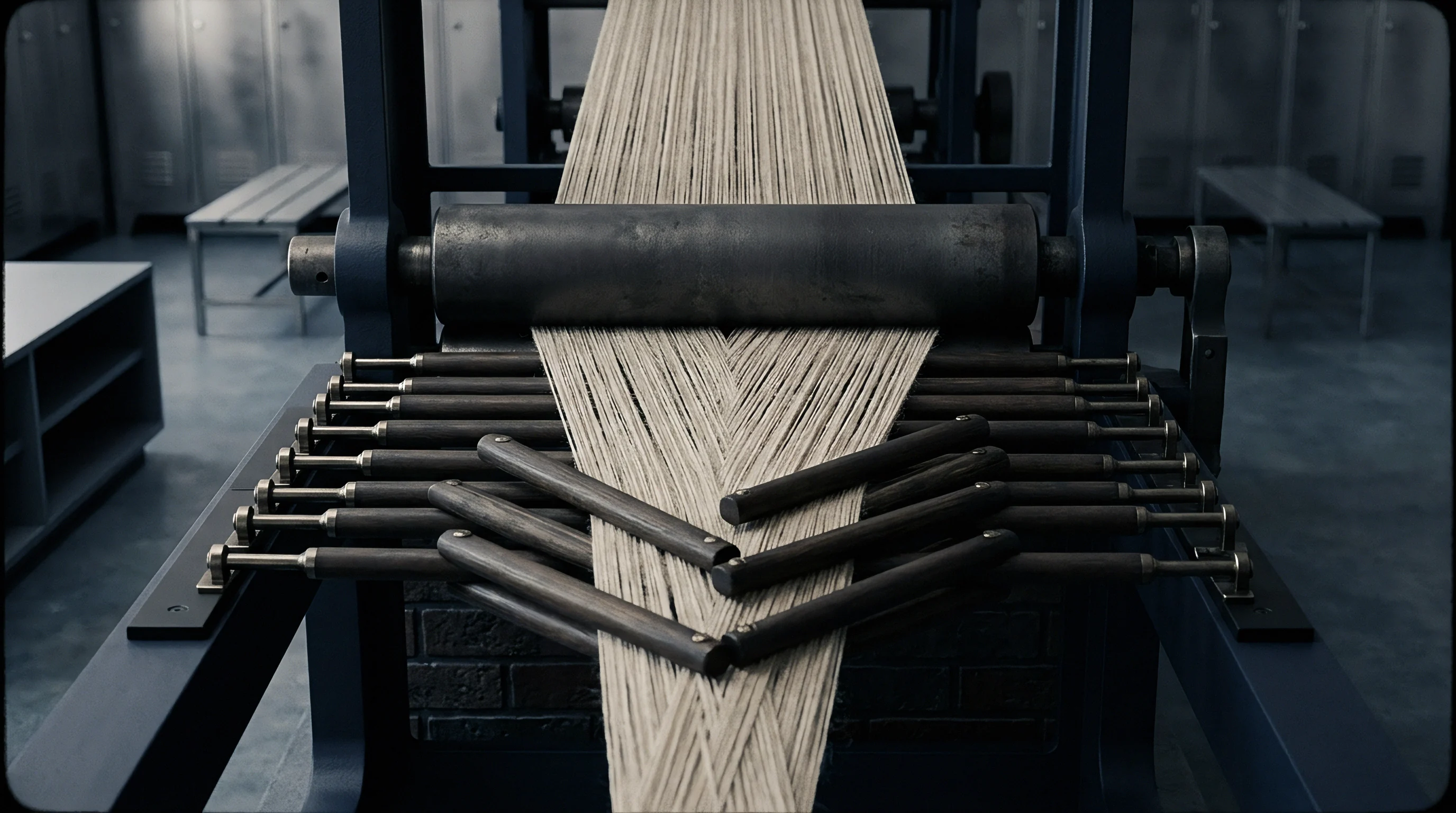
Standardized Moisture Auditing Protocols
Gravimetric oven drying under ISO 139 determines the dry mass of yarn samples taken from warp beams. Samples sit in a ventilated oven at one hundred and five degrees Celsius until consecutive weighings fifteen minutes apart differ by less than zero point zero five percent. Dividing the weight loss by the dry weight gives the absolute moisture regain percentage.
Dielectric or electrical resistance meters allow fast floor-level moisture auditing. However, calibration curves must be set against ISO 139 oven standards for each yarn count and preparation formula. Using handheld resistance meters without lot-specific calibration introduces errors up to two point five percent regain, leading technicians to misadjust room humidity.
The standard test protocols and quality threshold parameters governing high-speed linen warping operations appear in Table 3.
| Parameter | Standard Test Method | Target Specification | Acceptable Tolerance | Non-Conformance Impact |
|---|---|---|---|---|
| Residual Wax Content | ISO 3071 / Soxhlet | 0.75% by weight | ± 0.15% | Sizing coating rejection or ceramic guide clogging |
| Residual Pectin Content | Colorimetric Spectrophotometry | 2.50% by weight | ± 0.30% | Fiber bundle splitting or extreme thread stiffness |
| Moisture Regain | ISO 139 Gravimetric | 12.50% regain | +1.0% / -0.5% | Static buildup or beam mold and flange crushing |
| Kinetic Friction Coeff. | ASTM D3108 (Yarn-to-Metal) | 0.22 µ | ± 0.03 µ | High warp breaks or severe yarn micro-abrasion |
| Tensile Break Elongation | ISO 13934-1 Single Strand | 3.20% elongation | ± 0.40% | Instantaneous breakage during warping acceleration |
| Yarn Hairiness (S3 Value) | ISO 13930 Optical Laser | 1.20 (Fibers > 2mm/m) | +0.30 / -0.20 | Yarn clinging in reed and high loom stop rates |
Complete quality assurance dossier documentation requires recording test results alongside specific sampling coordinates pulled from the warp beam. A compliant delivery dossier must contain six mandatory data components:
- Certificates of Analysis detailing raw material origin, fiber length distribution metrics, and initial spinning oil formulation parameters.
- Chemical Extraction Logs detailing time, temperature, and chemical concentration profiles for bio-scouring or chemical washing preparation batches.
- Gravimetric Moisture Reports validating target regain levels across inner, middle, and outer beam layers post-warping.
- Tension Mapping Records showing electronic end-to-end tension distribution profiles across all creel zones recorded during production.
- Friction Coefficient Certificates confirming compliance with maximum friction limits under ASTM D3108 testing parameters.
- Tensile Test Reports detailing breaking force, tenacity, and percentage elongation at break curves under dynamic loading conditions.
Standard sales contracts under International Linen and Hemp Confederation rules specify that any delivery with residual wax below zero point forty percent or moisture regain under ten point five percent gives the buyer the right to reject the warp lot and charge machine downtime costs back to the spinner.


Yield
Throughput directly drives the cost per finished meter on rapier and air-jet looms. Warping is more than prep work ~ it sets weaving shed productivity. A beam with tension drift, uneven moisture, or damaged fiber forces looms to run up to thirty percent slower to avoid constant stops.
With modern weaving sheds costing thirty-five to fifty-five euros per loom hour to operate, every warp stop wastes yardage and overhead.
Connecting warping quality to loom performance shows clear financial consequences. High-speed rapier looms weaving a two-hundred-centimeter pure linen plain weave at five hundred picks per minute produce forty-five meters of cloth per shift at eighty-five percent efficiency. If poor warp prep causes stops to rise from zero point five to three point five per loom hour, efficiency drops to sixty-two percent.
Daily output falls by twelve point two meters per loom, driving up fixed machine overhead by twenty-seven percent per meter.
Maximizing yield requires treating chemical matrix extraction, moisture control, and mechanical tension as a single connected system. Investing in precise chemical dosing, ultrasonic humidification, and electronic creel monitoring during warping pays off directly at the loom through higher efficiency, better fabric quality, and lower landed cost per meter.

Weaving Shed Efficiency and Stop Rates
Warp breaks force loom downtime that reduces weekly yardage and inflates hourly overhead. When an end snaps, electric drop wires stop the loom automatically. The weaver then has to locate the break, thread it through the drop wire, heald eye, and reed dent, tie a knot, and restart the machine.
Repairing a break takes one point five to three minutes on average, and those delays add up quickly across a weave room running dozens of looms.
Weaving efficiency metrics show how stop frequency affects net output. A weave room running sixty rapier looms at four hundred and fifty picks per minute on a 140 g/m² plain linen fabric logs eighteen hundred loom hours a week. Running at two point five warp stops per loom hour with two minutes of repair time per stop consumes seventy-five loom hours in downtime ~ a loss of forty-one hundred meters of finished cloth weekly.
Improving warping prep to bring warp stops down to zero point six per loom hour recovers fifty-seven loom hours every week. Output grows by thirty-one hundred meters without extra looms, power, or labor. Better warp preparation directly improves plant capacity and margin.
Landed Cost Arithmetic per Finished Metre
Calculating landed cost requires tracking yarn preparation waste alongside energy use. Direct warping involves five main expense areas: raw yarn, chemical auxiliaries, power for high-speed drives and humidification, labor, and machinery depreciation. Cost modeling assigns these expenses directly to each finished meter of woven fabric.
Take a production run of fifty thousand meters of 180 g/m² pure linen on two-hundred-and-twenty-centimeter rapier looms. The warp calls for six thousand ends of Nm 26 wet-spun yarn. Raw linen yarn costs fourteen euros per kilogram.
Chemical wax auxiliaries add zero point twelve euros per kilogram, with power and humidification adding zero point zero eight euros. Direct labor and machine depreciation run zero point twenty-five euros per thousand warp meters.
Warping waste strongly affects final material cost. Tension swings and frequent breaks generate waste through piecing tails, discarded bobbin bottoms, and comb slubs. A well-controlled warping line limits total yarn waste to zero point eight percent by weight.
Poor matrix control and tension spikes push waste to three point two percent, adding zero point thirty-six euros in unrecoverable raw material loss per kilogram of yarn.
Weaving efficiency compounds these cost differences. High-quality warp beams running at eighty-eight percent loom efficiency result in a weaving transformation cost of one point fifteen euros per finished meter. Poor beams operating at sixty-four percent efficiency due to frequent stops raise that cost to one point sixty-two euros per meter.
High breakage also increases greige cloth defects, pushing up mending labor and forcing second-quality price downgrades at inspection.
Adding up raw materials, chemical prep, warping expenses, yarn waste, and weaving transformation costs shows that optimizing chemical matrix extraction and moisture balance reduces total landed cost from four point eighty-two euros per finished meter to four point twelve euros per meter. On a fifty-thousand-meter run, controlled warping saves seventy thousand euros in direct costs while turning out first-quality cloth that easily passes inspection.