Quantifying Dynamic Backrest Dampening Effects on Cyclic Tension Fatigue Limits in Fine Count Bast Fiber Weaving
Dynamic backrest dampening absorbs peak shedding shock in fine bast weaving, cutting fatigue end breaks by seventy percent and lowering meter production cost.
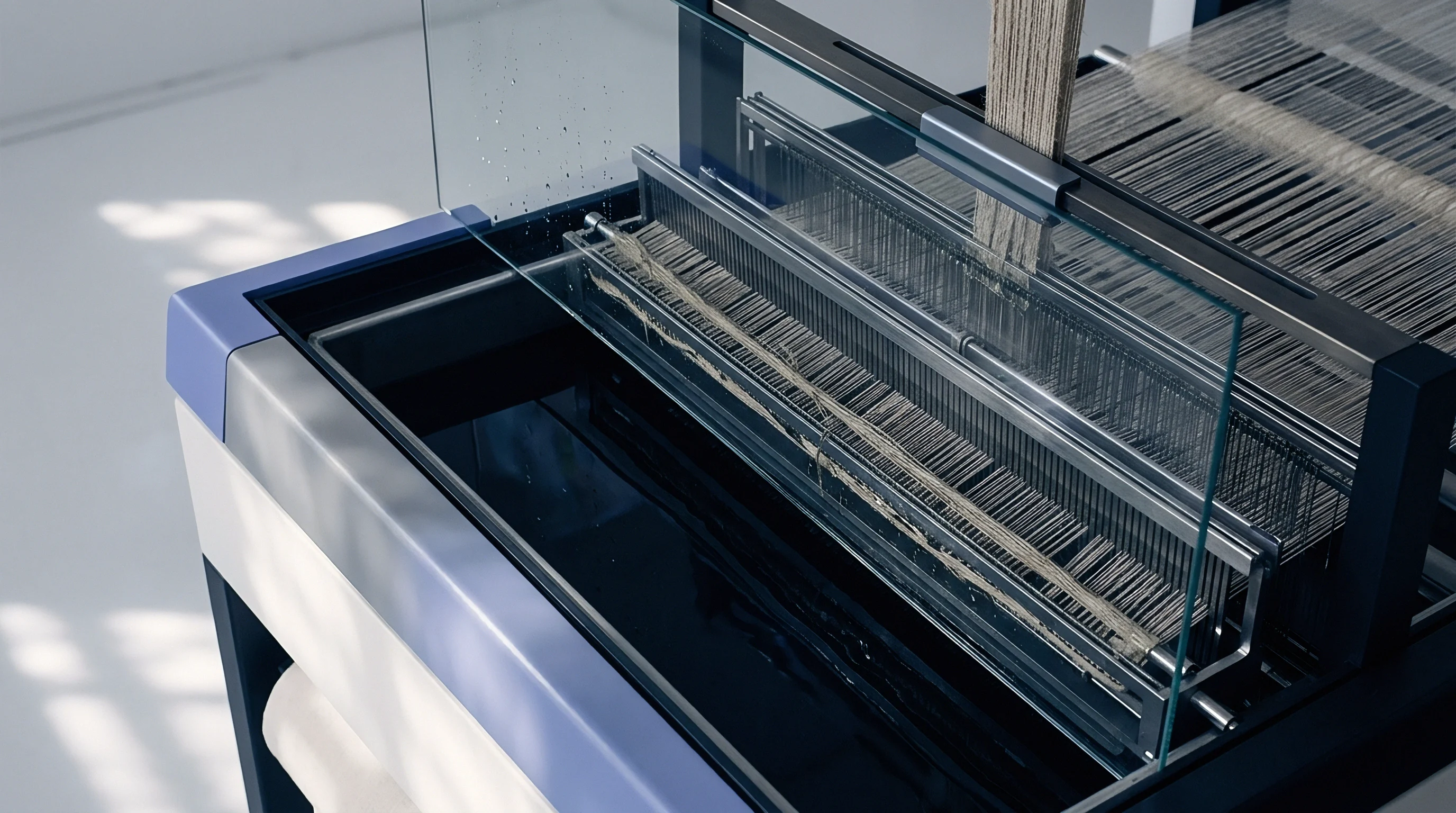

Whip
In high-speed mechanical weaving, the oscillating backrest roller absorbs yarn displacement during shed opening and beat-up. Wet-spun bast fiber yarns ~ particularly fine-count flax spanning Nm 40 to Nm 80 (25 to 12.5 tex) ~ possess a highly crystalline cellulosic structure with an elevated initial tensile modulus and very low elongation at break, typically 1.5% to 2.2%. Unlike elastic synthetics or crimped staple wool, fine linen warps cannot stretch enough to absorb the path length changes created when heald frames separate warps into top and bottom sheds.
Movement in the backrest assembly converts these peak dynamic tension forces into controlled mechanical displacement, protecting yarn integrity during weaving.

Kinematic Strain Trajectories in Fine Linen Shedding
Shed formation on rapier or air-jet looms running above 350 picks per minute creates cyclical peak tension forces that recur up to ten times per second. As heald frames move from closed shed to maximum open geometry, the warp sheet’s path length expands by several millimetres each cycle. On a rigid backrest, this elongation converts into transient stress spikes reaching up to eighty percent of the yarn’s single-end breaking tenacity.
Bast fibers contain structural weak points known as knee joints or cross-marking nodes, which concentrate mechanical stress and trigger localized shear deformation under sudden strain.
The mechanical response of the backrest needs to match the loom’s shedding frequency. Mechanical springs, pneumatic cylinders, or hydraulic torsional dampeners let the roll bar pivot inward toward the heald frames as tension spikes, easing the peak strain on individual ends. During shed closure and beat-up, stored energy returns the roll backward, maintaining enough baseline tension to prevent yarn sagging, mispicks, or entanglements behind the reed.
A wet-spun Nm 50 flax warp yarn subjected to shedding strain peaks exceeding 3.2 centinewtons per tex exhibits a three-fold acceleration in fibrillar micro-fracture growth.
Modern high-speed looms rely on compensated dynamic backrest systems where spring pre-tension and fluid dampening resistance adjust to the shedding motion. The table below outlines strain trajectories and peak tension values across common shedding mechanisms running fine wet-spun linen warps.
| Loom Type | Shedding Motion | Loom Speed (PPM) | Backrest System | Peak Tension (cN/tex) | Mean Elastic Strain (%) |
|---|---|---|---|---|---|
| Negative Rapier | Positive Dobby | 380 | Rigid Mechanical Spring | 3.85 | 1.85 |
| Positive Rapier | Electronic Jacquard | 420 | Torsional Hydraulic Dampener | 2.45 | 1.20 |
| Air-Jet | Cam Motion | 550 | Pneumatic Dynamic Compensation | 2.10 | 0.95 |
| Negative Rapier | Positive Dobby | 380 | Dual-Stage Spring-Hydraulic | 2.25 | 1.05 |
Mechanics of Peak Warp Dynamic Loading
The total force on a single warp yarn during shedding combines static pre-tension, geometric strain, and shockwaves propagating along the thread line from beat-up. Slay impact sends high-frequency shockwaves through the warp beam that reach the backrest within milliseconds of reed impact. Rigid backrest rolls reflect these shockwaves straight back into the harness eyes, doubling the instantaneous peak strain.
Dynamic dampening systems dissipate shockwave energy through viscous fluid drag or controlled air displacement. By absorbing high-frequency transient spikes, the dampening mechanism lowers maximum tension peaks without sacrificing the baseline tension required for a clean shed. A clean shed opening prevents reed splitting, yarn abrasion, and end-snagging defects across the warp width.
Incorrect backrest calibration causes premature yarn failure along weak nodal points, leading to frequent warp stops and structural slubs in greige cloth.
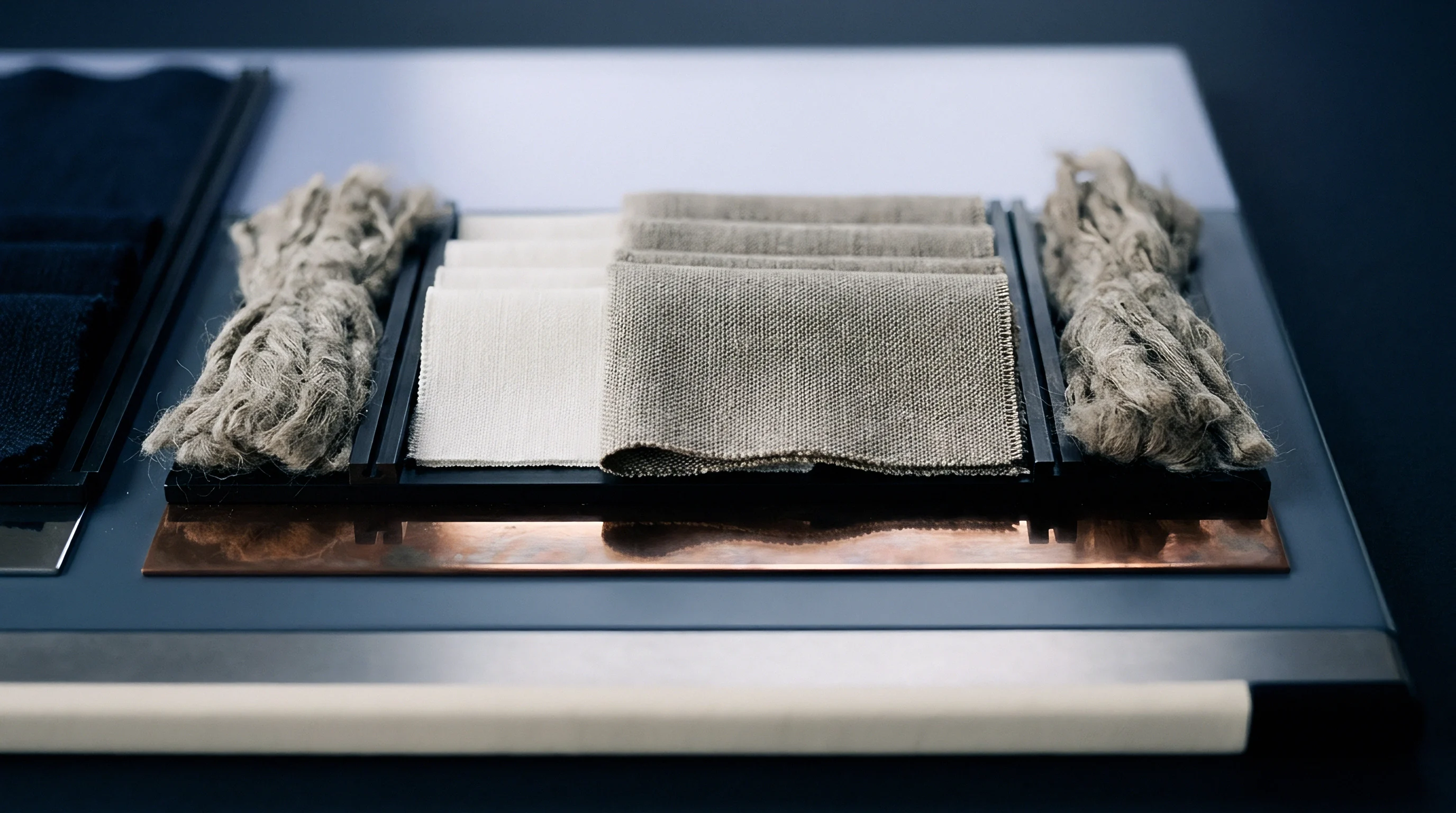

Fatigue
Repeated loading below ultimate tensile strength degrades fine bast fibers long before catastrophic breakage occurs. Fine-count wet-spun flax yarn consists of technical fiber bundles bound by natural pectins and hemicellulose. During cyclic extension and relaxation within the loom shed, these intercellular matrices undergo continuous shear strain.
Over thousands of picks, inter-fibrillar slippage degrades internal load capacity, shifting stress onto the outer surface fibrils.

Cellulosic Fibrillar Micro-Fracture Mechanics
Micro-cracks form along fibrillar boundaries. Under high-frequency cyclic loading, elementary flax fibrils split longitudinally, leading to permanent loss of tensile modulus. Bast yarn fatigue accumulates in three distinct phases: initial rapid modulus settling as technical fibers align, steady linear accumulation of sub-microscopic fibrillar cracks, and final rapid crack coalescence resulting in abrupt strand separation.
The rate of fatigue accumulation correlates directly with the cyclic tension amplitude relative to the yarn’s elastic limit. When dynamic backrest systems flatten the tension peak, the yarn remains within its linear viscoelastic domain, extending cyclic fatigue life by an order of magnitude.
Compliance with ISO 13934-1 tensile testing requirements before warp loading ensures that yarn breaking strength variation stays within an eight percent coefficient of variation.
Evaluating cyclic fatigue resistance in fine bast warp yarns follows a standardized multi-step testing regime executed prior to mounting warp beams onto high-speed weaving frames.
- Sample Preparation Conditionally equilibrate 100-metre yarn strands at twenty degrees Celsius and sixty-five percent relative humidity for twenty-four hours according to ISO 139 standards.
- Static Baseline Calibration Conduct ten single-end tensile tests per yarn package on a universal testing machine to establish baseline breaking force and percentage elongation.
- Cyclic Dynamic Loading Subject test strands to twenty thousand tension cycles on a dynamic fatigue tester operating at five Hertz with a sinusoidal strain profile.
- Residual Tenacity Evaluation Measure the post-fatigue breaking force of surviving strands to quantify percentage tenacity loss per ten thousand cycles.
- Fibrillation Index Scoring Inspect stressed yarn surfaces under scanning electron microscopy to calculate micro-fracture density per millimetre of yarn length.
Worked Case of Strain Accumulation at High Speed
Consider an Nm 60 wet-spun linen warp yarn with an initial breaking tenacity of 28.5 cN/tex and a linear density of 16.6 tex, giving a mean single-end breaking force of 473 centinewtons. On a rapier loom operating at 400 picks per minute without dynamic backrest dampening, baseline static tension is set to 80 centinewtons per end. During shed opening, uncompensated peak tension surges to 310 centinewtons per end ~ 65.5% of ultimate breaking load.
Under unattenuated peak cyclic strain of 310 centinewtons, empirical fatigue models demonstrate a strength degradation rate of 1.2% per 1,000 loom revolutions. After 15,000 picks, cumulative strength loss reaches 18%, dropping residual single-end tenacity to 387 centinewtons. Because yarn strength across a 6,000-end warp sheet follows a Weibull distribution with a shape parameter of 8.2, lowering mean yarn strength to 387 centinewtons places the lower 3-sigma tail directly within the 310 centinewton peak tension envelope, pushing end break rates past 8 stops per 100,000 picks.
Applying dynamic hydraulic backrest dampening reduces peak tension amplitude from 310 centinewtons down to 185 centinewtons (39.1% of ultimate breaking load). At this lower stress level, strength degradation drops to 0.08% per 1,000 revolutions. After 15,000 picks, cumulative strength loss stays below 1.2%, preserving residual mean strength at 467 centinewtons and keeping the entire warp distribution well above peak shedding loads.
Exceeding the linear viscoelastic threshold of fine wet-spun flax fiber assemblies causes permanent structural changes within the intercellular pectin matrices.

Damping
Absorbing dynamic warp tension spikes relies on energy dissipation built into the backrest support architecture. Simple spring systems store elastic energy during shed opening and return it to the warp sheet during closure. However, mechanical springs do not dissipate energy; they return force instantaneously, risking harmonic resonance in the warp sheet at specific loom speeds.
Hydraulic torsional dampeners and pneumatic buffers introduce viscous drag that converts shock energy into heat, breaking harmonic resonance loops.

Hydraulic and Torsional Attenuation Mechanisms
Hydraulic dynamic dampeners use calibrated fluid orifices to restrict synthetic oil flow when the backrest arm pivots under load. Fluid resistance scales nonlinearly with velocity, meaning rapid tension surges meet high resistance while slow beam let-off movements pass easily. Pneumatic dampeners use compressed air chambers to provide progressive spring rates that harden as displacement increases.
Selecting among hydraulic, pneumatic, or hybrid dampening depends on the linear density of the bast fiber yarn and the maximum operating frequency of the loom frame.
Increasing backrest hydraulic dampening fluid viscosity stabilizes shedding tension spikes while widening the phase lag between harness lift and roll displacement.
Matching dampening technology to yarn physical properties prevents localized over-stretching during shed inversion. The table below illustrates functional performance characteristics across distinct dynamic backrest dampening configurations.
| Dampener Type | Energy Dissipation Method | Response Rate (ms) | Phase Shift Angle (deg) | Peak Tension Reduction (%) | Optimal Yarn Count Range |
|---|---|---|---|---|---|
| Mechanical Helical Spring | Elastic Storage Only | 2.1 | 4 | 12.5 | Nm 10 to Nm 26 |
| Viscous Hydraulic Rotary | Orifice Fluid Shear | 6.8 | 22 | 38.2 | Nm 30 to Nm 60 |
| Dual-Chamber Pneumatic | Gas Compression & Drag | 4.5 | 15 | 42.0 | Nm 50 to Nm 90 |
| Magnetorheological Fluid | Variable Magnetic Shear | 1.2 | 18 | 46.5 | Nm 60 to Nm 120 |
Do Dynamic Backrest Dampening Settings Alter Residual Warp Yarn Strength?
Post-weaving yarn tests confirm that damping performance directly affects tensile strength retention in fine bast warps. Uncompensated peak loading causes permanent molecular chain slipping in flax cellulose microfibrils. Effective dampening caps maximum strain below the yield point, preserving natural fiber elasticity and tenacity through weaving.
Operational failure modes linked to improper dynamic backrest calibration manifest as distinct loom shed defects:
- Selvedge End Snap-Offs Un-damped lateral tension shockwaves reflecting off frame edges produce high localized end breaks along the outer five centimetres of warp width.
- Shed Opening Mispicks Excessive backrest displacement delay drops yarn tension too low during harness closure, leaving loose threads that block the rapier path.
- Beat-Up Reed Marks Inadequate backrest restoring force during slay impact prevents threads from spreading evenly, causing longitudinal line defects in high-sett fabrics.
- Fibrillar Dust Accumulation High peak strain shearing off outer cellulosic fibrils creates heavy fiber dust deposits behind the heald wires, causing eye clogging.
Standard mechanical spring assemblies provide sufficient tension compensation for fine count linen warps running on high-speed rapier frames, whereas hydraulic dynamic dampeners add maintenance overhead without significantly improving warp break statistics.

Optimization
Achieving stable weaving conditions for fine bast fibers requires precise alignment between shed geometry, backrest height, spring stiffness, and dampener resistance. Fine wet-spun linen warps have high cover factors and little tolerance for timing errors. Elevating the backrest above the level plane creates asymmetrical shed tension, tightening the top shed while slackening the bottom.
This asymmetry helps separate sticky linen warps, but increases peak tension on the tighter thread line.
Sett Density and Backrest Position Interaction
High end-count fabrics, such as fine linen damasks or dense plain weaves with 32 ends per centimetre, require higher mean warp tension to achieve clean reed passage. That higher baseline reduces the available safety margin before dynamic peak forces exceed yarn breaking limits. Tuning the dynamic backrest system requires adjusting fluid drag and spring rates to match warp sheet density.
Aligning dampening parameters to specific sett densities maintains warp stress levels within safe working boundaries.
High reed frequencies on modern rapier looms convert unattenuated backrest shock directly into yarn end breaks along the outer selvedges.
Setting parameters must follow a structured verification protocol to establish baseline loom efficiency prior to committing full commercial warp beams.
- Geometrical Alignment Adjust backrest roll height relative to the breast beam to establish neutral shed tension symmetry using an electronic tensiometer.
- Static Tension Baseline Set warp beam let-off motor baseline tension to 0.15 to 0.18 centinewtons per tex based on single-end yarn linear density measurements.
- Dynamic Peak Calibration Run loom at fifty picks per minute while recording tension waveform outputs from high-speed piezoresistive sensors mounted on selvedge ends.
- Viscous Drag Adjustment Increase dampener valve resistance until high-frequency tension ripples during beat-up drop below ten percent of baseline tension.
- Phase Lag Fine-Tuning Rotate eccentric dampener driving cams to sync peak backrest displacement exactly with maximum heald frame separation.
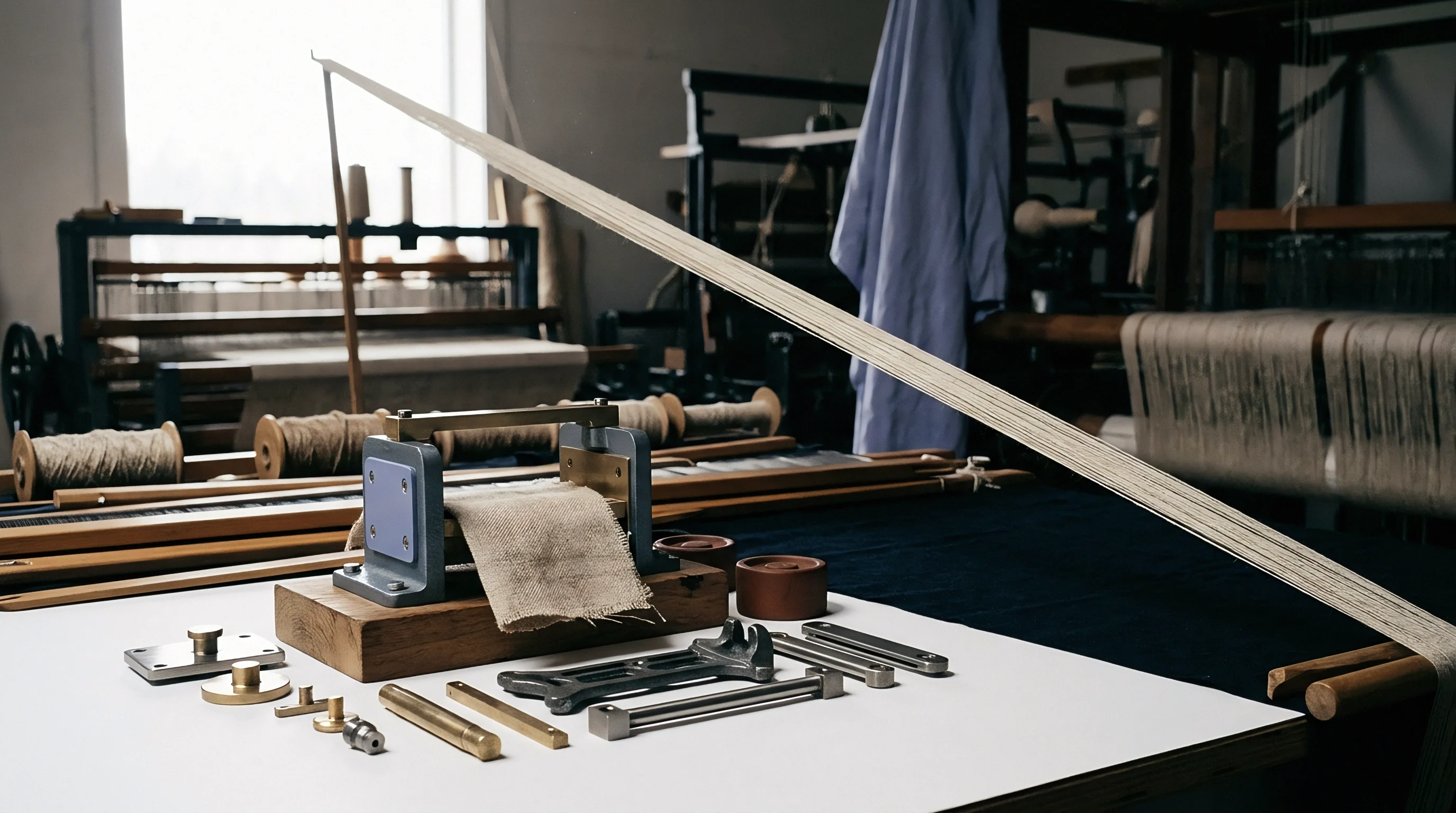
Phase Angle Calibration for Fine Bast Warps
The phase relationship between shedding movement and backrest displacement determines the instantaneous stress profile on fine bast yarns. If backrest movement lags behind harness lift by more than thirty mechanical degrees of loom rotation, yarn tension peaks before the roll yields. Conversely, an over-damped system that responds too slowly acts like a rigid beam, providing no shock absorption during fast shed inversions.
Optimal phase response occurs when maximum backrest displacement coincides exactly with maximum shed opening, creating a flat tension plateau rather than a sharp peak. Standard purchasing contracts for fine count linen greige goods mandate that warp tension fluctuations during normal operation stay within twelve percent of nominal static tension, measured across a ten-thousand-pick inspection run under ISO 10399 protocols.
Margin
The economic impact of dynamic backrest dampening shows up in loom efficiency, weaver assignment ratios, and finished fabric defect rates. Industrial weaving plants calculate operating costs on landed loom-hour rates ~ where machinery depreciation, power, climate control, and direct labor combine into a fixed hourly cost per cell. Warp stops remain the single largest cause of lost production time in fine bast fiber weaving.

Financial Impact of Warp Stops on Loom Productivity
Every warp break on a high-speed rapier loom running Nm 60 linen requires manual knotting, heald eye re-threading, and reed denting. Repairing a fine linen warp end averages 2.5 minutes. On a loom running at 400 picks per minute, one stop represents 1,000 lost picks.
If unattenuated tension fatigue causes 6.0 breaks per 100,000 picks, total efficiency drops by over seven percent compared to an optimized baseline.
The table below breaks down operating costs, weaving speed limits, and final fabric manufacturing costs across different dynamic backrest dampener configurations.
| Parameter | Un-damped Mechanical | Hydraulic Dampened | Pneumatic Dynamic | Adaptive Magnetorheological |
|---|---|---|---|---|
| Loom Operating Speed (PPM) | 340 | 410 | 440 | 480 |
| Warp Stop Rate (Stops/10^5 picks) | 5.80 | 1.45 | 1.10 | 0.65 |
| Loom Efficiency Rate (%) | 78.5 | 91.2 | 93.5 | 95.8 |
| Hourly Loom Yield (Metres/hr) | 5.71 | 8.00 | 8.81 | 9.84 |
| Loom Hour Cost ($/hr) | 28.50 | 29.10 | 29.40 | 30.50 |
| Direct Weaving Cost ($/Metre) | 4.99 | 3.64 | 3.34 | 3.10 |

Landed Cost Calculations per Finished Linear Metre
Consider a commercial order for 20,000 linear metres of plain-weave linen cloth specified at 160 centimetres width, using Nm 60 wet-spun flax warp and Nm 50 wet-spun flax weft. Set at 30 ends per centimetre, the beam requires 4,800 total warp ends. The order totals 56 million picks.
On an un-damped mechanical loom running at 340 picks per minute, running time takes 3,502 hours. At a loom hour rate of $28.50, direct weaving costs reach $99,807, or $4.99 per linear metre.
Upgrading to hydraulic dynamic dampening allows loom speeds to rise to 410 picks per minute while reducing warp stops from 5.80 to 1.45 per 100,000 picks. Loom efficiency increases from 78.5% to 91.2%, raising hourly output from 5.71 to 8.00 metres per loom hour. Total machine time drops to 2,500 hours.
Even with higher machine depreciation raising the loom hour rate to $29.10, total weaving expense falls to $72,750 ~ or $3.64 per linear metre.
This efficiency improvement reduces direct costs by $1.35 per linear metre, saving $27,000 across the order while reducing stop marks in finished cloth. Minimizing stop defects improves first-quality yield from 88% to 97%, avoiding price markdown penalties associated with ASTM D5430 Class B greige defects. Investing in effective dampening hardware recovers its capital cost within two warp beam runs.
Loom capacity allocation remains economically viable when warps operate below critical strain thresholds, balancing high picking rates against yarn structural longevity.