Optimizing Sizing Formulations and Beaming Tension for High Sett Linen
High sett linen demands flexible PVA-modified starch sizing at 8.5 percent add-on and uniform 24 cN beaming tension to prevent brittle warp breaks on high-speed looms.

Flax

Tensile Modulus under Cyclical Shedding Mechanics
Flax tow and line yarns feature an exceptionally high initial modulus alongside negligible elongation at break, typically failing between 1.5% and 2.5% strain. Without size, wet-spun line flax follows a steep linear Hookean slope straight into sudden brittle failure, driven by rigid, highly crystalline cellulose fibrils aligned parallel to the ultimate fiber axis. Natural gum fractions of hemicellulose and pectin glue these technical fiber bundles together.
On modern rapier looms operating above 400 picks per minute, high sett plain weaves create severe inter-yarn friction between the harness frames and the reed. As adjacent ends rub during counter-shedding, unglued surface fibrils peel back into micro-slubs that snag neighboring threads. This cling disrupts clean shed separation, causing floats, stitching defects, and warp breaks.
Weaving fine linen at setts exceeding 36 ends per centimeter requires a tailored sizing formulation. High pick frequencies compress the beat-up window, driving up peak warp strain during shedding. Because the yarn lacks stretch to distribute stress across neighboring ends, an unyielding warp thread takes the full localized shock of repeated heddle lifts.
| Fiber Type | Tensile Strength (cN/tex) | Elongation at Break (%) | Elastic Recovery at 2% Strain (%) | Initial Modulus (cN/tex) |
|---|---|---|---|---|
| Wet-Spun Flax Line (Nm 39) | 52.0 to 65.0 | 1.6 to 2.2 | 45 to 55 | 1800 to 2200 |
| Dry-Spun Flax Tow (Nm 24) | 28.0 to 38.0 | 2.0 to 2.8 | 35 to 45 | 950 to 1300 |
| Long-Staple Ring Cotton (Ne 40/1) | 22.0 to 28.0 | 5.5 to 7.0 | 70 to 80 | 450 to 600 |
| Viscose Rayon (30s Ne) | 18.0 to 24.0 | 15.0 to 22.0 | 30 to 40 | 350 to 500 |
Flax yarn has an initial modulus four times that of ring-spun combed cotton. Because of this rigidity, minor misalignments in the warp beam or slight let-off surges create sharp tension spikes. Rather than yielding elastically like cotton or viscose, the rigid cellulose bundles snap abruptly.
The mechanical rigidity of crystalline cellulose bundles produces yarn failure at strain thresholds where cotton warps yield elastically.
Inconsistent pectin removal during retting leaves localized flaws in the yarn batch. Under-retted bundles hold onto excess lignin and hydrophobic waxes that block chemical penetration during wet slashing. Over-retted fibers already suffer from broken cell walls and surface fibrillation before winding even begins.
Formulations for dense constructions must anchor deep into the core while maintaining a continuous surface film to enclose these structural defects.
The reed strike packs these rigid elements tightly together, concentrating friction inside the reed dents where high sett warps pass through.


Liquor

Polymer Selection and Film Flexibility Ratios
Formulating a wet-slashing bath for high sett linen warps calls for careful chemical balancing. The liquor must bind loose surface fibrils while penetrating into the core of the technical bundle. Polymers that sit entirely on the outside form a brittle shell that shatters into dust at the drop wires and heddles, leaving raw flax fibers exposed to abrasive shear.
An effective formula combines low-viscosity, fully hydrolyzed polyvinyl alcohol (PVA) with thin-boiling hydroxyethylated or carboxymethylated starches. Sizing fine line linen at metric counts from Nm 39 to Nm 68 demands fast penetration into the micro-voids between bast filaments. Carboxymethylated starch provides surface slip and easy desizing, while synthetic PVA adds film strength, elasticity, and abrasion resistance.
ISO 105-C06 wash liquor protocols establish that fully hydrolyzed vinyl polymers mandate water bath temperatures above 85 degrees Celsius for total chemical extraction.
Plasticizers govern whether the dry film can handle continuous shed flexing. Without them, starch-PVA mixes dry into high-modulus, brittle coatings that micro-fracture under sharp harness lifts. Adding polyoxyethylene tallow amine, sulfated castor oil, or synthetic polyglycol ethers lowers the glass transition temperature of the dried matrix, giving the size enough flexibility to ride through rapier sheds without flaking off the core bundle.
- Viscosity adjustment maintains an efflux velocity between 11 and 14 seconds through a Zahn Number 3 cup at 85 degrees Celsius, matching yarn interstitial absorption rates.
- Size add-on targeting achieves a dry dry-basis pickup between 7.5% and 9.5% calculated against dry yarn mass, limiting hairiness without overloading the reed dent spaces.
- Squeeze roller regulation locks linear loading across the pad box between 22 and 28 decanewtons per centimeter, preventing liquor surface puddling on fine singles flax.
- Moisture retention control stabilizes residual moisture within the exit warp sheet at 7.0% to 8.5%, forestalling destructive re-crystallization of dried native cellulose fibers.
Drying cylinders need a strict temperature profile. Hitting wet starch size with excessive heat right away causes blistering, which ruins the coating. Running temperatures sequentially from 65 to 80 to 90 degrees Celsius, then tapering off on the exit cans, allows smooth crystallization without skin delamination.
Creel
Direct Section Warping Tension Profiles
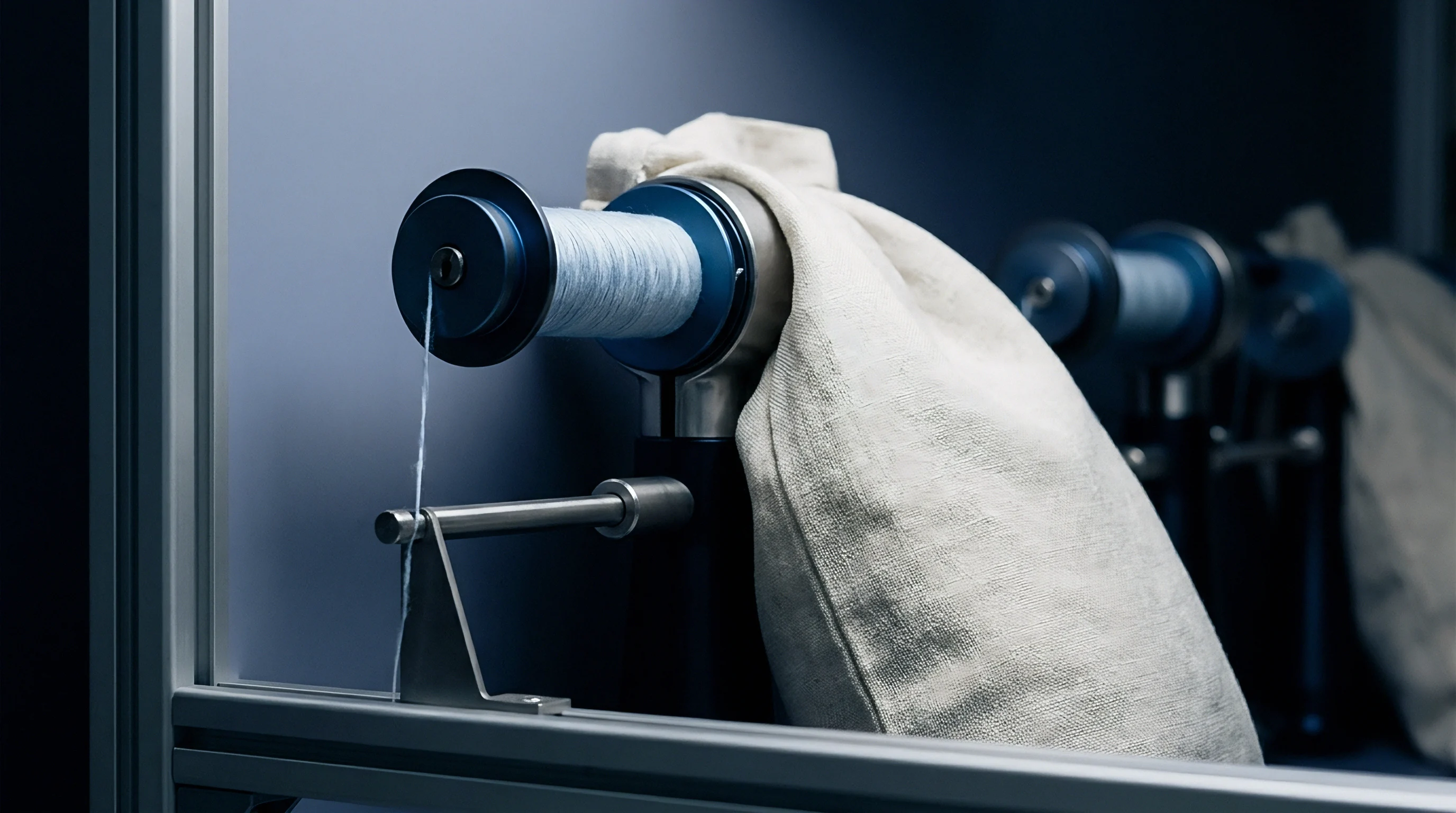
Beaming fine singles linen demands strict control at the creel. Irregular tension during creeling leads to uneven beam density, which causes erratic let-off tension on the loom. Direct section warping for high sett constructions uses electronic collective braking tuned to each yarn path.
Because linen has almost no stretch, minor friction changes across ceramic guide eyelets create wide tension variations. A thread passing through four guide pins builds up sliding drag, whereas an outer lane thread runs slack. Compensating tensioners with rotating ceramic discs and closed-loop optical sensors equalize tension end-to-end across the whole warp array.
| Process Stage | Operational Speed | Linear Running Tension | Ambient Relative Humidity | Ambient Temperature |
|---|---|---|---|---|
| Creel Unwinding to Section Drum | 450 to 550 m/min | 22 to 26 cN per end | 62% to 68% | 21 to 24 °C |
| Beaming off Section Drum to Weaver Beam | 60 to 90 m/min | 35 to 42 cN per end | 65% to 70% | 20 to 22 °C |
| Slashing Size Box Immersion | 40 to 65 m/min | 18 to 22 cN per end | Exhausted Steam Zone | 85 to 90 °C (Liquor) |
| Weaving Loom Warp Let-Off | 380 to 440 picks/min | 40 to 48 cN per end | 70% to 75% | 22 to 25 °C |
Sectional warping relies on an accurate cone traverse angle. The slope of the warper drum cone has to match the build-up rate calculated from yarn count, sett, and running tension. If the traverse steps outward too fast, the band edges slough off, leaving loose ends on the loom beam.
Stepping too narrow forces the yarn band up against the cone face, wedging outer ends beneath lower layers and snapping threads during unwinding.
For high sett warps, beam density must stay uniform from the inner barrel to the outer flanges. If the barrel flexes under package weight, center ends go slack while flange margins pull tight. Reinforced steel barrels with inner ribbing and precision-ground flanges prevent package deflection across wide looms.
Uneven tension set at the warping drum carries straight through the slasher, leaving permanent variations in warp stretch.

Draft

Can Sley Eccentricity Mitigate Beat-Up Strain?
Mechanical drive choices on modern looms control how much cyclic stress hits a rigid cellulosic warp. Loom builders run rapier sley drives using either double cams or matched four-bar linkages. Cam drives extend sley dwell at back dead center, giving rapiers room for insertion without forcing excessive reed acceleration.
The sley then sweeps quickly through beat-up, limiting friction time between steel reed wires and abrasive flax yarns.
High sett linen creates heavy resistance during beat-up. In a 36-end plain weave of Nm 39 singles, crossover geometry is extremely tight. Each reed stroke forces the new pick against the cloth fell, where crossing warp ends clamp it in place.
A high-eccentricity sley delivers a firm, decisive impulse that drives the pick home, avoiding the tracking errors common on lighter sley systems.
Shed timing directly affects warp breakage rates in dense weaves. Early shedding ~ crossing the harness frames before the reed hits the fell ~ traps the pick in position so it cannot spring back. While this spreads beat-up forces across both shed lines, it spikes peak tension on the tight warp sheet during impact.
Symmetrical counter-shed timing balances mechanical load, protecting individual flax ends from tension spikes.
- Asymmetric shed geometry elevates the back rest roller relative to the breast beam level, slackening the upper shed half during beat-up to suppress cyclic reed friction.
- Heddle eye specification utilizes polished nickel-plated steel flat heddles with oval eyes, eliminating sharp edges that strip polymer size films off the yarn bundle.
- Drop wire selection assigns weights between 0.7 and 1.1 grams according to yarn count, avoiding mechanical abrasion on low-stretch flax warps.
- Reed dent execution employs profile reeds with oval dent wires, lowering the warp contact area by 28% compared to standard flat steel wire shapes.
Smooth lease rods behind the harness frames are essential to divide the warp sheet cleanly. In dense drafts, ends rubbing together behind the frames form lint balls if the lease angle exceeds 18 degrees. Moving lease rods back toward the stop motion lengthens the separation path, flattening the angle so warp threads stay parallel.
This added clearance keeps yarn from fouling in the drop wires, preventing machine stops that leave visible starting marks on the cloth.


Yield

Loom Hour Arithmetic and Production Economics
Capacity models judge high sett linen weaving by output volume, running efficiency, and greige defect rates. A dense plain weave with 38 ends per centimeter and 34 picks per centimeter creates severe mechanical drag. On a positive rapier loom operating at 190 cm reed width and 420 picks per minute, efficiency can drop from a target 92% down to 78% if size chemistry or beaming tension is poorly matched.
To illustrate the cost structure, consider a standard commercial run: 10,000 meters of plain linen woven from Nm 39/1 warp and Nm 36/1 weft at 150 cm finished width under European shop-floor rates. Loom time costs 18.50 EUR per running hour, covering power, overhead, weavers, and technicians. Sizing and warping are billed separately.
| Process Metric | Case A: Sub-Optimal Size (78% Efficiency) | Case B: Balanced PVA-Starch (85% Efficiency) | Case C: Fully Optimized System (91% Efficiency) |
|---|---|---|---|
| Warp End Breaks per 100,000 Picks | 4.8 | 2.1 | 0.8 |
| Actual Insertion Rate (Effective PPM) | 327.6 | 357.0 | 382.2 |
| Total Machine Hours for 10,000 Metres | 1,729.7 hours | 1,587.3 hours | 1,482.6 hours |
| Direct Loom Time Cost (18.50 EUR/Hour) | 32,000 EUR | 29,365 EUR | 27,428 EUR |
| Loom Cost per Finished Metre | 3.20 EUR | 2.94 EUR | 2.74 EUR |
| Four-Point Grade A Yield (%) | 86.4% | 93.2% | 97.8% |
The numbers show how skimping on size formulation eats into profit margins. Case A relies on low-cost potato starch and cold tallow, producing an add-on variation of plus or minus 3.2% across the beam width. Frequent warp breaks cause constant loom stops, leaving set marks and end breaks that downgrade fabric under ASTM D5430 inspection rules.
Case C uses a formulation of low-viscosity carboxymethylated starch, fully hydrolyzed PVA, and ethoxylated wax, applied on an automated slasher while closed-loop load cells hold beaming tension at 42 cN per end. The 4,572 EUR saved in loom runtime far outweighs the higher cost of the size chemicals.
Higher weaving efficiency speeds up throughput, letting the mill ship orders reliably on schedule.


Fault

Warp-Induced Structural Greige Defects
Defects seen on the inspection frame tell the story of warp preparation. If warping tension drops below setpoint, ends loop forward when the rapier enters. A slack end tangles with adjacent threads, causing the rapier head to catch the group and slice a hole through multiple warp ends.
Too much size makes yarn stiff and brittle. As these rigid ends flex through the heddles, the polymer coating shatters into dust, leaving unbonded bast fibers exposed to drop-wire abrasion. Free fibers roll back along the yarn, creating tight lint balls that clog the reed dents and produce warp streaks or broken picks in the fabric.
A sizing recipe with insufficient film elongation causes premature size shed at the drop wires, leaving the core flax bundles unshielded against reed wear.
ASTM D5430 assigns penalty points according to defect length. Weaving dense flax with inconsistent size leads to repeated minor flaws that quickly push fabric past acceptable export limits.
- Clinging end floats score two to four points when tangled shed hairs prevent clean thread crossing over three consecutive picks.
- Starting marks score three points when loom stops leave high-density beat-up bands after tension relaxes at the cloth fell.
- Pin holes score one to two points where broken warp ends leave structural gaps before automated stop motions trip.
- Reed striping scores four points per piece when abrasive yarn deposits accumulate across individual dent wires, distorting the weave face.
Loom adjustments cannot fix poor warp preparation. If tension varied across the warper drum, setting let-off to clear slack ends in the middle will break tight ends along the flanges.
Beam density should be checked across the barrel with a Shore D durometer before approving production warps for dense linen orders.

Test
Physical Quality Audits on Sized Flax Warps
Testing verifies whether sized warp beams will survive weaving before they ever reach the loom. Sized yarn samples taken right off the slasher split rods undergo lab testing under ISO 139 atmospheric conditions, measuring size penetration, remaining elasticity, and yarn cohesion through desizing and tensile trials.
Size add-on is measured by enzymatic or chemical desizing per ISO 105-C06, weighing samples before and after extraction. Comparing dry weights across the left, middle, and right sides of the sheet checks squeeze roller uniformity; pickup variations greater than 1.2% across the beam signal uneven roller crown or unbalanced cylinder pressure.
Abrasion testing rubs sized yarn back and forth against vibrating steel wires under static tension. Sized linen yarns should withstand at least 1,200 double strokes before fraying causes yarn failure. Unsized flax singles fail below 180 double strokes under the same load, illustrating how much protection the polymer coating provides.
Hairiness testing uses optical sensors to count surface fibers extending past 1 millimeter. Sizing should cut measured hairiness by at least 70% compared to the raw yarn package. Laying down these long fibers prevents ends from tangling during rapier insertion, keeping sheds clear in dense reed setups.
Yarn batches that fail to reach 1,000 cycles on the abrasion tester must be stripped and resized before mounting on the loom.


Spec
Purchasing Specifications for High Density Linen
Sourcing agreements for high density linen fabrics require clear technical clauses on yarn processing, preparation tolerances, and delivery standards. Vague descriptions of fabric hand or appearance offer no protection when poor warp preparation causes loom downtime. Purchase contracts need to tie payment milestones to objective physical metrics for sizing and warping.
A thorough specification establishes baseline limits for size formulation, add-on percentage, warp tension variance, and loom efficiency guarantees. Mandating ASTM D5430 Four-Point inspection ratings creates clear quality accountability across large orders, ensuring fabric lots with repeated warp defects can be rejected before shipment.
Purchasing specifications must set explicit mechanical tolerances rather than general manufacturing preferences.
- The supplier applies a water-soluble, low-viscosity polyvinyl alcohol and modified starch formulation, guaranteeing total chemical removal during washing baths running at 80 degrees Celsius.
- Target dry size add-on remains within 8.5% plus or minus 0.8% across the entire warp beam width, verified by enzymatic desize testing on three-meter cut sections taken from outer flanges and beam center.
- Warp preparation uses direct sectional warping equipment with closed-loop individual yarn tension control, guaranteeing that running tension stays within 24 plus or minus 2 cN per end.
- Wound warp beams demonstrate surface hardness between 62 and 68 Shore D durometer units across all points on the beam barrel.
- Finished greige cloth must not exceed an average of 18 defect points per 100 square meters under ASTM D5430 Four-Point inspection criteria.
- The contract permits immediate order cancellation if loom efficiency falls below 80% during baseline production checks due to excessive warp end breaks.
Setting binding operational specs places quality responsibility back on sizing and beaming. With disciplined warp preparation, weaving high sett linen turns from an unpredictable, break-prone headache into a steady, profitable production run.
Raw dry-spun flax tow may run cleanly with generic starch sizes when loom speeds stay low, but commercial inspection data proves that quality fabric demands engineered chemical formulations and precise beaming tension control.