Warp Preparation and Sizing Standards for Wet Spun Linen Yarns
Optimal wet spun linen weaving requires low viscosity binder penetration, pneumatic water splices, and eight percent size pickup to maintain loom shed efficiency.

Bath
Wet-spun flax yarns complicate warping and weaving because of low elasticity and surface-bound residual pectins. The wet-spinning process packs long ultimate fibers into a smooth, dense central axis, leaving the thread without the natural crimp or stretch of wool or cotton. With elongation at break rarely exceeding two percent, sizing formulas must build a tough exterior film without soaking so far into the core that the bundle becomes brittle.
Sizing formulations combine primary film formers, secondary binders, and lubricants. Carboxymethyl cellulose gives predictable viscosity control and washes out easily during desizing. Cationic or thin-boiling potato starches bond tightly to cellulosic flax walls, while medium-polymerization polyvinyl alcohol adds abrasion resistance for high-density warp setts.
Adding lubricants like sulfonated tallow or hydrogenated vegetable fats lowers yarn-to-metal friction across drop wires and heald eyes.
Sizing liquor formulations for pure flax require lower viscosity binders than cotton to allow deep capillary core penetration before film formation.
Strict bath temperature control maintains binder solubility and uniform pickup. Holding the liquor between eighty-five and ninety degrees Celsius prevents polymer chain degradation at the upper end and starch retrogradation below eighty degrees, where dissolved molecules reassemble into insoluble gels. Those gels leave hard spots on the yarn that produce reed marks and warp breaks during weaving.
Common failure modes caused by incorrect sizing formulations:
- Excessive starch retrogradation occurs when liquor temperatures fall below seventy-five degrees Celsius, generating insoluble gel clusters that coat warp threads irregularly.
- Film brittleness develops from insufficient lubricant addition, causing micro-fractures in the protective size layer under cyclic loom shedding.
- Fiber dusting results from weak binder adhesion to wet spun flax surfaces, releasing powdery particulate across reed blades and drop wires.
- Excessive yarn stiffness occurs when total size solids exceed fourteen percent, reducing thread pliability and increasing heald wire chafing.
Continuous monitoring keeps liquor pH between six point five and seven point five, preventing acid hydrolysis of the cellulose fibers. Anti-foaming agents and synthetic wetting surfactants help high-density warp sheets absorb the bath evenly without overflowing the size box.
Lax temperature control or poor binder compatibility quickly fills the loom pit with shed powder, driving up downtime and racking up tens of thousands of dollars in lost production.
Viscosity
Fluid rheology determines how effectively size liquor penetrates the dense core of wet-spun linen yarn during rapid immersion. Because surface pectins hydrate and re-solidify during spinning, the thread structure remains tightly packed. Effective sizing targets fifty-five percent core penetration and forty-five percent surface coating; an external coat alone strips off under shedding stress because flax provides poor surface anchorage.
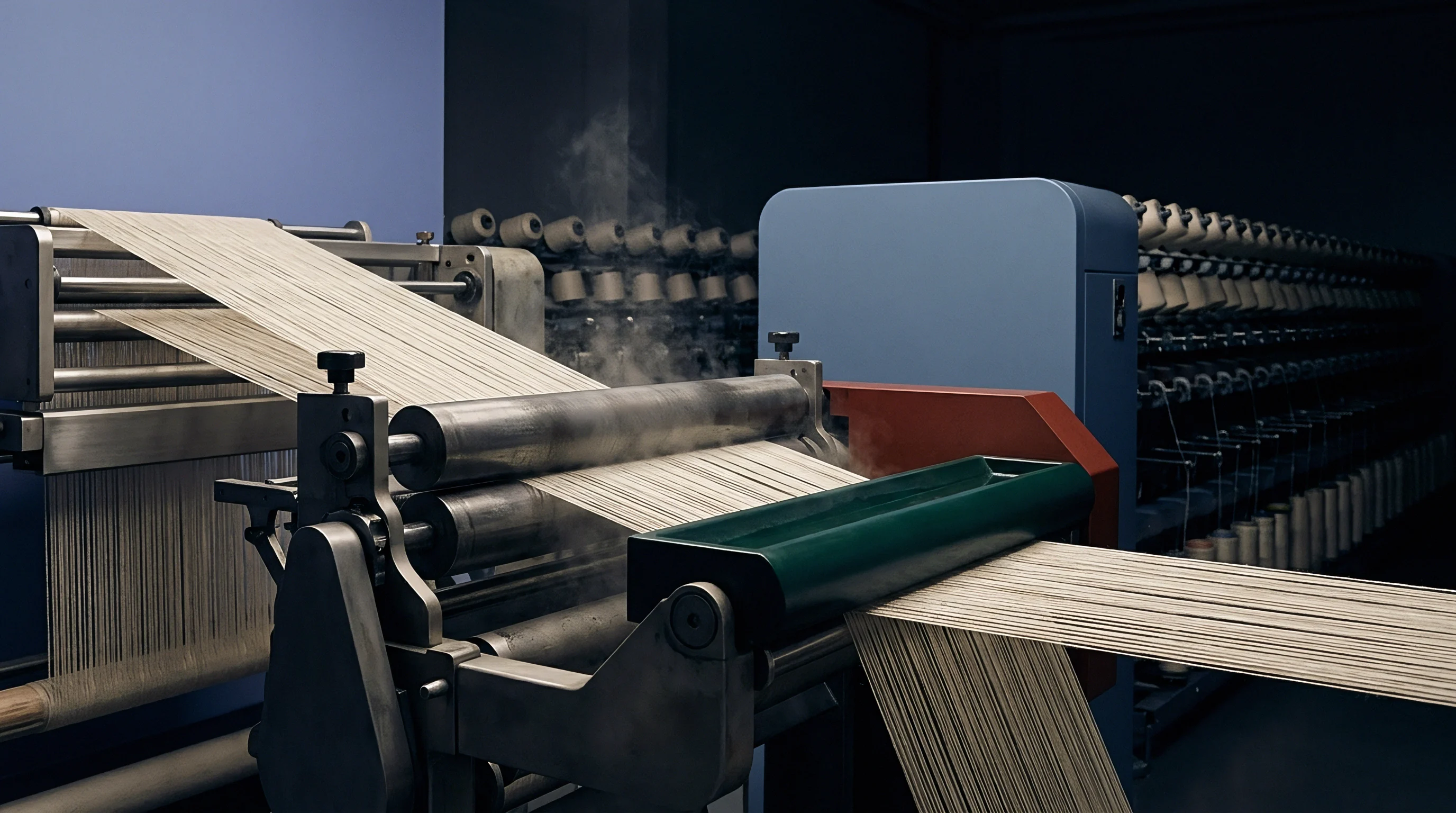
Squeeze roller pressure directly governs final pickup and penetration depth. Squeeze boxes running under pneumatic pressure between fifteen and thirty kilonewtons per meter force liquor into the inter-fiber voids. Higher line speeds reduce immersion time, requiring lower liquor viscosity for uniform absorption across all warp ends, whereas cold liquor pools on the surface.
A size liquor viscosity of thirty-five centipoise at eighty-five degrees Celsius yields optimal penetration depth for Nm 26 wet spun linen warps at thirty meters per minute squeeze box speed.
Yarn count, solids concentration, and liquor pickup together set the sizing profile across different fabric weights.
| Yarn Count (Nm) | Yarn Density (tex) | Target Size Pickup (%) | Solids Concentration (%) | Immersion Speed (m/min) |
|---|---|---|---|---|
| Nm 10 | 100 | 6.5 | 6.0 | 45 |
| Nm 26 | 38.5 | 8.5 | 8.5 | 35 |
| Nm 40 | 25 | 10.0 | 10.5 | 28 |
| Nm 60 | 16.6 | 12.0 | 12.5 | 20 |
| Data reflects pneumatic squeeze box pressure set at twenty kilonewtons per meter with liquor temperature maintained at eighty-eight degrees Celsius. | ||||
High shear inside the squeeze box changes the rheology of modified starch solutions. Non-Newtonian shear-thinning temporarily lowers liquor viscosity right at the roller nip to assist core penetration, while high shear stability keeps polymer binders from degrading over long production runs.
Over-application creates overly stiff warps that snap under tension. Because viscosity falls as bath temperatures rise, refractometer readings taken every thirty minutes keep total dissolved solids within a half-percent tolerance of the target formula.
High coat weight fails to compensate for inadequate core binder adhesion.
Splice
Warp beam preparation requires uniform tension across every end during creeling and direct warping. Because linen yarn barely stretches, any tension fluctuation on the creel creates slack or tight ends on the weaver’s beam. Tensioners must maintain four to six grams per tex of yarn drag across the full depth of the creel.
Traditional knots perform poorly on modern rapier and air-jet looms because their bulk catches in fine reed dents and snaps the yarn. Pneumatic air-water splicing replaces knots by untwisting thread ends with compressed air, intermingling the flax fibers, and retwisting the joint under a mist of water vapor to soften the rigid fiber bundle.
Warping sequence for high-density wet spun linen warps:
- Mount yarn packages on V-shaped creel frames equipped with individual magnetic disc tension compensators set to five grams per tex.
- Align thread paths through expansive leasing reeds to ensure straight parallel thread geometry without cross-ends.
- Activate automatic air-water pneumatic joiners for every package changeover, verifying joint thickness remains within one hundred fifteen percent of yarn diameter.
- Drive direct warping drum at constant linear speed while maintaining pneumatic beam presser arm force at three bar.
- Insert leasing cords every five hundred meters to hold thread order before transferring beams to the sizing machine creel.
Winding density must be carefully controlled so outer yarn layers do not crush underlying threads. Proper flange alignment and smooth barrel surfaces keep selvedge ends from sloughing off, while hydraulic presser rollers maintain a uniform beam density between zero point six five and zero point seven zero grams per cubic centimeter.
Pneumatic splices preserve tension uniformity across the warp. Splice strength must reach at least eighty-five percent of the unspliced yarn, while joint diameter cannot exceed one point two times nominal yarn thickness if threads are to pass smoothly through heald eyes.
Sourcing specifications that cite ISO 10383 section four restrict joint thickness multiples, requiring mills to standardize on water-injected pneumatic splicing rather than manual knots.
Abrasion
Loom shedding subjects wet-spun linen warps to relentless cyclic friction against drop wires, heald eyes, and reed dents. Rapid directional flexing and continuous surface scuffing quickly degrade unsized flax, causing surface fibers to fray and ends to break under tension.
Why Does Wet Spun Linen Require Low Encapsulation?
Without the natural stretch of other textile fibers, flax yarns encased in a thick size film become overly rigid and crack under shedding motion. Keeping encapsulation low allows the yarn to flex through heald eyes without breaking the protective coating. Deep micro-penetration binds the internal fibers together so the core holds while the outer surface remains pliable enough to absorb reed impact.
Evaluating sized yarn abrasion resistance requires specialized testing, including yarn-to-metal scuffing testers and loom simulation rigs.
| Polymer Base | Average Size Pickup (%) | Friction Coefficient (Yarn-Metal) | Abrasion Cycles to Break | End Breaks per 100,000 Picks |
|---|---|---|---|---|
| Native Corn Starch | 9.0 | 0.38 | 420 | 4.2 |
| Modified Potato Starch | 8.5 | 0.29 | 890 | 1.1 |
| CMC Blend | 8.0 | 0.24 | 1250 | 0.4 |
| PVA / Starch Hybrid | 8.5 | 0.22 | 1400 | 0.3 |
Unpenetrated size films tend to strip away under reed friction, while hard spots lead to needle damage. Controlling thread hairiness is critical: when fuzzy warp ends cling together during shedding, the shed fails to clear cleanly, allowing rapier heads to strike the warp sheet and slice through multiple threads at once.
Contractual compliance under ASTM D5430 standards requires warp end breakage rates to remain below two breaks per loom hour on high-speed rapier sheds.
In loom operations, sized yarn flexibility contributes more to overall productivity than raw gains in tensile strength.

Audit
Laboratory analysis verifies warp beam quality before beams reach the loom room. These audits confirm whether a sizing run hit target pickup levels, moisture regain, and film elasticity. Any gap between planned and actual size add-on points to temperature variations or incorrect squeeze roller calibration during processing.
Desizing tests evaluate how completely the sizing film washes out during finishing. Residual size blocks dye penetration, producing streaks and uneven shade across finished fabric. Lab technicians measure size removal by comparing oven-dry fabric weights before and after standardized enzymatic wash cycles.
Documentation required for every certified sized beam lot:
- Refractometer solids log records real-time sugar and polymer concentrations in the size box taken at thirty-minute intervals.
- Gravimetric size pickup report details dry yarn mass against sized yarn mass across five sample bands per warp beam.
- Moisture regain certificate confirms residual beam moisture remains strictly between seven and nine percent by weight.
- Tensile and elongation charts document yarn breaking strength and stretch retention tested on calibrated ISO 13934 equipment.
- Desizing washability index confirms ninety-eight percent size removal efficiency under standard sixty-degree enzymatic wash cycles.
Precise moisture regain prevents both storage mold and yarn brittleness. Sized flax stored below six percent moisture becomes brittle and snaps during loom setup, whereas moisture levels above ten percent soften the binder and cause warp ends to block on the beam. Poor desizing subsequently ruins downstream dye levelness.
The long-term impact of bio-based size substitutes on closed-loop effluent treatment systems remains an open question for European finishing plants.
Capacity
Weaving economics hinge on shed efficiency, beam run lengths, and stop frequency. High-speed rapier looms weaving wet-spun linen run at three hundred fifty to four hundred fifty picks per minute. Every warp break stops the machine for manual or semi-automatic repair, burning valuable loom hours.
While sizing chemicals cost relatively little, warp preparation dictates overall weaving speeds, as over-stretched yarn leads to frequent downstream breaks. Consider a standard production run of three thousand meters using Nm 26 wet spun linen warp with three thousand eight hundred ends at a reed width of175 centimeters. Sizing chemical cost averages zero point zero eight US dollars per meter of warp sheet.
Operating a modern rapier loom costs approximately twenty-five US dollars per loom hour.
| Metric | Poorly Sized Warp | Standard Sized Warp | Optimized High-Grade Warp |
|---|---|---|---|
| Loom Speed (rpm) | 320 | 380 | 420 |
| Stop Rate (per 100k picks) | 5.2 | 1.2 | 0.4 |
| Net Shed Efficiency (%) | 74.5 | 88.0 | 93.5 |
| Production (metres/hour) | 14.8 | 20.8 | 24.5 |
| Shed Cost per Metre (USD) | 1.68 | 1.20 | 1.02 |
Properly sized wet spun linen warp beams allow rapier looms to operate above ninety percent mechanical efficiency without yarn hairy cling.
A fifteen percent drop in efficiency from frequent warp stops adds zero point forty-six US dollars per linear meter to weaving costs. Investing in quality size polymers, tight viscosity control, and water-injected pneumatic splicing cuts machine stops dramatically. In the end, sizing quality directly drives hourly machine charges and sets the landed cost per meter long before greige fabric reaches inspection.