Optimizing Sizing Chemistry and Shed Kinematics to Overcome Friction Spikes in Fine Wet Spun Linen Warps
Optimizing modified starch PVA acrylic sizing formulations combined with staggered early shedding suppresses friction spikes and stabilizes fine wet spun linen warps.
Substrate
Fine wet spun linen pairs a high tensile modulus and low breaking elongation with severe surface hairiness. While dry spun flax leaves coarse fiber bundles held together by intact pectin matrices, wet spinning drafts individual ultimate fibers past one another through a warm water bath to reach fine counts between NeL 40 and NeL 80. Drawing aligns the crystalline cellulose regions, which boosts yarn tenacity but holds elongation at break to a narrow 2.2 percent to 2.8 percent band.
Sheared micro-fibrils also splay outward from the core during drafting, creating a stiff, abrasive fringe along the surface.
Warp preparation has to accommodate yarn that gives almost nothing under load. Standard ring-spun cotton yields up to 7 percent under peak shedding tension without taking damage, but fine wet spun linen possesses virtually no elasticity. Dynamic tension past 3.2 centinewtons per tex concentrates strain straight into the unyielding crystalline domains.
Without plastic deformation to absorb the surge, stress spikes at thin spots and structural knots, snapping the strand outright. Protruding surface fibrils make this worse whenever neighboring ends lock together during shed movement.
Ambient weave-room moisture directly affects wet spun flax because of residual pectins. Between 4 percent and 7 percent of the fiber’s dry weight consists of residual pectins and hemicellulose, polymers that soften or stiffen depending on humidity. Below 65 percent relative humidity, the pectins harden; surface fibrils turn brittle and break off under friction.
Above 78 percent, the same residues turn tacky, driving up yarn-to-yarn cling during shed separation. Running a stable warp sheet therefore demands rigid atmospheric regulation alongside a dedicated sizing recipe.
Loom speed compounds mechanical wear. At 320 picks per minute on a modern rapier loom, every end endures hundreds of cyclic flexural reversals each minute against drop wires, heald eyes, and reed dents. An unsized flax yarn starts breaking down within the first 2000 picks, losing surface fibrils to friction while core fibers begin slipping past one another.
The sizing must therefore achieve two opposing tasks: penetrate far enough into the bundle to anchor the internal ultimate fibers, while leaving a flexible external film. Deep penetration without surface coverage leaves the hairiness free to catch, whereas an unanchored outer shell quickly fractures under cyclic bending, throwing size dust and causing sharp friction spikes.
Flax ultimate fibers bound within wet spun strands possess a rigid crystalline structure that limits total warp elongation under tension.
Uneven fiber bundle drafting during wet spinning leaves irregularities along the entire yarn axis. Thick places concentrate pectins and block size penetration, while thin places absorb too much liquor and turn brittle. Standard single-end tensile tests fail to capture the friction surges caused by these variations.
In dynamic friction testing, the coefficient between two hairy wet spun strands climbs from a baseline of 0.22 up to 0.58 during shed division, creating localized tension spikes that quickly surpass the yarn’s yield point.
Any mismatch in sizing chemistry shows up quickly on the weaving floor. A brittle binder film develops micro-cracks under beat-up forces, shedding fine starch dust through the harness motion. This debris packs into heald eyes and drop wire slots, elevating sliding friction and driving warp tension higher on every shed opening.
The resulting end breaks trigger frequent loom stops, degrade fabric uniformity, and cut into overall weave room efficiency.
Binder
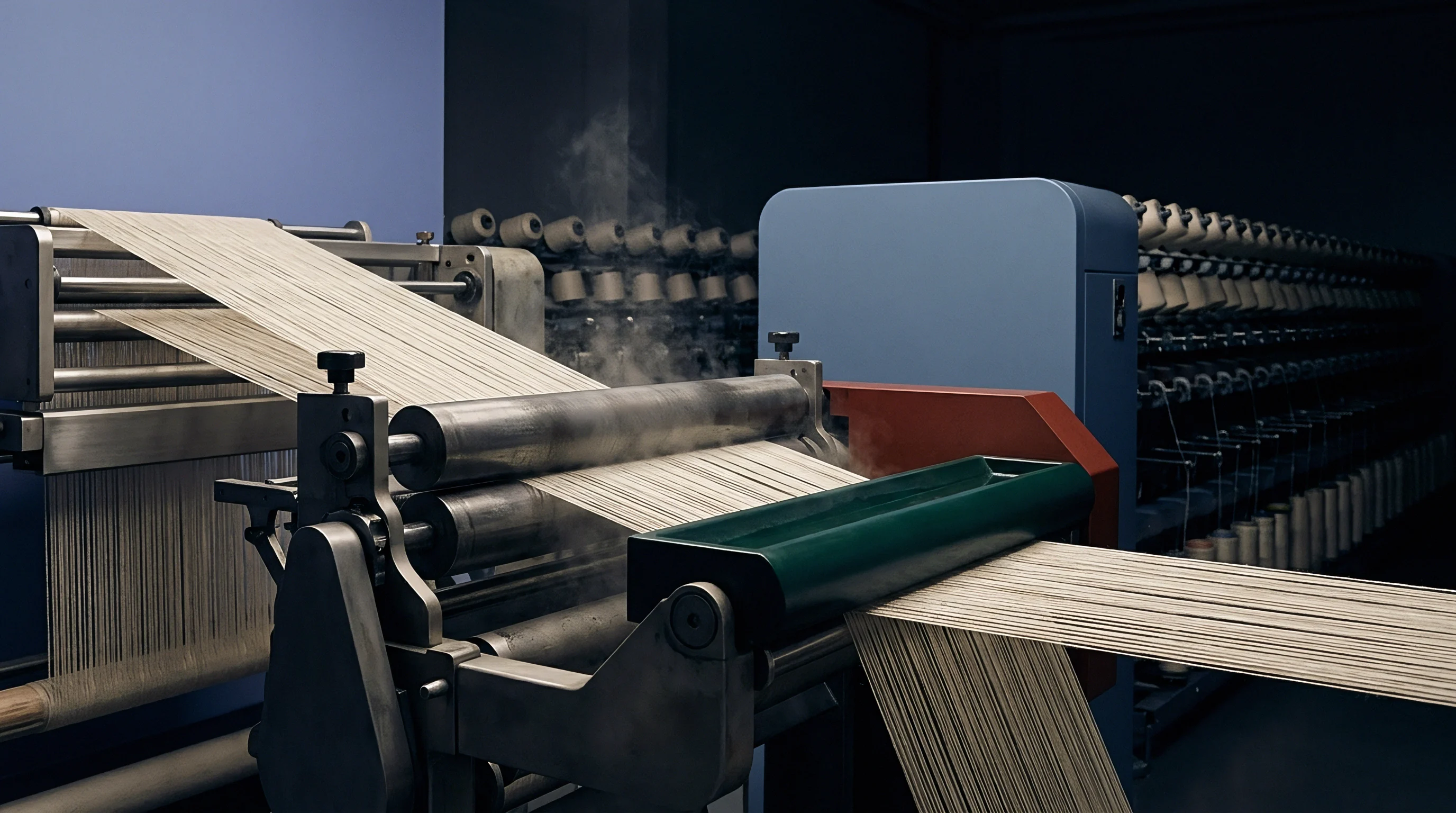
Sizing fine wet spun linen requires a film that grips cellulose securely while keeping surface friction down. Unmodified native starches lack the adhesion and flexibility needed for fine counts like NeL 60 or NeL 80. Carboxymethyl starches and thin-boiling modifications bring down paste viscosity, allowing size to seep into the dense flax bundle in a controlled way.
Fully hydrolyzed polyvinyl alcohol contributes tensile strength and toughness, but used alone, its high modulus creates a stiff film that makes warp separation harsh and difficult.
Adding acrylic copolymers adjusts the mechanics of the dried size by lowering its glass transition temperature. That softens the film without sacrificing adhesion to the cellulose fibers. A formulation combining oxidized potato starch, fully hydrolyzed polyvinyl alcohol, and acrylic copolymer in a 60:30:10 dry weight ratio yields a tough, pliable film.
It binds protruding micro-fibrils flat against the yarn core, keeping adjacent warp ends from locking together during shed crossover.
| Formulation Composition | Viscosity (mPa·s at 85°C) | Tensile Strength Increase (%) | Elongation at Break (%) | Coefficient of Friction (Yarn-to-Yarn) |
|---|---|---|---|---|
| Native Potato Starch (100%) | 140 | 12.4 | 1.8 | 0.42 |
| Oxidized Starch / PVA 88% (70/30) | 45 | 22.1 | 2.3 | 0.31 |
| Modified Starch / PVA 99% / Acrylic (60/30/10) | 28 | 31.5 | 3.1 | 0.21 |
| PVA 99% / Micro-wax Emulsion (92/8) | 35 | 28.2 | 2.9 | 0.19 |
| Test conditions: Viscosity measured on Brookfield RVT at 100 rpm. Tensile properties evaluated per ISO 2062 after conditioning at 20°C and 65% relative humidity for 24 hours. Friction evaluated on yarn friction tester at 20 m/min sliding speed. | ||||
Size distribution between the yarn core and perimeter depends heavily on bath viscosity. At 85°C, maintaining 25 mPa·s to 35 mPa·s lets the liquor filter through the outer fiber layers into the core of an NeL 60 yarn. Above 60 mPa·s, the size stays largely on the surface, setting into a brittle crust that fractures during shedding, generates lint, and exposes unanchored fibers.
Below 18 mPa·s, the bundle drinks the liquor up completely, leaving surface fibrils loose and prone to friction spikes.
Lubricants blended into the size mix reduce dynamic friction against loom metal and neighboring yarns. Sulphonated tallow, hydrogenated vegetable fats, and micro-emulsion polyethylene waxes all lower drag; micro-emulsions in particular disperse cleanly through the bath without forming grease spots on the beam. Introducing 1.5 percent to 2.5 percent lubricant by dry binder weight holds dynamic yarn-to-yarn friction below 0.22.
Pushing past 4.0 percent, however, weakens binder adhesion to the flax fibers, causing the film to peel away prematurely in the reed dents.
- Modified Starch Selection Lowers liquor viscosity and provides strong chemical affinity to native flax cellulose.
- Polyvinyl Alcohol Hydrolysis Controls film toughness and water solubility during desizing operations.
- Acrylic Copolymer Plasticizer Modifies binder elasticity to match the low elongation profile of fine wet spun linen.
- Micro-Emulsion Polyethylene Wax Reduces dynamic yarn friction against heald eyes and reed steel.
- Squeezing Roll Pressure Calibration Controls size liquor pick-up percentage and penetration depth across the warp sheet.
Controlling size pick-up requires steady squeeze roll pressure and bath temperatures. Target dry add-on for fine wet spun linen sits between 13 percent and 15 percent of dry fiber weight. Adding acrylic copolymer modifiers to a modified starch recipe on an NeL 60 warp produces a 42 percent drop in warp end breaks.
A dual-nip box running 18 kN to 22 kN squeeze pressure provides even penetration across the sheet, after which the wet warp enters drying cylinders with temperatures stepped down from 110°C to 70°C to prevent binder migration to the yarn exterior.
Applying up to 20 percent starch add-on is sometimes pitched as a way to avoid synthetic binders, but this overlooks the stiffness heavy starch imposes on inelastic flax. Oversized linen warps turn rigid and tear at the sizing machine lease rods; glued-together surface hairiness breaks filaments when the ends are forced apart. The resulting damage to the size film causes severe friction spikes and end breaks once the yarn reaches commercial loom speeds.

Motion
Shed kinematics define the mechanical stresses imposed on wet spun linen warps. In standard symmetric shedding, all harness frames move together, subjecting top and bottom warp sheets to peak tension at the identical point in crankshaft rotation. In dense linen constructions, this simultaneous movement concentrates maximum yarn contact right at peak crossover tension.
Protruding micro-fibrils interlock between opposing sheets, driving instantaneous tension past 90 centinewtons per end and breaking threads.
Asymmetric shed timing breaks up this direct interaction. By adjusting harness drive cams or dobby profiles, the crossover point can be moved away from top dead center to between 300 degrees and 320 degrees of crankshaft rotation. Opening the shed earlier relative to reed beat-up gives hairy linen ends more time to clear one another before peak warp tension occurs, distributing inter-yarn friction over a broader crank angle window.
Staggering heald frames introduces a vertical phase lag across the warp sheet. Offsetting adjacent frames by 12 millimeters to 18 millimeters vertically creates a split shed profile, so neighboring threads no longer rub across a single plane. Dividing the contact area into two separation zones cuts instantaneous inter-yarn friction roughly in half and prevents micro-fibril cling from developing into full warp entanglements.
| Kinematic Configuration | Shed Crossover Angle (°) | Frame Stagger (mm) | Peak Warp Tension (cN/end) | Warp Stops per 100,000 Picks |
|---|---|---|---|---|
| Symmetric Default | 0 (Top Dead Center) | 0 | 88.4 | 4.85 |
| Early Shedding | 310 | 0 | 68.2 | 2.41 |
| Asymmetric Staggered | 310 | 15 | 46.5 | 0.72 |
| Late Shedding Staggered | 340 | 15 | 62.1 | 1.95 |
| Summary Mean Stop Rate Across All Advanced Configurations | 1.69 | |||
Shed height settings must balance weft insertion clearance against warp strain. Openings above 62 millimeters clear rapier heads comfortably but force fine linen through excessive bending and axial stretch. With wet spun flax failing at roughly 2.5 percent strain, excessive shed height pulls warp ends past their yield limit.
Dropping shed opening height to 48 millimeters to 52 millimeters reduces peak tensile strain by 25 percent, though it requires well-aligned rapier tape guidance to avoid striking yarn during insertion.
Does Asymmetrical Harness Staggering Mitigate Inter-Warp Micro-Fibrillar Cling?
Asymmetrical harness staggering mitigates inter-warp micro-fibrillar cling by preventing simultaneous mechanical contact across adjacent warp threads. Splitting the harness movement stagger divides the warp sheet into multiple geometric planes during shed transition. Micro-fibrils protruding from adjacent yarns pass each other at different spatial points rather than rubbing along a single contiguous plane.
Friction forces remain distributed across the stroke, preventing localized locked-fiber conditions.
Backrest roller height alters tension distribution through the shed cycle. Raising the backrest 10 millimeters to 20 millimeters above the breast beam plane slackens the top shed line while tightening the bottom. The tighter bottom shed maintains clean drop wire tracking and prevents sagging, while the slightly looser top line allows hairy micro-fibrils to yield and slide past contact points without snapping.
Spring-loaded backrest systems help absorb shock loads during shed transitions. Rigid mountings transfer beat-up and shedding tension spikes straight into the warp. In contrast, spring-loaded or torsion-bar backrests yield slightly at shed crossover to cushion these peaks.
Setting backrest spring pre-load to suit the low elasticity of fine wet spun linen stabilizes shed geometry, holding baseline tension around 22 to 26 centinewtons per end throughout the weaving stroke.
- Mount warp beam on loom unrolling stand, checking alignment of beam collars against loom center line.
- Thread warp ends through drop wire pins, ensuring equal distribution across six sensor rows.
- Draw warp ends through heald eyes according to the specified draft plan, verifying harness frame leveling.
- Adjust electronic dobby drive cams to establish a shed crossover angle of 310 degrees crankshaft rotation.
- Set heald frame stagger offset to 15 millimeters between odd and even harness frames.
- Adjust backrest roller height to 15 millimeters above the breast beam horizontal line.
- Calibrate backrest spring pre-load to deliver 24 centinewtons static tension per warp thread.
- Run five meter sampling strip at 200 picks per minute while observing shed clearance at rapier entrance.
- Increase loom speed to targeted commercial operating velocity while monitoring electronic warp stop motion displays.
Kinematic adjustments cannot compensate for uneven warp tension on the beam itself. Density variations during winding leave loose and tight sections; tight ends take on disproportionate load during shed opening and break regardless of loom settings. Uniform beam preparation, matched with proper kinematic adjustments, protects yarn integrity through dense reed layouts.
Dynamic warp tension peaks on fine wet spun linen drop significantly when asymmetric shed timing separates harness crossover from reed beat-up.
Rapier entry must synchronize with shed development to avoid catching warp threads. Early shed opening provides the needed clearance before the bringing rapier enters, which should occur only after the shed has reached at least 80 percent of full height. Entering earlier risks striking partially opened ends, stripping size film, abrading fibers, and introducing sharp tension spikes.
Reliable shed clearance depends on the combination of geometry, binder film integrity, and mechanical settings. Keeping shed height low while staggering harness frames limits yarn elongation and reduces inter-warp cling, matching loom motion to the mechanical constraints of wet spun flax.
Drag
Friction spikes in wet spun linen warps develop along two main paths: inter-yarn cling between neighboring hairy threads and yarn-to-metal abrasion across loom elements. Static friction tests offer little insight here; measuring dynamic coefficient of friction (μ) requires pulling yarn strands past one another under controlled speed and normal force while recording transient tension with piezoelectric load cells.
Inter-yarn friction peaks during shed crossover as top and bottom sheets slide past each other. Raw, unsized linen exhibits dynamic friction coefficients between 0.45 and 0.65, high enough for protruding micro-fibrils to bridge adjacent ends. As the shed opens, these bridges resist separation, driving dynamic warp tension upward until the entangled fibers pull free or the end breaks.
Proper sizing and asymmetric shed kinematics lower this dynamic coefficient to a manageable 0.20 to 0.25 band.
Yarn-to-metal wear concentrates at drop wire slots, heald eyes, and reed dents, with heald eyes creating the most severe abrasion because of the sharp deflection angles involved. Standard steel eyes with surface roughness (Ra) above 0.4 micrometers scrub size off the yarn. Using ceramic inserts or polished nickel-chrome coatings with Ra below 0.1 micrometers reduces friction noticeably, keeping the protective film intact over long runs.
- Micro-Fibrillar Lockup Interlocking of unanchored surface fibers during shed crossover creates severe localized tension spikes.
- Size Film Fracture Shedding of brittle binder flakes inside heald eyes accelerates yarn-to-metal rubbing forces.
- Reed Dent Chattering Lateral vibration of high-density warp ends against reed wire edges strips protective surface coatings.
- Drop Wire Abrasion Accumulation of fiber fly inside drop wire slots restricts smooth yarn sliding during tension peaks.
- Asymmetric Shed Misalignment Incorrect heald stagger angles force opposing warp sheets to rub along a single high-friction plane.
Tracking dynamic tension spikes during full-speed weaving requires inline tensiometers positioned between the backrest roller and the back harness frame. Fast logging captures rapid force transients during shed division. On an NeL 60 linen with static baseline tension set at 25 centinewtons per thread, an unoptimized shed generates spikes of 85 to 110 centinewtons at opening.
Combining optimized size with staggered asymmetric shedding caps these peaks at 42 centinewtons, well under the yarn’s 65 centinewtons mean yield point.
ISO 5079 specifies single-fiber breaking force and elongation testing, establishing baseline tensile boundaries for wet spun flax bundles.
Reed friction adds further stress during beat-up, particularly in dense fabrics with setts exceeding 36 ends per centimeter. Each forward stroke forces warp ends against reed wires. If the size film is soft, the wires peel binder back into small collars behind the reed, restricting thread passage and elevating tension until an end breaks.
Photoelectric hairiness testing confirms how well the size has bound loose surface fibers by counting protrusions longer than 1 millimeter per meter. Raw NeL 60 wet spun yarn often exceeds 1800 micro-fibrils per meter, whereas effective sizing reduces that count below 150. Keeping residual hairiness low directly prevents inter-warp friction spikes during high-speed dobby operation.
What structural modifications can eliminate localized reed dent abrasion without reducing warp end density?
Capacity
Loom productivity and operating margins on fine wet spun linen depend heavily on controlling warp stop frequency. High-density fabrics in NeL 60 or NeL 80 counts consume loom hours quickly when stops mount. At 350 picks per minute, a modern rapier loom has a theoretical output of 21,000 picks per hour.
With each warp break requiring an average 2.5-minute operator repair, a stop rate of 5 stops per 100,000 picks pulls net efficiency from a target 92 percent down to 74 percent, disrupting production schedules and raising unit costs.
Weave room accounting assigns fixed overhead, labor, and power across operating hours, averaging around $22.50 per loom hour. When friction-induced stops drag output down from 14.2 meters to 11.4 meters per hour on standard 140 cm plain weave, direct machine costs alone rise by $0.48 per meter of landed greige cloth, even before factoring in repair labor, wasted filling yarn, or quality penalties from start marks.
| Setup Configuration | Loom Speed (RPM) | Efficiency (%) | Warp Stops / 100k Picks | Output (Meters/Hour) | Direct Loom Cost ($/Meter) |
|---|---|---|---|---|---|
| Unoptimized Starch / Symmetric Shed | 280 | 68.5 | 6.20 | 9.8 | $2.30 |
| Modified Starch / Early Shedding | 320 | 81.2 | 2.80 | 13.2 | $1.70 |
| PVA-Acrylic Blend / Staggered Shed | 360 | 91.5 | 0.85 | 16.8 | $1.34 |
| Over-Sized PVA / Rigid Kinematics | 320 | 76.0 | 4.10 | 12.3 | $1.83 |
Desizing requirements also influence recipe economics. Synthetic binders like PVA and acrylics deliver higher weaving efficiency, but scouring them out demands hot wash baths at 85°C to 95°C with specific surfactants. Modified starches wash out at milder temperatures yet run at lower loom efficiencies.
Procurement decisions need to weigh sizing chemistry costs ($3.80 per kg for PVA-acrylic blends against $1.40 per kg for modified starch) against loom efficiency gains and downstream wet processing energy.
Loom speed must be balanced against warp tension limits. Modern rapiers run fine linen smoothly between 340 and 380 picks per minute when kinematics and sizing align. Pushing speed to 450 picks per minute raises inertial acceleration on warp ends by 56 percent, causing tension spikes that exceed the binder film’s elasticity and causing enough end breaks to wipe out any nominal speed benefit.
- Detailed Warp Preparation Specifications Documenting precise yarn count, size add-on percentage, moisture regain, and beam density limits.
- Kinematic Machine Setup Dossier Recording shed crossover timing angles, harness frame stagger offsets, shed height, and backrest position.
- Batch Quality Acceptance Testing Report Including single-end tensile test results, yarn friction measurements, and desizing washability confirmation.
- Inline Monitoring Production Log Tracking real-time warp stop frequency per 100,000 picks, loom speed variations, and relative humidity logs.
Capacity planning needs realistic changeover allowances for wet spun linen. While cotton styles change over in 2.0 to 2.5 hours, fine linen takes 3.5 to 4.5 hours to handle warp tying, drop wire distribution, lease rod positioning, and kinematic alignment. Neglecting this extra setup time results in scheduling delays and unrecovered overhead during style transitions.
Loom efficiency calculations must weigh size binder material costs directly against machine downtime losses caused by preventable warp end breaks.
Standard procurement agreements for dense fine linen fabrics should incorporate explicit loom performance benchmarks. Contracts ought to stipulate: The mill shall maintain an average warp stop rate not exceeding 1.2 stops per 100,000 picks on NeL 60 warps, verified via loom monitoring system logs over a minimum continuous production run of 50,000 picks. Lots failing to meet this standard incur automatic price adjustments to offset repair costs and delivery delays.

Contract
Setting technical requirements for fine wet spun linen fabrics requires clear standards covering yarn preparation, loom settings, and physical tolerances. A thorough purchase specification aligns procurement with shed execution, minimizing disputes between mills and sourcing teams. Every chemical, physical, and kinematic parameter should be agreed upon before beams are warped.
Yarn specifications establish the baseline for warp performance. Contracts should define nominal count, allowable count variation (± 2.5%), minimum single-end tenacity (18.5 cN/tex), and maximum hairiness. Single-end testing per ISO 2062 confirms that incoming wet spun lots possess adequate strength for cyclic shed movement.
Prohibiting mechanical knots and specifying thermospliced joins prevents snagging in drop wires and fine heald eyes.
Size add-on and formulation need verified tolerances. Specifications should require 14 percent dry add-on within a ± 1.0 percent window across the full beam width, verified by desizing lab swatches from the front, middle, and back of each beam per ISO 6741. Moisture regain after drying must stay between 10 percent and 12 percent; overly dry beams lose pliability, whereas lots exceeding 13% moisture foster mildew growth during beam storage and warp handling.
Machine setup parameters must form part of the technical documentation for each production order. Specifications should detail asymmetric shed timing (crossover at 310circ ± 5circ), harness frame stagger (15 mm offset), shed height (50 mm maximum), and backrest position (+15 mm above breast beam). The mill must verify static warp tension at 24 centinewtons per thread using calibrated tensiometers before running at production speed.
Fabric grading should follow the ASTM D5430 four-point system. For high-end apparel or home textiles, specifications typically set a threshold below 15 total penalty points per 100 square meters. Major defects ~ such as warp streaks, start marks, size spots, and reed marks ~ carry heavy point penalties.
Enforcing clear point limits protects buyers from receiving greige rolls marred by warp friction defects.
Mill audits verify process control before full-scale weaving begins. Technical auditors check size preparation, test liquor viscosity with calibrated flow cups, verify kinematic settings on running looms, and inspect off-loom rolls on illuminated inspection tables. Formal pre-production approval sets the standard for the order, supporting consistent fabric quality, predictable landed costs, and on-time delivery.